

SIST-TP CEN/TR 14380:2025
(Main)Lighting applications - Tunnel lighting
General Information
- Abstract
This document describes the current practice in the design of the lighting of road tunnels and underpasses for motorized and mixed traffic. This concerns arrangements, levels and other parameters including daylight, which are related only to traffic safety. Aspects concerning visual comfort are generally chosen in agreement with national rules. The information in this report concerns any tunnel or underpass where the decision to provide lighting has been taken by any authority working within national legislation or other constraints. The design is based on photometric considerations, and all values of luminance or illuminance are maintained values.
The main body of the report covers the common aspects of Tunnel Lighting, and the various methods currently used in Europe are detailed in the annexes. No single method is recommended.
- Status
- Published
- Publication Date
- 04-Feb-2025
- Technical Committee
- STV - Steklo, svetloba in razsvetljava v gradbeništvu
- Current Stage
- 6060 - National Implementation/Publication (Adopted Project)
- Start Date
- 23-Oct-2024
- Due Date
- 28-Dec-2024
- Completion Date
- 05-Feb-2025

Overview
SIST-TP CEN/TR 14380:2025 is a technical report that outlines best practices for the lighting design of road tunnels and underpasses for both motorized and mixed traffic. Developed by the Slovenian Institute for Standardization (SIST) and harmonized with CEN guidelines, this standard addresses the arrangement, luminance levels, and other key parameters related to tunnel lighting to promote traffic safety. The document applies to any tunnel or underpass where authorities have decided, under national legislation or other constraints, to install lighting based strictly on photometric considerations. While the standard provides thorough guidance on design and performance criteria, it intentionally refrains from recommending a single method, instead presenting multiple approaches used across Europe.
Key Topics
- Tunnel Lighting Zones: Defines the various tunnel zones such as entrance, threshold, transition, interior, exit, and parting zones, each with specific lighting considerations to enhance visibility and safety for all users.
- Luminance and Illuminance: Emphasizes the importance of maintained values for luminance (road and wall surfaces) and illuminance to ensure consistent visual performance.
- Traffic Safety: Focuses exclusively on safety aspects, supporting drivers’ ability to perceive obstacles, adapt visually, and maintain safe stopping distances under varied lighting, traffic flows, and environmental conditions.
- Measurement and Maintenance: Details the measurement procedures for installed lighting and the importance of maintaining photometric values over time.
- Lighting in Emergency Conditions: Updates terminology and requirements for emergency or safety lighting, aligning with European regulatory directives.
- Photometric Design: Provides guidance on photometric-based design, including calculation methods without favoring a single approach, and references multiple methodologies in appendices (e.g., L20, CIE perceived contrast, energy-saving strategies).
- Traffic Composition Considerations: Outlines adaptation of lighting performance based on the proportion of trucks, presence of non-motorized users, and other tunnel-specific variables.
Applications
The SIST-TP CEN/TR 14380:2025 standard is essential for:
- Civil Engineers and Tunnel Designers: Provides critical guidance for integrating tunnel lighting systems during planning and construction phases to meet safety and performance criteria.
- Transportation Authorities and Road Operators: Offers a reference framework for tendering, evaluating, installing, and maintaining tunnel lighting to comply with national and European safety requirements.
- Lighting Manufacturers and Installers: Helps industry professionals design and provide compliant luminaires and control systems for tunnel and underpass environments.
- Maintenance Providers: Informs regular inspection routines to ensure long-term compliance with maintained luminance and illuminance levels.
- Regulatory Bodies: Facilitates harmonization of tunnel lighting practices across jurisdictions through clear terminology, definitions, and methods.
Related Standards
For a comprehensive approach to tunnel and roadway lighting, consult the following related standards:
- EN 12665 - Light and lighting - Basic terms and criteria for specifying lighting requirements
- CIE 88:2004 - Guide for the lighting of road tunnels and underpasses
- EN 13201 - Road lighting standards (including equipment and performance evaluation)
- European Directive 2004/54/EC - Tunnel safety in the trans-European road network
Other referenced resources include databases maintained by ISO, IEC, and CIE for lighting and photometric terminology.
By adhering to the guidelines of SIST-TP CEN/TR 14380:2025, stakeholders can enhance tunnel safety, facilitate efficient vehicle flow, and ensure compliance with evolving European tunnel lighting standards. This standard serves as an authoritative reference for all aspects of tunnel lighting tailored to safety-driven design and practical application.
Relations
- Effective Date
- 06-Jul-2022
- Effective Date
- 28-Jan-2026
Get Certified
Connect with accredited certification bodies for this standard

Zavod za gradbeništvo Slovenije (ZAG) - Inšpekcija
ZAG inspection body for construction products, structures, and materials.
Sponsored listings
Frequently Asked Questions
SIST-TP CEN/TR 14380:2025 is a technical report published by the Slovenian Institute for Standardization (SIST). Its full title is "Lighting applications - Tunnel lighting". This standard covers: This document describes the current practice in the design of the lighting of road tunnels and underpasses for motorized and mixed traffic. This concerns arrangements, levels and other parameters including daylight, which are related only to traffic safety. Aspects concerning visual comfort are generally chosen in agreement with national rules. The information in this report concerns any tunnel or underpass where the decision to provide lighting has been taken by any authority working within national legislation or other constraints. The design is based on photometric considerations, and all values of luminance or illuminance are maintained values. The main body of the report covers the common aspects of Tunnel Lighting, and the various methods currently used in Europe are detailed in the annexes. No single method is recommended.
This document describes the current practice in the design of the lighting of road tunnels and underpasses for motorized and mixed traffic. This concerns arrangements, levels and other parameters including daylight, which are related only to traffic safety. Aspects concerning visual comfort are generally chosen in agreement with national rules. The information in this report concerns any tunnel or underpass where the decision to provide lighting has been taken by any authority working within national legislation or other constraints. The design is based on photometric considerations, and all values of luminance or illuminance are maintained values. The main body of the report covers the common aspects of Tunnel Lighting, and the various methods currently used in Europe are detailed in the annexes. No single method is recommended.
SIST-TP CEN/TR 14380:2025 is classified under the following ICS (International Classification for Standards) categories: 93.060 - Tunnel construction; 93.080.40 - Street lighting and related equipment. The ICS classification helps identify the subject area and facilitates finding related standards.
SIST-TP CEN/TR 14380:2025 has the following relationships with other standards: It is inter standard links to SIST-TP CR 14380:2004, SIST EN 12665:2024. Understanding these relationships helps ensure you are using the most current and applicable version of the standard.
SIST-TP CEN/TR 14380:2025 is associated with the following European legislation: EU Directives/Regulations: 2004/54/EC. When a standard is cited in the Official Journal of the European Union, products manufactured in conformity with it benefit from a presumption of conformity with the essential requirements of the corresponding EU directive or regulation.
SIST-TP CEN/TR 14380:2025 is available in PDF format for immediate download after purchase. The document can be added to your cart and obtained through the secure checkout process. Digital delivery ensures instant access to the complete standard document.
Standards Content (Sample)
SLOVENSKI STANDARD
01-marec-2025
Nadomešča:
SIST-TP CR 14380:2004
Uporaba razsvetljave - Razsvetljava v predorih
Lighting applications - Tunnel lighting
Angewandte Lichttechnik - Tunnelbeleuchtung
Eclairagisme - Eclairage des tunnels
Ta slovenski standard je istoveten z: CEN/TR 14380:2024
ICS:
93.060 Gradnja predorov Tunnel construction
93.080.40 Cestna razsvetljava in Street lighting and related
pripadajoča oprema equipment
2003-01.Slovenski inštitut za standardizacijo. Razmnoževanje celote ali delov tega standarda ni dovoljeno.
CEN/TR 14380
TECHNICAL REPORT
RAPPORT TECHNIQUE
October 2024
TECHNISCHER REPORT
ICS 93.080.40 Supersedes CR 14380:2003
English Version
Lighting applications - Tunnel lighting
Eclairagisme - Eclairage des tunnels Angewandte Lichttechnik - Tunnelbeleuchtung
This Technical Report was approved by CEN on 6 October 2024. It has been drawn up by the Technical Committee CEN/TC 169.
CEN members are the national standards bodies of Austria, Belgium, Bulgaria, Croatia, Cyprus, Czech Republic, Denmark, Estonia,
Finland, France, Germany, Greece, Hungary, Iceland, Ireland, Italy, Latvia, Lithuania, Luxembourg, Malta, Netherlands, Norway,
Poland, Portugal, Republic of North Macedonia, Romania, Serbia, Slovakia, Slovenia, Spain, Sweden, Switzerland, Türkiye and
United Kingdom.
EUROPEAN COMMITTEE FOR STANDARDIZATION
COMITÉ EUROPÉEN DE NORMALISATION
EUROPÄISCHES KOMITEE FÜR NORMUNG
CEN-CENELEC Management Centre: Rue de la Science 23, B-1040 Brussels
© 2024 CEN All rights of exploitation in any form and by any means reserved Ref. No. CEN/TR 14380:2024 E
worldwide for CEN national Members.
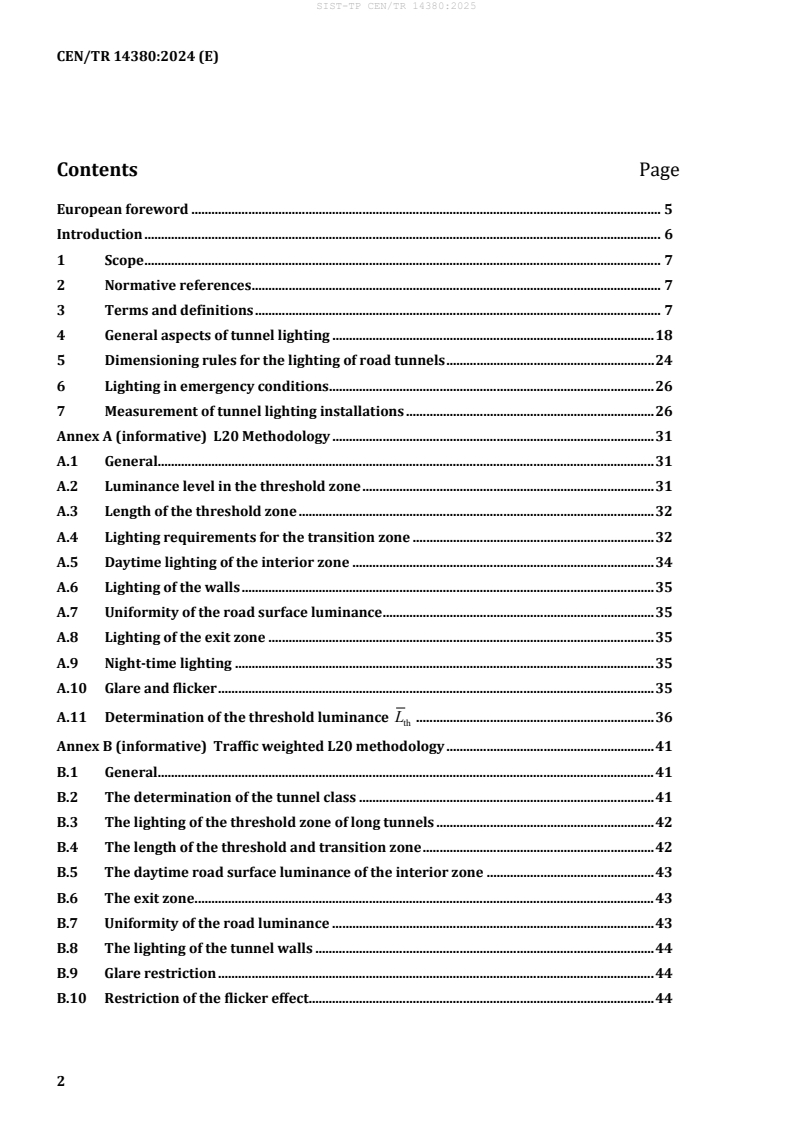
Contents Page
European foreword . 5
Introduction . 6
1 Scope . 7
2 Normative references . 7
3 Terms and definitions . 7
4 General aspects of tunnel lighting . 18
5 Dimensioning rules for the lighting of road tunnels . 24
6 Lighting in emergency conditions . 26
7 Measurement of tunnel lighting installations . 26
Annex A (informative) L20 Methodology . 31
A.1 General. 31
A.2 Luminance level in the threshold zone . 31
A.3 Length of the threshold zone . 32
A.4 Lighting requirements for the transition zone . 32
A.5 Daytime lighting of the interior zone . 34
A.6 Lighting of the walls . 35
A.7 Uniformity of the road surface luminance . 35
A.8 Lighting of the exit zone . 35
A.9 Night-time lighting . 35
A.10 Glare and flicker . 35
A.11 Determination of the threshold luminance L . 36
th
Annex B (informative) Traffic weighted L20 methodology . 41
B.1 General. 41
B.2 The determination of the tunnel class . 41
B.3 The lighting of the threshold zone of long tunnels . 42
B.4 The length of the threshold and transition zone . 42
B.5 The daytime road surface luminance of the interior zone . 43
B.6 The exit zone . 43
B.7 Uniformity of the road luminance . 43
B.8 The lighting of the tunnel walls . 44
B.9 Glare restriction . 44
B.10 Restriction of the flicker effect. 44
B.11 Night-time lighting . 44
Annex C (informative) The CIE perceived contrast methodology . 45
C.1 Definition of contrast . 45
C.2 Methodology bases . 46
C.3 The vision model for the veiling luminance. 47
C.4 Determination of the equivalent veiling luminance . 49
C.5 Calculation of threshold luminance . 52
C.6 Luminance level in the threshold zone . 53
C.7 Length of the threshold zone . 53
C.8 Lighting of the transition zone . 53
C.9 Daytime lighting of the interior zone . 53
C.10 Lighting of the walls . 53
C.11 Uniformity of the road surface luminance . 53
C.12 Lighting of the exit zone . 53
C.13 Night-time lighting . 53
C.14 Glare and flicker . 53
Annex D (informative) The space and time adaptation method as used in France . 54
D.1 The principle of the method . 54
D.2 The adaptation luminance . 54
D.3 The space adaptation . 55
D.4 The time adaptation . 55
D.5 Characterizing the lighting installation . 56
D.6 Calculating road luminance . 57
D.7 Algorithm of L calculations . 57
ch
D.8 Calculation details for one 10 m step for a rather simple case . 59
D.9 Calculating illuminance levels . 61
D.10 The results. 61
D.11 Road surface luminance of the interior zone at daytime . 67
D.12 Night-time lighting . 67
D.13 Lighting of the walls of the interior zone . 67
D.14 Uniformity of the road surface luminance . 68
Annex E (informative) An energy saving approach: practice from Italy . 69
E.1 Preamble . 69
E.2 Specific terms and conventional values . 70
E.3 Tunnel classification . 71
E.4 Lighting conditions for traffic safety . 72
E.5 Interior zone and night-time conditions . 73
E.6 Glare due to lighting installation. 73
E.7 Supplementary strategies to increase energy saving . 73
E.8 Calculations . 74
Annex F (informative) Determination of the need for daytime lighting of short tunnels . 75
F.1 Determination of the Look Through Percentage . 75
F.2 Using the Look Through Percentage . 77
F.3 Influencing the Look Through Percentage . 78
F.4 Daytime lighting of short tunnels . 78
F.5 A table method for determining the need of daytime electric lighting . 78
Annex G (informative) Calculation of the stopping distance . 81
Bibliography . 84
European foreword
This document (CEN/TR 14380:2024) has been prepared by Technical Committee CEN/TC 169 “Light
and Lighting”, the secretariat of which is held by DIN.
Attention is drawn to the possibility that some of the elements of this document may be the subject of
patent rights. CEN shall not be held responsible for identifying any or all such patent rights.
This document supersedes CEN CR 14380:2003.
In comparison with the previous edition, the following modifications have been made:
— The whole content has been rewritten to comply with the CEN/CENELEC Internal Regulations part
3 rules applying to Technical Reports (informative document);
— The definitions have been updated following EN 12665:2024, as closely as possible;
— A new Clause 5 (“Dimensioning rules for the lighting of road tunnels”) replaces the previous
subclause 4.2 (“Distinction between long and short tunnels”), Clause 5 (“Lighting of long tunnels”)
and Clause 6 (“Artificial lighting of short tunnels and underpasses”);
— The clause “Emergency lighting” has been renamed “Lighting in emergency conditions”;
— The term “Standby lighting” has been replaced by “Safety lighting”;
— In Clause 6 “Lighting in emergency conditions”, a Note has been added on the requirement of safety
lighting in tunnels concerned by the European Directive 2004/54/EC 12/2022;
— The previous Clause “Traffic signals” has been removed;
— In Annex A and Annex B, the levels of daytime luminance in the interior zone have been adapted in
accordance with the latest developments at CIE;
— A new Annex C has been added: “The CIE perceived contrast methodology”;
— Limited adaptations in Annex D “The space and time adaptation method as used in France”;
— A new Annex E has been added: “An energy saving approach: practice from Italy”;
— The previous Annex “Veiling Luminance Method As Used In The Netherlands” has been removed;
— The term “electric lighting” replaces “artificial lighting”;
— The following figures have been updated: Figures 3, Figures A.1, A.2, A.3, Figures C.1, C.2, Figures D.1,
D.2, D.3 to D.8, Figures F.1, F.4, F.5, Figures G.1 and G.2.
Any feedback and questions on this document should be directed to the users’ national standards body.
A complete listing of these bodies can be found on the CEN website.
Introduction
The aim of tunnel lighting is to ensure that users, both during the day and by night, can approach, pass
through, and exit the tunnel without changing direction or speed with the degree of safety commensurate
to that on the approach road.
To achieve safe passage through a road tunnel, it is necessary that all users have sufficient information
regarding the course of the road ahead, possible obstacles and the presence and actions of other users.
Furthermore, it is necessary that users, particularly drivers of motor vehicles, have at least an equal sense
of security to that experienced on the approach roads.
Principal characteristics that describe the quality of tunnel lighting are:
— the luminance of the road surface,
— the luminance of the walls up to 2 m in height above the road surface,
— the uniformity of the luminance distribution on the road and walls,
— the control of induced glare,
— the avoidance of critical flicker frequencies.
In some cases, the illuminance of the road surface is used.
All photometric quantities are based on photopic photometry.
1 Scope
This document describes the current practice in the design of the lighting of road tunnels and
underpasses for motorized and mixed traffic. This concerns arrangements, levels and other parameters
including daylight, which are related only to traffic safety. Aspects concerning visual comfort are
generally chosen in agreement with national rules. The information in this report concerns any tunnel or
underpass where the decision to provide lighting has been taken by any authority working within
national legislation or other constraints. The design is based on photometric considerations, and all
values of luminance or illuminance are maintained values.
The main body of the report covers the common aspects of Tunnel Lighting, and the various methods
currently used in Europe are detailed in the annexes. No single method is recommended.
2 Normative references
The following documents are referred to in the text in such a way that some or all of their content
constitutes requirements of this document. For dated references, only the edition cited applies. For
undated references, the latest edition of the referenced document (including any amendments) applies.
EN 12665, Light and lighting — Basic terms and criteria for specifying lighting requirements
3 Terms and definitions
For the purposes of this document, the terms and definitions given in EN 12665 and the following apply.
ISO, IEC and CIE maintain terminological databases for use in standardization at the following addresses:
— ISO Online browsing platform: available at https://www.iso.org/obp/
— IEC Electropedia: available at https://www.electropedia.org/
— e-ILV International Lighting Vocabulary: available at https://cie.co.at/e-ilv
3.1 Tunnel related zones
3.1.1
entrance portal
part of a road tunnel construction that corresponds to the beginning of the covered
part of the road tunnel or, when open sun screens are used, to the beginning of the sun screens
[SOURCE: EN 12665:2024, 3.5.41]
3.1.2
exit portal
part of a road tunnel construction that corresponds to the end of the covered part of
the road tunnel or, when open sun screens are used, to the end of the sun screens
[SOURCE: EN 12665:2024, 3.5.45]
3.1.3
access zone
part of the open road immediately outside (in front of) the entrance portal, covering
the distance over which an approaching driver must be able to see into a road tunnel
Note 1 to entry: The access zone begins at the stopping distance point ahead of the entrance portal and it ends at
the entrance portal.
[SOURCE: EN 12665:2024, 3.5.24]
3.1.4
access zone length
length of the access zone that begins at the stopping distance point ahead of the portal
and ends at the portal
Note 1 to entry: Access zone length is expressed in metres (m).
Note 2 to entry: Generally, for curved roads, the access zone is considered to begin from where the driver can see
the whole tunnel entrance portal, at least on his/her driving lane.
[SOURCE: EN 12665:2024, 3.5.25, modified – Note 2 to entry added]
3.1.5
threshold zone
first part of a road tunnel, directly after the entrance portal
Note 1 to entry: The threshold zone starts either at the beginning of the road tunnel or at the beginning of the sun
screen when a sun screen is installed. The length of the threshold zone is at least equal to the stopping distance.
[SOURCE: EN 12665:2024, 3.5.78]
3.1.6
transition zone
part of a road tunnel that follows directly after the threshold zone and ends at the
beginning of the interior zone
Note 1 to entry: In the transition zone, the lighting level is decreasing from the level at the end of the threshold zone
to the level of the interior zone.
[SOURCE: EN 12665:2024, 3.5.86]
3.1.7
entrance zone
combination of the threshold zone and the transition zone
Note 1 to entry: Entrance zone refers to the tunnel section where the eye’s adaptation passes from the external light
level to the interior zone lighting.
Note 2 to entry: In some countries the term entrance zone is also known as reinforcement zone.
[SOURCE: EN 12665:2024, 3.5.42, modified – Notes 1 and 2 to entry added]
3.1.8
interior zone
part of a road tunnel directly following the transition zone that stretches from the end
of the transition zone to the beginning of the exit zone
[SOURCE: EN 12665:2024, 3.5.52]
3.1.9
exit zone
part of a road tunnel where, during daytime, the vision of a driver approaching the
exit is predominantly influenced by the brightness outside the road tunnel
Note 1 to entry: The exit zone begins at the end of the interior zone. It ends at the exit portal of the road tunnel.
[SOURCE: EN 12665:2024, 3.5.46]
3.1.10
parting zone
first part of the open road directly after the exit portal of a road tunnel
Note 1 to entry: The parting zone is not a part of the road tunnel, but it is closely related to the road tunnel lighting.
The parting zone begins at the exit portal. It is advised that the length of the parting zone is equal to 2 times the
stopping distance. A length of more than 200 m is not necessary.
[SOURCE: EN 12665:2024, 3.5.66]
3.2 Lighting
3.2.1
visual guidance
optical and geometrical means that ensure that motorists are given adequate information on the course
of the road in the tunnel
3.2.2
threshold zone lighting
lighting of the threshold zone of the tunnel which allows drivers to see into the tunnel whilst in the access
zone
[SOURCE: EN 12665:2024, 3.5.79]
3.2.3
transition zone lighting
lighting of the transition zone which helps drivers to adapt to the lighting level in the zones ahead
[SOURCE: EN 12665:2024, 3.5.87]
3.2.4
interior zone lighting
lighting of the interior zone of the tunnel which provides adequate visibility in the interior of the tunnel
Note 1 to entry: At certain moments of the day, the interior zone lighting extends from the entrance portal to the
exit portal.
[SOURCE: EN 12665:2024, 3.5.53, modified – removed “irrespective of the use of vehicle headlights”,
Note 1 to entry added]
3.2.5
exit zone lighting
lighting that provides the visual contact for the driver still in a road tunnel with the
open road beyond the road tunnel
Note 1 to entry: It is assumed that visual contact will provide adaptation to the external condition.
[SOURCE: EN 12665:2024, 3.5.47]
3.2.6
safety lighting
lighting provided to ensure a minimum visibility for tunnel users to evacuate the
tunnel in the event of a breakdown of the main power supply
Note 1 to entry: Safety lighting is usually a part of the normal lighting installation.
3.2.7
daylight screen
daylight louvre
device that transmits part of the ambient daylight
Note 1 to entry: Screens or louvres may be applied for the lighting of the threshold zone and/or the entrance zone
of a tunnel
[SOURCE: EN 12665:2024, 3.4.10, modified – “part of” without brackets, Note to entry reworded]
3.2.8
sun-tight screen
screen that is constructed in such a fashion that direct sunlight can never reach the road
or wall surface under the screen
[SOURCE: EN 12665:2024, 3.4.11]
3.3 Luminance, illuminance
3.3.1
access zone luminance
eye adaptation luminance in the access zone
−2
Note 1 to entry: Access zone luminance is expressed in candelas per square metre (cd ⋅ m )
[SOURCE: EN 12665:2024, 3.2.38]
3.3.2
L access luminance
L
average luminance contained in a conical field of view, subtending an angle of 20° with
the apex at the position of the eye of an approaching driver and aimed at the tunnel mouth
Note 1 to entry: L access luminance is assessed from a point at a distance equal to the stopping distance from the
tunnel portal at the middle of the relevant carriageway or traffic lane.
−2
Note 2 to entry: L access luminance is expressed in candelas per square metre (cd⋅m ).
Note 3 to entry: If there is no national definition of the aiming, the definition of CIE 88:2004 can be used (i.e. aimed
towards a centred point at a height equal to one quarter of the height of the tunnel entrance portal).
[SOURCE: EN 12665:2024, 3.2.44, modified – “the centre of” removed, Symbol added, Note 3 to entry
added]
3.3.3
equivalent veiling luminance
L
seq
luminance that, when added by superposition to the luminance of both the adapting background and the
object, makes the luminance threshold or the luminance difference threshold the same under the two
following conditions: (1) glare present, but no additional luminance; (2) additional luminance present,
but no glare
−2
Note 1 to entry: Equivalent veiling luminance is expressed in candela per square metre (cd·m ).
[SOURCE: EN 12665:2024, 3.2.41, modified – different Symbol used]
3.3.4
atmospheric luminance
L
atm
light veil as a result of the scatter in the atmosphere expressed as a luminance
−2
Note 1 to entry: Atmospheric luminance is expressed in candela per square metre (cd·m ).
[SOURCE: EN 12665:2024, 3.4.9]
3.3.5
windscreen luminance
L
ws
light veil as a result of the scatter in the vehicle windscreen expressed as a luminance
−2
Note 1 to entry: Windscreen luminance is expressed in candela per square metre (cd·m ).
[SOURCE: EN 12665:2024, 3.2.52, modified – Symbol changed]
3.3.6
threshold zone luminance
L
th
average road surface luminance of a transverse strip at a given location in the threshold zone of the tunnel
(as a function of the measurements grid)
−2
Note 1 to entry: Threshold luminance is expressed in candela per square metre (cd·m ).
[SOURCE: EN 12665:2024, 3.2.48]
3.3.7
transition zone luminance
L
tr
average road surface luminance of a transverse strip at a given location in the transition zone of the tunnel
(as a function of the measurement grid)
−2
Note 1 to entry: Transition zone luminance is expressed in candela per square metre (cd·m ).
[SOURCE: EN 12665:2024, 3.2.50]
3.3.8
interior zone luminance
L
in
average road surface luminance of a transverse strip at a given location in the interior
zone of the tunnel (as a function of the measurement grid)
−2
Note 1 to entry: Interior zone luminance is expressed in candela per square metre (cd·m ).
[SOURCE: EN 12665:2024, 3.2.43]
3.3.9
vertical illuminance
E
v
illuminance on a vertical plane
Note 1 to entry: Vertical illuminance is expressed in lux (lx).
[SOURCE: EN 12665:2024, 3.2.59, modified – symbol E selected]
v
3.3.10
contrast revealing coefficient
q
c
quotient of the luminance, L, of a road surface and the vertical
illuminance, E , at a specific location in a tunnel
v
L
q =
c
E
v
-2 -1
Note 1 to entry: Contrast revealing coefficient is expressed in candelas per square metre per lux (cd ⋅ m ⋅ lx )
-1
which may be simplified to steradian to the power minus one (sr ).
Note 2 to entry: E is the illuminance at a particular location at a height of normally 0,1 m above the road surface, in
v
a plane facing the direction of oncoming traffic. The height of 0,1 m above the road surface is meant to represent the
centre of an object of 0,2 m × 0,2 m. This orientation is an acceptable approximation of the real situation.
[SOURCE: EN 12665:2024, 3.2.39, modified – index of L and E adapted, Note 2 to entry added]
v
3.3.11
threshold luminance ratio
k
ratio between the threshold zone luminance L and the access luminance L
th
L
th
k=
L
where
is the threshold zone luminance
L
th
L is the luminance in the access zone
Note 1 to entry: L is evaluated according to the methodology considered, e.g. L access luminance, L veiling
20 v
luminance, etc. According to the methodology considered to obtain L, the corresponding subscript is added to k, e.g.
k , k .
v 20
Note 2 to entry: In the L methodology, L is considered in the first part of the threshold zone.
20 th
3.3.12
luminance uniformity
overall uniformity (of road surface luminance, of wall surface luminance)
U
o
quotient of minimum luminance and average luminance of a surface
Note 1 to entry: Luminance uniformity has the unit one.
Note 2 to entry: Can apply to the reference field of calculation or measurement.
[SOURCE: EN 12665:2024, 3.2.54, modified – “overall uniformity (of road surface luminance, of wall
surface luminance)” added, Note 2 to entry added]
3.3.13
longitudinal uniformity
U
l
lowest of the ratios determined for each driving lane of the
carriageway as the ratio of the lowest to the highest road surface luminance found in a line in the centre
along the driving lane
Note 1 to entry: The longitudinal uniformity is considered for each driving lane.
Note 2 to entry: Can apply to the reference field of calculation or measurement.
Note 3 to entry: In tunnels longitudinal uniformity is used only in zones where the average luminance is constant.
Note 4 to entry: Longitudinal uniformity has the unit one.
[SOURCE: EN 12665:2024, 3.2.45, modified – Notes to entry added]
3.3.14
veiling luminance
L
v
luminance that superimposes on the retinal image and reduces the contrast
−2
Note 1 to entry: Veiling luminance is expressed in candela per square metre (cd·m ).
3.4 Traffic related concepts
3.4.1
carriageway
part of the road normally used by vehicular traffic
[SOURCE: EN12665:2024, 3.5.29]
3.4.2
traffic lane
strip of carriageway intended to accommodate a single line of moving vehicles
[SOURCE: EN12665:2024, 3.5.85]
3.4.3
emergency lane
hard shoulder
lane parallel to the traffic lane(s), provided for emergency and/or broken-down vehicles only
Note 1 to entry: The emergency lane is not part of the carriageway.
[SOURCE: EN12665:2024, 3.5.38, modified – Note 1 to entry added]
3.4.4
traffic flow
traffic volume
number of vehicles passing a specific point in a stated time in stated direction(s)
Note 1 to entry: In tunnel design, peak hour traffic per lane is used, expressed in vehicles per hour per lane.
[SOURCE: EN12665:2024, 3.5.88, modified – admitted terms added]
3.4.5
peak hour traffic
traffic volume during the one-hour period during which the greatest volume of traffic uses the road
section
Note 1 to entry: Peak hour traffic is expressed in vehicles per hour per lane.
3.4.6
speed limit
maximum legally allowed speed
−1
Note 1 to entry: Speed limit is expressed in kilometres per hour (km⋅h ).
[SOURCE: EN 12665:2024, 3.5.72]
3.4.7
design speed
speed adopted for a particular stated purpose in designing a road
−1
Note 1 to entry: Design speed is expressed in kilometres per hour (km⋅h )
[SOURCE: EN 12665:2024, 3.5.34]
3.4.8
reaction time
minimum time interval between the occurrence of an event demanding immediate action by the driver
and the response to the event
Note 1 to entry: The reaction time includes the time needed for perception, taking a decision and acting.
Note 2 to entry: Reaction time is expressed in seconds (s).
[SOURCE: EN 12665:2024, 3.1.13, modified – “by the driver” added]
3.4.9
stopping distance
SD
d
s
distance needed to bring a vehicle, driving at design speed, to a complete standstill
Note 1 to entry: The stopping distance is usually defined in national legislation or regulation.
Note 2 to entry: The stopping distance includes both the distance covered while reacting and the distance covered
while braking.
Note 3 to entry: Stopping distance is expressed in metres (m).
Note 4 to entry: The concept “Safe stopping distance” is not used in this Technical Report.
[SOURCE: EN 12665:2024, 3.5.75, modified – Abbreviation and symbol added, Note 4 to entry added]
3.4.10
mixed traffic
traffic that consists of motor vehicles, cyclists, pedestrians, etc
[SOURCE: EN 12665:2024, 3.5.60]
3.4.11
motor traffic
motorized traffic
traffic that consists of motorized vehicles only
Note 1 to entry: It depends on national legislation which vehicle types are included in this classification.
Note 2 to entry: In some countries it only includes vehicles which are capable of maintaining a minimum speed. In
others, mopeds are not considered as motorized traffic.
[SOURCE: EN 12665:2024, 3.5.61]
3.5 Symbols and abbreviations
Table 1 — Symbols and abbreviations
Symbol Abbreviation Name or description Unit
d SD
Stopping distance m
s
E -
Vertical illuminance lux
v
- −2
Average road surface luminance
L cd⋅m
r
-
−2
L Average wall surface luminance
cd⋅m
w
k - Threshold luminance ratio 1
−2 −1
q -
Contrast revealing coefficient
cd⋅m ⋅lx
c
−2
L -
Veiling luminance
cd⋅m
v
−2
L -
Atmospheric luminance
cd⋅m
atm
−2
L -
Windscreen luminance
cd⋅m
ws
−2
L -
Equivalent veiling luminance
cd⋅m
seq
−2
L - L access luminance
cd⋅m
20 20
- −2
L Threshold zone luminance
cd⋅m
th
-
−2
L
Transition zone luminance cd⋅m
tr
-
−2
L Interior zone luminance
cd⋅m
in
U -
Overall uniformity 1
o
U -
Longitudinal uniformity 1
l
f -
Maintenance factor 1
m
f -
Threshold increment %
TI
- LTP Look through percentage %
- Average daily traffic at peak vehicles per hour
AADT
hour per lane
- CBL Counter-beam lighting -
- SYM Symmetric lighting -
Table 2 — Symbols used in Annex C – The perceived contrast methodology
Symbols used in the perceived contrast methodology
Symbol Name or description Unit
C
Intrinsic contrast of the reference object 1
i
C
Minimum required perceived contrast of the reference object 1
p,m
C
Perceived contrast of the reference object 1
p
−2
L
Intrinsic luminance of the reference object cd⋅m
o,i
−2
L
Intrinsic luminance of the road surface near the reference object cd⋅m
r,i
−2
L
Perceived luminance of the reference object cd⋅m
o,p
−2
L
Perceived luminance of the road surface near the reference object cd⋅m
r,p
−2
L
Design value of the veiling luminance
cd⋅m
v,d
τ
Atmospheric transmittance 1
atm
τ
Windscreen transmittance 1
ws
ρ Reflectance of the reference object 1
−2
k Coefficient that evaluates the influence of the driver’s age
cd⋅m
Weight factor that considers the area of the i, j section of the
k
i,j
Adrian diagram
Angle between the direction of origin of the light and the foveal
θ degree
direction of view
Θ Solid angle of integration degree
dΕ Elementary contribution of the illuminance lx
x Longitudinal coordinate m
Angle between the direction of origin of the light and the foveal
δ degree
direction of view
4 General aspects of tunnel lighting
4.1 Tunnel conditions
4.1.1 General
Road and traffic conditions in tunnels may differ considerably from those that prevail on the open road.
The design of tunnel lighting installations takes these different conditions into account, with regard to
the traffic safety aspects.
Measurements of the tunnel lighting installation are taken after completion to ensure that the design
requirements have been met. Advice on measurement is given in Clause 7.
4.1.2 Stopping distance
Important parameters for the design of tunnel lighting installations include the speed, volume and
composition of traffic flow entering, and passing through.
There is a strong, but nonlinear relationship between the traffic flow and the accident risk: higher
volumes show a higher accident risk (except for very low or very high traffic volumes). The extra risk can
be counteracted, at least in part, by increasing the light level. This relationship is established for many
types of open roads, and it is assumed that it also holds for tunnels.
One of the most important factors is speed. In practice, road and tunnel designs are such that speed and
flow are usually interrelated, as a high design speed is selected for roads for which a high flow is expected.
High speeds require better visibility and therefore generally a higher luminance level.
When not defined in national standard or legislation, the stopping distance (SD) can be calculated
following the method described in Annex G.
4.1.3 The purpose of tunnel lighting
The lighting of a tunnel is necessary:
— to avoid the ‘black hole effect’ when a driver is unable to see into the tunnel,
— to reduce the likelihood of a collision with another tunnel user,
— to enable a driver to react and stop within the stopping distance (SD) if an unexpected hazard
appears.
4.1.4 Traffic composition
The traffic composition is relevant for the tunnel lighting in several aspects:
— the percentage of trucks,
— the presence/absence of pedal bicycles and/or mopeds,
— the presence/absence of pedestrians (non-emergency conditions),
— the presence/absence of authorization to allow the transit of hazardous material.
The lighting is adapted to these circumstances. Higher levels or better-quality lighting for the walls or the
road are necessary for the visual task when the conditions are more difficult or more hazardous.
4.1.5 Road and tunnel conditions
Driving comfort is an important aspect of the quality of the lighting installations of road traffic tunnels.
Good design prevents tunnels, constructed to overcome traffic obstructions, from becoming a traffic
obstruction in themselves: the traffic flow in and through the tunnel will be just as fluid as on the open
road. As a result of feelings of anxiety, drivers are likely to slow down near the tunnel entrance. Sudden
drops in speed reduce the traffic capacity and might lead to traffic jams and even to accidents. So, good
lighting that helps to overcome any feeling of anxiety is not only a matter of driving comfort but also a
matter of road capacity and of traffic safety.
This can be explained as follows. Driving a car safely is mainly a matter of attention. On long stretches of
motorway, attention can waver and the level of arousal is low. Drivers are not well prepared to cope with
emergencies if they occur unexpectedly. Near tunnels, the attention must be higher to cope with
additional hazard factors. Tunnels, being low and narrow, might cause concern or even fear, but also will
lead to an increase in arousal. The fear and the arousal are likely to cancel out each other to a large extent,
so that the more dangerous tunnel entrance need not lead to more accidents.
A tunnel is a confined environment that makes any accidents more critical. The object of installing lighting
in a road tunnel is to enable the traffic to pass through with the same or better degree of safety and
comfort, as is customary on the open road, and with an acceptable speed. The difficulty of the driving task
when approaching and passing through a tunnel is mainly influenced by the speed, the traffic volume
(flow) and the composition of the traffic and by the layout of the road and the tunnel and their immediate
surroundings. To enable a road user to drive safely when a tunnel is on his/her route, it is pertinent to
give them adequate and relevant information, which allows the driver to situate themselves in space and
time, to foresee a possible obstacle on the way.
When making the lighting design for a tunnel, it is important to consider the following aspects:
a) Altered perception:
The walls can generate a “wall shyness effect” which tends to make drivers keep further away.
Drivers’ visual performance can be considerably lower, especially regarding visual acuity, the
perception of contrast and distances, peripheral vision and the discrimination of colours. Time
perception can change: the perceived duration seems to be about twice as long as the actual time
span. And finally, some drivers can be affected by sensations such as claustrophobia.
b) Overall perception:
1) Before entering a tunnel:
— relevant signs show that one is approaching the tunnel,
— dark portals reduce the access zone luminance,
— black asphalt surface for the road up to the portal helps to adapt the driver to the lower
luminances inside the tunnel.
2) Entering the tunnel:
— East-West orientations can cause more problems than North-South orientations,
— green surfaces in the immediate surround of the entrance portal reduce the access
luminance around the portal,
— trees or other screens to avoid direct glare from the sun.
3) Inside the tunnel:
— discontinuities, ramps, and intersections in the geometric design, are treated by an ad hoc
lighting system,
— diffusing light-coloured road surfaces are better for symmetric lighting; specular surfaces
help in counter-beam lighting,
— adopting and maintaining markings, delineators etc. along the road provide good guiding
facilities.
4) At the exit:
— a glaring situation can be expected outside the exit; civil engineering works or planting that
will screen off the direct sunlight are important.
4.2 Lighting systems and contrast rendition methods
4.2.1 Electric lighting systems
The contrasts of objects can be negative or positive, depending on the reflection properties of the surface
of the object and on the lighting system used. There are two electric lighting systems in common use in
lighting design: the symmetric lighting system and the counter-beam lighting system. A third one, pro-
beam lighting, is seldom used and will not be described in this Technical Report. The symmetric and
counter-beam terms refer to the luminous intensity distribution of the luminaires that are used.
In a counter-beam lighting system (CBL), luminaires are used where the maximum luminous intensity is
aimed against the direction of the traffic and with a low luminous intensity in the direction of the traffic
so that the luminous intensity distribution is strongly asymmetric, as illustrated on Figure 1. The terms
refer only to the direction of normal traffic.
The symmetric lighting system is a system where the luminaires show a luminous intensity distribution
that is symmetric in relation to the 90°/270° C-plane (the plane usually normal to the direction of the
traffic), as illustrated on Figure 2.
The luminous intensity distribution is not sufficient to quantify the effect of the installation, because the
effect of the lighting is determined by the contrasts. The effect of the lighting is characterized by the value
of the contrast revealing coefficient q . CBL systems can be used to increase the contrast, typicall
...