

SIST EN 13877-3:2005
(Main)Concrete pavements - Part 3: Specifications for dowels to be used in concrete pavements
General Information
- Abstract
This document specifies the requirements for dowels to be used in cast "in situ" concrete pavements for roads, airfields and other trafficked areas.
- Status
- Published
- Publication Date
- 31-May-2005
- Technical Committee
- CES - Roads
- Current Stage
- 6060 - National Implementation/Publication (Adopted Project)
- Start Date
- 01-Jun-2005
- Due Date
- 01-Jun-2005
- Completion Date
- 01-Jun-2005
- Directive
- 305/2011 - Regulation (eu) No 305/2011 of the European Parliament and of the Council of 9 march 2011 laying down harmonised conditions for the marketing of construction products and repealing council directive 89/106/eecOJ Ref: C 259 OJ Date: 08-Aug-2014
89/106/EEC - Construction productsOJ Ref: C 139 OJ Date: 08-Jun-2005

Overview
EN 13877-3:2004 - Concrete pavements - Part 3: Specifications for dowels to be used in concrete pavements (CEN) specifies requirements for dowels intended for cast “in situ” concrete pavements for roads, airfields and other trafficked areas. The standard sets material, dimensional, durability and conformity-assessment rules that manufacturers, specifiers and conformity bodies use when placing dowels on the European market.
Key topics and technical requirements
- Scope: Dowels for cast in situ concrete pavements for roads, airfields and other trafficked areas.
- Mechanical properties: Dowels shall have a tensile strength of at least 250 MPa (tested per EN ISO 15630-1).
- Dimensions & tolerances:
- Diameters and tolerances in accordance with EN 10060.
- Minimum diameter: 16 mm.
- Length tolerance: ±10 mm.
- Dowels must be straight, free of burrs and irregularities; sliding ends sawn with no protrusions beyond nominal diameter.
- Coating / surface treatment:
- At least half the dowel length should be covered before use with a thin bituminous coating or thin plastic sheet to prevent adhesion to concrete; average coating thickness not greater than 1.25 mm.
- Durability: Ensured by factory-applied protective coating or site treatments in accordance with national application provisions.
- Evaluation of conformity:
- Initial Type Testing and ongoing Factory Production Control (FPC) required.
- FPC should be documented; a system conforming to EN ISO 9001 adapted for the product is accepted.
- Minimum FPC testing frequency example: tensile strength - one test per 2 500 dowels.
- CE marking & CPD/Construction Products:
- Annex ZA defines rules for attestation of conformity (system 4 for this product), declaration of conformity, and CE marking content (standard number EN 13877-3, declared characteristics, etc.).
Applications and users
- Practical use: specification and supply of dowels for cast “in situ” concrete pavements in roads, airfields and trafficked areas.
- Primary users:
- Dowels manufacturers and suppliers
- Road and airfield pavement engineers and specifiers
- Construction contractors and procurement teams
- Testing laboratories and notified bodies performing conformity assessment
- National standards and certification authorities
Related standards
- EN 13877-1: Concrete pavements - Part 1: Materials
- EN 13877-2: Concrete pavements - Part 2: Functional requirements for concrete pavements
- EN 10060 (dimensions/tolerances for hot rolled round steel bars)
- EN ISO 15630-1 (steel test methods)
- EN ISO 9001 (quality management / FPC requirements)
Keywords: EN 13877-3:2004, dowels, concrete pavements, tensile strength 250 MPa, CE marking, factory production control, durability, road construction standards.
Relations
- Effective Date
- 17-Sep-2026
- Effective Date
- 28-Jan-2026
- Effective Date
- 28-Jan-2026
- Effective Date
- 28-Jan-2026
- Effective Date
- 28-Jan-2026
- Effective Date
- 28-Jan-2026
- Effective Date
- 28-Jan-2026
- Effective Date
- 28-Jan-2026
- Referred By
SIST EN 13877-2:2013 - Concrete pavements - Part 2: Functional requirements for concrete pavements - Effective Date
- 28-Jan-2026
- Referred By
SIST EN 13877-2:2024 - Concrete pavements - Part 2: Functional requirements for concrete pavements - Effective Date
- 28-Jan-2026
Get Certified
Connect with accredited certification bodies for this standard

DIBt (Deutsches Institut für Bautechnik)
German Institute for Building Technology.
DIN CERTCO
DIN Group product certification.
Zavod za gradbeništvo Slovenije (ZAG) - Inšpekcija
ZAG inspection body for construction products, structures, and materials.
Sponsored listings
Frequently Asked Questions
SIST EN 13877-3:2005 is a standard published by the Slovenian Institute for Standardization (SIST). Its full title is "Concrete pavements - Part 3: Specifications for dowels to be used in concrete pavements". This standard covers: This document specifies the requirements for dowels to be used in cast "in situ" concrete pavements for roads, airfields and other trafficked areas.
This document specifies the requirements for dowels to be used in cast "in situ" concrete pavements for roads, airfields and other trafficked areas.
SIST EN 13877-3:2005 is classified under the following ICS (International Classification for Standards) categories: 91.100.30 - Concrete and concrete products; 93.080.20 - Road construction materials. The ICS classification helps identify the subject area and facilitates finding related standards.
SIST EN 13877-3:2005 has the following relationships with other standards: It is inter standard links to SIST EN ISO 9001:2026, SIST EN 10060:2004, SIST EN 13877-1:2005, SIST EN ISO 15630-1:2019, SIST EN ISO 9001:2015, SIST EN 16432-2:2017, SIST EN 13877-1:2024, SIST EN 13877-1:2013, SIST EN 13877-2:2013, SIST EN 13877-2:2024. Understanding these relationships helps ensure you are using the most current and applicable version of the standard.
SIST EN 13877-3:2005 is associated with the following European legislation: EU Directives/Regulations: 305/2011, 89/106/EEC; Standardization Mandates: M/001, M/124. When a standard is cited in the Official Journal of the European Union, products manufactured in conformity with it benefit from a presumption of conformity with the essential requirements of the corresponding EU directive or regulation.
SIST EN 13877-3:2005 is available in PDF format for immediate download after purchase. The document can be added to your cart and obtained through the secure checkout process. Digital delivery ensures instant access to the complete standard document.
Standards Content (Sample)
2003-01.Slovenski inštitut za standardizacijo. Razmnoževanje celote ali delov tega standarda ni dovoljeno.Fahrbahnbefestigungen aus Beton - Teil 3: Anforderungen an Dübel für Fahrbahnbefestigungen aus BetonChaussées en béton - Partie 3: Spécifications relatives aux goujons a utiliser dans les chaussées en bétonConcrete pavements - Part 3: Specifications for dowels to be used in concrete pavements93.080.20Materiali za gradnjo cestRoad construction materials91.100.30Beton in betonski izdelkiConcrete and concrete productsICS:Ta slovenski standard je istoveten z:EN 13877-3:2004SIST EN 13877-3:2005en01-junij-2005SIST EN 13877-3:2005SLOVENSKI
STANDARD
EUROPEAN STANDARDNORME EUROPÉENNEEUROPÄISCHE NORMEN 13877-3December 2004ICS 93.080.20English versionConcrete pavements - Part 3: Specifications for dowels to beused in concrete pavementsChaussées en béton - Partie 3: Spécifications relatives auxgoujons à utiliser dans les chaussées en bétonFahrbahnbefestigungen aus Beton - Teil 3: Anforderungenan Dübel für Fahrbahnbefestigungen aus BetonThis European Standard was approved by CEN on 20 October 2004.CEN members are bound to comply with the CEN/CENELEC Internal Regulations which stipulate the conditions for giving this EuropeanStandard the status of a national standard without any alteration. Up-to-date lists and bibliographical references concerning such nationalstandards may be obtained on application to the Central Secretariat or to any CEN member.This European Standard exists in three official versions (English, French, German). A version in any other language made by translationunder the responsibility of a CEN member into its own language and notified to the Central Secretariat has the same status as the officialversions.CEN members are the national standards bodies of Austria, Belgium, Cyprus, Czech Republic, Denmark, Estonia, Finland, France,Germany, Greece, Hungary, Iceland, Ireland, Italy, Latvia, Lithuania, Luxembourg, Malta, Netherlands, Norway, Poland, Portugal, Slovakia,Slovenia, Spain, Sweden, Switzerland and United Kingdom.EUROPEAN COMMITTEE FOR STANDARDIZATIONCOMITÉ EUROPÉEN DE NORMALISATIONEUROPÄISCHES KOMITEE FÜR NORMUNGManagement Centre: rue de Stassart, 36
B-1050 Brussels© 2004 CENAll rights of exploitation in any form and by any means reservedworldwide for CEN national Members.Ref. No. EN 13877-3:2004: ESIST EN 13877-3:2005
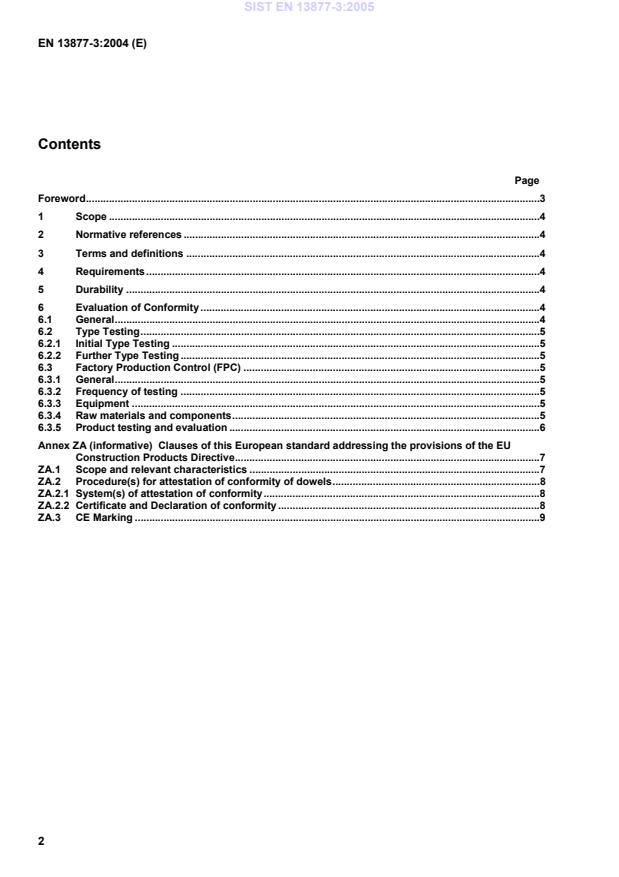
Clauses of this European standard addressing the provisions of the EU Construction Products Directive.7 ZA.1 Scope and relevant characteristics.7 ZA.2 Procedure(s) for attestation of conformity of dowels.8 ZA.2.1 System(s) of attestation of conformity.8 ZA.2.2 Certificate and Declaration of conformity.8 ZA.3 CE Marking.9
...