

SIST EN 1026:2016
(Main)Windows and doors - Air permeability - Test method
General Information
- Abstract
This European Standard defines the test method to be used to determine the air permeability of completely assembled windows and doorsets of any material, when submitted to positive or negative test pressures. This test method is designed to take account of conditions in use, when the window or doorset is installed in accordance with the manufacturer’s specification and the requirements of relevant European Standards and codes of practice.
This European Standard does not apply to the joints between the window or doorset frame and the building construction.
- Status
- Published
- Public Enquiry End Date
- 06-Dec-2015
- Publication Date
- 05-Apr-2016
- Technical Committee
- ISTP - Doors and windows
- Current Stage
- 6060 - National Implementation/Publication (Adopted Project)
- Start Date
- 29-Mar-2016
- Due Date
- 03-Jun-2016
- Completion Date
- 06-Apr-2016



Overview
EN 1026:2016 (CEN) specifies a laboratory test method for air permeability of completely assembled windows and doors (any material) when subjected to positive and negative test pressures. The method is intended to represent in-use conditions when products are installed per the manufacturer’s specification and relevant European standards and codes of practice. The standard excludes the joints between the window/doorset frame and the building construction.
Key topics and technical requirements
- Test principle: apply defined sequences of positive and negative test pressures and measure air flow (air leakage) through opening joints and seals.
- Test apparatus: airtight test chamber with an open face sized for the specimen, controlled pressure generation, rapid pressure pulses, and flow and pressure measurement instruments.
- Instrument accuracy: flow-measuring device accuracy ±5% for flows >1 m3/h and ±0.05 m3/h for flows ≤1 m3/h; pressure measurement ±5%.
- Test pressures and pulses:
- Pressure steps: 50 Pa increments up to 300 Pa; 150 Pa increments above 300 Pa.
- Pre-test pulses: three pulses at 10% above maximum test pressure or a set minimum (500 Pa for windows/external doorsets; 150 Pa for internal doorsets).
- Specimen preparation and conditioning:
- Condition specimen for at least 4 hours at 10–30 °C and 25–75% RH.
- Operable parts cycled open/closed at least once, then set to the tested closing condition (closed, latched, or locked as defined).
- Ventilation devices taped unless being measured.
- Test chamber correction:
- If chamber air permeability is <5% of the maximum permitted classification flow it may be assumed zero; otherwise measure and subtract chamber leakage. Chamber leakage must not exceed 30% of the combined leakage.
- Results and units:
- Airflow reported as m3/h and normalized to reference conditions.
- Results expressed per unit joint length (m3/(h·m)) and per overall area (m3/(h·m2)), recorded to two significant figures.
- Test report essentials: reference to EN 1026:2016, test lab, date, specimen ID and drawings, material/fixtures, closing condition, test method and climate, measurement uncertainty, and measured results.
Applications and users
- Who uses EN 1026:2016: window and doorset manufacturers, independent testing laboratories, certification bodies, architects, specifiers, quality control and R&D teams, and construction compliance officers.
- Practical uses:
- Demonstrating product performance for design, certification and regulatory compliance.
- Comparing air leakage across product lines or design revisions.
- Supporting building energy efficiency, indoor air quality and comfort assessments.
- Input for product classification and procurement specifications.
Related standards
- EN 1026:2016 is intended to be used alongside relevant European standards and codes of practice that define installation requirements, classification systems and performance criteria for windows and doors (see manufacturer guidance and national implementations).
Relations
- Effective Date
- 01-May-2016
- Effective Date
- 28-Jan-2026
- Effective Date
- 28-Jan-2026
- Effective Date
- 28-Jan-2026
- Effective Date
- 28-Jan-2026
- Effective Date
- 28-Jan-2026
- Effective Date
- 28-Jan-2026
- Effective Date
- 28-Jan-2026
- Effective Date
- 28-Jan-2026
- Effective Date
- 28-Jan-2026
- Effective Date
- 28-Jan-2026
- Effective Date
- 28-Jan-2026
Get Certified
Connect with accredited certification bodies for this standard

DIBt (Deutsches Institut für Bautechnik)
German Institute for Building Technology.
DIN CERTCO
DIN Group product certification.

Aboma Certification B.V.
Specialized in construction, metal, and transport sectors.
Sponsored listings
Frequently Asked Questions
SIST EN 1026:2016 is a standard published by the Slovenian Institute for Standardization (SIST). Its full title is "Windows and doors - Air permeability - Test method". This standard covers: This European Standard defines the test method to be used to determine the air permeability of completely assembled windows and doorsets of any material, when submitted to positive or negative test pressures. This test method is designed to take account of conditions in use, when the window or doorset is installed in accordance with the manufacturer’s specification and the requirements of relevant European Standards and codes of practice. This European Standard does not apply to the joints between the window or doorset frame and the building construction.
This European Standard defines the test method to be used to determine the air permeability of completely assembled windows and doorsets of any material, when submitted to positive or negative test pressures. This test method is designed to take account of conditions in use, when the window or doorset is installed in accordance with the manufacturer’s specification and the requirements of relevant European Standards and codes of practice. This European Standard does not apply to the joints between the window or doorset frame and the building construction.
SIST EN 1026:2016 is classified under the following ICS (International Classification for Standards) categories: 91.060.50 - Doors and windows. The ICS classification helps identify the subject area and facilitates finding related standards.
SIST EN 1026:2016 has the following relationships with other standards: It is inter standard links to SIST EN 1026:2001, SIST EN 12211:2016, SIST EN 14351-2:2019, SIST EN 12219:2000, SIST EN 13420:2011, SIST EN 12210:2016, SIST EN 14351-1:2006+A2:2016, SIST EN 1121:2001, SIST EN 14351-1:2006+A1:2010, SIST EN 14963:2007, SIST EN 12207:2000, SIST EN 12207:2017. Understanding these relationships helps ensure you are using the most current and applicable version of the standard.
SIST EN 1026:2016 is available in PDF format for immediate download after purchase. The document can be added to your cart and obtained through the secure checkout process. Digital delivery ensures instant access to the complete standard document.
Standards Content (Sample)
2003-01.Slovenski inštitut za standardizacijo. Razmnoževanje celote ali delov tega standarda ni dovoljeno.Okna in vrata - Prepustnost zraka - Preskusna metodaFenster und Türen - Luftdurchlässigkeit - PrüfverfahrenFenêtres et portes - Perméabilité à l'air - Méthode d'essaiWindows and doors - Air permeability - Test method91.060.50Vrata in oknaDoors and windowsICS:Ta slovenski standard je istoveten z:EN 1026:2016SIST EN 1026:2016en,fr,de01-maj-2016SIST EN 1026:2016SLOVENSKI
STANDARDSIST EN 1026:20011DGRPHãþD
EUROPEAN STANDARD NORME EUROPÉENNE EUROPÄISCHE NORM
EN 1026
March
t r s x ICS
{ sä r x rä w r Supersedes EN
s r t xã t r r rEnglish Version
Windows and doors æ Air permeability æ Test method Fenêtres et portes æ Perméabilité à l 5air æ Méthode d 5essai
Fenster und Türen æ Luftdurchlässigkeit æ Prüfverfahren This European Standard was approved by CEN on
{ January
t r s xä
egulations which stipulate the conditions for giving this European Standard the status of a national standard without any alterationä Upætoædate lists and bibliographical references concerning such national standards may be obtained on application to the CENæCENELEC Management Centre or to any CEN memberä
translation under the responsibility of a CEN member into its own language and notified to the CENæCENELEC Management Centre has the same status as the official versionsä
CEN members are the national standards bodies of Austriaá Belgiumá Bulgariaá Croatiaá Cyprusá Czech Republicá Denmarká Estoniaá Finlandá Former Yugoslav Republic of Macedoniaá Franceá Germanyá Greeceá Hungaryá Icelandá Irelandá Italyá Latviaá Lithuaniaá Luxembourgá Maltaá Netherlandsá Norwayá Polandá Portugalá Romaniaá Slovakiaá Sloveniaá Spainá Swedená Switzerlandá Turkey andUnited Kingdomä
EUROPEAN COMMITTEE FOR STANDARDIZATION COMITÉ EUROPÉEN DE NORMALISATION EUROPÄISCHES KOMITEE FÜR NORMUNG
CEN-CENELEC Management Centre:
Avenue Marnix 17,
B-1000 Brussels
t r s x CEN All rights of exploitation in any form and by any means reserved worldwide for CEN national Membersä Refä Noä EN
s r t xã t r s x ESIST EN 1026:2016
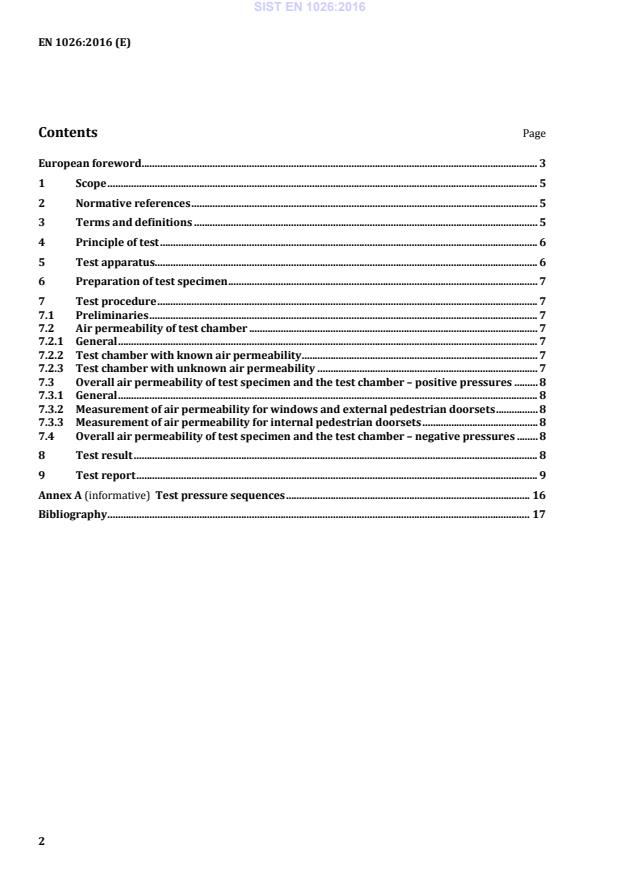
Test pressure sequences . 16 Bibliography . 17
...