

oSIST prEN 12915-2:2026
(Main)Products used for the treatment of water intended for human consumption - Granular activated carbon - Part 2: Reactivated granular activated carbon
- Abstract
This document is applicable to reactivated granular activated carbon used for treatment of water intended for human consumption. This document describes the characteristics of reactivated granular activated carbon and specifies the requirements and the corresponding test methods for reactivated granular activated carbon. This document gives information on the use of reactivated granular activated carbon in water treatment.
- Status
- Not Published
- Public Enquiry End Date
- 29-Nov-2026
- Technical Committee
- IOVO - Water supply and waste water engineering
- Current Stage
- 4020 - Public enquire (PE) (Adopted Project)
- Start Date
- 05-Oct-2026
- Due Date
- 22-Feb-2027

Relations
- Effective Date
- 19-Jan-2023
Get Certified
Connect with accredited certification bodies for this standard

ECOCERT
Organic and sustainability certification.

CIS Institut d.o.o.
Personal Protective Equipment (PPE) certification body. Notified Body NB-2890 for EU Regulation 2016/425 PPE.

Eurofins Food Testing Global
Global leader in food, environment, and pharmaceutical product testing.
Sponsored listings
Frequently Asked Questions
oSIST prEN 12915-2:2026 is a draft published by the Slovenian Institute for Standardization (SIST). Its full title is "Products used for the treatment of water intended for human consumption - Granular activated carbon - Part 2: Reactivated granular activated carbon". This standard covers: This document is applicable to reactivated granular activated carbon used for treatment of water intended for human consumption. This document describes the characteristics of reactivated granular activated carbon and specifies the requirements and the corresponding test methods for reactivated granular activated carbon. This document gives information on the use of reactivated granular activated carbon in water treatment.
This document is applicable to reactivated granular activated carbon used for treatment of water intended for human consumption. This document describes the characteristics of reactivated granular activated carbon and specifies the requirements and the corresponding test methods for reactivated granular activated carbon. This document gives information on the use of reactivated granular activated carbon in water treatment.
oSIST prEN 12915-2:2026 is classified under the following ICS (International Classification for Standards) categories: 13.060.20 - Drinking water; 71.100.80 - Chemicals for purification of water. The ICS classification helps identify the subject area and facilitates finding related standards.
oSIST prEN 12915-2:2026 has the following relationships with other standards: It is inter standard links to SIST EN 12915-2:2009. Understanding these relationships helps ensure you are using the most current and applicable version of the standard.
oSIST prEN 12915-2:2026 is available in PDF format for immediate download after purchase. The document can be added to your cart and obtained through the secure checkout process. Digital delivery ensures instant access to the complete standard document.
Standards Content (Sample)
SLOVENSKI STANDARD
01-november-2026
Izdelki, ki se uporabljajo za pripravo pitne vode - Aktivno oglje v zrnih - 2. del:
Reaktivirano aktivno oglje v zrnih
Products used for the treatment of water intended for human consumption - Granular
activated carbon - Part 2: Reactivated granular activated carbon
Produkte zur Aufbereitung von Wasser für den menschlichen Gebrauch - Granulierte
Aktivkohle - Teil 2: Reaktivierte granulierte Aktivkohle
Produits utilisés pour le traitement de l’eau destinée à la consommation humaine -
Charbon actif en grains - Partie 2: Charbon actif en grains réactivé
Ta slovenski standard je istoveten z: prEN 12915-2
ICS:
13.060.20 Pitna voda Drinking water
71.100.80 Kemikalije za čiščenje vode Chemicals for purification of
water
2003-01.Slovenski inštitut za standardizacijo. Razmnoževanje celote ali delov tega standarda ni dovoljeno.
DRAFT
EUROPEAN STANDARD
NORME EUROPÉENNE
EUROPÄISCHE NORM
September 2026
ICS 71.100.80 Will supersede EN 12915-2:2009
English Version
Products used for the treatment of water intended for
human consumption - Granular activated carbon - Part 2:
Reactivated granular activated carbon
Produits utilisés pour le traitement de l'eau destinée à Produkte zur Aufbereitung von Wasser für den
la consommation humaine - Charbon actif en grains - menschlichen Gebrauch - Granulierte Aktivkohle - Teil
Partie 2: Charbon actif en grains réactivé 2: Reaktivierte granulierte Aktivkohle
This draft European Standard is submitted to CEN members for enquiry. It has been drawn up by the Technical Committee
CEN/TC 164.
If this draft becomes a European Standard, CEN members are bound to comply with the CEN/CENELEC Internal Regulations
which stipulate the conditions for giving this European Standard the status of a national standard without any alteration.
This draft European Standard was established by CEN in three official versions (English, French, German). A version in any other
language made by translation under the responsibility of a CEN member into its own language and notified to the CEN-CENELEC
Management Centre has the same status as the official versions.
CEN members are the national standards bodies of Austria, Belgium, Bulgaria, Croatia, Cyprus, Czech Republic, Denmark, Estonia,
Finland, France, Germany, Greece, Hungary, Iceland, Ireland, Italy, Latvia, Lithuania, Luxembourg, Malta, Netherlands, Norway,
Poland, Portugal, Republic of North Macedonia, Romania, Serbia, Slovakia, Slovenia, Spain, Sweden, Switzerland, Türkiye and
United Kingdom.
Recipients of this draft are invited to submit, with their comments, notification of any relevant patent rights of which they are
aware and to provide supporting documentation.
Warning : This document is not a European Standard. It is distributed for review and comments. It is subject to change without
notice and shall not be referred to as a European Standard.
EUROPEAN COMMITTEE FOR STANDARDIZATION
COMITÉ EUROPÉEN DE NORMALISATION
EUROPÄISCHES KOMITEE FÜR NORMUNG
CEN-CENELEC Management Centre: Rue de la Science 23, B-1040 Brussels
© 2026 CEN All rights of exploitation in any form and by any means reserved Ref. No. prEN 12915-2:2026 E
worldwide for CEN national Members.
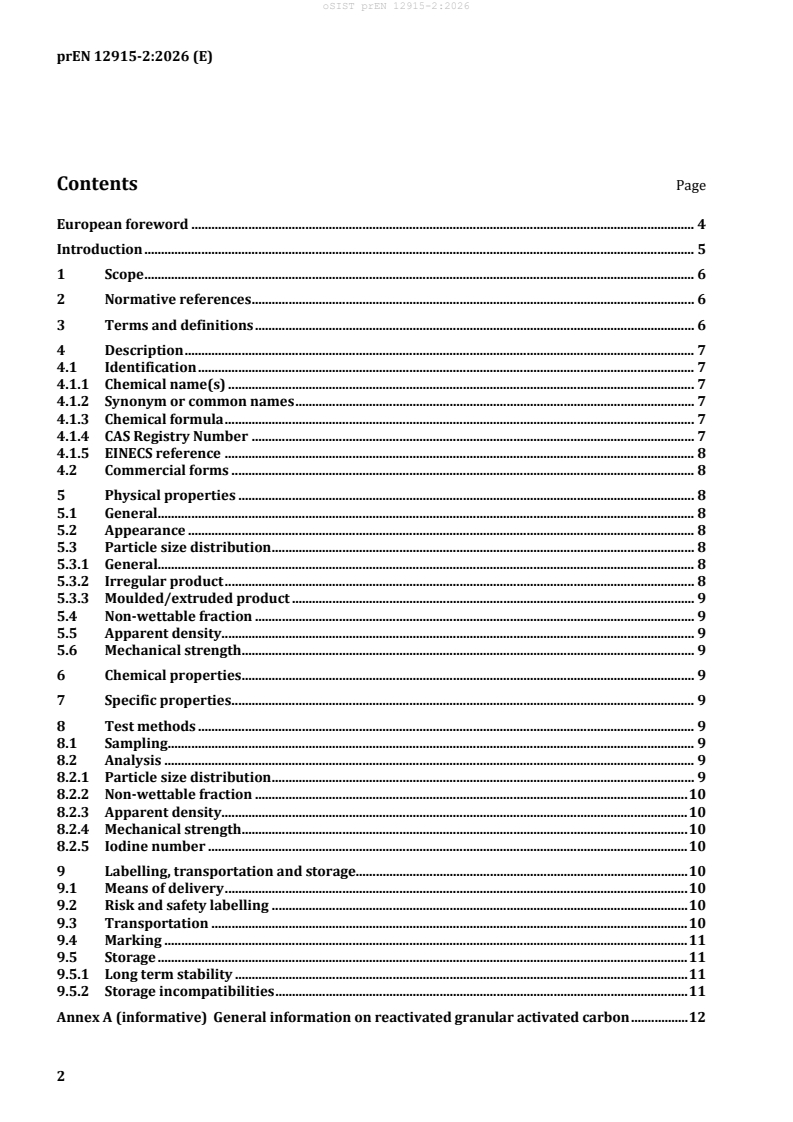
Contents Page
European foreword . 4
Introduction . 5
1 Scope . 6
2 Normative references . 6
3 Terms and definitions . 6
4 Description . 7
4.1 Identification . 7
4.1.1 Chemical name(s) . 7
4.1.2 Synonym or common names . 7
4.1.3 Chemical formula . 7
4.1.4 CAS Registry Number . 7
4.1.5 EINECS reference . 8
4.2 Commercial forms . 8
5 Physical properties . 8
5.1 General. 8
5.2 Appearance . 8
5.3 Particle size distribution . 8
5.3.1 General. 8
5.3.2 Irregular product . 8
5.3.3 Moulded/extruded product . 9
5.4 Non-wettable fraction . 9
5.5 Apparent density . 9
5.6 Mechanical strength . 9
6 Chemical properties . 9
7 Specific properties . 9
8 Test methods . 9
8.1 Sampling . 9
8.2 Analysis . 9
8.2.1 Particle size distribution . 9
8.2.2 Non-wettable fraction . 10
8.2.3 Apparent density . 10
8.2.4 Mechanical strength . 10
8.2.5 Iodine number . 10
9 Labelling, transportation and storage. 10
9.1 Means of delivery . 10
9.2 Risk and safety labelling . 10
9.3 Transportation . 10
9.4 Marking . 11
9.5 Storage . 11
9.5.1 Long term stability . 11
9.5.2 Storage incompatibilities . 11
Annex A (informative) General information on reactivated granular activated carbon . 12
Bibliography . 16
European foreword
This document (prEN 12915-2:2026) has been prepared by Technical Committee CEN/TC 164 “Water
supply”, the secretariat of which is held by AFNOR.
This document is currently submitted to the CEN Enquiry.
This document will supersede EN 12915-2:2009.
Differences between this edition and EN 12915-2:2009 include the following:
— particle size distribution for moulded/extruded product;
— non-wettable fraction replacing wettability;
— the term bulk density packed replaced by apparent density;
— a declared value for mechanical strength either as ball-pan hardness or abrasion;
— editorial to harmonize the text with other standards in this series.
The EN 12915 series, under the general title Products used for the treatment of water intended for human
consumption — Granular activated carbon, consists of the following parts:
— Part 1: Virgin granular activated carbon;
— Part 2: Reactivated granular activated carbon.
Introduction
In respect of potential adverse effects on the quality of water intended for human consumption, caused
by the product covered by this document:
a) this document provides no information as to whether the product may be used without restriction in
any of the Member States of the EU or EFTA;
b) it should be noted that, while awaiting the adoption of verifiable European criteria, existing national
regulations concerning the use and/or the characteristics of this product remain in force.
NOTE Conformity with this document does not confer or imply acceptance or approval of the product in any of
the Member States of the EU or EFTA. The use of the product covered by this document is subject to regulation or
control by National Authorities.
1 Scope
This document is applicable to reactivated granular activated carbon used for treatment of water
intended for human consumption. This document describes the characteristics of reactivated granular
activated carbon and specifies the requirements and the corresponding test methods for reactivated
granular activated carbon. This document gives information on the use of reactivated granular activated
carbon in water treatment.
2 Normative references
The following documents are referred to in the text in such a way that some or all of their content
constitutes requirements of this document. For dated references, only the edition cited applies. For
undated references, the latest edition of the referenced document (including any amendments) applies.
EN 12901, Products used for treatment of water intended for human consumption - Inorganic supporting
and filtering materials - Definitions
EN 12902, Products used for treatment of water intended for human consumption - Inorganic supporting
and filtering materials - Methods of test
3 Terms and definitions
For the purposes of this document, the terms and definitions given in EN 12901 and the following apply.
ISO and IEC maintain terminology databases for use in standardization at the following addresses:
— ISO Online browsing platform: available at https://www.iso.org/obp/
— IEC Electropedia: available at https://www.electropedia.org/
3.1
virgin activated carbon
freshly manufactured activated carbon that has not been used and has not been reactivated
[SOURCE: EN 12915-1:2026]
3.2
activated carbon
activated carbon produced by charring and activation of raw materials with
steam or other gases
3.3
activated carbon
activated carbon produced by charring and activation of raw materials with
chemical activation agents such as phosphoric acid
3.4
spent granular activated carbon
granular activated carbon with reduced adsorption capacity as a result of operational use
3.5
reactivation
process used to restore all or part of the adsorption capacity of spent granular activated carbon
Note 1 to entry: The most common process is thermal reactivation but other methods can be used.
3.6
reactivated granular activated carbon
spent granular activated carbon that has been subjected to reactivation
Note 1 to entry: Usually, reactivated granular activated carbon is returned to the water treatment plant at which
it was previously used. The delivered product can include make-up granular activated carbon and/or top-up
granular activated carbon.
3.7
make-up granular activated carbon
virgin granular activated carbon, or reactivated granular activated carbon from the same water treatment
plant, added to the reactivated granular activated carbon to compensate for losses during the operations
of reactivation (handling, transportation and reactivation itself)
3.8
mark-up granular activated carbon
top-up granular activated carbon
virgin granular activated carbon, or reactivated granular activated carbon from the same water treatment
plant, added to the reactivated granular activated carbon to compensate for losses due to operational (in-
service) losses due to attrition and wash-out of granular activated carbon at the water treatment plant
4 Description
4.1 Identification
4.1.1 Chemical name(s)
Activated Carbon – High Density Skeleton (steam activated carbon)
Activated Carbon – Low Density Skeleton (chemically activated carbon)
4.1.2 Synonym or common names
Reactivated activated coal, reactivated activated charcoal, reactivated active carbon, reactivated GAC.
4.1.3 Chemical formula
C (elementary).
4.1.4 CAS Registry Number
7440-44-0.
Chemical Abstracts Service Registry Number.
4.1.5 EINECS reference
931-328-0 (Activated Carbon – High Density Skeleton)
931-334-3 (Activated Carbon – Low Density Skeleton)
4.2 Commercial forms
Granular activated carbon is a granular product; by convention not less than a mass fraction of 90 % is
retained on a 180 µm aperture test sieve (see 5.3). The product can be either shaped (moulded/extruded)
or irregular (non-moulded), and is available in many grades, differing mainly in adsorption
characteristics, hardness, porosity, granulometry, shape and purity.
5 Physical properties
5.1 General
The physical properties of reactivated granular activated carbon are dependent on the quality of the
spent granular activated carbon as well as on the reactivation process.
NOTE See also Annex A.
5.2 Appearance
The commercial product consists of black, porous granules of irregular shape or, for moulded or extruded
products, in forms such as uniform cylinders, pellets or spheres.
5.3 Particle size distribution
5.3.1 General
The particle size distribution shall be determined on samples taken on completion of reactivation. The
particle size distribution shall be within the supplier’s stated tolerance.
NOTE 1 Different applications can require different particle size ranges.
NOTE 2 The particle size can decrease during transportation and handling.
NOTE 3 The particle size distribution is dependent on that of the spent
...