

SIST-TP ISO/TR 19815:2018
Information and documentation -- Management of the environmental conditions for archive and library collections
General Information
- Abstract
This document provides information on recent discussions and changes in recommendations and guidance on environmental management within the cultural heritage field. Conservation research on preventive methodologies and passive control provided by specific construction methods and renovations, developments in technology for controlling the environment, and energy and climate change issues are included.
This document is intended for archives and libraries and other institutions with large volumes of collections that are based on paper. Archives and libraries also have collections that include film, magnetic media, leather, and other organic, inorganic or composite materials. These institutions have a unique challenge of extending the lifespan of these materials for access and use in the present and for future generations. The environment plays a key role in extending the lifespan of all of these materials.
This document is intended for use in preservation planning and ongoing environmental management of permanent storage conditions for archives and library collections and applies to all collections being permanently stored for an institution.
- Status
- Published
- Publication Date
- 04-Sep-2018
- Technical Committee
- IDT - Information, documentation, language and terminology
- Current Stage
- 6060 - National Implementation/Publication (Adopted Project)
- Start Date
- 30-Jul-2018
- Due Date
- 04-Oct-2018
- Completion Date
- 05-Sep-2018
Buy Documents






ISO/TR 19815:2018 - Information and documentation -- Management of the environmental conditions for archive and library collections

ISO/TR 19815:2018 - Information and documentation — Management of the environmental conditions for archive and library collections/3/2018

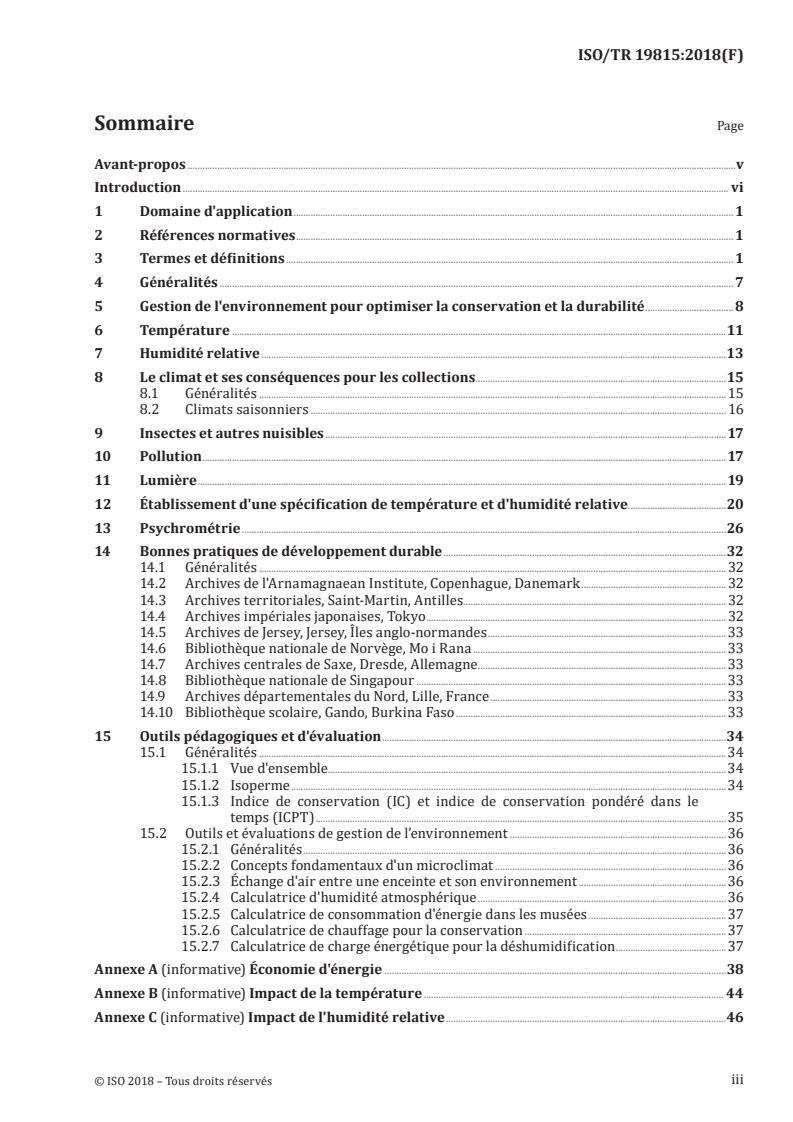
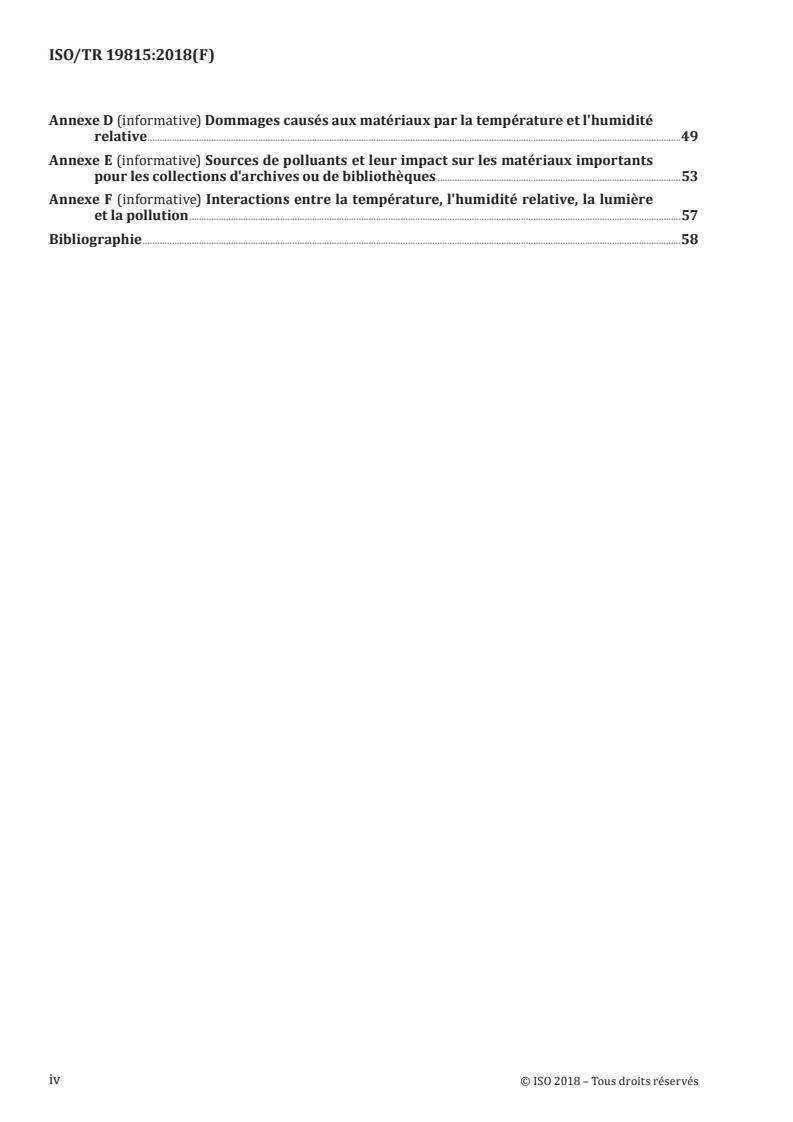
ISO/TR 19815:2018 - Information et documentation — Gestion des conditions environnementales pour les documents d'archive et de bibliotheque Released:2. 02. 2023
Overview
SIST-TP ISO/TR 19815:2018 - Information and documentation: Management of the environmental conditions for archive and library collections - is a technical report that consolidates recent research, guidance and evolving recommendations for environmental management of paper-based and mixed-material collections. Intended for archives, libraries and similar cultural institutions, the document supports preservation planning, passive and active environmental control, and long‑term strategies that balance collections care with energy efficiency and climate-change resilience.
Key topics and technical coverage
The report addresses practical and scientific aspects of environmental management, including:
- Temperature and relative humidity (RH) - rationale for setting specifications and implications for material decay.
- Climate and seasonal effects - how local and seasonal climates influence storage strategies.
- Psychrometrics - fundamentals for understanding moisture in air and its impact on collections.
- Light, pollution and pests - sources, risks and mitigation for light exposure, gaseous/particulate pollutants and biological agents (insects, mould).
- Passive control and building design - low‑energy construction and renovation methods that support stable microclimates.
- Energy, sustainability and climate change - approaches to minimize energy use while maintaining preservation outcomes.
- Assessment and educational tools - methods and calculators referenced in the report, such as Isoperm, Preservation Index (PI) and Time Weighted PI (TWPI), plus energy and moisture calculators.
- Practical examples and case studies - international institutional examples illustrating sustainable environmental management.
- Annexes on impacts of temperature/RH, pollutant sources and interactions among environmental factors.
Note: SIST-TP ISO/TR 19815:2018 is informative and does not contain normative references; it complements standards such as ISO 11799 and national guidance like BSI/PAS 198.
Practical applications - who uses this standard
This technical report is valuable to professionals who need evidence‑based guidance for long‑term storage and access:
- Archivists and librarians - to define environmental specifications for permanent storage and retrieval.
- Collection managers and conservators - to assess vulnerability of paper, film, magnetic media, leather and composite materials.
- Facilities managers, architects and HVAC engineers - to design or retrofit buildings using passive control and energy‑aware mechanical systems.
- Policy makers and preservation planners - to develop institutional policies that balance conservation goals with sustainability.
- Educators and consultants - to support training and condition-assessment workflows using the report’s tools and metrics.
Related standards and guidance
- ISO 11799 (storage and conditions for archival documents)
- BSI/PAS 198 (national guidance referenced in the report)
- ISO/TC 46 SC 10 (technical committee responsible for the work)
SIST-TP ISO/TR 19815:2018 helps institutions implement practical, science-based environmental management for archives and libraries - prioritizing material longevity, energy efficiency and adaptability to changing climates.
Buy Documents
ISO/TR 19815:2018 - Information and documentation -- Management of the environmental conditions for archive and library collections
ISO/TR 19815:2018 - Information and documentation — Management of the environmental conditions for archive and library collections/3/2018
ISO/TR 19815:2018 - Information et documentation — Gestion des conditions environnementales pour les documents d'archive et de bibliotheque Released:2. 02. 2023
Frequently Asked Questions
SIST-TP ISO/TR 19815:2018 is a technical report published by the Slovenian Institute for Standardization (SIST). Its full title is "Information and documentation -- Management of the environmental conditions for archive and library collections". This standard covers: This document provides information on recent discussions and changes in recommendations and guidance on environmental management within the cultural heritage field. Conservation research on preventive methodologies and passive control provided by specific construction methods and renovations, developments in technology for controlling the environment, and energy and climate change issues are included. This document is intended for archives and libraries and other institutions with large volumes of collections that are based on paper. Archives and libraries also have collections that include film, magnetic media, leather, and other organic, inorganic or composite materials. These institutions have a unique challenge of extending the lifespan of these materials for access and use in the present and for future generations. The environment plays a key role in extending the lifespan of all of these materials. This document is intended for use in preservation planning and ongoing environmental management of permanent storage conditions for archives and library collections and applies to all collections being permanently stored for an institution.
This document provides information on recent discussions and changes in recommendations and guidance on environmental management within the cultural heritage field. Conservation research on preventive methodologies and passive control provided by specific construction methods and renovations, developments in technology for controlling the environment, and energy and climate change issues are included. This document is intended for archives and libraries and other institutions with large volumes of collections that are based on paper. Archives and libraries also have collections that include film, magnetic media, leather, and other organic, inorganic or composite materials. These institutions have a unique challenge of extending the lifespan of these materials for access and use in the present and for future generations. The environment plays a key role in extending the lifespan of all of these materials. This document is intended for use in preservation planning and ongoing environmental management of permanent storage conditions for archives and library collections and applies to all collections being permanently stored for an institution.
SIST-TP ISO/TR 19815:2018 is classified under the following ICS (International Classification for Standards) categories: 01.140.20 - Information sciences. The ICS classification helps identify the subject area and facilitates finding related standards.
SIST-TP ISO/TR 19815:2018 is available in PDF format for immediate download after purchase. The document can be added to your cart and obtained through the secure checkout process. Digital delivery ensures instant access to the complete standard document.
Standards Content (Sample)
SLOVENSKI STANDARD
01-oktober-2018
Informatika in dokumentacija - Upravljanje okoljskih pogojev za zbirke arhivov in
knjižnic
Information and documentation -- Management of the environmental conditions for
archive and library collections
Information et documentation -- Gestion des conditions environnementales pour les
documents d'archive et de bibliothèque
Ta slovenski standard je istoveten z: ISO/TR 19815:2018
ICS:
01.140.20 Informacijske vede Information sciences
2003-01.Slovenski inštitut za standardizacijo. Razmnoževanje celote ali delov tega standarda ni dovoljeno.
TECHNICAL ISO/TR
REPORT 19815
First edition
2018-07
Information and documentation —
Management of the environmental
conditions for archive and library
collections
Information et documentation — Gestion des conditions
environnementales pour les documents d'archive et de bibliothèque
Reference number
©
ISO 2018
© ISO 2018
All rights reserved. Unless otherwise specified, or required in the context of its implementation, no part of this publication may
be reproduced or utilized otherwise in any form or by any means, electronic or mechanical, including photocopying, or posting
on the internet or an intranet, without prior written permission. Permission can be requested from either ISO at the address
below or ISO’s member body in the country of the requester.
ISO copyright office
CP 401 • Ch. de Blandonnet 8
CH-1214 Vernier, Geneva
Phone: +41 22 749 01 11
Fax: +41 22 749 09 47
Email: copyright@iso.org
Website: www.iso.org
Published in Switzerland
ii © ISO 2018 – All rights reserved
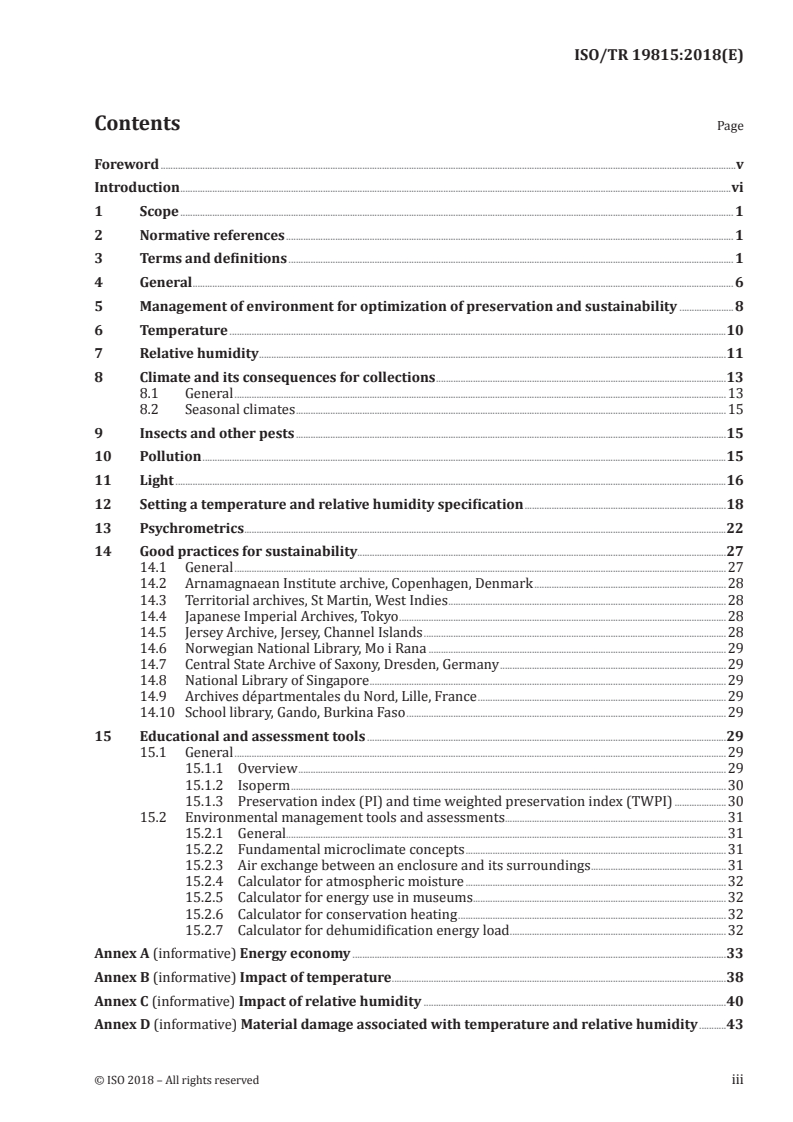
Contents Page
Foreword .v
Introduction .vi
1 Scope . 1
2 Normative references . 1
3 Terms and definitions . 1
4 General . 6
5 Management of environment for optimization of preservation and sustainability .8
6 Temperature .10
7 Relative humidity .11
8 Climate and its consequences for collections .13
8.1 General .13
8.2 Seasonal climates .15
9 Insects and other pests .15
10 Pollution .15
11 Light .16
12 Setting a temperature and relative humidity specification .18
13 Psychrometrics .22
14 Good practices for sustainability.27
14.1 General .27
14.2 Arnamagnaean Institute archive, Copenhagen, Denmark .28
14.3 Territorial archives, St Martin, West Indies .28
14.4 Japanese Imperial Archives, Tokyo .28
14.5 Jersey Archive, Jersey, Channel Islands .28
14.6 Norwegian National Library, Mo i Rana .29
14.7 Central State Archive of Saxony, Dresden, Germany .29
14.8 National Library of Singapore .29
14.9 Archives départmentales du Nord, Lille, France .29
14.10 School library, Gando, Burkina Faso .29
15 Educational and assessment tools .29
15.1 General .29
15.1.1 Overview .29
15.1.2 Isoperm .30
15.1.3 Preservation index (PI) and time weighted preservation index (TWPI) .30
15.2 Environmental management tools and assessments.31
15.2.1 General.31
15.2.2 Fundamental microclimate concepts .31
15.2.3 Air exchange between an enclosure and its surroundings .31
15.2.4 Calculator for atmospheric moisture .32
15.2.5 Calculator for energy use in museums .32
15.2.6 Calculator for conservation heating .32
15.2.7 Calculator for dehumidification energy load .32
Annex A (informative) Energy economy .33
Annex B (informative) Impact of temperature .38
Annex C (informative) Impact of relative humidity .40
Annex D (informative) Material damage associated with temperature and relative humidity .43
Annex E (informative) Sources of pollutants and their impact on materials significant to
archive or library collections .46
Annex F (informative) Interactions between temperature, RH, light and pollution .50
Bibliography .51
iv © ISO 2018 – All rights reserved
Foreword
ISO (the International Organization for Standardization) is a worldwide federation of national standards
bodies (ISO member bodies). The work of preparing International Standards is normally carried out
through ISO technical committees. Each member body interested in a subject for which a technical
committee has been established has the right to be represented on that committee. International
organizations, governmental and non-governmental, in liaison with ISO, also take part in the work.
ISO collaborates closely with the International Electrotechnical Commission (IEC) on all matters of
electrotechnical standardization.
The procedures used to develop this document and those intended for its further maintenance are
described in the ISO/IEC Directives, Part 1. In particular the different approval criteria needed for the
different types of ISO documents should be noted. This document was drafted in accordance with the
editorial rules of the ISO/IEC Directives, Part 2 (see www .iso .org/directives).
Attention is drawn to the possibility that some of the elements of this document may be the subject of
patent rights. ISO shall not be held responsible for identifying any or all such patent rights. Details of
any patent rights identified during the development of the document will be in the Introduction and/or
on the ISO list of patent declarations received (see www .iso .org/patents).
Any trade name used in this document is information given for the convenience of users and does not
constitute an endorsement.
For an explanation on the voluntary nature of standards, the meaning of ISO specific terms and
expressions related to conformity assessment, as well as information about ISO's adherence to the
World Trade Organization (WTO) principles in the Technical Barriers to Trade (TBT) see the following
URL: www .iso .org/iso/foreword .html.
This document was prepared by Technical Committee ISO/TC 46, Information and documentation,
Subcommittee SC 10, Requirements for document storage and conditions for preservation.
Any feedback or questions on this document should be directed to the user’s national standards body. A
complete listing of these bodies can be found at www .iso .org/members .html.
Introduction
[46]
This document covers much of the same ground as BSI/PAS 198 . The main difference is that BSI/
PAS 198 was designed to be applied in British conditions with a temperate climate. Challenges vary in
different climatic zones. Nevertheless, there are principles that are generally applicable.
No one set of conditions is appropriate for all collections in all circumstances because environmental
specifications are tailored to the needs of a specific collection, the resources of the institution and
the context within which it operates, and the local climate. This document sets out a framework for
decision making relating to appropriate environmental conditions for cultural collections in the
specific climatic zones.
Since archives, libraries and cultural institutions are guardians of the collective memory, their aim is
to preserve material in the long term. They also have a duty to do so in a manner that minimizes the
impact on the world's resources and climate. Climate change will affect cultural institutions as much
as any other institution, if not more, and the use of energy, particularly from non-renewable sources,
should be minimized. Wherever possible, passive (non-energy consuming) solutions are preferred, and
buildings should be designed with this aim in mind.
First, the extent and composition of the collections, their significance, their current condition, the ways
in which they are used, and the desired lifetime should be taken into account. For example, archive and
library collections are likely to contain (in addition to bound and unbound paper and parchment and
other organic materials, such as Xuan paper and silk, black and white and colour photographic prints
and negatives) gramophone records, tapes and films, and, increasingly, diverse electronic media. In
addition, the collections can contain all manner of artefacts in various materials. While many of these
materials have similar environmental sensitivities, some have specific requirements that need to be
taken into account.
The environment in which the collections are stored, used or displayed, and the resulting risks to them
should also be understood. On the basis of the information gathered about the collections, regarding
the nature and condition of the collections, it is possible to assess the vulnerability to factors such as
temperature, relative humidity, light and pollutants, and thus what steps need to be taken to mitigate
those risks. These might include the design of, or modifications to buildings, passive measures to
control the environment, or improvements to storage and display techniques.
Every collecting institution can and should be able to carry out these steps, no matter how limited
their resources, and irrespective of their climate. Knowledge of the collections, and of the risks, is
indispensable to proper management and long term survival of the collections.
The consensus amongst conservation professionals regarding environmental parameters for
exhibitions and loans is evolving rapidly. References [29], [206] and [236] give additional information
on this. Although there is no doubt that a controlled environment is significant in the preservation of
collections, provided that the parameters are appropriate to the materials, it is now generally accepted
that daily and seasonal variations in temperature and relative humidity will not cause harm to the
majority of collections.
This document also provides access to research that led to some of the changes in ISO 11799.
vi © ISO 2018 – All rights reserved
TECHNICAL REPORT ISO/TR 19815:2018(E)
Information and documentation — Management of
the environmental conditions for archive and library
collections
1 Scope
This document provides information on recent discussions and changes in recommendations and
guidance on environmental management within the cultural heritage field. Conservation research
on preventive methodologies and passive control provided by specific construction methods and
renovations, developments in technology for controlling the environment, and energy and climate
change issues are included.
This document is intended for archives and libraries and other institutions with large volumes of
collections that are based on paper. Archives and libraries also have collections that include film,
magnetic media, leather, and other organic, inorganic or composite materials. These institutions have
a unique challenge of extending the lifespan of these materials for access and use in the present and for
future generations. The environment plays a key role in extending the lifespan of all of these materials.
This document is intended for use in preservation planning and ongoing environmental management
of permanent storage conditions for archives and library collections and applies to all collections being
permanently stored for an institution.
2 Normative references
There are no normative references in this document.
3 Terms and definitions
For the purposes of this document, the following terms and definitions apply.
ISO and IEC maintain terminological databases for use in standardization at the following addresses:
— IEC Electropedia: available at http: //www .electropedia .org/
— ISO Online browsing platform: available at https: //www .iso .org/obp
3.1
air change rate
air flow rate to a space, expressed as volume per unit time, divided by the volume of the space in
consistent units
Note 1 to entry: Air change rate is often expressed as air changes per hour.
Note 2 to entry: This term is used where there is active ventilation [see also ventilation rate (3.40)].
[SOURCE: ISO 16814:2008, 3.5]
3.2
thermal stratification
tendency of heated air to rise and to arrange itself in layers with the warmest air at the top
3.3
collection
holding
type of documents kept in archives and libraries regardless of their physical format
Note 1 to entry: These are mainly books, manuscripts, files, maps, graphic collections and other documents
consisting of paper, but also parchment, papyrus, films, photographic materials, audio-visual recordings,
magnetic and optical media, as well as bindings and protective material.
Note 2 to entry: Holdings is a term used more often in archival institutions.
3.4
dew point
measure of atmospheric moisture
Note 1 to entry: It is the temperature at which the water vapour in the air becomes saturated and
condensation begins.
3.5
document
recorded information or material object which can be treated as a unit in a documentation process
3.6
effectiveness
extent to which planned activities are realized and planned results are achieved
3.7
energy
electricity, fuels, steam, heat, compressed air, and other like media
Note 1 to entry: For the purposes of this document, energy refers to the various forms of energy, including
renewable, which can be purchased, stored, treated, used in equipment or in a process, or recovered.
Note 2 to entry: Energy can be defined as the capacity of a system to produce external activity or perform work.
[SOURCE: ISO 50001:2011, 3.5]
3.8
energy economy
careful management of energy resources
Note 1 to entry: This focuses on appropriate minimal consumption of energy within an institution, and
incorporates both knowledge of energy performance and specific energy efficiency (3.9) of a building and/or
mechanical systems.
3.9
energy efficiency
measures that ensure the building and system function in accordance with the design parameters by
the efficient use of energy
[SOURCE: ISO 16813:2006, 3.17]
3.10
energy performance
measurable results related to energy efficiency (3.9), energy use and energy consumption
Note 1 to entry: In the context of energy management systems (3.12), results can be measured against the
organization's energy policy, objectives, targets and other energy performance requirements.
[SOURCE: ISO 50001:2011, 3.12]
2 © ISO 2018 – All rights reserved
3.11
environment
surroundings in which an organization operates, including air, water, land, natural resources, flora,
fauna, humans and their interrelationships
Note 1 to entry: Surroundings can extend from within an organization to the local, regional and global system.
Note 2 to entry: Surroundings can be described in terms of biodiversity, ecosystems, climate or other
characteristics.
[SOURCE: ISO 14001:2015, 3.2.1]
3.12
environmental management system
part of the management system used to manage environmental aspects, fulfil compliance obligations,
and address risks and opportunities
[SOURCE: ISO 14001:2015, 3.1.2]
3.13
environmental performance
performance related to the management of environmental aspects
Note 1 to entry: For an environmental management system (3.12), results can be measured against the
organization’s environmental policy (3.14), environmental objectives or other criteria, using indicators.
[SOURCE: ISO 14001:2015, 3.4.11]
3.14
environmental policy
intentions and direction of an organization related to environmental performance formally expressed
by its top management
[SOURCE: ISO 14001:2015, 3.1.3]
3.15
glass transition
reversible change in an amorphous polymer or in amorphous regions of a partially crystalline polymer
from (or to) a viscous or rubbery condition to (or from) a hard and relatively brittle one
[SOURCE: ISO 11357-2:2013, 3.1]
3.16
glass transition temperature
T
g
characteristic value of the temperature range over which the glass transition takes place
Note 1 to entry: The assigned glass transition temperature ( ) may vary, depending on the specific property and
g
on the method and conditions selected to measure it.
[SOURCE: ISO 11357-2:2013, 3.2]
3.17
HVAC system
system that provides heating, ventilation or air conditioning for buildings
[SOURCE: ISO 16814:2008, 3.18]
3.18
hydrolyse
chemical decomposition in which a compound is split into other compounds by reacting with water
3.19
indicator
measurable representation of the condition or status of operations, management or conditions
[SOURCE: ISO 14031:2013, 3.15]
3.20
infiltration air
uncontrolled passage of air into a space through leakage paths in the building envelope
[SOURCE: ISO 16814:2008, 3.20]
3.21
insulation
materials that conduct heat poorly and thereby slow down heat loss from an object or space
3.22
long term storage
storage, for a period of undefined length, of material kept for permanent retention
3.23
maintenance
actions of prevention or correction to support long term functionality of repositories and the systems
that support them
Note 1 to entry: Corrective action is taken to prevent recurrence whereas preventive action is taken to prevent
occurrence.
3.24
management system
set of interrelated or interacting elements of an organization to establish policies and objectives and
processes to achieve those objectives
Note 1 to entry: A management system can address a single discipline or several disciplines (e.g. quality,
environment, occupational health and safety, energy, financial management).
Note 2 to entry: The system elements include the organization’s structure, roles and responsibilities, planning
and operation, performance evaluation and improvement.
Note 3 to entry: The scope of a management system can include the whole of the organization, specific and
identified functions of the organization, specific and identified sections of the organization, or one or more
functions across a group of organizations.
[SOURCE: ISO 14001:2015, 3.1.1]
3.25
mechanical ventilation
ventilation provided by mechanically powered equipment
[SOURCE: ISO 16814:2008, 3.22]
3.26
monitoring
determining the status of a system, a process or an activity
Note 1 to entry: To determine the status, there might be a need to check, supervise or critically observe.
[SOURCE: ISO 14001:2015, 3.4.8]
4 © ISO 2018 – All rights reserved
3.27
natural ventilation
ventilation through leakage paths (infiltration) and intentional openings (ventilation) in the building
envelope or room enclosure, which relies on pressure differences without the aid of powered air-
moving components
[SOURCE: ISO 16814:2008, 3.24]
3.28
occupied zone
area designed for occupancy that is dependent on the geometry and the use of the room and specified
case by case
Note 1 to entry: Usually used only for areas designed for human occupancy and defined as a volume of air that
is confined by horizontal and vertical planes. The vertical planes are usually parallel with the walls of the room.
[SOURCE: ISO 16814:2008, 3.28]
3.29
outdoor air
air entering the system, or opening from outdoors before any air treatment
[SOURCE: ISO 16814:2008, 3.31]
3.30
outdoor air intake
opening through which outdoor air is admitted
[SOURCE: ISO 16814:2008, 3.30]
3.31
performance
measurable result
Note 1 to entry: Performance can relate either to quantitative or qualitative findings.
Note 2 to entry: Performance can relate to the management of activities, processes, products (including services),
systems or organizations.
[SOURCE: ISO 14001:2015, 3.4.10]
3.32
process
set of interrelated or interacting activities which transforms inputs into outputs
Note 1 to entry: A process can be documented or not.
[SOURCE: ISO 14001:2015, 3.3.5]
3.33
relative humidity
RH
mass of water vapour in the air by volume divided by mass of water vapour by volume at saturation at
the same temperature
[SOURCE: ISO 16814:2008, 3.34]
3.34
repository
building or room designed or arranged and used specifically and exclusively for long term storage of
archive or library material
3.35
requirement
need or expectation that is stated, generally implied or obligatory
Note 1 to entry: “Generally implied” means that it is custom or common practice for the organization and
interested parties that the need or expectation under consideration is implied.
Note 2 to entry: A specified requirement is one that is stated, for example in documented information.
Note 3 to entry: Requirements other than legal requirements become obligatory when the organization decides
to comply with them.
[SOURCE: ISO 14001:2015, 3.2.8]
3.36
sub-cool
process of cooling air below its initial dew point temperature to dehumidify via condensation
Note 1 to entry: The condensation dehumidification is followed by a reheat stage to manage temperature and
relative humidity.
3.37
sustainability
maintenance of ecosystem components and functions for future generations, to address economic
efficiency, social issues and environmental preservation
[SOURCE: ISO 16813:2006, 3.27]
3.38
systems
processes undergoing assessment
Note 1 to entry: Examples include heating, cooling, domestic hot water, lighting, ventilation and relevant
automation or control.
[SOURCE: ISO 23045:2008, 3.3]
3.39
ventilation
process of supplying or removing air by natural means or mechanical means to or from a space for the
purpose of controlling air contaminant levels, humidity, odours or temperature within the space
[SOURCE: ISO 16814:2008, 3.44]
3.40
ventilation rate
airflow rate at which outdoor air enters a building or enclosed space
[SOURCE: ISO 16814:2008, 3.45]
4 General
To manage the environment in an archive or library, objectives for planning and decisions should be
determined. It should be determined what purpose environmental management will serve in meeting
the preservation needs of the collections. Environmental management is often the major form of
preservation action that can be carried out for all collections to prevent or slow down the deterioration
of the most common materials found in archive and library collections. Determining the expected
lifespan for the collections will help to determine limits to exposure to high temperature and high
relative humidity and the priority within the collections for maintaining the best environment possible.
To do this appropriately, the knowledge of the collections and the specific vulnerabilities of materials
and formats is vital.
6 © ISO 2018 – All rights reserved
It is advisable to collect data relating to the collections, including:
— the materials present in the collections, and the quantities of each;
— the significance of the items, and the aspects of the items that form the basis of their significance;
— the desired lifetime of the items;
— the present condition of the collections;
— the ways in which the collections are used, including storage, handling, display or loan;
— the history of any conservation or other interventions that might affect the stability or vulnerability.
The quantities need only be approximate, but it is important that all materials present are identified.
The significance of an item is the key to why it is in the collections: it is important to understand what
aspect of it gives it its significance, as it is this that should be preserved.
All materials deteriorate slowly even under the best conditions. It is not helpful to say that items should
be preserved “in perpetuity”, as this implies that infinite resources should be spent on doing so. It may
be more useful to speak about the point at which the original significance of the item is lost, or when
[29]
it has become “unfit for use”. It has been suggested that each institution should select a planning
horizon that is realistic for their circumstances (possibly 50, 100, 500 years, or longer) and, on the basis
of the nature of the collections and the present storage environment, to predict when the item will cease
to be fit for purpose. If the point at which the item become unusable comes before the planning horizon,
it indicates that there is a choice of doing something about the lifetime or, if resources do not allow
action, accepting that this point is the item’s lifetime. If the point of non-usability is beyond the planning
horizon, it indicates that nothing needs to be changed. If the point of non-usability is somewhere close
to the planning horizon, it indicates that nothing needs to be changed in the present because a review at
set intervals may involve new information and a new starting point.
The long term planning horizon has been explored recently in a series of papers based on research
[241]
carried out at the Centre for Sustainable Heritage, University College of London . In this research,
surveys of public users of archive and library materials studied what is considered “unfit for use” in
terms of the threshold of damage, or extent of physical change that is assessed as damage. This research
is significant for the environmental management of collections because the changes considered were
discolouration and mechanical deterioration, such as tears and missing pieces, often an indicator of
brittle and fragile materials. These physical changes are often seen in archive and library materials
that have been maintained in inappropriate environments for long periods of time.
An assessment of the present condition may indicate whether items are stable, at risk or actively
deteriorating which may provide information on the suitability or unsuitability of the current
environment.
The institution will need to collect data relating to the environments in which collections are stored,
handled, displayed or loaned, including:
— records of the internal and external temperature and relative humidity;
— records of the levels of visible and ultraviolet light to which items are exposed, and the duration of
such exposure;
— records of gaseous and particulate pollutants to which items are exposed;
— where active methods of environmental control are used, such as mechanical ventilation, filtration,
heating, cooling, humidification and dehumidification, records shall be made of the control settings
and any alterations made to them (e.g. seasonal variations) and the amount of energy used by each
of these systems.
Where possible, records should be made of the conditions in each different environment in which
collections are housed.
All environmental monitoring equipment should be maintained and calibrated regularly, in accordance
with the manufacturers' recommendations.
All the above records should be kept permanently and shall be reviewed regularly to see whether there
are seasonal or longer term trends.
On the basis of the information gathered above, the institution will be able to assess the environmental
risks to the collections.
On the basis of the environmental risk assessment, the institution will be able to set an environmental
specification for the storage, handling, display and loan of items. As appropriate, this will set the
permissible upper and lower limits, rate of change and fluctuations for temperature and relative
humidity, the maximum permissible visible and ultraviolet light exposure, and the maximum
permissible gaseous and particulate pollutant concentrations.
Where active methods of environmental control are used, the institution should endeavour to minimize
the amount of non-renewable energy consumed.
5 Management of environment for optimization of preservation and
sustainability
Achieving long term, sustainable preservation of archive and library materials requires that
institutions approach the process of preservation with a different mindset than has been common in
the past. Because no one set of environmental conditions or building operations is appropriate for all
collections in all circumstances, and because it is no longer practical to achieve preservation while
disregarding energy costs and consumption of non-renewable resources, it is helpful to approach the
topic of sustainable preservation with a goal of optimising preservation with a building’s operation.
Defined, an optimal preservation environment is one that achieves the best possible preservation for
collections at the least possible energy cost, and that is sustainable over time.
Optimization requires a holistic understanding of the collections and the building that contains them. It
is not simply about temperature, relative humidity and other environmental factors, but about overall
risk management for the collections, an awareness of the challenges or benefits that the local outdoor
climate may provide, and knowledge of how the building and any mechanical systems that are designed
to temper those outdoor conditions. Documenting and understanding those factors forms three critical
questions that should be addressed as institutions manage the change from prescriptive environmental
standards to locally determined best practices for preservation and energy usage.
— What is the current preservation environment that is maintained?
— Could it or must it be improved?
— Is more energy used than necessary to achieve that environment?
Like many aspects of collections management, creating and optimizing a sustainable preservation
environment is not a onetime project, but rather an ongoing process that should be monitored and
maintained over time.
A team of interdisciplinary colleagues, in the form of an environmental management team consisting
of individuals from collections management and preservation, facilities management or engineering,
and institutional administration, will have the requisite skills and knowledge to shepherd this change.
The process requires a leader, often from the collections or facilities staff, to champion the process
and oversee the work of the group. The goal is to encourage joint decision making, taking into account
the needs of preservation, facilities, and administration on issues that involve collections preservation
environments. In order to achieve this level of communication, it is recommended that team members
strive to gain a working understanding of their colleagues’ responsibilities, meaning that collections
staff should learn about the building space and any mechanical systems that create the environment
for their collections, while facilities staff should learn more about the institution’s collections and their
preservation needs.
8 © ISO 2018 – All rights reserved
It may be advisable to refer to the educational and assessment tools (see Clause 15) as a group and/or
consult with professional colleagues in similar institutions, consultants in environmental management
specifically for cultural institutions and international (i.e. ICOM, IFLA and ICA) and national and
academic institutions.
Once the team is formed, optimization is a process that is continuous and includes the following steps:
— documentation;
— data gathering;
— analysis;
— experimentation and implementation;
— assessment and maintenance.
Documentation is the process of creating a shared repository of information about outdoor climate,
building characteristics, collections and their preservation needs, and any mechanical systems that may
impact the collections environment. Some information will be available through existing documents,
while other information, such as mechanical system layout or location of various collections, may need
to be discovered as part of the process.
Data gathering is the practice of using data loggers, building management systems, or other sources
of temperature, relative humidity, air flows, light or pollution measurements, to provide information
about long term environmental trends in collections and other building areas. The goal is to have
representative information that will allow for data driven decision making regarding environmental
conditions for the preservation of collections materials. Data should be gathered from any space where
collections are stored, exhibited, worked on, or otherwise present for any length of time. The length
of time for data gathering may vary, but to understand the behaviour of environments in response to
changing outdoor conditions, a minimum of one year is recommended. In all circumstances, the longer
the data gathering period, the more useful the information will be for assessment and strategic decision
making as it provides a way to track environmental conditions and building and mechanical system
performance over time.
Where automated monitoring systems are used, these should be capable of indicating any out of
specification condition without delay by means of an alarm or similar system. Sophisticated computer-
based data monitoring systems may be installed, which can aid with planning of preventive maintenance
and can also provide trend logging. Attention should be paid to the placement of the sensors to ensure
that the data are representative of the room as a whole. It is unwise to rely solely on a sensor in the
return air duct.
The analysis step is the process of examining the available data to identify and assess preservation risks
based on conditions of temperature, relative humidity, light, pollution, or other related factors. This
analysis may be as simple as comparing recording data to the target ranges of conditions, or may entail
more detailed analysis through the use of various tools/metrics (see Clause 15). Beyond identification,
another key aspect of the analysis step is to compare levels of risk from various threats to determine
where priorities for risk mitigation (lowering relative humidity to reducing mould risk, lowering
temperature to reduce rates of chemical decay) lie. In addition, the data analysis, when performed by
the environmental management team, may help identify opportunities for more sustainable operation
of preservation environments, such as occasions of overheating or humidification of spaces. As the
team performs the analysis, the identified risks and opportunities, whether for collections preservation
or for energy savings, should be documented. Once documented, the team should assign priority for
addressing the risks or opportunities.
Experimentation with, and implementation of, new environmental conditions or building or mechanical
system operational settings allows the team to test and identify new strategies that may be used for
either preservation benefit, energy savings without negatively impacting preservation quality, or both.
Proposed changes in management and approach should be tested, normally for periods of two to four
weeks, and conducted in multiple seasons if necessary. The team should continue data gathering for
the affected space throughout the test period, then analyse the data to assess whether the adjustment
successfully addressed the documented risk or opportunity, what the overall impact on the preservation
environment was, and whether the tested strategy will remain as part of the normal building/system/
environment operation.
Once the team has tested and adopted any strategies for optimizing the performance of the preservation
environment, the process enters the assessment and maintenance phase. As data gathering in the space
continues, the team can use the environmental data, combined with any tools or metrics, to assess
and quantify the impact of the changes on the overall preservation quality of the space, or to quantify
the impact of any energy optimization measures on sustainability or energy expenditure goals. This
quantification is a check against whether strategies are performing as expected, but also serves as
a valuable communication tool for institutional administration and other colleagues. The ongoing
assessment should include periodic reviews of data, strategies, and operational guidelines, to ensure
that the collections environment, building, and any mechanical systems are still performing as defined
by the team. When changes or anomalies are discovered, the team can repeat steps of the optimization
work process as needed to propose and identify the appropriate corrections to the collections
environment. As the team reaches the maintenance stage of the process, it can work at developing
appropriate institution specific procedures for the ongoing process, with the goal of integrating the
optimization process into normal institutional procedures and workflow.
Much of this process is outlined more specifically in the Reference [91].
6 Temperature
The environmental specification shall include parameters for temperature that will enable the expected
collections lifetime to be achieved, taking
...
TECHNICAL ISO/TR
REPORT 19815
First edition
2018-07
Information and documentation —
Management of the environmental
conditions for archive and library
collections
Information et documentation — Gestion des conditions
environnementales pour les documents d'archive et de bibliothèque
Reference number
©
ISO 2018
© ISO 2018
All rights reserved. Unless otherwise specified, or required in the context of its implementation, no part of this publication may
be reproduced or utilized otherwise in any form or by any means, electronic or mechanical, including photocopying, or posting
on the internet or an intranet, without prior written permission. Permission can be requested from either ISO at the address
below or ISO’s member body in the country of the requester.
ISO copyright office
CP 401 • Ch. de Blandonnet 8
CH-1214 Vernier, Geneva
Phone: +41 22 749 01 11
Fax: +41 22 749 09 47
Email: copyright@iso.org
Website: www.iso.org
Published in Switzerland
ii © ISO 2018 – All rights reserved
Contents Page
Foreword .v
Introduction .vi
1 Scope . 1
2 Normative references . 1
3 Terms and definitions . 1
4 General . 6
5 Management of environment for optimization of preservation and sustainability .8
6 Temperature .10
7 Relative humidity .11
8 Climate and its consequences for collections .13
8.1 General .13
8.2 Seasonal climates .15
9 Insects and other pests .15
10 Pollution .15
11 Light .16
12 Setting a temperature and relative humidity specification .18
13 Psychrometrics .22
14 Good practices for sustainability.27
14.1 General .27
14.2 Arnamagnaean Institute archive, Copenhagen, Denmark .28
14.3 Territorial archives, St Martin, West Indies .28
14.4 Japanese Imperial Archives, Tokyo .28
14.5 Jersey Archive, Jersey, Channel Islands .28
14.6 Norwegian National Library, Mo i Rana .29
14.7 Central State Archive of Saxony, Dresden, Germany .29
14.8 National Library of Singapore .29
14.9 Archives départmentales du Nord, Lille, France .29
14.10 School library, Gando, Burkina Faso .29
15 Educational and assessment tools .29
15.1 General .29
15.1.1 Overview .29
15.1.2 Isoperm .30
15.1.3 Preservation index (PI) and time weighted preservation index (TWPI) .30
15.2 Environmental management tools and assessments.31
15.2.1 General.31
15.2.2 Fundamental microclimate concepts .31
15.2.3 Air exchange between an enclosure and its surroundings .31
15.2.4 Calculator for atmospheric moisture .32
15.2.5 Calculator for energy use in museums .32
15.2.6 Calculator for conservation heating .32
15.2.7 Calculator for dehumidification energy load .32
Annex A (informative) Energy economy .33
Annex B (informative) Impact of temperature .38
Annex C (informative) Impact of relative humidity .40
Annex D (informative) Material damage associated with temperature and relative humidity .43
Annex E (informative) Sources of pollutants and their impact on materials significant to
archive or library collections .46
Annex F (informative) Interactions between temperature, RH, light and pollution .50
Bibliography .51
iv © ISO 2018 – All rights reserved
Foreword
ISO (the International Organization for Standardization) is a worldwide federation of national standards
bodies (ISO member bodies). The work of preparing International Standards is normally carried out
through ISO technical committees. Each member body interested in a subject for which a technical
committee has been established has the right to be represented on that committee. International
organizations, governmental and non-governmental, in liaison with ISO, also take part in the work.
ISO collaborates closely with the International Electrotechnical Commission (IEC) on all matters of
electrotechnical standardization.
The procedures used to develop this document and those intended for its further maintenance are
described in the ISO/IEC Directives, Part 1. In particular the different approval criteria needed for the
different types of ISO documents should be noted. This document was drafted in accordance with the
editorial rules of the ISO/IEC Directives, Part 2 (see www .iso .org/directives).
Attention is drawn to the possibility that some of the elements of this document may be the subject of
patent rights. ISO shall not be held responsible for identifying any or all such patent rights. Details of
any patent rights identified during the development of the document will be in the Introduction and/or
on the ISO list of patent declarations received (see www .iso .org/patents).
Any trade name used in this document is information given for the convenience of users and does not
constitute an endorsement.
For an explanation on the voluntary nature of standards, the meaning of ISO specific terms and
expressions related to conformity assessment, as well as information about ISO's adherence to the
World Trade Organization (WTO) principles in the Technical Barriers to Trade (TBT) see the following
URL: www .iso .org/iso/foreword .html.
This document was prepared by Technical Committee ISO/TC 46, Information and documentation,
Subcommittee SC 10, Requirements for document storage and conditions for preservation.
Any feedback or questions on this document should be directed to the user’s national standards body. A
complete listing of these bodies can be found at www .iso .org/members .html.
Introduction
[46]
This document covers much of the same ground as BSI/PAS 198 . The main difference is that BSI/
PAS 198 was designed to be applied in British conditions with a temperate climate. Challenges vary in
different climatic zones. Nevertheless, there are principles that are generally applicable.
No one set of conditions is appropriate for all collections in all circumstances because environmental
specifications are tailored to the needs of a specific collection, the resources of the institution and
the context within which it operates, and the local climate. This document sets out a framework for
decision making relating to appropriate environmental conditions for cultural collections in the
specific climatic zones.
Since archives, libraries and cultural institutions are guardians of the collective memory, their aim is
to preserve material in the long term. They also have a duty to do so in a manner that minimizes the
impact on the world's resources and climate. Climate change will affect cultural institutions as much
as any other institution, if not more, and the use of energy, particularly from non-renewable sources,
should be minimized. Wherever possible, passive (non-energy consuming) solutions are preferred, and
buildings should be designed with this aim in mind.
First, the extent and composition of the collections, their significance, their current condition, the ways
in which they are used, and the desired lifetime should be taken into account. For example, archive and
library collections are likely to contain (in addition to bound and unbound paper and parchment and
other organic materials, such as Xuan paper and silk, black and white and colour photographic prints
and negatives) gramophone records, tapes and films, and, increasingly, diverse electronic media. In
addition, the collections can contain all manner of artefacts in various materials. While many of these
materials have similar environmental sensitivities, some have specific requirements that need to be
taken into account.
The environment in which the collections are stored, used or displayed, and the resulting risks to them
should also be understood. On the basis of the information gathered about the collections, regarding
the nature and condition of the collections, it is possible to assess the vulnerability to factors such as
temperature, relative humidity, light and pollutants, and thus what steps need to be taken to mitigate
those risks. These might include the design of, or modifications to buildings, passive measures to
control the environment, or improvements to storage and display techniques.
Every collecting institution can and should be able to carry out these steps, no matter how limited
their resources, and irrespective of their climate. Knowledge of the collections, and of the risks, is
indispensable to proper management and long term survival of the collections.
The consensus amongst conservation professionals regarding environmental parameters for
exhibitions and loans is evolving rapidly. References [29], [206] and [236] give additional information
on this. Although there is no doubt that a controlled environment is significant in the preservation of
collections, provided that the parameters are appropriate to the materials, it is now generally accepted
that daily and seasonal variations in temperature and relative humidity will not cause harm to the
majority of collections.
This document also provides access to research that led to some of the changes in ISO 11799.
vi © ISO 2018 – All rights reserved
TECHNICAL REPORT ISO/TR 19815:2018(E)
Information and documentation — Management of
the environmental conditions for archive and library
collections
1 Scope
This document provides information on recent discussions and changes in recommendations and
guidance on environmental management within the cultural heritage field. Conservation research
on preventive methodologies and passive control provided by specific construction methods and
renovations, developments in technology for controlling the environment, and energy and climate
change issues are included.
This document is intended for archives and libraries and other institutions with large volumes of
collections that are based on paper. Archives and libraries also have collections that include film,
magnetic media, leather, and other organic, inorganic or composite materials. These institutions have
a unique challenge of extending the lifespan of these materials for access and use in the present and for
future generations. The environment plays a key role in extending the lifespan of all of these materials.
This document is intended for use in preservation planning and ongoing environmental management
of permanent storage conditions for archives and library collections and applies to all collections being
permanently stored for an institution.
2 Normative references
There are no normative references in this document.
3 Terms and definitions
For the purposes of this document, the following terms and definitions apply.
ISO and IEC maintain terminological databases for use in standardization at the following addresses:
— IEC Electropedia: available at http: //www .electropedia .org/
— ISO Online browsing platform: available at https: //www .iso .org/obp
3.1
air change rate
air flow rate to a space, expressed as volume per unit time, divided by the volume of the space in
consistent units
Note 1 to entry: Air change rate is often expressed as air changes per hour.
Note 2 to entry: This term is used where there is active ventilation [see also ventilation rate (3.40)].
[SOURCE: ISO 16814:2008, 3.5]
3.2
thermal stratification
tendency of heated air to rise and to arrange itself in layers with the warmest air at the top
3.3
collection
holding
type of documents kept in archives and libraries regardless of their physical format
Note 1 to entry: These are mainly books, manuscripts, files, maps, graphic collections and other documents
consisting of paper, but also parchment, papyrus, films, photographic materials, audio-visual recordings,
magnetic and optical media, as well as bindings and protective material.
Note 2 to entry: Holdings is a term used more often in archival institutions.
3.4
dew point
measure of atmospheric moisture
Note 1 to entry: It is the temperature at which the water vapour in the air becomes saturated and
condensation begins.
3.5
document
recorded information or material object which can be treated as a unit in a documentation process
3.6
effectiveness
extent to which planned activities are realized and planned results are achieved
3.7
energy
electricity, fuels, steam, heat, compressed air, and other like media
Note 1 to entry: For the purposes of this document, energy refers to the various forms of energy, including
renewable, which can be purchased, stored, treated, used in equipment or in a process, or recovered.
Note 2 to entry: Energy can be defined as the capacity of a system to produce external activity or perform work.
[SOURCE: ISO 50001:2011, 3.5]
3.8
energy economy
careful management of energy resources
Note 1 to entry: This focuses on appropriate minimal consumption of energy within an institution, and
incorporates both knowledge of energy performance and specific energy efficiency (3.9) of a building and/or
mechanical systems.
3.9
energy efficiency
measures that ensure the building and system function in accordance with the design parameters by
the efficient use of energy
[SOURCE: ISO 16813:2006, 3.17]
3.10
energy performance
measurable results related to energy efficiency (3.9), energy use and energy consumption
Note 1 to entry: In the context of energy management systems (3.12), results can be measured against the
organization's energy policy, objectives, targets and other energy performance requirements.
[SOURCE: ISO 50001:2011, 3.12]
2 © ISO 2018 – All rights reserved
3.11
environment
surroundings in which an organization operates, including air, water, land, natural resources, flora,
fauna, humans and their interrelationships
Note 1 to entry: Surroundings can extend from within an organization to the local, regional and global system.
Note 2 to entry: Surroundings can be described in terms of biodiversity, ecosystems, climate or other
characteristics.
[SOURCE: ISO 14001:2015, 3.2.1]
3.12
environmental management system
part of the management system used to manage environmental aspects, fulfil compliance obligations,
and address risks and opportunities
[SOURCE: ISO 14001:2015, 3.1.2]
3.13
environmental performance
performance related to the management of environmental aspects
Note 1 to entry: For an environmental management system (3.12), results can be measured against the
organization’s environmental policy (3.14), environmental objectives or other criteria, using indicators.
[SOURCE: ISO 14001:2015, 3.4.11]
3.14
environmental policy
intentions and direction of an organization related to environmental performance formally expressed
by its top management
[SOURCE: ISO 14001:2015, 3.1.3]
3.15
glass transition
reversible change in an amorphous polymer or in amorphous regions of a partially crystalline polymer
from (or to) a viscous or rubbery condition to (or from) a hard and relatively brittle one
[SOURCE: ISO 11357-2:2013, 3.1]
3.16
glass transition temperature
T
g
characteristic value of the temperature range over which the glass transition takes place
Note 1 to entry: The assigned glass transition temperature ( ) may vary, depending on the specific property and
g
on the method and conditions selected to measure it.
[SOURCE: ISO 11357-2:2013, 3.2]
3.17
HVAC system
system that provides heating, ventilation or air conditioning for buildings
[SOURCE: ISO 16814:2008, 3.18]
3.18
hydrolyse
chemical decomposition in which a compound is split into other compounds by reacting with water
3.19
indicator
measurable representation of the condition or status of operations, management or conditions
[SOURCE: ISO 14031:2013, 3.15]
3.20
infiltration air
uncontrolled passage of air into a space through leakage paths in the building envelope
[SOURCE: ISO 16814:2008, 3.20]
3.21
insulation
materials that conduct heat poorly and thereby slow down heat loss from an object or space
3.22
long term storage
storage, for a period of undefined length, of material kept for permanent retention
3.23
maintenance
actions of prevention or correction to support long term functionality of repositories and the systems
that support them
Note 1 to entry: Corrective action is taken to prevent recurrence whereas preventive action is taken to prevent
occurrence.
3.24
management system
set of interrelated or interacting elements of an organization to establish policies and objectives and
processes to achieve those objectives
Note 1 to entry: A management system can address a single discipline or several disciplines (e.g. quality,
environment, occupational health and safety, energy, financial management).
Note 2 to entry: The system elements include the organization’s structure, roles and responsibilities, planning
and operation, performance evaluation and improvement.
Note 3 to entry: The scope of a management system can include the whole of the organization, specific and
identified functions of the organization, specific and identified sections of the organization, or one or more
functions across a group of organizations.
[SOURCE: ISO 14001:2015, 3.1.1]
3.25
mechanical ventilation
ventilation provided by mechanically powered equipment
[SOURCE: ISO 16814:2008, 3.22]
3.26
monitoring
determining the status of a system, a process or an activity
Note 1 to entry: To determine the status, there might be a need to check, supervise or critically observe.
[SOURCE: ISO 14001:2015, 3.4.8]
4 © ISO 2018 – All rights reserved
3.27
natural ventilation
ventilation through leakage paths (infiltration) and intentional openings (ventilation) in the building
envelope or room enclosure, which relies on pressure differences without the aid of powered air-
moving components
[SOURCE: ISO 16814:2008, 3.24]
3.28
occupied zone
area designed for occupancy that is dependent on the geometry and the use of the room and specified
case by case
Note 1 to entry: Usually used only for areas designed for human occupancy and defined as a volume of air that
is confined by horizontal and vertical planes. The vertical planes are usually parallel with the walls of the room.
[SOURCE: ISO 16814:2008, 3.28]
3.29
outdoor air
air entering the system, or opening from outdoors before any air treatment
[SOURCE: ISO 16814:2008, 3.31]
3.30
outdoor air intake
opening through which outdoor air is admitted
[SOURCE: ISO 16814:2008, 3.30]
3.31
performance
measurable result
Note 1 to entry: Performance can relate either to quantitative or qualitative findings.
Note 2 to entry: Performance can relate to the management of activities, processes, products (including services),
systems or organizations.
[SOURCE: ISO 14001:2015, 3.4.10]
3.32
process
set of interrelated or interacting activities which transforms inputs into outputs
Note 1 to entry: A process can be documented or not.
[SOURCE: ISO 14001:2015, 3.3.5]
3.33
relative humidity
RH
mass of water vapour in the air by volume divided by mass of water vapour by volume at saturation at
the same temperature
[SOURCE: ISO 16814:2008, 3.34]
3.34
repository
building or room designed or arranged and used specifically and exclusively for long term storage of
archive or library material
3.35
requirement
need or expectation that is stated, generally implied or obligatory
Note 1 to entry: “Generally implied” means that it is custom or common practice for the organization and
interested parties that the need or expectation under consideration is implied.
Note 2 to entry: A specified requirement is one that is stated, for example in documented information.
Note 3 to entry: Requirements other than legal requirements become obligatory when the organization decides
to comply with them.
[SOURCE: ISO 14001:2015, 3.2.8]
3.36
sub-cool
process of cooling air below its initial dew point temperature to dehumidify via condensation
Note 1 to entry: The condensation dehumidification is followed by a reheat stage to manage temperature and
relative humidity.
3.37
sustainability
maintenance of ecosystem components and functions for future generations, to address economic
efficiency, social issues and environmental preservation
[SOURCE: ISO 16813:2006, 3.27]
3.38
systems
processes undergoing assessment
Note 1 to entry: Examples include heating, cooling, domestic hot water, lighting, ventilation and relevant
automation or control.
[SOURCE: ISO 23045:2008, 3.3]
3.39
ventilation
process of supplying or removing air by natural means or mechanical means to or from a space for the
purpose of controlling air contaminant levels, humidity, odours or temperature within the space
[SOURCE: ISO 16814:2008, 3.44]
3.40
ventilation rate
airflow rate at which outdoor air enters a building or enclosed space
[SOURCE: ISO 16814:2008, 3.45]
4 General
To manage the environment in an archive or library, objectives for planning and decisions should be
determined. It should be determined what purpose environmental management will serve in meeting
the preservation needs of the collections. Environmental management is often the major form of
preservation action that can be carried out for all collections to prevent or slow down the deterioration
of the most common materials found in archive and library collections. Determining the expected
lifespan for the collections will help to determine limits to exposure to high temperature and high
relative humidity and the priority within the collections for maintaining the best environment possible.
To do this appropriately, the knowledge of the collections and the specific vulnerabilities of materials
and formats is vital.
6 © ISO 2018 – All rights reserved
It is advisable to collect data relating to the collections, including:
— the materials present in the collections, and the quantities of each;
— the significance of the items, and the aspects of the items that form the basis of their significance;
— the desired lifetime of the items;
— the present condition of the collections;
— the ways in which the collections are used, including storage, handling, display or loan;
— the history of any conservation or other interventions that might affect the stability or vulnerability.
The quantities need only be approximate, but it is important that all materials present are identified.
The significance of an item is the key to why it is in the collections: it is important to understand what
aspect of it gives it its significance, as it is this that should be preserved.
All materials deteriorate slowly even under the best conditions. It is not helpful to say that items should
be preserved “in perpetuity”, as this implies that infinite resources should be spent on doing so. It may
be more useful to speak about the point at which the original significance of the item is lost, or when
[29]
it has become “unfit for use”. It has been suggested that each institution should select a planning
horizon that is realistic for their circumstances (possibly 50, 100, 500 years, or longer) and, on the basis
of the nature of the collections and the present storage environment, to predict when the item will cease
to be fit for purpose. If the point at which the item become unusable comes before the planning horizon,
it indicates that there is a choice of doing something about the lifetime or, if resources do not allow
action, accepting that this point is the item’s lifetime. If the point of non-usability is beyond the planning
horizon, it indicates that nothing needs to be changed. If the point of non-usability is somewhere close
to the planning horizon, it indicates that nothing needs to be changed in the present because a review at
set intervals may involve new information and a new starting point.
The long term planning horizon has been explored recently in a series of papers based on research
[241]
carried out at the Centre for Sustainable Heritage, University College of London . In this research,
surveys of public users of archive and library materials studied what is considered “unfit for use” in
terms of the threshold of damage, or extent of physical change that is assessed as damage. This research
is significant for the environmental management of collections because the changes considered were
discolouration and mechanical deterioration, such as tears and missing pieces, often an indicator of
brittle and fragile materials. These physical changes are often seen in archive and library materials
that have been maintained in inappropriate environments for long periods of time.
An assessment of the present condition may indicate whether items are stable, at risk or actively
deteriorating which may provide information on the suitability or unsuitability of the current
environment.
The institution will need to collect data relating to the environments in which collections are stored,
handled, displayed or loaned, including:
— records of the internal and external temperature and relative humidity;
— records of the levels of visible and ultraviolet light to which items are exposed, and the duration of
such exposure;
— records of gaseous and particulate pollutants to which items are exposed;
— where active methods of environmental control are used, such as mechanical ventilation, filtration,
heating, cooling, humidification and dehumidification, records shall be made of the control settings
and any alterations made to them (e.g. seasonal variations) and the amount of energy used by each
of these systems.
Where possible, records should be made of the conditions in each different environment in which
collections are housed.
All environmental monitoring equipment should be maintained and calibrated regularly, in accordance
with the manufacturers' recommendations.
All the above records should be kept permanently and shall be reviewed regularly to see whether there
are seasonal or longer term trends.
On the basis of the information gathered above, the institution will be able to assess the environmental
risks to the collections.
On the basis of the environmental risk assessment, the institution will be able to set an environmental
specification for the storage, handling, display and loan of items. As appropriate, this will set the
permissible upper and lower limits, rate of change and fluctuations for temperature and relative
humidity, the maximum permissible visible and ultraviolet light exposure, and the maximum
permissible gaseous and particulate pollutant concentrations.
Where active methods of environmental control are used, the institution should endeavour to minimize
the amount of non-renewable energy consumed.
5 Management of environment for optimization of preservation and
sustainability
Achieving long term, sustainable preservation of archive and library materials requires that
institutions approach the process of preservation with a different mindset than has been common in
the past. Because no one set of environmental conditions or building operations is appropriate for all
collections in all circumstances, and because it is no longer practical to achieve preservation while
disregarding energy costs and consumption of non-renewable resources, it is helpful to approach the
topic of sustainable preservation with a goal of optimising preservation with a building’s operation.
Defined, an optimal preservation environment is one that achieves the best possible preservation for
collections at the least possible energy cost, and that is sustainable over time.
Optimization requires a holistic understanding of the collections and the building that contains them. It
is not simply about temperature, relative humidity and other environmental factors, but about overall
risk management for the collections, an awareness of the challenges or benefits that the local outdoor
climate may provide, and knowledge of how the building and any mechanical systems that are designed
to temper those outdoor conditions. Documenting and understanding those factors forms three critical
questions that should be addressed as institutions manage the change from prescriptive environmental
standards to locally determined best practices for preservation and energy usage.
— What is the current preservation environment that is maintained?
— Could it or must it be improved?
— Is more energy used than necessary to achieve that environment?
Like many aspects of collections management, creating and optimizing a sustainable preservation
environment is not a onetime project, but rather an ongoing process that should be monitored and
maintained over time.
A team of interdisciplinary colleagues, in the form of an environmental management team consisting
of individuals from collections management and preservation, facilities management or engineering,
and institutional administration, will have the requisite skills and knowledge to shepherd this change.
The process requires a leader, often from the collections or facilities staff, to champion the process
and oversee the work of the group. The goal is to encourage joint decision making, taking into account
the needs of preservation, facilities, and administration on issues that involve collections preservation
environments. In order to achieve this level of communication, it is recommended that team members
strive to gain a working understanding of their colleagues’ responsibilities, meaning that collections
staff should learn about the building space and any mechanical systems that create the environment
for their collections, while facilities staff should learn more about the institution’s collections and their
preservation needs.
8 © ISO 2018 – All rights reserved
It may be advisable to refer to the educational and assessment tools (see Clause 15) as a group and/or
consult with professional colleagues in similar institutions, consultants in environmental management
specifically for cultural institutions and international (i.e. ICOM, IFLA and ICA) and national and
academic institutions.
Once the team is formed, optimization is a process that is continuous and includes the following steps:
— documentation;
— data gathering;
— analysis;
— experimentation and implementation;
— assessment and maintenance.
Documentation is the process of creating a shared repository of information about outdoor climate,
building characteristics, collections and their preservation needs, and any mechanical systems that may
impact the collections environment. Some information will be available through existing documents,
while other information, such as mechanical system layout or location of various collections, may need
to be discovered as part of the process.
Data gathering is the practice of using data loggers, building management systems, or other sources
of temperature, relative humidity, air flows, light or pollution measurements, to provide information
about long term environmental trends in collections and other building areas. The goal is to have
representative information that will allow for data driven decision making regarding environmental
conditions for the preservation of collections materials. Data should be gathered from any space where
collections are stored, exhibited, worked on, or otherwise present for any length of time. The length
of time for data gathering may vary, but to understand the behaviour of environments in response to
changing outdoor conditions, a minimum of one year is recommended. In all circumstances, the longer
the data gathering period, the more useful the information will be for assessment and strategic decision
making as it provides a way to track environmental conditions and building and mechanical system
performance over time.
Where automated monitoring systems are used, these should be capable of indicating any out of
specification condition without delay by means of an alarm or similar system. Sophisticated computer-
based data monitoring systems may be installed, which can aid with planning of preventive maintenance
and can also provide trend logging. Attention should be paid to the placement of the sensors to ensure
that the data are representative of the room as a whole. It is unwise to rely solely on a sensor in the
return air duct.
The analysis step is the process of examining the available data to identify and assess preservation risks
based on conditions of temperature, relative humidity, light, pollution, or other related factors. This
analysis may be as simple as comparing recording data to the target ranges of conditions, or may entail
more detailed analysis through the use of various tools/metrics (see Clause 15). Beyond identification,
another key aspect of the analysis step is to compare levels of risk from various threats to determine
where priorities for risk mitigation (lowering relative humidity to reducing mould risk, lowering
temperature to reduce rates of chemical decay) lie. In addition, the data analysis, when performed by
the environmental management team, may help identify opportunities for more sustainable operation
of preservation environments, such as occasions of overheating or humidification of spaces. As the
team performs the analysis, the identified risks and opportunities, whether for collections preservation
or for energy savings, should be documented. Once documented, the team should assign priority for
addressing the risks or opportunities.
Experimentation with, and implementation of, new environmental conditions or building or mechanical
system operational settings allows the team to test and identify new strategies that may be used for
either preservation benefit, energy savings without negatively impacting preservation quality, or both.
Proposed changes in management and approach should be tested, normally for periods of two to four
weeks, and conducted in multiple seasons if necessary. The team should continue data gathering for
the affected space throughout the test period, then analyse the data to assess whether the adjustment
successfully addressed the documented risk or opportunity, what the overall impact on the preservation
environment was, and whether the tested strategy will remain as part of the normal building/system/
environment operation.
Once the team has tested and adopted any strategies for optimizing the performance of the preservation
environment, the process enters the assessment and maintenance phase. As data gathering in the space
continues, the team can use the environmental data, combined with any tools or metrics, to assess
and quantify the impact of the changes on the overall preservation quality of the space, or to quantify
the impact of any energy optimization measures on sustainability or energy expenditure goals. This
quantification is a check against whether strategies are performing as expected, but also serves as
a valuable communication tool for institutional administration and other colleagues. The ongoing
assessment should include periodic reviews of data, strategies, and operational guidelines, to ensure
that the collections environment, building, and any mechanical systems are still performing as defined
by the team. When changes or anomalies are discovered, the team can repeat steps of the optimization
work process as needed to propose and identify the appropriate corrections to the collections
environment. As the team reaches the maintenance stage of the process, it can work at developing
appropriate institution specific procedures for the ongoing process, with the goal of integrating the
optimization process into normal institutional procedures and workflow.
Much of this process is outlined more specifically in the Reference [91].
6 Temperature
The environmental specification shall include parameters for temperature that will enable the expected
collections lifetime to be achieved, taking into account the materials and structures of collections items
and their sensitivity to temperature and changes in temperature. These parameters shall include:
a) the permissible upper limit for temperature;
b) the permissible lower limit for temperature;
c) the permissible rate of change for temperature;
d) the permissible fluctuations for temperature, including the time scale (daily, weekly, and
seasonally);
e) the specification of a target or target range.
NOTE 1 The temperature set points depend upon the dew point control in the space and the relative humidity
parameters specified. See Clause 13.
NOTE 2 Items c) and d) have been the subject of research and the findings indicate that rates of change and
[130]
fluctuations are less significant for archive and library collections than indicated in previous standards .
The rates of many deterioration mechanisms (chemical, biological and physical) increase as temperature
increases. Changes in temperature within a collection space can also cause deterioration. Given the
different dependencies on temperature of these mechanisms, and their differing impact on collections,
a universal temperature range and permissible fluctuations for collections cannot be specifi
...
TECHNICAL ISO/TR
REPORT 19815
First edition
2018-07
Information and documentation —
Management of the environmental
conditions for archive and library
collections
Information et documentation — Gestion des conditions
environnementales pour les documents d'archive et de bibliothèque
Reference number
©
ISO 2018
© ISO 2018
All rights reserved. Unless otherwise specified, or required in the context of its implementation, no part of this publication may
be reproduced or utilized otherwise in any form or by any means, electronic or mechanical, including photocopying, or posting
on the internet or an intranet, without prior written permission. Permission can be requested from either ISO at the address
below or ISO’s member body in the country of the requester.
ISO copyright office
CP 401 • Ch. de Blandonnet 8
CH-1214 Vernier, Geneva
Phone: +41 22 749 01 11
Fax: +41 22 749 09 47
Email: copyright@iso.org
Website: www.iso.org
Published in Switzerland
ii © ISO 2018 – All rights reserved
Contents Page
Foreword .v
Introduction .vi
1 Scope . 1
2 Normative references . 1
3 Terms and definitions . 1
4 General . 6
5 Management of environment for optimization of preservation and sustainability .8
6 Temperature .10
7 Relative humidity .11
8 Climate and its consequences for collections .13
8.1 General .13
8.2 Seasonal climates .15
9 Insects and other pests .15
10 Pollution .15
11 Light .16
12 Setting a temperature and relative humidity specification .18
13 Psychrometrics .22
14 Good practices for sustainability.27
14.1 General .27
14.2 Arnamagnaean Institute archive, Copenhagen, Denmark .28
14.3 Territorial archives, St Martin, West Indies .28
14.4 Japanese Imperial Archives, Tokyo .28
14.5 Jersey Archive, Jersey, Channel Islands .28
14.6 Norwegian National Library, Mo i Rana .29
14.7 Central State Archive of Saxony, Dresden, Germany .29
14.8 National Library of Singapore .29
14.9 Archives départmentales du Nord, Lille, France .29
14.10 School library, Gando, Burkina Faso .29
15 Educational and assessment tools .29
15.1 General .29
15.1.1 Overview .29
15.1.2 Isoperm .30
15.1.3 Preservation index (PI) and time weighted preservation index (TWPI) .30
15.2 Environmental management tools and assessments.31
15.2.1 General.31
15.2.2 Fundamental microclimate concepts .31
15.2.3 Air exchange between an enclosure and its surroundings .31
15.2.4 Calculator for atmospheric moisture .32
15.2.5 Calculator for energy use in museums .32
15.2.6 Calculator for conservation heating .32
15.2.7 Calculator for dehumidification energy load .32
Annex A (informative) Energy economy .33
Annex B (informative) Impact of temperature .38
Annex C (informative) Impact of relative humidity .40
Annex D (informative) Material damage associated with temperature and relative humidity .43
Annex E (informative) Sources of pollutants and their impact on materials significant to
archive or library collections .46
Annex F (informative) Interactions between temperature, RH, light and pollution .50
Bibliography .51
iv © ISO 2018 – All rights reserved
Foreword
ISO (the International Organization for Standardization) is a worldwide federation of national standards
bodies (ISO member bodies). The work of preparing International Standards is normally carried out
through ISO technical committees. Each member body interested in a subject for which a technical
committee has been established has the right to be represented on that committee. International
organizations, governmental and non-governmental, in liaison with ISO, also take part in the work.
ISO collaborates closely with the International Electrotechnical Commission (IEC) on all matters of
electrotechnical standardization.
The procedures used to develop this document and those intended for its further maintenance are
described in the ISO/IEC Directives, Part 1. In particular the different approval criteria needed for the
different types of ISO documents should be noted. This document was drafted in accordance with the
editorial rules of the ISO/IEC Directives, Part 2 (see www .iso .org/directives).
Attention is drawn to the possibility that some of the elements of this document may be the subject of
patent rights. ISO shall not be held responsible for identifying any or all such patent rights. Details of
any patent rights identified during the development of the document will be in the Introduction and/or
on the ISO list of patent declarations received (see www .iso .org/patents).
Any trade name used in this document is information given for the convenience of users and does not
constitute an endorsement.
For an explanation on the voluntary nature of standards, the meaning of ISO specific terms and
expressions related to conformity assessment, as well as information about ISO's adherence to the
World Trade Organization (WTO) principles in the Technical Barriers to Trade (TBT) see the following
URL: www .iso .org/iso/foreword .html.
This document was prepared by Technical Committee ISO/TC 46, Information and documentation,
Subcommittee SC 10, Requirements for document storage and conditions for preservation.
Any feedback or questions on this document should be directed to the user’s national standards body. A
complete listing of these bodies can be found at www .iso .org/members .html.
Introduction
[46]
This document covers much of the same ground as BSI/PAS 198 . The main difference is that BSI/
PAS 198 was designed to be applied in British conditions with a temperate climate. Challenges vary in
different climatic zones. Nevertheless, there are principles that are generally applicable.
No one set of conditions is appropriate for all collections in all circumstances because environmental
specifications are tailored to the needs of a specific collection, the resources of the institution and
the context within which it operates, and the local climate. This document sets out a framework for
decision making relating to appropriate environmental conditions for cultural collections in the
specific climatic zones.
Since archives, libraries and cultural institutions are guardians of the collective memory, their aim is
to preserve material in the long term. They also have a duty to do so in a manner that minimizes the
impact on the world's resources and climate. Climate change will affect cultural institutions as much
as any other institution, if not more, and the use of energy, particularly from non-renewable sources,
should be minimized. Wherever possible, passive (non-energy consuming) solutions are preferred, and
buildings should be designed with this aim in mind.
First, the extent and composition of the collections, their significance, their current condition, the ways
in which they are used, and the desired lifetime should be taken into account. For example, archive and
library collections are likely to contain (in addition to bound and unbound paper and parchment and
other organic materials, such as Xuan paper and silk, black and white and colour photographic prints
and negatives) gramophone records, tapes and films, and, increasingly, diverse electronic media. In
addition, the collections can contain all manner of artefacts in various materials. While many of these
materials have similar environmental sensitivities, some have specific requirements that need to be
taken into account.
The environment in which the collections are stored, used or displayed, and the resulting risks to them
should also be understood. On the basis of the information gathered about the collections, regarding
the nature and condition of the collections, it is possible to assess the vulnerability to factors such as
temperature, relative humidity, light and pollutants, and thus what steps need to be taken to mitigate
those risks. These might include the design of, or modifications to buildings, passive measures to
control the environment, or improvements to storage and display techniques.
Every collecting institution can and should be able to carry out these steps, no matter how limited
their resources, and irrespective of their climate. Knowledge of the collections, and of the risks, is
indispensable to proper management and long term survival of the collections.
The consensus amongst conservation professionals regarding environmental parameters for
exhibitions and loans is evolving rapidly. References [29], [206] and [236] give additional information
on this. Although there is no doubt that a controlled environment is significant in the preservation of
collections, provided that the parameters are appropriate to the materials, it is now generally accepted
that daily and seasonal variations in temperature and relative humidity will not cause harm to the
majority of collections.
This document also provides access to research that led to some of the changes in ISO 11799.
vi © ISO 2018 – All rights reserved
TECHNICAL REPORT ISO/TR 19815:2018(E)
Information and documentation — Management of
the environmental conditions for archive and library
collections
1 Scope
This document provides information on recent discussions and changes in recommendations and
guidance on environmental management within the cultural heritage field. Conservation research
on preventive methodologies and passive control provided by specific construction methods and
renovations, developments in technology for controlling the environment, and energy and climate
change issues are included.
This document is intended for archives and libraries and other institutions with large volumes of
collections that are based on paper. Archives and libraries also have collections that include film,
magnetic media, leather, and other organic, inorganic or composite materials. These institutions have
a unique challenge of extending the lifespan of these materials for access and use in the present and for
future generations. The environment plays a key role in extending the lifespan of all of these materials.
This document is intended for use in preservation planning and ongoing environmental management
of permanent storage conditions for archives and library collections and applies to all collections being
permanently stored for an institution.
2 Normative references
There are no normative references in this document.
3 Terms and definitions
For the purposes of this document, the following terms and definitions apply.
ISO and IEC maintain terminological databases for use in standardization at the following addresses:
— IEC Electropedia: available at http: //www .electropedia .org/
— ISO Online browsing platform: available at https: //www .iso .org/obp
3.1
air change rate
air flow rate to a space, expressed as volume per unit time, divided by the volume of the space in
consistent units
Note 1 to entry: Air change rate is often expressed as air changes per hour.
Note 2 to entry: This term is used where there is active ventilation [see also ventilation rate (3.40)].
[SOURCE: ISO 16814:2008, 3.5]
3.2
thermal stratification
tendency of heated air to rise and to arrange itself in layers with the warmest air at the top
3.3
collection
holding
type of documents kept in archives and libraries regardless of their physical format
Note 1 to entry: These are mainly books, manuscripts, files, maps, graphic collections and other documents
consisting of paper, but also parchment, papyrus, films, photographic materials, audio-visual recordings,
magnetic and optical media, as well as bindings and protective material.
Note 2 to entry: Holdings is a term used more often in archival institutions.
3.4
dew point
measure of atmospheric moisture
Note 1 to entry: It is the temperature at which the water vapour in the air becomes saturated and
condensation begins.
3.5
document
recorded information or material object which can be treated as a unit in a documentation process
3.6
effectiveness
extent to which planned activities are realized and planned results are achieved
3.7
energy
electricity, fuels, steam, heat, compressed air, and other like media
Note 1 to entry: For the purposes of this document, energy refers to the various forms of energy, including
renewable, which can be purchased, stored, treated, used in equipment or in a process, or recovered.
Note 2 to entry: Energy can be defined as the capacity of a system to produce external activity or perform work.
[SOURCE: ISO 50001:2011, 3.5]
3.8
energy economy
careful management of energy resources
Note 1 to entry: This focuses on appropriate minimal consumption of energy within an institution, and
incorporates both knowledge of energy performance and specific energy efficiency (3.9) of a building and/or
mechanical systems.
3.9
energy efficiency
measures that ensure the building and system function in accordance with the design parameters by
the efficient use of energy
[SOURCE: ISO 16813:2006, 3.17]
3.10
energy performance
measurable results related to energy efficiency (3.9), energy use and energy consumption
Note 1 to entry: In the context of energy management systems (3.12), results can be measured against the
organization's energy policy, objectives, targets and other energy performance requirements.
[SOURCE: ISO 50001:2011, 3.12]
2 © ISO 2018 – All rights reserved
3.11
environment
surroundings in which an organization operates, including air, water, land, natural resources, flora,
fauna, humans and their interrelationships
Note 1 to entry: Surroundings can extend from within an organization to the local, regional and global system.
Note 2 to entry: Surroundings can be described in terms of biodiversity, ecosystems, climate or other
characteristics.
[SOURCE: ISO 14001:2015, 3.2.1]
3.12
environmental management system
part of the management system used to manage environmental aspects, fulfil compliance obligations,
and address risks and opportunities
[SOURCE: ISO 14001:2015, 3.1.2]
3.13
environmental performance
performance related to the management of environmental aspects
Note 1 to entry: For an environmental management system (3.12), results can be measured against the
organization’s environmental policy (3.14), environmental objectives or other criteria, using indicators.
[SOURCE: ISO 14001:2015, 3.4.11]
3.14
environmental policy
intentions and direction of an organization related to environmental performance formally expressed
by its top management
[SOURCE: ISO 14001:2015, 3.1.3]
3.15
glass transition
reversible change in an amorphous polymer or in amorphous regions of a partially crystalline polymer
from (or to) a viscous or rubbery condition to (or from) a hard and relatively brittle one
[SOURCE: ISO 11357-2:2013, 3.1]
3.16
glass transition temperature
T
g
characteristic value of the temperature range over which the glass transition takes place
Note 1 to entry: The assigned glass transition temperature ( ) may vary, depending on the specific property and
g
on the method and conditions selected to measure it.
[SOURCE: ISO 11357-2:2013, 3.2]
3.17
HVAC system
system that provides heating, ventilation or air conditioning for buildings
[SOURCE: ISO 16814:2008, 3.18]
3.18
hydrolyse
chemical decomposition in which a compound is split into other compounds by reacting with water
3.19
indicator
measurable representation of the condition or status of operations, management or conditions
[SOURCE: ISO 14031:2013, 3.15]
3.20
infiltration air
uncontrolled passage of air into a space through leakage paths in the building envelope
[SOURCE: ISO 16814:2008, 3.20]
3.21
insulation
materials that conduct heat poorly and thereby slow down heat loss from an object or space
3.22
long term storage
storage, for a period of undefined length, of material kept for permanent retention
3.23
maintenance
actions of prevention or correction to support long term functionality of repositories and the systems
that support them
Note 1 to entry: Corrective action is taken to prevent recurrence whereas preventive action is taken to prevent
occurrence.
3.24
management system
set of interrelated or interacting elements of an organization to establish policies and objectives and
processes to achieve those objectives
Note 1 to entry: A management system can address a single discipline or several disciplines (e.g. quality,
environment, occupational health and safety, energy, financial management).
Note 2 to entry: The system elements include the organization’s structure, roles and responsibilities, planning
and operation, performance evaluation and improvement.
Note 3 to entry: The scope of a management system can include the whole of the organization, specific and
identified functions of the organization, specific and identified sections of the organization, or one or more
functions across a group of organizations.
[SOURCE: ISO 14001:2015, 3.1.1]
3.25
mechanical ventilation
ventilation provided by mechanically powered equipment
[SOURCE: ISO 16814:2008, 3.22]
3.26
monitoring
determining the status of a system, a process or an activity
Note 1 to entry: To determine the status, there might be a need to check, supervise or critically observe.
[SOURCE: ISO 14001:2015, 3.4.8]
4 © ISO 2018 – All rights reserved
3.27
natural ventilation
ventilation through leakage paths (infiltration) and intentional openings (ventilation) in the building
envelope or room enclosure, which relies on pressure differences without the aid of powered air-
moving components
[SOURCE: ISO 16814:2008, 3.24]
3.28
occupied zone
area designed for occupancy that is dependent on the geometry and the use of the room and specified
case by case
Note 1 to entry: Usually used only for areas designed for human occupancy and defined as a volume of air that
is confined by horizontal and vertical planes. The vertical planes are usually parallel with the walls of the room.
[SOURCE: ISO 16814:2008, 3.28]
3.29
outdoor air
air entering the system, or opening from outdoors before any air treatment
[SOURCE: ISO 16814:2008, 3.31]
3.30
outdoor air intake
opening through which outdoor air is admitted
[SOURCE: ISO 16814:2008, 3.30]
3.31
performance
measurable result
Note 1 to entry: Performance can relate either to quantitative or qualitative findings.
Note 2 to entry: Performance can relate to the management of activities, processes, products (including services),
systems or organizations.
[SOURCE: ISO 14001:2015, 3.4.10]
3.32
process
set of interrelated or interacting activities which transforms inputs into outputs
Note 1 to entry: A process can be documented or not.
[SOURCE: ISO 14001:2015, 3.3.5]
3.33
relative humidity
RH
mass of water vapour in the air by volume divided by mass of water vapour by volume at saturation at
the same temperature
[SOURCE: ISO 16814:2008, 3.34]
3.34
repository
building or room designed or arranged and used specifically and exclusively for long term storage of
archive or library material
3.35
requirement
need or expectation that is stated, generally implied or obligatory
Note 1 to entry: “Generally implied” means that it is custom or common practice for the organization and
interested parties that the need or expectation under consideration is implied.
Note 2 to entry: A specified requirement is one that is stated, for example in documented information.
Note 3 to entry: Requirements other than legal requirements become obligatory when the organization decides
to comply with them.
[SOURCE: ISO 14001:2015, 3.2.8]
3.36
sub-cool
process of cooling air below its initial dew point temperature to dehumidify via condensation
Note 1 to entry: The condensation dehumidification is followed by a reheat stage to manage temperature and
relative humidity.
3.37
sustainability
maintenance of ecosystem components and functions for future generations, to address economic
efficiency, social issues and environmental preservation
[SOURCE: ISO 16813:2006, 3.27]
3.38
systems
processes undergoing assessment
Note 1 to entry: Examples include heating, cooling, domestic hot water, lighting, ventilation and relevant
automation or control.
[SOURCE: ISO 23045:2008, 3.3]
3.39
ventilation
process of supplying or removing air by natural means or mechanical means to or from a space for the
purpose of controlling air contaminant levels, humidity, odours or temperature within the space
[SOURCE: ISO 16814:2008, 3.44]
3.40
ventilation rate
airflow rate at which outdoor air enters a building or enclosed space
[SOURCE: ISO 16814:2008, 3.45]
4 General
To manage the environment in an archive or library, objectives for planning and decisions should be
determined. It should be determined what purpose environmental management will serve in meeting
the preservation needs of the collections. Environmental management is often the major form of
preservation action that can be carried out for all collections to prevent or slow down the deterioration
of the most common materials found in archive and library collections. Determining the expected
lifespan for the collections will help to determine limits to exposure to high temperature and high
relative humidity and the priority within the collections for maintaining the best environment possible.
To do this appropriately, the knowledge of the collections and the specific vulnerabilities of materials
and formats is vital.
6 © ISO 2018 – All rights reserved
It is advisable to collect data relating to the collections, including:
— the materials present in the collections, and the quantities of each;
— the significance of the items, and the aspects of the items that form the basis of their significance;
— the desired lifetime of the items;
— the present condition of the collections;
— the ways in which the collections are used, including storage, handling, display or loan;
— the history of any conservation or other interventions that might affect the stability or vulnerability.
The quantities need only be approximate, but it is important that all materials present are identified.
The significance of an item is the key to why it is in the collections: it is important to understand what
aspect of it gives it its significance, as it is this that should be preserved.
All materials deteriorate slowly even under the best conditions. It is not helpful to say that items should
be preserved “in perpetuity”, as this implies that infinite resources should be spent on doing so. It may
be more useful to speak about the point at which the original significance of the item is lost, or when
[29]
it has become “unfit for use”. It has been suggested that each institution should select a planning
horizon that is realistic for their circumstances (possibly 50, 100, 500 years, or longer) and, on the basis
of the nature of the collections and the present storage environment, to predict when the item will cease
to be fit for purpose. If the point at which the item become unusable comes before the planning horizon,
it indicates that there is a choice of doing something about the lifetime or, if resources do not allow
action, accepting that this point is the item’s lifetime. If the point of non-usability is beyond the planning
horizon, it indicates that nothing needs to be changed. If the point of non-usability is somewhere close
to the planning horizon, it indicates that nothing needs to be changed in the present because a review at
set intervals may involve new information and a new starting point.
The long term planning horizon has been explored recently in a series of papers based on research
[241]
carried out at the Centre for Sustainable Heritage, University College of London . In this research,
surveys of public users of archive and library materials studied what is considered “unfit for use” in
terms of the threshold of damage, or extent of physical change that is assessed as damage. This research
is significant for the environmental management of collections because the changes considered were
discolouration and mechanical deterioration, such as tears and missing pieces, often an indicator of
brittle and fragile materials. These physical changes are often seen in archive and library materials
that have been maintained in inappropriate environments for long periods of time.
An assessment of the present condition may indicate whether items are stable, at risk or actively
deteriorating which may provide information on the suitability or unsuitability of the current
environment.
The institution will need to collect data relating to the environments in which collections are stored,
handled, displayed or loaned, including:
— records of the internal and external temperature and relative humidity;
— records of the levels of visible and ultraviolet light to which items are exposed, and the duration of
such exposure;
— records of gaseous and particulate pollutants to which items are exposed;
— where active methods of environmental control are used, such as mechanical ventilation, filtration,
heating, cooling, humidification and dehumidification, records shall be made of the control settings
and any alterations made to them (e.g. seasonal variations) and the amount of energy used by each
of these systems.
Where possible, records should be made of the conditions in each different environment in which
collections are housed.
All environmental monitoring equipment should be maintained and calibrated regularly, in accordance
with the manufacturers' recommendations.
All the above records should be kept permanently and shall be reviewed regularly to see whether there
are seasonal or longer term trends.
On the basis of the information gathered above, the institution will be able to assess the environmental
risks to the collections.
On the basis of the environmental risk assessment, the institution will be able to set an environmental
specification for the storage, handling, display and loan of items. As appropriate, this will set the
permissible upper and lower limits, rate of change and fluctuations for temperature and relative
humidity, the maximum permissible visible and ultraviolet light exposure, and the maximum
permissible gaseous and particulate pollutant concentrations.
Where active methods of environmental control are used, the institution should endeavour to minimize
the amount of non-renewable energy consumed.
5 Management of environment for optimization of preservation and
sustainability
Achieving long term, sustainable preservation of archive and library materials requires that
institutions approach the process of preservation with a different mindset than has been common in
the past. Because no one set of environmental conditions or building operations is appropriate for all
collections in all circumstances, and because it is no longer practical to achieve preservation while
disregarding energy costs and consumption of non-renewable resources, it is helpful to approach the
topic of sustainable preservation with a goal of optimising preservation with a building’s operation.
Defined, an optimal preservation environment is one that achieves the best possible preservation for
collections at the least possible energy cost, and that is sustainable over time.
Optimization requires a holistic understanding of the collections and the building that contains them. It
is not simply about temperature, relative humidity and other environmental factors, but about overall
risk management for the collections, an awareness of the challenges or benefits that the local outdoor
climate may provide, and knowledge of how the building and any mechanical systems that are designed
to temper those outdoor conditions. Documenting and understanding those factors forms three critical
questions that should be addressed as institutions manage the change from prescriptive environmental
standards to locally determined best practices for preservation and energy usage.
— What is the current preservation environment that is maintained?
— Could it or must it be improved?
— Is more energy used than necessary to achieve that environment?
Like many aspects of collections management, creating and optimizing a sustainable preservation
environment is not a onetime project, but rather an ongoing process that should be monitored and
maintained over time.
A team of interdisciplinary colleagues, in the form of an environmental management team consisting
of individuals from collections management and preservation, facilities management or engineering,
and institutional administration, will have the requisite skills and knowledge to shepherd this change.
The process requires a leader, often from the collections or facilities staff, to champion the process
and oversee the work of the group. The goal is to encourage joint decision making, taking into account
the needs of preservation, facilities, and administration on issues that involve collections preservation
environments. In order to achieve this level of communication, it is recommended that team members
strive to gain a working understanding of their colleagues’ responsibilities, meaning that collections
staff should learn about the building space and any mechanical systems that create the environment
for their collections, while facilities staff should learn more about the institution’s collections and their
preservation needs.
8 © ISO 2018 – All rights reserved
It may be advisable to refer to the educational and assessment tools (see Clause 15) as a group and/or
consult with professional colleagues in similar institutions, consultants in environmental management
specifically for cultural institutions and international (i.e. ICOM, IFLA and ICA) and national and
academic institutions.
Once the team is formed, optimization is a process that is continuous and includes the following steps:
— documentation;
— data gathering;
— analysis;
— experimentation and implementation;
— assessment and maintenance.
Documentation is the process of creating a shared repository of information about outdoor climate,
building characteristics, collections and their preservation needs, and any mechanical systems that may
impact the collections environment. Some information will be available through existing documents,
while other information, such as mechanical system layout or location of various collections, may need
to be discovered as part of the process.
Data gathering is the practice of using data loggers, building management systems, or other sources
of temperature, relative humidity, air flows, light or pollution measurements, to provide information
about long term environmental trends in collections and other building areas. The goal is to have
representative information that will allow for data driven decision making regarding environmental
conditions for the preservation of collections materials. Data should be gathered from any space where
collections are stored, exhibited, worked on, or otherwise present for any length of time. The length
of time for data gathering may vary, but to understand the behaviour of environments in response to
changing outdoor conditions, a minimum of one year is recommended. In all circumstances, the longer
the data gathering period, the more useful the information will be for assessment and strategic decision
making as it provides a way to track environmental conditions and building and mechanical system
performance over time.
Where automated monitoring systems are used, these should be capable of indicating any out of
specification condition without delay by means of an alarm or similar system. Sophisticated computer-
based data monitoring systems may be installed, which can aid with planning of preventive maintenance
and can also provide trend logging. Attention should be paid to the placement of the sensors to ensure
that the data are representative of the room as a whole. It is unwise to rely solely on a sensor in the
return air duct.
The analysis step is the process of examining the available data to identify and assess preservation risks
based on conditions of temperature, relative humidity, light, pollution, or other related factors. This
analysis may be as simple as comparing recording data to the target ranges of conditions, or may entail
more detailed analysis through the use of various tools/metrics (see Clause 15). Beyond identification,
another key aspect of the analysis step is to compare levels of risk from various threats to determine
where priorities for risk mitigation (lowering relative humidity to reducing mould risk, lowering
temperature to reduce rates of chemical decay) lie. In addition, the data analysis, when performed by
the environmental management team, may help identify opportunities for more sustainable operation
of preservation environments, such as occasions of overheating or humidification of spaces. As the
team performs the analysis, the identified risks and opportunities, whether for collections preservation
or for energy savings, should be documented. Once documented, the team should assign priority for
addressing the risks or opportunities.
Experimentation with, and implementation of, new environmental conditions or building or mechanical
system operational settings allows the team to test and identify new strategies that may be used for
either preservation benefit, energy savings without negatively impacting preservation quality, or both.
Proposed changes in management and approach should be tested, normally for periods of two to four
weeks, and conducted in multiple seasons if necessary. The team should continue data gathering for
the affected space throughout the test period, then analyse the data to assess whether the adjustment
successfully addressed the documented risk or opportunity, what the overall impact on the preservation
environment was, and whether the tested strategy will remain as part of the normal building/system/
environment operation.
Once the team has tested and adopted any strategies for optimizing the performance of the preservation
environment, the process enters the assessment and maintenance phase. As data gathering in the space
continues, the team can use the environmental data, combined with any tools or metrics, to assess
and quantify the impact of the changes on the overall preservation quality of the space, or to quantify
the impact of any energy optimization measures on sustainability or energy expenditure goals. This
quantification is a check against whether strategies are performing as expected, but also serves as
a valuable communication tool for institutional administration and other colleagues. The ongoing
assessment should include periodic reviews of data, strategies, and operational guidelines, to ensure
that the collections environment, building, and any mechanical systems are still performing as defined
by the team. When changes or anomalies are discovered, the team can repeat steps of the optimization
work process as needed to propose and identify the appropriate corrections to the collections
environment. As the team reaches the maintenance stage of the process, it can work at developing
appropriate institution specific procedures for the ongoing process, with the goal of integrating the
optimization process into normal institutional procedures and workflow.
Much of this process is outlined more specifically in the Reference [91].
6 Temperature
The environmental specification shall include parameters for temperature that will enable the expected
collections lifetime to be achieved, taking into account the materials and structures of collections items
and their sensitivity to temperature and changes in temperature. These parameters shall include:
a) the permissible upper limit for temperature;
b) the permissible lower limit for temperature;
c) the permissible rate of change for temperature;
d) the permissible fluctuations for temperature, including the time scale (daily, weekly, and
seasonally);
e) the specification of a target or target range.
NOTE 1 The temperature set points depend upon the dew point control in the space and the relative humidity
parameters specified. See Clause 13.
NOTE 2 Items c) and d) have been the subject of research and the findings indicate that rates of change and
[130]
fluctuations are less significant for archive and library collections than indicated in previous standards .
The rates of many deterioration mechanisms (chemical, biological and physical) increase as temperature
increases. Changes in temperature within a collection space can also cause deterioration. Given the
different dependencies on temperature of these mechanisms, and their differing impact on collections,
a universal temperature range and permissible fluctuations for collections cannot be specifi
...
RAPPORT ISO/TR
TECHNIQUE 19815
Première édition
2018-06
Information et documentation —
Gestion des conditions
environnementales pour les
documents d'archive et de
bibliothèque
Information and documentation — Management of the
environmental conditions for archive and library collections
Numéro de référence
DOCUMENT PROTÉGÉ PAR COPYRIGHT
© ISO 2018
Tous droits réservés. Sauf prescription différente ou nécessité dans le contexte de sa mise en œuvre, aucune partie de cette
publication ne peut être reproduite ni utilisée sous quelque forme que ce soit et par aucun procédé, électronique ou mécanique,
y compris la photocopie, ou la diffusion sur l’internet ou sur un intranet, sans autorisation écrite préalable. Une autorisation peut
être demandée à l’ISO à l’adresse ci-après ou au comité membre de l’ISO dans le pays du demandeur.
ISO copyright office
Case postale 401 • Ch. de Blandonnet 8
CH-1214 Vernier, Genève
Tél.: +41 22 749 01 11
E-mail: copyright@iso.org
Web: www.iso.org
Publié en Suisse
ii
Sommaire Page
Avant-propos .v
Introduction . vi
1 Domaine d'application .1
2 Références normatives .1
3 Termes et définitions . 1
4 Généralités . 7
5 Gestion de l'environnement pour optimiser la conservation et la durabilité .8
6 Température .11
7 Humidité relative .13
8 Le climat et ses conséquences pour les collections .15
8.1 Généralités . 15
8.2 Climats saisonniers . 16
9 Insectes et autres nuisibles .17
10 Pollution .17
11 Lumière .19
12 Établissement d'une spécification de température et d'humidité relative .20
13 Psychrométrie .26
14 Bonnes pratiques de développement durable .32
14.1 Généralités . 32
14.2 Archives de l'Arnamagnaean Institute, Copenhague, Danemark . 32
14.3 Archives territoriales, Saint-Martin, Antilles. 32
14.4 Archives impériales japonaises, Tokyo . 32
14.5 Archives de Jersey, Jersey, Îles anglo-normandes . 33
14.6 Bibliothèque nationale de Norvège, Mo i Rana . 33
14.7 Archives centrales de Saxe, Dresde, Allemagne . 33
14.8 Bibliothèque nationale de Singapour . 33
14.9 Archives départementales du Nord, Lille, France . 33
14.10 Bibliothèque scolaire, Gando, Burkina Faso . 33
15 Outils pédagogiques et d'évaluation .34
15.1 Généralités .34
15.1.1 Vue d'ensemble.34
15.1.2 Isoperme .34
15.1.3 Indice de conservation (IC) et indice de conservation pondéré dans le
temps (ICPT) . 35
15.2 Outils et évaluations de gestion de l’environnement .36
15.2.1 Généralités .36
15.2.2 Concepts fondamentaux d'un microclimat .36
15.2.3 Échange d'air entre une enceinte et son environnement .36
15.2.4 Calculatrice d'humidité atmosphérique .36
15.2.5 Calculatrice de consommation d'énergie dans les musées . 37
15.2.6 Calculatrice de chauffage pour la conservation . 37
15.2.7 Calculatrice de charge énergétique pour la déshumidification . 37
Annexe A (informative) Économie d'énergie .38
Annexe B (informative) Impact de la température . 44
Annexe C (informative) Impact de l'humidité relative .46
iii
Annexe D (informative) Dommages causés aux matériaux par la température et l'humidité
relative . .49
Annexe E (informative) Sources de polluants et leur impact sur les matériaux importants
pour les collections d'archives ou de bibliothèques .53
Annexe F (informative) Interactions entre la température, l'humidité relative, la lumière
et la pollution .57
Bibliographie .58
iv
Avant-propos
L'ISO (Organisation internationale de normalisation) est une fédération mondiale d'organismes
nationaux de normalisation (comités membres de l'ISO). L'élaboration des Normes internationales est
en général confiée aux comités techniques de l'ISO. Chaque comité membre intéressé par une étude
a le droit de faire partie du comité technique créé à cet effet. Les organisations internationales,
gouvernementales et non gouvernementales, en liaison avec l'ISO participent également aux travaux.
L'ISO collabore étroitement avec la Commission électrotechnique internationale (IEC) en ce qui
concerne la normalisation électrotechnique.
Les procédures utilisées pour élaborer le présent document et celles destinées à sa mise à jour sont
décrites dans les Directives ISO/IEC, Partie 1. Il convient, en particulier de prendre note des différents
critères d'approbation requis pour les différents types de documents ISO. Le présent document
a été rédigé conformément aux règles de rédaction données dans les Directives ISO/IEC, Partie 2
(voir www.iso.org/directives).
L'attention est attirée sur le fait que certains des éléments du présent document peuvent faire l'objet de
droits de propriété intellectuelle ou de droits analogues. L'ISO ne saurait être tenue pour responsable
de ne pas avoir identifié de tels droits de propriété et averti de leur existence. Les détails concernant
les références aux droits de propriété intellectuelle ou autres droits analogues identifiés lors de
l'élaboration du document sont indiqués dans l'Introduction et/ou dans la liste des déclarations de
brevets reçues par l'ISO (voir www.iso.org/brevets).
Les appellations commerciales éventuellement mentionnées dans le présent document sont données
pour information, par souci de commodité, à l’intention des utilisateurs et ne sauraient constituer un
engagement.
Pour une explication de la nature volontaire des normes, la signification des termes et expressions
spécifiques de l'ISO liés à l'évaluation de la conformité, ou pour toute information au sujet de l'adhésion
de l'ISO aux principes de l’Organisation mondiale du commerce (OMC) concernant les obstacles
techniques au commerce (OTC), voir le lien suivant: www.iso.org/iso/fr/avant-propos.
Le présent document a été élaboré par le comité technique ISO/TC 46, Information et documentation,
sous-comité SC 10, Exigences pour le stockage et la conservation des documents.
Il convient que l’utilisateur adresse tout retour d’information ou toute question concernant le présent
document à l’organisme national de normalisation de son pays. Une liste exhaustive desdits organismes
se trouve à l’adresse www.iso.org/fr/members.html.
v
Introduction
[46]
Le présent document couvre en grande partie le même domaine que la BSI/PAS 198 . La principale
différence est que la BSI/PAS 198 a été conçue pour s'appliquer au climat tempéré britannique. Les
enjeux varient selon les zones climatiques, mais certains principes peuvent être généralisés.
Aucune condition ne saurait convenir à toutes les collections et en toutes circonstances, car les
spécifications environnementales sont adaptées aux besoins d'une collection particulière, aux
ressources de l'institution et au contexte dans lequel elle opère, et au climat local. Le présent document
établit un cadre pour la prise de décision concernant les conditions environnementales appropriées
pour les collections patrimoniales dans des zones climatiques spécifiques.
Les archives, les bibliothèques et les institutions patrimoniales étant les gardiens de la mémoire
collective, leur mission est de conserver durablement les collections dont elles ont la charge. Elles ont
également le devoir de le faire de manière à ce que l'impact sur les ressources mondiales et le climat soit
le plus faible possible. Le changement climatique touchera les institutions patrimoniales autant, sinon
plus, que toute autre institution, et il convient de limiter la consommation d'énergie, en particulier
celle provenant de sources non renouvelables. Dans la mesure du possible, des solutions passives (non
consommatrices d'énergie) sont préférées et il convient que les bâtiments soient conçus dans cette
optique.
En premier lieu, il convient de tenir compte de l'étendue et de la nature des collections, de leur intérêt
patrimonial, de leur état de conservation, de leur usage et de la durée de vie souhaitée. Par exemple,
les documents d'archives et de bibliothèques sont susceptibles de contenir (en plus du papier et du
parchemin reliés et non reliés et d'autres matériaux organiques, comme le papier Xuan et la soie, les
tirages et négatifs photographiques en noir et blanc et en couleurs) des disques, des bandes magnétiques,
des films et, de plus en plus, divers supports électroniques. En outre, les collections peuvent contenir
toutes sortes d'artefacts constitués de matériaux divers. Bien que ces documents présentent, pour
nombre d'entre eux, des sensibilités à l'environnement similaires, certains requièrent des exigences
particulières qu'il est nécessaire de prendre en compte.
Il convient également de comprendre l'environnement dans lequel les collections sont stockées, utilisées
ou exposées, et les risques auxquels elles sont soumises. Sur la base des informations recueillies sur
la nature et l'état des collections, il est possible d'évaluer leur vulnérabilité vis-à-vis de facteurs tels
que la température, l'humidité relative, la lumière et les polluants, et donc de déterminer les mesures
nécessaires pour atténuer ces risques. Celles-ci peuvent comprendre la conception ou la réhabilitation
de bâtiments, l'adoption de moyens passifs de gestion de l'environnement ou l'amélioration des
techniques de conservation et d'exposition.
Il convient que chaque institution conservant des collections puisse se doter des moyens d'appliquer
ces mesures, quels que soient ses ressources et son environnement climatique. La connaissance des
collections et des risques auxquels elles sont exposées est indispensable à leur bonne gestion et à leur
pérennité.
Le consensus sur les paramètres environnementaux à adopter pour les expositions et les prêts évolue
rapidement parmi les professionnels de la conservation. Les Références [29], [206] et [236] contiennent
des informations complémentaires sur ce sujet. Bien qu'il ne fasse aucun doute qu'un environnement
contrôlé est important pour la conservation des collections, à condition que les paramètres soient
adaptés aux matériaux qui les constituent, il est maintenant généralement admis que les variations
quotidiennes et saisonnières de température et d'humidité relative ne causeront pas de dommages à la
majorité des collections.
Le présent document donne également accès aux recherches qui ont conduit à certaines des
modifications apportées à l'ISO 11799.
vi
RAPPORT TECHNIQUE ISO/TR 19815:2018(F)
Information et documentation — Gestion des conditions
environnementales pour les documents d'archive et de
bibliothèque
1 Domaine d'application
Le présent document fournit des informations sur les récentes réflexions et les récentes modifications
apportées aux recommandations et aux règles de management environnemental dans le domaine du
patrimoine culturel. Sont également abordées, la recherche sur les méthodes préventives et le contrôle
passif du climat assuré par des dispositifs de construction et des rénovations spécifiques, les évolutions
des technologies de contrôle des conditions environnementales et les questions relatives à l'énergie et
au changement climatique.
Le présent document est destiné aux archives et aux bibliothèques ainsi qu'à d'autres institutions
possédant d'importantes collections à base de papier. Les archives et les bibliothèques possèdent
également des collections comprenant des films, des supports magnétiques, du cuir et d'autres matériaux
organiques, inorganiques ou composites. L'unique enjeu pour ces institutions est de prolonger la durée
de vie de ces documents afin que les générations actuelles et futures puissent y accéder et les utiliser.
L'environnement joue un rôle essentiel dans le prolongement de la durée de vie de l'ensemble de ces
documents.
Le présent document est destiné à être utilisé dans le cadre de la mise en place de plans de conservation
préventive et de la gestion en continu des conditions environnementales pour la conservation pérenne
des documents d'archives et de bibliothèques et s'applique à l'ensemble des collections conservées de
manière permanente par une institution.
2 Références normatives
Le présent document ne contient aucune référence normative.
3 Termes et définitions
Pour les besoins du présent document, les termes et définitions suivants s'appliquent.
L'ISO et l'IEC tiennent à jour des bases de données terminologiques destinées à être utilisées en
normalisation, consultables aux adresses suivantes:
— IEC Electropedia: disponible à l'adresse https:// www .electropedia .org/
— ISO Online browsing platform: disponible à l'adresse https:// www .iso .org/ obp
3.1
taux de renouvellement d'air
débit d'air vers un espace, exprimé en volume par unité de temps, divisé par le volume de l'espace en
unités cohérentes
Note 1 à l'article: Le débit de renouvellement d'air est souvent exprimé en renouvellements d'air par heure.
Note 2 à l'article: Le terme est utilisé lorsqu'il y a une ventilation active [voir aussi débit de renouvellement d'air
(3.40)].
[SOURCE: ISO 16814:2008, 3.5]
3.2
stratification thermique
tendance de l'air chauffé à s'élever et à se disposer en couches, l'air le plus chaud se situant au sommet
3.3
collection
fonds
type de document conservé dans les archives et les bibliothèques, quel que soit son format physique
Note 1 à l'article: Ce sont principalement des livres, des manuscrits, des dossiers, des cartes et plans, des
collections graphiques et d'autres documents composés de papier, mais aussi des parchemins, des papyrus, des
films, des documents photographiques, des documents audiovisuels, des documents sur support magnétique et
optique, de même que des reliures et des matériaux de protection.
Note 2 à l'article: Le terme «fonds» est plus souvent utilisé dans les institutions d'archives.
3.4
point de rosée
mesure de l'humidité atmosphérique
Note 1 à l'article: Il s'agit de la température à laquelle l’air devient saturé en vapeur d’eau, et à laquelle de la
condensation commence à se former.
3.5
document
information portée sur un support, ou objet matériel, qui peut être traité(e) comme une unité dans un
processus de traitement documentaire
3.6
efficacité
niveau de réalisation des activités planifiées et d'obtention des résultats escomptés
3.7
énergie
électricité, combustibles, vapeur, chaleur, air comprimé et autres vecteurs similaires
Note 1 à l'article: Pour les besoins du présent document, l'énergie fait référence aux divers types d'énergie, y
compris renouvelables, qui peuvent être achetés, stockés, traités ou utilisés dans un équipement ou processus, ou
récupérés.
Note 2 à l'article: L'énergie peut être définie comme la capacité d'un système à produire une activité externe ou à
exécuter un travail.
[SOURCE: ISO 50001:2011, 3.5]
3.8
économie d'énergie
gestion prudente des ressources énergétiques
Note 1 à l'article: Elle est axée sur une consommation minimale d'énergie appropriée au sein d'une institution et
intègre à la fois la connaissance de la performance énergétique et de l'efficacité énergétique (3.9) spécifique d'un
bâtiment et/ou de systèmes mécaniques.
3.9
efficacité énergétique
mesures garantissant que le bâtiment et les systèmes fonctionnent conformément aux paramètres de
conception en assurant l'efficacité de la consommation d'énergie
[SOURCE: ISO 16813:2006, 3.17]
3.10
performance énergétique
résultats mesurables liés à l'efficacité énergétique (3.9), à l'usage énergétique et à la consommation
énergétique
Note 1 à l'article: Dans le contexte des systèmes de management de l'énergie (3.12), les résultats peuvent être
mesurés par rapport à la politique énergétique de l'organisme, à des objectifs énergétiques, à des cibles
énergétiques et à d'autres exigences en matière de performance énergétique.
[SOURCE: ISO 50001:2011, 3.12]
3.11
environnement
milieu dans lequel un organisme fonctionne, incluant l'air, l'eau, le sol, les ressources naturelles, la flore,
la faune, les êtres humains et leurs interrelations
Note 1 à l'article: Le milieu peut s'étendre de l'intérieur de l'organisme au système local, régional et mondial.
Note 2 à l'article: Le milieu peut être décrit en termes de biodiversité, d'écosystèmes, de climat ou autres
caractéristiques.
[SOURCE: ISO 14001:2015, 3.2.1]
3.12
système de management environnemental
composante du système de management utilisée pour gérer les aspects environnementaux, satisfaire
aux obligations de conformité et traiter les risques et opportunités
[SOURCE: ISO 14001:2015, 3.1.2]
3.13
performance environnementale
performance liée au management des aspects environnementaux
Note 1 à l'article: Pour un système de management environnemental (3.12), les résultats peuvent être mesurés
par rapport à la politique environnementale (3.14) de l'organisme, aux objectifs environnementaux ou à d'autres
critères, au moyen d'indicateurs.
[SOURCE: ISO 14001:2015, 3.4.11]
3.14
politique environnementale
intentions et orientation d'un organisme en matière de performance environnementale, telles qu'elles
sont officiellement formulées par sa direction
[SOURCE: ISO 14001:2015, 3.1.3]
3.15
transition vitreuse
changement réversible dans un polymère amorphe ou dans les parties amorphes d'un polymère
partiellement cristallin, d'un état visqueux ou gommeux vers un état dur et relativement fragile, ou vice
versa
[SOURCE: ISO 11357-2:2013, 3.1]
3.16
température de transition vitreuse
T
g
valeur conventionnelle du domaine de température dans lequel se produit la transition vitreuse
Note 1 à l'article: La température de transition vitreuse désignée ( ) peut varier en fonction de la propriété
g
spécifique, de la méthode et des conditions d'essai choisies pour effectuer le mesurage.
[SOURCE: ISO 11357-2:2013, 3.2]
3.17
système CVC
système assurant le chauffage, la ventilation ou la climatisation des bâtiments
[SOURCE: ISO 16814:2008, 3.18]
3.18
hydrolyse
décomposition chimique dans laquelle un composé se scinde en d'autres composés par réaction avec
l'eau
3.19
indicateur
représentation mesurable de l'état ou du statut des opérations, du management ou des conditions
[SOURCE: ISO 14031:2013, 3.15]
3.20
air d'infiltration
passage d'air non contrôlé dans un espace par des voies de fuite dans l'enveloppe du bâtiment
[SOURCE: ISO 16814:2008, 3.20]
3.21
isolation
matériaux qui conduisent mal la chaleur et ralentissent ainsi la perte de chaleur d'un objet ou d'un
espace
3.22
conservation à long terme
stockage, pour une période indéfinie, d'un document à des fins de conservation permanente
3.23
maintenance
actions préventives ou correctives permettant d'assurer la fonctionnalité à long terme des magasins et
des systèmes qui les maintiennent
Note 1 à l'article: Une action corrective est entreprise pour éviter la répétition, alors qu'une action préventive est
entreprise pour éviter l'apparition.
3.24
système de management
ensemble d'éléments corrélés ou en interaction d'un organisme, utilisés pour établir des politiques, des
objectifs et des processus de façon à atteindre lesdits objectifs
Note 1 à l'article: Un système de management peut traiter d'un seul ou de plusieurs domaines (par exemple,
qualité, environnement, santé et sécurité au travail, énergie, management financier).
Note 2 à l'article: Les éléments du système comprennent la structure, les rôles et responsabilités, la planification,
le fonctionnement de l'organisme, ainsi que l'évaluation et l'amélioration des performances.
Note 3 à l'article: Le domaine d'application d'un système de management peut comprendre l'ensemble de
l'organisme, des fonctions ou des sections spécifiques et identifiées de l'organisme, ou une ou plusieurs fonctions
dans un groupe d'organismes.
[SOURCE: ISO 14001:2015, 3.1.1]
3.25
ventilation mécanique
ventilation assurée par un équipement mécanique
[SOURCE: ISO 16814:2008, 3.22]
3.26
surveillance
détermination de l'état d'un système, d'un processus ou d'une activité
Note 1 à l'article: Pour déterminer cet état, il peut être nécessaire de vérifier, de superviser ou d'observer d'un
point de vue critique.
[SOURCE: ISO 14001:2015, 3.4.8]
3.27
ventilation naturelle
ventilation par des voies de fuite (infiltration) et des ouvertures ad hoc (ventilation) dans l'enveloppe
du bâtiment ou l'enceinte d'une pièce, qui résulte des différences de pression sans l'assistance de
composants motorisés pour déplacer l'air
[SOURCE: ISO 16814:2008, 3.24]
3.28
zone occupée
zone conçue en vue d'être occupée, qui dépend de la géométrie et de l'usage de la pièce et qui est
spécifiée au cas par cas
Note 1 à l'article: En général, uniquement utilisée pour les zones destinées à une occupation humaine et définie
comme un volume d'air confiné entre des plans horizontaux et verticaux. Les plans verticaux sont généralement
parallèles aux murs de la pièce.
[SOURCE: ISO 16814:2008, 3.28]
3.29
air extérieur
air entrant dans le système ou à travers l'ouverture sur l'extérieur avant tout traitement
[SOURCE: ISO 16814:2008, 3.31]
3.30
entrée d'air extérieur
toute ouverture par laquelle entre l'air extérieur
[SOURCE: ISO 16814:2008, 3.30]
3.31
performance
résultat mesurable
Note 1 à l'article: Les performances peuvent être liées à des résultats quantitatifs ou qualitatifs.
Note 2 à l'article: Les performances peuvent concerner le management d'activités, de processus, de produits (y
compris de services), de systèmes ou d'organismes.
[SOURCE: ISO 14001:2015, 3.4.10]
3.32
processus
ensemble d'activités corrélées ou en interaction qui transforme des éléments d'entrée en éléments de
sortie
Note 1 à l'article: Un processus peut être documenté ou non.
[SOURCE: ISO 14001:2015, 3.3.5]
3.33
humidité relative
HR
masse de vapeur d'eau dans l'air par volume divisée par la masse de vapeur d'eau par volume à
saturation à la même température
[SOURCE: ISO 16814:2008, 3.34]
3.34
magasin
bâtiment ou pièce, conçu ou aménagé et utilisé spécifiquement et exclusivement pour la conservation à
long terme des documents d'archives ou de bibliothèques
3.35
exigence
besoin ou attente formulé, généralement implicite ou obligatoire
Note 1 à l'article: «Généralement implicite» signifie qu'il est habituel ou courant, pour l'organisme et les parties
intéressées, que le besoin ou l'attente en question soit implicite.
Note 2 à l'article: Une exigence spécifiée est une exigence formulée, par exemple une information documentée.
Note 3 à l'article: Les exigences autres que les exigences légales deviennent obligatoires dès lors que l'organisme
décide de s'y conformer.
[SOURCE: ISO 14001:2015, 3.2.8]
3.36
sous-refroidir
processus de refroidissement de l'air en dessous de sa température initiale de point de rosée pour le
déshumidifier par condensation
Note 1 à l'article: La déshumidification par condensation est suivie d'une étape de réchauffage pour gérer la
température et l'humidité relative.
3.37
développement durable
préservation des composantes et des fonctions de l'écosystème pour les générations futures, pour
traiter l'efficacité économique, les questions sociales et la préservation de l'environnement
[SOURCE: ISO 16813:2006, 3.27]
3.38
systèmes
processus soumis à l'évaluation
Note 1 à l'article: Les exemples comprennent le chauffage, le refroidissement, l'eau chaude sanitaire, l'éclairage, la
ventilation et le système de régulation ou l'automatisme associé.
[SOURCE: ISO 23045:2008, 3.3]
3.39
ventilation
processus de fourniture ou d'extraction d'air dans un espace, par des moyens naturels ou des dispositifs
mécaniques, dans le but de contrôler les niveaux d'aérocontaminants, l'humidité, les odeurs ou la
température à l'intérieur de cet espace
[SOURCE: ISO 16814:2008, 3.44]
3.40
débit de renouvellement d'air
débit auquel l'air extérieur pénètre dans un bâtiment ou un espace clos
[SOURCE: ISO 16814:2008, 3.45]
4 Généralités
Pour gérer les conditions environnementales dans un bâtiment d'archives ou une bibliothèque, il
convient de fixer des objectifs pour la planification et les décisions. Il convient de déterminer la façon
dont le management environnemental peut répondre aux besoins liés à la conservation des collections.
Le management environnemental constitue souvent la principale mesure de conservation préventive
qui puisse être mise en œuvre pour éviter ou ralentir la détérioration des principaux matériaux qui
composent les collections d'archives et de bibliothèques. Le fait d'établir la durée de vie souhaitée des
collections aide à définir des limites d'exposition à des températures et des humidités relatives élevées,
ainsi que la priorité au sein des collections pour maintenir des conditions environnementales optimales.
Pour le faire de manière appropriée, il est essentiel d'avoir une bonne connaissance des collections et
des vulnérabilités spécifiques inhérentes aux matériaux qui les composent et à leurs formats.
Il est conseillé de recueillir les données suivantes relatives aux collections:
— la nature des matériaux présents dans les collections et leur quantité;
— l'intérêt patrimonial des objets et les indicateurs sur lesquels on s'appuie pour le définir;
— la durée de vie souhaitée des objets;
— l'état de conservation des collections;
— la manière dont les collections sont utilisées, y compris la conservation, la manipulation, l'exposition
ou le prêt;
— l'historique des opérations de conservation-restauration ou toute autre intervention ayant pu avoir
une incidence sur la stabilité ou la vulnérabilité de l'objet.
Les quantités déterminées peuvent être approximatives, mais il est important que tous les documents
présents soient identifiés.
L'intérêt patrimonial d'un objet est la clé de sa présence dans une collection: il est important de
comprendre quel aspect lui confère son intérêt patrimonial, car c'est lui qu'il convient de préserver.
Tous les matériaux se détériorent lentement, même dans les meilleures conditions de conservation. Il
n'est pas utile de dire qu'il convient de préserver les objets «indéfiniment», car cela implique que des
ressources infinies soient consacrées à cette fin. Il peut être plus utile de parler du moment à partir
duquel l'intérêt patrimonial initial de l'objet est perdu ou à partir duquel où il est devenu «impropre à
[29]
l'usage». Il a été suggéré qu'il convient que chaque institution établisse une durée de planification
réaliste tenant compte de sa situation (peut-être 50 ans, 100 ans, 500 ans ou plus) et, en fonction de
la nature des collections et des conditions environnementales de conservation qui sont les siennes,
prédise le moment à partir duquel l'objet cessera d'être apte à l'usage prévu. Si ce moment est antérieur
au terme de la période de planification, cela indique qu'il est possible soit d'intervenir pour améliorer
la durée de vie de l'objet, soit, si les ressources disponibles ne permettent pas d'agir, d'accepter que ce
moment corresponde à la durée de vie de l'objet. Si ce moment se situe au-delà du terme de la période
de planification, cela indique qu'aucune modification n'est nécessaire. Si le moment où l'objet perd son
aptitude à l'usage prévu est proche du terme de la période de planification, cela indique qu'aucune
modification n'est nécessaire pour le moment étant donné qu'une réévaluation réalisée à intervalles
déterminés peut nécessiter de nouvelles informations et un nouveau point de départ.
La planification à long terme a été explorée récemment dans une série d'articles s'appuyant sur
[241]
des recherches menées au Centre for Sustainable Heritage, University College of London . Dans
le cadre de ces recherches, des enquêtes ont été réalisées auprès d'acteurs du secteur public qui
utilisent des documents d'archives et de bibliothèques. Le panel était interrogé sur la notion de seuil
critique d’altération ou sur l’étendue des modifications physiques imputables à une altération, dans
le but d’étudier la qualification d’objet «impropre à l’usage». Ces recherches sont importantes pour le
management environnemental des collections, car les modifications prises en considération étaient la
décoloration et la détérioration mécanique, telles que les déchirures et les lacunes, souvent révélatrices
de documents cassants et fragiles. Ces changements physiques sont souvent observés sur les documents
d'archives et de bibliothèques ayant été conservés dans des environnements inappropriés pendant de
longues périodes.
Une évaluation de l'état de conservation des objets peut indiquer si ceux-ci sont stables, menacés ou en
phase de détérioration active, ce qui peut fournir des informations sur l'adéquation ou l'inadéquation
des conditions environnementales.
Il sera nécessaire pour l'institution de collecter des données relatives aux environnements dans lesquels
les collections sont stockées, manipulées, exposées ou prêtées; cela inclut:
— les enregistrements de température intérieure et extérieure et d'humidité relative;
— les enregistrements des niveaux de lumière visible et ultraviolette auxquels sont exposés les objets,
ainsi que la durée d'une telle exposition;
— les enregistrements des polluants gazeux et particulaires auxquels sont exposés les objets;
— lorsque des méthodes actives de maîtrise de l'environnement sont utilisées, telles qu'une
ventilation mécanique, une filtration, un chauffage, un rafraîchissement, une humidification et
une déshumidification, les paramètres de régulation et toute modification qui leur est apportée
(variations saisonnières, par exemple) ainsi que la quantité d'énergie utilisée par chacun de ces
systèmes doivent être enregistrés.
Il convient si possible d'enregistrer les conditions de chacun des différents environnements dans
lesquels les collections sont conservées.
Il convient que tous les équipements de surveillance de l'environnement soient entretenus et étalonnés
régulièrement, conformément aux recommandations des fabricants.
Il convient que tous les enregistrements mentionnés ci-dessus soient conservés de manière permanente;
ces enregistrements doivent être régulièrement examinés pour voir s'il existe des tendances
saisonnières ou à long terme.
Sur la base des informations réunies ci-dessus, l'institution sera en mesure d'évaluer les risques
environnementaux auxquels les collections sont exposées.
Sur la base de l'appréciation des risques environnementaux, l'institution sera en mesure d'établir des
spécifications environnementales pour la conservation, la manipulation, l'exposition et le prêt des
objets. Selon le cas, elle fixera les limites supérieure et inférieure admissibles, la vitesse de variation et
les fluctuations de la température et de l'humidité relative, la durée d'exposition maximale admissible
à la lumière visible et ultraviolette, ainsi que les concentrations maximales admissibles de polluants
gazeux et particulaires.
Lorsque des méthodes actives de maîtrise de l'environnement sont utilisées, il convient que l'institution
s'efforce de limiter la quantité d'énergie non renouvelable consommée.
5 Gestion de l'environnement pour optimiser la conservation et la durabilité
Pour assurer la conservation pérenne et durable des documents d'archives et de bibliothèques, les
institutions doivent aborder le processus de conservation avec un état d'esprit différent de celui qui
était communément adopté par le passé. Comme il n'existe pas de conditions environnementales
ou de mesures d'exploitation d'un bâtiment qui conviennent à toutes les collections et en toutes
circonstances, et qu'il n'est plus possible d'assurer la conservation des collections sans tenir compte
des coûts énergétiques et de la consommation de ressources non renouvelables, il est utile d'aborder la
question de la conservation durable avec comme objectif l'optimisation de la conservation sous l'angle
de l'exploitation du bâtiment. Dans cette perspective, un environnement de conservation optimal est un
environnement qui permet d'assurer la meilleure conservation possible des collections moyennant un
coût énergétique le plus bas possible, et cela de manière durable dans le temps.
L'optimisation exige une compréhension holistique des collections et du bâtiment qui les abrite. Elle
ne se limite pas à la simple question de la température, de l'humidité relative et d'autres facteurs
environnementaux, mais suppose une gestion globale des risques auxquels les collections sont
exposées, une conscience des difficultés ou des avantages que peut présenter le climat extérieur
local, et une connaissance de la façon dont le bâtiment et tous les systèmes mécaniques sont conçus
pour atténuer ces conditions extérieures. La documentation et la compréhension de ces facteurs font
apparaître trois questions critiques qu’il convient d’étudier au moment même où les institutions gèrent
le changement, partant de l’application de normes environnementales prescriptives pour élaborer
aujourd’hui de bonnes pratiques de préservation et d’utilisation de l’énergie, définies à l’échelle locale.
Ces trois questions sont les suivantes:
— Quel est l’environnement de conservation actuellement adopté?
— Peut-il ou doit-il être amélioré?
— Consomme-t-on plus d’énergie que nécessaire pour atteindre ces conditions?
Comme c'est le cas pour de nombreux aspects de la gestion des collections, la création et l'optimisation
d'un environnement de conservation durable ne constituent pas un projet ponctuel, mais plutôt un
processus continu qu'il convient de surveiller et de maintenir dans le temps.
Une équipe de collaborateurs interdisciplinaires, sous la forme d'une équipe de management
environnemental composée de personnes issues des domaines de la gestion et de la conservation des
collections, de la maintenance ou de l'ingénierie des installations techniques et de l'administration
institutionnelle, aura les compétences et les connaissances requises pour conduire ce changement.
Le processus exige qu'un responsable, souvent issu du personnel en charge des collections ou
des installations techniques, pilote le processus et supervise les travaux du groupe. L'objectif est
d'encourager la prise de décision conjointe sur les questions concernant les environnements de
conservation des collections, qui tiennent compte à la fois des besoins liés à leur conservation, des
installations techniques, et des questions administratives. Pour atteindre ce niveau de communication,
il est recommandé que les membres de l'équipe s'efforcent d'acquérir une compréhension pratique des
compétences de leurs collègues, ce qui signifie qu'il convient que le personnel en charge des collections
se renseigne sur le bâtiment et sur tous les systèmes mécaniques qui créent l'environnement de leurs
collections, tandis qu'il convient que le personnel en charge des installations s'informe davantage sur
les collections conservées par l'institution et sur les besoins liés à leur sauvegarde.
Il peut être judicieux de se référer aux outils pédagogiques et d'évaluation (voir Article 15) dans leur
ensemble et/ou de consulter des collègues professionnels d'institutions similaires, des consultants
en management environnemental spécialisés dans les institutions patrimoniales, les organismes
internationaux (c'est-à-dire ICOM, IFLA et ICA), et les institutions nationales et universitaires.
Lorsque l'équipe est formée, l'optimisation est un processus continu qui comprend les étapes suivantes:
— documentation;
— collecte des données;
— analyse;
— expérimentation et mise en œuvre;
— évaluation et maintenance.
La documentation est le processus de création d'une base commune d'informations sur le climat
extérieur, les caractéristiques des bâtiments, les collections et les besoins liés à leur conservation, et
tous les systèmes mécaniques susceptibles d'avoir une incidence sur les conditions environnementales
des collections. Certaines informations seront disponibles dans des documents existants, alors que
d'autres, telles que l'agencement des systèmes mécaniques ou l'emplacement des diverses collections,
devront éventuellement être obtenues dans le cadre du processus.
La collecte de données est la pratique qui consiste à utiliser des enregistreurs de données, des systèmes
de gestion technique des bâtiments ou d'autres sources de mesures de la température, de l'humidité
relative, des débits d'air, de la lumière ou de la pollution, pour obtenir des informations sur les tendances
environnementales à long terme dans les zones de conservation des collections et dans d'autres
zones des bâtiments. L'objectif est d'obtenir des informations fiables qui permettront de prendre des
décisions sur les conditions environnementales de conservation des collections basées sur des données.
Il convient de collecter des données sur tous les espaces dans lesquels les collections sont stockées,
exposées, traitées ou présentes pour d'au
...