


SIST EN 60730-2-7:2010/AC:2012
(Main)Automatic electrical controls for household and similar use - Part 2-7: Particular requirements for timers and time switches
Automatic electrical controls for household and similar use - Part 2-7: Particular requirements for timers and time switches
In general, this part of IEC 60730 applies to timers and time switches for household and similar use that may use electricity, gas, oil, solid fuel, solar thermal energy, etc. or a combination thereof, including heating, air conditioning and similar applications. This standard is also applicable to individual timers utilized as part of a control system or timers which are mechanically integral with multifunctional controls having non-electrical outlets. This standard does not apply to time-delay switches (TDS) within the scope of IEC 60669-2-3. Throughout this standard, the word “timers” means timers and time switches, unless the type is specifically mentioned. Devices which only indicate time or passage of time are not included. This standard does not apply to multi-functional controls having an integrated timing function which is not capable of being tested as a separate timing device.
Automatische elektrische Regel- und Steuergeräte für den Hausgebrauch und ähnliche Anwendungen - Teil 2-7: Besondere Anforderungen an Zeitsteuergeräte und Schaltuhren
Dispositifs de commande électrique automatiques à usage domestique et analogue - Partie 2-7: Règles particulières pour les minuteries et les minuteries cycliques
Avtomatske električne krmilne naprave za uporabo v gospodinjstvu in za podobno uporabo - 2-7. del: Posebne zahteve za stikalne ure in časovna stikala
Na splošno ta del IEC 60730 velja za stikalne ure in časovna stikala za gospodinjstva in podobno uporabo, ki lahko porabljajo elektriko, plin, nafto, trdno gorivo, solarno termalno energijo ali njihove kombinacije, vključno z ogrevanjem, prezračevanjem in podobnimi rabami. Ta standard prav tako velja za posamične stikalne ure, uporabljene kot del nadzornega sistema ali stikalne ure, ki so mehansko združene v večfunkcijske krmilne naprave, z priključki, ki niso električni. Ta standard ne velja za stikala s časovno zakasnitvijo (TDS) znotraj področja uporabe IEC 60669-2-3. V tem standardu besedna zveza »stikalne ure« pomeni stiskalne ure in časovna stikala, razen če je vrsta posebej omenjena. Naprave, ki kažejo zgolj čas ali minevanje časa, niso vključene. Ta standard ne velja za večfunkcijske krmilne naprave, ki imajo vgrajeno funkcijo za izbiro časa, ki je ni možno preskusiti kot ločeno napravo za izbiro časa.
General Information
- Status
- Withdrawn
- Publication Date
- 24-Jan-2012
- Withdrawal Date
- 30-May-2023
- Technical Committee
- ISS EIT.NZG - Household apliances
- Current Stage
- 9900 - Withdrawal (Adopted Project)
- Start Date
- 29-May-2023
- Due Date
- 21-Jun-2023
- Completion Date
- 31-May-2023
Relations
- Effective Date
- 19-Nov-2013
- Effective Date
- 28-Feb-2012
- Effective Date
- 06-May-2014



Frequently Asked Questions
SIST EN 60730-2-7:2010/AC:2012 is a corrigendum published by the Slovenian Institute for Standardization (SIST). Its full title is "Automatic electrical controls for household and similar use - Part 2-7: Particular requirements for timers and time switches". This standard covers: In general, this part of IEC 60730 applies to timers and time switches for household and similar use that may use electricity, gas, oil, solid fuel, solar thermal energy, etc. or a combination thereof, including heating, air conditioning and similar applications. This standard is also applicable to individual timers utilized as part of a control system or timers which are mechanically integral with multifunctional controls having non-electrical outlets. This standard does not apply to time-delay switches (TDS) within the scope of IEC 60669-2-3. Throughout this standard, the word “timers” means timers and time switches, unless the type is specifically mentioned. Devices which only indicate time or passage of time are not included. This standard does not apply to multi-functional controls having an integrated timing function which is not capable of being tested as a separate timing device.
In general, this part of IEC 60730 applies to timers and time switches for household and similar use that may use electricity, gas, oil, solid fuel, solar thermal energy, etc. or a combination thereof, including heating, air conditioning and similar applications. This standard is also applicable to individual timers utilized as part of a control system or timers which are mechanically integral with multifunctional controls having non-electrical outlets. This standard does not apply to time-delay switches (TDS) within the scope of IEC 60669-2-3. Throughout this standard, the word “timers” means timers and time switches, unless the type is specifically mentioned. Devices which only indicate time or passage of time are not included. This standard does not apply to multi-functional controls having an integrated timing function which is not capable of being tested as a separate timing device.
SIST EN 60730-2-7:2010/AC:2012 is classified under the following ICS (International Classification for Standards) categories: 39.040.99 - Other time-measuring instruments; 97.120 - Automatic controls for household use. The ICS classification helps identify the subject area and facilitates finding related standards.
SIST EN 60730-2-7:2010/AC:2012 has the following relationships with other standards: It is inter standard links to SIST EN IEC 60730-2-7:2021, SIST EN 60730-2-7:2010, SIST EN IEC 60730-2-7:2021. Understanding these relationships helps ensure you are using the most current and applicable version of the standard.
SIST EN 60730-2-7:2010/AC:2012 is associated with the following European legislation: EU Directives/Regulations: 2004/108/EC, 2004/108/EU, 2006/95/EC, 2014/30/EU, 2014/35/EU. When a standard is cited in the Official Journal of the European Union, products manufactured in conformity with it benefit from a presumption of conformity with the essential requirements of the corresponding EU directive or regulation.
SIST EN 60730-2-7:2010/AC:2012 is available in PDF format for immediate download after purchase. The document can be added to your cart and obtained through the secure checkout process. Digital delivery ensures instant access to the complete standard document.
Standards Content (Sample)
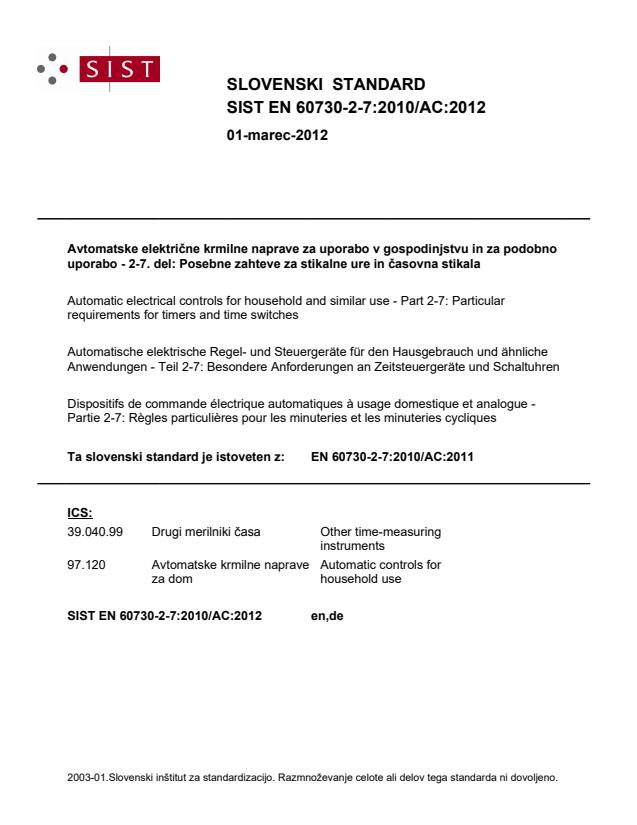
2003-01.Slovenski inštitut za standardizacijo. Razmnoževanje celote ali delov tega standarda ni dovoljeno.LNDODAutomatische elektrische Regel- und Steuergeräte für den Hausgebrauch und ähnliche Anwendungen - Teil 2-7: Besondere Anforderungen an Zeitsteuergeräte und SchaltuhrenDispositifs de commande électrique automatiques à usage domestique et analogue - Partie 2-7: Règles particulières pour les minuteries et les minuteries cycliquesAutomatic electrical controls for household and similar use - Part 2-7: Particular requirements for timers and time switches97.120Avtomatske krmilne naprave za domAutomatic controls for household use39.040.99Other time-measuring instrumentsICS:Ta slovenski standard je istoveten z:EN 60730-2-7:2010/AC:2011SIST EN 60730-2-7:2010/AC:2012en,de01-marec-2012SIST EN 60730-2-7:2010/AC:2012SLOVENSKI
STANDARD
Corrigendum to EN 60730-2-7:2010 English version ___________ Foreword
Replace in the first sentence “EN 60730-2-1” with “EN 60730-2-7”.
Information
Table 7.2
Replace the existing t
...
Questions, Comments and Discussion
Ask us and Technical Secretary will try to provide an answer. You can facilitate discussion about the standard in here.
Loading comments...