

SIST EN 10310:2004
(Main)Steel tubes and fittings for onshore and offshore pipelines - Internal and external polyamide powder based coatings
- Abstract
The purpose of this standard is to define the internal and/or external coatings of polyamide powders applied by dipping in a fluidised bed or by spraying, or by roto-coating. These coatings are intended for protecting the outer and inner surface of steel tubes and their fittings (components) used as pipeline component parts. This standard may be applied for accessories (such as valves, pumps, screens, etc ... ).
This type of coating is used for the protection of buried, submerged or above ground pipelines conveying fluids at working temperatures between 0 °C and + 60 °C. Other working service temperature may be used after agreement between the purchaser and the coater.
The coatings covered by this standard are applicable to longitudinally or spirally welded steel tubes and to seamless steel tubes and their fittings components used for the construction of pipelines conveying liquids.
The internal coating of tubes to be used for the transportation of water intended for human consumption shall not affect the quality of that water to such an extent that it fails to comply with the requirements of the EU and EFTA regulations.
For this purpose, reference shall be made to the relevant national regulations and standards, transposing EN standards when available, dealing with the influence of materials on water quality and to the requirements for coatings.
NOTE An European Acceptance Scheme (EAS) is in course of development in relation to the CPD and the DWD. Its requirements will be introduced in this standard when completed.
- Status
- Published
- Publication Date
- 31-May-2004
- Technical Committee
- IFEK - Ferrous metals
- Current Stage
- 6060 - National Implementation/Publication (Adopted Project)
- Start Date
- 01-Jun-2004
- Due Date
- 01-Jun-2004
- Completion Date
- 01-Jun-2004



SIST EN 10310:2004 is the SIST adoption of EN 10310:2003, published by SIST. It specifies internal and external polyamide powder based coatings for steel tubes, fittings and related accessories used in onshore and offshore pipelines. In practice, it gives purchasers, coaters and coating manufacturers a shared basis for selecting the coating system, preparing the steel, and checking performance.
What does SIST EN 10310:2004 specify?
SIST EN 10310:2004 defines polyamide powder coatings applied by dipping in a fluidised bed, spraying or roto-coating. It covers coatings for the inner and outer surfaces of steel tubes and fittings used as pipeline components, including accessories such as valves, pumps and screens.
The standard applies to buried, submerged and above ground pipelines conveying fluids at working temperatures between 0 °C and + 60 °C, unless the purchaser and coater agree otherwise. For tubes carrying water intended for human consumption, the internal coating must not impair water quality beyond EU and EFTA requirements.
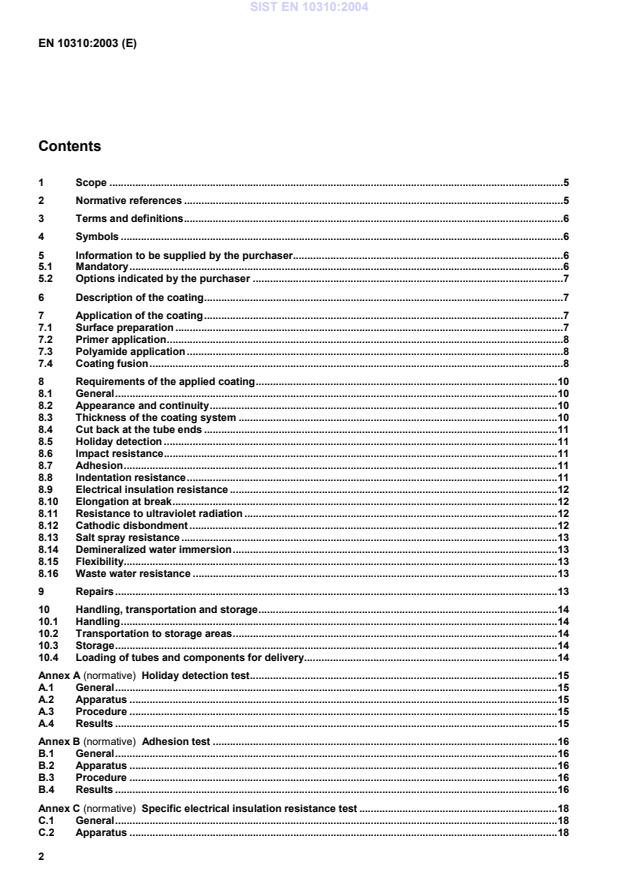
The document is organized into clauses 1 to 10 and normative annexes A to I.
| Annex | What it covers |
|---|---|
| A | Holiday detection test |
| B | Adhesion test |
| C | Specific electrical insulation resistance test |
| D | Resistance to ultraviolet radiation |
| E | Cathodic disbondment test |
| F | Demineralized water immersion test |
| G | Flexibility test |
| H | Waste water resistance test |
| I | Viscosity analysis test |
What are the key requirements of SIST EN 10310:2004?
SIST EN 10310:2004 requires a primer film covered by a fully fused polyamide powder layer. That matters because the document treats the coating as a system, not just a single layer.
Surface preparation and application
Clause 7 requires abrasive blast cleaning to at least Sa 2½, with surface roughness Rz between 40 µm and 90 µm. The steel must be clean, dry and free from contamination, and the surface temperature must be at least 3 °C above the dew point before coating. In practice, this controls adhesion and reduces the risk of trapped moisture.
The primer is applied immediately after preparation, and the polyamide layer is then applied according to established procedures and the coating manufacturer’s recommendations. The coating manufacturer’s data sheet must include the listed product, processing and performance data. This means the coater needs documented application settings before production starts.
Purchaser information and agreed options
Clause 5 requires the purchaser to identify the tubes or components, reference the standard, and state the nature of the fluid being conveyed. The purchaser may also specify cut back length, chemical treatment, marking, maximum repair area and number of repairs, and maximum coating thickness. This is the point where project-specific limits are fixed.
Coating quality and acceptance
Clause 8 requires visual inspection for appearance and continuity, and the coating must be uniform, smooth and free from laminations. Thickness is measured by EN ISO 2808, with a minimum coating system thickness of 200 µm and 150 µm on sharp edges with a radius below 3 mm. In practice, buyers can also specify a maximum thickness where mating tolerances matter.
Performance is checked with holiday detection, impact resistance, adhesion, indentation resistance, and several durability tests. For example, adhesion must be rating 2 or better, and external coatings are also checked for specific electrical insulation resistance, cathodic disbondment, ultraviolet resistance, salt spray resistance, demineralized water immersion, flexibility and waste water resistance. These tests show whether the coating can survive handling and the intended service environment.
What terms does SIST EN 10310:2004 define?
- Coating manufacturer - the supplier of the coating material in a condition ready for application.
- Coater - the company that applies the coating to the tubes or components.
- Purchaser - the company that buys the coated products.
- Rz - the roughness parameter used for the prepared steel surface.
- Rs - the specific electrical insulation resistance, expressed in ohms square metres.
- k - the correction factor used for impact resistance.
- RT - room temperature.
Who uses SIST EN 10310:2004?
SIST EN 10310:2004 is used by pipe makers, fitting manufacturers, coating plants, pipeline purchasers and inspection personnel. It is relevant to onshore and offshore pipeline projects, especially where buried, submerged or above ground steel pipelines carry liquids.
Coaters use it to set up surface preparation, application and repair work. Quality managers and test laboratories use it to verify coating thickness, adhesion, insulation resistance and environmental resistance before shipment or acceptance.
What changed in SIST EN 10310:2004 from the previous edition?
SIST EN 10310:2004 is identified as identical to EN 10310:2003.
Which standards are used with SIST EN 10310:2004?
| Reference | What it contributes |
|---|---|
| EN ISO 60 | Apparent density |
| EN ISO 62 | Water absorption |
| EN ISO 527-3 | Tensile properties for films and sheets |
| EN ISO 868 | Shore hardness |
| prEN ISO 1183-1, prEN ISO 1183-2, EN ISO 1183-3 | Density of non-cellular plastics |
| EN ISO 2808 | Film thickness measurement |
| EN ISO 3146 | Melting behaviour |
| EN ISO 4287 | Surface texture terms and parameters |
| EN ISO 4892-2 | Xenon-arc light exposure |
| EN ISO 6272 | Falling-weight impact |
| EN ISO 7253 | Neutral salt spray |
| EN ISO 8501-1 | Visual assessment of steel cleanliness |
| ISO 3105 | Ubbelohde viscometer specification |
| ISO 6441 | Indentation test |
What does the SIST EN 10310:2004 document contain?
The document gives the coating description, purchaser information items, application guidance and repair rules. It also includes the handling, transportation and storage provisions needed to avoid damage after coating.
Clause 7 includes the product data sheet content in Table 1, and Clause 8 sets out coating properties and acceptance conditions in Table 2 and Table 3. The annexes provide full test methods, including apparatus, procedures and result recording.
Several annexes also define test setups and calculations. Annex C gives the formula for specific electrical insulation resistance, Annex D gives the UV exposure cycle and viscosity change calculation, and Annex I gives the dilute solution viscosity method for polyamide.
Relations
- Effective Date
- 25-Aug-2026
- Effective Date
- 08-Apr-2026
- Refers
SIST EN ISO 9227:2023 - Corrosion tests in artificial atmospheres - Salt spray tests (ISO 9227:2022) - Effective Date
- 28-Jan-2026
- Effective Date
- 28-Jan-2026
- Effective Date
- 28-Jan-2026
- Effective Date
- 28-Jan-2026
- Effective Date
- 28-Jan-2026
- Effective Date
- 28-Jan-2026
- Effective Date
- 28-Jan-2026
- Refers
SIST EN ISO 2808:2019 - Paints and varnishes - Determination of film thickness (ISO 2808:2019) - Effective Date
- 28-Jan-2026
- Effective Date
- 28-Jan-2026
- Effective Date
- 28-Jan-2026
- Effective Date
- 28-Jan-2026
- Effective Date
- 28-Jan-2026
- Effective Date
- 28-Jan-2026
Get Certified
Connect with accredited certification bodies for this standard

DVS-ZERT GmbH
German welding certification society.

Element Materials Technology
Materials testing and product certification.
Inštitut za kovinske materiale in tehnologije
Institute of Metals and Technology. Materials testing, metallurgical analysis, NDT.
Sponsored listings
Frequently Asked Questions
SIST EN 10310:2004 is a standard published by the Slovenian Institute for Standardization (SIST). Its full title is "Steel tubes and fittings for onshore and offshore pipelines - Internal and external polyamide powder based coatings". This standard covers: The purpose of this standard is to define the internal and/or external coatings of polyamide powders applied by dipping in a fluidised bed or by spraying, or by roto-coating. These coatings are intended for protecting the outer and inner surface of steel tubes and their fittings (components) used as pipeline component parts. This standard may be applied for accessories (such as valves, pumps, screens, etc ... ). This type of coating is used for the protection of buried, submerged or above ground pipelines conveying fluids at working temperatures between 0 °C and + 60 °C. Other working service temperature may be used after agreement between the purchaser and the coater. The coatings covered by this standard are applicable to longitudinally or spirally welded steel tubes and to seamless steel tubes and their fittings components used for the construction of pipelines conveying liquids. The internal coating of tubes to be used for the transportation of water intended for human consumption shall not affect the quality of that water to such an extent that it fails to comply with the requirements of the EU and EFTA regulations. For this purpose, reference shall be made to the relevant national regulations and standards, transposing EN standards when available, dealing with the influence of materials on water quality and to the requirements for coatings. NOTE An European Acceptance Scheme (EAS) is in course of development in relation to the CPD and the DWD. Its requirements will be introduced in this standard when completed.
The purpose of this standard is to define the internal and/or external coatings of polyamide powders applied by dipping in a fluidised bed or by spraying, or by roto-coating. These coatings are intended for protecting the outer and inner surface of steel tubes and their fittings (components) used as pipeline component parts. This standard may be applied for accessories (such as valves, pumps, screens, etc ... ). This type of coating is used for the protection of buried, submerged or above ground pipelines conveying fluids at working temperatures between 0 °C and + 60 °C. Other working service temperature may be used after agreement between the purchaser and the coater. The coatings covered by this standard are applicable to longitudinally or spirally welded steel tubes and to seamless steel tubes and their fittings components used for the construction of pipelines conveying liquids. The internal coating of tubes to be used for the transportation of water intended for human consumption shall not affect the quality of that water to such an extent that it fails to comply with the requirements of the EU and EFTA regulations. For this purpose, reference shall be made to the relevant national regulations and standards, transposing EN standards when available, dealing with the influence of materials on water quality and to the requirements for coatings. NOTE An European Acceptance Scheme (EAS) is in course of development in relation to the CPD and the DWD. Its requirements will be introduced in this standard when completed.
SIST EN 10310:2004 is classified under the following ICS (International Classification for Standards) categories: 25.220.60 - Organic coatings; 77.140.75 - Steel pipes and tubes for specific use. The ICS classification helps identify the subject area and facilitates finding related standards.
SIST EN 10310:2004 has the following relationships with other standards: It is inter standard links to SIST ISO 3105:1995, SIST EN ISO 1183-2:2026, SIST EN ISO 9227:2023, SIST EN ISO 4892-2:2013, SIST EN ISO 1183-1:2025, SIST EN ISO 60:2023, SIST EN 13375:2005, SIST EN ISO 1183-2:2019, SIST EN ISO 868:2003, SIST EN ISO 2808:2019, SIST EN ISO 1183-3:2000, SIST EN ISO 21920-2:2022, SIST EN ISO 62:2009, SIST EN ISO 8501-1:2007, SIST EN ISO 3146:2022. Understanding these relationships helps ensure you are using the most current and applicable version of the standard.
SIST EN 10310:2004 is available in PDF format for immediate download after purchase. The document can be added to your cart and obtained through the secure checkout process. Digital delivery ensures instant access to the complete standard document.
Standards Content (Sample)
2003-01.Slovenski inštitut za standardizacijo. Razmnoževanje celote ali delov tega standarda ni dovoljeno.Steel tubes and fittings for onshore and offshore pipelines - Internal and external polyamide powder based coatingsStahlrohre und -formstücke für erd- und wasserverlegte Rohrleitungen - Auskleidungen und Beschichtungen aus Polyamid-PulverTubes et raccords en acier pour canalisations enterrées et immergées - Revetements internes et externes a base de poudre polyamideSteel tubes and fittings for onshore and offshore pipelines - Internal and external polyamide powder based coatings77.140.75Jeklene cevi in cevni profili za posebne nameneSteel pipes and tubes for specific use25.220.60Organske prevlekeOrganic coatingsICS:Ta slovenski standard je istoveten z:EN 10310:2003SIST EN 10310:2004en01-junij-2004SIST EN 10310:2004SLOVENSKI
STANDARD
EUROPEAN STANDARDNORME EUROPÉENNEEUROPÄISCHE NORMEN 10310December 2003ICS 23.040.99; 25.220.60English versionSteel tubes and fittings for onshore and offshore pipelines -Internal and external polyamide powder based coatingsTubes en acier et raccords pour canalisations enterrées etimmergées - Revêtements internes et externes à base depoudre polyamideStahlrohre und -formstücke für erd- und wasserverlegteRohrleitungen - Auskleidungen und Beschichtungen ausPolyamid-PulverThis European Standard was approved by CEN on 20 February 2003.CEN members are bound to comply with the CEN/CENELEC Internal Regulations which stipulate the conditions for giving this EuropeanStandard the status of a national standard without any alteration. Up-to-date lists and bibliographical references concerning such nationalstandards may be obtained on application to the Management Centre or to any CEN member.This European Standard exists in three official versions (English, French, German). A version in any other language made by translationunder the responsibility of a CEN member into its own language and notified to the Management Centre has the same status as the officialversions.CEN members are the national standards bodies of Austria, Belgium, Czech Republic, Denmark, Finland, France, Germany, Greece,Hungary, Iceland, Ireland, Italy, Luxembourg, Malta, Netherlands, Norway, Portugal, Slovakia, Spain, Sweden, Switzerland and UnitedKingdom.EUROPEAN COMMITTEE FOR STANDARDIZATIONCOMITÉ EUROPÉEN DE NORMALISATIONEUROPÄISCHES KOMITEE FÜR NORMUNGManagement Centre: rue de Stassart, 36
B-1050 Brussels© 2003 CENAll rights of exploitation in any form and by any means reservedworldwide for CEN national Members.Ref. No. EN 10310:2003 ESIST EN 10310:2004
Holiday detection test.15A.1General.15A.2Apparatus.15A.3Procedure.15A.4Results.15Annex B (normative)
Adhesion test.16B.1General.16B.2Apparatus.16B.3Procedure.16B.4Results.16Annex C (normative)
Specific electrical insulation resistance test.18C.1General.18C.2Apparatus.18SIST EN 10310:2004
Resistance to ultraviolet radiation.21D.1General.21D.2Apparatus.21D.3Procedure.21D.4Results.21Annex E (normative)
Cathodic disbondment test.23E.1General.23E.2Apparatus.23E.3Sampling.24E.4Procedure.24E.5Results.25Annex F (normative)
Demineralized water immersion test.29F.1General.29F.2Apparatus.29F.3Procedure.29F.4Results.29Annex G (normative)
Flexibility test.30G.1General.30G.2Apparatus.30G.3Procedure.31Annex H (normative)
Waste water resistance test.32H.1General.32H.2Apparatus.32H.3Procedure.32H.4Results.33Annex I (normative)
Viscosity analysis test.34I.1General.34I.2Equipment.34I.3Procedure.34I.4Results.35SIST EN 10310:2004
1)To be published.SIST EN 10310:2004
...