

oSIST prEN 15189:2026
(Main)Ductile iron pipes, fittings and accessories - External polyurethane coating for pipes - Requirements and test methods
General Information
- Abstract
This document specifies the requirements and test methods applicable to factory applied external polyurethane based coatings for heavy duty (see EN 545:2010, Clause D.3) corrosion protection of buried ductile iron pipes in accordance with EN 545, EN 598 and EN 969 for use at operating temperatures up to 50 °C.
This document is not applicable to ductile iron pipes protected with zinc with a finishing layer of polyurethane.
This document is not applicable to special activities on site such as tapping, clamping, etc., which could affect the corrosion protection properties of the polyurethane coating.
NOTE These operations are usually specified in the laying instructions supplied by manufacturers of clamps, house connection saddles, etc. and any relevant user procedures.
- Status
- Not Published
- Public Enquiry End Date
- 01-May-2026
- Technical Committee
- TLP - Pressure vessels
- Current Stage
- 4020 - Public enquire (PE) (Adopted Project)
- Start Date
- 04-Mar-2026
- Due Date
- 22-Jul-2026
- Completion Date
- 29-May-2026

Overview
oSIST prEN 15189:2026: Ductile Iron Pipes, Fittings, and Accessories - External Polyurethane Coating for Pipes - Requirements and Test Methods is a draft European Standard developed by CEN. This technical standard specifies the requirements and testing methods for factory-applied external polyurethane-based coatings designed for heavy-duty corrosion protection on buried ductile iron pipes, in accordance with standards EN 545, EN 598, and EN 969, for use at service temperatures up to 50°C.
Polyurethane coatings provide an effective barrier against corrosion in challenging environments, such as for pipelines used in water, wastewater, and gas distribution systems. The document succeeds EN 15189:2006, updating key technical requirements and introducing new guidance on glass transition temperature and compatibility with potable water systems.
Key Topics
Scope and Applicability
- Applies to ductile iron pipes, fittings, and accessories with factory-applied external polyurethane coatings
- Focused on heavy-duty corrosion protection for buried pipelines
- Not applicable to pipes with zinc and polyurethane finishing layers or on-site activities that may affect coating performance
Technical Requirements
- Surface preparation standards to ensure optimal coating adhesion and performance
- Specifications for the appearance, minimum thickness (≥700 µm), uniformity, and continuity of the polyurethane coating
- Requirements for non-porosity, hardness (e.g., typical 70 Shore D), and minimum adhesion (≥8 MPa)
- Chemical resistance to water and diluted sulphuric acid, evaluated over long-term immersion
- Mechanical performance criteria including impact strength, indentation resistance, and elongation at break
Test Methods
- Factory routine testing and periodic performance testing for coating quality control
- Methods for measuring properties such as thickness, adhesion, hardness, and electrical resistance
- Requirement for differential scanning calorimetry (DSC) to assess glass transition temperature
Marking and Identification
- Durable and legible marking of coatings in accordance with relevant pipe standards
Applications
The requirements and test methods outlined in oSIST prEN 15189:2026 are critical for:
Water Supply and Distribution
- Ensures ductile iron pipes used in drinking water networks resist corrosion and maintain water quality
- Addresses the requirements for contact with water intended for human consumption
Sewage and Wastewater Pipelines
- Offers reliable protection in environments with aggressive soils and corrosive media, prolonging asset life
Gas Pipeline Infrastructure
- Provides external barrier protection for ductile iron pipes transporting gaseous media
Buried Pipeline Systems
- Guards against corrosion from soil and external contaminants, ensuring ongoing system integrity
By adhering to this standard, manufacturers, utilities, and infrastructure operators can improve the durability, safety, and compliance of their piping systems.
Related Standards
- EN 545: Ductile iron pipes, fittings, accessories and their joints for water pipelines - Requirements and test methods
- EN 598: Ductile iron pipes, fittings, accessories, and their joints for sewerage applications
- EN 969: Ductile iron pipes, fittings, accessories, and their joints for gas pipelines
- EN 14901-1: Organic coatings of ductile iron fittings and accessories - Epoxy coating
- EN ISO 62: Plastics - Determination of water absorption
- EN ISO 868: Determination of indentation hardness (Shore hardness)
- EN ISO 4624: Paints and varnishes - Pull-off test for adhesion
- EN ISO 8501-1: Visual assessment of surface cleanliness
Implementation of oSIST prEN 15189:2026 builds on these harmonized European and international standards to ensure a consistent, high-quality approach in factory-applied polyurethane coatings for ductile iron pipeline components, optimizing performance and reliability for critical infrastructure.
Relations
- Effective Date
- 01-Apr-2026
Get Certified
Connect with accredited certification bodies for this standard

DVS-ZERT GmbH
German welding certification society.

Element Materials Technology
Materials testing and product certification.
Inštitut za kovinske materiale in tehnologije
Institute of Metals and Technology. Materials testing, metallurgical analysis, NDT.
Sponsored listings
Frequently Asked Questions
oSIST prEN 15189:2026 is a draft published by the Slovenian Institute for Standardization (SIST). Its full title is "Ductile iron pipes, fittings and accessories - External polyurethane coating for pipes - Requirements and test methods". This standard covers: This document specifies the requirements and test methods applicable to factory applied external polyurethane based coatings for heavy duty (see EN 545:2010, Clause D.3) corrosion protection of buried ductile iron pipes in accordance with EN 545, EN 598 and EN 969 for use at operating temperatures up to 50 °C. This document is not applicable to ductile iron pipes protected with zinc with a finishing layer of polyurethane. This document is not applicable to special activities on site such as tapping, clamping, etc., which could affect the corrosion protection properties of the polyurethane coating. NOTE These operations are usually specified in the laying instructions supplied by manufacturers of clamps, house connection saddles, etc. and any relevant user procedures.
This document specifies the requirements and test methods applicable to factory applied external polyurethane based coatings for heavy duty (see EN 545:2010, Clause D.3) corrosion protection of buried ductile iron pipes in accordance with EN 545, EN 598 and EN 969 for use at operating temperatures up to 50 °C. This document is not applicable to ductile iron pipes protected with zinc with a finishing layer of polyurethane. This document is not applicable to special activities on site such as tapping, clamping, etc., which could affect the corrosion protection properties of the polyurethane coating. NOTE These operations are usually specified in the laying instructions supplied by manufacturers of clamps, house connection saddles, etc. and any relevant user procedures.
oSIST prEN 15189:2026 is classified under the following ICS (International Classification for Standards) categories: 23.040.01 - Pipeline components and pipelines in general; 25.220.60 - Organic coatings; 77.140.75 - Steel pipes and tubes for specific use. The ICS classification helps identify the subject area and facilitates finding related standards.
oSIST prEN 15189:2026 has the following relationships with other standards: It is inter standard links to SIST EN 15189:2007. Understanding these relationships helps ensure you are using the most current and applicable version of the standard.
oSIST prEN 15189:2026 is available in PDF format for immediate download after purchase. The document can be added to your cart and obtained through the secure checkout process. Digital delivery ensures instant access to the complete standard document.
Standards Content (Sample)
SLOVENSKI STANDARD
01-april-2026
Cevi, fitingi in pribor iz duktilne železove litine - Poliuretanska zunanja prevleka
cevi - Zahteve in preskusne metode
Ductile iron pipes, fittings and accessories - External polyurethane coating for pipes -
Requirements and test methods
Rohre, Formstücke und Zubehör aus duktilem Gusseisen - Polyurethanumhüllung von
Rohren - Anforderungen und Prüfverfahren
Tuyaux, raccords et accessoires en fonte ductile - Revêtement extérieur en polyuréthane
des tuyaux - Exigences et méthodes d’essais
Ta slovenski standard je istoveten z: prEN 15189
ICS:
23.040.01 Deli cevovodov in cevovodi Pipeline components and
na splošno pipelines in general
25.220.60 Organske prevleke Organic coatings
77.140.75 Jeklene cevi in cevni profili Steel pipes and tubes for
za posebne namene specific use
2003-01.Slovenski inštitut za standardizacijo. Razmnoževanje celote ali delov tega standarda ni dovoljeno.
DRAFT
EUROPEAN STANDARD
NORME EUROPÉENNE
EUROPÄISCHE NORM
February 2026
ICS 25.220.60 Will supersede EN 15189:2006
English Version
Ductile iron pipes, fittings and accessories - External
polyurethane coating for pipes - Requirements and test
methods
Tuyaux, raccords et accessoires en fonte ductile - Rohre, Formstücke und Zubehör aus duktilem
Revêtement extérieur en polyuréthane des tuyaux - Gusseisen - Polyurethanumhüllung von Rohren -
Exigences et méthodes d'essais Anforderungen und Prüfverfahren
This draft European Standard is submitted to CEN members for enquiry. It has been drawn up by the Technical Committee
CEN/TC 203.
If this draft becomes a European Standard, CEN members are bound to comply with the CEN/CENELEC Internal Regulations
which stipulate the conditions for giving this European Standard the status of a national standard without any alteration.
This draft European Standard was established by CEN in three official versions (English, French, German). A version in any other
language made by translation under the responsibility of a CEN member into its own language and notified to the CEN-CENELEC
Management Centre has the same status as the official versions.
CEN members are the national standards bodies of Austria, Belgium, Bulgaria, Croatia, Cyprus, Czech Republic, Denmark, Estonia,
Finland, France, Germany, Greece, Hungary, Iceland, Ireland, Italy, Latvia, Lithuania, Luxembourg, Malta, Netherlands, Norway,
Poland, Portugal, Republic of North Macedonia, Romania, Serbia, Slovakia, Slovenia, Spain, Sweden, Switzerland, Türkiye and
United Kingdom.
Recipients of this draft are invited to submit, with their comments, notification of any relevant patent rights of which they are
aware and to provide supporting documentation.
Warning : This document is not a European Standard. It is distributed for review and comments. It is subject to change without
notice and shall not be referred to as a European Standard.
EUROPEAN COMMITTEE FOR STANDARDIZATION
COMITÉ EUROPÉEN DE NORMALISATION
EUROPÄISCHES KOMITEE FÜR NORMUNG
CEN-CENELEC Management Centre: Rue de la Science 23, B-1040 Brussels
© 2026 CEN All rights of exploitation in any form and by any means reserved Ref. No. prEN 15189:2026 E
worldwide for CEN national Members.
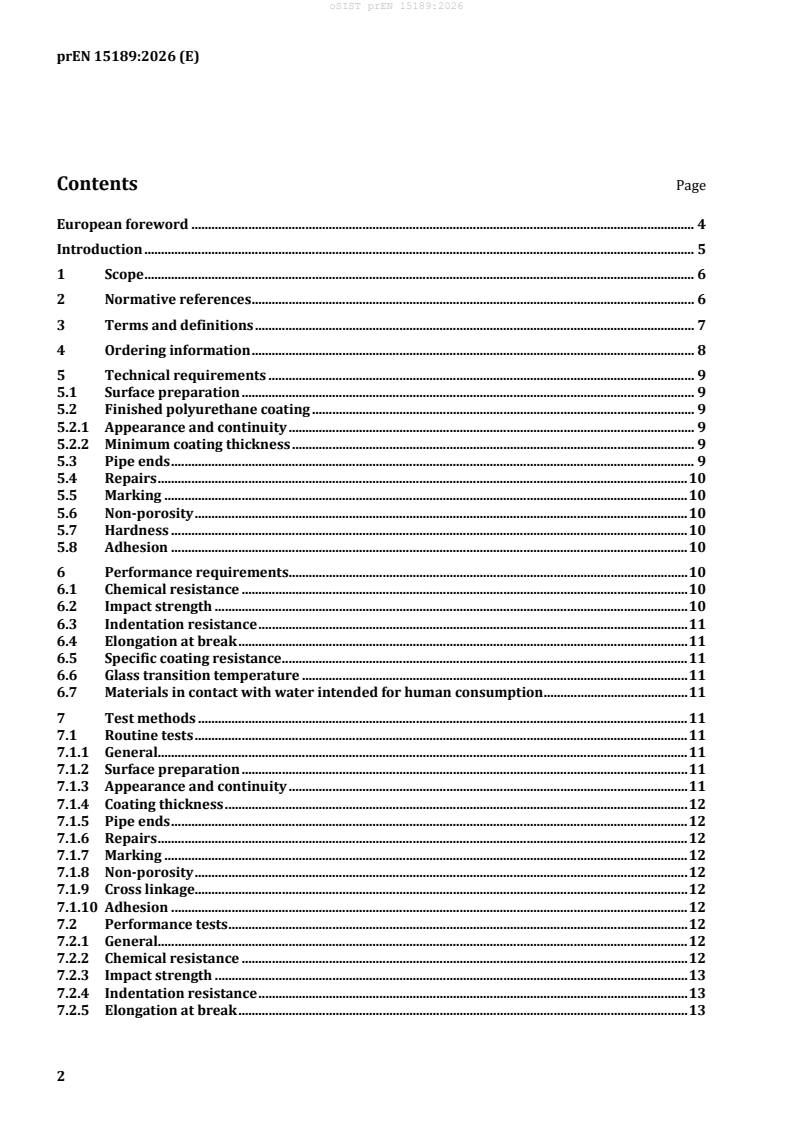
Contents Page
European foreword . 4
Introduction . 5
1 Scope . 6
2 Normative references . 6
3 Terms and definitions . 7
4 Ordering information . 8
5 Technical requirements . 9
5.1 Surface preparation . 9
5.2 Finished polyurethane coating . 9
5.2.1 Appearance and continuity . 9
5.2.2 Minimum coating thickness . 9
5.3 Pipe ends . 9
5.4 Repairs . 10
5.5 Marking . 10
5.6 Non-porosity . 10
5.7 Hardness . 10
5.8 Adhesion . 10
6 Performance requirements . 10
6.1 Chemical resistance . 10
6.2 Impact strength . 10
6.3 Indentation resistance . 11
6.4 Elongation at break . 11
6.5 Specific coating resistance . 11
6.6 Glass transition temperature . 11
6.7 Materials in contact with water intended for human consumption . 11
7 Test methods . 11
7.1 Routine tests . 11
7.1.1 General. 11
7.1.2 Surface preparation . 11
7.1.3 Appearance and continuity . 11
7.1.4 Coating thickness . 12
7.1.5 Pipe ends . 12
7.1.6 Repairs . 12
7.1.7 Marking . 12
7.1.8 Non-porosity . 12
7.1.9 Cross linkage. 12
7.1.10 Adhesion . 12
7.2 Performance tests . 12
7.2.1 General. 12
7.2.2 Chemical resistance . 12
7.2.3 Impact strength . 13
7.2.4 Indentation resistance . 13
7.2.5 Elongation at break . 13
7.2.6 Specific coating resistance . 13
7.2.7 Differential scanning calorimetry (DSC) test . 14
Annex A (informative) Quality assurance . 15
Annex B (informative) Coating application process . 18
Annex C (informative) Packaging . 19
Bibliography . 20
European foreword
This document (prEN 15189:2026) has been prepared by Technical Committee CEN/TC 203 “Cast iron
pipes, fittings and their joints”, the secretariat of which is held by AFNOR.
This document is currently submitted to the CEN Enquiry.
This document will supersede EN 15189:2006.
This document includes the following significant technical changes with respect to EN 15189:2006:
— 5.3 Bituminous paint on pipe ends deleted and replaced by synthetic resin paint;
— 6.6 Introduction of glass transition temperature measured by differential scanning calorimetry as
determination of the cross linkage of the polymer and calibration of the routine hardness test;
— 6.7 Introduction of materials in contact with water intended for human consumption.
Introduction
This document is in accordance with the general requirements already established by CEN/TC 164 in the
field of water supply (e.g. potable water) and CEN/TC 165 in the field of waste water.
In respect of potential adverse effects on the quality of water intended for human consumption caused
by the product covered by this document:
a) this document provides no information as to whether the product may be used without restriction in
any of the member states of the EU or EFTA;
b) it should be noted that, while awaiting the adoption of verifiable European criteria, existing national
regulations concerning the use and/or the characteristics of this product remain in force.
1 Scope
This document specifies the requirements and test methods applicable to factory applied external
polyurethane based coatings for heavy duty (see EN 545:2010, Clause D.3) corrosion protection of buried
ductile iron pipes in accordance with EN 545, EN 598 and EN 969 for use at operating temperatures up
to 50 °C.
This document is not applicable to ductile iron pipes protected with zinc with a finishing layer of
polyurethane.
This document is not applicable to special activities on site such as tapping, clamping, etc., which could
affect the corrosion protection properties of the polyurethane coating.
NOTE These operations are usually specified in the laying instructions supplied by manufacturers of clamps,
house connection saddles, etc. and any relevant user procedures.
2 Normative references
The following documents are referred to in the text in such a way that some or all of their content
constitutes requirements of this document. For dated references, only the edition cited applies. For
undated references, the latest edition of the referenced document (including any amendments) applies.
EN 545:2010, Ductile iron pipes, fittings, accessories and their joints for water pipelines — Requirements
and test methods
EN 598, Ductile iron pipes, fittings, accessories and their joints for sewerage application — Requirements
and test methods
EN 969, Ductile iron pipes, fittings, accessories and their joints for gas pipelines — Requirements and test
methods
EN 14901-1, Ductile iron pipes, fittings and accessories — Requirements and test methods for organic
coatings of ductile iron fittings and accessories — Part 1: Epoxy coating (heavy duty)
EN ISO 62, Plastics — Determination of water absorption (ISO 62)
EN ISO 527-3, Plastics — Determination of tensile properties — Part 3: Test conditions for films and sheets
(ISO 527-3)
EN ISO 868, Plastics and ebonite — Determination of indentation hardness by means of a durometer (Shore
hardness) (ISO 868)
EN ISO 4624, Paints and varnishes — Pull-off test for adhesion (ISO 4624)
EN ISO 8501-1, Preparation of steel substrates before application of paints and related products — Visual
assessment of surface cleanliness — Part 1: Rust grades and preparation grades of uncoated steel substrates
and of steel substrates after overall removal of previous coatings (ISO 8501-1)
EN ISO 11357-2, Plastics — Differential scanning calorimetry (DSC) — Part 2: Determination of glass
transition temperature and step height (ISO 11357-2)
3 Terms and definitions
For the purposes of this document, the following terms and definitions apply.
ISO and IEC maintain terminology databases for use in standardization at the following addresses:
— ISO Online browsing platform: available at https://www.iso.org/obp/
— IEC Electropedia: available at https://www.electropedia.org/
3.1
ductile iron
cast iron used for pipes, fittings and accessories in which graphite is present; substantially in spheroidal
form
3.2
adhesion
force per unit area, applied perpendicularly to the surface, which is necessary to separate the coating
from its substrate
3.3
impact strength
impact energy which a coating can withstand without damage under defined test conditions
3.4
hardness
resistance of the coating to penetration of a ball under defined test conditions
3.5
non-porosity
absence of gaps in a high voltage test under defined test conditions
3.6
polyurethane coating
factory applied coating which consists of polyurethane, polyurea and their mixtures on the outside of the
pipe barrel and external socket
Note 1 to entry: Pipe ends such as the spigot end, the socket face, the socket entrance and gasket seat may be coated
differently (see 5.3 and Figure 1)
Key
1 gasket seat
2 socket entrance
3 socket face
4 external socket
5 pipe barrel
6 spigot end
Figure 1 — Location of the defined pipe areas
3.7
specific coating resistance
R
s
surface related electric resistance of the coating perpendicular to the pipe wall
3.8
performance test
test which is done once and is repeated according to a schedule or after a relevant change of coating
material and/or coating supplier or change in process application
3.9
routine test
test carried out to control the manufacturing process with a frequency defined by the manufacturer
3.10
test specimen
free films of coating prepared from the same coating material with the same mixing ratio approx. 1 mm
in thickness, produced and cured in a similar way to the pipe coating
4 Ordering information
Ductile iron pipes according to EN 545, EN 598 or EN 969, but externally coated in accordance with this
document, shall be specified in the purchaser enquiry and order by reference to this document.
EXAMPLE
— 5 000 m of ductile iron pipe DN 300 according to EN 545;
— external polyurethane coating according to EN 15189.
The type of coating to be used for pipe ends shall be as agreed at the time of order (see 5.3).
5 Technical requirements
5.1 Surface preparation
Prior to application of the polyurethane coating, the surface of the pipes shall be technically clean, free of
rust, loose constituent materials, dirt, oil, grease and moisture.
NOTE 1 For guidance on the coating application process, see Annex B.
NOTE 2 For recommendations on packaging to avoid damage to the coating, see Annex C.
In cold weather, or anytime when moisture tends to condense on the surface of the pipe, the pipe shall be
uniformly warmed for a sufficient time to dry the pipe prior to cleaning. The pipe temperature shall be
maintained at least 5 °C above the dew point.
Surface preparation shall be designed in order to reach the required performances specified in this
document.
NOTE 3 It is normally the responsibility of the manufacturer to demonstrate the fitness for purpose of surface
preparation technology and to put in place a quality control procedure to ensure the stability of those performances
(see 7.1.2).
5.2 Finished polyurethane coating
5.2.1 Appearance and continuity
The polyurethane coating shall be:
— uniform in colour, except the spigot and the socket which may be of a different colour for permitted
marking;
— uniform appearance and smoothness except for admissible repairs;
— free of visible defects (pinholes, bubbles, blisters, wrinkles, cracks or voids).
Slight superficial variations of colour or brilliance, due to repairs or prolonged exposure to sunlight or
contact with other pipes are permissible.
5.2.2 Minimum coating thickness
When measured in accordance with 7.1.3, the minimum coating thickness (x − 2σ) shall be 700 µm.
5.3 Pipe ends
Spigot end, socket face, socket entrance and gasket seat shall be coated with one of the following:
a) epoxy coating in accordance with EN 14901-1;
b) polyurethane in accordance with this document except gasket seat, socket face and socket entrance
with a minimum coating thickness of 100 µm;
c) synthetic resin paint; in this case these designated zones shall be protected after laying using
appropriate measures, e.g. heat shrinkable sleeves, which are not within the scope of this document.
When the spigot end and socket entrance are coated with polyurethane or epoxy, the corresponding
diameters shall be such that the joint can be assembled.
oSIST pr
...