

SIST EN 10289:2003
(Main)Steel tubes and fittings for onshore and offshore pipelines - External liquid applied epoxy and epoxy-modified coatings
- Abstract
The standard defines the reqiurements of liquid applied external coating, epoxy (EP) and epoxy-modified (EP-MOD), for the corrosion protection of tubes and pipeline fittings.
The coating in this standard can be applied to longitudinally or spirally welded and to seamless steel tubes and fittings used for the construction of pipelines for conveying liquids or gases.
If the component has to be cold bent the coating shall be applied after bending unless otherwise approved by the purchaser.
The coating shall consist normally of one layer of liquid product, applied by brush or by spray airless technique. Other application methods can be recommended by the product manufacturer, in accordance with the kind of product.
This coating can be used for the protection of buried or submerged steel tubes for service at the following temperatures and with three thickness classes A (400 *m), B (800 *m) and C(1500 *m) based on the following combination:
- type 1 : - 20 °C to 40 °C, thickness class A or B or C
- type 2 : - 20 °C to 60 °C, thickness class B or C
- type 3 : - 20 °C to 80 °C, thickness class C
Other temperatures can be agreed ; in this case, tests shall be carried out at the required temperature.
In this standard the word components is used for tubes and fittings.
Frequencies of tests on fittings shall be agreed by the parties at the ordering stage.
Components coated with these types of coatings may be further protected by means of cathodic protection.
- Status
- Published
- Publication Date
- 31-Mar-2003
- Technical Committee
- IFEK - Ferrous metals
- Current Stage
- 6060 - National Implementation/Publication (Adopted Project)
- Start Date
- 01-Apr-2003
- Due Date
- 01-Apr-2003
- Completion Date
- 01-Apr-2003



SIST EN 10289:2003 is the Slovenian adoption of EN 10289:2002 from SIST. It covers external liquid-applied epoxy (EP) and epoxy-modified (EP-MOD) coatings for steel tubes and fittings used in onshore and offshore pipelines, and it specifies how those coatings are prepared, applied, inspected and tested.
What does SIST EN 10289:2003 specify?
SIST EN 10289:2003 specifies requirements for external liquid-applied coatings used for corrosion protection of steel tubes and pipeline fittings. In the document, the word components is used for tubes and fittings, and the coating is intended for pipelines conveying liquids or gases.
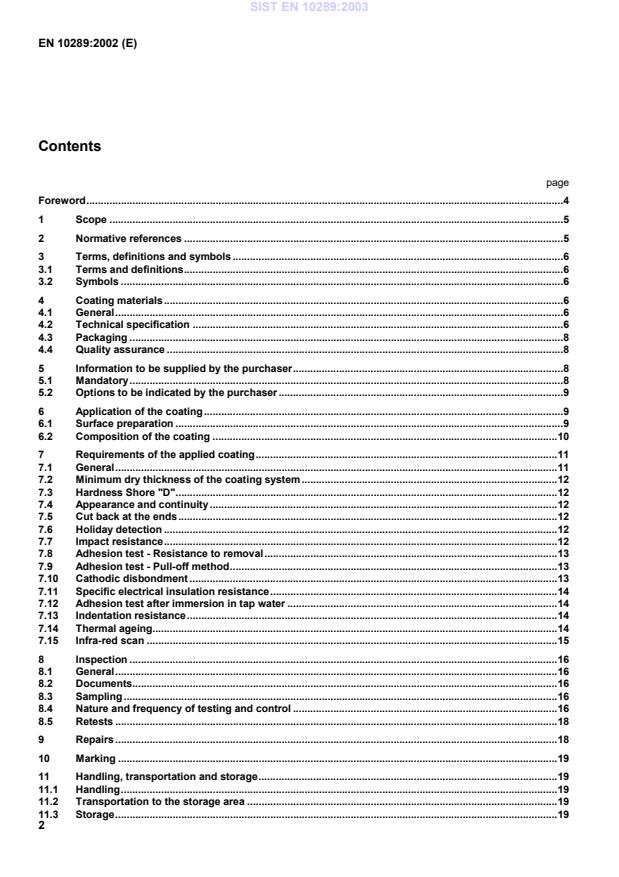
The standard is organized into clauses 1 to 11 and annexes A to L. Clauses cover scope, references, terms, coating materials, purchaser information, application, required properties, inspection, repairs, marking, and handling, transportation and storage.
| Annex | What it covers |
|---|---|
| A | Dry thickness of the coating system |
| B | Holiday detection test |
| C | Impact test |
| D | Adhesion test - Resistance to removal |
| E | Cathodic disbondment test |
| F | Specific electrical insulation resistance test |
| G | Adhesion test after immersion in tap water |
| H | Indentation test |
| J | Thermal ageing |
| K | Types of inspection documents |
| L | A-deviation |
What are the key requirements of SIST EN 10289:2003?
The standard sets out the coating system, the surface condition before coating, the test properties that must be checked, and the documentation and repair rules that support acceptance.
Coating type, service range and thickness class
SIST EN 10289:2003 defines three service-temperature types and three thickness classes. Type 1 applies to -20 °C to 40 °C with class A, B or C; Type 2 applies to -20 °C to 60 °C with class B or C; Type 3 applies to -20 °C to 80 °C with class C. In practice, the buyer selects the coating class to match the operating temperature of the pipeline.
Class A, B and C correspond to minimum dry thickness levels of 400 µm, 800 µm and 1 500 µm. That matters because thickness is tied to mechanical protection and corrosion performance.
Surface preparation and application
Before coating, the steel shall be dry, free from contamination and free from surface defects that would harm adhesion. Components shall be abrasive blast cleaned to Sa 2 1/2, with surface roughness Rz between 50 µm and 90 µm, and kept at least 3 °C above the dew point. In practice, this controls adhesion and reduces the risk of trapped moisture.
The coating is normally one layer of liquid product, applied by brush or airless spray, although the product manufacturer may recommend other methods. If cold bending is needed, the coating is applied after bending unless the purchaser approves otherwise.
Mixing, curing and field conditions
The coating is a two-pack system made from a base and a curing agent. They are supplied separately, mixed in the manufacturer’s proportions, and used within the stated pot-life. No thinner may be used unless the product manufacturer recommends it.
Field application is restricted by weather: coating shall not be applied in rain, fog or mist, on wet surfaces, or when the metal is too close to the dew point, too cold, or in very humid air. This means site control and recording of temperature and humidity are part of normal application practice.
Required coating performance
SIST EN 10289:2003 requires checks for dry thickness, Shore D hardness, appearance and continuity, holiday detection, impact resistance, adhesion, cathodic disbondment, specific electrical insulation resistance, indentation resistance and thermal ageing. Some tests are mandatory acceptance checks, while others are reported for information or agreed at ordering stage.
The practical point is that the finished coating is not accepted on appearance alone - it must also pass electrical, mechanical and adhesion tests that reflect burial or immersion service.
Inspection, repair and acceptance
Inspection is linked to the moment when the coating reaches the manufacturer’s recommended hardness. The purchaser may witness inspection, and the standard gives inspection-document options in annex K. Sampling, retests and acceptance of nonconforming results are defined so the parties know how to react to a failed test.
Defects found by holiday detection and areas affected by destructive tests shall be repaired with compatible materials suited to the service conditions, then rechecked by holiday detection. That keeps repaired areas under the same control as the original coating.
What terms does SIST EN 10289:2003 define?
- Product manufacturer - the supplier of the two-pack coating materials ready for application.
- Coater - the party responsible for applying the coating to the components.
- Purchaser - the company buying the coated products.
- Components - the document’s term for tubes and fittings.
- EP - epoxy.
- EP-MOD - epoxy-modified.
- Rz - the roughness parameter, based on five successive evaluation areas.
- Rs - specific electrical insulation resistance of the coating.
Who uses SIST EN 10289:2003?
This standard is used by tube and fitting manufacturers, coating applicators, pipeline project buyers, inspection bodies and quality staff. They use it to specify coating class and service temperature, prepare the steel surface, control application conditions, perform acceptance tests, document results, and decide whether coated components can be delivered or need repair.
It is relevant to onshore and offshore pipeline work, especially where steel tubes or fittings will be buried or submerged and may also be supplemented by cathodic protection.
What changed in SIST EN 10289:2003 from the previous edition?
SIST EN 10289:2003 is the Slovenian standard identical to EN 10289:2002.
Which standards are used with SIST EN 10289:2003?
- EN 10021 - general technical delivery requirements and purchaser witnessing of inspection.
- EN 24624 - pull-off adhesion test.
- EN ISO 868 - Shore D hardness test.
- EN ISO 2808 - wet film thickness measurement.
- EN ISO 8501-1 - visual assessment of steel surface cleanliness before coating.
- ISO 2815 - Buchholz indentation test, named in the national A-deviation.
- ISO 4287-1 - surface roughness terminology used for Rz.
What does the SIST EN 10289:2003 document contain?
The document contains material data-sheet requirements, purchaser ordering information, application rules, performance requirements, inspection rules, repair requirements, marking rules, and handling, transportation and storage instructions. It also includes detailed test methods in annexes A to J, with figures for the test cells and procedures in annexes E and F.
Tables 1 to 5 organize coating data, required properties, resistance values, inspection frequency and document types. Annex D includes a rating system for adhesion, annex F includes the resistance calculation and regression check, and annex K lists the inspection certificate types used for delivery and control.
Relations
- Effective Date
- 28-Jan-2026
- Effective Date
- 28-Jan-2026
- Effective Date
- 28-Jan-2026
- Refers
SIST EN ISO 2808:2019 - Paints and varnishes - Determination of film thickness (ISO 2808:2019) - Effective Date
- 28-Jan-2026
- Effective Date
- 28-Jan-2026
- Effective Date
- 28-Jan-2026
- Effective Date
- 28-Jan-2026
- Effective Date
- 28-Jan-2026
- Effective Date
- 28-Jan-2026
- Effective Date
- 28-Jan-2026
- Effective Date
- 28-Jan-2026
- Effective Date
- 28-Jan-2026
- Effective Date
- 22-Dec-2008
Get Certified
Connect with accredited certification bodies for this standard

DVS-ZERT GmbH
German welding certification society.

Element Materials Technology
Materials testing and product certification.
Inštitut za kovinske materiale in tehnologije
Institute of Metals and Technology. Materials testing, metallurgical analysis, NDT.
Sponsored listings
Frequently Asked Questions
SIST EN 10289:2003 is a standard published by the Slovenian Institute for Standardization (SIST). Its full title is "Steel tubes and fittings for onshore and offshore pipelines - External liquid applied epoxy and epoxy-modified coatings". This standard covers: The standard defines the reqiurements of liquid applied external coating, epoxy (EP) and epoxy-modified (EP-MOD), for the corrosion protection of tubes and pipeline fittings. The coating in this standard can be applied to longitudinally or spirally welded and to seamless steel tubes and fittings used for the construction of pipelines for conveying liquids or gases. If the component has to be cold bent the coating shall be applied after bending unless otherwise approved by the purchaser. The coating shall consist normally of one layer of liquid product, applied by brush or by spray airless technique. Other application methods can be recommended by the product manufacturer, in accordance with the kind of product. This coating can be used for the protection of buried or submerged steel tubes for service at the following temperatures and with three thickness classes A (400 *m), B (800 *m) and C(1500 *m) based on the following combination: - type 1 : - 20 °C to 40 °C, thickness class A or B or C - type 2 : - 20 °C to 60 °C, thickness class B or C - type 3 : - 20 °C to 80 °C, thickness class C Other temperatures can be agreed ; in this case, tests shall be carried out at the required temperature. In this standard the word components is used for tubes and fittings. Frequencies of tests on fittings shall be agreed by the parties at the ordering stage. Components coated with these types of coatings may be further protected by means of cathodic protection.
The standard defines the reqiurements of liquid applied external coating, epoxy (EP) and epoxy-modified (EP-MOD), for the corrosion protection of tubes and pipeline fittings. The coating in this standard can be applied to longitudinally or spirally welded and to seamless steel tubes and fittings used for the construction of pipelines for conveying liquids or gases. If the component has to be cold bent the coating shall be applied after bending unless otherwise approved by the purchaser. The coating shall consist normally of one layer of liquid product, applied by brush or by spray airless technique. Other application methods can be recommended by the product manufacturer, in accordance with the kind of product. This coating can be used for the protection of buried or submerged steel tubes for service at the following temperatures and with three thickness classes A (400 *m), B (800 *m) and C(1500 *m) based on the following combination: - type 1 : - 20 °C to 40 °C, thickness class A or B or C - type 2 : - 20 °C to 60 °C, thickness class B or C - type 3 : - 20 °C to 80 °C, thickness class C Other temperatures can be agreed ; in this case, tests shall be carried out at the required temperature. In this standard the word components is used for tubes and fittings. Frequencies of tests on fittings shall be agreed by the parties at the ordering stage. Components coated with these types of coatings may be further protected by means of cathodic protection.
SIST EN 10289:2003 is classified under the following ICS (International Classification for Standards) categories: 25.220.60 - Organic coatings; 77.140.75 - Steel pipes and tubes for specific use. The ICS classification helps identify the subject area and facilitates finding related standards.
SIST EN 10289:2003 has the following relationships with other standards: It is inter standard links to SIST EN 13442:2003, SIST EN 10021:2007, SIST EN ISO 868:2003, SIST EN ISO 2808:2019, SIST EN ISO 4624:2023, SIST EN ISO 8501-1:2007, SIST EN 12007-3:2000, SIST EN 1594:2013, SIST EN 1594:2024, SIST EN 15001-1:2009, SIST EN 1594:2009, SIST EN 10329:2006; is excused to SIST EN 10290:2003. Understanding these relationships helps ensure you are using the most current and applicable version of the standard.
SIST EN 10289:2003 is available in PDF format for immediate download after purchase. The document can be added to your cart and obtained through the secure checkout process. Digital delivery ensures instant access to the complete standard document.
Standards Content (Sample)
2003-01.Slovenski inštitut za standardizacijo. Razmnoževanje celote ali delov tega standarda ni dovoljeno.Stahlrohre und Formstücke für On- und Offschoreverlegte Rohrleitungen - Umhüllung (Außenbeschichtung) mit Epoxi- und epoxi-modifizierten MaterialienTubes et raccords en acier pour canalisations enterrées et immergées - Revetements externes en résine époxyde ou époxyde modifiée appliquée a l'état liquideSteel tubes and fittings for onshore and offshore pipelines - External liquid applied epoxy and epoxy-modified coatings77.140.75Jeklene cevi in cevni profili za posebne nameneSteel pipes and tubes for specific use25.220.60Organske prevlekeOrganic coatingsICS:Ta slovenski standard je istoveten z:EN 10289:2002SIST EN 10289:2003en01-april-2003SIST EN 10289:2003SLOVENSKI
STANDARD
EUROPEAN STANDARDNORME EUROPÉENNEEUROPÄISCHE NORMEN 10289August 2002ICS 23.040.99; 25.220.60English versionSteel tubes and fittings for onshore and offshore pipelines -External liquid applied epoxy and epoxy-modified coatingsTubes et raccords en acier pour canalisations enterrées etimmergées - Revêtements externes en résine époxyde ouépoxyde modifiée appliquée à l'état liquideStahlrohre und Formstücke für On- und OffschoreverlegteRohrleitungen - Umhüllung (Außenbeschichtung) mit Epoxi-und epoxi-modifizierten MaterialienThis European Standard was approved by CEN on 11 April 2002.CEN members are bound to comply with the CEN/CENELEC Internal Regulations which stipulate the conditions for giving this EuropeanStandard the status of a national standard without any alteration. Up-to-date lists and bibliographical references concerning such nationalstandards may be obtained on application to the Management Centre or to any CEN member.This European Standard exists in three official versions (English, French, German). A version in any other language made by translationunder the responsibility of a CEN member into its own language and notified to the Management Centre has the same status as the officialversions.CEN members are the national standards bodies of Austria, Belgium, Czech Republic, Denmark, Finland, France, Germany, Greece,Iceland, Ireland, Italy, Luxembourg, Malta, Netherlands, Norway, Portugal, Spain, Sweden, Switzerland and United Kingdom.EUROPEAN COMMITTEE FOR STANDARDIZATIONCOMITÉ EUROPÉEN DE NORMALISATIONEUROPÄISCHES KOMITEE FÜR NORMUNGManagement Centre: rue de Stassart, 36
B-1050 Brussels© 2002 CENAll rights of exploitation in any form and by any means reservedworldwide for CEN national Members.Ref. No. EN 10289:2002 ESIST EN 10289:2003
Dry thickness of the coating system.20A.1General.20A.2Apparatus.20A.3Procedure.20A.4Results.20Annex B (normative)
Holiday detection test.21B.1General.21B.2Apparatus.21B.3Procedure.21B.4Results.21Annex C (normative)
Impact test.22C.1General.22C.2Apparatus.22C.3Procedure.22C.4Results.23Annex D (normative)
Adhesion test - Resistance to removal.24D.1General.24D.2Apparatus.24D.3Procedure.24D.4Results.25Annex E (normative)
Cathodic disbondment test.26E.1Principle.26E.2Apparatus.26E.3Sampling.27E.4Procedure.28E.5Investigation procedure.28E.6Results.28Annex F (normative)
Specific electrical insulation resistance test.32F.1Test at ambient temperature ((23 ± 2) °C).32F.2Test at maximum service temperature.33Annex G (normative)
Adhesion test after immersion in tap water.36G.1General.36G.2Apparatus.36G.3Procedure.36G.4Results.36Annex H (normative)
Indentation test.37H.1General.37H.2Apparatus.37H.3Procedure.37H.4Results.37Annex J (normative)
Thermal ageing.38J.1General.38J.2Apparatus.38J.3Sampling.38J.4Procedure.38J.5Results.38Annex K (normative)
Types of inspection documents.39Annex L (informative)
A-Deviation.40Bibliography.41SIST EN 10289:2003
2) °C;¾ 28 days at (23 ± 2) °C.Other testing regimes may be used by agreement.SIST EN 10289:2003
R
RSS ³ 0,8Table 3 : Specific electrical insulation resistanceRs value ( Wm²)after 100 days at (23 ± 2) °CRs value ( Wm²)after 30 days at maximum servicetemperature ± 2 °CClass BClass CClass BClass C106107104104For coating class A, the requirements have to be agreed between the purchaser and product manufacturer.7.12 Adhesion test after immersion in tap waterThis test shall be carried out in accordance with the method defined in annex G.Results shall be given for information.7.13 Indentation resistanceIndentation resistance shall be determined by testing in accordance with the method defined in annex H.The test shall be carried out on a coating thickness in the range of 400 µm to 600 µm for class A , in the range of800 µm to 1 200 µm for class B and in the range of 1 500 to 2 000 for class C.The test shall be carried out at (23 ± 2) °C and at the maximum tube service temperature ± 2 °C.The indentation shall not be more than 0,2 mm at (23 ± 2) °C and 30 % of the initial measured coating thickness atthe maximum service temperature ± 2 °C.7.14 Thermal ageingThermal ageing shall be determined by testing in accordance with the method defined in annex J after exposure tothe following conditions:¾ type 1:100 days at (60 ± 2) °C ;¾ type 2:100 days at (80 ± 2) °C ;¾ type 3:100 days at (100 ± 2) °C.SIST EN 10289:2003
Shore "D"7.3EN ISO8684 per shift3 componentsAppearance and continuity7.4VisualEvery component3 componentsCut back7.5VisualEvery component3 componentsHoliday detection7.6annex BEvery component3 componentsImpact resistance at(-5 ± 3) °C and at (23 ± 2) °C7.7annex C-3 samplesiAdhesion test -Resistance to removal7.8annex DOnce per shift at(23 ± 2) °Conce per week atmax. temperaturec3 componentsAdhesion Test -Pull-off methodf7.9EN 24624g3 panelsCathodic disbondmentf h7.10annex Eg i3 componentsSpecific electrical insulationresistancef h7.11annex Fg i3 tubesAdhesion test after immersion intap waterf h7.12annex Gg3 panelsIndentation resistancef7.13annex Hg i3 tubesThermal ageingf h7.14annex Jg i3 tubesInfra-red scanf7.15-g3 componentsaAll tests detailed shall be undertaken at least every 3 years for the same system, material and significant technical process.The system and applicator approval may be combined with a coating production run.bOption 10Other schemes of qualification may be requested by the purchaser.cIf the process is discontinuous this test shall carried out on every component.dThe test shall be carried out as follows :automatic plant :1 tube every 5, or each fitting ;manual application :3 times per component.eAny component from the beginning to the end of production may be used for this test.fOption to be indicated by the purchaser.gThe test and their frequency shall be defined at the time of the inquiry and order.hThe delivery of tubes can be undertaken prior to the completion of the test.iBy agreement the test can be carried out on panels or samples coated at the same time and in the same way as production.This is permissible if qualification trials have been carried out both on panels and components.SIST EN 10289:2003
...