

SIST EN 14031:2021
(Main)Workplace exposure - Quantitative measurement of airborne endotoxins
General Information
- Abstract
This document specifies methods for the quantitative measurement of airborne endotoxins and gives general requirements for sampling on filters, transportation, storage as well as the analysis of samples.
This document provides also guidelines for the assessment of workplace exposure to airborne endotoxins.
- Status
- Published
- Public Enquiry End Date
- 03-May-2020
- Publication Date
- 16-Aug-2021
- Technical Committee
- KAZ - Air quality
- Current Stage
- 6060 - National Implementation/Publication (Adopted Project)
- Start Date
- 27-Jul-2021
- Due Date
- 01-Oct-2021
- Completion Date
- 17-Aug-2021



Overview
EN 14031:2021 - Workplace exposure: Quantitative measurement of airborne endotoxins (CEN) specifies standardized methods and general requirements for measuring endotoxin (lipopolysaccharide, LPS) in workplace air. The standard covers procedures from sampling through transport, storage, extraction and laboratory analysis, and provides guidance for assessing occupational exposure to airborne endotoxins. EN 14031:2021 supersedes EN 14031:2003 and aligns terminology with EN 1540.
Key topics and technical requirements
- Scope and purpose: Standardizes quantitative measurement and exposure assessment of airborne endotoxins in workplace atmospheres.
- Sampling strategy: Preferential sampling of the inhalable fraction on filters; use of personal sampling for exposure evaluation and static sampling for source identification and background levels.
- Equipment requirements: Sampling pumps and personal samplers must meet EN ISO 13137 and collect the inhalable fraction as defined in EN 481. Filter holders/cassettes should be rendered endotoxinfree.
- Filter selection: Binder‑free glass fibre filters are recommended for collection efficiency, low blanks and recovery; if alternatives are used their performance must be demonstrated comparable.
- Aseptic technique and contamination control: Sampling personnel need training in aseptic methods; blank samples and contamination tests are required.
- Transport and storage: Rules for safe transportation and defined laboratory storage conditions to avoid degradation or contamination of samples.
- Extraction and analysis: Defined extraction procedures, storage of extracts, and analytical methods (primarily LAL‑assays - Limulus Amoebocyte Lysate). The standard notes the recombinant Factor C (rFC) method as an alternative. Calibration, validation, precision and documentation requirements are specified.
- Results and reporting: Expression of results in endotoxin units (EU) traceable to reference standard endotoxin (RSE), plus required content of test reports.
- Informative annexes: Properties and occupational sources of endotoxins, principle of LAL assays, and deposition on sampler inner walls.
Applications and users
EN 14031:2021 is used for:
- Occupational hygienists and exposure assessors conducting workplace air monitoring for endotoxins.
- Accredited analytical laboratories performing extraction and LAL/rFC analysis.
- Employers and safety managers evaluating respiratory risk from organic dusts.
- Regulators and researchers developing exposure limits, guidelines and epidemiological studies.
Practical uses include routine exposure monitoring, source identification, validation of control measures (ventilation, PPE), and supporting health risk investigations.
Related standards
- EN 481 - Size fraction definitions (inhalable fraction)
- EN 1540 - Workplace exposure terminology
- EN ISO 13137 - Pumps for personal sampling
- EN 13098 - Related biological sampling terminology and methods
Keywords: EN 14031:2021, workplace exposure, airborne endotoxins, inhalable fraction, LAL assay, rFC method, sampling, extraction, occupational hygiene.
Relations
- Effective Date
- 01-Sep-2021
- Effective Date
- 28-Jan-2026
- Effective Date
- 28-Jan-2026
- Effective Date
- 28-Jan-2026
Get Certified
Connect with accredited certification bodies for this standard

CIS Institut d.o.o.
Personal Protective Equipment (PPE) certification body. Notified Body NB-2890 for EU Regulation 2016/425 PPE.

Kiwa BDA Testing
Building and construction product certification.
Kmetijski inštitut Slovenije
Agricultural Institute of Slovenia. Soil testing, plant health, agricultural product analysis.
Sponsored listings
Frequently Asked Questions
SIST EN 14031:2021 is a standard published by the Slovenian Institute for Standardization (SIST). Its full title is "Workplace exposure - Quantitative measurement of airborne endotoxins". This standard covers: This document specifies methods for the quantitative measurement of airborne endotoxins and gives general requirements for sampling on filters, transportation, storage as well as the analysis of samples. This document provides also guidelines for the assessment of workplace exposure to airborne endotoxins.
This document specifies methods for the quantitative measurement of airborne endotoxins and gives general requirements for sampling on filters, transportation, storage as well as the analysis of samples. This document provides also guidelines for the assessment of workplace exposure to airborne endotoxins.
SIST EN 14031:2021 is classified under the following ICS (International Classification for Standards) categories: 13.040.30 - Workplace atmospheres. The ICS classification helps identify the subject area and facilitates finding related standards.
SIST EN 14031:2021 has the following relationships with other standards: It is inter standard links to SIST EN 14031:2003, SIST EN 481:1998, SIST EN ISO 13137:2023, SIST EN 1540:2022. Understanding these relationships helps ensure you are using the most current and applicable version of the standard.
SIST EN 14031:2021 is available in PDF format for immediate download after purchase. The document can be added to your cart and obtained through the secure checkout process. Digital delivery ensures instant access to the complete standard document.
Standards Content (Sample)
SLOVENSKI STANDARD
01-september-2021
Nadomešča:
SIST EN 14031:2003
Izpostavljenost na delovnem mestu - Kvantitativno določevanje lebdečih
endotoksinov
Workplace exposure - Quantitative measurement of airborne endotoxins
Exposition am Arbeitsplatz - Quantitative Messung von luftgetragenen Endotoxinen
Exposition sur les lieux de travail - Mesure quantitative des endotoxines aéroportées
Ta slovenski standard je istoveten z: EN 14031:2021
ICS:
13.040.30 Kakovost zraka na delovnem Workplace atmospheres
mestu
2003-01.Slovenski inštitut za standardizacijo. Razmnoževanje celote ali delov tega standarda ni dovoljeno.
EN 14031
EUROPEAN STANDARD
NORME EUROPÉENNE
July 2021
EUROPÄISCHE NORM
ICS 13.040.30 Supersedes EN 14031:2003
English Version
Workplace exposure - Quantitative measurement of
airborne endotoxins
Exposition sur les lieux de travail - Mesure quantitative Exposition am Arbeitsplatz - Quantitative Messung von
des endotoxines aéroportées luftgetragenen Endotoxinen
This European Standard was approved by CEN on 7 June 2021.
CEN members are bound to comply with the CEN/CENELEC Internal Regulations which stipulate the conditions for giving this
European Standard the status of a national standard without any alteration. Up-to-date lists and bibliographical references
concerning such national standards may be obtained on application to the CEN-CENELEC Management Centre or to any CEN
member.
This European Standard exists in three official versions (English, French, German). A version in any other language made by
translation under the responsibility of a CEN member into its own language and notified to the CEN-CENELEC Management
Centre has the same status as the official versions.
CEN members are the national standards bodies of Austria, Belgium, Bulgaria, Croatia, Cyprus, Czech Republic, Denmark, Estonia,
Finland, France, Germany, Greece, Hungary, Iceland, Ireland, Italy, Latvia, Lithuania, Luxembourg, Malta, Netherlands, Norway,
Poland, Portugal, Republic of North Macedonia, Romania, Serbia, Slovakia, Slovenia, Spain, Sweden, Switzerland, Turkey and
United Kingdom.
EUROPEAN COMMITTEE FOR STANDARDIZATION
COMITÉ EUROPÉEN DE NORMALISATION
EUROPÄISCHES KOMITEE FÜR NORMUNG
CEN-CENELEC Management Centre: Rue de la Science 23, B-1040 Brussels
© 2021 CEN All rights of exploitation in any form and by any means reserved Ref. No. EN 14031:2021 E
worldwide for CEN national Members.
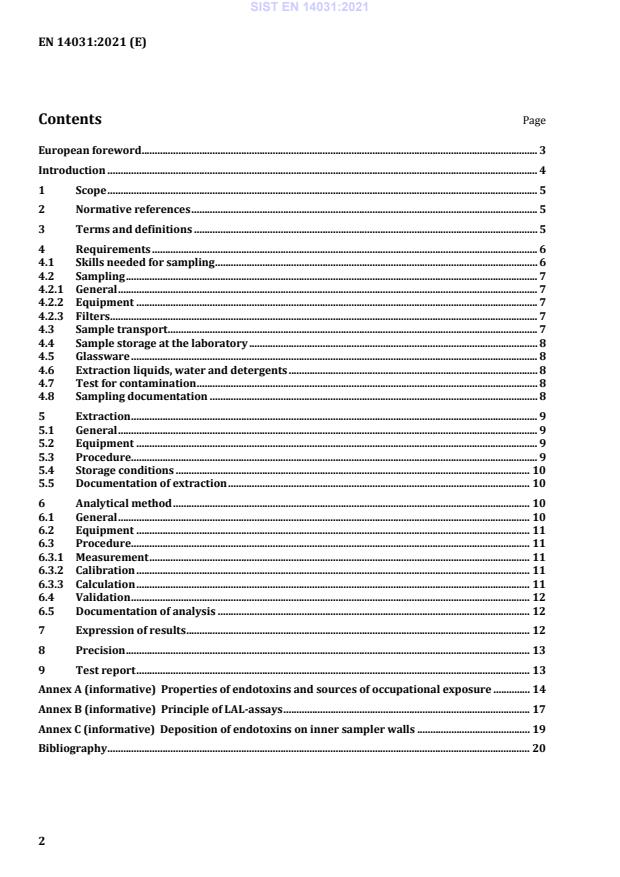
Contents Page
European foreword . 3
Introduction . 4
1 Scope . 5
2 Normative references . 5
3 Terms and definitions . 5
4 Requirements . 6
4.1 Skills needed for sampling . 6
4.2 Sampling . 7
4.2.1 General . 7
4.2.2 Equipment . 7
4.2.3 Filters . 7
4.3 Sample transport . 7
4.4 Sample storage at the laboratory . 8
4.5 Glassware . 8
4.6 Extraction liquids, water and detergents . 8
4.7 Test for contamination . 8
4.8 Sampling documentation . 8
5 Extraction . 9
5.1 General . 9
5.2 Equipment . 9
5.3 Procedure. 9
5.4 Storage conditions . 10
5.5 Documentation of extraction . 10
6 Analytical method . 10
6.1 General . 10
6.2 Equipment . 11
6.3 Procedure. 11
6.3.1 Measurement . 11
6.3.2 Calibration . 11
6.3.3 Calculation . 11
6.4 Validation . 12
6.5 Documentation of analysis . 12
7 Expression of results . 12
8 Precision . 13
9 Test report . 13
Annex A (informative) Properties of endotoxins and sources of occupational exposure . 14
Annex B (informative) Principle of LAL-assays . 17
Annex C (informative) Deposition of endotoxins on inner sampler walls . 19
Bibliography . 20
European foreword
This document (EN 14031:2021) has been prepared by Technical Committee CEN/TC 137 “Assessment
of workplace exposure to chemical and biological agents”, the secretariat of which is held by DIN.
This European Standard shall be given the status of a national standard, either by publication of an
identical text or by endorsement, at the latest by January 2022, and conflicting national standards shall
be withdrawn at the latest by January 2022.
Attention is drawn to the possibility that some of the elements of this document may be the subject of
patent rights. CEN shall not be held responsible for identifying any or all such patent rights.
This document supersedes EN 14031:2003.
The major technical changes between this document and the previous edition are as follows:
a) document title adjusted to the wording used in the Scope;
b) terms and definitions taken over from EN 13098:2019, where appropriate;
c) Clause 4 restructured;
d) requirements for sample storage at the laboratory rewritten;
e) recommendations for extraction of samples revised;
f) storage conditions described more precisely;
g) further requirements on documentation of extraction added;
h reference given to the recombinant Factor C (rFC) method as Note to 6.1;
i) new Table A.1 with examples on working areas with exposure to endotoxin added;
j) new Annex C on deposition of endotoxins on inner sampler walls added;
k) whole document editorially revised.
Any feedback and questions on this document should be directed to the users’ national standards body.
A complete listing of these bodies can be found on the CEN website.
According to the CEN-CENELEC Internal Regulations, the national standards organisations of the
following countries are bound to implement this European Standard: Austria, Belgium, Bulgaria,
Croatia, Cyprus, Czech Republic, Denmark, Estonia, Finland, France, Germany, Greece, Hungary, Iceland,
Ireland, Italy, Latvia, Lithuania, Luxembourg, Malta, Netherlands, Norway, Poland, Portugal, Republic of
North Macedonia, Romania, Serbia, Slovakia, Slovenia, Spain, Sweden, Switzerland, Turkey and the
United Kingdom.
Introduction
The term 'endotoxin' refers to lipopolysaccharides that are present in the outer membrane of the cell
walls of Gram-negative bacteria. These lipopolysaccharides are a class of pure lipid carbohydrate
molecules (free of protein and other cell wall components) that are held responsible for most of the
biological properties characteristic of bacterial endotoxins.
Endotoxins play an important role in the development of organic dust-related symptoms (for example,
inflammatory reactions in the airways and/or systemic reactions) among workers exposed via
inhalation.
To investigate ill health resulting from occupational exposure to airborne endotoxins it is important
therefore to measure their presence in workplace air accurately. At present, different methods are used
to measure airborne endotoxins. Standardization with respect to sampling, transportation, extraction,
analytical methods and storage of samples or extracts is important in order to obtain accurate and
comparable results and reduce uncertainties in exposure assessment.
1 Scope
This document specifies methods for the quantitative measurement of airborne endotoxins and gives
general requirements for sampling on filters, transportation, storage as well as the analysis of samples.
This document provides also guidelines for the assessment of workplace exposure to airborne
endotoxins.
2 Normative references
The following documents are referred to in the text in such a way that some or all of their content
constitutes requirements of this document. For dated references, only the edition cited applies. For
undated references, the latest edition of the referenced document (including any amendments) applies.
EN 481, Workplace atmospheres — Size fraction definitions for measurement of airborne particles
EN 1540, Workplace exposure — Terminology
EN ISO 13137, Workplace atmospheres — Pumps for personal sampling of chemical and biological agents
— Requirements and test methods (ISO 13137)
3 Terms and definitions
For the purposes of this document, the terms and definitions given in EN 1540 and the following apply.
ISO and IEC maintain terminological databases for use in standardization at the following addresses:
— IEC Electropedia: available at https://www.electropedia.org/
— ISO Online browsing platform: available at https://www.iso.org/obp
Note 1 to entry: In particular, the following terms used in this document are defined in EN 1540: aerosol,
biological agent, bioaerosol, exposure (by inhalation), inhalable fraction, measuring procedure, personal sampling,
static sampling and workplace.
3.1
control standard endotoxin
CSE
standard that is traceable to the reference standard endotoxin (RSE)
3.2
endotoxin
constituent of the external membrane of Gram-negative bacteria (lipopolysaccharide), consisting of a
complex lipid, lipid A, which is covalently bound to a polysaccharide
Note 1 to entry: “Free endotoxin” is liberated after cell death and by budding from living cells. Lipid A is the
active (toxic) part and is a potent pro-inflammatory substance and can induce febrile, bronchial and other
symptoms in exposed workers. The composition and the toxicity of endotoxin differ between bacteria species.
Note 2 to entry: A brief overview with respect to physical and chemical properties of endotoxins and sources of
occupational exposure is given in Annex A.
[SOURCE: EN 13098:2019, 3.9 – modified, Note 2 to entry added]
3.3
endotoxinfree liquid
water or solution containing no measurable endotoxin
Note 1 to entry: Endotoxinfree and pyrogenfree are used interchangeably in the literature.
Note 2 to entry: In practise, less than 0,2 endotoxin units per millilitre is often used as threshold value for
endotoxinfree.
3.4
endotoxin unit
EU
unit standardized against the defined reference material, reference standard endotoxin
[SOURCE: EN 13098:2019, 3.10]
3.5
Limulus Amoebocyte Lysate
LAL
enzymes extracted from the blood cells of the horse shoe crab (Limulus polyphemus) that are activated
by endotoxin and other molecules (glucans etc.)
[SOURCE: EN 13098:2019, 3.16]
3.6
Limulus Amoebocyte Lysate-assay
LAL-assay
functional assay to measure endotoxin concentrations
Note 1 to entry: The method is highly sensitive and based on the activation of a clotting enzyme present in the
lysate of hemolymph of the horseshoe crab (Limulus polyphemus).
3.7
lipopolysaccharide
LPS
water-soluble and stable molecule composed of lipid and polysaccharide present in Gram-negative
bacteria
Note 1 to entry: The lipid part of LPS is termed 'lipid A' and is essential for the toxic properties of LPS.
Note 2 to entry: The terms 'endotoxin' and 'lipopolysaccharide' are often used interchangeably in scientific
literature regarding occupational health.
3.8
reference standard endotoxin
RSE
purified lipopolysaccharide from Escherichia coli that serves as an international reference standard
4 Requirements
4.1 Skills needed for sampling
The person who takes the sample shall be trained in aseptic techniques to avoid contamination of the
sample during any measurement phase. This includes knowledge about sampling equipment and how
to perform the sampling.
4.2 Sampling
4.2.1 General
Measurement of airborne endotoxins should preferably be performed by sampling of the inhalable
fraction of aerosols. Aerosols shall be sampled on a filter using a pump to draw air through the filter.
Personal sampling shall be used for risk evaluation including comparison with exposure guidelines.
Static sampling can be used to identify sources of exposure and to measure background concentrations
of airborne endotoxins.
NOTE Other comparable sampling methods can be used for evaluation of other specific parameters, for
example, to measure endotoxins in different size distributions or particle size fractions, or for short- or long-term
exposure measurement.
4.2.2 Equipment
The pumps used for personal sampling and static sampling shall fulfil the requirements specified in
EN ISO 13137. Personal samplers shall collect the inhalable fraction of aerosols as specified in EN 481.
The filter holder or cassette should be rendered endotoxinfree. Heat-resistant reusuable filter
holder/transportation jars shall be made endotoxinfree by heating up according to 4.5. Transportation
jars that do not meet these requirements shall be cleaned thoroughly so that contamination of the
samples is avoided. Cleaning agents shall be removed by subsequent washing in endotoxinfree water.
Disposable filter holder do not need to be sterilized when it is assumed that they are endotoxinfree due
to the manufacturing process. Possible contamination shall be controlled by examination of blank
samples (see 4.7).
4.2.3 Filters
Binderfree glass fibre filters should be used for sampling of airborne endotoxins because these filters
perform very well regarding their collection efficiency, blank values and recovery. If any other filter is
used the performance of these parameters shall be comparable.
NOTE 1 The type of filter used when sampling endotoxins from the air has a strong influence on the
measurement results. Several studies report higher measured concentrations when glass fibre filters were used.
However, in other studies, concentrations measured with the use of PVC, PC or PTFE filters were equivalent to or
even higher than those measured with glass fibre filters. The effect of the nature of the filter seems to be
multifactorial and probably involves parameters as diverse as the filter material itself (possibility of adsorption of
endotoxins on the filter, interference during analysis), the sampling method, the extraction protocol etc. In the
current state of knowledge, it is difficult to give precise recommendations concerning the choice of filters and
further studies are still necessary for that purpose.
NOTE 2 Several filter materials (for example, polyvinylchloride, polytetrafluoroethylene and polycarbonate)
are commonly used but some materials adsorb endotoxins and thereby give false low values.
4.3 Sample transport
After sampling, filters shall be prepared for transport by sealing in a container or sampler cassette. The
sample shall be transported in conditions that prevent large variations in temperature and the gaining
of moisture. If transport time is above 24 h, or there is risk of large temperature variations, actions to
prevent moisture shall be taken, either by using an isolating container or by including a dehumidifier.
Conditions during transport shall be documented, including transport time and temperature log.
If the temperature is above 30 °C the filters shall be placed in cooler conditions (for example, by using a
cooling box).
4.4 Sample storage at the laboratory
If the sample is not extracted within two weeks after arrival at the laboratory the sample shall be stored
in conditions that prevent large variations in temperature and gain of moisture. Alternatively, for
storage of more than two weeks they should be frozen at a temperature of about – 20 °C or below,
because endotoxins are very stable when frozen. However, samples shall not be frozen and thawed
more than once, as this can affect the detectable endotoxin content of them.
4.5 Glassware
Glassware shall be rendered endotoxinfree, for example, by heating to at least 180 °C for about 4 h.
4.6 Extraction liquids, water and detergents
All liquids used shall be endotoxinfree.
4.7 Test for contamination
To test for contamination at least two filters shall be included in each sampling run as blank samples.
Except for the actual sampling, the filters used as blank samples shall be treated in the same way as the
other filters that are used for sampling.
NOTE If not more than four samples are collected, one blank sample can be seen as sufficient.
4.8 Sampling documentation
The sampling operations carried out shall be documented to obtain comparable and reliable
concentration values of endotoxins.
The sampling documentation shall include at least the following information:
a) name of the organization and person performing the sampling;
b) date of sampling;
c) purpose of sampling;
d) a unique identifier code for the sample and sampling device (for example, sampling pump, used);
e) name and address of the company where the sampling was carried out, or a unique identifier to
preserve confidentiality;
f) workplace description including bioaerosol generating activities;
g) type and name of sampler used;
h) type and name of filter used;
i) type of sampling (personal or static) and in case of personal sampling: name and function of the
person who was involved in the sampling, or a unique identifier to preserve confidentiality; or in
case of static sampling, placement of sampling equipment;
j) positioning of sampling equipment;
k) location of sampling inlet and orientation relative to air movement, where applicable;
l) start and end time of sa
...