

SIST EN 14583:2022
(Main)Workplace exposure - Volumetric bioaerosol samplers - General requirements and evaluation of performance
General Information
- Abstract
This document specifies general requirements for the evaluation of volumetric bioaerosol samplers in order to assess workplace exposure and their physical and biological performance.
This document describes the procedures for the development of volumetric bioaerosol samplers as well as their properties and validation.
This document provides a description of a test facility and selection criteria for microbial strains that can be used to assess their biological performance.
This document addresses requirements to manufacturers and developers of volumetric bioaerosol samplers as well as to test facilities with the equipment and skills to carry out the performance measurements of these samplers (see Annex D for application guidance).
This document is not intended for operators who use volumetric bioaerosol samplers to carry out exposure measurements for workers at occupational settings.
This document is not applicable for clean room measurements other than for occupational safety.
- Status
- Published
- Public Enquiry End Date
- 01-Oct-2020
- Publication Date
- 08-Feb-2022
- Technical Committee
- KAZ - Air quality
- Current Stage
- 6060 - National Implementation/Publication (Adopted Project)
- Start Date
- 28-Jan-2022
- Due Date
- 04-Apr-2022



Overview
EN 14583:2021 (CEN) defines general requirements and test procedures for volumetric bioaerosol samplers used to assess workplace exposure to airborne microorganisms. The standard specifies how to evaluate both the physical sampling efficiency and the biological preservation efficiency of samplers, describes suitable test facilities and microbial model organisms, and gives guidance for manufacturers and test laboratories on sampler development, validation and performance reporting. EN 14583:2021 supersedes EN 14583:2004 and is intended to support the development and verification of equipment used for bioaerosol sampling in occupational environments (not for routine operator exposure measurements or clean‑room testing other than for occupational safety).
Key Topics and Requirements
- Scope and purpose: Defines performance characteristics and validation procedures for volumetric bioaerosol samplers used in workplace atmospheres.
- Design and construction: Requirements for mechanical construction, materials (to minimise moisture uptake and electrostatic bias), indicators, adjustments, battery management, and labelling.
- Airflow control and calibration: Requirements for accurate airflow measurement, calibration and maintenance of the sampler pump in accordance with related pump standards.
- Sampling performance:
- Physical sampling efficiency - the ability to capture airborne particles across relevant aerodynamic diameters.
- Biological preservation efficiency - the ability of the sampler to preserve microorganism viability during collection and handling.
- Test methods and facilities: Description of suitable test chambers and experimental conditions, concentration ranges, aerosol generation and stabilization time, and orientation and loading considerations.
- Microbial model organisms: Selection criteria and examples of microbial strains for laboratory performance tests (see Annex C).
- Documentation: Required test report content and informative application guidance (Annex D).
- Safety note: The standard warns about hazards when using test organisms and aerosols and requires appropriate safety measures.
Applications and Intended Users
- Manufacturers and developers of volumetric bioaerosol samplers seeking to design, validate and certify product performance.
- Test laboratories and research facilities performing comparative performance evaluations and biological preservation testing.
- Occupational hygiene researchers and instrument developers who require standardized methods to assess sampler performance in workplace exposure studies.
- Not intended for routine users conducting workplace exposure measurements (operators) or for clean-room process qualification (except where occupational safety applies).
Related Standards
- EN 13098 - Measurement of airborne microorganisms (general requirements)
- EN 1540 - Workplace exposure terminology
- EN ISO 13137 - Pumps for personal sampling (requirements/test methods)
- EN IEC 60079 series - Requirements for equipment in potentially explosive atmospheres
Keywords: EN 14583:2021, volumetric bioaerosol samplers, workplace exposure, bioaerosol sampling, biological preservation efficiency, physical sampling efficiency, test facility, CEN.
Relations
- Effective Date
- 01-Mar-2022
- Effective Date
- 09-Feb-2026
- Effective Date
- 09-Feb-2026
- Effective Date
- 09-Feb-2026
- Effective Date
- 09-Feb-2026
- Effective Date
- 09-Feb-2026
- Effective Date
- 09-Feb-2026
- Effective Date
- 09-Feb-2026
- Effective Date
- 09-Feb-2026
- Effective Date
- 09-Feb-2026
- Effective Date
- 28-Jan-2026
- Effective Date
- 28-Jan-2026
- Effective Date
- 28-Jan-2026
Get Certified
Connect with accredited certification bodies for this standard

CIS Institut d.o.o.
Personal Protective Equipment (PPE) certification body. Notified Body NB-2890 for EU Regulation 2016/425 PPE.

Kiwa BDA Testing
Building and construction product certification.
Kmetijski inštitut Slovenije
Agricultural Institute of Slovenia. Soil testing, plant health, agricultural product analysis.
Sponsored listings
Frequently Asked Questions
SIST EN 14583:2022 is a standard published by the Slovenian Institute for Standardization (SIST). Its full title is "Workplace exposure - Volumetric bioaerosol samplers - General requirements and evaluation of performance". This standard covers: This document specifies general requirements for the evaluation of volumetric bioaerosol samplers in order to assess workplace exposure and their physical and biological performance. This document describes the procedures for the development of volumetric bioaerosol samplers as well as their properties and validation. This document provides a description of a test facility and selection criteria for microbial strains that can be used to assess their biological performance. This document addresses requirements to manufacturers and developers of volumetric bioaerosol samplers as well as to test facilities with the equipment and skills to carry out the performance measurements of these samplers (see Annex D for application guidance). This document is not intended for operators who use volumetric bioaerosol samplers to carry out exposure measurements for workers at occupational settings. This document is not applicable for clean room measurements other than for occupational safety.
This document specifies general requirements for the evaluation of volumetric bioaerosol samplers in order to assess workplace exposure and their physical and biological performance. This document describes the procedures for the development of volumetric bioaerosol samplers as well as their properties and validation. This document provides a description of a test facility and selection criteria for microbial strains that can be used to assess their biological performance. This document addresses requirements to manufacturers and developers of volumetric bioaerosol samplers as well as to test facilities with the equipment and skills to carry out the performance measurements of these samplers (see Annex D for application guidance). This document is not intended for operators who use volumetric bioaerosol samplers to carry out exposure measurements for workers at occupational settings. This document is not applicable for clean room measurements other than for occupational safety.
SIST EN 14583:2022 is classified under the following ICS (International Classification for Standards) categories: 13.040.30 - Workplace atmospheres. The ICS classification helps identify the subject area and facilitates finding related standards.
SIST EN 14583:2022 has the following relationships with other standards: It is inter standard links to SIST EN 14583:2004, SIST EN IEC 60079-0:2018, SIST EN 60079-6:2016, SIST EN IEC 60079-18:2025, SIST EN IEC 60079-11:2025, SIST EN 60079-7:2016, SIST EN 60079-5:2015, SIST EN 60079-1:2015, SIST EN 60079-2:2015, SIST EN IEC 60079-25:2022, SIST EN ISO 13137:2023, SIST EN 13098:2019, SIST EN 1540:2022. Understanding these relationships helps ensure you are using the most current and applicable version of the standard.
SIST EN 14583:2022 is available in PDF format for immediate download after purchase. The document can be added to your cart and obtained through the secure checkout process. Digital delivery ensures instant access to the complete standard document.
Standards Content (Sample)
SLOVENSKI STANDARD
01-marec-2022
Nadomešča:
SIST EN 14583:2004
Izpostavljenost na delovnem mestu - Vzorčevalniki za volumetrijsko vzorčenje
bioaerosolov - Splošne zahteve in vrednotenje lastnosti
Workplace exposure - Volumetric bioaerosol samplers - General requirements and
evaluation of performance
Exposition am Arbeitsplatz - Volumetrische Sammler für Bioaerosole - Allgemeine
Anforderungen und Bewertung der Leistungsfähigkeit
Exposition sur les lieux de travail - Dispositifs de prélèvement volumétrique des
bioaérosols - Exigences générales et évaluation des performances
Ta slovenski standard je istoveten z: EN 14583:2021
ICS:
13.040.30 Kakovost zraka na delovnem Workplace atmospheres
mestu
2003-01.Slovenski inštitut za standardizacijo. Razmnoževanje celote ali delov tega standarda ni dovoljeno.
EN 14583
EUROPEAN STANDARD
NORME EUROPÉENNE
December 2021
EUROPÄISCHE NORM
ICS 13.040.30 Supersedes EN 14583:2004
English Version
Workplace exposure - Volumetric bioaerosol samplers -
General requirements and evaluation of performance
Exposition sur les lieux de travail - Dispositifs de Exposition am Arbeitsplatz - Volumetrische Sammler
prélèvement volumétrique des bioaérosols - Exigences für Bioaerosole - Allgemeine Anforderungen und
générales et évaluation des performances Bewertung der Leistungsfähigkeit
This European Standard was approved by CEN on 8 November 2021.
CEN members are bound to comply with the CEN/CENELEC Internal Regulations which stipulate the conditions for giving this
European Standard the status of a national standard without any alteration. Up-to-date lists and bibliographical references
concerning such national standards may be obtained on application to the CEN-CENELEC Management Centre or to any CEN
member.
This European Standard exists in three official versions (English, French, German). A version in any other language made by
translation under the responsibility of a CEN member into its own language and notified to the CEN-CENELEC Management
Centre has the same status as the official versions.
CEN members are the national standards bodies of Austria, Belgium, Bulgaria, Croatia, Cyprus, Czech Republic, Denmark, Estonia,
Finland, France, Germany, Greece, Hungary, Iceland, Ireland, Italy, Latvia, Lithuania, Luxembourg, Malta, Netherlands, Norway,
Poland, Portugal, Republic of North Macedonia, Romania, Serbia, Slovakia, Slovenia, Spain, Sweden, Switzerland, Turkey and
United Kingdom.
EUROPEAN COMMITTEE FOR STANDARDIZATION
COMITÉ EUROPÉEN DE NORMALISATION
EUROPÄISCHES KOMITEE FÜR NORMUNG
CEN-CENELEC Management Centre: Rue de la Science 23, B-1040 Brussels
© 2021 CEN All rights of exploitation in any form and by any means reserved Ref. No. EN 14583:2021 E
worldwide for CEN national Members.
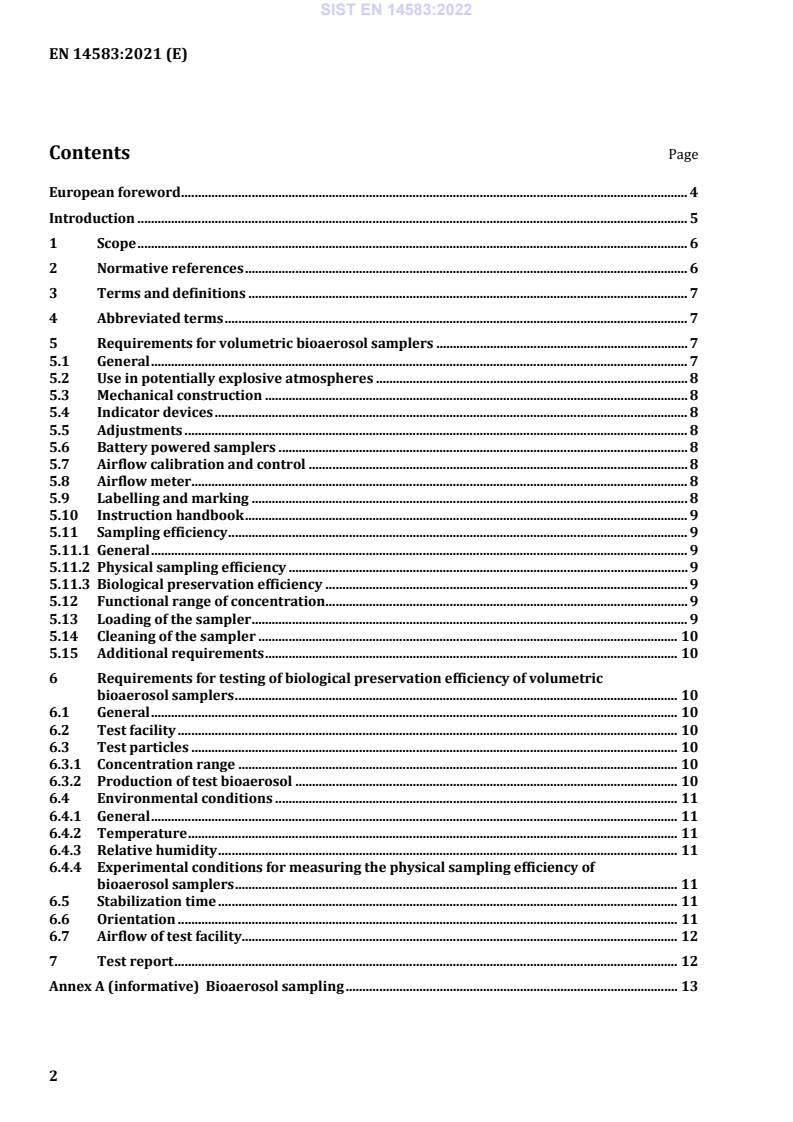
Contents Page
European foreword . 4
Introduction . 5
1 Scope . 6
2 Normative references . 6
3 Terms and definitions . 7
4 Abbreviated terms . 7
5 Requirements for volumetric bioaerosol samplers . 7
5.1 General . 7
5.2 Use in potentially explosive atmospheres . 8
5.3 Mechanical construction . 8
5.4 Indicator devices . 8
5.5 Adjustments . 8
5.6 Battery powered samplers . 8
5.7 Airflow calibration and control . 8
5.8 Airflow meter . 8
5.9 Labelling and marking . 8
5.10 Instruction handbook . 9
5.11 Sampling efficiency . 9
5.11.1 General . 9
5.11.2 Physical sampling efficiency . 9
5.11.3 Biological preservation efficiency . 9
5.12 Functional range of concentration . 9
5.13 Loading of the sampler . 9
5.14 Cleaning of the sampler . 10
5.15 Additional requirements . 10
6 Requirements for testing of biological preservation efficiency of volumetric
bioaerosol samplers . 10
6.1 General . 10
6.2 Test facility . 10
6.3 Test particles . 10
6.3.1 Concentration range . 10
6.3.2 Production of test bioaerosol . 10
6.4 Environmental conditions . 11
6.4.1 General . 11
6.4.2 Temperature . 11
6.4.3 Relative humidity . 11
6.4.4 Experimental conditions for measuring the physical sampling efficiency of
bioaerosol samplers . 11
6.5 Stabilization time . 11
6.6 Orientation . 11
6.7 Airflow of test facility. 12
7 Test report . 12
Annex A (informative) Bioaerosol sampling . 13
Annex B (normative) Test facilities usable for assessing biological performance of
volumetric bioaerosol samplers . 15
Annex C (informative) Microbial model organisms used for bioaerosol studies . 19
Annex D (informative) Application guidance . 21
Bibliography . 22
European foreword
This document (EN 14583:2021) has been prepared by Technical Committee CEN/TC 137 “Assessment
of workplace exposure to chemical and biological agents”, the secretariat of which is held by DIN.
This European Standard shall be given the status of a national standard, either by publication of an
identical text or by endorsement, at the latest by June 2022, and conflicting national standards shall be
withdrawn at the latest by June 2022.
Attention is drawn to the possibility that some of the elements of this document may be the subject of
patent rights. CEN shall not be held responsible for identifying any or all such patent rights.
This document supersedes EN 14583:2004.
The major technical changes between this document and the previous edition are as follows:
a) document title changed;
b) Scope rewritten and given more detailed;
c) Terms and definitions already referred to in EN 1540 or EN 13098 deleted;
d) Annex B revised by replacing the former content by general requirements on test facilities and an
overview on different types and examples of test facilities;
e) new Annex C on microbial model organisms used for bioaerosol studies added;
f) new Annex D giving application guidance added;
g) Bibliography updated;
h) whole document restructured, editorially and technically revised.
Any feedback and questions on this document should be directed to the users’ national standards body.
A complete listing of these bodies can be found on the CEN website.
According to the CEN-CENELEC Internal Regulations, the national standards organisations of the
following countries are bound to implement this European Standard: Austria, Belgium, Bulgaria, Croatia,
Cyprus, Czech Republic, Denmark, Estonia, Finland, France, Germany, Greece, Hungary, Iceland, Ireland,
Italy, Latvia, Lithuania, Luxembourg, Malta, Netherlands, Norway, Poland, Portugal, Republic of North
Macedonia, Romania, Serbia, Slovakia, Slovenia, Spain, Sweden, Switzerland, Turkey and the United
Kingdom.
Introduction
This document is needed to promote the development of new equipment for measurement of
microorganisms in the work environment. This document can also apply to existing equipment. It is
intended to specify requirements and methods to determine performance characteristics of volumetric
bioaerosol samplers used to collect bioaerosols from the workplace atmosphere. Examples of test
facilities and microbial model organisms usually used for laboratory measurements of the biological
preservation efficiency of volumetric bioaerosol samplers are provided.
WARNING — The use of this document can involve hazardous materials, operations and
equipment. This document does not purport to address all of the safety problems associated with
its use. It is the responsibility of the user of this document to take appropriate health and safety
precautions and to check which restrictive rules and regulations need to be taken into account
prior to use.
1 Scope
This document specifies general requirements for the evaluation of volumetric bioaerosol samplers in
order to assess workplace exposure and their physical and biological performance.
This document describes the procedures for the development of volumetric bioaerosol samplers as well
as their properties and validation.
This document provides a description of a test facility and selection criteria for microbial strains that can
be used to assess their biological performance.
This document addresses requirements to manufacturers and developers of volumetric bioaerosol
samplers as well as to test facilities with the equipment and skills to carry out the performance
measurements of these samplers (see Annex D for application guidance).
This document is not intended for operators who use volumetric bioaerosol samplers to carry out
exposure measurements for workers at occupational settings.
This document is not applicable for clean room measurements other than for occupational safety.
2 Normative references
The following documents are referred to in the text in such a way that some or all of their content
constitutes requirements of this document. For dated references, only the edition cited applies. For
undated references, the latest edition of the referenced document (including any amendments) applies.
EN 1540, Workplace exposure - Terminology
EN 13098:2019, Workplace exposure - Measurement of airborne microorganisms and microbial
compounds - General requirements
EN 60079-1, Explosive atmospheres - Part 1: Equipment protection by flameproof enclosures "d"
EN 60079-2, Explosive atmospheres - Part 2: Equipment protection by pressurized enclosure "p"
EN 60079-5, Explosive atmospheres - Part 5: Equipment protection by powder filling "q"
EN 60079-6, Explosive atmospheres - Part 6: Equipment protection by liquid immersion "o"
EN 60079-7, Explosive atmospheres - Part 7: Equipment protection by increased safety "e"
EN 60079-11, Explosive atmospheres - Part 11: Equipment protection by intrinsic safety “i”
EN 60079-18, Explosive atmospheres - Part 18: Equipment protection by encapsulation "m"
EN 60079-25, Explosive atmospheres - Part 25: Intrinsically safe electrical systems
EN IEC 60079-0, Explosive atmospheres - Part 0: Equipment - General requirements (IEC 60079-0)
EN ISO 13137, Workplace atmospheres - Pumps for personal sampling of chemical and biological agents -
Requirements and test methods (ISO 13137)
3 Terms and definitions
For the purposes of this document, the terms and definitions given in EN 1540, EN 13098 and the
following apply.
ISO and IEC maintain terminological databases for use in standardization at the following addresses:
— ISO Online browsing platform: available at https://www.iso.org/obp
— IEC Electropedia: available at https://www.electropedia.org/
3.1
personal sampler
sampler, attached to a person, that collects gases, vapours or airborne particles in the breathing zone for
the purpose of measuring exposure to chemical agents and/or biological agents
Note 1 to entry: Some samplers have integral pumps, and some do not. Where the personal sampler requires the
use of an external pump, the pump is not subject to the requirements of this document.
[SOURCE: ISO 18158:2016, 2.2.2.2, modified – Note 1 to entry has been added.]
3.2
particle aerodynamic diameter
diameter of a sphere of 1 g/cm density with the same terminal settling velocity in calm air as the particle,
under the prevailing conditions of temperature, pressure and relative humidity
[SOURCE: ISO 18158:2016, 2.1.4.8, [21]]
4 Abbreviated terms
ATCC American Type Culture Collection
CBS Centraalbureau voor Schimmelcultures
CCUG Culture Collection University of Göteborg
DSMZ Deutsche Stammsammlung für Mikroorganismen und Zellkulturen
HEPA High Efficiency Particulate Air-(filter)
NCTC National Collection of Type Cultures
OPC Optical Particle Counter
5 Requirements for volumetric bioaerosol samplers
5.1 General
The pumps used for personal sampling shall fulfil the requirements specified in EN ISO 13137.
NOTE EN 13205 can be used to assess the sampler performance for measurement of airborne particle
concentrations. However, at present no practical experience is reported on the application of EN 13205 for
volumetric bioaerosol samplers.
5.2 Use in potentially explosive atmospheres
When the sampler covered by this document is to be used in potentially explosive atmospheres, it shall
comply with EN IEC 60079-0, EN 60079-1, EN 60079-2, EN 60079-5, EN 60079-6, EN 60079-7,
EN 60079-11, EN 60079-18 and EN 60079-25.
5.3 Mechanical construction
Every sampler shall be constructed in such a manner that it is easily accessible for regular function checks
and that airflow can easily be measured and calibrated. The sampling pump shall maintain the required
airflow rate throughout the sampling period.
Material used in the sampling head should be chosen to avoid moisture uptake and electrostatic charges.
5.4 Indicator devices
An indicator device shall be provided to show that the sampler is switched on. If the sampler has more
than one measuring range, the selected range shall be clearly identified.
NOTE It is an advantage if elapsed time indicators, low flow rate indicators, flow interrupted indicators are
given.
5.5 Adjustments
Any equipment (switch, knob, etc.) used for modifying the operating parameters (sampling time, flow
rate, etc.) of the sampler shall be protected against inadvertent or purposeful adjustment during
sampling. The operational settings should be displayed.
5.6 Battery powered samplers
Samplers powered with integrated batteries shall be provided with an early indication of low battery
condition.
5.7 Airflow calibration and control
During sampling the deviation from the required airflow should not exceed ± 5 %.
The manufacturer shall state the following:
a) the way in which the calibration of the air flow rate of the sampler can be checked and re-calibration
can be done, if necessary;
b) the parameters that should be calibrated, the frequency required and whether the calibration can be
carried out by the operator.
5.8 Airflow meter
A device to measure the airflow through the sampler before and after sampling in the field should be
supplied if required.
NOTE This device can be different from that used for calibration.
Samplers with integral airflow meters shall be calibrated against a traceable external airflow meter
before use.
5.9 Labelling and marking
The manufacturer of the sampler shall be clearly identified to ensure traceability to specified
performance characteristics.
5.10 Instruction handbook
The instruction handbook shall be written in a language, which is understandable in the country of the
operator. It shall be easily understood and every function explained.
The instruction handbook shall illustrate all components and their handling by figures.
The instruction handbook shall give the environmental conditions and other conditions under which the
sampler shall be operated including limitations to its use. It shall give exact calibration instructions and
recommended equipment (e.g. flow meters) to be used. The instruction handbook shall also give
instructions for troubleshooting and maintenance of the sampler.
5.11 Sampling efficiency
5.11.1 General
The sampling efficiency of samplers collecting biological agents comprises of a physical part, the physical
sampling efficiency (see 5.11.2) and the biological preservation efficiency (see 5.11.3).
The sampler should be able to collect a representative sample of the required health-related fraction of
the bioaerosol according to EN 481.
The health-related fraction to be used shall be specified by the manufacturer.
5.11.2 Physical sampling efficiency
The physical sampling efficiency can be measured as a function of particle aerodynamic diameter and
other influent parameters. For bioaerosol samplers the physical sampling efficiency which corresponds
to the (size-selective) sampling efficiency should comply with EN 13205, where applicable.
When assessing the performance of any bioaerosol sampler, the overall sampling efficiency (see A.2,
item c)) shall be determined.
The performance of a personal sampler is affected by the proximity of the operator's body when worn
within the breathing zone. This needs to be taken into account when assessing that performance. See A.2.
NOTE Annex A gives some information about the physical behaviour of a sampler and the experimental
assessment of its physical sampling efficiency in the laboratory.
5.11.3 Biological preservation efficiency
To determine the culturable number of microorganisms, the sampler shall be tested with relevant
microorganisms to establish the biological preservation efficiency. The ability of the sampling medium to
maintain the integrity of the sampled microorganisms shall be known.
5.12 Functional range of concentration
The manufacturer shall give the upper and lower functional range for the concentration of collected
culturable microorganisms and/or the total number of microorganisms.
The manufacturer shall specify the maximum sampling time or the sampling volume that can be sampled
without recharging battery-operated samplers or replacing the collection substrate.
NOTE The sampling time can vary from a few minutes up to an 8 h workshift.
5.13 Loading of the sampler
The sampler shall be loaded, emptied and reloaded easily with aseptic collection substrates at the
workplace with a minimum loss of collected bioaerosol.
5.14 Cleaning of the sampler
The sampler shall be constructed in such a way that cleaning and decontamination in the field can be
done easily and disinfection in the laboratory is possible.
If required for biosecurity or contamination control purposes, samplers shall be resistant to
decontamination by surface disinfection or fumigation, e.g. by using hydrogen peroxide vapour.
5.15 Additional requirements
When possible, battery-operated samplers should have a short recharge time.
All samplers should be light-weighted and have low noise levels.
6 Requirements for testing of biological preservation efficiency of volumetric
bioaerosol samplers
6.1 General
The test conditions applied shall be within the operational range of the sampler as specified by the
manufacturer.
The risk class to which the microbial model organisms belong to shall be compatible with the level of
safety of the test facility and the training of the operators so that microbial model organisms are handled
under optimum safety and health protection conditions.
For the purpose of testing the performance of samplers, the tests shall be carried out on at least two
replicate samplers and compared to the performance of a reference sampler.
The biological preservation efficiency itself cannot be determined as the actual concentration cannot be
measured without any bias. In practise, bioaerosol samplers are compared to each other to show
differences with regard to their biological preservation efficiency.
6.2 Test facility
The biological performance of the bioaerosol samplers shall be studied in a test facility into which specific
aerosols of microorganisms can be generated in suitable conditions (see Annex B). The ratio between the
concentration of microorganisms measured by the sampler to be tested and the concentration assessed
by the reference sampler shall be calculated by using representative microorganisms (see Annex C).
The reference sampler shall comply with the requirements given in EN 13098:2019, 6.2.2.
6.3 Test particles
6.3.1 Concentration range
The test environment shall consist of single particles as well as aggregates of particles in an atmosphere
with controllable relative humidity and temperature. The concentration range of particles within which
the sampler is evaluated shall be given. The temperature and relative humidity of the test environment
shall be stated.
Restrictions on the usability of the sampler in terms of temperature and relative humidity shall be
specified by the manufacturer.
6.3.2 Production of test bioaerosol
Microbial cell suspensions shall be controllably aeroso
...