

SIST ISO 24611:2013
(Main)Language resource management -- Morpho-syntactic annotation framework (MAF)
General Information
- Abstract
ISO 24611:2012 provides a framework for the representation of annotations of word-forms in texts; such annotations concern tokens, their relationship with lexical units, and their morpho-syntactic properties.It describes a metamodel for morpho-syntactic annotation that relates to a reference to the data categories contained in the ISOCat data category registry (DCR, as defined in ISO 12620). It also describes an XML serialization for morpho-syntactic annotations, with equivalences to the guidelines of the TEI (text encoding initiative).
- Status
- Published
- Publication Date
- 06-Jun-2013
- Technical Committee
- IDT - Information, documentation, language and terminology
- Current Stage
- 6060 - National Implementation/Publication (Adopted Project)
- Start Date
- 31-May-2013
- Due Date
- 05-Aug-2013
- Completion Date
- 07-Jun-2013
Buy Documents


ISO 24611:2012 - Language resource management — Morpho-syntactic annotation framework (MAF) Released:10/19/2012


ISO 24611:2012 - Gestion des ressources langagieres — Cadre d'annotation morphosyntaxique (MAF) Released:6/30/2016


ISO 24611:2012 - Language resource management — Morpho-syntactic annotation framework (MAF) Released:8/20/2014
Overview
SIST ISO 24611:2013 (ISO 24611:2012) - Morpho-syntactic annotation framework (MAF) defines a standardized framework for morpho-syntactic annotation of word-forms in texts. It provides a meta-model that links tokens, word-forms, lexical references and morpho‑syntactic properties to an authoritative registry of semantic descriptors (the ISOCat / ISO 12620 data category registry). The standard also specifies an XML serialization for MAF and describes equivalences with TEI (Text Encoding Initiative) guidelines to promote interoperability.
Key technical topics and requirements
- MAF meta-model: conceptual separation of text segmentation (tokens), linguistic units (word-forms), and their morpho‑syntactic descriptions.
- Tokenization strategies: inline, stand-off and TEI‑aligned notations; rules for joining, overlapping and spanning tokens.
- Word-form modeling: attachment patterns (one-to-one, one-to-many, discontinuous or zero-token forms), compound word-forms and lexical pointers.
- Morpho-syntactic content: representation using feature structures, compact tagsets, and FSR libraries; guidance for designing reusable tagsets.
- Handling ambiguities: mechanisms for encoding alternative analyses (e.g., , local lattices, simplified linear/mixed representations).
- XML elements and serialization: normative element names and structures (e.g., , , , , , , ) are specified in the normative annex.
- Data category linkage: mandatory referencing of data categories in ISOCat/ISO 12620 for stable semantic interoperability.
- Normative and informative annexes: includes encoded examples and a full MAF specification to support implementation.
Practical applications and users
MAF is intended to enable consistent, interoperable morpho‑syntactic annotation across tools and corpora. Typical applications:
- Corpus annotation and standards-compliant corpora for linguistics research
- POS tagging and morphological analysis for NLP pipelines
- Creation and exchange of annotated training data for machine learning
- Interchange between TEI-encoded texts and NLP tools
- Lexicography and language resource management
Primary users:
- Corpus linguists, computational linguists, NLP engineers
- Language resource managers and standards implementers
- Digital humanities researchers and TEI practitioners
- Tool developers creating annotation editors, converters, or corpus platforms
Related standards
- ISO 12620 - Data category registry (ISOCat): provides the semantic descriptors MAF references.
- TEI guidelines - MAF specifies equivalences to TEI encoding for easier integration with TEI‑based resources.
By adopting ISO 24611 (MAF), organizations ensure transparent morpho-syntactic encoding, stronger interoperability, and clearer semantic grounding for annotated language resources.
Relations
- Effective Date
- 06-Jun-2022
Buy Documents
ISO 24611:2012 - Language resource management — Morpho-syntactic annotation framework (MAF) Released:10/19/2012
ISO 24611:2012 - Gestion des ressources langagieres — Cadre d'annotation morphosyntaxique (MAF) Released:6/30/2016
ISO 24611:2012 - Language resource management — Morpho-syntactic annotation framework (MAF) Released:8/20/2014
Get Certified
Connect with accredited certification bodies for this standard

BSI Group
BSI (British Standards Institution) is the business standards company that helps organizations make excellence a habit.

NYCE
Mexican standards and certification body.
Sponsored listings
Frequently Asked Questions
SIST ISO 24611:2013 is a standard published by the Slovenian Institute for Standardization (SIST). Its full title is "Language resource management -- Morpho-syntactic annotation framework (MAF)". This standard covers: ISO 24611:2012 provides a framework for the representation of annotations of word-forms in texts; such annotations concern tokens, their relationship with lexical units, and their morpho-syntactic properties.It describes a metamodel for morpho-syntactic annotation that relates to a reference to the data categories contained in the ISOCat data category registry (DCR, as defined in ISO 12620). It also describes an XML serialization for morpho-syntactic annotations, with equivalences to the guidelines of the TEI (text encoding initiative).
ISO 24611:2012 provides a framework for the representation of annotations of word-forms in texts; such annotations concern tokens, their relationship with lexical units, and their morpho-syntactic properties.It describes a metamodel for morpho-syntactic annotation that relates to a reference to the data categories contained in the ISOCat data category registry (DCR, as defined in ISO 12620). It also describes an XML serialization for morpho-syntactic annotations, with equivalences to the guidelines of the TEI (text encoding initiative).
SIST ISO 24611:2013 is classified under the following ICS (International Classification for Standards) categories: 01.020 - Terminology (principles and coordination); 01.140.20 - Information sciences; 35.240.30 - IT applications in information, documentation and publishing. The ICS classification helps identify the subject area and facilitates finding related standards.
SIST ISO 24611:2013 has the following relationships with other standards: It is inter standard links to oSIST ISO/DIS 24611-1:2024. Understanding these relationships helps ensure you are using the most current and applicable version of the standard.
SIST ISO 24611:2013 is available in PDF format for immediate download after purchase. The document can be added to your cart and obtained through the secure checkout process. Digital delivery ensures instant access to the complete standard document.
Standards Content (Sample)
SLOVENSKI STANDARD
01-julij-2013
Upravljanje z jezikovnimi viri - Ogrodje za oblikoskladenjsko označevanje (MAF)
Language resource management -- Morpho-syntactic annotation framework (MAF)
Gestion des ressources langagières -- Cadre d'annotation morphosyntaxique (MAF)
Ta slovenski standard je istoveten z: ISO 24611:2012
ICS:
01.020 Terminologija (načela in Terminology (principles and
koordinacija) coordination)
01.140.20 Informacijske vede Information sciences
35.240.30 Uporabniške rešitve IT v IT applications in information,
informatiki, dokumentiranju in documentation and
založništvu publishing
2003-01.Slovenski inštitut za standardizacijo. Razmnoževanje celote ali delov tega standarda ni dovoljeno.
INTERNATIONAL ISO
STANDARD 24611
First edition
2012-11-01
Language resource management —
Morpho-syntactic annotation framework
(MAF)
Gestion des ressources langagières — Cadre d'annotation
morphosyntaxique (MAF)
Reference number
©
ISO 2012
© ISO 2012
All rights reserved. Unless otherwise specified, no part of this publication may be reproduced or utilized in any form or by any means,
electronic or mechanical, including photocopying and microfilm, without permission in writing from either ISO at the address below or
ISO's member body in the country of the requester.
ISO copyright office
Case postale 56 CH-1211 Geneva 20
Tel. + 41 22 749 01 11
Fax + 41 22 749 09 47
E-mail copyright@iso.org
Web www.iso.org
Published in Switzerland
ii © ISO 2012 – All rights reserved
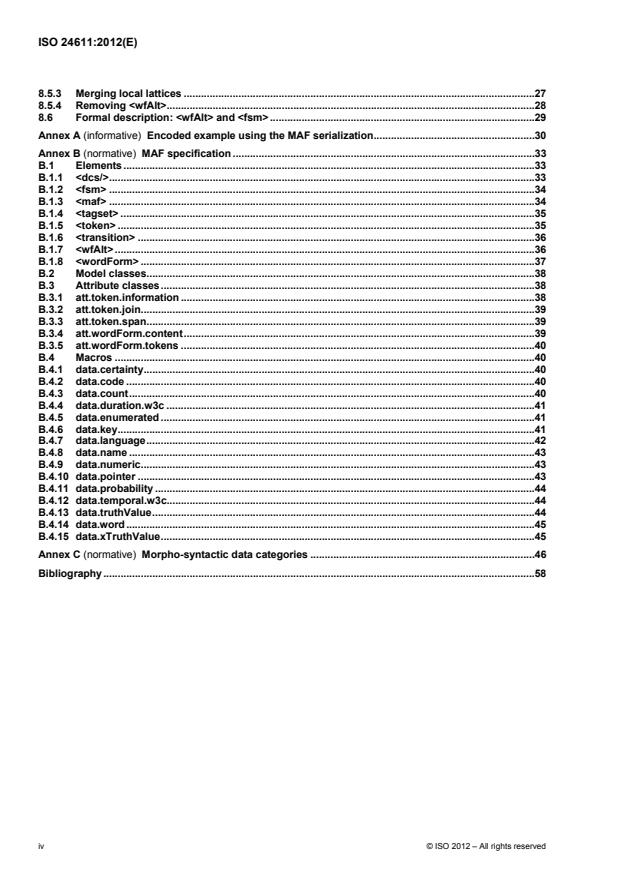
Contents Page
Foreword . v
Introduction . vi
1 Scope . 1
2 Normative references . 1
3 Terms and definitions . 1
4 The MAF meta-model . 4
4.1 Overview . 4
4.2 MAF Meta-model . 4
5 Segmenting with tokens . 6
5.1 General . 6
5.2 Formal description: . 7
5.3 Embedding notation . 7
5.4 Alternate representation for TEI based documents . 8
5.5 Stand-off notation . 9
5.6 Informative attributes . 9
5.7 Completing the inline token notation . 10
5.7.1 Joining tokens in embedded mode . 10
5.7.2 Overlapping tokens . 11
6 Word-forms as linguistic units . 11
6.1 Formal description: . 12
6.2 Token attachment . 12
6.2.1 One token; one word-form . 12
6.2.2 Several contiguous tokens; one word-form . 12
6.2.3 Several discontinuous tokens; one word-form . 13
6.2.4 Zero token; one word-form . 13
6.2.5 One token; several word-forms . 14
6.3 Referring to lexical entries . 14
6.4 Compound word-forms . 15
6.5 Identification of word-forms within a TEI-compliant document . 15
7 Morpho-syntactic content . 18
7.1 General . 18
7.2 Using feature structures . 18
7.3 Compact morpho-syntactic tags . 18
7.4 FSR libraries . 19
7.5 Designing tagsets . 20
7.6 Formal description: . 22
8 Handling ambiguities . 22
8.1 Word-form content ambiguities . 22
8.2 Lexical Ambiguities . 23
8.3 Structural ambiguities . 23
8.3.1 Structural ambiguities with word-forms . 23
8.3.2 Structural ambiguities with tokens . 24
8.4 Simplified structuring variants . 24
8.4.1 Non-ambiguous linear representation . 24
8.4.2 Mixed linear and lattice representation . 25
8.5 Expanding the simplified variants . 26
8.5.1 Separating tokens and word-forms . 26
8.5.2 Wrapping into local lattices . 26
8.5.3 Merging local lattices .27
8.5.4 Removing .28
8.6 Formal description: and .29
Annex A (informative) Encoded example using the MAF serialization .30
Annex B (normative) MAF specification .33
B.1 Elements .33
B.1.1 .33
B.1.2 .34
B.1.3 .34
B.1.4 .35
B.1.5 .35
B.1.6 .36
B.1.7 .36
B.1.8 .37
B.2 Model classes .38
B.3 Attribute classes .38
B.3.1 att.token.information .38
B.3.2 att.token.join .39
B.3.3 att.token.span .39
B.3.4 att.wordForm.content .39
B.3.5 att.wordForm.tokens .40
B.4 Macros .40
B.4.1 data.certainty .40
B.4.2 data.code .40
B.4.3 data.count .40
B.4.4 data.duration.w3c .41
B.4.5 data.enumerated .41
B.4.6 data.key .41
B.4.7 data.language .42
B.4.8 data.name .43
B.4.9 data.numeric .43
B.4.10 data.pointer .43
B.4.11 data.probability .44
B.4.12 data.temporal.w3c.44
B.4.13 data.truthValue .44
B.4.14 data.word .45
B.4.15 data.xTruthValue .45
Annex C (normative) Morpho-syntactic data categories .46
Bibliography .58
iv © ISO 2012 – All rights reserved
Foreword
ISO (the International Organization for Standardization) is a worldwide federation of national standards bodies
(ISO member bodies). The work of preparing International Standards is normally carried out through ISO
technical committees. Each member body interested in a subject for which a technical committee has been
established has the right to be represented on that committee. International organizations, governmental and
non-governmental, in liaison with ISO, also take part in the work. ISO collaborates closely with the
International Electrotechnical Commission (IEC) on all matters of electrotechnical standardization.
International Standards are drafted in accordance with the rules given in the ISO/IEC Directives, Part 2.
The main task of technical committees is to prepare International Standards. Draft International Standards
adopted by the technical committees are circulated to the member bodies for voting. Publication as an
International Standard requires approval by at least 75 % of the member bodies casting a vote.
Attention is drawn to the possibility that some of the elements of this document may be the subject of patent
rights. ISO shall not be held responsible for identifying any or all such patent rights.
ISO 24611 was prepared by Technical Committee ISO/TC 37, Terminology and other language and content
resources, Subcommittee SC 4, Language resource management.
Introduction
ISO/TC 37/SC 4 focuses on the definition of models and formats for the representation of annotated language
resources. To this end, it has generalised the modelling strategy initiated by its sister committee, SC 3, for the
representation of terminological data [Romary, 2001], through which linguistic data models are seen as the
combination of a generic data pattern (a meta-model), which is further refined through a selection of data
categories that provide the descriptors for this specific annotation level. Such models are defined
independently of any specific formats, and ensure that an implementer has the necessary conceptual
instrument with which to design and compare formats with regard to their degrees of interoperability.
One important aspect of representing any kind of annotation is the capacity to provide a clear and reliable
semantics for the various descriptors used, either in the form of formal features and feature values, or directly
as objects in a representation that is expressed, for instance, in XML. In order to be shared across various
annotation schemas and encoding applications, such a semantics should be implemented as a centralised
registry of concepts: we will henceforth refer to these as data categories. As such, data categories should
bear the following constraints.
From a technical point of view, they must provide unique, stable references (implemented as persistent
identifiers, in the sense of ISO 24619) such that the designer of a specific encoding schema can refer to
them in his or her specification. By doing so, two annotations will be deemed to be equivalent when they
are in fact defined in relation to the same data categories (as feature and feature value).
From a descriptive point of view, each unique semantic reference should be associated with precise
documentation combining a full text elicitation of the meaning of the descriptor with the expression of
specific constraints that bear upon the category.
In recent years, ISO has developed a general framework for representing and maintaining such a registry of
data categories, encompassing all domains of language resources. This initiative, described in ISO 12620,
has led to the implementation of an online environment providing access to all data categories that have been
standardized in the context of the various language resource-related activities within ISO, or specifically as
part of the maintenance of the data category registry. It also provides access to the various data categories
that individual language technology practitioners have defined in the course of their own work and decided to
share with the community.
The ISO data category registry, as available through the ISOCat (www.isocat.org) implementation, is intended
as a ‘flat’ marketplace of semantic objects, providing only a limited set of ontological constraints. The objective
there is to facilitate the maintenance of a comprehensive descriptive environment where new categories are
easily inserted and reused without the need for any strong consistency check with the registry at large.
Indeed, the following basic constraints are part of the data category model, as defined in ISO 12620:
simple generic-specific relations, when these are useful for the proper identification of interoperability
descriptors between data categories. For instance, the fact that /properNoun/ is a sub-category of /noun/
makes it possible to compare morpho-syntactic annotations based on different descriptive levels of
granularity;
the description of conceptual domains, in the sense of ISO 11179, to identify, when known or applicable,
the possible value of so-called complex data categories For instance, it can be used to record that
possible values of /grammaticalGender/ (limited to a small group of languages [Romary 2011]), could be
a subset of {/masculine/, /feminine/ and /neutral/};
language-specific constraints, either in the form of specific application notes or as explicit restrictions
bearing upon the conceptual domains of complex data categories. For instance, it is possible to express
explicitly that /grammaticalGender/ in French can only take the two values: {/masculine/ and /feminine/}.
vi © ISO 2012 – All rights reserved
This International Standard provides a comprehensive framework for the representation of morpho-syntactic
(also referred to as part-of-speech) annotations. Such an annotation level corresponds to a first lexical
abstraction level over language data (textual or spoken) and, depending on the language to be annotated,
together with the characteristics of the annotation tool or annotation scheme that is being used, can vary
enormously in structure and complexity.
In order to deal with such complex issues as ambiguity and determinism in morpho-syntactic annotation, this
International Standard introduces a meta-model that draws a clear distinction between the two levels of tokens
(representing the surface segmentation of the source) and word-forms (identifying lexical abstractions
associated with groups of tokens). These two levels share the following specificities: on the one hand, they
can be represented as simple sequences and as local graphs such as multiple segmentations and ambiguous
compounds; on the other hand, any n-to-n combination can stand between word forms and tokens.
As linguistic segments (sometimes called ‘markables’ in the literature [see, for instance, Carletta et al. 1997]),
tokens may be embedded in the source document as inline mark-up, or they may point remotely to it by
means of so-called stand-off annotations.
As linguistic abstractions, word-forms can be qualified by various linguistic features characterising the
morpho-syntactic properties that are instantiated in the realisation of the lexical entry within the annotated text.
Such properties may range from the simple indication of a lemma up to an explicit reference to a lexical entry
in a dictionary. In most existing applications of morpho-syntactic annotation, linguistic properties are
expressed by means of so-called tags; these codes refer to basic feature structures (see early examples in
Monachini and Calzolari, 1994). Such codes may also provide morphological information, including its part of
speech (e.g. noun, adjective or verb), and features such as number, gender, person, mood and verbal tense.
In keeping with the general modelling strategy of ISO/TC 37, this International Standard/MAF provides means
of relating morpho-syntactic tags expressed as feature structures (compliant with ISO 24610) to the data
categories available in ISOCat. A normative annex of this International Standard elicits a core set of data
categories that can be used as reference for most current morpho-syntactic annotation tasks in a multilingual
context. However, when implementers of this International Standard find these categories inappropriate in
either coverage, scope or semantics, they are encouraged to use ISOCat to define their own categories in
compliance with ISO/TC 37 principles.
Associated to the meta-model, MAF also provides a default XML syntax that may be used to serialise MAF-
compliant annotation models. Since many existing projects are based on the text encoding initiative (TEI)
guidelines (www.tei-c.org) — particularly in digital humanities, where a proper encoding of textual sources is
essential — this International Standard will also provide clues about how to articulate the MAF model with TEI-
compliant encodings. Indeed, the TEI guidelines already offer a variety of constructs and mechanisms to cope
with many issues relevant to spoken corpora and their annotations (Romary and Witt, 2012).
Finally, it should be noted here that this International Standard forms the conceptual basis for the
development of the ISO 24614 series on word segmentation, whereby all general principles and rules defined
in ISO 24614-1, as well as the constraints expressed in additional parts for specific languages, are to be
understood according to the token–word-form dichotomy.
INTERNATIONAL STANDARD ISO 24611:2012(E)
Language resource management — Morpho-syntactic
annotation framework (MAF)
1 Scope
This International Standard provides a framework for the representation of annotations of word-forms in texts;
such annotations concern tokens, their relationship with lexical units, and their morpho-syntactic properties.
It describes a metamodel for morpho-syntactic annotation that relates to a reference to the data categories
contained in the ISOCat data category registry (DCR, as defined in ISO 12620). It also describes an XML
serialization for morpho-syntactic annotations, with equivalences to the guidelines of the TEI (text encoding
initiative).
2 Normative references
The following referenced documents are indispensable for the application of this document. For dated
references, only the edition cited applies. For undated references, the latest edition of the referenced
document (including any amendments) applies.
ISO 24610-1, Language resource management — Feature structures — Part 1: Feature structure
representation
3 Terms and definitions
For the purposes of this document, the terms and definitions given in ISO 24610-1 and the following apply.
3.1
DAG
directed acyclic graph
graph with directed edges and no cycles
Note 1 to entry: DAGs are a subset of finite state automata (3.4).
3.3
feature structure
set of feature specifications, used in the morpho-syntactic annotation framework (MAF) to express morpho-
syntactic content
Note 1 to entry: Feature structures are described in ISO 24610-1.
3.4
FSA
finite state automata
graphs made up of states with an initial state and a final state, and a finite set of transitions from state to state
Note 1 to entry: See also DAG (3.1).
3.5
grapheme
minimal unit in a written language
EXAMPLE Letter, pictogram, ideogram, numeral, punctuation.
3.6
inflection
modification or marking of a lexeme that reflects its morpho-syntactic properties
3.7
inflected form
form that a word can take when used in a sentence or a phrase
Note 1 to entry: An inflected form of a word is associated with a combination of morphological features, such as
grammatical number and case.
3.8
lemma
lemmatised form
conventional form chosen to represent a lexeme
Note 1 to entry: In European languages, the lemma is usually the singular if there is a variation in number, the
masculine form if there is a variation in gender, and the infinitive for all verbs. In some languages, certain nouns are
defective in the singular form; in these cases, the plural is chosen. For verbs in Arabic, the lemma is usually deemed to be
the third person singular with the accomplished aspect.
3.9
lexeme
morpheme generally associated with a set of word-forms sharing a common meaning
3.10
lexical entry
container for managing a set of word-forms and possibly one or more meanings to describe a lexeme
3.11
lexicon
resource comprising a collection of lexical entries for a language
3.12
morpheme
smallest linguistic unit that carries a meaning in a discourse, but which cannot be divided into smaller
meaningful units
Note 1 to entry: A morpheme is either grammatical (grammeme) or lexical (lexeme).
3.13
morphological feature
morpho-syntactic feature
feature induced from the inflected form of a word
Note 1 to entry: The ISOCat data category registry provides a comprehensive list of values for European languages.
EXAMPLE “grammaticalGender”.
3.14
morphology
description of the structure and formation of word-forms
2 © ISO 2012 – All rights reserved
3.15
morpho-syntactic tag
tag
feature structure used systematically to qualify a word-form
3.16
tagset
comprehensive set of tags used for the morpho-syntactic description of a language
Note 1 to entry: The ISOCat data category registry is to be used as the reference for describing a tagset.
3.17
part of speech
grammatical category
category assigned to a word based on its grammatical and semantic properties
EXAMPLE Noun, verb.
Note 1 to entry: The ISOCat data category registry provides a comprehensive list of values for parts of speech.
3.18
phoneme
minimal unit in the sound system of a language
3.19
script
set of graphic characters used for the written form of one or more languages
3.20
syntagmatic relation
relation by which linguistic units in a discourse are associated
3.21
token
non-empty contiguous sequence of graphemes or phonemes in a document
Note 1 to entry: For editorial reasons, some annotation scheme may extend the notion of token to an empty sequence.
See the section on token attachment (6.2).
3.22
tokenization
process identifying tokens
3.23
transcription
form resulting from a coherent method of writing down speech sounds
3.24
transliteration
form resulting from the conversion of one script into another, usually through a one-to-one correspondence
between characters
3.25
word-form
morpho-syntactic unit
contiguous or non-contiguous linguistic unit identified as corresponding to a lexical entity in a language
Note 1 to entry: Word-forms may have no acoustic or graphic realization, or may correspond to one or more tokens.
3.26
word lattice
set of possible alternative decompositions of a text or speech segment into word-forms
Note 1 to entry: A word lattice has the algebraic properties of a directed acyclic graph with an initial node and a final
node.
Note 2 to entry: See also DAG (3.1) and FSA (3.4).
4 The MAF meta-model
4.1 Overview
Morpho-syntactic annotations provide an important layer of linguistic information in a document. This
International Standard is based on a meta-model that draws a clear distinction between the two levels of
tokens (representing the surface segmentation of the source) and word-forms (identifying lexical abstractions
associated to groups of tokens). These two levels share the following specificities: on the one hand, they can
be represented as simple sequences and as local graphs (e.g. multiple segmentations and ambiguous
compounds); on the other hand, any n-to-n combination can stand between word-forms and tokens. This
International Standard delimits minimal and maximal sequences in documents (either text or speech) that can
be identified as word-forms and seeks to categorise the linguistic and distributional criteria that may be used
to mark these word-forms within some larger syntagmatic context. Minimal units cannot be further
decomposed using similar criteria, but may however be divided into smaller units using morphological or
phonological properties. Word-forms can be aggregated to form maximal units (such as compound words or
multi-word units) that act as elementary units for other levels of linguistic analysis, particularly syntax. In
particular, word-forms correspond to the non-terminal level defined in ISO 24615.
4.2 MAF Meta-model
Figure 1 presents a simplified view of the proposed meta-model for morpho-syntactic annotations, whereas
Figure 2 presents a more formal view based on UML (Unified Modeling Language).
4 © ISO 2012 – All rights reserved
Figure 1 — Simplified view of MAF meta-model
An annotated document comprises an original document and a set of annotations. Annotations are associated
with word-forms corresponding to zero or more tokens in the original document. A word-form may also be
associated with a lexical entry providing information about its underlying lemma and inflected form. The
morpho-syntactic annotation associated with a word-form is represented by a tag, the significance of which
may be expressed as a feature structure. A set of such tags used by a particular annotation scheme is
referred to as a tagset, and corresponds to what is defined in the ISO 24610-2-specified feature structures
representation (FSR) as a feature structure library. Each discrete category within such a tagset should be
describable in terms of registered data categories as described in ISO 12620 and implemented in ISOCat.
Because annotation may be applied both to tokens and to word-forms, structural ambiguity is likely. Hence
annotation is typically conceptualised as one or more streams, each represented as a word lattice or more
formally as a directed acyclic graph (DAG).
Figure 2 — UML view of MAF meta-model
5 Segmenting with tokens
5.1 General
Morpho-syntactic annotations are carried by segments, called tokens, that are present in the document flow,
but this does not imply that the resulting segmentation corresponds to a sequence of adjacent segments
partitioning the original document. It is particularly important to distinguish the word-forms from their
realisations. Some parts of a document may carry no annotations (e.g. typographic marks, stage directions
and markup elements) while other parts may not correspond exactly to their segmented form (e.g.
abbreviations, brachygraphies, orthographic errors and variations, and typographic and morphological
contractions). A word-form may not correspond exactly to a segment identified by orthographic marks such as
white spaces or hyphens (e.g. for German compound words, speech transcription and Sanskrit writing).
6 © ISO 2012 – All rights reserved
The following list shows typical examples of tokenised inputs in two languages, with the original linguistic
segment followed by the representation of tokens as vertical bar-separated strings:
La petite fille
La|petite|fille
白菜和猪肉
白|菜|和|猪|肉
The element is used to represent those segments of the original document which, in approximate
terms, follow orthographic, morphological, or phonological boundaries. This International Standard does not
define the linguistic properties of tokens. In different languages, a token may be identified through its
typographic properties (white-space, hyphens or characters), its phonological properties (e.g. linking
phenomena, hiatus, elision and final-obstruent devoicing such as the "Auslautverhärtung" in German), its
morphological properties (radical, affix, morpheme etc.), or by all of them. The description of the orthographic,
morphological, phonological and lexical structures that may define a token is not covered by this International
Standard.
Also not covered by this International Standard are those aspects of a writing system that are used to format
pages or to separate words and paragraphs, and provide similar encoding information, since these do not
constitute morpho-syntactic annotation.
5.2 Formal description:
The token level in MAF is implemented by means of the element. This is formally defined as follows.
element used to mark tokens as defined in 3.21:
@from Left span boundary
@to Right span boundary
@join Relationship with neighbouring tokens
att.token.information attributes used to provide additional information about the content of a token:
@form normalised form of the token
@phonetic phonetic transcription
@transcription general transcription
@transliteration transliteration to some other script
5.3 Embedding notation
It is not always necessary to separate the original document from its annotations. In simple cases, textual
content may be directly embedded within elements in the form of an inline annotation. An example is
shown in Figure 3.
The
victim
's
friends
told
police
that
Krueger
drove
into
the
quarry
and
never
surfaced
.
Figure 3 — Inline annotation of tokens for the sentence ‘The victim's friends told the police that
Krueger drove into the quarry and never surfaced.’ (en)
Although this inline notation is used for most of the examples provided for MAF, it may pose problems in
certain circumstances, for example where the treatment of white space characters in XML has not been
properly taken into account, or more significantly in the presence of other conflicting hierarchies. In such
circumstances it may be preferable to define the content of a token using stand-off notation.
5.4 Alternate representation for TEI based documents
For representations that are based on texts or transcriptions encoded according to the TEI guidelines, the
element has to be used within the TEI namespace (http://www.tei-c.org/ns/1.0) in order to implement the token
level of the MAF meta-model. For punctuation marks, the element has to be used. This is illustrated by
the example shown in Figure 4.
The
victim
's
friends
told
police
that
Krueger
drove
into
the
quarry
and
never
surfaced
.
Figure 4 — Tokenised text encoded in compliance with the TEI guidelines
8 © ISO 2012 – All rights reserved
5.5 Stand-off notation
The content of a element may also be defined independently of the original document by referencing
an interval within the stream of characters constituting the document. The @from and @to attributes are used
to define such intervals. The value of these attributes depends both on a chosen addressing schema to
denote non-ambiguous document positions and on the nature of the original document. In the simplest cases,
character offsets may be sufficient. ISO 24612 makes use of anchors to refer to locations in between the base
units of the data representation. Assuming a document beginning ‘The victim's friends.’ we might therefore
represent the first four tokens as shown in Figure 5.
Locations in the document:
|T|h|e| |v|i|c|t|i|m|'|s| |f|r|i|e|n|d|s|
0 1 2 3 4 5 6 7 8 9 0 1 2 3 4 5 6 7 8 9 0
1 2
Figure 5 — Serialisation of a stand-off tokenisation
When the tokenisation is to be implemented within a TEI encoded document, the syntax shown in Figure 6
has to be applied.
Figure 6 — Stand-off annotation in compliance to the TEI guidelines
5.6 Informative attributes
Tokens identify segments of the original document, either by enclosing them or by pointing to them in a stand-
off manner, through the specification of a start and end point within the character stream that the document
consists of. It is also often useful to associate with each token some additional abstract information, for
instance concerning graphical or phonological variations, even if it is not linguistically relevant. The non-
mandatory attributes @form, @phonetic, and @transliteration may be used to perform such abstraction.
These attributes are typically used to provide a preferred normalisation in the presence, for example, of
variations, a phonetic transcription, or a transliteration into some other writing system. See Figure 7.
etc.
form="etcetera"
phonetic="/etsettrə/"
from="1251"
to="1253"/>
csar
tsar
цар
February 23rd 2003
Figure 7 — Usage examples of the @form attribute
The abstraction provided by the @form attribute is also appropriate for dealing with the phenomena of
contraction and agglutination, where two tokens may cover the same segment of the original document while
having distinct values (see 5.7.2, on overlapping tokens).
5.7 Completing the inline token notation
As mentioned above, inline token notation is less precise than stand-off notation, in particular because it does
not make the contiguity and overlapping of tokens fully explicit. In the absence of strict conventions for the
interpretation of the embedded token notation, more precise identification of segments is possible using
document positions, as in the case of stand-off notation.
5.7.1 Joining tokens in embedded mode
By convention, two sibling tokens are considered to be separated by whatever separator is standard for the
document language, for instance, a space. This convention may be modified by using the @join attribute to
specify how a token is joined to its sibling tokens. The attribute @join takes the value ‘left’ or ‘right’ to indicate
that a token is contiguous with its preceding and following siblings respectively, rather than separated from
them.
L'
on
dit
Figure 8 — Tokenisation of ‘L'on dit’ (fr – ‘it is said .’)
The value ‘both’ is used to show that a token is contiguous with both left and right siblings, as may be the case
if it encloses material usually considered as separator, such as spaces, newline, dash or apostrophe (see
Figure 9).
L
'
on
dit
Figure 9 — Tokenisation of ‘L'on dit’ (fr – ‘it is said .’)
Another example, in Modern Greek, is provided by the idiomatic expression ‘ϰαλοϰαγαϑὸϛ’ (el – ‘good and
brave’). This expression may be regarded as three agglutinated segments ϰαλὸϛ, ϰαι, and αγαϑὸϛ and
represented by Figure 10.
10 © ISO 2012 – All rights reserved
ϰαλο
ϰ
αγαϑὸϛ
Figure 10 — Tokenisation of ‘ϰαλοϰαγαϑὸϛ’ (el – ‘good and brave’) with the @join attribu
...
INTERNATIONAL ISO
STANDARD 24611
First edition
2012-11-01
Language resource management —
Morpho-syntactic annotation framework
(MAF)
Gestion des ressources langagières — Cadre d'annotation
morphosyntaxique (MAF)
Reference number
©
ISO 2012
© ISO 2012
All rights reserved. Unless otherwise specified, no part of this publication may be reproduced or utilized in any form or by any means,
electronic or mechanical, including photocopying and microfilm, without permission in writing from either ISO at the address below or
ISO's member body in the country of the requester.
ISO copyright office
Case postale 56 CH-1211 Geneva 20
Tel. + 41 22 749 01 11
Fax + 41 22 749 09 47
E-mail copyright@iso.org
Web www.iso.org
Published in Switzerland
ii © ISO 2012 – All rights reserved
Contents Page
Foreword . v
Introduction . vi
1 Scope . 1
2 Normative references . 1
3 Terms and definitions . 1
4 The MAF meta-model . 4
4.1 Overview . 4
4.2 MAF Meta-model . 4
5 Segmenting with tokens . 6
5.1 General . 6
5.2 Formal description: . 7
5.3 Embedding notation . 7
5.4 Alternate representation for TEI based documents . 8
5.5 Stand-off notation . 9
5.6 Informative attributes . 9
5.7 Completing the inline token notation . 10
5.7.1 Joining tokens in embedded mode . 10
5.7.2 Overlapping tokens . 11
6 Word-forms as linguistic units . 11
6.1 Formal description: . 12
6.2 Token attachment . 12
6.2.1 One token; one word-form . 12
6.2.2 Several contiguous tokens; one word-form . 12
6.2.3 Several discontinuous tokens; one word-form . 13
6.2.4 Zero token; one word-form . 13
6.2.5 One token; several word-forms . 14
6.3 Referring to lexical entries . 14
6.4 Compound word-forms . 15
6.5 Identification of word-forms within a TEI-compliant document . 15
7 Morpho-syntactic content . 18
7.1 General . 18
7.2 Using feature structures . 18
7.3 Compact morpho-syntactic tags . 18
7.4 FSR libraries . 19
7.5 Designing tagsets . 20
7.6 Formal description: . 22
8 Handling ambiguities . 22
8.1 Word-form content ambiguities . 22
8.2 Lexical Ambiguities . 23
8.3 Structural ambiguities . 23
8.3.1 Structural ambiguities with word-forms . 23
8.3.2 Structural ambiguities with tokens . 24
8.4 Simplified structuring variants . 24
8.4.1 Non-ambiguous linear representation . 24
8.4.2 Mixed linear and lattice representation . 25
8.5 Expanding the simplified variants . 26
8.5.1 Separating tokens and word-forms . 26
8.5.2 Wrapping into local lattices . 26
8.5.3 Merging local lattices .27
8.5.4 Removing .28
8.6 Formal description: and .29
Annex A (informative) Encoded example using the MAF serialization .30
Annex B (normative) MAF specification .33
B.1 Elements .33
B.1.1 .33
B.1.2 .34
B.1.3 .34
B.1.4 .35
B.1.5 .35
B.1.6 .36
B.1.7 .36
B.1.8 .37
B.2 Model classes .38
B.3 Attribute classes .38
B.3.1 att.token.information .38
B.3.2 att.token.join .39
B.3.3 att.token.span .39
B.3.4 att.wordForm.content .39
B.3.5 att.wordForm.tokens .40
B.4 Macros .40
B.4.1 data.certainty .40
B.4.2 data.code .40
B.4.3 data.count .40
B.4.4 data.duration.w3c .41
B.4.5 data.enumerated .41
B.4.6 data.key .41
B.4.7 data.language .42
B.4.8 data.name .43
B.4.9 data.numeric .43
B.4.10 data.pointer .43
B.4.11 data.probability .44
B.4.12 data.temporal.w3c.44
B.4.13 data.truthValue .44
B.4.14 data.word .45
B.4.15 data.xTruthValue .45
Annex C (normative) Morpho-syntactic data categories .46
Bibliography .58
iv © ISO 2012 – All rights reserved
Foreword
ISO (the International Organization for Standardization) is a worldwide federation of national standards bodies
(ISO member bodies). The work of preparing International Standards is normally carried out through ISO
technical committees. Each member body interested in a subject for which a technical committee has been
established has the right to be represented on that committee. International organizations, governmental and
non-governmental, in liaison with ISO, also take part in the work. ISO collaborates closely with the
International Electrotechnical Commission (IEC) on all matters of electrotechnical standardization.
International Standards are drafted in accordance with the rules given in the ISO/IEC Directives, Part 2.
The main task of technical committees is to prepare International Standards. Draft International Standards
adopted by the technical committees are circulated to the member bodies for voting. Publication as an
International Standard requires approval by at least 75 % of the member bodies casting a vote.
Attention is drawn to the possibility that some of the elements of this document may be the subject of patent
rights. ISO shall not be held responsible for identifying any or all such patent rights.
ISO 24611 was prepared by Technical Committee ISO/TC 37, Terminology and other language and content
resources, Subcommittee SC 4, Language resource management.
Introduction
ISO/TC 37/SC 4 focuses on the definition of models and formats for the representation of annotated language
resources. To this end, it has generalised the modelling strategy initiated by its sister committee, SC 3, for the
representation of terminological data [Romary, 2001], through which linguistic data models are seen as the
combination of a generic data pattern (a meta-model), which is further refined through a selection of data
categories that provide the descriptors for this specific annotation level. Such models are defined
independently of any specific formats, and ensure that an implementer has the necessary conceptual
instrument with which to design and compare formats with regard to their degrees of interoperability.
One important aspect of representing any kind of annotation is the capacity to provide a clear and reliable
semantics for the various descriptors used, either in the form of formal features and feature values, or directly
as objects in a representation that is expressed, for instance, in XML. In order to be shared across various
annotation schemas and encoding applications, such a semantics should be implemented as a centralised
registry of concepts: we will henceforth refer to these as data categories. As such, data categories should
bear the following constraints.
From a technical point of view, they must provide unique, stable references (implemented as persistent
identifiers, in the sense of ISO 24619) such that the designer of a specific encoding schema can refer to
them in his or her specification. By doing so, two annotations will be deemed to be equivalent when they
are in fact defined in relation to the same data categories (as feature and feature value).
From a descriptive point of view, each unique semantic reference should be associated with precise
documentation combining a full text elicitation of the meaning of the descriptor with the expression of
specific constraints that bear upon the category.
In recent years, ISO has developed a general framework for representing and maintaining such a registry of
data categories, encompassing all domains of language resources. This initiative, described in ISO 12620,
has led to the implementation of an online environment providing access to all data categories that have been
standardized in the context of the various language resource-related activities within ISO, or specifically as
part of the maintenance of the data category registry. It also provides access to the various data categories
that individual language technology practitioners have defined in the course of their own work and decided to
share with the community.
The ISO data category registry, as available through the ISOCat (www.isocat.org) implementation, is intended
as a ‘flat’ marketplace of semantic objects, providing only a limited set of ontological constraints. The objective
there is to facilitate the maintenance of a comprehensive descriptive environment where new categories are
easily inserted and reused without the need for any strong consistency check with the registry at large.
Indeed, the following basic constraints are part of the data category model, as defined in ISO 12620:
simple generic-specific relations, when these are useful for the proper identification of interoperability
descriptors between data categories. For instance, the fact that /properNoun/ is a sub-category of /noun/
makes it possible to compare morpho-syntactic annotations based on different descriptive levels of
granularity;
the description of conceptual domains, in the sense of ISO 11179, to identify, when known or applicable,
the possible value of so-called complex data categories For instance, it can be used to record that
possible values of /grammaticalGender/ (limited to a small group of languages [Romary 2011]), could be
a subset of {/masculine/, /feminine/ and /neutral/};
language-specific constraints, either in the form of specific application notes or as explicit restrictions
bearing upon the conceptual domains of complex data categories. For instance, it is possible to express
explicitly that /grammaticalGender/ in French can only take the two values: {/masculine/ and /feminine/}.
vi © ISO 2012 – All rights reserved
This International Standard provides a comprehensive framework for the representation of morpho-syntactic
(also referred to as part-of-speech) annotations. Such an annotation level corresponds to a first lexical
abstraction level over language data (textual or spoken) and, depending on the language to be annotated,
together with the characteristics of the annotation tool or annotation scheme that is being used, can vary
enormously in structure and complexity.
In order to deal with such complex issues as ambiguity and determinism in morpho-syntactic annotation, this
International Standard introduces a meta-model that draws a clear distinction between the two levels of tokens
(representing the surface segmentation of the source) and word-forms (identifying lexical abstractions
associated with groups of tokens). These two levels share the following specificities: on the one hand, they
can be represented as simple sequences and as local graphs such as multiple segmentations and ambiguous
compounds; on the other hand, any n-to-n combination can stand between word forms and tokens.
As linguistic segments (sometimes called ‘markables’ in the literature [see, for instance, Carletta et al. 1997]),
tokens may be embedded in the source document as inline mark-up, or they may point remotely to it by
means of so-called stand-off annotations.
As linguistic abstractions, word-forms can be qualified by various linguistic features characterising the
morpho-syntactic properties that are instantiated in the realisation of the lexical entry within the annotated text.
Such properties may range from the simple indication of a lemma up to an explicit reference to a lexical entry
in a dictionary. In most existing applications of morpho-syntactic annotation, linguistic properties are
expressed by means of so-called tags; these codes refer to basic feature structures (see early examples in
Monachini and Calzolari, 1994). Such codes may also provide morphological information, including its part of
speech (e.g. noun, adjective or verb), and features such as number, gender, person, mood and verbal tense.
In keeping with the general modelling strategy of ISO/TC 37, this International Standard/MAF provides means
of relating morpho-syntactic tags expressed as feature structures (compliant with ISO 24610) to the data
categories available in ISOCat. A normative annex of this International Standard elicits a core set of data
categories that can be used as reference for most current morpho-syntactic annotation tasks in a multilingual
context. However, when implementers of this International Standard find these categories inappropriate in
either coverage, scope or semantics, they are encouraged to use ISOCat to define their own categories in
compliance with ISO/TC 37 principles.
Associated to the meta-model, MAF also provides a default XML syntax that may be used to serialise MAF-
compliant annotation models. Since many existing projects are based on the text encoding initiative (TEI)
guidelines (www.tei-c.org) — particularly in digital humanities, where a proper encoding of textual sources is
essential — this International Standard will also provide clues about how to articulate the MAF model with TEI-
compliant encodings. Indeed, the TEI guidelines already offer a variety of constructs and mechanisms to cope
with many issues relevant to spoken corpora and their annotations (Romary and Witt, 2012).
Finally, it should be noted here that this International Standard forms the conceptual basis for the
development of the ISO 24614 series on word segmentation, whereby all general principles and rules defined
in ISO 24614-1, as well as the constraints expressed in additional parts for specific languages, are to be
understood according to the token–word-form dichotomy.
INTERNATIONAL STANDARD ISO 24611:2012(E)
Language resource management — Morpho-syntactic
annotation framework (MAF)
1 Scope
This International Standard provides a framework for the representation of annotations of word-forms in texts;
such annotations concern tokens, their relationship with lexical units, and their morpho-syntactic properties.
It describes a metamodel for morpho-syntactic annotation that relates to a reference to the data categories
contained in the ISOCat data category registry (DCR, as defined in ISO 12620). It also describes an XML
serialization for morpho-syntactic annotations, with equivalences to the guidelines of the TEI (text encoding
initiative).
2 Normative references
The following referenced documents are indispensable for the application of this document. For dated
references, only the edition cited applies. For undated references, the latest edition of the referenced
document (including any amendments) applies.
ISO 24610-1, Language resource management — Feature structures — Part 1: Feature structure
representation
3 Terms and definitions
For the purposes of this document, the terms and definitions given in ISO 24610-1 and the following apply.
3.1
DAG
directed acyclic graph
graph with directed edges and no cycles
Note 1 to entry: DAGs are a subset of finite state automata (3.4).
3.3
feature structure
set of feature specifications, used in the morpho-syntactic annotation framework (MAF) to express morpho-
syntactic content
Note 1 to entry: Feature structures are described in ISO 24610-1.
3.4
FSA
finite state automata
graphs made up of states with an initial state and a final state, and a finite set of transitions from state to state
Note 1 to entry: See also DAG (3.1).
3.5
grapheme
minimal unit in a written language
EXAMPLE Letter, pictogram, ideogram, numeral, punctuation.
3.6
inflection
modification or marking of a lexeme that reflects its morpho-syntactic properties
3.7
inflected form
form that a word can take when used in a sentence or a phrase
Note 1 to entry: An inflected form of a word is associated with a combination of morphological features, such as
grammatical number and case.
3.8
lemma
lemmatised form
conventional form chosen to represent a lexeme
Note 1 to entry: In European languages, the lemma is usually the singular if there is a variation in number, the
masculine form if there is a variation in gender, and the infinitive for all verbs. In some languages, certain nouns are
defective in the singular form; in these cases, the plural is chosen. For verbs in Arabic, the lemma is usually deemed to be
the third person singular with the accomplished aspect.
3.9
lexeme
morpheme generally associated with a set of word-forms sharing a common meaning
3.10
lexical entry
container for managing a set of word-forms and possibly one or more meanings to describe a lexeme
3.11
lexicon
resource comprising a collection of lexical entries for a language
3.12
morpheme
smallest linguistic unit that carries a meaning in a discourse, but which cannot be divided into smaller
meaningful units
Note 1 to entry: A morpheme is either grammatical (grammeme) or lexical (lexeme).
3.13
morphological feature
morpho-syntactic feature
feature induced from the inflected form of a word
Note 1 to entry: The ISOCat data category registry provides a comprehensive list of values for European languages.
EXAMPLE “grammaticalGender”.
3.14
morphology
description of the structure and formation of word-forms
2 © ISO 2012 – All rights reserved
3.15
morpho-syntactic tag
tag
feature structure used systematically to qualify a word-form
3.16
tagset
comprehensive set of tags used for the morpho-syntactic description of a language
Note 1 to entry: The ISOCat data category registry is to be used as the reference for describing a tagset.
3.17
part of speech
grammatical category
category assigned to a word based on its grammatical and semantic properties
EXAMPLE Noun, verb.
Note 1 to entry: The ISOCat data category registry provides a comprehensive list of values for parts of speech.
3.18
phoneme
minimal unit in the sound system of a language
3.19
script
set of graphic characters used for the written form of one or more languages
3.20
syntagmatic relation
relation by which linguistic units in a discourse are associated
3.21
token
non-empty contiguous sequence of graphemes or phonemes in a document
Note 1 to entry: For editorial reasons, some annotation scheme may extend the notion of token to an empty sequence.
See the section on token attachment (6.2).
3.22
tokenization
process identifying tokens
3.23
transcription
form resulting from a coherent method of writing down speech sounds
3.24
transliteration
form resulting from the conversion of one script into another, usually through a one-to-one correspondence
between characters
3.25
word-form
morpho-syntactic unit
contiguous or non-contiguous linguistic unit identified as corresponding to a lexical entity in a language
Note 1 to entry: Word-forms may have no acoustic or graphic realization, or may correspond to one or more tokens.
3.26
word lattice
set of possible alternative decompositions of a text or speech segment into word-forms
Note 1 to entry: A word lattice has the algebraic properties of a directed acyclic graph with an initial node and a final
node.
Note 2 to entry: See also DAG (3.1) and FSA (3.4).
4 The MAF meta-model
4.1 Overview
Morpho-syntactic annotations provide an important layer of linguistic information in a document. This
International Standard is based on a meta-model that draws a clear distinction between the two levels of
tokens (representing the surface segmentation of the source) and word-forms (identifying lexical abstractions
associated to groups of tokens). These two levels share the following specificities: on the one hand, they can
be represented as simple sequences and as local graphs (e.g. multiple segmentations and ambiguous
compounds); on the other hand, any n-to-n combination can stand between word-forms and tokens. This
International Standard delimits minimal and maximal sequences in documents (either text or speech) that can
be identified as word-forms and seeks to categorise the linguistic and distributional criteria that may be used
to mark these word-forms within some larger syntagmatic context. Minimal units cannot be further
decomposed using similar criteria, but may however be divided into smaller units using morphological or
phonological properties. Word-forms can be aggregated to form maximal units (such as compound words or
multi-word units) that act as elementary units for other levels of linguistic analysis, particularly syntax. In
particular, word-forms correspond to the non-terminal level defined in ISO 24615.
4.2 MAF Meta-model
Figure 1 presents a simplified view of the proposed meta-model for morpho-syntactic annotations, whereas
Figure 2 presents a more formal view based on UML (Unified Modeling Language).
4 © ISO 2012 – All rights reserved
Figure 1 — Simplified view of MAF meta-model
An annotated document comprises an original document and a set of annotations. Annotations are associated
with word-forms corresponding to zero or more tokens in the original document. A word-form may also be
associated with a lexical entry providing information about its underlying lemma and inflected form. The
morpho-syntactic annotation associated with a word-form is represented by a tag, the significance of which
may be expressed as a feature structure. A set of such tags used by a particular annotation scheme is
referred to as a tagset, and corresponds to what is defined in the ISO 24610-2-specified feature structures
representation (FSR) as a feature structure library. Each discrete category within such a tagset should be
describable in terms of registered data categories as described in ISO 12620 and implemented in ISOCat.
Because annotation may be applied both to tokens and to word-forms, structural ambiguity is likely. Hence
annotation is typically conceptualised as one or more streams, each represented as a word lattice or more
formally as a directed acyclic graph (DAG).
Figure 2 — UML view of MAF meta-model
5 Segmenting with tokens
5.1 General
Morpho-syntactic annotations are carried by segments, called tokens, that are present in the document flow,
but this does not imply that the resulting segmentation corresponds to a sequence of adjacent segments
partitioning the original document. It is particularly important to distinguish the word-forms from their
realisations. Some parts of a document may carry no annotations (e.g. typographic marks, stage directions
and markup elements) while other parts may not correspond exactly to their segmented form (e.g.
abbreviations, brachygraphies, orthographic errors and variations, and typographic and morphological
contractions). A word-form may not correspond exactly to a segment identified by orthographic marks such as
white spaces or hyphens (e.g. for German compound words, speech transcription and Sanskrit writing).
6 © ISO 2012 – All rights reserved
The following list shows typical examples of tokenised inputs in two languages, with the original linguistic
segment followed by the representation of tokens as vertical bar-separated strings:
La petite fille
La|petite|fille
白菜和猪肉
白|菜|和|猪|肉
The element is used to represent those segments of the original document which, in approximate
terms, follow orthographic, morphological, or phonological boundaries. This International Standard does not
define the linguistic properties of tokens. In different languages, a token may be identified through its
typographic properties (white-space, hyphens or characters), its phonological properties (e.g. linking
phenomena, hiatus, elision and final-obstruent devoicing such as the "Auslautverhärtung" in German), its
morphological properties (radical, affix, morpheme etc.), or by all of them. The description of the orthographic,
morphological, phonological and lexical structures that may define a token is not covered by this International
Standard.
Also not covered by this International Standard are those aspects of a writing system that are used to format
pages or to separate words and paragraphs, and provide similar encoding information, since these do not
constitute morpho-syntactic annotation.
5.2 Formal description:
The token level in MAF is implemented by means of the element. This is formally defined as follows.
element used to mark tokens as defined in 3.21:
@from Left span boundary
@to Right span boundary
@join Relationship with neighbouring tokens
att.token.information attributes used to provide additional information about the content of a token:
@form normalised form of the token
@phonetic phonetic transcription
@transcription general transcription
@transliteration transliteration to some other script
5.3 Embedding notation
It is not always necessary to separate the original document from its annotations. In simple cases, textual
content may be directly embedded within elements in the form of an inline annotation. An example is
shown in Figure 3.
The
victim
's
friends
told
police
that
Krueger
drove
into
the
quarry
and
never
surfaced
.
Figure 3 — Inline annotation of tokens for the sentence ‘The victim's friends told the police that
Krueger drove into the quarry and never surfaced.’ (en)
Although this inline notation is used for most of the examples provided for MAF, it may pose problems in
certain circumstances, for example where the treatment of white space characters in XML has not been
properly taken into account, or more significantly in the presence of other conflicting hierarchies. In such
circumstances it may be preferable to define the content of a token using stand-off notation.
5.4 Alternate representation for TEI based documents
For representations that are based on texts or transcriptions encoded according to the TEI guidelines, the
element has to be used within the TEI namespace (http://www.tei-c.org/ns/1.0) in order to implement the token
level of the MAF meta-model. For punctuation marks, the element has to be used. This is illustrated by
the example shown in Figure 4.
The
victim
's
friends
told
police
that
Krueger
drove
into
the
quarry
and
never
surfaced
.
Figure 4 — Tokenised text encoded in compliance with the TEI guidelines
8 © ISO 2012 – All rights reserved
5.5 Stand-off notation
The content of a element may also be defined independently of the original document by referencing
an interval within the stream of characters constituting the document. The @from and @to attributes are used
to define such intervals. The value of these attributes depends both on a chosen addressing schema to
denote non-ambiguous document positions and on the nature of the original document. In the simplest cases,
character offsets may be sufficient. ISO 24612 makes use of anchors to refer to locations in between the base
units of the data representation. Assuming a document beginning ‘The victim's friends.’ we might therefore
represent the first four tokens as shown in Figure 5.
Locations in the document:
|T|h|e| |v|i|c|t|i|m|'|s| |f|r|i|e|n|d|s|
0 1 2 3 4 5 6 7 8 9 0 1 2 3 4 5 6 7 8 9 0
1 2
Figure 5 — Serialisation of a stand-off tokenisation
When the tokenisation is to be implemented within a TEI encoded document, the syntax shown in Figure 6
has to be applied.
Figure 6 — Stand-off annotation in compliance to the TEI guidelines
5.6 Informative attributes
Tokens identify segments of the original document, either by enclosing them or by pointing to them in a stand-
off manner, through the specification of a start and end point within the character stream that the document
consists of. It is also often useful to associate with each token some additional abstract information, for
instance concerning graphical or phonological variations, even if it is not linguistically relevant. The non-
mandatory attributes @form, @phonetic, and @transliteration may be used to perform such abstraction.
These attributes are typically used to provide a preferred normalisation in the presence, for example, of
variations, a phonetic transcription, or a transliteration into some other writing system. See Figure 7.
etc.
form="etcetera"
phonetic="/etsettrə/"
from="1251"
to="1253"/>
csar
tsar
цар
February 23rd 2003
Figure 7 — Usage examples of the @form attribute
The abstraction provided by the @form attribute is also appropriate for dealing with the phenomena of
contraction and agglutination, where two tokens may cover the same segment of the original document while
having distinct values (see 5.7.2, on overlapping tokens).
5.7 Completing the inline token notation
As mentioned above, inline token notation is less precise than stand-off notation, in particular because it does
not make the contiguity and overlapping of tokens fully explicit. In the absence of strict conventions for the
interpretation of the embedded token notation, more precise identification of segments is possible using
document positions, as in the case of stand-off notation.
5.7.1 Joining tokens in embedded mode
By convention, two sibling tokens are considered to be separated by whatever separator is standard for the
document language, for instance, a space. This convention may be modified by using the @join attribute to
specify how a token is joined to its sibling tokens. The attribute @join takes the value ‘left’ or ‘right’ to indicate
that a token is contiguous with its preceding and following siblings respectively, rather than separated from
them.
L'
on
dit
Figure 8 — Tokenisation of ‘L'on dit’ (fr – ‘it is said .’)
The value ‘both’ is used to show that a token is contiguous with both left and right siblings, as may be the case
if it encloses material usually considered as separator, such as spaces, newline, dash or apostrophe (see
Figure 9).
L
'
on
dit
Figure 9 — Tokenisation of ‘L'on dit’ (fr – ‘it is said .’)
Another example, in Modern Greek, is provided by the idiomatic expression ‘ϰαλοϰαγαϑὸϛ’ (el – ‘good and
brave’). This expression may be regarded as three agglutinated segments ϰαλὸϛ, ϰαι, and αγαϑὸϛ and
represented by Figure 10.
10 © ISO 2012 – All rights reserved
ϰαλο
ϰ
αγαϑὸϛ
Figure 10 — Tokenisation of ‘ϰαλοϰαγαϑὸϛ’ (el – ‘good and brave’) with the @join attribute
5.7.2 Overlapping tokens
Two tokens may overlap, for instance to denote an agglutinated or contracted form. In such cases, a
may not only mark the realisation of a typographical or vocal sequence, but also express a deeper linguistic
reality relevant for segmenting a document. However, it is more usual to disregard the overlap at the token
level of analysis and to defer consideration of the issue to the level of linguistic analysis (‘word-forms’) as
discussed in the next section.
The value overlap for the @join attribute may be used to denote overlapping at the level of inline tokens. For
instance, in ‘etc.’, the dot may be seen as a token that overlaps: it is used both within the abbreviation and as
a punctuation mark. This may be encoded as shown in Figures 11 and 12.
Figure 11 — Stand-off notation
etc.
Figure 12 — Inline notation
6 Word-forms as linguistic units
The segments identified by elements correspond to word-forms. A word-form may be associated with
a lexical entry in a lexicon using the @entry attribute (see 6.3). It may also be characterised by qualifying part-
of-speech information that expresses morphological and grammatical properties
...
NORME ISO
INTERNATIONALE 24611
Première édition
2012-11-01
Gestion des ressources langagières —
Cadre d'annotation morphosyntaxique
(MAF)
Language resource management — Morpho-syntactic annotation
framework (MAF)
Numéro de référence
©
ISO 2012
DOCUMENT PROTÉGÉ PAR COPYRIGHT
© ISO 2012, Publié en Suisse
Droits de reproduction réservés. Sauf indication contraire, aucune partie de cette publication ne peut être reproduite ni utilisée sous
quelque forme que ce soit et par aucun procédé, électronique ou mécanique, y compris la photocopie, l’affichage sur l’internet ou sur un
Intranet, sans autorisation écrite préalable. Les demandes d’autorisation peuvent être adressées à l’ISO à l’adresse ci-après ou au comité
membre de l’ISO dans le pays du demandeur.
ISO copyright office
Ch. de Blandonnet 8 CP 401
CH-1214 Vernier, Geneva, Switzerland
Tel. + 41 22 749 01 11
Fax + 41 22 749 09 47
copyright@iso.org
www.iso.org
ii © ISO 2012 – Tous droits réservés
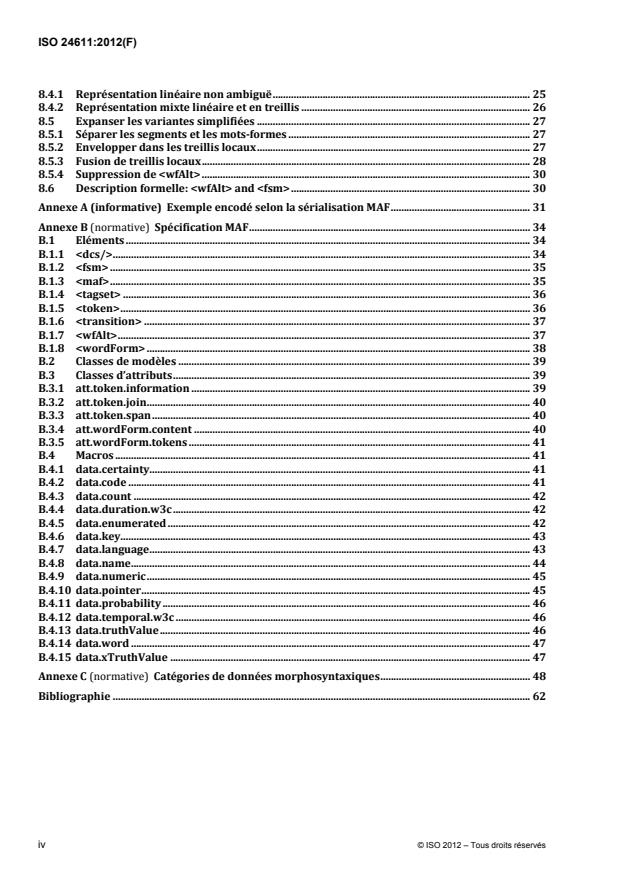
Sommaire Page
Avant-propos . v
Introduction . vi
1 Domaine d’application . 1
2 Références normatives . 1
3 Termes et définitions . 1
4 Le métamodèle MAF . 4
4.1 Vue d’ensemble . 4
4.2 Métamodèle MAF . 5
5 Segmentation . 6
5.1 Aspect général . 6
5.2 Description formelle: . 7
5.3 Notation enchâssée . 8
5.4 Représentation alternative pour les documents conformes à la TEI . 8
5.5 Notation déportée . 9
5.6 Attributs informatifs . 10
5.7 Compléter la notation enchâssée . 10
5.7.1 Joindre des segments dans le mode enchâssé . 11
5.7.2 Segments chevauchants . 11
6 Les mots-formes en tant qu’unités linguistiques . 12
6.1 Description formelle: . 13
6.2 Attachement de segment . 13
6.2.1 Un segment, un mot-forme . 13
6.2.2 Plusieurs segments contigus, un mot-forme . 13
6.2.3 Plusieurs segments discontigus, un mot forme . 13
6.2.4 Absence de segment, un mot-forme . 14
6.2.5 Un segment, plusieurs mots-formes . 14
6.3 Référencer les entrées lexicales . 15
6.4 Mots-formes composés . 16
6.5 Identification des mots-formes au sein d’un document conforme à la TEI . 16
7 Contenu morphosyntaxique . 19
7.1 Aspect général . 19
7.2 Utiliser les structures de traits . 19
7.3 Balises morphosyntaxiques compactes. 20
7.4 Les bibliothèques FSR . 20
7.5 Conception des ensembles de balises . 21
7.6 Description formelle: . 23
8 Gestion des ambiguïtés . 23
8.1 Ambiguïtés du contenu des mots-formes . 23
8.2 Ambiguïtés lexicales . 24
8.3 Ambiguïtés structurelles . 24
8.3.1 Ambiguïtés structurelles avec des mots-formes . 24
8.3.2 Ambiguïtés structurelles avec les segments . 25
8.4 Variantes structurées simplement . 25
8.4.1 Représentation linéaire non ambiguë . 25
8.4.2 Représentation mixte linéaire et en treillis . 26
8.5 Expanser les variantes simplifiées . 27
8.5.1 Séparer les segments et les mots-formes . 27
8.5.2 Envelopper dans les treillis locaux . 27
8.5.3 Fusion de treillis locaux . 28
8.5.4 Suppression de . 30
8.6 Description formelle: and . 30
Annexe A (informative) Exemple encodé selon la sérialisation MAF . 31
Annexe B (normative) Spécification MAF . 34
B.1 Eléments . 34
B.1.1 . 34
B.1.2 . 35
B.1.3 . 35
B.1.4 . 36
B.1.5 . 36
B.1.6 . 37
B.1.7 . 37
B.1.8 . 38
B.2 Classes de modèles . 39
B.3 Classes d’attributs . 39
B.3.1 att.token.information . 39
B.3.2 att.token.join . 40
B.3.3 att.token.span . 40
B.3.4 att.wordForm.content . 40
B.3.5 att.wordForm.tokens . 41
B.4
Macros . 41
B.4.1 data.certainty. 41
B.4.2 data.code . 41
B.4.3 data.count . 42
B.4.4 data.duration.w3c . 42
B.4.5 data.enumerated . 42
B.4.6 data.key. 43
B.4.7 data.language . 43
B.4.8 data.name . 44
B.4.9 data.numeric . 45
B.4.10 data.pointer . 45
B.4.11 data.probability . 46
B.4.12 data.temporal.w3c . 46
B.4.13 data.truthValue . 46
B.4.14 data.word . 47
B.4.15 data.xTruthValue . 47
Annexe C (normative) Catégories de données morphosyntaxiques . 48
Bibliographie . 62
iv © ISO 2012 – Tous droits réservés
Avant-propos
L'ISO (Organisation internationale de normalisation) est une fédération mondiale d'organismes
nationaux de normalisation (comités membres de l'ISO). L'élaboration des Normes internationales est
en général confiée aux comités techniques de l'ISO. Chaque comité membre intéressé par une étude a le
droit de faire partie du comité technique créé à cet effet. Les organisations internationales,
gouvernementales et non gouvernementales, en liaison avec l'ISO participent également aux travaux.
L'ISO collabore étroitement avec la Commission électrotechnique internationale (IEC) en ce qui
concerne la normalisation électrotechnique.
Les procédures utilisées pour élaborer le présent document et celles destinées à sa mise à jour sont
décrites dans les Directives ISO/IEC, Partie 1. Il convient, en particulier de prendre note des différents
critères d'approbation requis pour les différents types de documents ISO. Le présent document a été
rédigé conformément aux règles de rédaction données dans les Directives ISO/IEC, Partie 2
(voir www.iso.org/directives).
L'attention est appelée sur le fait que certains des éléments du présent document peuvent faire l'objet
de droits de propriété intellectuelle ou de droits analogues. L'ISO ne saurait être tenue pour
responsable de ne pas avoir identifié de tels droits de propriété et averti de leur existence. Les détails
concernant les références aux droits de propriété intellectuelle ou autres droits analogues identifiés
lors de l'élaboration du document sont indiqués dans l'Introduction et/ou dans la liste des déclarations
de brevets reçues par l'ISO (voir www.iso.org/brevets).
Les appellations commerciales éventuellement mentionnées dans le présent document sont données
pour information, par souci de commodité, à l’intention des utilisateurs et ne sauraient constituer un
engagement.
Pour une explication de la signification des termes et expressions spécifiques de l'ISO liés à l'évaluation
de la conformité, ou pour toute information au sujet de l'adhésion de l'ISO aux principes de
l’Organisation mondiale du commerce (OMC) concernant les obstacles techniques au commerce (OTC),
voir le lien suivant: www.iso.org/iso/fr/avant‐propos.html.
Le comité chargé de l'élaboration du présent document est l'ISO/TC 37, Terminologie et autres
ressources langagières et ressources de contenu, sous‐comité SC4, Gestion de ressources linguistiques.
Introduction
L’ISO/TC 37/SC 4 se concentre sur la définition des modèles et des formats utilisés pour représenter les
ressources linguistiques annotées. A cette fin, il généralise la stratégie de modélisation initialisée par
son comité frère le SC 3 pour la représentation des données terminologiques [Romary, 2001], selon
laquelle les modèles de données linguistiques sont considérés comme la combinaison d’un patron de
données génériques (un métamodèle), qui est ensuite perfectionné au moyen d’une sélection de
catégories de données qui fournissent les descripteurs correspondant à ce niveau spécifique
d’annotation. Ces modèles sont définis indépendamment des formats spécifiques et permettent à
l’implémenteur de disposer de l’outil conceptuel nécessaire pour concevoir et comparer les formats en
fonction de leurs niveaux d’interopérabilité.
Pour représenter tout type d’annotation, il est important de mettre à disposition une sémantique claire
et fiable pour les divers descripteurs utilisés, soit sous la forme de traits valués formels, soit
directement comme objets d’une représentation exprimée par exemple en XML. Pour que cette
sémantique puisse être partagée entre différents schémas d’annotation et d’applications d’encodage, il
convient de l’implémenter comme un registre centralisé de concepts: aussi, nous considérerons ces
concepts comme des catégories de données. En tant que telles, il convient que ces catégories de données
remplissent les conditions suivantes:
d’un point de vue technique, elles doivent fournir des références uniques et stables (implémentées
sous la forme d’identifiants pérennes au sens de l’ISO 24619) de telle manière que le concepteur
d’un schéma spécifique d’encodage puisse les référencer dans ses spécifications. Ainsi, deux
annotations seront considérées comme équivalentes quand elles feront référence à la même
catégorie de données (en tant que trait et valeur).
d’un point de vue descriptif, il convient que chaque référence sémantiquement unique soit associée
à une documentation précise combinant une explication en prose de la signification du descripteur
avec l’expression des contraintes spécifiques qui portent sur la catégorie.
Ces dernières années, l’ISO a développé un cadre général pour représenter et maintenir un tel registre
de catégories de données couvrant tous les domaines des ressources linguistiques. Cette initiative,
spécifiée par l’ISO 12620, a abouti à l’implémentation d’un environnement mis en ligne afin d’une part
de fournir l’accès à toutes les catégories de données qui ont été normalisées dans le contexte des
activités liées aux diverses ressources linguistiques au sein de l’ISO, et d’autre part spécifiquement au
titre de la maintenance du registre de catégories de données. Le système propose aussi un accès aux
diverses catégories de données que les praticiens des technologies du langage ont définies dans le cadre
de leur propre travail et qu’ils ont partagé ensuite avec la communauté.
Le registre de catégories de données, accessible via l’implémentation ISOCat (www.isocat.org) est juste
un espace d’objets sémantiques n’offrant qu’un ensemble limité de contraintes ontologiques. L’objectif
est de faciliter la maintenance d’un environnement au sein duquel de nouvelles catégories sont
facilement insérées et réutilisées sans qu’il soit nécessaire de procéder à une vérification approfondie
de la cohérence par rapport au reste du registre. En effet, les contraintes de base sont intrinsèques au
modèle de catégorie de données tel que défini par l’ISO 12620:
de simples relations génériques‐spécifiques quand elles sont utiles à une identification exacte des
descripteurs d’interopérabilité entre catégories de données. Par exemple, le fait que /properNoun/
soit une sous‐catégorie de /noun/ permet de comparer des annotations morphosyntaxiques
fondées sur différents niveaux de granularité;
vi © ISO 2012 – Tous droits réservés
la description des domaines conceptuels au sens de l’ISO 11179 pour identifier, quand elle est
connue ou identifiable la valeur possible de la dite catégorie de donnée complexe. Par exemple, elle
peut être utilisée pour enregistrer que la valeur possible de /grammaticalGender/ (limitée à un
petit groupe de langues [Romary 2011]), peut être un sous‐ensemble de {/ masculine/, /feminine/
et /neutral/};
des contraintes linguistiques spécifiques, soit sous la forme de notes d’application ou comme des
restrictions explicites portant sur les domaines conceptuels des catégories de données. Par
exemple, il est possible d’exprimer explicitement que /grammaticalGender/ en français ne peut
prendre que les deux valeurs: {/masculine/ et /feminine/}.
La présente Norme internationale fournit un cadre complet pour la représentation des annotations
morphosyntactiques (aussi dénommées annotations en partie du discours). Ce niveau d’annotation
correspond à un premier niveau d’abstraction par rapport aux données linguistiques (textuelles ou
parlées), dont la structure et la complexité peuvent varier considérablement en fonction de la langue à
annoter, de même que selon les caractéristiques de l’outil d’annotation ou du schéma d’annotation
utilisé.
Pour résoudre les problématiques complexes de l’ambiguïté et du déterminisme en annotation
morphosyntaxique, la présente Norme internationale introduit un méta‐modèle qui établit une
distinction nette entre les deux niveaux que sont les segments (représentant le découpage de surface de
la source) et lesmots‐formes (identifiant les abstractions lexicales associées aux groupes de segments).
Ces deux niveaux partagent les caractéristiques suivantes: d’une part, ils peuvent être représentés
comme de simples séquences et des graphes locaux tels que segmentations multiples et éléments
ambigus, et d’autre part, toute combinaison N à M peut relier les segments et les mots‐formes.
En tant que segments linguistiques (quelquefois dénommés ‘tokens’ ou ‘markables ‘ dans la littérature
technique anglaise [par exemple, Carletta et al. 1997]), ces segments peuvent être enchâssés dans le
document source comme une balise en ligne, ou peuvent y faire référence par l’intermédiaire
d’annotations déportées (‘stand‐off annotation’ en anglais).
En tant qu’abstractions linguistiques, les mots‐formes peuvent être qualifiés par divers traits
linguistiques caractérisant les propriétés morphosyntaxiques qui sont instanciées dans la réalisation de
l’entrée lexicale dans le texte annoté. Ces propriétés peuvent prendre diverses formes: de la simple
indication d'un lemme à une référence explicite à une entrée lexicale dans un dictionnaire. Dans la
plupart des applications existantes de l’annotation morphosyntaxique, les propriétés linguistiques sont
exprimées au moyen de balises; ces codes font référence aux structures de traits basiques (voir les
exemples dans Monachini and Calzolari, 1994). Ces codes peuvent aussi fournir de l’information
morphologique, incluant la partie du discours (par exemple, nom, adjectif ou verbe), et des traits
comme le nombre, le genre, la personne, le mode et le temps du verbe.
En phase avec la stratégie générale de modélisation de l’ISO/TC 37, la présente Norme internationale/le
cadre MAF fournit les moyens de mise en relation des balises morphosyntaxiques exprimées en tant
que structures de traits (conformes à l’ISO 24610) avec les catégories de données d’ISOCat. Une annexe
normative de la présente Norme internationale explicite un jeu de base de catégories de données qui
peuvent être utilisées comme référence pour la plupart des tâches d’annotation morphosyntaxiques
dans un contexte multilingue. Néanmoins, si des utilisateurs de la présente Norme internationale
estiment que ces catégories sont inappropriées du point de vue de la couverture, du domaine
d’application ou de la sémantique, ils sont invités à utiliser ISOCat pour définir leurs propres catégories
en conformité avec les principes de l’ISO/TC 37.
Associé au méta‐modèle, le cadre MAF fournit aussi une syntaxe XML par défaut qui peut être utilisée
pour sérialiser les modèles d’annotation conformes. Etant donné que de nombreux projets existants
sont basés sur les lignes directrices émanant du consortium TEI (Text Encoding Initiative, www.tei‐
c.org) — particulièrement dans les humanités numériques, où un encodage correct des sources
textuelles est essentiel — la présente Norme internationale fournira aussi des informations sur la façon
concilier le modèle MAF et les encodages conformes à la TEI. En effet, les lignes directrices de la TEI
offrent d’ores et déjà une grande variété de constructions et de mécanismes pour prendre en charge les
nombreux défis posés par les corpus oraux et leurs annotations (Romary and Witt, 2012).
Enfin, il convient de noter que la présente Norme internationale constitue la base conceptuelle
permettant d’élaborer la série de normes ISO 24614 relative à la segmentation des unités lexicales. La
totalité des règles et principes généraux définis dans l’ISO 24614‐1 de même que les contraintes
exprimées dans des parties complémentaires traitant de langues spécifiques, doivent être appréhendés
dans le respect de la dichotomie segment / mot‐forme.
viii © ISO 2012 – Tous droits réservés
NORME INTERNATIONALE ISO 24611:2012(F)
Gestion des ressources langagières — Cadre d'annotation
morphosyntaxique (MAF)
1 Domaine d’application
La présente Norme internationale fournit un cadre pour la représentation des annotations des mots‐
formes dans les textes; ces annotations concernent les segments, leurs relations avec les unités
lexicales, et leurs propriétés morphosyntaxiques.
Elle présente un métamodèle pour l’annotation morphosyntaxique qui référence les catégories de
données dans le registre des catégories de données ISOCat (DCR tel que défini dans l’ISO 12620). Elle
décrit aussi une sérialisation XML pour l’annotation morphosyntaxique, avec les équivalences des lignes
directrices de la TEI (Text Encoding Initiative).
2 Références normatives
Les documents référencés sont indispensables à l’application de ce document. Pour les références
datées, seule l’édition citée s’applique. Pour les références non datées, la dernière édition du document
référencé s’applique (incluant ses éventuels amendements).
ISO 24610‐1, Gestion des ressources linguistiques — Structures de traits — Partie 1: Représentation de
structures de traits
3 Termes et définitions
Pour les besoins du présent document, les termes et définitions donnés dans l’ISO 24610‐1 ainsi que les
suivants s’appliquent:
3.1
GOA
DAG
graphe orienté acyclique
graphe contenant des arcs orientés et sans cycle
Note 1 à l’article: les graphes orientés acycliques sont des sous‐ensembles des automates finis (3.4).
3.3
structure de trait
ensemble des spécifications de trait, utilisé dans le cadre d’annotation morphosyntaxique (MAF) pour
exprimer le contenu morphosyntaxique
Note 1 à l’article: les structures de trait sont spécifiées dans l’ISO 24610‐1.
3.4
AEF
FSA
automate fini
graphes comprenant plusieurs états avec un état initial et un état final, et un ensemble fini de
transitions pour passer d'un état à l'autre
Note 1 à l’article: Voir aussi GOA (3.1).
3.5
graphème
unité minimale dans une langue écrite
EXEMPLE Lettre, pictogramme, idéogramme, numérique, ponctuation.
3.6
flexion
modification ou balise d’un lexème qui reflète ses propriétés morphosyntaxiques
3.7
forme fléchie
forme qu’un mot peut prendre dans une phrase ou une proposition
Note 1 à l’article: Une forme fléchie d’un mot est associée avec une combinaison de traits morphologiques
comme le nombre grammatical ou le cas.
3.8
lemme
forme lemmatisée
forme conventionnelle choisie pour représenter un lexème
Note 1 à l’article: Dans les langues européennes, le lemme est habituellement le singulier s’il y a une variation en
nombre, le masculin s’il y a une variation en genre, et l’infinitif pour tous les verbes. Dans certaines langues,
certains noms sont défectifs au singulier, auquel cas on choisit le pluriel. Pour les verbes en arabe, le lemme est
habituellement la troisième personne du singulier à l’aspect accompli
3.9
lexème
morphème généralement associé à un ensemble de mots‐formes partageant un sens en commun
3.10
entrée lexicale
conteneur pour gérer un ensemble de mots‐formes et éventuellement un ou plusieurs sens pour décrire
un lexème
3.11
lexique
ressource comprenant une collection d’entrées lexicales pour une langue
3.12
morphème
plus petite unité linguistique porteuse de sens dans un discours et qui ne peut être divisée en de plus
petites unités porteuses de sens
Note 1 à l’article: Un morphème est soit grammatical (grammème), soit lexical (lexème).
2 © ISO 2012 – Tous droits réservés
3.13
trait morphologique
trait morphosyntaxique
trait induit à partir de la forme fléchie d’un mot
Note 1 à l’article: Le registre de catégories de données ISOCat fournit une liste complète de valeurs pour les
langues européennes.
EXEMPLE “genre grammatical”.
3.14
morphologie
description de la structure et de la formation des mots‐formes
3.15
balise morphosyntaxique
balise
structure de trait utilisée systématiquement pour qualifier un mot‐forme
3.16
ensemble de balises
tagset
jeu d'étiquettes de segments
ensemble complet de balises, utilisé pour la description morphosyntaxique d’une langue
Note 1 à l’article: Pour décrire un ensemble de balises, il y a lieu d'utiliser le registre de catégories de données
ISOCat.
3.17
partie du discours
catégorie grammaticale
catégorie affectée à un mot en vertu de ses propriétés grammaticales et sémantiques
EXEMPLE nom, verbe.
Note 1 à l’article: Le registre de catégories de données ISOCat fournit une liste complète de valeurs pour des
parties du discours.
3.18
phonème
plus petite unité du système audio‐phonatoire d’une langue
3.19
écriture
ensemble de caractères graphiques utilisés dans la forme écrite d’une ou plusieurs langues
3.20
relation syntagmatique
relation par laquelle sont associées des unités linguistiques de discours
3.21
segment
séquence non vide contiguë de graphèmes ou de phonèmes dans un document
Note 1 à l’article: Pour des raisons éditoriales, certains schémas d’annotations peuvent étendre la notion de
segment à une séquence vide. Voir la section sur l’attachement de segment (6.2).
3.22
segmentation
processus identifiant les segments
3.23
transcription
forme résultant de l'application d’une méthode cohérente d’écriture d’une production orale
3.24
translittération
forme résultant de la conversion d’une écriture dans une autre, habituellement via une correspondance
une à une entre caractères
3.25
mot-forme
unité morphosyntaxique
unité linguistique contiguë ou non contiguë identifiée comme correspondant à une entrée lexicale dans
une langue
Note 1 à l’article: Les mots‐formes peuvent avoir ou ne pas avoir de réalisation acoustique ou graphique, ou
peuvent correspondre à un ou plusieurs segments.
3.26
treillis de mots
ensemble des décompositions possibles d’un texte oral ou écrit, en mots‐formes
Note 1 à l’article: Un treillis de mots possède les propriétés algébriques d’un graphe orienté acyclique avec un
nœud initial et un nœud final.
Note 2 à l’article: Voir aussi GOA (3.1) et AEF (3.4).
4 Le métamodèle MAF
4.1 Vue d’ensemble
Les annotations morphosyntaxiques fournissent une couche importante des informations linguistiques
d’un document. La présente Norme internationale est fondée sur un métamodèle qui opère une claire
distinction entre les deux niveaux de segments (représentant la segmentation de surface de la source)
et les mots‐formes (identifiant des abstractions lexicales associées aux groupes de segments). Ces deux
niveaux partagent les spécificités suivantes: d’une part, ils peuvent être représentés comme de simples
séquences et comme des graphes locaux (par exemple, de multiples segmentations et des composés
ambigus), et d’autre part, toute combinaison N à M peut relier les mots‐formes et les segments. Cette
Norme internationale délimite des séquences minimales et maximales dans les documents (qu’elles
soient écrites ou orales) qui peuvent être identifiées comme mots‐formes et cherche à catégoriser les
critères linguistiques et distributionnels qui peuvent être utilisés pour marquer ces mots‐formes au
sein de contextes syntagmatiques plus étendus. Les unités minimales ne peuvent pas être décomposées
plus avant en utilisant des critères similaires, mais elles peuvent néanmoins être subdivisées en
fonction de propriétés morphologiques ou phonologiques. Les mots‐formes peuvent être agrégés pour
constituer des unités plus grandes (telles que mots composés ou des unités multi‐mots) qui agissent en
4 © ISO 2012 – Tous droits réservés
tant qu'unités élémentaires pour d’autres niveaux de l’analyse linguistique, notamment la syntaxe. En
particulier, les mots‐formes correspondent au niveau non terminal défini dans l’ISO 24615.
4.2 Métamodèle MAF
La Figure 1 présente une vue simplifiée du métamodèle proposé pour les annotations
morphosyntaxiques, alors que la Figure 2 présente une vue plus formelle fondée sur UML (Unified
Modeling Language).
Figure 1 — Vue simplifiée du métamodèle MAF
Un document annoté comporte un document original et un ensemble d’annotations. Les annotations
sont associées à des mots‐formes correspondant à zéro ou plusieurs segments dans le document
original. Un mot‐forme peut aussi être associé à une entrée lexicale fournissant de l’information à
propos de son lemme sous‐jacent et sa forme fléchie. L’annotation morphosyntaxique associée au mot‐
forme est représentée par une balise dont la signification peut être exprimée sous la forme d’une
structure de trait. L'ensemble des balises utilisées par un schéma d’annotation particulier est appelé jeu
de balises, et correspond à ce qui est défini dans l’ISO 24610‐2 pour les représentations de structures
de traits (FSR) en tant que bibliothèque de structures de traits. Il convient que chaque catégorie
discrète contenue dans le jeu de balises soit descriptible dans les termes du registre des catégories de
données décrit dans l’ISO 12620 et implémenté dans ISOCat. Du fait que l’annotation peut être
appliquée à la fois aux segments et aux mots‐formes, une ambiguïté structurelle peut apparaître. Ainsi,
l’annotation est typiquement conceptualisée comme un ou plusieurs flux, chacun représentant un
treillis de mots, ou plus formellement, comme un graphe orienté acyclique (DAG).
Figure 2 — Vue UML du métamodèle MAF
5 Segmentation
5.1 Aspect général
Les annotations morphosyntaxiques sont portées par les segments, appelés “tokens” en anglais, qui sont
présents dans le flux du document, mais ceci n’implique pas que la segmentation résultante
corresponde à une séquence de segments adjacents qui partitionne le document original. Il est
particulièrement important de distinguer les mots‐formes de leurs réalisations. Quelques sections d’un
document peuvent ne porter aucune annotation (ex. marques typographiques, directives intermédiaires
6 © ISO 2012 – Tous droits réservés
ou éléments de balise) alors que d’autres sections ne correspondent pas exactement à leur forme
segmentée (ex: abréviations, sténographies, erreurs et variantes orthographiques, contractions
typographiques et morphologiques). Un mot‐forme peut ne pas correspondre exactement à un segment
identifié par des marques orthographiques tels que des espaces ou des tirets (ex: mots composés
allemands, transcriptions de la parole ou orthographe sanskrite).
La liste suivante montre des exemples typiques d’entrées segmentées dans deux langues, avec le
fragment linguistique original suivi de la représentation en segments avec des chaînes de caractères
séparées par une barre verticale:
La petite fille
La|petite|fille
白菜和猪肉
白|菜|和|猪|肉
L’élément est utilisé pour représenter ces segments du document original qui,
approximativement, suit les frontières orthographiques, morphologiques ou phonologiques. La
présente Norme internationale ne définit pas les propriétés linguistiques des segments. Selon la langue
considérée, un segment peut être identifié par ses propriétés typographiques (espace, tirets ou
caractères), ses propriétés phonologiques (ex: phénomène de liaison, hiatus, élision, dévoisement final
comme dans "Auslautverhärtung" en allemand), ses propriétés morphologiques (radical, affixe,
morphème etc.), ou par toutes ces propriétés. La description des structures orthographiques,
morphologiques, phonologiques et lexicales pouvant définir un segment, n’est pas couverte par la
présente Norme internationale.
Ne sont pas couverts par la présente Norme internationale, les aspects du système d’écriture qui sont
utilisés pour formater les pages ou séparer les mots et paragraphes, et qui fournissent de l’information
d’encodage, sachant que ces dispositifs ne constituent pas l’annotation morphosyntaxique.
5.2 Description formelle:
Le niveau segment dans MAF est implémenté au moyen de l’élément . C’est formellement défini
comme suit:
élément utilisé pour baliser les segments comme défini en 3.21:
@from Frontière d’empan gauche
@to Frontière d’empan droite
@join Relation entre segments voisins
att.token.information attributs utilisés pour de fournir de l’information supplémentaire sur le
contenu du segment:
@form Forme canonique du segment
@phonetic Transcription phonétique
@transcription Transcription générale
@transliteration Transcription en d’autres écritures
5.3 Notation enchâssée
Il n’est pas toujours nécessaire de séparer le document original de ses annotations. Dans les cas simples,
le contenu textuel peut être directement enchâssé entre des éléments sous forme d’une
annotation en ligne. Un exemple est montré dans la Figure 3.
The
victim
's
friends
told
police
that
Krueger
drove
into
the
quarry
and
never
surfaced
.
Figure 3 — Annotation enchâssée de segments pour la phrase ‘The victim's friends told the
police that Krueger drove into the quarry and never surfaced.’ (en)
Bien que cette annotation enchâssée soit utilisée dans la plupart des exemples de MAF, elle peut poser
problème dans certaines circonstances où les caractères d’espacement en XML n’ont pas été
proprement pris en compte, ou plus significativement en présence de hiérarchies en conflit les unes
avec les autres. Dans de telles circonstances, il peut être préférable de définir le contenu du segment à
l’aide de la notation déportée.
5.4 Représentation alternative pour les documents conformes à la TEI
Pour les représentations qui sont basées sur des textes ou des transcriptions encodés conformément
aux lignes directrices émanant de la TEI, il faut utiliser l’élément dans l’espace de nom TEI
(http://www.tei‐c.org/ns/1.0) afin d’implémenter le niveau segment du métamodèle MAF. Pour les
marques de ponctuation, il faut utiliser l’élément . Cela est illustré par l’exemple présenté à la
Figure 4.
8 © ISO 2012 – Tous droits réservés
The
victim
's
friends
told
police
that
Krueger
drove
into
the
quarry
and
never
surfaced
.
Figure 4 — Texte segmenté encodé conformément aux lignes directrices émanant de la TEI
5.5 Notation déportée
Le contenu de l’élément peut aussi être défini indépendamment du document original en
référençant un intervalle au sein du flux de caractères constituant le document. Les attributs @from et
@to sont utilisés pour définir de tels intervalles. La valeur de ces attributs dépend d’une part du schéma
d’adressage choisi pour dénoter des positions non ambigues dans le document et d’autre part de la
nature du document original. Dans les cas simples, les déplacements de caractères sont suffisants. L’ISO
24612 fait usage de points d’ancrage pour référencer ces lieux physiques au milieu des données de
base. En supposant un document commençant par ‘The victim's friends.’, nous pouvons ainsi
représenter les quatre premiers segments comme suit dans la Figure 5.
Positions dans le document:
|T|h|e| |v|i|c|t|i|m|'|s| |f|r|i|e|n|d|s|
0 1 2 3 4 5 6 7 8 9 0 1 2 3 4 5 6 7 8 9 0
1 2
Figure 5 — Sérialisation dans la segmentation déportée
Quand la segmentation doit être implémentée dans un document encodé selon la TEI, il faut appliquer la
syntaxe présentée à la Figure 6.
Figure 6 — Annotation déportée en conformité avec les lignes directrices de la TEI
5.6 Attributs informatifs
Les segments identifient des fragments du document original, soit en les englobant ou soit en pointant
vers eux de manière déportée, au travers de la spécificatio
...
МЕЖДУНАРОДНЫЙ ISO
СТАНДАРТ 24611
Первое издание
2012-11-01
Управление языковыми ресурсами.
Морфосинтаксическая аннотационная
система (MAF)
Language resource management. – Morpho-syntactic
annotation framework (MAF)
Ответственность за подготовку русской версии несѐт GOST R
(Российская Федерация) в соответствии со статьѐй 18.1 Устава ISO
Ссылочный номер
©
ISO 2012
ДОКУМЕНТ ЗАЩИЩЁН АВТОРСКИМ ПРАВОМ
© ISO 2012
Все права сохраняются. Если не указано иное, никакую часть настоящей публикации нельзя копировать или использовать в
какой-либо форме или каким-либо электронным или механическим способом, включая фотокопии и микрофильмы, без
предварительного получения письменного согласия ISO по указанному ниже адресу или организации-члена ISO в стране
запрашивающей стороны.
Бюро ISO по авторским правам:
Case postale 56 CH-1211 Geneva 20
Тел.: + 41 22 749 01 11
Факс: + 41 22 749 09 47
Эл. почта: copyright@iso.org
Веб-сайт: www.iso.org
Опубликовано в Швейцарии
©
ii ISO 2012 – Все права сохраняются
Содержание Страница
Предисловие. v
Введение . vi
1 Область применения . 1
2 Нормативные ссылки . 1
3 Термины и определения . 1
4 Метамодель MAF . 4
4.1 Общий обзор . 4
4.2 Метамодель MAF . 5
5 Сегментирование с помощью лексем . 6
5.1 Общие замечания . 6
5.2 Формальное описание: . 7
5.3 Нотация вложения . 7
5.4 Альтернативное представление документов на основе рекомендаций TEI . 8
5.5 Автономная аннотация . 8
5.6 Информативные атрибуты . 9
5.7 Улучшение строковой формы записи лексем . 10
5.7.1 Соединение лексем в режиме вложения . 10
5.7.2 Перекрещивающиеся лексемы . 10
6 Словоформы как лингвистические единицы . 11
6.1 Формальное описание словоформы: . 12
6.2 Присоединение лексических единиц . 12
6.2.1 Одна лексическая единица - одна словоформа . 12
6.2.2 Несколько неразрывных лексем – одна словоформа . 12
6.2.3 Несколько дискретных лексем – одна словоформа . 12
6.2.4 Нулевое число лексем – одна словоформа . 13
6.2.5 Одна лексема – несколько словоформ. 14
6.3 Ссылки на лексические статьи . 14
6.4 Сложносоставные словоформы . 15
6.5 Идентификация словоформ в рамках TEI-совместимого документа . 15
7 Морфосинтаксическое содержание . 18
7.1 Общие замечания . 18
7.2 Использование признаковых структур . 18
7.3 Компактные морфосинтаксические теги . 19
7.4 Библиотеки FSR . 19
7.5 Построение теговых наборов . 20
7.6 Формализованное описание: . 22
8 Обработка неопределѐнностей . 22
8.1 Неопределѐнности содержания словоформ . 22
8.2 Лексические неопределѐнности . 23
8.3 Структурные неопределѐнности . 23
8.3.1 Структурные неопределѐнности словоформ . 23
8.3.2 Структурные неопределѐнности, связанные с лексемами . 24
8.4 Упрощѐнные варианты структурирования . 24
8.4.1 Непротиворечивое линейное представление . 24
8.4.2 Смешанное линейно-решѐточное представление . 25
8.5 Расширение упрощѐнных вариантов . 26
8.5.1 Разбиение лексем и словоформ . 26
8.5.2 Свѐртывание в локальные решѐтки . 26
8.5.3 Слияние локальных решѐток . 27
8.5.4 Удаление элемента . 28
8.6 Формализованное описание элементов и . 29
Приложение A (информативное) Пример кодирования с использованием сериализации MAF . 30
iii
Приложение B (информативное) Спецификация MAF . 33
B.1 Элементы . 33
B.1.1 . 33
B.1.2 . 34
B.1.3 . 34
B.1.4 . 35
B.1.5 . 35
B.1.6 . 36
B.1.7 . 36
B.1.8 . 37
B.2 Классы моделей . 38
B.3 Классы атрибутов . 38
B.3.1 att.token.information . 38
B.3.2 att.token.join . 39
B.3.3 att.token.span . 39
B.3.4 att.wordForm.content . 39
B.3.5 att.wordForm.tokens . 40
B.4 Макросы . 40
B.4.1 data.certainty . 40
B.4.2 data.code . 40
B.4.3 data.count . 40
B.4.4 data.duration.w3c . 41
B.4.5 data.enumerated . 41
B.4.6 data.key . 41
B.4.7 data.language . 42
B.4.8 data.name . 43
B.4.9 data.numeric . 43
B.4.10 data.pointer . 43
B.4.11 data.probability . 44
B.4.12 data.temporal.w3c . 44
B.4.13 data.truthValue . 44
B.4.14 data.word. 45
B.4.15 data.xTruthValue . 45
Приложение C (нормативное) Категории морфосинтаксических данных . 46
Библиография . 62
iv
Предисловие
Международная организация по стандартизации (ISO) является всемирной федерацией национальных
организаций по стандартизации (комитетов-членов ISO). Разработка международных стандартов
обычно осуществляется техническими комитетами ISO. Каждый комитет-член, заинтересованный в
деятельности, для которой был создан технический комитет, имеет право быть представленным в этом
комитете. Международные правительственные и неправительственные организации, имеющие связь с
ISO, также принимают участие в работе. ISO работает в тесном сотрудничестве с Международной
электротехнической комиссией (IEC) по всем вопросам стандартизации в области электротехники.
Проекты международных стандартов разрабатываются согласно правилам, приведѐнным в Директивах
ISO/IEC, Часть 2.
Разработка международных стандартов является основной задачей технических комитетов. Проекты
международных стандартов, принятые техническими комитетами, рассылаются комитетам-членам на
голосование. Для публикации в качестве международного стандарта требуется одобрение не менее
75 % комитетов-членов, принявших участие в голосовании.
Принимается во внимание тот факт, что некоторые из элементов настоящей части стандарта ISO 9735
могут быть объектом патентных прав. ISO не принимает на себя обязательств по определению
отдельных или всех таких патентных прав.
ISO 24611 был подготовлен Техническим комитетом ISO/TC 37, Терминология и другие языковые и
информационные ресурсы, Подкомитетом SC 4, Управление языковыми ресурсами.
v
Введение
Внимание подкомитета SC 4 Технического комитета TC 37 сосредоточено на определении моделей и форм
представления аннотированных языковых ресурсов, вследствие чего он распространил стратегию построения
моделей, определѐнную родственным подкомитетом SC 3, на представление терминологических данных [14];
благодаря этому модели лингвистической информации рассматриваются как обобщѐнные структуры данных
(метамодели), которые в дальнейшем детализируются путѐм отбора соответствующих категорий данных на роль
дескрипторов для конкретного уровня аннотирования. Такие модели определяются независимо от каких-либо
конкретных форматов и предоставляют в распоряжение специалиста, реализующего определѐнный проектный
замысел, нужный для этого концептуальный инструментарий, который позволяет ему проектировать и сравнивать
разные форматы представления по их функциональной эффективности.
Одним из важнейших аспектов представления аннотации любого вида является возможность чѐткого и
достоверного описания семантики различных используемых дескрипторов – либо в виде формального
описания их характеристик и конкретных значений, либо как объектов формализованного
представления, например, на языке XML. In order to be shared across various annotation schemas and
encoding applications, такие семантические средства должны реализовываться как некий
централизованный реестр понятий, к которому пользователь может обращаться как к справочнику
категорий данных. Категории данных как таковые должны нести в себе следующие ограничения:
С технической точки зрения, они должны обеспечивать однозначные стабильные ссылки (реализуемые как
постоянные идентификаторы в том смысле, как они определены в ISO 24619), чтобы разработчик конкретной
схемы кодирования мог использовать ссылки на стандартизованные категории данных в своѐм описании. При
таком подходе две аннотации будут считаться эквивалентными, когда они определены применительно к
одним и тем же категориям (что и характеристика с еѐ значением).
В дескриптивном плане каждая уникальная семантическая ссылка должна ассоциироваться с
подробной документацией, которая содержит в себе полнотекстовый фрагмент описания значения
дескриптора с представлением конкретных ограничений, обусловливающих категорию данных.
В последние годы ISO был разработана общая основа для представления и сопровождения такого реестра
категорий данных, охватывающего все сферы использования языковых ресурсов. Реализация этой
инициативной разработки, описанной в стандарте ISO 12620, привела к созданию оперативно доступной
лингвистической среды применительно ко всем категориям данных, которые стандартизуются в рамках
многочисленных операций с языковыми ресурсами в связи с внутренней деятельностью ISO, или специально –
как часть механизма сопровождения реестра категорий данных. Через этот реестр обеспечивается также доступ
к многочисленным категориям данных, которые специалисты по лингвистическим технологиям определяют
применительно к конкретным языкам в рамках своей повседневной работы и считают целесообразным довести
информацию о них до сведения пользовательского сообщества.
Реестр категорий данных ISO в том виде, как он доступен на сайте ISOCat (www.isocat.org), призван играть роль ―не
спекулятивной‖ рыночной площадки семантических объектов, которая накладывает минимум онтологических
ограничений. Цель создания подобного реестра заключается в том, чтобы облегчить сопровождение всеобъемлющей
дескриптивной среды, в которую легко встраиваются для повторного использования новые категории, без
необходимости жѐсткой проверки их на соответствие всему реестру в целом. При этом, естественно, частью модели
категорий данных являются перечисленные ниже базовые ограничения, как они определены в ISO 12620:
связи типа ―общий - специальный‖ должны быть простыми, чтобы они могли использоваться для точной
идентификации дескрипторов совместимости различных категорий данных. Например, тот факт, что
/properNoun/ (имя собственное) является подкатегорией /noun/ (имени существительного), делает возможным
сравнение морфосинтаксических аннотаций на основе описаний с разными уровнями детализации;
описание концептуальных областей должно соответствовать требованиям ISO 11179 для облегчения
идентификации возможных значений так называемых сложных категорий данных, когда они применимы или
распознаваемы. Например, подобное описание может использоваться для регистрации того факта, что
возможные значения концепта /grammaticalGender/ (грамматический род) в малочисленной группе языков [15],
могут принадлежать подмножеству {/masculine/, /feminine/ and /neutral/} (мужской, женский и средний);
ограничения, относящиеся к конкретному языку, должны представляться в форме замечаний по
vi
применению или явно сформулированных ограничений, касающихся концептуальных областей сложных
категорий данных. Например, можно в явной форме записать, что концепт /grammaticalGender/ во
французском языке может принимать только два значения: {/masculine/ и /feminine/} (мужской и женский).
Настоящий международный стандарт обеспечивает широкую основу для представления аннотаций
морфосинтаксических структур (называемых также частями речи). Такая аннотация соответствует
первому уровню абстрагирования от лексических значений языковых данных (текстовых или речевых),
и в зависимости от языка, в рамках которого осуществляется аннотирование, и от характеристик
используемого метода или схемы аннотирования, может в очень широких пределах изменяться по
своей структуре и степени сложности.
Для облегчения проработки таких сложных вопросов аннотирования, как обеспечение однозначности и
детерминизма, настоящим Международным стандартом определяется метамодель, в которой
проводится чѐткое различие между двумя уровнями лексических единиц (представляющих
сегментацию источника информации на поверхностном уровне) и словоформами (которые
идентифицируют лексические абстракции, связанные с группами лексических единиц). Оба этих уровня
обладают следующими одинаковыми особенностями: с одной стороны, они могут представляться как
простые последовательности и локальные графы множества сегментаций и неоднозначных компоновок,
а с другой стороны, все N словоформ могут образовывать комбинации с N лексическими единицами.
В качестве лингвистических сегментов, которые иногда называются в специальной литературе, как,
например, в [12], маркерами (‗markables‘), лексические единицы могут встраиваться в первоисточник
информации в виде внутристрочных меток либо могут указывать на него дистанционно посредством
так называемых автономных аннотаций.
Словоформы как лингвистические абстракции могут классифицироваться по различным лингвистическим
признакам, характеризующим морфосинтаксические свойства, которые приписаны конкретной реализации
лексической статьи в рамках аннотируемого текста. Такие свойства могут варьироваться в широком диапазоне –
от простого указания на лемму до представленной явным образом ссылки на лексему в словаре. В большинстве
существующих приложений морфосинтаксического аннотирования лингвистические характеристики
отображаются с помощью так называемых тегов, которые являются кодовым представлением основных
признаковых структур (их давние примеры приведены в работе Моначини и Кальзолари [13]). Эти коды могут
также нести в себе морфологическую информацию, включая указание части речи (например, существительное,
прилагательное или глагол) и такие характеристики, как число, род, лицо, наклонение и глагольное время.
В соответствии с общей стратегией моделирования, принятой Техническим комитетом ISO/TC 37,
представленная в настоящем Международном стандарте морфосинтаксическая аннотационная система (MAF)
обеспечивает необходимые средства привязки морфосинтаксических тегов, реализуемых признаковыми
структурами (согласно ISO 24610), к категориям данных, имеющимся на сайте ISOCat. Нормативное
Приложение настоящего Международного стандарта устанавливает множество ключевых категорий данных,
которые могут использоваться в режиме ссылок при решении наиболее актуальных текущих задач
морфосинтаксического аннотирования в многоязычном контексте. Тем пользователям настоящего
Международного стандарта, которые сочтут представленные в нѐм категории не подходящими им по охвату,
сфере применения или семантическим характеристикам, рекомендуется использовать реестр ISOCat для
определения собственных категорий данных в соответствии с принципами работы ISO/TC 37.
В соединении с метамоделью MAF обеспечивает также стандартную синтаксическую структуру языка XML,
которая может использоваться для сериализации аннотационных моделей, совместимых с MAF. Так как многие
существующие лингвистические проекты основываются на рекомендациях Международной организации по
кодированию текстовой информации [Text Encoding Initiative (TEI)] (www.tei-c.org), жизненно важных для
цифрового представления текстовых первоисточников в компьютеризованном обществе, настоящий
Международный стандарт нацелен также на разъяснение способов использования модели MAF в сочетании с
TEI-совместимыми методами кодирования. В рамках руководящих указаний TEI уже предложено множество
концепций и механизмов для решения широкого круга проблем, связанных с формированием корпусов
разговорных языков и их аннотирования [15].
В заключение следует отметить, что данный международный стандарт создаѐт концептуальную основу для
разработки стандартов серии ISO 24614, касающихся сегментирования текстовой информации, общие принципы и
правила которого определены в ISO 24614-1, равно как и для понимания ограничений, излагаемых в
дополнительных частях этой серии, которые относятся к конкретным языкам, в соответствии с дихотомией
лексема – словоформа.
vii
МЕЖДУНАРОДНЫЙ СТАНДАРТ ISO 24611:2012(R)
Управление языковыми ресурсами. Морфосинтаксическая
аннотационная система (MAF)
1 Область применения
Настоящий международный стандарт обеспечивает основу для представления аннотаций словоформ
в текстах; такие аннотации содержат в себе лексемы, а также их связи с лексическими единицами и
морфосинтаксические свойства.
В стандарте описывается метамодель морфосинтаксической аннотации применительно к ссылкам на
категории данных, которые содержатся в реестре категорий данных ISOCat (определѐнном как DCR в
ISO 12620). Описывается также сериализация XML-описаний для морфосинтаксических аннотаций в
соответствии с рекомендациями TEI (Text Encoding Initiative).
2 Нормативные ссылки
Перечисленные ниже ссылочные документы обязательны для применения данного документа. В
случае датированных ссылок действующим является только указанное издание. Применительно к
недатированным ссылочным документам применяются их самые последние издания (включая все
последующие изменения):
ISO 24610-1, Управление языковыми ресурсами. Структуры элементов. Часть 1: Представление
структур элементов
3 Термины и определения
Для целей данного документа используются термины и определения из стандарта ISO 24610-1, а
также терминология, приведѐнная ниже.
3.1
орграф без циклов, ациклический орграф
DAG
directed acyclic graph
граф с ориентированными дугами, не имеющий циклов
Примечание 1 к статье: графы без циклов являются подмножеством конечных автоматов (3.4).
3.3
признаковая структура
feature structure
множество спецификаций элементов, используемых в системе морфосинтаксического аннотирования
(MAF) для выражения морфосинтаксического содержания
Примечание к статье 1: признаковые структуры описываются как структуры элементов в ISO 24610-1.
3.4
конечные автоматы, КА
FSA
finite state automata
графы переходных состояний, отображающие начальное и конечное состояния и конечное множество
переходов автомата из одного состояния в другое
Примечание 1 к статье: см. также орграф без циклов (3.1).
3.5
графема
grapheme
минимальная единица письменного языка
ПРИМЕР буква, пиктограмма, идеограмма, число, знак пунктуации.
3.6
изменение формы слова
inflection
модификация или маркировка лексемы, отражающая еѐ морфосинтаксические свойства
3.7
изменѐнная форма
inflected form
форма, которую слово может принимать в предложении или грамматическом обороте
Примечание 1 к статье: Изменѐнная форма слова ассоциируется с какой-либо из морфологических характеристик,
таких как грамматическое число и падеж.
3.8
лемма
лемматизированная форма
lemma
lemmatised form
общеупотребительная форма представления лексемы
Примечание 1 к статье: В европейских языках лемма обычно представляется в единственном числе, если
существует множественное; в мужском роде, когда существует изменение по родам, и в инфинитиве глаголов. В
некоторых языках определѐнные имена существительные в форме единственного числа имеют недостаточную
парадигму; в таких случаях для представления леммы выбирается множественное число. Для глаголов арабского
языка лемма обычно представляется в третьем лице единственного числа совершенного вида.
3.9
лексема
lexeme
морфема, обычно ассоциируемая с множеством словоформ, соответствующих одному общему значению
3.10 лексическая статья
lexical entry
контейнер, обеспечивающий манипулирование множеством словоформ и, возможно, одним или
несколькими значениями для описания лексемы
3.11
словарь
lexicon
информационный ресурс, содержащий коллекцию лексических статей некоторого языка
3.12 морфема
morpheme
мельчайшая лингвистическая единица, которая несѐт в себе смысл в дискурсе, но не может быть
разбита на более мелкие значимые единицы
Примечание 1 к статье: Морфема может быть грамматической (и тогда она называется граммемой) или
лексической (т.е. лексемой).
3.13
морфологическая характеристика
морфосинтаксическая характеристика
morphological feature
morpho-syntactic feature
характеристика, выводимая из формы слова
Примечание 1 к статье: Реестр категорий данных ISOCat предоставляет всеобъемлющий список значений для
европейских языков.
ПРИМЕР ―grammaticalGender‖ (грамматический род).
3.14
морфология
morphology
описание структуры и способа образования словоформ
ПРИМЕЧАНИЕ 2 Структуры элементов частично упорядочены. Минимальными в этом упорядочении являются
пустые структуры элементов.
3.15
морфосинтаксический тег
morpho-syntactic tag
tag
признаковая структура, систематически используемая в качестве спецификатора словоформы
3.16
набор тегов, теговый набор
tagset
исчерпывающее множество тегов, используемых для морфосинтаксического описания языка
Примечание 1 к статье: Для описания набора тегов в качестве ссылочного источника должен использоваться
реестр категорий данных ISOCat.
3.17
часть речи
грамматическая категория
part of speech
grammatical category
категория, присваиваемая слову на основе учѐта его грамматических и семантических свойств
ПРИМЕР существительное, глагол.
Примечание 1 к статье: Исчерпывающий список значений для частей речи даѐт реестр категорий данных ISOCat.
3.18
фонема
phoneme
минимальная единица звуковой системы языка
3.19
типографский шрифт
script
набор графических символов, используемых в одном или нескольких письменных языках
3.20
синтагматическое отношение
syntagmatic relation
отношение, которым связаны лингвистические единицы в дискурсе
3.21
лексический элемент
token
непустая смежная последовательность графем или фонем в документе
Примечание 1 к статье: В некоторых случаях по редакционным причинам в аннотационной схеме понятие
лексической единицы может распространяться и на пустую последовательность. См. раздел 6.2, касающийся
соединения лексических единиц.
3.22
лексемизация
tokenization
процесс идентификации лексем
3.23
транскрипция
transcription
форма слова, получаемая в результате применения когерентного метода записи звуков речи
3.24
транслитерация
transliteration
форма слова, получаемая в результате преобразования одного текста в другой - обычно путѐм
эквивалентной замены символов
3.25
словоформа
морфосинтаксическая единица
word-form
morpho-syntactic unit
смежная или несмежная лингвистическая единица, определяемая как соответствующая лексическому
элементу языка
Примечание 1 к статье: Словоформа может не иметь звуковой или графической реализации либо может
соответствовать больше чем одной лексеме.
3.26
словесная решѐтка
word lattice
совокупность вариантов разбиения сегмента текста или речевого оборота на словоформы
Примечание 1 к статье: Словесная решѐтка обладает алгебраическими свойствами графа без циклов с
начальным и конечным узлами.
Примечание 2 к статье: см. также орграф без циклов (3.1) и конечные автоматы (3.4).
4 Метамодель MAF
4.1 Общий обзор
Морфосинтаксические аннотации образуют важный уровень лингвистической информации в документе.
Настоящий Международный стандарт базируется на метамодели, в которой проводится чѐткое
разграничение двух уровней: лексических единиц (представляющих поверхностную сегментацию
исходного документа) и словоформ (идентифицирующих лексические абстракции, ассоциируемые с
группами лексических единиц). У этих двух уровней есть общие особенности: с одной стороны, они
могут представляться как простые последовательности и как локальные графы (например,
множественными сегментациями и неоднозначными сложными конструкциями), а с другой стороны,
все N словоформ могут образовывать комбинации с N лексическими единицами. Настоящий
Международный стандарт разграничивает минимальные и максимальные последовательности в
документах (текстовые или речевые), могущие идентифицироваться как словоформы, и реализует
попытку категоризации лингвистических и распределительных критериев, которые могут
использоваться для маркировки этих словоформ в рамках более крупных синтагматических контекстов.
Минимальные единицы не могут быть подвергнуты дальнейшему разложению с использованием
подобных критериев, но могут быть разбиты на более мелкие единицы с учѐтом морфологических или
фонологических свойств. Словоформы могут агрегироваться в максимальные единицы (такие как
сложные или многословные конструкции), которые на других уровнях лингвистического анализа
выступают в роли элементарных единиц – в частности, синтаксических. Словоформы могут
соответствовать нетерминальному уровню, определѐнному в ISO 24615.
4.2 Метамодель MAF
Рисунок 1 показывает в упрощѐнном виде предлагаемую метамодель морфосинтаксических аннотаций,
а на Рисунке 2 представлен еѐ более формализованный вид на универсальном языке моделирования
UML (Unified Modeling Language).
Рисунок 1 — Упрощѐнный вид метамодели MAF
Аннотированный документ состоит из исходного документа и совокупности аннотаций. Аннотации
ассоциируются со словоформами, которые соответствуют нулевому или большему числу лексем в
первичном документе. Словоформа может также ассоциироваться с лексической статьѐй, которая
предоставляет информацию об основополагающей лемме и изменѐнной форме слова.
Морфосинтаксическая аннотация, ассоциируемая со словоформой, представляется тегом, значение
которого может быть выражено признаковой структурой. Набор таких тегов, используемый в
конкретной схеме аннотирования, называется tagset и в рамках описанных в ISO 24610-2
представлений признаковых структур (FSR) определяется как библиотека структур элементов. Каждая
отдельная категория внутри такого набора (tagset) должна допускать описание в терминах
каталогизированных категорий данных, представленных в ISO 12620 и реализованных в реестре
ISOCat. Поскольку аннотация может составляться применительно как к лексемам, так и к
словоформам, возможно появление структурной неоднозначности (омонимии). Поэтому аннотация
обычно концептуализируется как одна или несколько ветвей, каждая из которых представляется
словесной решѐткой или ациклическим орграфом (DAG).
Рисунок 2 — Представление метамодели MAF на языке UML
5 Сегментирование с помощью лексем
5.1 Общие замечания
Морфосинтаксические аннотации строятся на основе сегментов, называемых лексемами, которые
присутствуют в потоке документов, но это не означает, что результирующая сегментация будет
соответствовать последовательности сопряжѐнных сегментов, полученных в процессе разбиения
первичного документа. Особенно важно проводить различие между словоформами и их конкретными
реализациями. Некоторые части документа могут не иметь аннотаций (например, типографские метки,
сценические ремарки и элементы разметки), тогда как другие его части могут не иметь точного
соответствия сегментированной форме (например, сокращения, скорописные тексты,
орфографические ошибки и вариации слов, а также типографские и морфологические контрактуры).
Словоформа может не иметь точного соответствия сегменту, который идентифицируется по
орфографическим меткам в виде пробелов или дефисов (например, в сложных немецких словах, в
транскрипции устной речи и в санскритском письме).
Ниже показаны типичные примеры лексемизированного ввода на двух языках, соответствующие
исходному лексическому сегменту, за которым следует представление лексем в виде строки с
разделительными символами вертикальной черты:
La petite fille
La|petite|fille
白菜和猪肉
白|菜|和|猪|肉
Элемент используется для представления тех сегментов исходного документа, которые
приближѐнно соответствуют установленным орфографическим, морфологическим или
фонологическим границам. В настоящем Международном стандарте лингвистические свойства лексем
не определяются. В разных языках лексемы могут распознаваться по их типографским особенностям
(пробелам, дефисам или символам), по фонологическим свойствам (например, по ссылкам, хиатусам,
элизиям и оглушению конечного согласного звука), по морфологическим свойствам (радикал, аффикс,
морфема и т.п.) или по всем этим признакам одновременно. Описание орфографической,
морфологической, фонологической и лексической структур, которые тоже могут определять лексему,
выходит за рамки данного Международного стандарта.
Не охватываются настоящим Международным стандартом и аспекты системы письма, которые
касаются форматирования страниц, разделения слов и абзацев, а также предоставления подобной
информации для операций кодирования, так как эти аспекты не имеют отношения к
морфосинтаксическому аннотированию.
5.2 Формальное описание:
Уровень лексем реализуется в модели MAF с помощью элемента , который формально
определяется следующим образом:
─ элемент, используемый для маркировки лексем, как они определены в 3.21:
@from левая граница диапазона
@to правая граница диапазона
@join связь с соседними лексемами
─ att.token.information атрибуты, используемые для предоставления дополнительной информации о
содержании лексемы:
@form нормализованная форма лексической единицы
@phonetic
фонетическая транскрипция
@transcription общая транскрипция
@transliteration транслитерация в некоторой другой системе письма
5.3 Нотация вложения
Не всегда требуется отделять исходный документ от его аннотаций. В простых случаях текстовое
содержание может быть вложено непосредственно между двумя элементами в форме
строковой аннотации. Пример приводится ниже как Рисунок 3.
The
victim
's
friends
told
police
that
Krueger
drove
into
the
quarry
and
never
surfaced
.
Рисунок 3 — Строковая аннотация лексем для английского предложения
―The victim's friends told the police that Krueger drove into the quarry and never surfaced.‖
(Друзья жертвы сказали полиции, что Крюгер заехал в каменоломню и больше на поверхности не
появился.)
Хотя такая внутристрочная аннотация используется в подавляющем большинстве примеров для MAF,
она при определѐнных обстоятельствах создавать трудности: например, в случаях, когда не уделяется
должного внимания символам пустого пространства в тексте на языке XML, или (что более
существенно) в присутствии других конфликтующих иерархических структур. В этих ситуациях лучше
определять содержание лексемы с использованием автономной аннотации.
5.4 Альтернативное представление документов на основе рекомендаций TEI
Применительно к представлениям, которые базируются на текстах или транскрипциях,
закодированных в соответствии с руководящими указаниями TEI, для реализации лексемного уровня
метамодели MAF в пространстве имѐн TEI (http://www.tei-c.org/ns/1.0) должен использоваться элемент
, а в качестве метки пунктуации подлежит использованию элемент , как показано на Рисунке 4.
The
victim
's
friends
told
police
that
Krueger
drove
into
the
quarry
and
never
surfaced
.
Рисунок 4 — Лексемизированный текст, закодированный согласно рекомендациям TEI
5.5 Автономная аннотация
Содержание элемента может определяться и независимо от исходного документа путѐм
установки соответствующего интервала для потока символов, образующих документ. Для задания
таких интервалов используются атрибуты @from и @to. Значение этих атрибутов зависит как от
выбранной схемы адресации при однозначном обозначении символьных позиций в документе, так и от
характера исходного документа. В простейших случаях может быть достаточным простого смещения
символов. В стандарте ISO 24612 для задания позиций между базовыми единицами представления
данных используются твѐрдые привязки ссылок (анкеры). Предположив, что документ начинается со
слов ‗The victim's friends.‘, можно представить четыре первые лексемы так, как показано ниже на
Рисунке 5.
Locations in the document:
|T|h|e| |v|i|c|t|i|m|'|s| |f|r|i|e|n|d|s|
0 1 2 3 4 5 6 7 8 9 0 1 2 3 4 5 6 7 8 9 0
1 2
Рисунок 5 — Сериализация автономной лексемизации
В тех случаях, когда лексемизация должна осуществляться в рамках документа, закодированного
согласно рекомендациям TEI, подлежит использованию синтаксическая структура, представленная на
Рисунке 6.
Рисунок 6 — Автономное аннотирование согласно рекомендациям TEI
5.6 Информативные атрибуты
Лексемы идентифицируют сегменты исходного документа, отмечая их слева и справа или указывая на
них в случае автономной записи, посредством определения начальной и конечной точек в потоке
символов, образующих документ. Иногда бывает целесообразно связывать с каждой лексемой
некоторую дополнительную отвлечѐнную информацию (например, соответствующие графические или
фонологические вариации), даже если это информация не лингвистического характера. Для
выполнения подобного абстрагирования могут использоваться необязательные атрибуты @form,
@phonetic и @transliteration.
Такие атрибуты применяются, как правило, для обеспечения предпочтительной нормализации в
присутствии, например, вариаций, фонетической транскрипции или транслитерации какой-либо иной
системы письма (см. Рисунок 7).
etc.
form="etcetera"
phonetic="/etsettrə/"
from="1251"
to="1253"/>
csar
tsar
царь
February 23rd 2003
Рисунок 7 — Прим
...