

SIST-TS CEN/TS 17951:2024
(Main)Lighting Applications - Adaptive Emergency Escape Lighting Systems
General Information
- Abstract
This CEN Technical Specification specifies the lighting and operating requirements for the application of adaptive emergency escape lighting systems that can interact with management and control systems or be provided with functionality to modify the operation of emergency escape lighting according to situational requirements, in terms of luminous flux output, escape directions and the characteristics and meaning of emergency escape lighting.
The situational requirements can require the involvement and interaction with components and systems other than emergency escape lighting systems.
Requirements for these components or systems are not part of this document.
- Status
- Published
- Publication Date
- 07-Oct-2024
- Technical Committee
- STV - Steklo, svetloba in razsvetljava v gradbeništvu
- Current Stage
- 6060 - National Implementation/Publication (Adopted Project)
- Start Date
- 11-Jun-2024
- Due Date
- 16-Aug-2024
- Completion Date
- 08-Oct-2024

Overview
CEN/TS 17951:2024 - Lighting Applications: Adaptive Emergency Escape Lighting Systems - is a CEN Technical Specification that defines lighting and operating requirements for adaptive emergency escape lighting systems (AEELS). It covers systems that can change luminous flux, escape directions and the characteristics/meaning of emergency signage in response to situational inputs (for example from a Building Management System, sensors or a responsible operator). The document was approved for provisional application in 2024 and addresses design, operation and verification of AEELS without prescribing requirements for other interacting systems.
Key topics and technical requirements
- Scope and definitions: Clear terminology for AEELS, escape route lighting, open-area (anti‑panic) lighting, local-area lighting, high‑risk task area lighting, signage, conspicuity and comprehensibility.
- Parameters to be controlled: Luminous flux output, directional indications, sign behaviour (including periodic changes such as flashing or sequential arrows) and consistency of escape information.
- Signage and conspicuity: Requirements on legibility, comprehensibility and the behaviour of internally illuminated directional signs to support revised escape routing.
- Operation modes: AEELS may change signage at evacuation start or dynamically update guidance during an evolving incident. In case of controller failure, systems should either remain in the last known state or revert to the original EN 1838 design condition depending on risk assessment.
- System lifecycle stages: Execution stages are specified - design, installation, commissioning, initial verification, operation and maintenance (including monthly and annual verification).
- Interfaces and control: Definition of AEELS control unit (AEELS CU) and AEELS interface for receiving inputs/commands. Interaction with external systems (BMS, sensors) is allowed but requirements for those external systems are outside this TS.
Applications and who uses it
- Building and lighting designers specifying emergency lighting for complex or high-occupancy buildings.
- Fire safety engineers and risk assessors planning adaptive routing for evolving hazards.
- System integrators and installers implementing AEELS with signs and luminaires.
- Facility managers and maintenance teams responsible for commissioning and periodic verification.
- Regulators and standards bodies referencing best practice for dynamic escape guidance.
AEELS are especially relevant in: large public venues, transport hubs, healthcare facilities, industrial sites and high‑risk process environments where escape routes may need to be adapted in real time.
Related standards
- EN 1838 - Emergency lighting for buildings
- EN 50172 - Emergency escape lighting systems
- EN 60598-2-22 - Luminaires for emergency lighting
- EN 62034 - Automatic test systems for battery‑powered emergency lighting
- EN ISO 7010 - Registered safety signs
Keywords: CEN/TS 17951:2024, AEELS, adaptive emergency escape lighting systems, emergency escape lighting, adaptive signage, directional exit signs, emergency lighting standard.
Relations
- Effective Date
- 09-Feb-2026
- Effective Date
- 09-Feb-2026
- Effective Date
- 09-Feb-2026
- Effective Date
- 28-Jan-2026
- Effective Date
- 28-Jan-2026
Get Certified
Connect with accredited certification bodies for this standard

DIBt (Deutsches Institut für Bautechnik)
German Institute for Building Technology.
DIN CERTCO
DIN Group product certification.

Aboma Certification B.V.
Specialized in construction, metal, and transport sectors.
Sponsored listings
Frequently Asked Questions
SIST-TS CEN/TS 17951:2024 is a technical specification published by the Slovenian Institute for Standardization (SIST). Its full title is "Lighting Applications - Adaptive Emergency Escape Lighting Systems". This standard covers: This CEN Technical Specification specifies the lighting and operating requirements for the application of adaptive emergency escape lighting systems that can interact with management and control systems or be provided with functionality to modify the operation of emergency escape lighting according to situational requirements, in terms of luminous flux output, escape directions and the characteristics and meaning of emergency escape lighting. The situational requirements can require the involvement and interaction with components and systems other than emergency escape lighting systems. Requirements for these components or systems are not part of this document.
This CEN Technical Specification specifies the lighting and operating requirements for the application of adaptive emergency escape lighting systems that can interact with management and control systems or be provided with functionality to modify the operation of emergency escape lighting according to situational requirements, in terms of luminous flux output, escape directions and the characteristics and meaning of emergency escape lighting. The situational requirements can require the involvement and interaction with components and systems other than emergency escape lighting systems. Requirements for these components or systems are not part of this document.
SIST-TS CEN/TS 17951:2024 is classified under the following ICS (International Classification for Standards) categories: 01.080.10 - Public information symbols. Signs. Plates. Labels; 91.160.10 - Interior lighting. The ICS classification helps identify the subject area and facilitates finding related standards.
SIST-TS CEN/TS 17951:2024 has the following relationships with other standards: It is inter standard links to SIST EN 62034:2012, SIST EN 50172:2024, SIST EN IEC 60598-2-22:2022, SIST EN 1838:2025, SIST EN ISO 7010:2020. Understanding these relationships helps ensure you are using the most current and applicable version of the standard.
SIST-TS CEN/TS 17951:2024 is available in PDF format for immediate download after purchase. The document can be added to your cart and obtained through the secure checkout process. Digital delivery ensures instant access to the complete standard document.
Standards Content (Sample)
SLOVENSKI STANDARD
01-november-2024
Uporaba razsvetljave - Prilagodljivi sistemi varnostne razsvetljave
Lighting Applications - Adaptive Emergency Escape Lighting Systems
Angewandte Lichttechnik - Adaptive Sicherheitsbeleuchtungsanlagen
Éclairagisme - Systèmes d'éclairage de sécurité adaptatifs
Ta slovenski standard je istoveten z: CEN/TS 17951:2024
ICS:
01.080.10 Simboli za javno obveščanje. Public information symbols.
Znaki. Table. Označbe Signs. Plates. Labels
91.160.10 Notranja razsvetljava Interior lighting
2003-01.Slovenski inštitut za standardizacijo. Razmnoževanje celote ali delov tega standarda ni dovoljeno.
CEN/TS 17951
TECHNICAL SPECIFICATION
SPÉCIFICATION TECHNIQUE
June 2024
TECHNISCHE SPEZIFIKATION
ICS 01.080.10; 91.160.10
English Version
Lighting Applications - Adaptive Emergency Escape
Lighting Systems
Éclairagisme - Systèmes d'éclairage de sécurité Angewandte Lichttechnik - Adaptive
adaptatifs Sicherheitsbeleuchtungsanlagen
This Technical Specification (CEN/TS) was approved by CEN on 8 January 2024 for provisional application.
The period of validity of this CEN/TS is limited initially to three years. After two years the members of CEN will be requested to
submit their comments, particularly on the question whether the CEN/TS can be converted into a European Standard.
CEN members are required to announce the existence of this CEN/TS in the same way as for an EN and to make the CEN/TS
available promptly at national level in an appropriate form. It is permissible to keep conflicting national standards in force (in
parallel to the CEN/TS) until the final decision about the possible conversion of the CEN/TS into an EN is reached.
CEN members are the national standards bodies of Austria, Belgium, Bulgaria, Croatia, Cyprus, Czech Republic, Denmark, Estonia,
Finland, France, Germany, Greece, Hungary, Iceland, Ireland, Italy, Latvia, Lithuania, Luxembourg, Malta, Netherlands, Norway,
Poland, Portugal, Republic of North Macedonia, Romania, Serbia, Slovakia, Slovenia, Spain, Sweden, Switzerland, Türkiye and
United Kingdom.
EUROPEAN COMMITTEE FOR STANDARDIZATION
COMITÉ EUROPÉEN DE NORMALISATION
EUROPÄISCHES KOMITEE FÜR NORMUNG
CEN-CENELEC Management Centre: Rue de la Science 23, B-1040 Brussels
© 2024 CEN All rights of exploitation in any form and by any means reserved Ref. No. CEN/TS 17951:2024 E
worldwide for CEN national Members.
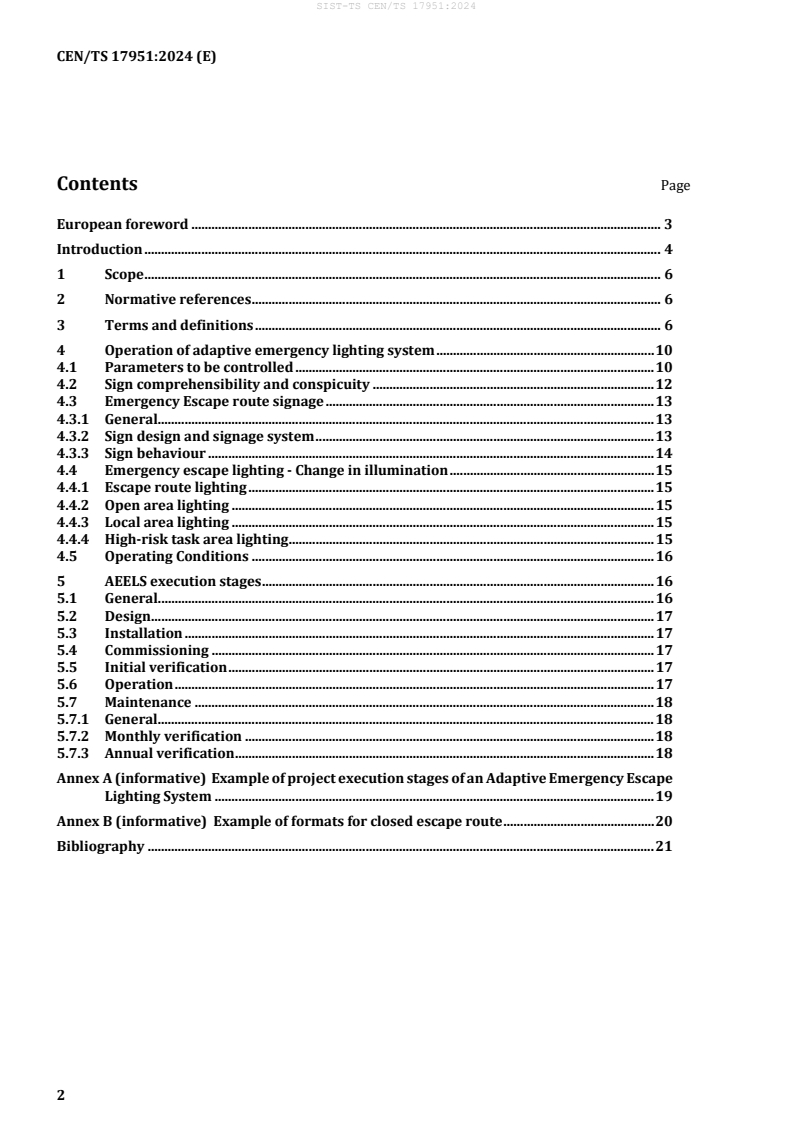
Contents Page
European foreword . 3
Introduction . 4
1 Scope . 6
2 Normative references . 6
3 Terms and definitions . 6
4 Operation of adaptive emergency lighting system . 10
4.1 Parameters to be controlled . 10
4.2 Sign comprehensibility and conspicuity . 12
4.3 Emergency Escape route signage . 13
4.3.1 General. 13
4.3.2 Sign design and signage system . 13
4.3.3 Sign behaviour . 14
4.4 Emergency escape lighting - Change in illumination . 15
4.4.1 Escape route lighting . 15
4.4.2 Open area lighting . 15
4.4.3 Local area lighting . 15
4.4.4 High-risk task area lighting . 15
4.5 Operating Conditions . 16
5 AEELS execution stages . 16
5.1 General. 16
5.2 Design . 17
5.3 Installation . 17
5.4 Commissioning . 17
5.5 Initial verification . 17
5.6 Operation . 17
5.7 Maintenance . 18
5.7.1 General. 18
5.7.2 Monthly verification . 18
5.7.3 Annual verification . 18
Annex A (informative) Example of project execution stages of an Adaptive Emergency Escape
Lighting System . 19
Annex B (informative) Example of formats for closed escape route . 20
Bibliography . 21
European foreword
This document (CEN/TS 17951:2024) has been prepared by Technical Committee CEN/TC 169, “Light
and Lighting”.
Attention is drawn to the possibility that some of the elements of this document may be the subject of
patent rights. CEN shall not be held responsible for identifying any or all such patent rights.
Any feedback and questions on this document should be directed to the users’ national standards body.
A complete listing of these bodies can be found on the CEN website.
According to the CEN/CENELEC Internal Regulations, the national standards organisations of the
following countries are bound to announce this Technical Specification: Austria, Belgium, Bulgaria,
Croatia, Cyprus, Czech Republic, Denmark, Estonia, Finland, France, Germany, Greece, Hungary, Iceland,
Ireland, Italy, Latvia, Lithuania, Luxembourg, Malta, Netherlands, Norway, Poland, Portugal, Republic of
North Macedonia, Romania, Serbia, Slovakia, Slovenia, Spain, Sweden, Switzerland, Türkiye and the
United Kingdom.
Introduction
Emergency lighting is provided for use when the power supply to the normal lighting fails and is therefore
powered from a source independent of that supplying the normal lighting. Whilst the supply to the
normal lighting is present, emergency lighting can operate in non-maintained or in maintained mode.
In particular, the objective of escape route lighting is to assist the safe exit from a location for occupants
by providing appropriate visual conditions and direction finding on escape routes by means of a
combination of luminaires and signs designed to meet predetermined conditions.
Adaptive Emergency Escape Lighting Systems (AEELS) can be used to revise the escape routing and
increase the conspicuity of emergency signage depending upon the location of a particular hazard, by
using directional exit signs that can be controlled to change routing information and to direct occupants
away from an exit route that has become unusable.
Adaptive Emergency Escape Lighting Systems can operate in two ways, where signage is changed at the
start of the evacuation procedure only, or alternatively where the information displayed by the signs can
be changed during the evacuation as circumstances dictate. In this second mode, during an evolving
incident, escape routing can be revised using AEELS by using directional exit signs that can be controlled
to change routing information directing occupants away from an exit route that has become unusable.
To improve the conspicuity of emergency signage AEELS could, for example, introduce a time-varying
component to the sign such as a flashing or sequentially activated directional arrow.
In case of failure of the AEELS control unit making it impossible to provide control signals to the
Emergency Lighting System (ELS), luminaires of the ELS would remain in the last known condition or
revert to the original condition in accordance with the EN 1838 design requirements depending on risk
assessment. It is essential, that in all cases the consistency between all escape signage is preserved.
For the purposes of this technical specification, Adaptive Emergency Escape Lighting Systems are
regarded as a generic term of which there are a number of specific forms, depending upon the
configuration and available system inputs as shown in Figure 1.
Figure 1 — Example of AEELS configuration
1 Scope
This document specifies the lighting and operating requirements for the application of adaptive
emergency escape lighting systems that can interact with management and control systems or be
provided with functionality to modify the operation of emergency escape lighting according to situational
requirements, in terms of luminous flux output, escape directions and the characteristics and meaning of
emergency escape lighting.
The situational requirements can require the involvement and interaction with components and systems
other than emergency escape lighting systems. Requirements for these components or systems are not
part of this document.
2 Normative references
The following documents are referred to in the text in such a way that some or all of their content
constitutes requirements of this document. For dated references, only the edition cited applies. For
undated references, the latest edition of the referenced document (including any amendments) applies.
EN 1838, Lighting applications - Emergency lighting for buildings
EN 50172, Emergency escape lighting systems
EN 60598-2-22, Luminaires - Part 2-22: Particular requirements - Luminaires for emergency lighting
EN 62034, Automatic test systems for battery powered emergency escape lighting
EN ISO 7010, Graphical symbols - Safety colours and safety signs - Registered safety signs (ISO 7010)
3 Terms and definitions
For the purposes of this document, the terms and definitions given in EN 1838 and the following apply.
ISO and IEC maintain terminological databases for use in standardization at the following addresses:
• ISO Online browsing platform: available at https://www.iso.org/obp
• IEC Electropedia: available at https://www.electropedia.org/
3.1
emergency lighting
lighting provided for use when the power supply to the normal lighting fails
[SOURCE: EN 12665:2024, 3.5.6]
3.2
escape route
designated route used to evacuate, in case of an emergency, to a place of safety
3.3
emergency escape lighting
part of emergency lighting that provides illumination for visibility of the escape route and of safety
signage for fire-fighting and safety equipment and for the guidance and the safety of people leaving a
location to a place of safety or attempting to terminate a potentially hazardous process or situation before
doing so
[SOURCE: EN 12665:2024, 3.5.36]
3.4
adaptive emergency escape lighting
enhanced emergency escape lighting responding to various circumstances or according to predefined
conditions
Note 1 to entry: Emergency escape lighting with fixed/defined illumination level and/or fixed safety sign
information is not considered as adaptive emergency escape lighting
Note 2 to entry: The term “dynamic emergency escape lighting” is used with the similar meaning.
3.5
escape route lighting
part of emergency escape lighting provided to ensure that the escape route can be effectively identified
and safely used when the location is occupied
3.6
open area (anti-panic) lighting
part of emergency escape lighting provided to avoid panic and provide illumination allowing people to
reach a place where an escape route can be identified
3.7
local area lighting
part of emergency lighting that provides illumination for people allowed to remain temporarily in a
premise during a mains supply failure if it is risk assessed for the activities that are allowed to be
performed
3.8
high risk task area lighting
part of emergency lighting that provides illumination for the safety of people involved in a potentially
dangerous process or situation and to enable proper shut down procedures for the safety of the operator
and other occupants of the building
3.9
standby lighting
part of emergency lighting provided to enable normal activities to continue substantially unchanged
[SOURCE: EN 12665:2024, 3.5.74]
3.10
emergency exit
way out marked with a safety sign that is intended to be used during an emergency leading to a defined
place of safety
[SOURCE: EN 12665:— , modified: definition elaborated, will be aligned in final version of EN 12665]
3.11
safety sign
sign that gives a general safety message, conveyed by a combination of colour and geometric shape and
which, by the addition of a graphical symbol, gives a particular safety message
[SOURCE: ISO 3864-1:2011, 3.12]
3.12
supplementary sign
sign that is supportive of a safety sign and the main purpose of which is to provide additional clarification
[SOURCE: ISO 3864-1:2011, 3.14]
3.13
additional sign
symbol or text that is supportive of a safety sign or a supplementary sign, the main purpose of which is
to provide additional information
Note 1 to entry: an example of an additional sign is a red X escape route closure symbol.
3.14
adaptive emergency escape route signage
emergency escape route signage using internally illuminated escape route signs that can change the
information they display
Note 1 to entry: signs include safety signs, supplementary signs and additional signs
3.15
emergency escape lighting system
all items functioning together in order to provide emergency escape lighting
Note 1 to entry: This includes luminaires, controlgear, wiring etc.
3.16
emergency lighting system design
set of documentation approved by the lighting system designer detailing the information used and the
solutions proposed for the emergency lighting project
3.17
adaptive emergency escape lighting system
AEELS
electrically operated escape lighting system which provides directional guidance and adequate
illuminance by means of a set of emergency lighting luminaires and directional indication that can
manually or automatically change the escape route direction and improve the conspicuity of the
emergency signage and optionally the lighting level on escape routes
3.18
AEELS control unit
AEELS CU
hardware or software interface, either external or integrated in the luminaires with or without signs,
provided to control operation of an emergency lighting luminaire or system, based on external
sources/control interface
Note 1 to entry: External sources/control interface can be provided by, for example, a BMS, sensor or by responsible
person or entity.
3.19
AEELS interface
system component(s), software and hardware, necessary to collect and provide input signals/commands
to an AEELS control unit in an appropriate format
3.20
closed escape route
escape route that is no longer to be used due to a significant event or a temporary change of use
Note 1 to entry: Examples for significant events are fire, toxic gas, flood, earthquake, terrorism which require an
adaptation of the escape route situation.
3.21
comprehensibility (of a sign)
measure of how readily an observer can understand the message intended to be conveyed by the sign
[SOURCE: CIE S 017:2020; 17-31-104, modified: Note to entry omitted]
3.22
conspicuity
quality of an object or a light source to appear prominent in its surroundings
[SOURCE: CIE S 017:2020; 17-31-028, modified: Notes to entry omitted]
3.23
periodic changes (of an internally illuminated sign)
regularly occurring change between different graphical symbols (e.g. signs) and/or their luminance
levels
Note 1 to entry: Could include sliding in and sliding out (changes in position in the horizontal or vertical direction),
flashing, etc.
3.24
system designer
any individual or organization responsible for the design of the emergency
lighting system
[SOURCE: IEC/TS 63116:2021, modified, emergency added]
3.25
competent person
person having suitable knowledge, qualification and experience to undertake the required role
[SOURCE: CEN/TS 17165:2018, 3.5]
4 Operation of adaptive emergency lighting system
4.1 Parameters to be controlled
Adaptive emergency escape lighting systems operate to modify the indicated direction or message of
safety signage. Additionally, they could increase luminous flux of the luminaire(s) and/or illuminance on
the escape routes.
Adaptive lighting exists in two formats:
— single scenario: set only once at the time of activation,
— multi scenario: set and resettable throughout the length of the emergency/evacuation.
If a scenario needs to activate luminaires being previously set in rest mode or in inhibit mode, their
operation mode should be activated according to the scenario. A self-diagnosis routine shall be
incorporated in the AEELS CU (control unit) in order to ensure it is operating correctly. The output of the
self-diagnosis shall be reported either on the AEELS CU (control unit) panel or on a specific device.
Luminaires and internally illuminated exit signs, where part of an AEELS, shall comply with the
requirements of EN 60598-2-22, EN 62034 and EN 1838 when in a normal situation i.e. non-evacuation
situation. When in evacuation situations, the nature of the conspicuity and comprehensibility of the
luminaires and internally illuminated exit signs that are part of the AEELS shall not be diminished and
shall comply with the requirements of 4.2.
Any additional safety signage to be used on an evacuation route shall be readily understood by the
occupants both during and outside daylight conditions. The use of additional emergency lighting
luminaires whether high or low mounted, is allowed to supplement the function of AEELS as long as they
do not interfere with and are not a substitute for compliant electrical escape route lighting.
If an escape route leads through an area which, due to specific processes or contents, has a high risk of
smoke, the use of additional signage and/or lighting can be necessary. Since smoke is hot, travels upwards
and collects on the ceiling, these should be placed close to the floor (low mounted) in the walls or in the
floor. Close to the floor means that its upper edge should not be higher than 40 cm above the floor. It shall
be ensured that when low-mounted signage is used, it can respond in the same way as the high-mounted
emergency escape route safety signage to indicate the same direction of escape. If the evacuation
direction is indicated by other solutions these shall also give information that is consistent with other
emergency escape route signage.
Table 1 and Table 2 show the states of the AEELS in the different mains power conditions.
Table 1 — Mains power to the normal lighting present
a a
Normal situation Abnormal situation
ON if in maintained mode
Emergency escape signage Always ON
OFF if in non-maintained mode
Safety and additional signs design At start: according to a
According to a pre-determined
predetermined
configuration
with possible changes in the
configuration
displayed information: e.g. change
of direction, closure of a direction May vary over time if multi-
or an exit/entrance (red cross), scenario system
display of additional information
b b c
Sign luminance Normal or dimmed level Normal or enhanced
level
d d e
Sign operation Fixed mode Fixed or variable mode
Emergency escape lighting OFF if in non-maintained mode OFF if in non-maintained
mode
b b c
Level of illuminance Normal or dimmed level if in Normal or enhanced
maintained mode level
Supplementary luminaires (e.g. Not normally active According to a
low mounting) predetermined scenario
and programmed
conditions
a
Normal situation implies that there is no emergency condition or requirement to evacuate.
Abnormal situation implies there is a situation requiring a response. This may vary between a minor
response with or without limited evacuation, or a full evacuation.
b
Normal level for luminance and illuminance is according to EN 1838 requirements respecting national
deviations.
c
Enhanced level for luminance and illuminance with a level defined higher than normal level, respecting national
regulations.
For example, when the mains supply is still present and the general lighting is active the emergency escape
signage/lighting may need to be made more prominent due to the higher level of ambient illumination
d
Fixed mode is with constant output (the opposite of variable mode).
e
Variable mode may be blinking, flashing or animation of the sign or a part of the sign (e.g. arrow, red cross)
CEN/TS 17951
...