

SIST EN 15502-1:2022+A1:2024
(Main + Amendment)Gas-fired heating boilers - Part 1: General requirements and tests
General Information
- Abstract
This European Standard specifies the common requirements and test methods, as well as the classification, marking and energy labelling of gas-fired central heating boilers that are fitted with atmospheric burners, fan assisted atmospheric burners or fully premixed burners, and are hereafter referred to as “boilers”.
This European Standard is to be used in conjunction with the specific Parts 2 (Part 2-1 and following ones).
This European Standard applies to boilers of types B and C.
NOTE For further background information on appliance types see CEN/TR 1749:2014 [1].
a) that use one or more combustible gases of the three gas families at the pressures stated in EN 437;
b) where the temperature of the water is below or above 105 °C during normal operation;
c) where the maximum operating pressure in the water circuit does not exceed 6 bar;
d) which can give rise to condensation under certain circumstances;
e) which are declared in the instructions for installation to be either a "condensing" boiler or a "low temperature boiler" or a "standard boiler" or an "other boiler". If no declaration is given the boiler is to be considered both a "standard boiler" and an "other boiler";
NOTE The Ecodesign Directive defines "other boilers", "low temperature boilers" and "condensing boilers". The Boiler Efficiency Directive defines "standard boilers", "low temperature boilers" and "condensing boilers". Depending on the legislation applied, a boiler can be both "a standard boiler" and an "other boiler"."
f) which are intended to be installed inside a building or in a partially protected place;
g) which are intended to produce also hot water either by the instantaneous or storage principle as a single unit.
This European Standard applies to boilers designed for sealed water systems or for open water systems.
NOTE This general standard and the specific standards (see Part 2) provide requirements for boilers with known constructions. For boilers with any alternative constructions, which might not fully be covered by this standard or a specific standard, the risk associated with this alternative construction will need to be assessed.
An example of an assessment methodology, based upon risk assessment, is given in Clause 11.
This European Standard is not intended to cover appliances intended for connection to gas grids where the quality of the distributed gas is likely to vary to a large extent over the lifetime of the appliance (see Annex EE).
This European Standard is not intended to cover appliances designed and constructed to burn gas containing toxic components.
- Status
- Published
- Publication Date
- 15-Oct-2024
- Technical Committee
- PLN - Gas appliances for domestic use
- Current Stage
- 6060 - National Implementation/Publication (Adopted Project)
- Start Date
- 12-Jun-2024
- Due Date
- 17-Aug-2024
- Completion Date
- 16-Oct-2024
- Directive
- 2016/426 - REGULATION (EU) 2016/426 OF THE EUROPEAN PARLIAMENT AND OF THE COUNCIL of 9 March 2016 on appliances burning gaseous fuels and repealing Directive 2009/142/ECOJ Ref: 2.12.2024, 2024/2944, L, OJ, OJ L OJ Date: 02-Dec-2024
811/2013 - Commission Delegated Regulation (EU) No 811/2013 of 18 February 2013 supplementing Directive 2010/30/EU of the European Parliament and of the Council with regard to the energy labelling of space heaters, combination heaters, packages of space heater, temperature control and solar device and packages of combination heater, temperature control and solar deviceOJ Ref: 2024/2909, L (25.11.2024), OJ L OJ Date: 25-Nov-2024
813/2013 - Commission Regulation (EU) No 813/2013 of 2 August 2013 implementing Directive 2009/125/EC of the European Parliament and of the Council with regard to ecodesign requirements for space heaters and combination heatersOJ Ref: 2024/2909, L (25.11.2024), OJ L OJ Date: 25-Nov-2024

Overview
EN 15502-1:2021+A1:2023 (CEN) is the European standard for gas-fired central heating boilers - Part 1: General requirements and tests. It defines common requirements, classification, marking and energy labelling for boilers fitted with atmospheric, fan‑assisted atmospheric or fully premixed burners. This Part 1 is intended to be used together with the specific Part 2 documents (Part 2‑1 and following) and applies to appliance types B and C.
Key scope points:
- Applies to boilers using one or more combustible gases from the three gas families at pressures per EN 437.
- Covers boilers where water temperature may be below or above 105 °C and where max water‑side operating pressure ≤ 6 bar.
- Includes condensing, low‑temperature and standard boilers; instantaneous or storage domestic hot water variants.
- Applies to sealed and open water systems, intended for indoor or partially protected installation.
- Excludes appliances for gas networks with highly variable gas quality and boilers burning gases with toxic components (see Annex EE).
Key topics and technical requirements
This standard sets out technical and test requirements across product life cycle and safety domains, for example:
- Classification, marking & energy labelling - gas families, appliance types, pressure classes.
- Construction & materials - materials, corrosion durability, insulation and water‑contact materials.
- Burners & combustion - atmospheric, fan‑assisted and premixed burner requirements and conversion to different gases.
- Controls & safety devices - gas pressure regulators, ignition, flame supervision, gas/air ratio control, thermostats, remote control.
- Operational tests - soundness (gas, combustion, water circuits), hydraulic resistance, heat input/output determination, ignition and flame stability, limiting temperatures.
- Electrical & electromagnetic safety, fan behaviour, drainage, frost protection, and performance for domestic hot water.
- Risk assessment - Clause 11 gives an example methodology for alternative constructions not fully covered by the standard.
Applications & users
Who uses EN 15502-1:
- Manufacturers - product design, type testing, documentation, CE/conformity assessment and energy labelling.
- Testing and certification bodies - standardized test methods and acceptance criteria.
- Installers and technical specifiers - selecting compliant boilers for buildings and systems.
- Regulators and compliance officers - aligning national rules with CEN requirements.
- R&D and safety engineers - assessing alternative constructions and carrying out risk assessments.
Practical uses:
- Verifying compliance for market access, preparing installation instructions, conducting safety and performance testing, and ensuring compatibility with ecodesign and efficiency labelling requirements.
Related standards
- EN 15502 Part 2 series (product‑specific requirements and tests) - to be used in conjunction with Part 1.
- EN 437 - reference and limit gases.
- CEN/TR 1749:2014 - background on appliance types.
Keywords: EN 15502-1:2021+A1:2023, gas-fired heating boilers, boiler testing, CEN standard, condensing boiler, low temperature boiler, energy labelling, Part 1 general requirements.
Relations
- Effective Date
- 01-Oct-2024
- Replaces
SIST EN 15502-1:2022/AC:2023 - Gas-fired heating boilers - Part 1: General requirements and tests - Effective Date
- 01-Oct-2024
- Effective Date
- 09-Feb-2026
- Effective Date
- 09-Feb-2026
- Effective Date
- 09-Feb-2026
- Effective Date
- 09-Feb-2026
- Effective Date
- 09-Feb-2026
- Effective Date
- 09-Feb-2026
- Effective Date
- 09-Feb-2026
- Effective Date
- 09-Feb-2026
- Effective Date
- 09-Feb-2026
- Effective Date
- 09-Feb-2026
- Effective Date
- 09-Feb-2026
- Effective Date
- 09-Feb-2026
- Effective Date
- 28-Jan-2026
Get Certified
Connect with accredited certification bodies for this standard

DNV
DNV is an independent assurance and risk management provider.

Lloyd's Register
Lloyd's Register is a global professional services organisation specialising in engineering and technology.

DIBt (Deutsches Institut für Bautechnik)
German Institute for Building Technology.
Sponsored listings
Frequently Asked Questions
SIST EN 15502-1:2022+A1:2024 is a standard published by the Slovenian Institute for Standardization (SIST). Its full title is "Gas-fired heating boilers - Part 1: General requirements and tests". This standard covers: This European Standard specifies the common requirements and test methods, as well as the classification, marking and energy labelling of gas-fired central heating boilers that are fitted with atmospheric burners, fan assisted atmospheric burners or fully premixed burners, and are hereafter referred to as “boilers”. This European Standard is to be used in conjunction with the specific Parts 2 (Part 2-1 and following ones). This European Standard applies to boilers of types B and C. NOTE For further background information on appliance types see CEN/TR 1749:2014 [1]. a) that use one or more combustible gases of the three gas families at the pressures stated in EN 437; b) where the temperature of the water is below or above 105 °C during normal operation; c) where the maximum operating pressure in the water circuit does not exceed 6 bar; d) which can give rise to condensation under certain circumstances; e) which are declared in the instructions for installation to be either a "condensing" boiler or a "low temperature boiler" or a "standard boiler" or an "other boiler". If no declaration is given the boiler is to be considered both a "standard boiler" and an "other boiler"; NOTE The Ecodesign Directive defines "other boilers", "low temperature boilers" and "condensing boilers". The Boiler Efficiency Directive defines "standard boilers", "low temperature boilers" and "condensing boilers". Depending on the legislation applied, a boiler can be both "a standard boiler" and an "other boiler"." f) which are intended to be installed inside a building or in a partially protected place; g) which are intended to produce also hot water either by the instantaneous or storage principle as a single unit. This European Standard applies to boilers designed for sealed water systems or for open water systems. NOTE This general standard and the specific standards (see Part 2) provide requirements for boilers with known constructions. For boilers with any alternative constructions, which might not fully be covered by this standard or a specific standard, the risk associated with this alternative construction will need to be assessed. An example of an assessment methodology, based upon risk assessment, is given in Clause 11. This European Standard is not intended to cover appliances intended for connection to gas grids where the quality of the distributed gas is likely to vary to a large extent over the lifetime of the appliance (see Annex EE). This European Standard is not intended to cover appliances designed and constructed to burn gas containing toxic components.
This European Standard specifies the common requirements and test methods, as well as the classification, marking and energy labelling of gas-fired central heating boilers that are fitted with atmospheric burners, fan assisted atmospheric burners or fully premixed burners, and are hereafter referred to as “boilers”. This European Standard is to be used in conjunction with the specific Parts 2 (Part 2-1 and following ones). This European Standard applies to boilers of types B and C. NOTE For further background information on appliance types see CEN/TR 1749:2014 [1]. a) that use one or more combustible gases of the three gas families at the pressures stated in EN 437; b) where the temperature of the water is below or above 105 °C during normal operation; c) where the maximum operating pressure in the water circuit does not exceed 6 bar; d) which can give rise to condensation under certain circumstances; e) which are declared in the instructions for installation to be either a "condensing" boiler or a "low temperature boiler" or a "standard boiler" or an "other boiler". If no declaration is given the boiler is to be considered both a "standard boiler" and an "other boiler"; NOTE The Ecodesign Directive defines "other boilers", "low temperature boilers" and "condensing boilers". The Boiler Efficiency Directive defines "standard boilers", "low temperature boilers" and "condensing boilers". Depending on the legislation applied, a boiler can be both "a standard boiler" and an "other boiler"." f) which are intended to be installed inside a building or in a partially protected place; g) which are intended to produce also hot water either by the instantaneous or storage principle as a single unit. This European Standard applies to boilers designed for sealed water systems or for open water systems. NOTE This general standard and the specific standards (see Part 2) provide requirements for boilers with known constructions. For boilers with any alternative constructions, which might not fully be covered by this standard or a specific standard, the risk associated with this alternative construction will need to be assessed. An example of an assessment methodology, based upon risk assessment, is given in Clause 11. This European Standard is not intended to cover appliances intended for connection to gas grids where the quality of the distributed gas is likely to vary to a large extent over the lifetime of the appliance (see Annex EE). This European Standard is not intended to cover appliances designed and constructed to burn gas containing toxic components.
SIST EN 15502-1:2022+A1:2024 is classified under the following ICS (International Classification for Standards) categories: 27.060.30 - Boilers and heat exchangers; 91.140.10 - Central heating systems; 97.100.20 - Gas heaters. The ICS classification helps identify the subject area and facilitates finding related standards.
SIST EN 15502-1:2022+A1:2024 has the following relationships with other standards: It is inter standard links to SIST EN 15502-1:2022, SIST EN 15502-1:2022/AC:2023, SIST EN 60335-1:2012/A2:2019, SIST EN 60335-1:2012/A11:2014, SIST EN 60529:1997, SIST EN 60335-1:2012, SIST EN IEC 60730-2-9:2019, SIST EN 60335-1:2012/A1:2019, SIST EN 60335-1:2012/A14:2019, SIST EN IEC 60730-2-9:2019/A1:2019, SIST EN IEC 60730-2-9:2019/A2:2020, SIST EN 60529:1997/A2:2014, SIST EN 60335-2-102:2016, SIST EN 60335-1:2012/A13:2017, SIST EN 437:2021. Understanding these relationships helps ensure you are using the most current and applicable version of the standard.
SIST EN 15502-1:2022+A1:2024 is associated with the following European legislation: EU Directives/Regulations: 2016/426, 811/2013, 813/2013, EUR-PUB; Standardization Mandates: M/066, M/535, M/595. When a standard is cited in the Official Journal of the European Union, products manufactured in conformity with it benefit from a presumption of conformity with the essential requirements of the corresponding EU directive or regulation.
SIST EN 15502-1:2022+A1:2024 is available in PDF format for immediate download after purchase. The document can be added to your cart and obtained through the secure checkout process. Digital delivery ensures instant access to the complete standard document.
Standards Content (Sample)
SLOVENSKI STANDARD
01-december-2024
Nadomešča:
SIST EN 15502-1:2022
SIST EN 15502-1:2022/AC:2023
Plinski kotli za ogrevanje - 1. del: Splošne zahteve in preskusi
Gas-fired heating boilers - Part 1: General requirements and tests
Heizkessel für gasförmige Brennstoffe - Teil 1: Allgemeine Anforderungen und
Prüfungen
Chaudières de chauffage central utilisant les combustibles gazeux - Partie 1: Exigences
générales et essais
Ta slovenski standard je istoveten z: EN 15502-1:2021+A1:2023
ICS:
27.060.30 Grelniki vode in prenosniki Boilers and heat exchangers
toplote
91.140.10 Sistemi centralnega Central heating systems
ogrevanja
97.100.20 Plinski grelniki Gas heaters
2003-01.Slovenski inštitut za standardizacijo. Razmnoževanje celote ali delov tega standarda ni dovoljeno.
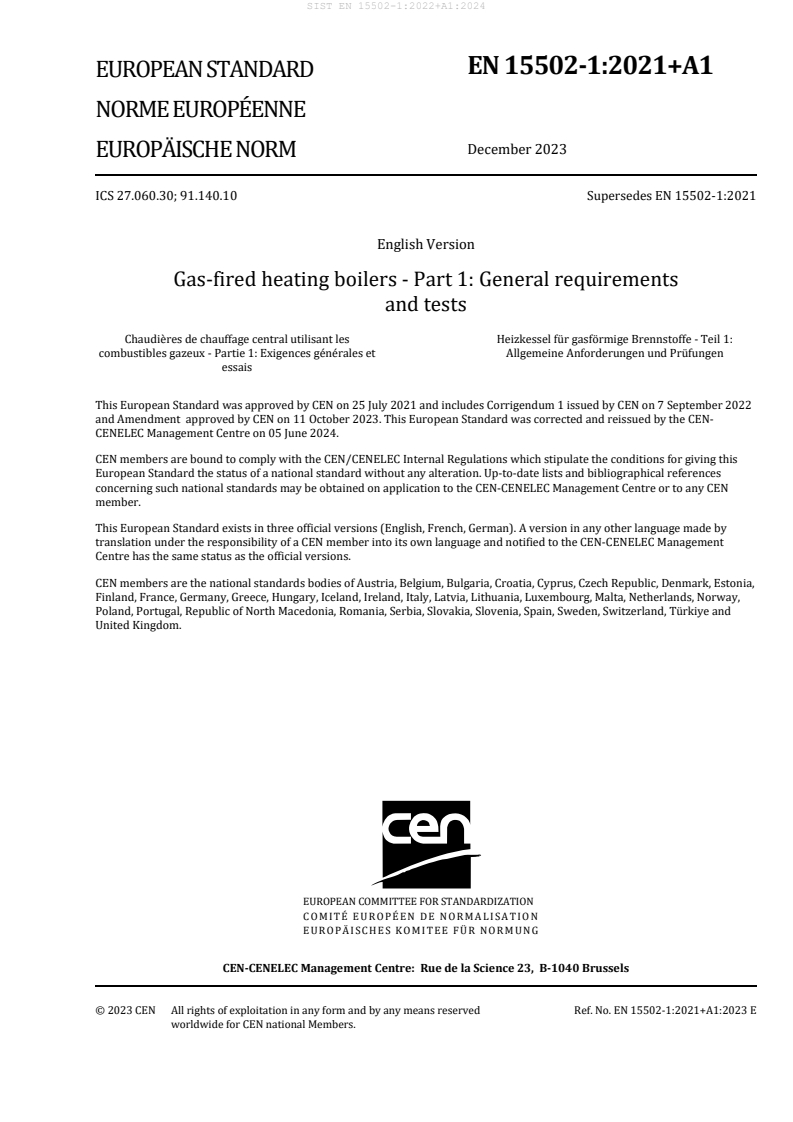
EN 15502-1:2021+A1
EUROPEAN STANDARD
NORME EUROPÉENNE
December 2023
EUROPÄISCHE NORM
ICS 27.060.30; 91.140.10 Supersedes EN 15502-1:2021
English Version
Gas-fired heating boilers - Part 1: General requirements
and tests
Chaudières de chauffage central utilisant les Heizkessel für gasförmige Brennstoffe - Teil 1:
combustibles gazeux - Partie 1: Exigences générales et Allgemeine Anforderungen und Prüfungen
essais
This European Standard was approved by CEN on 25 July 2021 and includes Corrigendum 1 issued by CEN on 7 September 2022
and Amendment approved by CEN on 11 October 2023. This European Standard was corrected and reissued by the CEN-
CENELEC Management Centre on 05 June 2024.
CEN members are bound to comply with the CEN/CENELEC Internal Regulations which stipulate the conditions for giving this
European Standard the status of a national standard without any alteration. Up-to-date lists and bibliographical references
concerning such national standards may be obtained on application to the CEN-CENELEC Management Centre or to any CEN
member.
This European Standard exists in three official versions (English, French, German). A version in any other language made by
translation under the responsibility of a CEN member into its own language and notified to the CEN-CENELEC Management
Centre has the same status as the official versions.
CEN members are the national standards bodies of Austria, Belgium, Bulgaria, Croatia, Cyprus, Czech Republic, Denmark, Estonia,
Finland, France, Germany, Greece, Hungary, Iceland, Ireland, Italy, Latvia, Lithuania, Luxembourg, Malta, Netherlands, Norway,
Poland, Portugal, Republic of North Macedonia, Romania, Serbia, Slovakia, Slovenia, Spain, Sweden, Switzerland, Türkiye and
United Kingdom.
EUROPEAN COMMITTEE FOR STANDARDIZATION
COMITÉ EUROPÉEN DE NORMALISATIO N
EUROPÄISCHES KOMITEE FÜR NORMUN G
CEN-CENELEC Management Centre: Rue de la Science 23, B-1040 Brussels
© 2023 CEN All rights of exploitation in any form and by any means reserved Ref. No. EN 15502-1:2021+A1:2023 E
worldwide for CEN national Members.
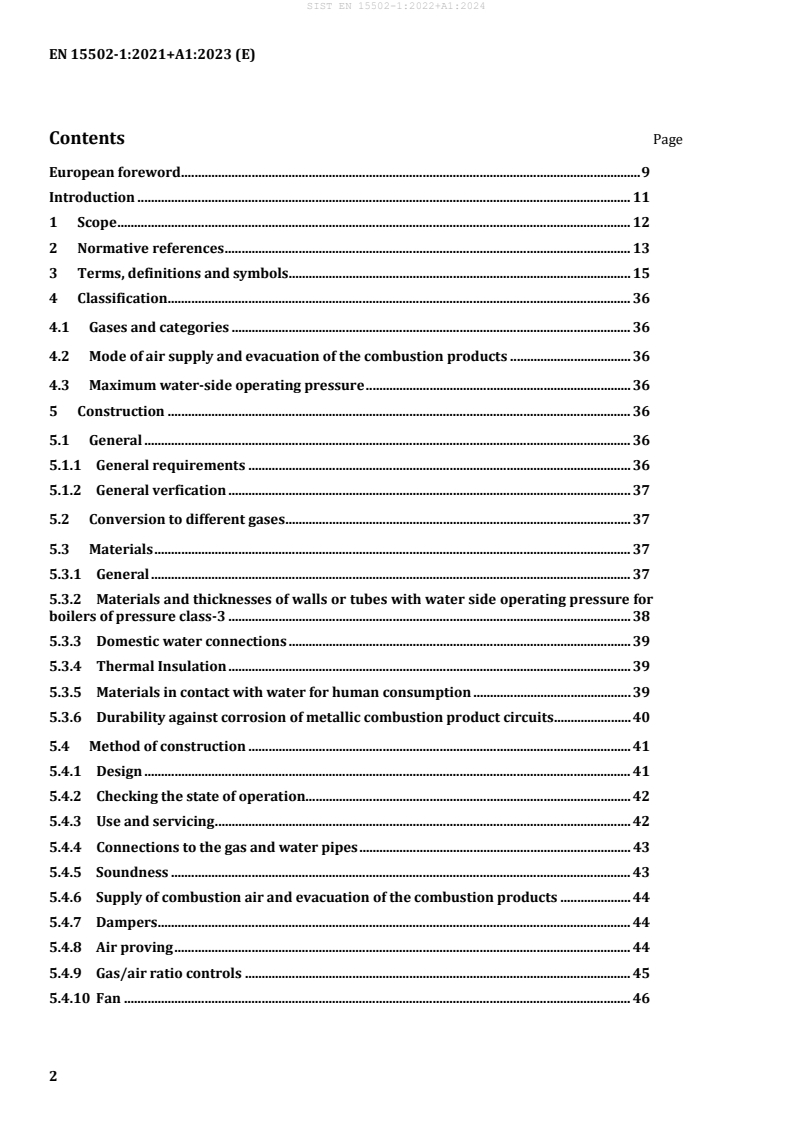
Contents Page
European foreword . 9
Introduction . 11
1 Scope . 12
2 Normative references . 13
3 Terms, definitions and symbols. 15
4 Classification . 36
4.1 Gases and categories . 36
4.2 Mode of air supply and evacuation of the combustion products . 36
4.3 Maximum water-side operating pressure . 36
5 Construction . 36
5.1 General . 36
5.1.1 General requirements . 36
5.1.2 General verfication . 37
5.2 Conversion to different gases . 37
5.3 Materials . 37
5.3.1 General . 37
5.3.2 Materials and thicknesses of walls or tubes with water side operating pressure for
boilers of pressure class-3 . 38
5.3.3 Domestic water connections . 39
5.3.4 Thermal Insulation . 39
5.3.5 Materials in contact with water for human consumption . 39
5.3.6 Durability against corrosion of metallic combustion product circuits . 40
5.4 Method of construction . 41
5.4.1 Design . 41
5.4.2 Checking the state of operation . 42
5.4.3 Use and servicing . 42
5.4.4 Connections to the gas and water pipes . 43
5.4.5 Soundness . 43
5.4.6 Supply of combustion air and evacuation of the combustion products . 44
5.4.7 Dampers . 44
5.4.8 Air proving . 44
5.4.9 Gas/air ratio controls . 45
5.4.10 Fan . 46
5.4.11 Drainage . 46
5.4.12 Operational safety in the event of failure of the auxiliary energy . 46
5.4.13 Special provision for Low Temperature Boilers and Condensing Boilers . 46
5.5 Burners . 47
5.6 Pressure test points . 48
5.7 Requirements for the application of control and safety devices . 48
5.7.1 General. 48
5.7.2 Adjusters and range-rating devices . 48
5.7.3 Gas circuit . 49
5.7.4 Gas pressure regulator . 50
5.7.5 Ignition devices. 51
5.7.6 Flame supervision devices . 51
5.7.7 Gas/air ratio control tubes . 52
5.7.8 Thermostats and water flow temperature limiting devices . 52
5.7.9 Remote control . 53
5.7.10 Expansion vessel and pressure gauge . 54
5.7.11 Protection against frost for boilers intended to be installed in a partially protected
place 54
5.7.12 Adjusting, control and safety devices for the domestic hot water circuit . 55
6 Electrical and electromagnetic safety . 55
7 Controls . 55
7.1 General . 55
7.2 Detailed specifications . 56
7.2.1 Control and safety devices . 56
7.2.2 Valves used in boilers . 56
7.2.3 Not relevant aspects for controls tested in combination with the boiler . 56
7.2.4 Relevant aspects for controls tested in combination with the boiler . 57
7.3 Thermostats and flow temperature limiting devices . 57
7.3.1 General. 57
7.3.2 Construction requirements . 58
7.3.3 Performance . 59
8 Operational requirements . 61
8.1 General . 61
8.1.1 Characteristics of the reference and limit gases . 61
8.1.2 General test conditions . 62
8.2 Soundness . 66
8.2.1 Soundness of the gas circuit . 66
8.2.2 Soundness of the combustion circuit . 67
8.2.3 Soundness of the water circuit . 67
8.2.4 Soundness of the domestic water circuit . 68
8.3 Hydraulic resistance . 68
8.3.1 Requirements . 68
8.3.2 Test conditions . 68
8.4 Heat inputs and heat output . 69
8.4.1 Determination of the nominal heat input or the maximum and minimum heat input
8.4.2 Adjustment of the heat input by the downstream gas pressure . 71
8.4.3 Ignition rate . 71
8.4.4 Nominal output . 71
8.4.5 Verification of the nominal condensing output . 71
8.4.6 Nominal domestic hot water heat input . 72
8.4.7 Water pressure to obtain the nominal heat input for instantaneous combination
boilers . 72
8.4.8 Obtaining the domestic hot water temperature for instantaneous combination
boilers . 72
8.4.9 Heating-up time of the domestic hot water . 73
8.5 Limiting temperatures. 73
8.5.1 General . 73
8.5.2 Limiting temperatures of the adjusting, control and safety devices . 73
8.5.3 Limiting temperatures of the side walls, the front and the top . 74
8.5.4 Limiting temperature of the test panels and the floor . 74
8.6 Ignition, cross lighting, flame stability . 75
8.6.1 General . 75
8.6.2 Limit conditions . 75
8.6.3 Special flue conditions . 76
8.6.4 Reduction of the gas rate of the ignition burner . 77
8.7 Reduction of the gas pressure . 77
8.7.1 Requirements . 77
8.7.2 Test conditions . 77
8.8 Defective closure of the gas valve immediately upstream of the main burner . 77
8.8.1 Requirements . 77
8.8.2 Test conditions . 78
8.9 Pre-purge . 78
8.10 Functioning of a permanent ignition burner when the fan stops during the standby
time 78
8.10.1 Requirements . 78
8.10.2 Test conditions . 78
8.11 Adjustment, control and safety devices . 78
8.11.1 Requirement . 78
8.11.2 Test method for determining the operating temperature range . 78
8.11.3 Combination Boilers . 79
8.11.4 Control devices . 82
8.11.5 Ignition devices. 82
8.11.6 Flame supervision device . 84
8.11.7 Gas pressure regulator . 87
8.11.8 Thermostats and flow temperature limiting devices . 88
8.12 Carbon monoxide . 90
8.12.1 General. 90
8.12.2 Limit conditions. 92
8.12.3 Special conditions . 92
8.12.4 Sooting . 93
8.12.5 Condensate discharge blockage test . 94
8.13 NO . 94
x
8.13.1 Requirement . 94
8.13.2 Test methods . 95
8.13.3 Calculation of emissions of NO in mg/kWh based on GCV . 97
X
8.14 Special provisions for boilers intended to be installed in a partially protected place
8.14.1 Frost protection system for boilers intended to be installed in a partially protected
place 98
8.14.2 Protection against the ingress of rain . 98
8.15 Formation of condensate . 98
8.15.1 Requirements . 98
8.15.2 Test conditions . 98
8.16 Temperature of combustion products . 99
8.16.1 Requirements . 99
8.16.2 Test conditions . 99
8.17 Sound power level L . 99
WA
9 Useful efficiencies . 99
9.1 General . 99
9.1.1 Correction of measured efficiency to reference conditions . 99
9.1.2 Use of the general test conditions . 100
9.2 Useful efficiency at the nominal heat input. 100
9.2.1 Requirements . 100
9.2.2 Tests . 100
9.3 Useful efficiency at part load . 102
9.3.1 Requirements . 102
9.3.2 Tests . 102
9.4 Heat output, Seasonal energy efficiency and energy consumption . 109
9.4.1 Rated heat output (P and P ) . 109
rated 4
9.4.2 Useful heat output at 30% of rated heat output and low-temperature regime (P )
9.4.3 Useful efficiency (GCV) at rated heat output and high-temperature regime (η ) 109
9.4.4 Useful efficiency (GCV) at 30% of rated heat output and low-temperature regime
(η1) 110
9.4.5 Ignition burner power consumption (GCV) (P ) . 110
ign
9.4.6 Calculation of the seasonal space heating energy efficiency (η ) . 110
s
9.4.7 Calculation of the annual energy consumption for space heating (Q ) (GCV) . 112
HE
9.4.8 Water heating energy efficiency and energy consumption of combination boilers for
water heating mode . 112
10 Electric auxiliary energy . 113
10.1 Auxiliary energy consumption . 113
10.1.1 General . 113
10.1.2 System boundaries . 113
10.1.3 Auxiliary energy at nominal heat input . 113
10.1.4 Auxiliary energy at part load . 114
10.1.5 Auxiliary energy at stand-by . 114
10.2 Auxiliary electricity consumption measurements required for eco-design and
labelling regulations . 114
10.2.1 General . 114
10.2.2 System boundaries . 114
10.2.3 Auxiliary electricity consumption [kW] at nominal heat input . 115
10.2.4 Auxiliary electricity consumption at part load [kW] . 115
10.2.5 Auxiliary electricity consumption at stand by [kW] . 115
11 Risk assessment . 115
12 Marking and instructions . 116
12.1 Boiler marking . 116
12.1.1 Data plate . 116
12.1.2 Markings related to the state of adjustment . 117
12.1.3 Packaging . 117
12.1.4 Warnings notices on the boiler and the packaging . 117
12.1.5 Other information . 118
12.2 Instructions . 119
12.2.1 Instructions for installation . 119
12.2.2 Instructions for use and servicing . 124
12.2.3 Conversion instructions . 124
12.3 Presentation . 125
Annex A (normative) Properties of carbon and stainless steels . 133
Annex B (normative) Minimum requirements for cast iron . 134
Annex C (normative) Parts in aluminium and aluminium alloys . 135
Annex D (normative) Parts in copper or copper alloys . 136
Annex E (normative) Minimum thicknesses for rolled parts . 137
Annex F (normative) Nominal minimum thicknesses of boiler sections of cast materials
under water pressure . 138
Annex G (normative) Parameters for welded joints and welding processes . 139
Annex H (informative) Examples of the composition of the gas circuit according to 5.7.3.2
Annex I (informative) Compilation of the test conditions for the various gas families . 153
Annex J (normative) Calculation of conversions of NOx . 155
Annex K (informative) Example of calculation of the weighting factors NOx . 157
Annex L (informative) Practical method of calibrating the test rig to enable the heat loss
Dp to be determined . 159
Annex M (informative) Means of determining the ignition time at full rate . 160
Annex N (informative) Determination of the heat losses from the test rig of the indirect
method and the contributions of the circulating pump of the test rig . 161
Annex O (informative) Example of a risk assessment method. 162
Annex P (informative) Examples of risk assessment with a method described in Annex O165
Annex Q (informative) Realisation of a protective measure. 170
Annex R (informative) Overall classification of a basic risk . 172
Annex S (informative) Not exhaustive list of classification examples . 175
Annex T (normative) Correction for the determined efficiency in the low water
temperature test of low temperature boilers (LTB) and condensing boilers (CB) . 178
Annex U (normative) Use of test gases . 180
Annex V (informative) Alternative method for heat output as enthalpy difference. 181
Annex AA (informative) Product Information related to Eco-design Regulation and
Labelling Regulation . 184
Annex AB (informative) Variations in gas quality . 188
Annex AC (normative) Non-exhaustive list of materials used in contact with drinking water
Annex ZA (informative) Left empty on purpose . 195
Annex ZB (informative) Clauses of this European Standard addressing the methods for the
verification of the efficiency of the EU Directive 92/42/EEC, relating to the efficiency of new
hot boilers with an output of 4 – 400 kW . 196
Annex ZC (informative) Relationship between this European Standard and the ecodesign
requirements of Commission Regulation (EU) No 813/2013 L 239/136 aimed to be covered
Annex ZD (informative) Relationship between this European Standard and the energy
labelling requirements of Commission Delegated Regulation (EU) No 811/2013 L 239/1
aimed to be covered . 200
Annex ZE (informative) Relationship between this European Standard and the essential
requirements of Regulation (EU) 2016/426 of the European Parliament and of the Council
of 9 March 2016 on appliances burning gaseous fuels and repealing Directive 2009/142/EC
aimed to be covered . 203
Bibliography . 213
European foreword
This document (EN 15502-1:2021+A1:2023) has been prepared by Technical Committee CEN/TC 109
“Central heating boilers using gaseous fuels”, the secretariat of which is held by NEN.
This European Standard shall be given the status of a national standard, either by publication of an
identical text or by endorsement, at the latest by June 2024, and conflicting national standards shall be
withdrawn at the latest by June 2024.
The start and finish of text introduced or altered by corrigendum is indicated in the text by tags ˜™.
This document supersedes !EN 15502-1:2021".
This document includes Amendment 1, approved by CEN on 2023-10-11.
The start and finish of text introduced or altered by amendment is indicated in the text by tags !"
!deleted paragraphs"
EN 15502 consists of the following parts under the general title “Gas-fired heating boilers":
— Part 1: General requirements and tests (this standard);
— Part 2-1: Specific standard for type C appliances and type B2, B3 and B5 appliances of a nominal heat
input not exceeding 1 000 kW;
—
Part 2-2: Specific standard for type B1 appliances.
This document is to be used in conjunction with the specific Parts 2.
This document has been prepared under mandates M89/6 and M066, given to CEN by the European
Commission and the European Free Trade Association, and supports essential requirements as meant in
article 3 of EU Directive 2009/142/EC, relating to appliances burning gaseous fuels and the verification
methods valid for production and measurements, as meant in article 5.2 of EU Directive 92/42/EEC,
relating to the efficiency requirements for new hot water boilers fired with liquid or gaseous fuels, with
an output of 4 – 400 kW.
This document has been prepared under the mandates M/534 and M/535, given to CEN by the European
Commission and the European Free Trade Association to provide a means of conforming to:
— requirements of Commission Regulation (EC) No 813/2013 of 2 August 2013 implementing Directive
2009/125/EC of the European Parliament and of the Council with regard to ecodesign requirements
for space heaters and combination heaters;
— requirements of Commission Delegated Regulation (EC) No 811/2013 of 18 February 2013
supplementing Directive 2010/30/EC of the European Parliament and of the Council with regard to
energy labelling of space heaters, combination heaters, packages of space heater, temperature
control and solar device and packages of combination heater, temperature control and solar device.
For relationship with EU Directive(s) and Commission Regulations, see informative Annexes ZB, ZC and
ZD, ZE which are integral parts of this document.
Any feedback and questions on this document should be directed to the users’ national standards body.
A complete listing of these bodies can be found on the CEN website.
According to the CEN-CENELEC Internal Regulations, the national standards organisations of the
following countries are bound to implement this European Standard: Austria, Belgium, Bulgaria, Croatia,
Cyprus, Czech Republic, Denmark, Estonia, Finland, France, Germany, Greece, Hungary, Iceland, Ireland,
Italy, Latvia, Lithuania, Luxembourg, Malta, Netherlands, Norway, Poland, Portugal, Republic of North
Macedonia, Romania, Serbia, Slovakia, Slovenia, Spain, Sweden, Switzerland, Turkey and the United
Kingdom.
Introduction
The basic function of gas-fired heating boiler is to generate heat by direct heat transfer in a heat
exchanger, from the combustion gasses to the water.
The boiler can include in one design more than one function. It can include for example:
— a sanitary hot water function;
— a function to supply the combustion air from the outside/open air;
— a function to dispose the combustion products to the outside/open air.
The boiler design can be supplied to the market in more than one part. If the boiler is supplied to the
market in multiple parts, the boiler is the assembly of various parts according to the instructions for
installation.
Boilers can be designed to be connected to specific parts of a building. Connection to a chimney and the
means of combustion air supply is particularly relevant.
This document is a first part of a series of standards that will describe the special requirements for
specific appliance types of the boiler. This European Standard contains the common requirements that
are applicable for the majority of the appliance types of the boiler.
Matters related to quality assurance systems, tests during production, and certificates of conformity of
auxiliary devices are not dealt with in this series of European Standards.
1 Scope
This document specifies the common requirements and test methods, as well as the classification,
marking and energy labelling of gas-fired central heating boilers that are fitted with atmospheric burners,
fan assisted atmospheric burners or fully premixed burners, and are hereafter referred to as “boilers”.
This document is to be used in conjunction with the specific Parts 2 (Part 2-1, Part 2-2 and following
ones).
This document applies to boilers of types B and C:
NOTE For further background information on appliance types see EN 1749:2020.
a) that use one or more combustible gases of the three gas families at the pressures stated in EN
437:2021;
b) where the temperature of the water does not exceed 105 °C during normal operation;
c) where the maximum operating pressure in the water circuit does not exceed 6 bar;
d) which can give rise to condensation under certain circumstances;
e) which are declared in the instructions for installation to be either a "condensing" boiler or a "low
temperature boiler" or a "standard boiler" or an "other boiler". If no declaration is given the boiler is
to be considered both a "standard boiler" and an "other boiler";
f) which are intended to be installed inside a building or in a partially protected place;
g) which are intended to produce also hot water either by the instantaneous or storage principle as a
single unit.
This document applies to boilers designed for sealed water systems or for open water systems.
NOTE This general standard and the specific standards (see Part 2) provide requirements for boilers with known
constructions. For boilers with any alternative constructions, which might not fully be covered by this standard or a specific
standard, the risk associated with this alternative construction will need to be assessed.
An example of an assessment methodology, based upon risk assessment, is given in Clause 11.
This document is not intended to cover appliances intended for connection to gas grids where the quality
of the distributed gas is likely to vary to a large extent over the lifetime of the appliance (see Annex AB).
This document does not cover all the requirements for :
aa) appliances above 1000 kW;
ab) appliances designed and constructed to burn gas containing carbon monoxide or other toxic
components;
ac) appliance having a supplementary heater.
2 Normative references
The following documents are referred to in the text in such a way that some or all of their content
constitutes requirements of this document. For dated references, only the edition cited applies. For
undated references, the latest edition of the referenced document (including any amendments) applies.
EN 88-1:2011+A1:2016, Pressure regulators and associated safety devices for gas appliances - Part 1:
Pressure regulators for inlet pressures up to and including 50 kPa
EN 125:2010+A1:2015, Flame supervision devices for gas burning appliances - Thermoelectric flame
supervision devices
EN 126:2012, Multifunctional controls for gas burning appliances
EN 161:2011+A3:2013, Automatic shut-off valves for gas burners and gas appliances
EN 298:2012, Automatic burner control systems for burners and appliances burning gaseous or liquid fuels
EN 437:2021, Test gases - Test pressures - Appliance categories
EN 573-1:2004, Aluminium and aluminium alloys - Chemical composition and form of wrought products -
Part 1: Numerical designation system EN 1057:2006+A1:2010, Copper and copper alloys - Seamless, round
copper tubes for water and gas in sanitary and heating applications
EN 1092-1:2018, Flanges and their joints —- Circular flanges for pipes, valves, fittings and accessories, PN
designated – Part 1: Steel flanges
EN 1092-2:1997, Flanges and their joints - Circular flanges for pipes, valves, fittings and accessories, PN
designated - Part 2: Cast iron flanges
EN 1092-3:2003, Flanges and their joints - Circular flanges for pipes, valves, fittings and accessories, PN
designated - Part 3: Copper alloy flanges
EN 1092-4:2002, Flanges and their joints - Circular flanges for pipes, valves, fittings and accessories, PN
designated - Part 4: Aluminium alloy flanges
EN 1561:2011, Founding - Grey cast irons
EN 1749:2020, Classification of gas appliances according to the method of supplying combustion air and of
evacuation of the combustion products
EN 1856-1:2009, Chimneys - Requirements for metal chimneys - Part 1: System chimney products
EN 10029:2010, Hot-rolled steel plates 3 mm thick or above - Tolerances on dimensions and shape
EN 10088-1:2014, Stainless steels - Part 1: List of stainless steels EN 10226-1:2004, Pipe threads where
pressure tight joints are made on the threads - Part 1: Taper external threads and parallel internal threads
- Dimensions, tolerances and designation
EN 10226-2:2005, Pipe threads where pressure tight joints are made on the threads - Part 2: Taper external
threads and taper internal threads - Dimensions, tolerances and designation
EN 12067-2:2004, Gas/air ratio controls for gas burners and gas burning appliances - Part 2: Electronic
types
EN 13203-1:2015, Gas fired domestic appliances producing hot water - Part 1: Assessment of
pe
...