

SIST EN 13889:2004+A1:2009
(Main)Forged steel shackles for general lifting purposes - Dee shackles and bow shackles - Grade 6 - Safety
- Abstract
This European Standard specifies requirements for forged steel Dee and bow shackles of grade 6 for general lifting purposes in a range of working load limits 0,5 t to 25 t maximum.
This standard applies only to those shackles with threaded pins.
Annex A gives information on the safe use of shackles, annex B gives information on types of pins, and annex C gives an example of a designation system for forged steel shackles.
The hazards covered are identified in clause 4.
- Status
- Published
- Publication Date
- 09-Dec-2008
- Technical Committee
- DTN - Lift and transport appliances
- Current Stage
- 6060 - National Implementation/Publication (Adopted Project)
- Start Date
- 08-Dec-2008
- Due Date
- 12-Feb-2009
- Completion Date
- 10-Dec-2008
- Directive
- 2006/42/EC - Directive 2006/42/EC of the European Parliament and of the Council of 17 May 2006 on machinery, and amending Directive 95/16/EC (recast)OJ Ref: C 214, TIP C,7.9.2026 UMIK 20.1.2027 OJ Date: 08-Sep-2009 Conflicting Date: 20-Jan-2027
98/37/EC - MachineryOJ Ref: C 74 OJ Date: 28-Mar-2009



SIST EN 13889:2004+A1:2009 is the Slovenian adoption of EN 13889:2003+A1:2008, a European standard from CEN for forged steel Dee and bow shackles for general lifting purposes. It specifies the safety requirements, test methods, marking and user information for grade 6 shackles with threaded pins in the working load limit (WLL) range 0,5 t to 25 t.
What does SIST EN 13889:2004+A1:2009 specify?
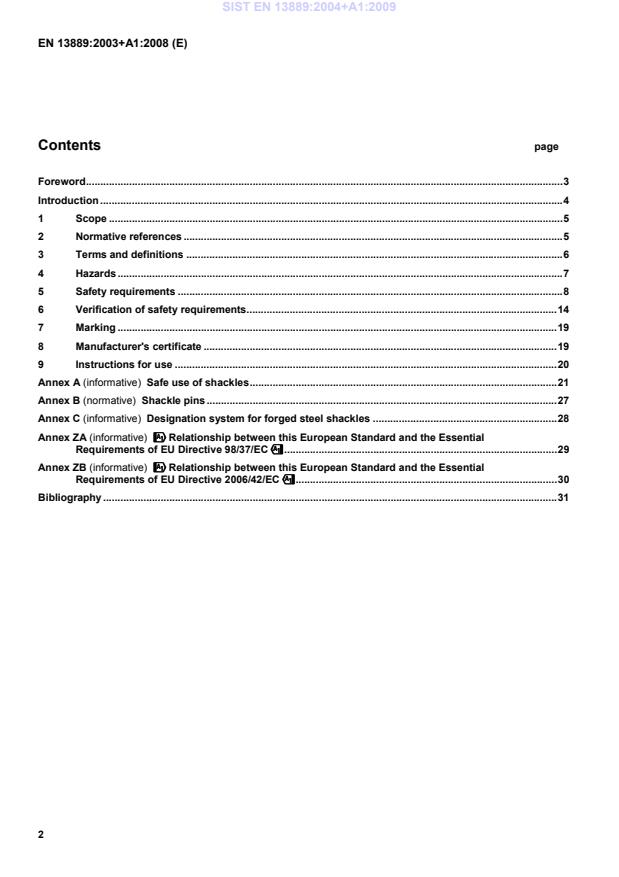
SIST EN 13889:2004+A1:2009 covers forged steel Dee shackles and bow shackles for general lifting use, and it applies only to shackles with threaded pins. The document is organized into clauses on scope, references, terms, hazards, safety requirements, verification, marking, the manufacturer’s certificate, and instructions for use, followed by annexes for safe use, pin types, a designation system, and the EU directive relationships.
| Annex | What it covers |
|---|---|
| Annex A | Safe use of shackles |
| Annex B | Shackle pins |
| Annex C | Designation system for forged steel shackles |
| Annex ZA | Relationship with EU Directive 98/37/EC |
| Annex ZB | Relationship with EU Directive 2006/42/EC |
The scope says the hazards covered are identified in clause 4. That matters because the standard is intended for safety-critical lifting equipment, not just geometry or material description.
What are the key requirements of SIST EN 13889:2004+A1:2009?
The standard ties the shackle size, pin, material, proof testing and marking together so that a user can match the right shackle to the load and trace it back to production. In practice, that means manufacturers must control design, manufacture, inspection and documentation, and users must fit and use the shackle correctly.
Dimensions and design
Clause 5 requires the principal dimensions of Dee and bow shackles to match Table 2 according to WLL. It also limits screw-thread forms to ISO metric or inch thread systems, and the pin and body hole dimensions are controlled so the pin fits correctly without reducing the jaw width too much. This matters because poor fit can lead to incorrect assembly and failure in service.
Manufacture and materials
Clause 5 requires the shackle body to be hot forged in one piece, with no welding on the body or pin and no casting of pins. The steel must be produced by an electric or oxygen blown process, fully killed, stabilized against strain-age-embrittlement, and heat treated before proof testing. In practice, the standard is controlling the material and process so the finished shackle keeps its strength and toughness.
Mechanical performance
Clause 5 sets a manufacturing proof force (MPF), minimum breaking force (BF) and fatigue resistance requirement of at least 20 000 cycles. It also requires a Charpy V-notch impact value of 27 J at -20 °C. For buyers and inspectors, these are the core strength and toughness checks that show the shackle can survive repeated lifting and cold conditions.
Verification and acceptance
Clause 6 distinguishes type testing from manufacturing testing. Type testing uses three samples for deformation, static tensile, fatigue and impact tests, while routine manufacturing testing depends on whether the manufacturer has a quality system in accordance with EN ISO 9001 and certified by a body accredited to EN 45012. This matters because the testing burden changes with the manufacturer’s quality control system.
Marking, certificate and use information
Clause 7 requires each shackle to be marked with WLL, grade 6, the manufacturer identification and a traceability code. Clause 8 requires a certificate with the standard number, traceability code, quantity, description, WLL, MPF confirmation and other production data. Clause 9 requires use information on fitting, inspection, pin replacement, side loading, sling angles, pin security and periodic examination. In practice, this supports safe selection, traceability and post-sale use.
What terms does SIST EN 13889:2004+A1:2009 define?
- Shackle - A lifting accessory made of a body and a separable pin, used to connect a load to a lifting machine or other lifting accessories.
- Dee shackle - A shackle whose crown forms a semicircle.
- Bow shackle - A shackle whose crown forms more than a semicircle.
- Working load limit (WLL) - The maximum mass a shackle is authorized to sustain in general service.
- Manufacturing proof force (MPF) - The force applied during the manufacturing proof test.
- Breaking force (BF) - The maximum force reached in the static tensile test before the shackle fails to retain the load.
- Traceability code - Marking that allows the manufacturing history and steel cast identity to be traced.
- Type W / Type X pin - Two threaded pin designs, one screwed with eye and collar, the other bolt type with hexagon head, nut and split cotter pin.
Who uses SIST EN 13889:2004+A1:2009?
SIST EN 13889:2004+A1:2009 is used by shackle manufacturers, test laboratories, certification bodies, quality managers, lifting-equipment suppliers and competent persons who inspect or examine shackles. It is also relevant for buyers and users who need to select the correct shackle type, WLL and pin type for lifting assemblies.
What changed in SIST EN 13889:2004+A1:2009 from the previous edition?
SIST EN 13889:2004+A1:2009 supersedes EN 13889:2003 and incorporates Amendment 1 approved by CEN in 2008.
Which standards are used with SIST EN 13889:2004+A1:2009?
The standard refers to several documents that support design, testing and quality control:
- EN 292-2 - basic safety and technical principles for machinery design.
- EN 1050 - risk assessment principles for machinery.
- EN 10025 - steel terms used for deoxidation and material quality.
- EN 10045-1 and EN 10045-2 - Charpy impact testing method and machine verification.
- EN 10228-1 and EN 10228-2 - magnetic particle and penetrant testing of steel forgings.
- EN 45012 - requirements for bodies that certify quality systems.
- EN ISO 7500-1 - verification of static tensile testing machines.
- ISO 261 and ISO 263 - screw thread standards.
- ISO 643 - grain size determination for steel.
What does the SIST EN 13889:2004+A1:2009 document contain?
The document includes dimensional drawings for Dee and bow shackles, a table of limiting dimensions by WLL, and tables for chemical limits, mechanical properties, and proof-test sample sizes. It also provides figures for shackle geometry, pin types, and Charpy specimen placement. For practice, those tables and figures are the parts used for design control, type testing, routine inspection and certification.
Relations
- Effective Date
- 01-Sep-2010
- Effective Date
- 09-Feb-2026
- Effective Date
- 28-Jan-2026
- Effective Date
- 28-Jan-2026
- Effective Date
- 28-Jan-2026
- Effective Date
- 28-Jan-2026
- Effective Date
- 28-Jan-2026
- Effective Date
- 28-Jan-2026
- Effective Date
- 28-Jan-2026
- Effective Date
- 28-Jan-2026
- Effective Date
- 28-Jan-2026
- Effective Date
- 28-Jan-2026
- Effective Date
- 28-Jan-2026
- Effective Date
- 28-Jan-2026
- Effective Date
- 28-Jan-2026
Frequently Asked Questions
SIST EN 13889:2004+A1:2009 is a standard published by the Slovenian Institute for Standardization (SIST). Its full title is "Forged steel shackles for general lifting purposes - Dee shackles and bow shackles - Grade 6 - Safety". This standard covers: This European Standard specifies requirements for forged steel Dee and bow shackles of grade 6 for general lifting purposes in a range of working load limits 0,5 t to 25 t maximum. This standard applies only to those shackles with threaded pins. Annex A gives information on the safe use of shackles, annex B gives information on types of pins, and annex C gives an example of a designation system for forged steel shackles. The hazards covered are identified in clause 4.
This European Standard specifies requirements for forged steel Dee and bow shackles of grade 6 for general lifting purposes in a range of working load limits 0,5 t to 25 t maximum. This standard applies only to those shackles with threaded pins. Annex A gives information on the safe use of shackles, annex B gives information on types of pins, and annex C gives an example of a designation system for forged steel shackles. The hazards covered are identified in clause 4.
SIST EN 13889:2004+A1:2009 is classified under the following ICS (International Classification for Standards) categories: 53.020.30 - Accessories for lifting equipment. The ICS classification helps identify the subject area and facilitates finding related standards.
SIST EN 13889:2004+A1:2009 has the following relationships with other standards: It is inter standard links to SIST EN 13889:2004, SIST ISO 263:1998, SIST EN 10228-1:2016, SIST EN 1050:2000, SIST EN 292-2:1996, SIST EN ISO 7500-1:2000, SIST EN 10228-2:2016, SIST EN 572-7:2004, SIST EN ISO 148-3:2017, SIST EN ISO 12402-3:2006/A1:2010, SIST EN ISO 148-2:2017, SIST EN ISO 10855-2:2018, SIST EN 13155:2021+A1:2025, SIST EN 17822:2023, SIST EN 12079-2:2007. Understanding these relationships helps ensure you are using the most current and applicable version of the standard.
SIST EN 13889:2004+A1:2009 is associated with the following European legislation: EU Directives/Regulations: 2006/42/EC, 98/37/EC; Standardization Mandates: M/396. When a standard is cited in the Official Journal of the European Union, products manufactured in conformity with it benefit from a presumption of conformity with the essential requirements of the corresponding EU directive or regulation.
SIST EN 13889:2004+A1:2009 is available in PDF format for immediate download after purchase. The document can be added to your cart and obtained through the secure checkout process. Digital delivery ensures instant access to the complete standard document.
Standards Content (Sample)
2003-01.Slovenski inštitut za standardizacijo. Razmnoževanje celote ali delov tega standarda ni dovoljeno.Kovane jeklene skobe za splošne dvigalne namene - Ravne in zakrivljene skobe - Kakovostni razred 6 - VarnostGeschmiedete Schäkel für allgemeine Hebezwecke - Gerade und geschweifte Schäkel - Güteklasse 6 - SicherheitManilles forgées en acier pour applications générales de levage - Manilles droites et manilles lyres - Classe 6 - SécuritéForged steel shackles for general lifting purposes - Dee shackles and bow shackles - Grade 6 - Safety53.020.30Pribor za dvigalno opremoAccessories for lifting equipmentICS:Ta slovenski standard je istoveten z:EN 13889:2003+A1:2008SIST EN 13889:2004+A1:2009en,fr,de01-januar-2009SIST EN 13889:2004+A1:2009SLOVENSKI
STANDARD
EUROPEAN STANDARD NORME EUROPÉENNE EUROPÄISCHE NORM
EN 13889:2003+A1
November 2008 ICS 53.020.30 Supersedes EN 13889:2003 English Version
Forged steel shackles for general lifting purposes - Dee shackles and bow shackles - Grade 6 - Safety
Manilles forgées en acier pour applications générales de levage - Manilles droites et manilles lyres - Classe 6 - Sécurité
Geschmiedete Schäkel für allgemeine Hebezwecke - Gerade und geschweifte Schäkel - Güteklasse 6 - Sicherheit This European Standard was approved by CEN on 25 April 2003 and includes Amendment 1 approved by CEN on 9 September 2008.
CEN members are bound to comply with the CEN/CENELEC Internal Regulations which stipulate the conditions for giving this European Standard the status of a national standard without any alteration. Up-to-date lists and bibliographical references concerning such national standards may be obtained on application to the CEN Management Centre or to any CEN member.
This European Standard exists in three official versions (English, French, German). A version in any other language made by translation under the responsibility of a CEN member into its own language and notified to the CEN Management Centre has the same status as the official versions.
CEN members are the national standards bodies of Austria, Belgium, Bulgaria, Cyprus, Czech Republic, Denmark, Estonia, Finland, France, Germany, Greece, Hungary, Iceland, Ireland, Italy, Latvia, Lithuania, Luxembourg, Malta, Netherlands, Norway, Poland, Portugal, Romania, Slovakia, Slovenia, Spain, Sweden, Switzerland and United Kingdom.
EUROPEAN COMMITTEE FOR STANDARDIZATION
COMITÉ EUROPÉEN DE NORMALISATION EUROPÄISCHES KOMITEE FÜR NORMUNG
Management Centre: rue de Stassart, 36
B-1050 Brussels © 2008 CEN All rights of exploitation in any form and by any means reserved worldwide for CEN national Members. Ref. No. EN 13889:2003+A1:2008: ESIST EN 13889:2004+A1:2009
Safe use of shackles.21 Annex B (normative)
Shackle pins.27 Annex C (informative)
Designation system for forged steel shackles.28 Annex ZA (informative)
!!!!Relationship between this European Standard and the Essential Requirements of EU Directive 98/37/EC"""".29 Annex ZB (informative)
!!!!Relationship between this European Standard and the Essential Requirements of EU Directive 2006/42/EC"""".30 Bibliography.31
3 Terms and definitions For the purposes of this European Standard the terms and definitions given in EN 10025: 1990 and the following apply: 3.1 shackle a lifting accessory comprising a body and pin as shown in Figures 1 and 2 which are readily separable and can be used to connect a load to a lifting machine directly or in conjunction with other lifting accessories.
3.2 body a part of the shackle formed to the shape of a dee or bow and terminating in eyes as shown in Figures 1 and 2.
3.3 pin a component of circular section which passes through the eyes of the shackle, as shown in Figures 1, 2 and B.1 and which can be readily disassembled.
3.4 dee shackle a shackle the crown of which forms a semicircle of internal radius half the width, W, between the eyes as shown in Figure 1. 3.5 bow shackle a shackle the crown of which forms more than a semicircle of internal radius more than half the width, W, between the eyes as shown in Figure 2. 3.6 working load limit WLL maximum mass that a shackle is authorized to sustain in general service NOTE This term has the same meaning as the term maximum working load used in EN 292-2: 1991, annex A. 3.7 manufacturing proof force MPF force applied to the shackle during the manufacturing proof test 3.8 breaking force BF maximum force reached during the static tensile test of a shackle at which the shackle fails to retain the load 3.9 traceability code series of letters and/or numbers marked on a shackle that enables its manufacturing history, including identity of the cast of steel used, to be traced
3.10 lot number of shackles of the same type and dimensions, manufactured during the same production run from the same cast of steel and subjected to the same heat treatment process
3.11 type W pin screwed pin with eye and collar and which screws into one eye of the shackle body
3.13 competent person designated person, suitably trained, qualified by knowledge and practical experience, and with the necessary instruction to enable the required test and examination to be carried out NOTE EN ISO 9001 gives guidance on training. 4 Hazards Accidental release of a load, or release of a load due to failure of shackle puts at risk, either directly or indirectly the safety or health of those persons within the danger zone. In order to provide the necessary strength and durability of shackles EN 13889 gives requirements for the design, manufacture and testing to ensure the specified levels of performance are met. Since failure can be caused by the incorrect choice of grade and specification of shackle EN 13889 also gives the requirements for marking and the manufacturer's certificate. Errors of fitting can also lead to failure and EN 13889 contains dimensional requirements to allow correct fit. Risk of injury due to sharp edges, sharp angles or rough surfaces when handling is also covered by this standard. Those aspects of safe use associated with good practice are given in annex A. Table 1 contains those hazards, which require action to reduce risk identified by risk assessment as being specific and significant for shackles.
Table 1 — Hazards and associated requirements Hazards identified in annex A Relevant clause Relevant clause/ EN 1050: 1996,
of annex A of EN 292-2: 1991 subclause of
EN 13889 1 Mechanical hazard 1.3.2
due to inadequacy 4.1.2.3
of strength 1.3.2 4.1.2.3 4.1.2.5 5 5 5
4.2.4 6
4.3.2 7
4.2.4 8
1.7.4 9 1.3 Cutting hazard 1.3.4 5.3 1.8 Friction or abrasion hazard 1.3.4 5.3 15 Errors of fitting hazard 1.5.4 5.1
Key: 1 Crown 2 Body 3 Example of screwed pin with eye and collar – type W 4 Eye 5 Bolt type pin with hexagon head, hexagon nut and split cotter pin – type X Figure 1 — Dimensions of dee shackles SIST EN 13889:2004+A1:2009
Key: 1 Crown 2 Body 3 Example of screwed pin with eye and collar – type W 4 Eye 5 Bolt type pin with hexagon head, hexagon nut and split cotter pin – type X Figure 2 — Dimensions of Bow shackles SIST EN 13889:2004+A1:2009
Table 2 — Limiting values for Dee shackles and Bow shackles
WLL Nominal bow diameter dn Nominal pin diameter Dn Nominal inside width Wn at pin
Minimum eye diameter en Dee shackle: minimum inside length S Bow shackle: minimum inside length
S Minimum inside width of bow
Emin t mm mm mm mm mm mm mm 0,5 6,50 8 12 15,5 20 27 19 0,75 8 9,5
13,5 18,5 25 29 20 1 10 11 16,5 22 27 32 24 1,5 11,2 12,2 19 25 33 39 27 2 13,5 16 21,5 29,5 38 44 30 3,25 16,5 19 27 38 47 57 39 4,75 20 22 31,5 44 52 65 48 6,5 23 25 36,5 50 65 76 55 8,5 25,5 28 43 56 74 88 64 9,5 29 32 46,5 64 83 101 70 12 33 35 51,5 70 87 108 78 13,5 36,5 38 57 76 104 126 85 17 39,5 42 60 84 115 139 94 25 46 51 74 100 139 168 119 NOTE: Tolerances: - Bow dia, dn :0,5 t up to and including 2 t : +1,5/ - 1 mm
3,25 t up to and including 12 t : +/- 2,5 mm
13,5 t up to and including 25 t : +/- 3 mm Allow bow diameter dn to be oval, + 10 % for sizes 3,25 t up to and including 17 t, + 25 % for size 25 t (same tolerances as above) - Pin dia, Dn : 0,5 t up to and including 2 t : +/- 1 mm
3,25 t up to and including 25 t : +/- 2 mm - Inside width at pin,Wn : 0,5 t up to and including 2 t : +/- 2,5 mm
3,25 t up to and including 9,5 t : +/- 3 mm
12 t up to and including 25 t : +/- 4 mm
5.2 Design 5.2.1 Screw threads Screw threads shall conform either to ISO 261 class 7H/8g or to ISO 263 class 1A/1B. NOTE For hot dip galvanized or coated pins it is permissible for the threads to be undercut prior to galvanizing or coating. SIST EN 13889:2004+A1:2009
Cast analysis Check analysis
%
%
Sulfur 0,025 0,030 Phosphorus 0,025 0,030
Table 4 — Mechanical properties Working load limit WLL Manufacturing proof force MPF Minimum breaking force BFmin t kN kN 0,5 9,8 24,5 0,75 14,7 36,8 1 19,6 49,1 1,5 29,4 73,6 2 39,2 98,1 3,25 63,7 160 4,75 93,1 233 6,5 128 319 8,5 167 417 9,5 187 466 12 236 589 13,5 265 662 17 334 834 25 491 1226
NOTE The mechanical properties specified in Table 4 are calculated values. It is common practice for manufacturers to round MPF and BF up to higher values that may appear in their published catalogues. SIST EN 13889:2004+A1:2009
...