

SIST ISO 45004:2024
(Main)Occupational health and safety management - Guidelines on performance evaluation
General Information
- Abstract
This document gives guidance regarding how organizations can establish monitoring, measurement, analysis and evaluation processes, including the development of relevant indicators for the assessment of occupational health and safety (OH&S) performance. It enables organizations to determine if intended results are being achieved, including continual improvement of OH&S performance.
This document is applicable to all organizations regardless of type, industry sector, level of risk, size or location. It can be used independently or as part of OH&S management systems, including those based on ISO 45001:2018, or other standards or guidelines.
- Status
- Published
- Public Enquiry End Date
- 29-Jun-2023
- Publication Date
- 15-Apr-2024
- Technical Committee
- VZK - Quality management and quality assurance
- Current Stage
- 6060 - National Implementation/Publication (Adopted Project)
- Start Date
- 23-Feb-2024
- Due Date
- 29-Apr-2024
- Completion Date
- 16-Apr-2024
Buy Documents



ISO 45004:2024 - Occupational health and safety management — Guidelines on performance evaluation Released:14. 03. 2024

ISO 45004:2024 - Occupational health and safety management — Guidelines on performance evaluation Released:9/4/2024
Overview
SIST ISO 45004:2024 - "Occupational health and safety management - Guidelines on performance evaluation" provides practical guidance for establishing and operating processes to monitor, measure, analyse and evaluate occupational health and safety (OH&S) performance. Applicable to organizations of any size, sector or risk level, the standard helps determine whether intended OH&S results are being achieved and supports continual improvement. SIST ISO 45004:2024 can be used independently or alongside OH&S management systems such as ISO 45001:2018.
Key topics and technical requirements
ISO 45004 focuses on performance evaluation as a systematic set of processes. Key technical topics include:
- Performance evaluation process (clause 5): guidance on designing evaluation processes and selecting diverse information sources to avoid incomplete assessments.
- Sources and tools (clause 5.3): inspections, pre‑ and post‑activity reviews, exposure assessments, occupational health surveillance, meetings, focus groups, surveys, interviews, injury/ill‑health tracking, incident investigations and audits.
- Performance indicators (clause 6): selection, life cycle, characteristics and types of indicators - including leading and lagging, quantitative and qualitative, and the value and limitations of benchmarking.
- Monitoring, measurement, analysis and evaluation (clause 8): methods to collect data, address uncertainty, analyse results and make evaluations that inform decision‑making.
- Communication and action (clauses 9–10): presenting results to stakeholders and acting on findings to drive improvement.
- Review of evaluation processes (clause 11): periodic reassessment to ensure processes remain effective and relevant.
- Risk of unintended consequences: guidance to avoid data distortion, under‑/over‑reporting and blaming individuals for systemic deficiencies.
- Normative reference to ISO 45001:2018 and alignment with ISO 45002 guidance where relevant.
Practical applications and users
ISO 45004 is intended for:
- OH&S managers, safety professionals and occupational health practitioners
- Senior management using KPIs for governance and continual improvement
- Internal and external auditors, consultants and compliance teams
- Small, medium and large organizations across industries seeking to design or improve OH&S performance measurement
Typical uses:
- Designing balanced OH&S dashboards combining leading and lagging indicators
- Integrating performance evaluation into management review and business processes
- Improving incident investigation, surveillance and audit programs through better data use
- Avoiding unintended incentive effects (e.g., under‑reporting) by selecting robust indicators
- Supporting regulatory compliance and demonstrable continual improvement
Related standards
- ISO 45001:2018 - Occupational health and safety management systems (normative reference)
- ISO 45002 - Guidance for implementation of ISO 45001 (complementary guidance)
Keywords: SIST ISO 45004:2024, occupational health and safety, OH&S performance evaluation, performance indicators, monitoring and measurement, ISO 45001, leading indicators, lagging indicators, KPIs, continual improvement.
Buy Documents
ISO 45004:2024 - Occupational health and safety management — Guidelines on performance evaluation Released:14. 03. 2024
ISO 45004:2024 - Occupational health and safety management — Guidelines on performance evaluation Released:9/4/2024
Get Certified
Connect with accredited certification bodies for this standard

BSI Group
BSI (British Standards Institution) is the business standards company that helps organizations make excellence a habit.

Bureau Veritas
Bureau Veritas is a world leader in laboratory testing, inspection and certification services.

DNV
DNV is an independent assurance and risk management provider.
Sponsored listings
Frequently Asked Questions
SIST ISO 45004:2024 is a standard published by the Slovenian Institute for Standardization (SIST). Its full title is "Occupational health and safety management - Guidelines on performance evaluation". This standard covers: This document gives guidance regarding how organizations can establish monitoring, measurement, analysis and evaluation processes, including the development of relevant indicators for the assessment of occupational health and safety (OH&S) performance. It enables organizations to determine if intended results are being achieved, including continual improvement of OH&S performance. This document is applicable to all organizations regardless of type, industry sector, level of risk, size or location. It can be used independently or as part of OH&S management systems, including those based on ISO 45001:2018, or other standards or guidelines.
This document gives guidance regarding how organizations can establish monitoring, measurement, analysis and evaluation processes, including the development of relevant indicators for the assessment of occupational health and safety (OH&S) performance. It enables organizations to determine if intended results are being achieved, including continual improvement of OH&S performance. This document is applicable to all organizations regardless of type, industry sector, level of risk, size or location. It can be used independently or as part of OH&S management systems, including those based on ISO 45001:2018, or other standards or guidelines.
SIST ISO 45004:2024 is classified under the following ICS (International Classification for Standards) categories: 13.100 - Occupational safety. Industrial hygiene. The ICS classification helps identify the subject area and facilitates finding related standards.
SIST ISO 45004:2024 is available in PDF format for immediate download after purchase. The document can be added to your cart and obtained through the secure checkout process. Digital delivery ensures instant access to the complete standard document.
Standards Content (Sample)
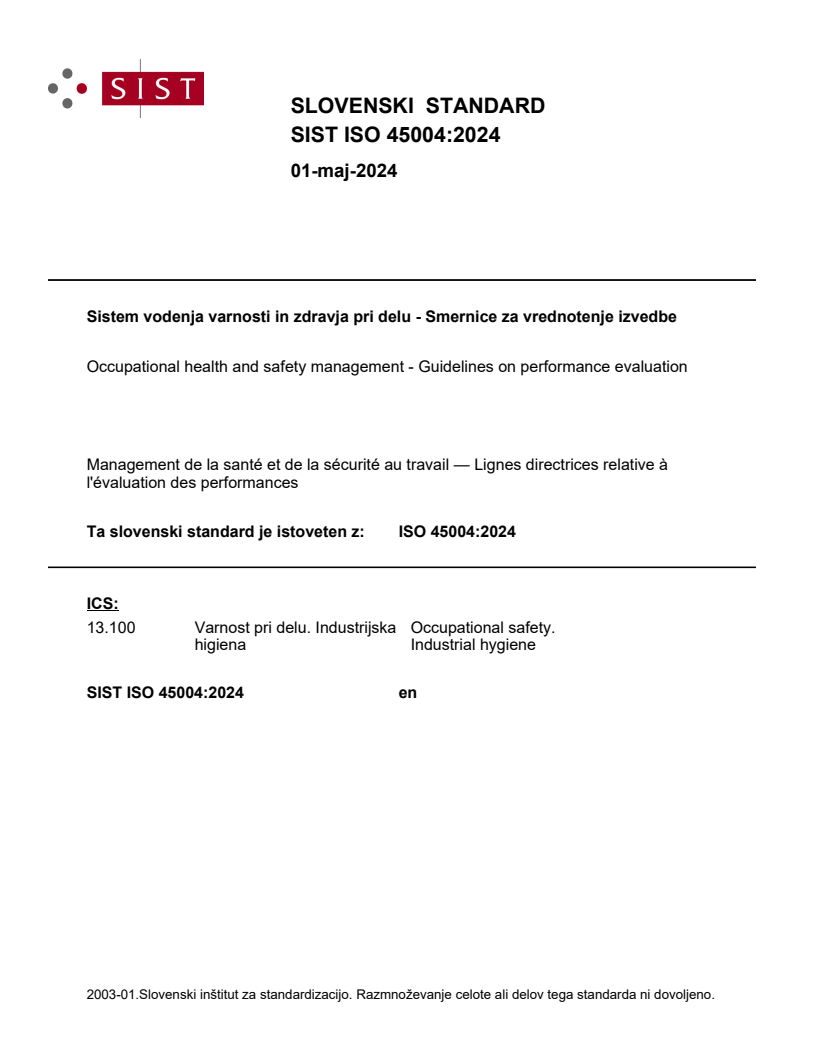
SLOVENSKI STANDARD
01-maj-2024
Sistem vodenja varnosti in zdravja pri delu - Smernice za vrednotenje izvedbe
Occupational health and safety management - Guidelines on performance evaluation
Management de la santé et de la sécurité au travail — Lignes directrices relative à
l'évaluation des performances
Ta slovenski standard je istoveten z: ISO 45004:2024
ICS:
13.100 Varnost pri delu. Industrijska Occupational safety.
higiena Industrial hygiene
2003-01.Slovenski inštitut za standardizacijo. Razmnoževanje celote ali delov tega standarda ni dovoljeno.
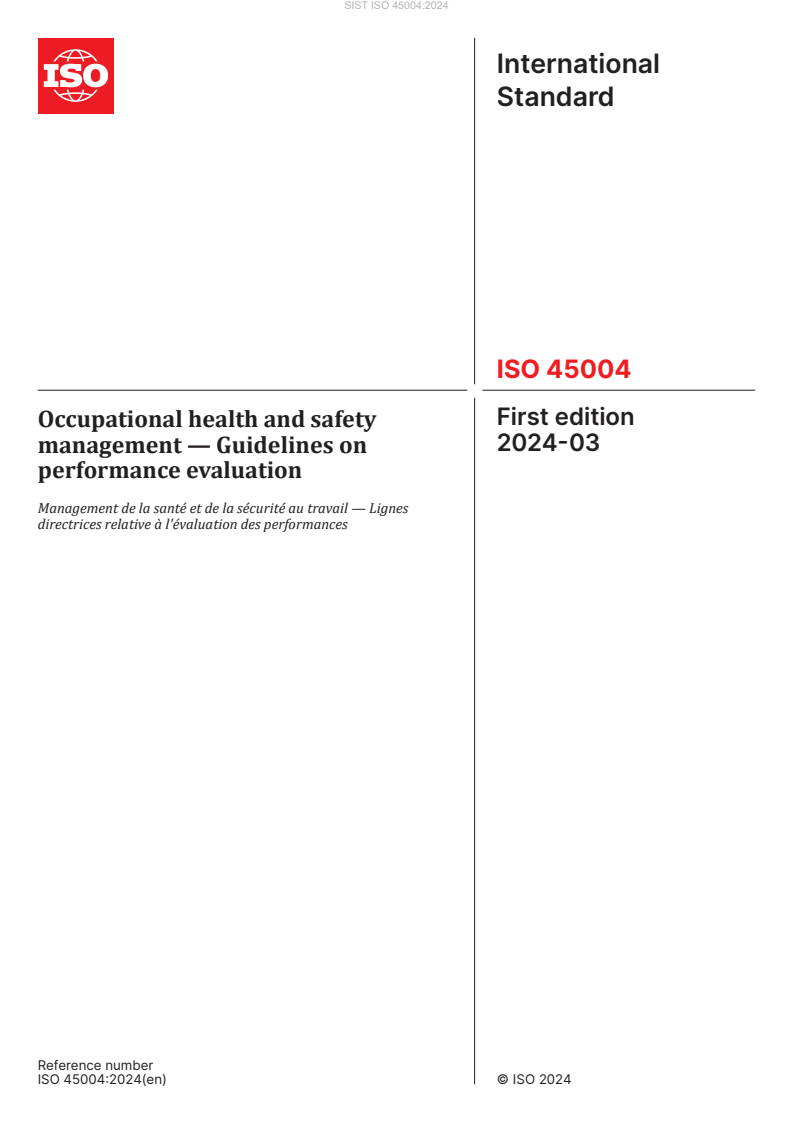
International
Standard
ISO 45004
First edition
Occupational health and safety
2024-03
management — Guidelines on
performance evaluation
Management de la santé et de la sécurité au travail — Lignes
directrices relative à l'évaluation des performances
Reference number
© ISO 2024
All rights reserved. Unless otherwise specified, or required in the context of its implementation, no part of this publication may
be reproduced or utilized otherwise in any form or by any means, electronic or mechanical, including photocopying, or posting on
the internet or an intranet, without prior written permission. Permission can be requested from either ISO at the address below
or ISO’s member body in the country of the requester.
ISO copyright office
CP 401 • Ch. de Blandonnet 8
CH-1214 Vernier, Geneva
Phone: +41 22 749 01 11
Email: copyright@iso.org
Website: www.iso.org
Published in Switzerland
ii
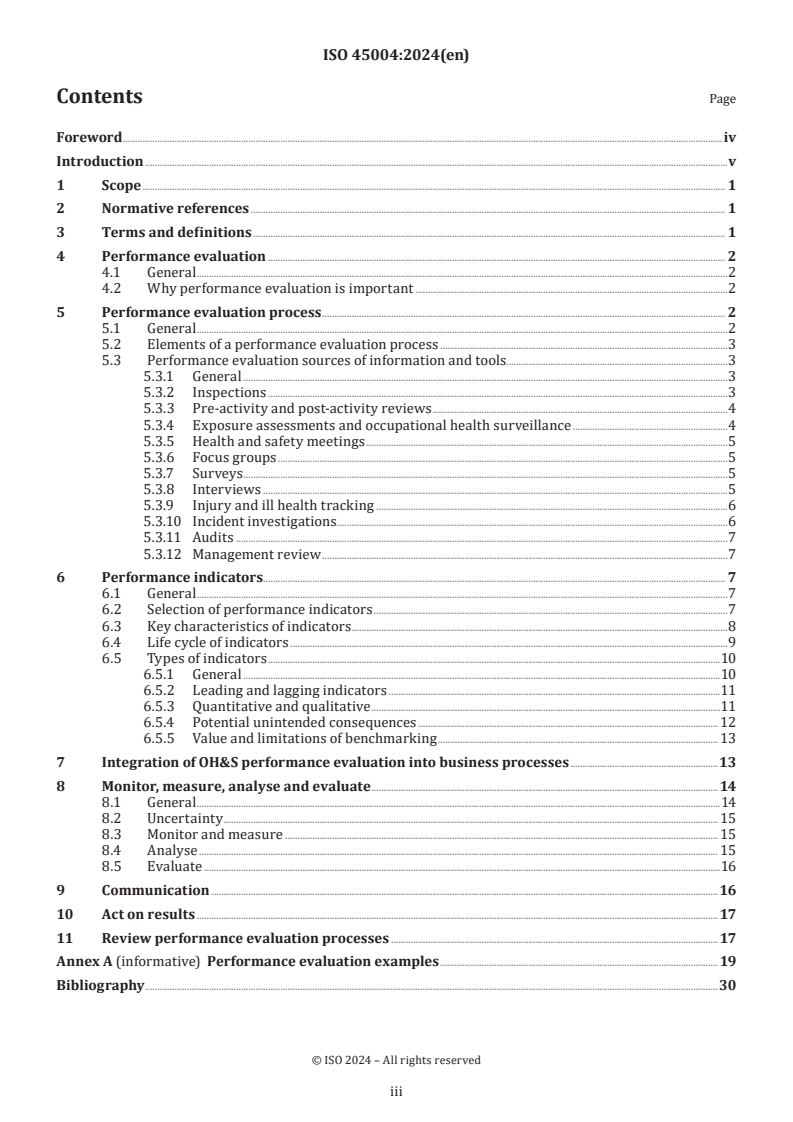
Contents Page
Foreword .iv
Introduction .v
1 Scope . 1
2 Normative references . 1
3 Terms and definitions . 1
4 Performance evaluation . 2
4.1 General .2
4.2 Why performance evaluation is important .2
5 Performance evaluation process . 2
5.1 General .2
5.2 Elements of a performance evaluation process .3
5.3 Performance evaluation sources of information and tools .3
5.3.1 General .3
5.3.2 Inspections .3
5.3.3 Pre-activity and post-activity reviews .4
5.3.4 Exposure assessments and occupational health surveillance .4
5.3.5 Health and safety meetings .5
5.3.6 Focus groups .5
5.3.7 Surveys .5
5.3.8 Interviews .5
5.3.9 Injury and ill health tracking .6
5.3.10 Incident investigations . . .6
5.3.11 Audits .7
5.3.12 Management review .7
6 Performance indicators. 7
6.1 General .7
6.2 Selection of performance indicators .7
6.3 Key characteristics of indicators .8
6.4 Life cycle of indicators .9
6.5 Types of indicators .10
6.5.1 General .10
6.5.2 Leading and lagging indicators .11
6.5.3 Quantitative and qualitative .11
6.5.4 Potential unintended consequences . 12
6.5.5 Value and limitations of benchmarking . 13
7 Integration of OH&S performance evaluation into business processes .13
8 Monitor, measure, analyse and evaluate . 14
8.1 General .14
8.2 Uncertainty . 15
8.3 Monitor and measure . 15
8.4 Analyse . 15
8.5 Evaluate .16
9 Communication .16
10 Act on results . 17
11 Review performance evaluation processes . 17
Annex A (informative) Performance evaluation examples . 19
Bibliography .30
iii
Foreword
ISO (the International Organization for Standardization) is a worldwide federation of national standards
bodies (ISO member bodies). The work of preparing International Standards is normally carried out through
ISO technical committees. Each member body interested in a subject for which a technical committee
has been established has the right to be represented on that committee. International organizations,
governmental and non-governmental, in liaison with ISO, also take part in the work. ISO collaborates closely
with the International Electrotechnical Commission (IEC) on all matters of electrotechnical standardization.
The procedures used to develop this document and those intended for its further maintenance are described
in the ISO/IEC Directives, Part 1. In particular, the different approval criteria needed for the different types
of ISO document should be noted. This document was drafted in accordance with the editorial rules of the
ISO/IEC Directives, Part 2 (see www.iso.org/directives).
ISO draws attention to the possibility that the implementation of this document may involve the use of
(a) patent(s). ISO takes no position concerning the evidence, validity or applicability of any claimed patent
rights in respect thereof. As of the date of publication of this document, ISO had not received notice of
(a) patent(s) which may be required to implement this document. However, implementers are cautioned that
this may not represent the latest information, which may be obtained from the patent database available at
www.iso.org/patents. ISO shall not be held responsible for identifying any or all such patent rights.
Any trade name used in this document is information given for the convenience of users and does not
constitute an endorsement.
For an explanation of the voluntary nature of standards, the meaning of ISO specific terms and expressions
related to conformity assessment, as well as information about ISO’s adherence to the World Trade
Organization (WTO) principles in the Technical Barriers to Trade (TBT), see www.iso.org/iso/foreword.html.
This document was prepared by Technical Committee ISO/TC 283, Occupational health and safety
management.
Any feedback or questions on this document should be directed to the user’s national standards body. A
complete listing of these bodies can be found at www.iso.org/members.html.
iv
Introduction
This document is intended to help organizations to effectively monitor, measure, analyse and evaluate
occupational health and safety (OH&S) performance.
OH&S performance evaluation includes the processes that the organization uses to assess the adequacy of
activities that are expected to achieve intended results. OH&S performance is normally evaluated by using
a combination of processes and sources of information such as incident investigations, inspections, audits,
qualitative and quantitative indicators, culture surveys and interviews.
This document gives guidance on performance evaluation processes, including:
— selection and use of performance processes including indicators;
— monitoring and measuring to obtain data;
— analysing the data to allow performance of evaluation;
— unintended consequences;
— limitations, such as under- and over-reporting, and data distortion.
This document can be used by organizations of all types, regardless of whether they have implemented a
formal OH&S management system (see ISO 45001 and ISO 45002).
This document provides examples which demonstrate how to evaluate performance to drive continual
improvement and support the organization in achieving its intended results.
This document recommends a balanced approach based on selection of performance evaluation processes
and indicators, with emphasis on proactive (leading) OH&S performance indicators. It recognizes that over-
emphasis on past performance (lagging) indicators, such as incidence and frequency rates, can undermine
efforts to improve OH&S performance.
As every organization is unique, and intended results vary, there is not a standardized set of performance
evaluation processes or set of indicators that fulfil the needs of all organizations. Therefore, every
organization has to identify performance evaluation processes and indicators to suit its needs.
Effective performance evaluation can help the organization to demonstrate continual improvement, and
therefore may need to be adjusted when the organization’s performance changes. Effectiveness is the
result of selecting the appropriate performance evaluation processes and properly implementing them.
When performance evaluation processes are used inappropriately (e.g. in a way that is perceived to blame
individuals for system deficiencies), they can produce unintended consequences. The most common of these
consequences are discussed in this document.
This document is designed to complement ISO 45001 by providing performance evaluation approaches that
align with requirements of that standard. This document can be used independently, by any organization, to
improve OH&S performance.
v
International Standard ISO 45004:2024(en)
Occupational health and safety management — Guidelines on
performance evaluation
1 Scope
This document gives guidance regarding how organizations can establish monitoring, measurement,
analysis and evaluation processes, including the development of relevant indicators for the assessment
of occupational health and safety (OH&S) performance. It enables organizations to determine if intended
results are being achieved, including continual improvement of OH&S performance.
This document is applicable to all organizations regardless of type, industry sector, level of risk, size or
location. It can be used independently or as part of OH&S management systems, including those based on
ISO 45001:2018, or other standards or guidelines.
2 Normative references
The following documents are referred to in the text in such a way that some or all of their content constitutes
requirements of this document. For dated references, only the edition cited applies. For undated references,
the latest edition of the referenced document (including any amendments) applies.
ISO 45001:2018, Occupational health and safety management systems — Requirements with guidance for use
3 Terms and definitions
For the purposes of this document, the terms and definitions given in ISO 45001:2018 and the following
apply.
ISO and IEC maintain terminology databases for use in standardization at the following addresses:
— ISO Online browsing platform: available at https:// www .iso .org/ obp
— IEC Electropedia: available at https:// www .electropedia .org/
3.1
measurement
process to determine a value
Note 1 to entry: Measurement can relate to managing activities, processes, products, services, systems or
organizations.
[SOURCE: ISO 45001:2018, 3.31, modified — Note 1 to entry replaced.]
3.2
indicator
variable that can be measured or described, representing the status or a characteristic of operations,
processes, management, and conditions or outcomes
Note 1 to entry: Indicators are generally measurable and can be quantitative or qualitative.
Note 2 to entry: Lagging indicators relate to past performance.
Note 3 to entry: Leading indicators relate to factors that can influence future performance.
Note 4 to entry: Some organizations use the term “metric” instead of “indicator”.
Note 5 to entry: Significant indicators used to direct decision-making by top management are sometimes referred to
as “key performance indicators (KPIs)”.
4 Performance evaluation
4.1 General
Performance evaluation is a process or set of processes that compares performance achieved by an
organization against intended results. The organization’s intended results can include continual
improvement of OH&S performance, achievement of OH&S objectives, and fulfilment of legal requirements
and other requirements.
The organization should take into account that there are many sources of information that can provide
input to performance evaluation (see 5.3). The organization should consider using a variety of sources of
information as inputs to achieve a more comprehensive assessment, as a single source used in isolation can
lead to an incomplete or inaccurate assessment.
Clause A.3 provides examples of processes that can help achieve intended results.
4.2 Why performance evaluation is important
The intent of performance evaluation is to assist the organization in determining the extent to which
intended results are being achieved.
For example, performance evaluation allows the organization to determine:
a) if top management is demonstrating commitment to and support for OH&S;
b) which processes are achieving planned results and which are not;
c) the degree of variation in processes or activities that affect OH&S performance and the causes of those
variations;
d) if there are opportunities or if there is a need for actions to improve processes.
Performance evaluation is essential to ensure effective management of OH&S performance and to contribute
to the effectiveness of the organization’s decision-making process(es).
5 Performance evaluation process
5.1 General
When implementing the performance evaluation process, the organization should take into account:
a) its processes (e.g. purchasing, planning, manufacturing, service provision, logistics, training) relevant
to its context and activities (e.g. working at height, permit to work, exposure assessment);
b) the effectiveness of OH&S management, including worker participation, hazard identification,
assessment of risk and risk controls;
c) its conscious or unconscious assumptions about OH&S that influence organizational behaviour;
EXAMPLE It is a common erroneous assumption that incidents are always caused by unsafe behaviour by
workers. Similarly, it is often erroneously assumed that a low incident rate always means the workplace is safe.
d) organizational culture that influences behaviours that affect OH&S (e.g. reporting OH&S incidents or
issues is encouraged and supported, without fear of reprisal);
e) interdependencies within the system (e.g. the effectiveness of inspections can depend on the time
available, training of inspectors and the willingness of workers to report issues to inspectors);
f) processes of the organization that can impact OH&S performance.
NOTE Examples of processes that can impact OH&S performance are provided in Clause A.1.
5.2 Elements of a performance evaluation process
The organization should undertake specific performance evaluation processes to determine if the intended
results are being achieved. The organization should take into account the types of activities being undertaken
when considering the frequency and nature of performance evaluation processes.
The organization should:
a) establish the intended results;
b) determine what should be done to achieve the intended results;
c) choose the performance evaluation processes, sources of information and tools (see 5.3);
d) determine the information needed (e.g. inspection results, evaluation outcomes, audit findings) and
whether it is possible to obtain it (see 5.3);
e) monitor, measure, analyse and evaluate performance (see Clause 8);
f) take action based on evaluation of performance (see Clause 10);
g) review unintended consequences (see 6.5.4);
h) take action to address issues identified within the performance evaluation process and its results (see
Clause 11).
5.3 Performance evaluation sources of information and tools
5.3.1 General
The organization should determine the most effective performance evaluation sources of information
and tools to evaluate if intended results are being achieved. This activity should include consultation with
workers or worker representatives.
The organization should consider OH&S processes such as training, risk assessments, contractor safety
and management of change, or information acquired from incidents such as near misses, overexposure to
airborne contaminants, injuries, chemical spills or illnesses. Further information on the selection and use of
indicators is provided in Clause 6.
Subclauses 5.3.2 to 5.3.12 provide a list of the most common sources of information and tools; however, the
list is not exhaustive. The organization should take into account that there are many sources of information
that can provide input to performance evaluation (see 5.3). These sources of information may include non-
OH&S business processes and activities.
The organization should identify additional sources of information or tools where appropriate due to the
nature of work, type of OH&S hazards and exposures, and level of risk.
The organization should respect the confidentiality, protection of privacy and sensitive information of
workers throughout the performance evaluation process.
5.3.2 Inspections
Inspections can provide organizations with relatively quick, efficient means for reviewing the status of
OH&S risk control implementation, progress toward and achievement of objectives, and fulfilment of legal
requirements and other requirements.
The organization can use inspections to:
a) observe and learn from workers how work is actually being done;
b) acquire both general and specific information (e.g. work conditions; if workers are using controls as
intended; fulfilment of legal requirements and other requirements);
c) acquire information on more than one aspect of OH&S performance at one time (e.g. correct use of
personal protective equipment (PPE); operation of ventilation systems and other controls; how workers
interact and collaborate; safe use of machinery or equipment; opportunities for improvement);
d) gain insight into hazards and risks and why incidents happen, as well as to assess high-risk and non-
routine work performances which were successful;
e) review information related to processes (e.g. procedures during equipment breakdowns).
The organization should consider if it is useful to implement regular inspections for specific OH&S objectives
(e.g. daily checks of safety-critical equipment such as cranes, ventilation, chemical enclosures or safety
devices on power presses).
5.3.3 Pre-activity and post-activity reviews
Pre-activity reviews (sometimes referred to as “pre-job reviews”, “pre-task reviews” or “dynamic risk
assessments”) and post-activity reviews (sometimes called “post-job debriefs” or “after-action reviews”) can
be a rich source of performance evaluation information. The organization should consider the use of pre-
and post-activity reviews, to acquire information on aspects such as:
a) resource issues, including the need for more workers or workers with different skills, equipment repair,
availability and condition of safety-critical items such as ventilation systems, air quality monitoring and
machine guards;
b) competence gaps and the potential need for training;
c) gaps in the fulfilment of legal requirements and other requirements;
d) current working conditions compared with those anticipated when the job was planned;
e) effectiveness of hazard identification and assessment of risks, and identification of opportunities;
f) effectiveness of existing controls, procedures and processes;
g) the protection of privacy and personal data as reported.
The organization should ensure that workers involved in the task participate in pre- and post-activity
reviews, and determine the necessary actions to be taken to ensure information is comprehensive and
accurate.
5.3.4 Exposure assessments and occupational health surveillance
The organization should use information from exposure assessment monitoring and health surveillance
programmes to help evaluate the effectiveness of processes and controls (e.g. ventilation, hearing protection)
and determine the level of exposure before harm to workers occurs.
The organization should compare exposures against established OH&S criteria and determine if levels are
exceeded.
The organization should use health surveillance programmes to identify signs or symptoms of ill health.
To understand OH&S performance, the organization should measure and monitor exposure to health
hazards, such as:
— chemical (e.g. liquids, gases, other airborne contaminants);
— biological (e.g. toxins, viruses, bacteria, fungi, animal bites);
— physical (e.g. excessive heat or cold, noise, radiation, vibration);
— psychosocial (e.g. work overload, bullying, stress);
— ergonomic (e.g. repetitive movement, tasks requiring awkward postures, manual handling).
The organization should take into account that it can take months or years before negative effects of exposure
result in symptoms of ill health. The organization should combine the data from health surveillance and
exposure assessments. The organization can take into account additional information resulting from worker
information including vulnerable groups (e.g. pregnant women, disabled workers) and surveys to evaluate
the effectiveness of controls and identify opportunities for improvement.
The organization should protect the confidentiality of the personal health surveillance data.
5.3.5 Health and safety meetings
If appropriate to its size and the number of workers, the organization can implement health and safety
meetings at different levels of the organization (e.g. corporate, facility, department, work team). The
organization should consider using the results of safety meetings as part of the performance evaluation
process, to analyse information from other activities and sources, such as injury and ill health rates, incident
investigations, exposure assessment data, results of surveys or findings from inspections. The organization
should take into account the objectives of meetings to determine their frequency and who participates.
5.3.6 Focus groups
The organization should consider the use of temporary focus groups to gain insight and improve
understanding of specific concerns and topics of interest. A focus group can consist of a small number of
people more closely related to the issue of concern or with knowledge of the subject, and the organization
should consider this mechanism when it needs to acquire a deeper understanding of a particular issue.
The organization can use short-term focus groups for activities such as identifying opportunities to improve
OH&S performance, how a task is performed, or to explore the underlying causes of process failures, such
as why workers are reluctant to report an incident. The organization should ensure the focus group is
facilitated in an unbiased way and that the workers involved feel comfortable to share information.
EXAMPLE Focus groups can be used when an organization does not understand the results of a culture survey
and wants to learn why workers responded in a certain way.
5.3.7 Surveys
The organization should consider using surveys to acquire insight on aspects such as organizational culture,
evaluation of OH&S performance related to internal and external issues, needs of interested parties, work
environment, health and well-being, or perception of effectiveness of processes and controls.
Surveys can be integrated into existing employee surveys and performed at different levels of the
organization and with relevant interested parties, depending on the subject of the survey. The organization
should consider the use of anonymous surveys, when appropriate (e.g. for potentially sensitive issues such
as the work environment, psychological health and safety, psychosocial factors, effective leadership or
potentially unsafe working practices).
NOTE Surveys can be helpful to quantify issues or clarify if concerns are limited to a small number of workers
or more general. They can also provide qualitative indicators or information if they include open questions where
responders can provide their insights.
5.3.8 Interviews
The organization should consider the use of formal and informal interviews with workers at all levels to
gather information on hazards, the effectiveness of controls, performance of the management system or
business processes, adverse health symptoms, recent experiences, how workers are feeling, their concerns
and ideas for improvement. The organization should provide interviewers with appropriate training and
tools.
When carrying out interviews, the organization should take into account:
a) the importance of creating an environment where workers feel safe to answer (e.g. not being interviewed
by their supervisors or by others with authority over them) without fear of adverse consequences (e.g.
embarrassment, threats, stigma, any type of reprisal);
b) the literacy levels of the interviewees and the potential need for translators or interpreters;
c) the potential benefits of confidential one-to-one or small group discussions to encourage open and
honest discussion;
d) the need for interviewers to mainly ask open-ended questions that cannot be answered with a simple
yes or no rather than closed-ended questions to encourage the interviewee to share all relevant
information;
e) the need for interviewers to ask non-judgemental questions without bias or directing answers to a pre-
determined conclusion;
f) the importance of listening and documenting answers (if needed), accurately and objectively.
5.3.9 Injury and ill health tracking
The organization should consider the role injury and ill health tracking can play in performance evaluation.
If there are very low numbers of injuries and illnesses, the organization should consider if this is due to a
reluctance to report, a lack of awareness of how to report or why something should be reported. This is
an example of why it is important to use multiple performance evaluation sources of information to either
support or contradict the results.
The organization should consider if workers are sufficiently aware of OH&S hazards, and should also
consider including tracking near misses and less serious medical issues in addition to injuries and illnesses
with more significance. The organization should track occupational health issues that cause workers to take
time off work and establish processes to monitor instances of workers coming to work when they are unwell
or unfit to work.
The organization can analyse this data in various ways, depending on the information it needs (e.g. by
department, type of injury or ill health, body part, job classification, type of activity, time of day an incident
happens).
5.3.10 Incident investigations
The information acquired from incident investigations can provide useful input to performance evaluation
by identifying issues with processes, controls and underlying factors such as how work is organized,
insufficient resources, or interactions between people (e.g. communication) or between people and
processes (e.g. an activity or process interacting with another in a hazardous way).
The organization should use information acquired through incident investigations to understand what
happened and why an incident, injury or ill health occurred. The organization can use incident investigations
to understand the context surrounding the event, build knowledge, ensure the causes have been identified
and ensure the most effective corrective actions are taken.
The organization should ensure incident investigations do not establish misconduct or worker error as the
cause of the incident without considering organizational and other factors, such as pace of work, desire for
increased productivity or resource level, that can lead to worker fatigue and cause workers to take shortcuts
and jeopardize their own safety and the safety of others.
5.3.11 Audits
The organization can use the results of internal and any external audits as inputs to performance evaluation
to identify process and system deficiencies, to identify opportunities for improvement and as the basis for
indicators.
NOTE Further information on auditing is provided in ISO 19011.
5.3.12 Management review
Management review is part of performance evaluation processes.
The organization should use management review as a key source of information for performance evaluation,
to determine the extent to which it is achieving its intended results, and any improvements needed.
The organization should take into account the information acquired from other processes and activities
including monitoring, measuring, analysing and evaluating results, and consultation and participation of
workers.
6 Performance indicators
6.1 General
The organization should use performance indicators to measure or describe the status or a characteristic of
operations, processes, management, and conditions or results.
They can be selected and applied at several levels or functions in the organization. These can include:
a) the whole organization: evaluating overall OH&S performance;
b) top management: capturing the key OH&S issues top management needs to follow;
c) management of functions, areas or sites of the organization;
d) individual processes and tasks: evaluating if they achieve intended results.
The organization should also consider selection of indicators based on different type of hazards (e.g.
physical, chemical, biological, psychosocial, ergonomic).
Indicators can demonstrate that the level of performance has improved, remained the same or deteriorated.
If necessary, the organization should establish an action plan to ensure the intended result will be achieved.
Indicators can measure the progress of the action plan towards achieving the intended result.
NOTE Examples of performance indicators are provided in Clause A.2.
6.2 Selection of performance indicators
The organization should base its performance evaluation process on its intended results in line with its
OH&S policy.
When possible, the intended results should be clearly defined to determine if the level of performance
is acceptable. The organization should define the roles and responsibilities of those with performance
evaluation duties to avoid gaps and overlap. Those roles should be communicated to relevant interested
parties.
The organization should monitor the extent to which the OH&S performance evaluation process meets
the needs and expectations of interested parties (e.g. regulatory authorities, managers and other relevant
workers, contractors).
The organization can use a variety of indicators that range from globally recognized indicators, which enable
comparisons to be made with other organizations, to more specific ones that relate to the organization’s
context.
EXAMPLE In a large multinational company, to promote a culture that supports OH&S, several focus groups were
held in each region with internal interested parties (human resources, workers, maintenance, etc.) to identify specific
processes or activities to be monitored and to select suitable indicators. This provided a good opportunity to align
indicators with different departments and with the intended results.
6.3 Key characteristics of indicators
The organization should ensure that indicators are:
a) meaningful, measurable, aligned to OH&S policy and relevant to the organization’s intended results;
b) related either to information that is already available or information that can be obtained if not yet
available;
c) responsive to changes in the characteristics that are being measured, so that the organization can act
rapidly;
d) verifiable (i.e. results can be checked);
e) comparable (i.e. allow comparison of results with other results acquired using the same criteria, for
example benchmarking);
f) capable of measuring both short- and long-term changes, measured as often as necessary.
The organization should ensure that the indicators chosen are understandable at an operational level and
are communicated to relevant interested parties.
The organization should use indicators specific to different functions and OH&S processes, and should
ensure that these different indicators are compatible and consistent.
Table 1 gives examples of indicators for different levels in an organization.
Organizations with several work sites or operating in different geographical areas should consider the need
to adapt indicators to reflect differences in local context, while taking into account the benefits of indicators
being similar to allow comparisons and aggregations across locations.
Table 1 — Indicators for different levels or functions in the organization
Level or function Examples of indicators
Whole organization/ — incidence rate of injuries and incidences of ill health, and their trends
top management
— aggregate results of health surveillance, respecting individual confidentiality
— degree of worker involvement (e.g. participation of workers in performance evaluation
and risk assessment activities, providing suggestions for improvement of OH&S)
OH&S management — extent of implementation of an OH&S management system
system (where one
— percentage of objectives achieved
exists)/persons
responsible for OH&S
— percentage of equipment modifications that trigger an OH&S review of potential
management
consequences
— results of tests of effectiveness of OH&S improvement programmes
Individual — degree of implementation of actions to address risks
departments/
— percentage of risk reduced or eliminated, or opportunities implemented
managers
— effectiveness of site inspections
Processes and tasks, — percentage of procedures updated according to schedule
supervisors
— percentage of monitoring equipment calibrated
— percentage of available competent workers for an activity in relation to required
numbers
Worker — percentage of concerns or suggestions received
participation
— percentage of participation in health and safety meetings
— percentage of incidents reported
6.4 Life cycle of indicators
The organization should take into account that indicators do not always provide the information required
or stay relevant for a long time. As the organization’s context changes (e.g. changes to processes, legal
requirements, knowledge about hazards) indicators potentially cease to be relevant and others can require
development. The organization should be aware that, after some time, indicators can fail to accurately
measure performance or can cause unintended consequences such as under-reporting, misrepresentation
or distortion of data. To prevent this happening, the organization should regularly review indicators to
confirm that they are still valid and modify them to remain relevant if necessary (see Clause 11).
When establishing or revising processes, organizations often select quantitative indicators which measure
the adoption of the process (e.g. percentage of incidents investigated, percentage of corrective actions
achieved). As performance evaluation processes mature, the organization should adjust or expand the scope
of its indicators to measure both the quality and effectiveness of the process. This can include greater use of
qualitative indicators (e.g. conclusions from investigations).
Table 2 provides examples of how indicators can develop as the performance evaluation process matures.
NOTE A combination of initial, developing and mature indicators can be relevant and used by an organization at
the same time for different aspects of OH&S performance evaluation.
Table 2 — Examples of how indicators can develop
Process Initial indicator Developed indicator Mature indicator
Training — number of — degree to which the training fulfils — extent to which trainees apply
workers the training needs training skills on the job
attending OH&S
— feedback on the effectiveness of the — number of workers
training each
training (worker survey) demonstrating increased
year
knowledge and skills
— number of workers completing
training within specified time — observ
...
International
Standard
ISO 45004
First edition
Occupational health and safety
2024-03
management — Guidelines on
performance evaluation
Management de la santé et de la sécurité au travail — Lignes
directrices relative à l'évaluation des performances
Reference number
© ISO 2024
All rights reserved. Unless otherwise specified, or required in the context of its implementation, no part of this publication may
be reproduced or utilized otherwise in any form or by any means, electronic or mechanical, including photocopying, or posting on
the internet or an intranet, without prior written permission. Permission can be requested from either ISO at the address below
or ISO’s member body in the country of the requester.
ISO copyright office
CP 401 • Ch. de Blandonnet 8
CH-1214 Vernier, Geneva
Phone: +41 22 749 01 11
Email: copyright@iso.org
Website: www.iso.org
Published in Switzerland
ii
Contents Page
Foreword .iv
Introduction .v
1 Scope . 1
2 Normative references . 1
3 Terms and definitions . 1
4 Performance evaluation . 2
4.1 General .2
4.2 Why performance evaluation is important .2
5 Performance evaluation process . 2
5.1 General .2
5.2 Elements of a performance evaluation process .3
5.3 Performance evaluation sources of information and tools .3
5.3.1 General .3
5.3.2 Inspections .3
5.3.3 Pre-activity and post-activity reviews .4
5.3.4 Exposure assessments and occupational health surveillance .4
5.3.5 Health and safety meetings .5
5.3.6 Focus groups .5
5.3.7 Surveys .5
5.3.8 Interviews .5
5.3.9 Injury and ill health tracking .6
5.3.10 Incident investigations . . .6
5.3.11 Audits .7
5.3.12 Management review .7
6 Performance indicators. 7
6.1 General .7
6.2 Selection of performance indicators .7
6.3 Key characteristics of indicators .8
6.4 Life cycle of indicators .9
6.5 Types of indicators .10
6.5.1 General .10
6.5.2 Leading and lagging indicators .11
6.5.3 Quantitative and qualitative .11
6.5.4 Potential unintended consequences . 12
6.5.5 Value and limitations of benchmarking . 13
7 Integration of OH&S performance evaluation into business processes .13
8 Monitor, measure, analyse and evaluate . 14
8.1 General .14
8.2 Uncertainty . 15
8.3 Monitor and measure . 15
8.4 Analyse . 15
8.5 Evaluate .16
9 Communication .16
10 Act on results . 17
11 Review performance evaluation processes . 17
Annex A (informative) Performance evaluation examples . 19
Bibliography .30
iii
Foreword
ISO (the International Organization for Standardization) is a worldwide federation of national standards
bodies (ISO member bodies). The work of preparing International Standards is normally carried out through
ISO technical committees. Each member body interested in a subject for which a technical committee
has been established has the right to be represented on that committee. International organizations,
governmental and non-governmental, in liaison with ISO, also take part in the work. ISO collaborates closely
with the International Electrotechnical Commission (IEC) on all matters of electrotechnical standardization.
The procedures used to develop this document and those intended for its further maintenance are described
in the ISO/IEC Directives, Part 1. In particular, the different approval criteria needed for the different types
of ISO document should be noted. This document was drafted in accordance with the editorial rules of the
ISO/IEC Directives, Part 2 (see www.iso.org/directives).
ISO draws attention to the possibility that the implementation of this document may involve the use of
(a) patent(s). ISO takes no position concerning the evidence, validity or applicability of any claimed patent
rights in respect thereof. As of the date of publication of this document, ISO had not received notice of
(a) patent(s) which may be required to implement this document. However, implementers are cautioned that
this may not represent the latest information, which may be obtained from the patent database available at
www.iso.org/patents. ISO shall not be held responsible for identifying any or all such patent rights.
Any trade name used in this document is information given for the convenience of users and does not
constitute an endorsement.
For an explanation of the voluntary nature of standards, the meaning of ISO specific terms and expressions
related to conformity assessment, as well as information about ISO’s adherence to the World Trade
Organization (WTO) principles in the Technical Barriers to Trade (TBT), see www.iso.org/iso/foreword.html.
This document was prepared by Technical Committee ISO/TC 283, Occupational health and safety
management.
Any feedback or questions on this document should be directed to the user’s national standards body. A
complete listing of these bodies can be found at www.iso.org/members.html.
iv
Introduction
This document is intended to help organizations to effectively monitor, measure, analyse and evaluate
occupational health and safety (OH&S) performance.
OH&S performance evaluation includes the processes that the organization uses to assess the adequacy of
activities that are expected to achieve intended results. OH&S performance is normally evaluated by using
a combination of processes and sources of information such as incident investigations, inspections, audits,
qualitative and quantitative indicators, culture surveys and interviews.
This document gives guidance on performance evaluation processes, including:
— selection and use of performance processes including indicators;
— monitoring and measuring to obtain data;
— analysing the data to allow performance of evaluation;
— unintended consequences;
— limitations, such as under- and over-reporting, and data distortion.
This document can be used by organizations of all types, regardless of whether they have implemented a
formal OH&S management system (see ISO 45001 and ISO 45002).
This document provides examples which demonstrate how to evaluate performance to drive continual
improvement and support the organization in achieving its intended results.
This document recommends a balanced approach based on selection of performance evaluation processes
and indicators, with emphasis on proactive (leading) OH&S performance indicators. It recognizes that over-
emphasis on past performance (lagging) indicators, such as incidence and frequency rates, can undermine
efforts to improve OH&S performance.
As every organization is unique, and intended results vary, there is not a standardized set of performance
evaluation processes or set of indicators that fulfil the needs of all organizations. Therefore, every
organization has to identify performance evaluation processes and indicators to suit its needs.
Effective performance evaluation can help the organization to demonstrate continual improvement, and
therefore may need to be adjusted when the organization’s performance changes. Effectiveness is the
result of selecting the appropriate performance evaluation processes and properly implementing them.
When performance evaluation processes are used inappropriately (e.g. in a way that is perceived to blame
individuals for system deficiencies), they can produce unintended consequences. The most common of these
consequences are discussed in this document.
This document is designed to complement ISO 45001 by providing performance evaluation approaches that
align with requirements of that standard. This document can be used independently, by any organization, to
improve OH&S performance.
v
International Standard ISO 45004:2024(en)
Occupational health and safety management — Guidelines on
performance evaluation
1 Scope
This document gives guidance regarding how organizations can establish monitoring, measurement,
analysis and evaluation processes, including the development of relevant indicators for the assessment
of occupational health and safety (OH&S) performance. It enables organizations to determine if intended
results are being achieved, including continual improvement of OH&S performance.
This document is applicable to all organizations regardless of type, industry sector, level of risk, size or
location. It can be used independently or as part of OH&S management systems, including those based on
ISO 45001:2018, or other standards or guidelines.
2 Normative references
The following documents are referred to in the text in such a way that some or all of their content constitutes
requirements of this document. For dated references, only the edition cited applies. For undated references,
the latest edition of the referenced document (including any amendments) applies.
ISO 45001:2018, Occupational health and safety management systems — Requirements with guidance for use
3 Terms and definitions
For the purposes of this document, the terms and definitions given in ISO 45001:2018 and the following
apply.
ISO and IEC maintain terminology databases for use in standardization at the following addresses:
— ISO Online browsing platform: available at https:// www .iso .org/ obp
— IEC Electropedia: available at https:// www .electropedia .org/
3.1
measurement
process to determine a value
Note 1 to entry: Measurement can relate to managing activities, processes, products, services, systems or
organizations.
[SOURCE: ISO 45001:2018, 3.31, modified — Note 1 to entry replaced.]
3.2
indicator
variable that can be measured or described, representing the status or a characteristic of operations,
processes, management, and conditions or outcomes
Note 1 to entry: Indicators are generally measurable and can be quantitative or qualitative.
Note 2 to entry: Lagging indicators relate to past performance.
Note 3 to entry: Leading indicators relate to factors that can influence future performance.
Note 4 to entry: Some organizations use the term “metric” instead of “indicator”.
Note 5 to entry: Significant indicators used to direct decision-making by top management are sometimes referred to
as “key performance indicators (KPIs)”.
4 Performance evaluation
4.1 General
Performance evaluation is a process or set of processes that compares performance achieved by an
organization against intended results. The organization’s intended results can include continual
improvement of OH&S performance, achievement of OH&S objectives, and fulfilment of legal requirements
and other requirements.
The organization should take into account that there are many sources of information that can provide
input to performance evaluation (see 5.3). The organization should consider using a variety of sources of
information as inputs to achieve a more comprehensive assessment, as a single source used in isolation can
lead to an incomplete or inaccurate assessment.
Clause A.3 provides examples of processes that can help achieve intended results.
4.2 Why performance evaluation is important
The intent of performance evaluation is to assist the organization in determining the extent to which
intended results are being achieved.
For example, performance evaluation allows the organization to determine:
a) if top management is demonstrating commitment to and support for OH&S;
b) which processes are achieving planned results and which are not;
c) the degree of variation in processes or activities that affect OH&S performance and the causes of those
variations;
d) if there are opportunities or if there is a need for actions to improve processes.
Performance evaluation is essential to ensure effective management of OH&S performance and to contribute
to the effectiveness of the organization’s decision-making process(es).
5 Performance evaluation process
5.1 General
When implementing the performance evaluation process, the organization should take into account:
a) its processes (e.g. purchasing, planning, manufacturing, service provision, logistics, training) relevant
to its context and activities (e.g. working at height, permit to work, exposure assessment);
b) the effectiveness of OH&S management, including worker participation, hazard identification,
assessment of risk and risk controls;
c) its conscious or unconscious assumptions about OH&S that influence organizational behaviour;
EXAMPLE It is a common erroneous assumption that incidents are always caused by unsafe behaviour by
workers. Similarly, it is often erroneously assumed that a low incident rate always means the workplace is safe.
d) organizational culture that influences behaviours that affect OH&S (e.g. reporting OH&S incidents or
issues is encouraged and supported, without fear of reprisal);
e) interdependencies within the system (e.g. the effectiveness of inspections can depend on the time
available, training of inspectors and the willingness of workers to report issues to inspectors);
f) processes of the organization that can impact OH&S performance.
NOTE Examples of processes that can impact OH&S performance are provided in Clause A.1.
5.2 Elements of a performance evaluation process
The organization should undertake specific performance evaluation processes to determine if the intended
results are being achieved. The organization should take into account the types of activities being undertaken
when considering the frequency and nature of performance evaluation processes.
The organization should:
a) establish the intended results;
b) determine what should be done to achieve the intended results;
c) choose the performance evaluation processes, sources of information and tools (see 5.3);
d) determine the information needed (e.g. inspection results, evaluation outcomes, audit findings) and
whether it is possible to obtain it (see 5.3);
e) monitor, measure, analyse and evaluate performance (see Clause 8);
f) take action based on evaluation of performance (see Clause 10);
g) review unintended consequences (see 6.5.4);
h) take action to address issues identified within the performance evaluation process and its results (see
Clause 11).
5.3 Performance evaluation sources of information and tools
5.3.1 General
The organization should determine the most effective performance evaluation sources of information
and tools to evaluate if intended results are being achieved. This activity should include consultation with
workers or worker representatives.
The organization should consider OH&S processes such as training, risk assessments, contractor safety
and management of change, or information acquired from incidents such as near misses, overexposure to
airborne contaminants, injuries, chemical spills or illnesses. Further information on the selection and use of
indicators is provided in Clause 6.
Subclauses 5.3.2 to 5.3.12 provide a list of the most common sources of information and tools; however, the
list is not exhaustive. The organization should take into account that there are many sources of information
that can provide input to performance evaluation (see 5.3). These sources of information may include non-
OH&S business processes and activities.
The organization should identify additional sources of information or tools where appropriate due to the
nature of work, type of OH&S hazards and exposures, and level of risk.
The organization should respect the confidentiality, protection of privacy and sensitive information of
workers throughout the performance evaluation process.
5.3.2 Inspections
Inspections can provide organizations with relatively quick, efficient means for reviewing the status of
OH&S risk control implementation, progress toward and achievement of objectives, and fulfilment of legal
requirements and other requirements.
The organization can use inspections to:
a) observe and learn from workers how work is actually being done;
b) acquire both general and specific information (e.g. work conditions; if workers are using controls as
intended; fulfilment of legal requirements and other requirements);
c) acquire information on more than one aspect of OH&S performance at one time (e.g. correct use of
personal protective equipment (PPE); operation of ventilation systems and other controls; how workers
interact and collaborate; safe use of machinery or equipment; opportunities for improvement);
d) gain insight into hazards and risks and why incidents happen, as well as to assess high-risk and non-
routine work performances which were successful;
e) review information related to processes (e.g. procedures during equipment breakdowns).
The organization should consider if it is useful to implement regular inspections for specific OH&S objectives
(e.g. daily checks of safety-critical equipment such as cranes, ventilation, chemical enclosures or safety
devices on power presses).
5.3.3 Pre-activity and post-activity reviews
Pre-activity reviews (sometimes referred to as “pre-job reviews”, “pre-task reviews” or “dynamic risk
assessments”) and post-activity reviews (sometimes called “post-job debriefs” or “after-action reviews”) can
be a rich source of performance evaluation information. The organization should consider the use of pre-
and post-activity reviews, to acquire information on aspects such as:
a) resource issues, including the need for more workers or workers with different skills, equipment repair,
availability and condition of safety-critical items such as ventilation systems, air quality monitoring and
machine guards;
b) competence gaps and the potential need for training;
c) gaps in the fulfilment of legal requirements and other requirements;
d) current working conditions compared with those anticipated when the job was planned;
e) effectiveness of hazard identification and assessment of risks, and identification of opportunities;
f) effectiveness of existing controls, procedures and processes;
g) the protection of privacy and personal data as reported.
The organization should ensure that workers involved in the task participate in pre- and post-activity
reviews, and determine the necessary actions to be taken to ensure information is comprehensive and
accurate.
5.3.4 Exposure assessments and occupational health surveillance
The organization should use information from exposure assessment monitoring and health surveillance
programmes to help evaluate the effectiveness of processes and controls (e.g. ventilation, hearing protection)
and determine the level of exposure before harm to workers occurs.
The organization should compare exposures against established OH&S criteria and determine if levels are
exceeded.
The organization should use health surveillance programmes to identify signs or symptoms of ill health.
To understand OH&S performance, the organization should measure and monitor exposure to health
hazards, such as:
— chemical (e.g. liquids, gases, other airborne contaminants);
— biological (e.g. toxins, viruses, bacteria, fungi, animal bites);
— physical (e.g. excessive heat or cold, noise, radiation, vibration);
— psychosocial (e.g. work overload, bullying, stress);
— ergonomic (e.g. repetitive movement, tasks requiring awkward postures, manual handling).
The organization should take into account that it can take months or years before negative effects of exposure
result in symptoms of ill health. The organization should combine the data from health surveillance and
exposure assessments. The organization can take into account additional information resulting from worker
information including vulnerable groups (e.g. pregnant women, disabled workers) and surveys to evaluate
the effectiveness of controls and identify opportunities for improvement.
The organization should protect the confidentiality of the personal health surveillance data.
5.3.5 Health and safety meetings
If appropriate to its size and the number of workers, the organization can implement health and safety
meetings at different levels of the organization (e.g. corporate, facility, department, work team). The
organization should consider using the results of safety meetings as part of the performance evaluation
process, to analyse information from other activities and sources, such as injury and ill health rates, incident
investigations, exposure assessment data, results of surveys or findings from inspections. The organization
should take into account the objectives of meetings to determine their frequency and who participates.
5.3.6 Focus groups
The organization should consider the use of temporary focus groups to gain insight and improve
understanding of specific concerns and topics of interest. A focus group can consist of a small number of
people more closely related to the issue of concern or with knowledge of the subject, and the organization
should consider this mechanism when it needs to acquire a deeper understanding of a particular issue.
The organization can use short-term focus groups for activities such as identifying opportunities to improve
OH&S performance, how a task is performed, or to explore the underlying causes of process failures, such
as why workers are reluctant to report an incident. The organization should ensure the focus group is
facilitated in an unbiased way and that the workers involved feel comfortable to share information.
EXAMPLE Focus groups can be used when an organization does not understand the results of a culture survey
and wants to learn why workers responded in a certain way.
5.3.7 Surveys
The organization should consider using surveys to acquire insight on aspects such as organizational culture,
evaluation of OH&S performance related to internal and external issues, needs of interested parties, work
environment, health and well-being, or perception of effectiveness of processes and controls.
Surveys can be integrated into existing employee surveys and performed at different levels of the
organization and with relevant interested parties, depending on the subject of the survey. The organization
should consider the use of anonymous surveys, when appropriate (e.g. for potentially sensitive issues such
as the work environment, psychological health and safety, psychosocial factors, effective leadership or
potentially unsafe working practices).
NOTE Surveys can be helpful to quantify issues or clarify if concerns are limited to a small number of workers
or more general. They can also provide qualitative indicators or information if they include open questions where
responders can provide their insights.
5.3.8 Interviews
The organization should consider the use of formal and informal interviews with workers at all levels to
gather information on hazards, the effectiveness of controls, performance of the management system or
business processes, adverse health symptoms, recent experiences, how workers are feeling, their concerns
and ideas for improvement. The organization should provide interviewers with appropriate training and
tools.
When carrying out interviews, the organization should take into account:
a) the importance of creating an environment where workers feel safe to answer (e.g. not being interviewed
by their supervisors or by others with authority over them) without fear of adverse consequences (e.g.
embarrassment, threats, stigma, any type of reprisal);
b) the literacy levels of the interviewees and the potential need for translators or interpreters;
c) the potential benefits of confidential one-to-one or small group discussions to encourage open and
honest discussion;
d) the need for interviewers to mainly ask open-ended questions that cannot be answered with a simple
yes or no rather than closed-ended questions to encourage the interviewee to share all relevant
information;
e) the need for interviewers to ask non-judgemental questions without bias or directing answers to a pre-
determined conclusion;
f) the importance of listening and documenting answers (if needed), accurately and objectively.
5.3.9 Injury and ill health tracking
The organization should consider the role injury and ill health tracking can play in performance evaluation.
If there are very low numbers of injuries and illnesses, the organization should consider if this is due to a
reluctance to report, a lack of awareness of how to report or why something should be reported. This is
an example of why it is important to use multiple performance evaluation sources of information to either
support or contradict the results.
The organization should consider if workers are sufficiently aware of OH&S hazards, and should also
consider including tracking near misses and less serious medical issues in addition to injuries and illnesses
with more significance. The organization should track occupational health issues that cause workers to take
time off work and establish processes to monitor instances of workers coming to work when they are unwell
or unfit to work.
The organization can analyse this data in various ways, depending on the information it needs (e.g. by
department, type of injury or ill health, body part, job classification, type of activity, time of day an incident
happens).
5.3.10 Incident investigations
The information acquired from incident investigations can provide useful input to performance evaluation
by identifying issues with processes, controls and underlying factors such as how work is organized,
insufficient resources, or interactions between people (e.g. communication) or between people and
processes (e.g. an activity or process interacting with another in a hazardous way).
The organization should use information acquired through incident investigations to understand what
happened and why an incident, injury or ill health occurred. The organization can use incident investigations
to understand the context surrounding the event, build knowledge, ensure the causes have been identified
and ensure the most effective corrective actions are taken.
The organization should ensure incident investigations do not establish misconduct or worker error as the
cause of the incident without considering organizational and other factors, such as pace of work, desire for
increased productivity or resource level, that can lead to worker fatigue and cause workers to take shortcuts
and jeopardize their own safety and the safety of others.
5.3.11 Audits
The organization can use the results of internal and any external audits as inputs to performance evaluation
to identify process and system deficiencies, to identify opportunities for improvement and as the basis for
indicators.
NOTE Further information on auditing is provided in ISO 19011.
5.3.12 Management review
Management review is part of performance evaluation processes.
The organization should use management review as a key source of information for performance evaluation,
to determine the extent to which it is achieving its intended results, and any improvements needed.
The organization should take into account the information acquired from other processes and activities
including monitoring, measuring, analysing and evaluating results, and consultation and participation of
workers.
6 Performance indicators
6.1 General
The organization should use performance indicators to measure or describe the status or a characteristic of
operations, processes, management, and conditions or results.
They can be selected and applied at several levels or functions in the organization. These can include:
a) the whole organization: evaluating overall OH&S performance;
b) top management: capturing the key OH&S issues top management needs to follow;
c) management of functions, areas or sites of the organization;
d) individual processes and tasks: evaluating if they achieve intended results.
The organization should also consider selection of indicators based on different type of hazards (e.g.
physical, chemical, biological, psychosocial, ergonomic).
Indicators can demonstrate that the level of performance has improved, remained the same or deteriorated.
If necessary, the organization should establish an action plan to ensure the intended result will be achieved.
Indicators can measure the progress of the action plan towards achieving the intended result.
NOTE Examples of performance indicators are provided in Clause A.2.
6.2 Selection of performance indicators
The organization should base its performance evaluation process on its intended results in line with its
OH&S policy.
When possible, the intended results should be clearly defined to determine if the level of performance
is acceptable. The organization should define the roles and responsibilities of those with performance
evaluation duties to avoid gaps and overlap. Those roles should be communicated to relevant interested
parties.
The organization should monitor the extent to which the OH&S performance evaluation process meets
the needs and expectations of interested parties (e.g. regulatory authorities, managers and other relevant
workers, contractors).
The organization can use a variety of indicators that range from globally recognized indicators, which enable
comparisons to be made with other organizations, to more specific ones that relate to the organization’s
context.
EXAMPLE In a large multinational company, to promote a culture that supports OH&S, several focus groups were
held in each region with internal interested parties (human resources, workers, maintenance, etc.) to identify specific
processes or activities to be monitored and to select suitable indicators. This provided a good opportunity to align
indicators with different departments and with the intended results.
6.3 Key characteristics of indicators
The organization should ensure that indicators are:
a) meaningful, measurable, aligned to OH&S policy and relevant to the organization’s intended results;
b) related either to information that is already available or information that can be obtained if not yet
available;
c) responsive to changes in the characteristics that are being measured, so that the organization can act
rapidly;
d) verifiable (i.e. results can be checked);
e) comparable (i.e. allow comparison of results with other results acquired using the same criteria, for
example benchmarking);
f) capable of measuring both short- and long-term changes, measured as often as necessary.
The organization should ensure that the indicators chosen are understandable at an operational level and
are communicated to relevant interested parties.
The organization should use indicators specific to different functions and OH&S processes, and should
ensure that these different indicators are compatible and consistent.
Table 1 gives examples of indicators for different levels in an organization.
Organizations with several work sites or operating in different geographical areas should consider the need
to adapt indicators to reflect differences in local context, while taking into account the benefits of indicators
being similar to allow comparisons and aggregations across locations.
Table 1 — Indicators for different levels or functions in the organization
Level or function Examples of indicators
Whole organization/ — incidence rate of injuries and incidences of ill health, and their trends
top management
— aggregate results of health surveillance, respecting individual confidentiality
— degree of worker involvement (e.g. participation of workers in performance evaluation
and risk assessment activities, providing suggestions for improvement of OH&S)
OH&S management — extent of implementation of an OH&S management system
system (where one
— percentage of objectives achieved
exists)/persons
responsible for OH&S
— percentage of equipment modifications that trigger an OH&S review of potential
management
consequences
— results of tests of effectiveness of OH&S improvement programmes
Individual — degree of implementation of actions to address risks
departments/
— percentage of risk reduced or eliminated, or opportunities implemented
managers
— effectiveness of site inspections
Processes and tasks, — percentage of procedures updated according to schedule
supervisors
— percentage of monitoring equipment calibrated
— percentage of available competent workers for an activity in relation to required
numbers
Worker — percentage of concerns or suggestions received
participation
— percentage of participation in health and safety meetings
— percentage of incidents reported
6.4 Life cycle of indicators
The organization should take into account that indicators do not always provide the information required
or stay relevant for a long time. As the organization’s context changes (e.g. changes to processes, legal
requirements, knowledge about hazards) indicators potentially cease to be relevant and others can require
development. The organization should be aware that, after some time, indicators can fail to accurately
measure performance or can cause unintended consequences such as under-reporting, misrepresentation
or distortion of data. To prevent this happening, the organization should regularly review indicators to
confirm that they are still valid and modify them to remain relevant if necessary (see Clause 11).
When establishing or revising processes, organizations often select quantitative indicators which measure
the adoption of the process (e.g. percentage of incidents investigated, percentage of corrective actions
achieved). As performance evaluation processes mature, the organization should adjust or expand the scope
of its indicators to measure both the quality and effectiveness of the process. This can include greater use of
qualitative indicators (e.g. conclusions from investigations).
Table 2 provides examples of how indicators can develop as the performance evaluation process matures.
NOTE A combination of initial, developing and mature indicators can be relevant and used by an organization at
the same time for different aspects of OH&S performance evaluation.
Table 2 — Examples of how indicators can develop
Process Initial indicator Developed indicator Mature indicator
Training — number of — degree to which the training fulfils — extent to which trainees apply
workers the training needs training skills on the job
attending OH&S
— feedback on the effectiveness of the — number of workers
training each
training (worker survey) demonstrating increased
year
knowledge and skills
— number of workers completing
training within specified time — observations from
supervisors on the
— number of workers in a target group
competency of workers who
to have completed specific OH&S
attended training
training
Injuries and — number of — percentage or number of incident — effectiveness of actions
ill health injuries, investigations completed and taken to prevent injuries and
investigations number of actions identified incidences of ill health
incidences of ill
— quality of incident investigations
health
6.5 Types of indicators
6.5.1 General
The organization should consider the different types of indicators available and how these interact and
support each other at strategic, tactical and operational levels. The organization should use indicators of
different types to provide information on its OH&S performance and to drive improvement.
The organization should establish clear definitions of indicators and apply these consistently to support
effective monitoring, measurement, analysis and evaluation of OH&S performance.
When selecting leading indicators, the organization should ensure that the indicator reflects the performance
of activities that
...
Norma internacional
ISO 45004
Primera edición
Gestión de la seguridad y salud en
2024-03
el trabajo — Directrices sobre la
evaluación del desempeño
Occupational health and safety management — Guidelines on
performance evaluation
Publicado por la Secretaría Central de ISO en Ginebra, Suiza,
como traducción oficial en español avalada por el Translation
Management Group, que ha certificado la conformidad en
relación con las versiones inglesa y francesa.
Número de referencia
DOCUMENTO PROTEGIDO POR COPYRIGHT
© ISO 2024
Reservados los derechos de reproducción. Salvo prescripción diferente, no podrá reproducirse ni utilizarse ninguna parte de
esta publicación bajo ninguna forma y por ningún medio, electrónico o mecánico, incluidos el fotocopiado, o la publicación en
Internet o una Intranet, sin la autorización previa por escrito. La autorización puede solicitarse a ISO en la siguiente dirección o al
organismo miembro de ISO en el país solicitante.
ISO copyright office
CP 401 • Ch. de Blandonnet 8
CH-1214 Vernier, Geneva
Phone: +41 22 749 01 11
Email: copyright@iso.org
Website: www.iso.org
Publicado en Suiza
Versión en español publicada en 2024
Traducción oficial
ii
Índice Página
Prólogo .iv
Prólogo de la versión en español.v
Introducción .vi
1 Objeto y campo de aplicación . 1
2 Referencias normativas . 1
3 Términos y definiciones . 1
4 Evaluación del desempeño . 2
4.1 Generalidades .2
4.2 Por qué es importante la evaluación del desempeño .2
5 Proceso de evaluación del desempeño . 2
5.1 Generalidades .2
5.2 Elementos de un proceso de evaluación del desempeño .3
5.3 Fuentes de información y herramientas de evaluación del desempeño .3
5.3.1 Generalidades .3
5.3.2 Inspecciones .4
5.3.3 Revisiones previas y posteriores a la actividad .4
5.3.4 Evaluaciones de la exposición y vigilancia de la salud en el trabajo .5
5.3.5 Reuniones sobre seguridad y salud .5
5.3.6 Grupos de discusión .5
5.3.7 Encuestas .6
5.3.8 Entrevistas .6
5.3.9 Seguimiento de lesiones y deterioro de la salud .6
5.3.10 Investigaciones de incidentes .7
5.3.11 Auditorías .7
5.3.12 Revisión por la dirección.7
6 Indicadores de desempeño . 7
6.1 Generalidades .7
6.2 Selección de indicadores de desempeño .8
6.3 Características clave de los indicadores .8
6.4 Ciclo de vida de los indicadores .9
6.5 Tipos de indicadores.10
6.5.1 Generalidades .10
6.5.2 Indicadores proactivos y reactivos .11
6.5.3 Cuantitativos y cualitativos . 12
6.5.4 Posibles consecuencias no previstas . 13
6.5.5 Valor y limitaciones de los estudios comparativos (benchmarking).14
7 Integración de la evaluación del desempeño de la SST en los procesos de negocio . 14
8 Seguimiento, medición, análisis y evaluación .15
8.1 Generalidades . 15
8.2 Incertidumbre . 15
8.3 Seguimiento y medición .16
8.4 Analizar .16
8.5 Evaluar .16
9 Comunicación . 17
10 Actuar sobre los resultados . 17
11 Revisar los procesos de evaluación del desempeño .18
Anexo A (informativo) Ejemplos de evaluación del desempeño .20
Bibliografía.31
Traducción oficial
iii
Prólogo
ISO (Organización Internacional de Normalización) es una federación mundial de organismos nacionales
de normalización (organismos miembros de ISO). El trabajo de elaboración de las Normas Internacionales
se lleva a cabo normalmente a través de los comités técnicos de ISO. Cada organismo miembro interesado
en una materia para la cual se haya establecido un comité técnico, tiene el derecho de estar representado
en dicho comité. Las organizaciones internacionales, gubernamentales y no gubernamentales, vinculadas
con ISO, también participan en el trabajo. ISO colabora estrechamente con la Comisión Electrotécnica
Internacional (IEC) en todos los temas de normalización electrotécnica.
En la Parte 1 de las Directivas ISO/IEC se describen los procedimientos utilizados para desarrollar este
documento y aquellos previstos para su mantenimiento posterior. En particular debería tomarse nota de los
diferentes criterios de aprobación necesarios para los distintos tipos de documentos ISO. Este documento
ha sido redactado de acuerdo con las reglas editoriales de la Parte 2 de las Directivas ISO/IEC (véase
www.iso.org/directives).
ISO llama la atención sobre la posibilidad de que la implementación de este documento pueda conllevar el uso
de una o varias patentes. ISO no se posiciona respecto a la evidencia, validez o aplicabilidad de los derechos
de patente reivindicados. A la fecha de publicación de este documento, ISO no había recibido notificación
de que una o varias patentes pudieran ser necesarias para su implementación. No obstante, se advierte a
los usuarios que esta puede no ser la información más reciente, la cual puede obtenerse de la base de datos
de patentes disponible en www.iso.org/patents. ISO no será responsable de la identificación de parte o la
totalidad de dichos derechos de patente.
Cualquier nombre comercial utilizado en este documento es información que se proporciona para comodidad
del usuario y no constituye una recomendación.
Para una explicación de la naturaleza voluntaria de las normas, el significado de los términos específicos de
ISO y las expresiones relacionadas con la evaluación de la conformidad, así como la información acerca de la
adhesión de ISO a los principios de la Organización Mundial del Comercio (OMC) respecto a los Obstáculos
Técnicos al Comercio (OTC), véase www.iso.org/iso/foreword.html.
Este documento ha sido elaborado por el Comité Técnico ISO/TC 283, Gestión de la seguridad y salud en el
trabajo.
Cualquier comentario o pregunta sobre este documento deberían dirigirse al organismo nacional de
normalización del usuario. En www.iso.org/members.html se puede encontrar un listado completo de estos
organismos.
Traducción oficial
iv
Prólogo de la versión en español
Este documento ha sido traducido por el Grupo de Trabajo Spanish Translation Task Force (STTF) del Comité
Técnico ISO/TC 283, Gestión de la seguridad y salud en el trabajo, en el que participan representantes de
los organismos nacionales de normalización y otras partes interesadas, para lograr la unificación de la
terminología en lengua española en el ámbito de la gestión de la seguridad y salud en el trabajo.
Este documento ha sido validado por el ISO/TMBG/Spanish Translation Management Group (STMG)
conformado por los siguientes países: Argentina, Bolivia, Chile, Colombia, Costa Rica, Cuba, Ecuador, El
Salvador, España, Guatemala, Honduras, República Dominicana, México, Panamá, Paraguay, Perú y Uruguay.
Traducción oficial
v
Introducción
El propósito de este documento es ayudar a las organizaciones a dar seguimiento, medir, analizar y evaluar
eficazmente el desempeño de la seguridad y salud en el trabajo (SST).
La evaluación del desempeño de la SST incluye los procesos que la organización utiliza para evaluar la
idoneidad de las actividades que se espera que logren los resultados previstos. Normalmente, el desempeño
de la SST se evalúa mediante el uso de una combinación de procesos y fuentes de información, como
investigaciones de incidentes, inspecciones, auditorías, indicadores cualitativos y cuantitativos, encuestas
de cultura y entrevistas.
Este documento proporciona orientación sobre los procesos de evaluación del desempeño, incluyendo:
— selección y utilización de procesos de desempeño, incluyendo indicadores;
— seguimiento y medición para la obtención de datos;
— el análisis de los datos para permitir la realización de la evaluación;
— consecuencias no previstas;
— limitaciones, como la insuficiencia y el exceso de información, y la distorsión de los datos.
Este documento puede ser utilizado por organizaciones de todo tipo, independientemente de si han
implementado un sistema formal de gestión de SST (ver ISO 45001 e ISO 45002).
Este documento proporciona ejemplos que demuestran cómo evaluar el desempeño para impulsar la mejora
continua y apoyar a la organización en el logro de los resultados previstos.
Este documento recomienda un enfoque equilibrado basado en la selección de procesos e indicadores de
evaluación del desempeño, con énfasis en indicadores de desempeño de la SST proactivos (leading). Reconoce
que el énfasis excesivo en los indicadores de desempeño pasado o reactivos (lagging), tales como las tasas de
incidencia y frecuencia, puede socavar los esfuerzos para mejorar el desempeño de la SST.
Dado que cada organización es única y los resultados previstos varían, no existe un conjunto normalizado de
procesos de evaluación del desempeño o un conjunto de indicadores que satisfagan las necesidades de todas
las organizaciones. Por lo tanto, cada organización tiene que identificar procesos e indicadores de evaluación
del desempeño que se adapten a sus necesidades.
La evaluación eficaz del desempeño puede ayudar a la organización a demostrar la mejora continua y,
por lo tanto, es posible que deba ajustarse cuando cambie el desempeño de la organización. La eficacia
es el resultado de seleccionar los procesos adecuados de evaluación del desempeño e implementarlos
adecuadamente. Cuando los procesos de evaluación del desempeño se utilizan de manera inapropiada (por
ejemplo, de una manera que se percibe que culpabiliza a las personas por las deficiencias del sistema),
pueden producir consecuencias no previstas. Las más comunes de estas consecuencias se analizan en este
documento.
Este documento está diseñado para complementar la Norma ISO 45001 proporcionando enfoques de
evaluación del desempeño que se alinean con los requisitos de esa norma. Este documento puede ser
utilizado de forma independiente, por cualquier organización, para mejorar el desempeño de la SST.
Traducción oficial
vi
Norma internacional ISO 45004:2024(es)
Gestión de la seguridad y salud en el trabajo — Directrices
sobre la evaluación del desempeño
1 Objeto y campo de aplicación
Este documento proporciona orientación sobre cómo las organizaciones pueden establecer procesos
de seguimiento, medición, análisis y evaluación, incluido el desarrollo de indicadores pertinentes para la
evaluación del desempeño de la seguridad y salud en el trabajo (SST). Permite a las organizaciones determinar
si se están logrando los resultados previstos, incluida la mejora continua del desempeño de la SST.
Este documento es aplicable a todas las organizaciones, independientemente del tipo, sector industrial, nivel
de riesgo, tamaño o ubicación. Se puede utilizar de forma independiente o como parte de los sistemas de
gestión de la SST, incluidos los basados en la Norma ISO 45001:2018, u otras normas o directrices.
2 Referencias normativas
Los documentos indicados a continuación, en su totalidad o en parte, son normas para consulta indispensables
para la aplicación de este documento. Para las referencias con fecha, solo se aplica la edición citada. Para las
referencias sin fecha se aplica la última edición (incluida cualquier modificación de esta).
ISO 45001:2018, Sistemas de gestión de la seguridad y salud en el trabajo — Requisitos con orientación para su uso
3 Términos y definiciones
Para los fines de este documento, se aplican los términos y definiciones incluidos en la Norma ISO 45001:2018
además de los siguientes.
ISO e IEC mantienen bases de datos terminológicas para su utilización en normalización en las siguientes
direcciones:
— Plataforma de búsqueda en línea de ISO: disponible en https:// www .iso .org/ obp
— Electropedia de IEC: disponible en https:// www .electropedia .org/
3.1
medición
proceso para determinar un valor
Nota 1 a la entrada: La medición puede estar relacionada con la gestión de actividades, procesos, productos, servicios,
sistemas u organizaciones.
[FUENTE: ISO 45001:2018, 3.31, modificada — Se reemplaza la Nota 1 a la entrada sustituida]
3.2
indicador
variable que puede ser medida o descrita, representando el estado o una característica de las operaciones,
procesos, gestión y condiciones o resultados
Nota 1 a la entrada: Los indicadores son generalmente medibles y pueden ser cuantitativos o cualitativos.
Nota 2 a la entrada: Los indicadores reactivos (lagging) se relacionan con el desempeño en el pasado.
Nota 3 a la entrada: Los indicadores proactivos (leading) se relacionan con factores que pueden influir en el desempeño
en el futuro.
Traducción oficial
Nota 4 a la entrada: Algunas organizaciones utilizan el término "métrica" en lugar de "indicador".
Nota 5 a la entrada: A veces se hace referencia a los indicadores significativos utilizados para dirigir la toma de
decisiones por parte de la alta dirección como "indicadores clave de desempeño (KPI)".
4 Evaluación del desempeño
4.1 Generalidades
La evaluación del desempeño es un proceso o conjunto de procesos que compara el desempeño alcanzado
por una organización con los resultados previstos. Los resultados previstos por la organización pueden
incluir la mejora continua del desempeño de la SST, el logro de los objetivos de SST y el cumplimiento de los
requisitos legales y otros requisitos.
La organización debería tener en cuenta que existen muchas fuentes de información que pueden servir de
entrada para la evaluación del desempeño (véase 5.3). La organización debería considerar el uso de una
variedad de fuentes de información como entradas para lograr una evaluación más completa, ya que una
sola fuente utilizada de forma aislada puede conducir a una evaluación incompleta o inexacta.
El Capítulo A.3 proporciona ejemplos de procesos que pueden ayudar a lograr los resultados previstos.
4.2 Por qué es importante la evaluación del desempeño
La intención de la evaluación del desempeño es ayudar a la organización a determinar el grado en que se
están logrando los resultados previstos.
Por ejemplo, la evaluación del desempeño permite a la organización determinar:
a) si la alta dirección está demostrando su compromiso y apoyo a la SST;
b) qué procesos están logrando los resultados previstos y cuáles no;
c) el grado de variación en los procesos o actividades que afectan el desempeño de la SST y las causas de
esas variaciones;
d) si existen oportunidades o si existe la necesidad de acciones para mejorar los procesos.
La evaluación del desempeño es esencial para asegurar una gestión eficaz del desempeño de la SST y para
contribuir a la eficacia de los procesos de toma de decisiones de la organización.
5 Proceso de evaluación del desempeño
5.1 Generalidades
Al implementar el proceso de evaluación del desempeño, la organización debería tener en cuenta:
a) sus procesos (por ejemplo, compras, planificación, fabricación, prestación de servicios, logística,
formación) pertinentes a su contexto y actividades (por ejemplo, trabajo en altura, permiso de trabajo,
evaluación de la exposición);
b) la eficacia de la gestión de la SST, incluyendo la participación de los trabajadores, la identificación de
peligros, la evaluación de riesgos y los controles de riesgos;
c) sus suposiciones conscientes o inconscientes sobre la SST que influyen en el comportamiento
organizacional;
EJEMPLO Es una suposición errónea común que los incidentes siempre son causados por un comportamiento
inseguro por parte de los trabajadores. Del mismo modo, a menudo se asume erróneamente que una baja tasa de
incidentes siempre significa que el lugar de trabajo es seguro.
Traducción oficial
d) la cultura organizacional que influye en los comportamientos que afectan a la SST (por ejemplo, se
fomenta y apoya informar incidentes o cuestiones de SST, sin temor a represalias);
e) interdependencias dentro del sistema (por ejemplo, la eficacia de las inspecciones puede depender del
tiempo disponible, de la formación de los inspectores y de la disposición de los trabajadores a informar
de los problemas a los inspectores);
f) procesos de la organización que pueden afectar el desempeño de la SST.
NOTA En el Capítulo A.1 se proporcionan ejemplos de procesos que pueden afectar el desempeño de la SST.
5.2 Elementos de un proceso de evaluación del desempeño
La organización debería aplicar procesos específicos de evaluación del desempeño para determinar si se
están logrando los resultados previstos. La organización debería tener en cuenta los tipos de actividades
que se llevan a cabo al considerar la frecuencia y la naturaleza de los procesos de evaluación del desempeño.
La organización debería:
a) establecer los resultados previstos;
b) determinar lo que debería hacerse para lograr los resultados previstos;
c) elegir los procesos, las fuentes de información y las herramientas de evaluación del desempeño (véase 5.3);
d) determinar la información necesaria (por ejemplo, resultados de inspecciones, resultados de
evaluaciones, hallazgos de auditoría) y si es posible obtenerla (véase 5.3);
e) dar seguimiento, medir, analizar y evaluar el desempeño (véase el Capítulo 8);
f) tomar acciones basadas en la evaluación del desempeño (véase el Capítulo 10);
g) revisar las consecuencias no previstas (véase 6.5.4);
h) tomar acciones para abordar los problemas identificados en el proceso de evaluación del desempeño y
sus resultados (véase el Capítulo 11).
5.3 Fuentes de información y herramientas de evaluación del desempeño
5.3.1 Generalidades
La organización debería determinar las fuentes de información y las herramientas de evaluación del
desempeño más efectivas para evaluar si se están logrando los resultados previstos. Esta actividad debería
incluir la consulta a los trabajadores o a los representantes de los trabajadores.
La organización debería considerar los procesos de SST, tales como la formación, las evaluaciones de riesgos,
la seguridad de los contratistas y la gestión del cambio, o la información adquirida a partir de incidentes
como cuasi accidentes, sobreexposición a contaminantes ambientales, lesiones, derrames químicos o
enfermedades. En el Capítulo 6 se proporciona más información sobre la selección y el uso de los indicadores.
Los apartados 5.3.2 a 5.3.12 proporcionan una lista de las fuentes de información y herramientas más
comunes; sin embargo, la lista no es exhaustiva. La organización debería tener en cuenta que existen muchas
fuentes de información que pueden servir de entrada para la evaluación del desempeño (véase 5.3). Estas
fuentes de información pueden incluir actividades y procesos de negocio no relacionados con la SST.
La organización debería identificar fuentes de información o herramientas adicionales, cuando corresponda,
debido a la naturaleza del trabajo, el tipo de peligros y exposiciones de SST y el nivel de riesgo.
La organización debería respetar la confidencialidad, la protección de la privacidad y la información sensible
de los trabajadores durante todo el proceso de evaluación del desempeño.
Traducción oficial
5.3.2 Inspecciones
Las inspecciones pueden proporcionar a las organizaciones medios relativamente rápidos y eficientes para
revisar el estado de la implementación del control de riesgos de SST, el progreso y el logro de los objetivos, y
el cumplimiento de los requisitos legales y otros requisitos.
La organización puede utilizar las inspecciones para:
a) observar y aprender de los trabajadores cómo se realiza realmente el trabajo;
b) adquirir información tanto general como específica (por ejemplo, condiciones de trabajo; si los
trabajadores están utilizando los controles según lo previsto; cumplimiento de los requisitos legales y
otros requisitos);
c) adquirir información sobre más de un aspecto del desempeño de la SST a la vez (por ejemplo, el uso
correcto del equipo de protección personal (EPP); el funcionamiento de los sistemas de ventilación y
otros controles; la forma en que los trabajadores interactúan y colaboran; el uso seguro de la maquinaria
o el equipo; oportunidades de mejora);
d) obtener información sobre los peligros y riesgos y por qué ocurren los incidentes, así como para evaluar
formas de desempeñar trabajos de alto riesgo y no rutinarios que han demostrado ser exitosas;
e) revisar la información relacionada con los procesos (por ejemplo, los procedimientos a aplicar durante
las averías de los equipos).
La organización debería considerar si es útil implementar inspecciones periódicas para objetivos específicos
de SST (por ejemplo, comprobaciones diarias de equipos críticos para la seguridad, tales como grúas,
ventilación, depósitos de químicos o dispositivos de seguridad de prensas mecánicas).
5.3.3 Revisiones previas y posteriores a la actividad
Las revisiones previas a la actividad (a veces denominadas "revisiones previas al trabajo", "revisiones
previas a la tarea" o "evaluaciones dinámicas de riesgos") y las revisiones posteriores a la actividad (a veces
denominadas "informes posteriores al trabajo" o "revisiones posteriores a la acción") pueden ser una rica
fuente de información sobre la evaluación del desempeño. La organización debería considerar el uso de
revisiones previas y posteriores a la actividad, para adquirir información sobre aspectos como:
a) problemas de recursos, incluida la necesidad de contar con más trabajadores o trabajadores con
diferentes competencias, la reparación de equipos, la disponibilidad y el estado de los elementos
críticos para la seguridad, como los sistemas de ventilación, el seguimiento de la calidad del aire y las
protecciones de las máquinas;
b) las brechas en competencias y la posible necesidad de formación;
c) las brechas en el cumplimiento de los requisitos legales y otros requisitos;
d) las condiciones de trabajo actuales en comparación con las previstas cuando se planificó el trabajo;
e) eficacia de la identificación de peligros y la evaluación de riesgos, así como la identificación de
oportunidades;
f) eficacia de los controles, procedimientos y procesos existentes;
g) la protección de la privacidad y de los datos personales según lo informado.
La organización debería asegurarse de que los trabajadores involucrados en la tarea participen en las
revisiones previas y posteriores a la actividad, y determinar las acciones necesarias a aplicar para asegurar
que la información sea completa y precisa.
Traducción oficial
5.3.4 Evaluaciones de la exposición y vigilancia de la salud en el trabajo
La organización debería utilizar la información de los programas de seguimiento de la evaluación de la
exposición y vigilancia de la salud para ayudar a evaluar la eficacia de los procesos y controles (por ejemplo,
ventilación, protección auditiva) y determinar el nivel de exposición antes de que se produzcan daños a los
trabajadores.
La organización debería comparar las exposiciones con los criterios de SST establecidos y determinar si se
exceden los niveles.
La organización debería utilizar programas de vigilancia de la salud para identificar signos o síntomas de
deterioro de la salud.
Para comprender el desempeño de la SST, la organización debería medir y dar seguimiento a la exposición a
peligros para la salud, tales como:
— químicos (por ejemplo, líquidos, gases, otros contaminantes ambientales);
— biológicos (por ejemplo, toxinas, virus, bacterias, hongos, mordeduras de animales);
— físicos (por ejemplo, calor o frío excesivos, ruido, radiación, vibraciones);
— psicosociales (por ejemplo, sobrecarga de trabajo, acoso, estrés);
— ergonómicos (por ejemplo, movimientos repetitivos, tareas que requieren posturas incómodas,
manipulación manual).
La organización debería tener en cuenta que pueden pasar meses o años antes de que los efectos negativos
de la exposición se traduzcan en síntomas de deterioro de la salud. La organización debería combinar los
datos de la vigilancia de la salud y las evaluaciones de la exposición. La organización puede tener en cuenta
información adicional resultante de la información de los trabajadores, incluidos los grupos vulnerables
(por ejemplo, mujeres embarazadas, trabajadores discapacitados) y las encuestas para evaluar la eficacia de
los controles e identificar oportunidades de mejora.
La organización debería proteger la confidencialidad de los datos personales de vigilancia de la salud.
5.3.5 Reuniones sobre seguridad y salud
Si es apropiado para su tamaño y número de trabajadores, la organización puede implementar reuniones
sobre seguridad y salud en diferentes niveles de la organización (por ejemplo, corporativo, instalación,
departamento, equipos de trabajo). La organización debería considerar la posibilidad de utilizar los
resultados de las reuniones de seguridad como parte del proceso de evaluación del desempeño, para
analizar la información de otras actividades y fuentes, como las tasas de lesiones y deterioro de la salud, las
investigaciones de incidentes, los datos de evaluación de la exposición, los resultados de las encuestas o los
resultados de las inspecciones. La organización debería tener en cuenta los objetivos de las reuniones para
determinar su frecuencia y quiénes participan.
5.3.6 Grupos de discusión
La organización debería considerar el uso de grupos de discusión temporales para obtener conocimiento
y mejorar la comprensión de aspectos específicos y temas de interés. Un grupo de discusión puede estar
formado por un pequeño número de personas más estrechamente relacionadas con el tema de interés o con
conocimiento del tema, y la organización debería considerar este mecanismo cuando necesite adquirir una
comprensión más profunda de un tema en particular.
La organización puede utilizar grupos de discusión de corta duración para desarrollar actividades como la
identificación de oportunidades de mejora del desempeño de la SST, averiguar cómo se realiza una tarea o
para explorar las causas subyacentes de los fallos en los procesos, como por qué los trabajadores son reacios
Traducción oficial
a informar un incidente. La organización debería asegurarse de que el grupo de discusión se constituya de
manera imparcial y que los trabajadores involucrados se sientan cómodos para compartir información.
EJEMPLO Los grupos de discusión se pueden utilizar cuando una organización no entiende los resultados de una
encuesta de cultura organizacional y quiere averiguar por qué los trabajadores respondieron de determinada manera.
5.3.7 Encuestas
La organización debería considerar el uso de encuestas para adquirir información sobre aspectos como
la cultura organizacional, la evaluación del desempeño de la SST en relación con los aspectos internos y
externos, las necesidades de las partes interesadas, el entorno de trabajo, la salud y el bienestar, o la
percepción de la eficacia de los procesos y controles.
Las encuestas pueden integrarse en otras encuestas ya existentes a los empleados y realizarse a diferentes
niveles de la organización y con las partes interesadas pertinentes, según el tema de la encuesta. La
organización debería considerar el uso de encuestas anónimas, cuando sea apropiado (por ejemplo, para
temas potencialmente delicados como el entorno de trabajo, la seguridad y salud psicológicas, los factores
psicosociales, el liderazgo efectivo o las prácticas de trabajo potencialmente inseguras).
NOTA Las encuestas pueden ser útiles para cuantificar los problemas o aclarar si las preocupaciones se limitan
a un pequeño número de trabajadores o son más generales. También pueden proporcionar indicadores cualitativos o
información si incluyen preguntas abiertas en las que las personas que respondan puedan aportar sus puntos de vista.
5.3.8 Entrevistas
La organización debería considerar el uso de entrevistas formales e informales con los trabajadores a todos
los niveles para recopilar información sobre los peligros, la eficacia de los controles, el desempeño del sistema
de gestión o de los procesos de negocio, los síntomas adversos para la salud, las experiencias recientes, cómo
se sienten los trabajadores, sus preocupaciones e ideas para mejorar. La organización debería proporcionar
a los entrevistadores la formación y las herramientas adecuadas.
A la hora de realizar las entrevistas, la organización debería tener en cuenta:
a) la importancia de crear un entorno en el que los trabajadores se sientan seguros para responder (por
ejemplo, no ser entrevistados por sus supervisores o por otras personas con autoridad sobre ellos) sin
temor a consecuencias adversas (por ejemplo, vergüenza, amenazas, estigmatización, cualquier tipo de
represalia);
b) los niveles de alfabetización de los entrevistados y la posible necesidad de traductores o intérpretes;
c) los beneficios potenciales de debates confidenciales individuales o en grupos pequeños para fomentar
una discusión abierta y franca;
d) la necesidad de que los entrevistadores formulen principalmente preguntas abiertas que no puedan
responderse con un simple sí o no, en lugar de preguntas cerradas para animar al entrevistado a
compartir toda la información pertinente;
e) la necesidad de que los entrevistadores hagan preguntas sin prejuicios, sin sesgos ni dirigiendo las
respuestas a una conclusión predeterminada;
f) la importancia de escuchar y documentar las respuestas (si es necesario), de forma precisa y objetiva.
5.3.9 Seguimiento de lesiones y deterioro de la salud
La organización debería considerar el rol que puede desempeñar el seguimiento de las lesiones y el deterioro
de la salud en la evaluación del desempeño.
Si hay un número muy bajo de lesiones y enfermedades, la organización debería considerar si esto se debe
a la renuencia a informar, a la falta de conocimiento de cómo informar o por qué se debería informar algo.
Este es un ejemplo de por qué es importante utilizar múltiples fuentes de información de evaluación del
desempeño para apoyar o contradecir los resultados.
Traducción oficial
La organización debería considerar si los trabajadores son lo suficientemente conscientes de los peligros
para la SST, y también debería considerar incluir el seguimiento de cuasi accidentes y problemas médicos
menos graves, además de las lesiones y enfermedades con mayor importancia. La organización debería
hacer un seguimiento de los problemas de salud ocupacional que causan que los trabajadores se ausenten
del trabajo y establecer procesos para dar seguimiento a los casos de trabajadores que vienen a trabajar
cuando no se encuentran bien o no son aptos para trabajar.
La organización puede analizar estos datos de varias maneras, dependiendo de la información que necesite
(por ejemplo, por departamento, tipo de lesión o deterioro de la salud, parte del cuerpo, clasificación del
trabajo, tipo de actividad, hora del día en que ocurre un incidente).
5.3.10 Investigaciones de incidentes
La información obtenida de las investigaciones de incidentes puede proporcionar información útil para la
evaluación del desempeño identificando problemas con los procesos, los controles y factores subyacentes,
como la forma en que se organiza el trabajo, recursos insuficientes o las interacciones entre personas (por
ejemplo, comunicación) o entre personas y procesos (por ejemplo, una actividad o proceso que interactúa
con otro de manera peligrosa).
La organización debería utilizar la información adquirida a través de las investigaciones de incidentes
para comprender qué sucedió y por qué ocurrió un incidente, una lesión o un deterioro de la salud. La
organización puede utilizar las investigaciones de incidentes para comprender el contexto que rodea al
evento, generar conocimiento, asegurarse de que se han identificado las causas y asegurar que se tomen las
acciones correctivas más efectivas.
La organización debería asegurarse de que las investigaciones de incidentes no establezcan la mala conducta
o el error del trabajador como la causa del incidente sin tener en cuenta los factores organizativos y de otro
tipo, como el ritmo de trabajo, el deseo de aumentar la productividad o el nivel de recursos, que pueden
provocar fatiga de los trabajadores y hacer que los trabajadores tomen atajos y pongan en peligro su propia
seguridad y la seguridad de los demás.
5.3.11 Auditorías
La organización puede utilizar los resultados de las auditorías internas y externas como elementos
de entrada para la evaluación del desempeño a fin de identificar deficiencias en los procesos y sistemas,
identificar oportunidades de mejora y como base para los indicadores.
NOTA Se proporciona más información sobre auditoría en la Norma ISO 19011.
5.3.12 Revisión por la dirección
La revisión por la dirección forma parte de los procesos de evaluación del desempeño.
La organización debería utilizar la revisión por la dirección como una fuente clave de información para la
evaluación del desempeño, a fin de determinar el grado en que está logrando los resultados previstos y las
mejoras que puedan ser necesarias.
La organización debería tener en cuenta la información obtenida de otros procesos y actividades, como el
seguimiento, la medición, el análisis y la evaluación de los resultados, así como la consulta y participación de
los trabajadores.
6 Indicadores de desempeño
6.1 Generalidades
La organización debería utilizar indicadores de desempeño para medir o describir el estado o una
característica de las operaciones, los procesos, la gestión y las condiciones o resultados.
Traducción oficial
Pueden seleccionarse y aplicarse a varios niveles o funciones de la organización. Estos pueden incluir:
a) toda la organización: evaluación del desempeño global de la SST;
b) alta dirección: captación de las cuestiones clave de SST que la alta dirección necesita seguir;
c) gestión de funciones, áreas o sitios de la organización;
d) procesos y tareas individuales: evaluar si alcanzan los resultados previstos.
La organización también debería considerar la selección de indicadores basados en diferentes tipos de
peligros (por ejemplo, físicos, químicos, biológicos, psicosociales, ergonómicos).
Los indicadores pueden demostrar que el nivel de desempeño ha mejorado, se ha mantenido igual o se ha
deteriorado. Si es necesario, la organización debería establecer un plan de acción para asegurar que se logre
el resultado previsto. Los indicadores pueden medir el progreso del plan de acción encaminado a alcanzar el
resultado previsto.
NOTA En el Capítulo A.2 se ofrecen ejemplos de indicadores de desempeño.
6.2 Selección de indicadores de desempeño
La organización debería basar su proceso de evaluación del desempeño en los resultados previstos, de
acuerdo con su política de SST.
Cuando sea posible, los resultados previstos deberían definirse claramente para determinar si el nivel de
desempeño es aceptable. La organización debería definir los roles y responsabilidades de quienes tienen
responsabilidades de evaluación del desempeño para evitar brechas y superposiciones. Dichos roles
deberían comunicarse a las partes interesadas pertinentes.
La organización debería dar seguimiento al grado en que el proceso de evaluación del desempeño de la SST
satisface las necesidades y expectativas de las partes interesadas (por ejemplo, autoridades reguladoras,
gerentes y otros trabajadores pertinentes, contratistas).
La organización puede utilizar una variedad de indicadores que van desde indicadores reconocidos
globalmente, que permiten hacer comparaciones con otras organizaciones, hasta otros más específicos que
se relacionan con el contexto de la organización.
EJEMPLO En una gran empresa multinacional, para promover una cultura que apoye la SST, se mantuvieron varios
grupos de discusión en cada región con partes interesadas internas (recursos humanos, trabajadores, mantenimiento,
etc.) para identificar procesos o actividades específicos que requieren seguimiento y seleccionar indicadores
adecuados. Esto brindó una buena oportunidad para alinear los indicadores con los diferentes departamentos y con
los resultados previstos.
6.3 Características clave de los indicadores
La organización debería asegurarse de que los indicadores sean:
a) significativos, medibles, alineados con la política de SST y pertinentes para los resultados previstos por
la organización;
b) re
...