

SIST EN 16904:2025
(Main)Plastics piping systems inside the building structure - Environmental product declarations - Product category rules complementary to EN 15804
General Information
- Abstract
This document specifies product category rules (PCR) for Environmental Product Declarations (EPDs), as described in EN ISO 14025 and EN 15942.
This document is applicable to:
- functional unit as plastics piping systems inside the building structure;
- declared unit as one or more main structural components which are represented by pipes and fittings, as specified by the list of product standards provided in Annex CC.
This document gives guidelines for:
- both pressure and non-pressure applications;
- metal fittings (including manifolds) which are used in a plastic piping system.
The intended function of the system considered is to convey liquids according to EN 806 (for potable water supply), EN 1264 (for heating and cooling systems), EN 12828 (for radiators), EN 12056 (for soil and waste discharge and for water traps).
This document specifies product category rules of construction products as defined in and is intended to be used in conjunction with EN 15804+A2.
This document provides in Annex DD a non-exhaustive list of application fields. In addition, the insulated pipes are not in the scope of this document.
In addition to EN 15804+A2, this document specifies:
- the functional unit (consisting of pipes, fittings and ancillary components) and declared unit (consisting of pipes and/or fittings);
- the system boundaries and additional mandatory modules to be declared;
- the processes to be included in the installation phase;
- scenarios for module A4, A5;
- reference service life (RSL);
- end of life scenarios.
- Status
- Published
- Public Enquiry End Date
- 30-May-2024
- Publication Date
- 12-Oct-2025
- Technical Committee
- PCV - Plastic pipes, fittings and valves
- Current Stage
- 6060 - National Implementation/Publication (Adopted Project)
- Start Date
- 09-Oct-2025
- Due Date
- 14-Dec-2025
- Completion Date
- 13-Oct-2025

Overview
SIST EN 16904:2025, developed by CEN, sets forth the Product Category Rules (PCR) for Environmental Product Declarations (EPDs) for plastics piping systems inside building structures. This standard provides detailed guidelines that complement EN 15804+A2, enabling manufacturers, specifiers, and regulators to accurately assess and declare the environmental impacts of plastic pipes and fittings used within buildings. SIST EN 16904:2025 builds on recognized life cycle assessment (LCA) principles and is aligned with key standards such as EN ISO 14025 and EN 15942, ensuring global harmonization in the communication of environmental performance data for construction products.
Key Topics
Scope and Applicability
- Applicable to plastics piping systems installed within building structures, including both pressure and non-pressure applications.
- Covers systems designed to convey liquids for potable water (EN 806), heating and cooling (EN 1264), radiator supply (EN 12828), as well as soil, waste discharge, and water traps (EN 12056).
- Includes metal fittings (such as manifolds) used within plastic piping systems.
Declared and Functional Units
- Establishes how to define and report both functional units (complete systems based on performance for a specific application) and declared units (component-based, mass-related measurements).
Life Cycle Stages
- Outlines mandatory modules for life cycle assessment, including product stage (A1-A3), construction stage (A4-A5), and end-of-life (C1-C4), as well as additional modules for benefits and loads beyond the system boundary (D).
System Boundaries and Data Requirements
- Sets boundaries for LCA, specifying which stages, processes, and ancillary components must be considered.
- Provides direction on the inclusion of installation processes and loss estimates during installation.
Reference Service Life (RSL)
- Integrates the concept of reference service life, typically matching the assumed lifespan of the building (commonly 50 years).
End-of-Life Scenarios
- Specifies processes for waste management and material recycling or disposal post-demolition.
Applications
SIST EN 16904:2025 provides practical value for a wide array of construction and sustainability professionals:
- Manufacturers can use the standard to prepare standardized EPDs for plastic pipes and fittings, supporting transparency and optimized product environmental performance.
- Architects and Specifiers benefit from clear, comparable environmental data when making material selection choices for building projects, including residential, commercial, or mixed-use developments.
- Sustainability Consultants and LCA Practitioners rely on the defined product category rules to ensure accurate life cycle analysis and compliance in EPD development.
- Regulators and public procurement bodies can use EPDs based on SIST EN 16904:2025 for sustainable procurement and compliance with green building requirements.
- Building Information Modeling (BIM) practitioners can integrate EPD data for plastic piping systems within digital project models, enhancing sustainability calculations across whole building lifecycles.
Related Standards
- EN 15804+A2 – Core rules for EPDs of construction products.
- EN ISO 14025 – General principles for Type III environmental declarations.
- EN 15942 – Communication structure for EPDs for construction products.
- EN 806 – Potable water installations inside buildings.
- EN 1264 – Embedded surface heating and cooling systems.
- EN 12828 – Water-based heating systems in buildings.
- EN 12056 – Gravity drainage systems inside buildings.
- EN 15941 – Data quality for construction works LCA.
- ISO 22057 – Data templates for using EPDs in BIM models.
By following SIST EN 16904:2025, the construction industry can improve consistency in environmental reporting, simplify the comparison of plastic piping systems, and promote sustainable building practices throughout Europe and beyond.
Relations
- Effective Date
- 28-Jan-2026
- Effective Date
- 28-Jan-2026
- Effective Date
- 28-Jan-2026
- Effective Date
- 28-Jan-2026
- Effective Date
- 28-Jan-2026
- Effective Date
- 28-Jan-2026
- Effective Date
- 28-Jan-2026
- Effective Date
- 28-Jan-2026
- Effective Date
- 28-Jan-2026
- Effective Date
- 28-Jan-2026
- Effective Date
- 28-Jan-2026
- Effective Date
- 28-Jan-2026
- Effective Date
- 28-Jan-2026
- Effective Date
- 28-Jan-2026
- Effective Date
- 28-Jan-2026
Get Certified
Connect with accredited certification bodies for this standard

BSI Group
BSI (British Standards Institution) is the business standards company that helps organizations make excellence a habit.

Bureau Veritas
Bureau Veritas is a world leader in laboratory testing, inspection and certification services.

DNV
DNV is an independent assurance and risk management provider.
Sponsored listings
Frequently Asked Questions
SIST EN 16904:2025 is a standard published by the Slovenian Institute for Standardization (SIST). Its full title is "Plastics piping systems inside the building structure - Environmental product declarations - Product category rules complementary to EN 15804". This standard covers: This document specifies product category rules (PCR) for Environmental Product Declarations (EPDs), as described in EN ISO 14025 and EN 15942. This document is applicable to: - functional unit as plastics piping systems inside the building structure; - declared unit as one or more main structural components which are represented by pipes and fittings, as specified by the list of product standards provided in Annex CC. This document gives guidelines for: - both pressure and non-pressure applications; - metal fittings (including manifolds) which are used in a plastic piping system. The intended function of the system considered is to convey liquids according to EN 806 (for potable water supply), EN 1264 (for heating and cooling systems), EN 12828 (for radiators), EN 12056 (for soil and waste discharge and for water traps). This document specifies product category rules of construction products as defined in and is intended to be used in conjunction with EN 15804+A2. This document provides in Annex DD a non-exhaustive list of application fields. In addition, the insulated pipes are not in the scope of this document. In addition to EN 15804+A2, this document specifies: - the functional unit (consisting of pipes, fittings and ancillary components) and declared unit (consisting of pipes and/or fittings); - the system boundaries and additional mandatory modules to be declared; - the processes to be included in the installation phase; - scenarios for module A4, A5; - reference service life (RSL); - end of life scenarios.
This document specifies product category rules (PCR) for Environmental Product Declarations (EPDs), as described in EN ISO 14025 and EN 15942. This document is applicable to: - functional unit as plastics piping systems inside the building structure; - declared unit as one or more main structural components which are represented by pipes and fittings, as specified by the list of product standards provided in Annex CC. This document gives guidelines for: - both pressure and non-pressure applications; - metal fittings (including manifolds) which are used in a plastic piping system. The intended function of the system considered is to convey liquids according to EN 806 (for potable water supply), EN 1264 (for heating and cooling systems), EN 12828 (for radiators), EN 12056 (for soil and waste discharge and for water traps). This document specifies product category rules of construction products as defined in and is intended to be used in conjunction with EN 15804+A2. This document provides in Annex DD a non-exhaustive list of application fields. In addition, the insulated pipes are not in the scope of this document. In addition to EN 15804+A2, this document specifies: - the functional unit (consisting of pipes, fittings and ancillary components) and declared unit (consisting of pipes and/or fittings); - the system boundaries and additional mandatory modules to be declared; - the processes to be included in the installation phase; - scenarios for module A4, A5; - reference service life (RSL); - end of life scenarios.
SIST EN 16904:2025 is classified under the following ICS (International Classification for Standards) categories: 13.020.20 - Environmental economics. Sustainability; 23.040.20 - Plastics pipes; 23.040.45 - Plastics fittings; 91.010.99 - Other aspects. The ICS classification helps identify the subject area and facilitates finding related standards.
SIST EN 16904:2025 has the following relationships with other standards: It is inter standard links to SIST EN 1264-4:2021, SIST EN 806-1:2001/A1:2001, SIST EN 806-2:2005, SIST EN 12056-5:2001, SIST EN 1264-2:2021, SIST EN 1264-1:2021, SIST EN 12056-2:2001, SIST EN 15804:2012+A2:2019, SIST EN 1264-5:2021, SIST EN 12056-4:2001, SIST EN 806-1:2001, SIST EN 1264-3:2021, SIST EN 806-5:2012, SIST EN 806-4:2011, SIST EN 12056-1:2001. Understanding these relationships helps ensure you are using the most current and applicable version of the standard.
SIST EN 16904:2025 is available in PDF format for immediate download after purchase. The document can be added to your cart and obtained through the secure checkout process. Digital delivery ensures instant access to the complete standard document.
Standards Content (Sample)
SLOVENSKI STANDARD
01-december-2025
Cevni sistemi iz polimernih materialov znotraj stavbne strukture - Okoljske
deklaracije za proizvode - Pravila za kategorije proizvodov, ki dopolnjujejo EN
Plastics piping systems inside the building structure - Environmental product declarations
- Product category rules complementary to EN 15804
Kunststoff-Rohrleitungssysteme innerhalb der Gebäudestruktur -
Umweltproduktdeklarationen - Produktkategorieregeln entsprechend EN 15804
Systèmes de canalisations en plastique à l’intérieur de la structure du bâtiment -
Déclarations environnementales des produits - Règles régissant les catégories de
produits complémentaires de l’EN 15804
Ta slovenski standard je istoveten z: EN 16904:2025
ICS:
13.020.20 Okoljska ekonomija. Environmental economics.
Trajnostnost Sustainability
23.040.20 Cevi iz polimernih materialov Plastics pipes
2003-01.Slovenski inštitut za standardizacijo. Razmnoževanje celote ali delov tega standarda ni dovoljeno.
EN 16904
EUROPEAN STANDARD
NORME EUROPÉENNE
October 2025
EUROPÄISCHE NORM
ICS 23.040.20; 23.040.45; 91.010.99
English Version
Plastics piping systems inside the building structure -
Environmental product declarations - Product category
rules complementary to EN 15804
Systèmes de canalisations en plastique à l'intérieur de Kunststoff-Rohrleitungssysteme innerhalb der
la structure du bâtiment - Déclarations Gebäudestruktur - Umweltproduktdeklarationen -
environnementales des produits - Règles régissant les Produktkategorieregeln entsprechend EN 15804
catégories de produits complémentaires de l'EN 15804
This European Standard was approved by CEN on 13 July 2025.
CEN members are bound to comply with the CEN/CENELEC Internal Regulations which stipulate the conditions for giving this
European Standard the status of a national standard without any alteration. Up-to-date lists and bibliographical references
concerning such national standards may be obtained on application to the CEN-CENELEC Management Centre or to any CEN
member.
This European Standard exists in three official versions (English, French, German). A version in any other language made by
translation under the responsibility of a CEN member into its own language and notified to the CEN-CENELEC Management
Centre has the same status as the official versions.
CEN members are the national standards bodies of Austria, Belgium, Bulgaria, Croatia, Cyprus, Czech Republic, Denmark, Estonia,
Finland, France, Germany, Greece, Hungary, Iceland, Ireland, Italy, Latvia, Lithuania, Luxembourg, Malta, Netherlands, Norway,
Poland, Portugal, Republic of North Macedonia, Romania, Serbia, Slovakia, Slovenia, Spain, Sweden, Switzerland, Türkiye and
United Kingdom.
EUROPEAN COMMITTEE FOR STANDARDIZATION
COMITÉ EUROPÉEN DE NORMALISATION
EUROPÄISCHES KOMITEE FÜR NORMUNG
CEN-CENELEC Management Centre: Rue de la Science 23, B-1040 Brussels
© 2025 CEN All rights of exploitation in any form and by any means reserved Ref. No. EN 16904:2025 E
worldwide for CEN national Members.
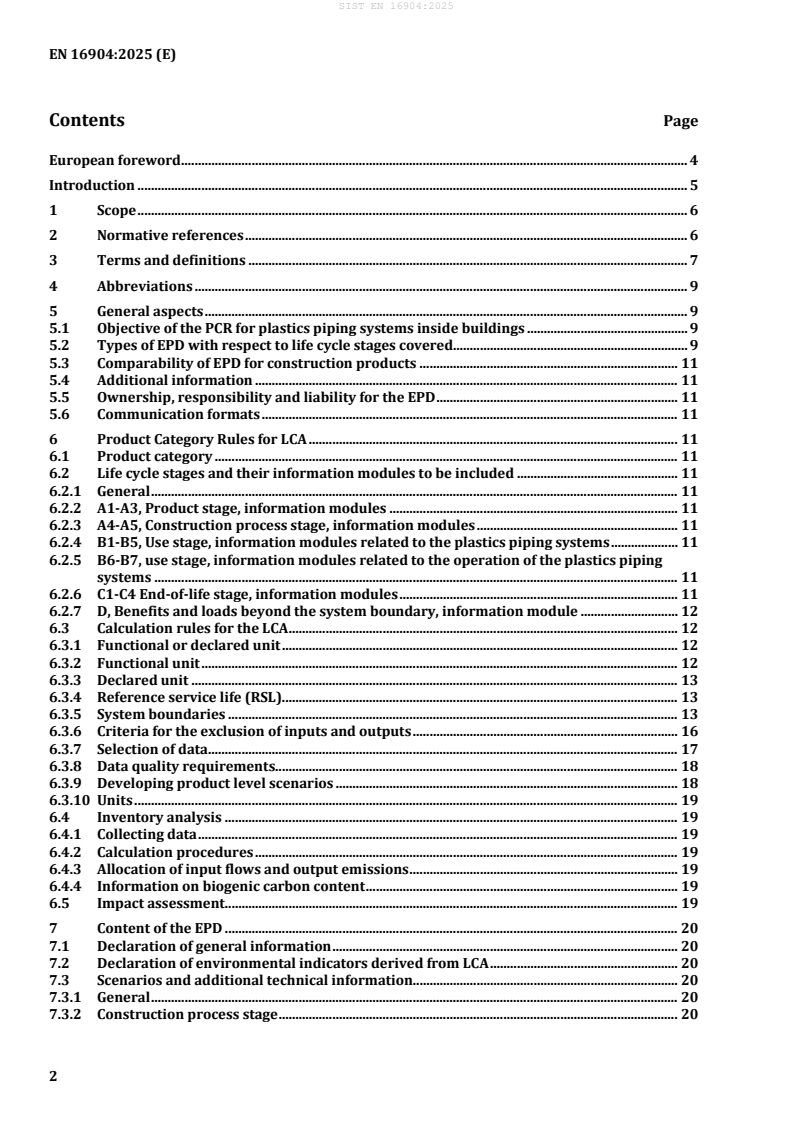
Contents Page
European foreword . 4
Introduction . 5
1 Scope . 6
2 Normative references . 6
3 Terms and definitions . 7
4 Abbreviations . 9
5 General aspects . 9
5.1 Objective of the PCR for plastics piping systems inside buildings . 9
5.2 Types of EPD with respect to life cycle stages covered . 9
5.3 Comparability of EPD for construction products . 11
5.4 Additional information . 11
5.5 Ownership, responsibility and liability for the EPD . 11
5.6 Communication formats . 11
6 Product Category Rules for LCA . 11
6.1 Product category . 11
6.2 Life cycle stages and their information modules to be included . 11
6.2.1 General . 11
6.2.2 A1-A3, Product stage, information modules . 11
6.2.3 A4-A5, Construction process stage, information modules . 11
6.2.4 B1-B5, Use stage, information modules related to the plastics piping systems . 11
6.2.5 B6-B7, use stage, information modules related to the operation of the plastics piping
systems . 11
6.2.6 C1-C4 End-of-life stage, information modules . 11
6.2.7 D, Benefits and loads beyond the system boundary, information module . 12
6.3 Calculation rules for the LCA . 12
6.3.1 Functional or declared unit . 12
6.3.2 Functional unit . 12
6.3.3 Declared unit . 13
6.3.4 Reference service life (RSL). 13
6.3.5 System boundaries . 13
6.3.6 Criteria for the exclusion of inputs and outputs . 16
6.3.7 Selection of data . 17
6.3.8 Data quality requirements. 18
6.3.9 Developing product level scenarios . 18
6.3.10 Units . 19
6.4 Inventory analysis . 19
6.4.1 Collecting data . 19
6.4.2 Calculation procedures . 19
6.4.3 Allocation of input flows and output emissions . 19
6.4.4 Information on biogenic carbon content . 19
6.5 Impact assessment . 19
7 Content of the EPD . 20
7.1 Declaration of general information . 20
7.2 Declaration of environmental indicators derived from LCA . 20
7.3 Scenarios and additional technical information. 20
7.3.1 General . 20
7.3.2 Construction process stage . 20
7.3.3 B1-B7 use stage . 21
7.3.4 End-of-life . 21
7.4 Additional information on release of dangerous substances to, soil and ground
water during the use stage . 21
7.4.1 Indoor air . 21
7.4.2 Soil and ground water . 21
7.5 Aggregation of information modules . 21
8 Project report . 21
8.1 General . 21
8.2 LCA-related elements of the project report . 21
8.3 Documentation on additional information . 21
8.4 Data availability for verification . 21
9 Verification and validity of an EPD . 22
Annex A (informative) Waste . 23
A.1 End-of-waste . 23
A.2 Properties of hazardous wastes for of EN 15804:2012+A2:2019 . 23
Annex B (informative) Examples for functional and declared units . 24
B.1 Example 1: Functional unit- Life cycle assessment of a PE-X hot and cold drinking
water system inside the building structure . 24
B.2 Example 2: Functional unit - Life cycle assessment of a PVC-U Soil and Waste system
inside building structure . 26
B.3 Example 3: Declared unit -Life Cycle Assessment of a Hot and Cold PE-X pipe . 28
Annex C (informative) List of product and application standards . 30
Annex D (informative) Applications and intended used of plastic piping system buried
outside building structure . 33
Annex E (informative) Reading guide . 34
Bibliography . 35
European foreword
This document (EN 16904:2025) has been prepared by Technical Committee CEN/TC 155 “Plastics
piping systems and ducting systems”, the secretariat of which is held by NEN.
This European Standard shall be given the status of a national standard, either by publication of an
identical text or by endorsement, at the latest by April 2026, and conflicting national standards shall be
withdrawn at the latest by April 2026.
Attention is drawn to the possibility that some of the elements of this document may be the subject of
patent rights. CEN shall not be held responsible for identifying any or all such patent rights.
Any feedback and questions on this document should be directed to the users’ national standards body.
A complete listing of these bodies can be found on the CEN website.
According to the CEN-CENELEC Internal Regulations, the national standards organisations of the
following countries are bound to implement this European Standard: Austria, Belgium, Bulgaria, Croatia,
Cyprus, Czech Republic, Denmark, Estonia, Finland, France, Germany, Greece, Hungary, Iceland, Ireland,
Italy, Latvia, Lithuania, Luxembourg, Malta, Netherlands, Norway, Poland, Portugal, Republic of North
Macedonia, Romania, Serbia, Slovakia, Slovenia, Spain, Sweden, Switzerland, Türkiye and the United
Kingdom.
Introduction
The European standard EN 15804+A2 specifies core product category rules for all construction products
and services. It specifies a structure to ensure that all Environmental Product Declarations (EPD) of
construction products, construction services and construction processes are derived, verified and
presented in a harmonized way.
This document, based on EN 15804+A2, specifies the Product Category Rules for Environmental Product
Declarations (EPD) for plastics piping systems inside the building structure and their main structural
components.
An EPD communicates verifiable, accurate, non-misleading environmental information for products and
their applications, thereby supporting scientifically based, fair choices and stimulating the potential for
market-driven continuous environmental improvement.
The standardization process has taken place in accordance with EN ISO 14025. All common issues are
covered horizontally for all product types in order to minimize vertical (branch specific) deviations.
EPD information is expressed in information modules, as specified in EN 15804+A2, which allow easy
organization and expression of data packages throughout the life cycle of the buried plastics piping
systems (constructions work). The approach requires that the underlying data should be consistent,
reproducible and comparable.
The EPD is expressed in a form that allows aggregation (addition) to provide complete information for
construction works. This standard does not deal with aggregation at the construction work level nor does
this standard describes the rules for applying EPD in a construction work assessment.
The standard deals with a set of quantifiable predetermined parameters defined in EN 15804+A2. Future
revisions may incorporate additional predetermined parameters in line with the changes of
EN 15804+A2.
A reading guide of this document is provided in Annex E.
1 Scope
This document specifies product category rules (PCR) for Environmental Product Declarations (EPDs),
as described in EN ISO 14025 and EN 15942.
This document is applicable to:
— functional unit as plastics piping systems inside the building structure;
— declared unit as one or more main structural components which are represented by pipes and
fittings, as specified by the list of product standards provided in Annex C.
This document gives guidelines for:
— both pressure and non-pressure applications;
— metal fittings (including manifolds) which are used in a plastic piping system.
The intended function of the system considered is to convey liquids according to EN 806 (for potable
water supply), EN 1264 (for heating and cooling systems), EN 12828 (for radiators), EN 12056 (for soil
and waste discharge and for water traps).
This document specifies product category rules of construction products as defined in and is intended to
be used in conjunction with EN 15804+A2.
This document provides in Annex D a non-exhaustive list of application fields. In addition, the insulated
pipes are not in the scope of this document.
In addition to EN 15804+A2, this document specifies:
— the functional unit (consisting of pipes, fittings and ancillary components) and declared unit
(consisting of pipes and/or fittings);
— the system boundaries and additional mandatory modules to be declared;
— the processes to be included in the installation phase;
— scenarios for module A4, A5;
— reference service life (RSL);
— end of life scenarios.
2 Normative references
The following documents are referred to in the text in such a way that some or all of their content
constitutes requirements of this document. For dated references, only the edition cited applies. For
undated references, the latest edition of the referenced document (including any amendments) applies.
EN 806 (all parts), Specifications for installations inside buildings conveying water for human consumption
EN 1264 (all parts), Water based surface embedded heating and cooling systems
EN 12056 (all parts), Gravity drainage systems inside buildings
EN 12828, Heating systems in buildings — Design for water-based heating systems
EN 15804:2012+A2:2019 , Sustainability of construction works — Environmental product declarations —
Core rules for the product category of construction products
EN 15941, Sustainability of construction works — Data quality for environmental assessment of products
and construction work — Selection and use of data
ISO 22057, Sustainability in buildings and civil engineering works — Data templates for the use of
environmental product declarations (EPDs) for construction products in building information modelling
(BIM)
3 Terms and definitions
For the purposes of this document, the terms and definitions given in EN 15804:2012+A2:2019 and the
following apply.
ISO and IEC maintain terminology databases for use in standardization at the following addresses:
— ISO Online browsing platform: available at https://www.iso.org/obp
— IEC Electropedia: available at https://www.electropedia.org/
3.1
application classes
classification system for common service conditions for pressurized hot and cold water systems
[SOURCE: ISO 10508:2006]
3.2
nominal size
DN
numerical designation of the size of a component, other than a component designated by thread size,
which is approximately equal to the manufacturing dimension in mm
NOTE 1 to entry: Nominal size is expressed in millimetres (mm).
NOTE 2 to entry: This designation is not used for threaded components.
3.3
nominal size
DN/OD
nominal size, related to the outside diameter
3.4
nominal wall thickness
e
n
numerical designation of the wall thickness of a component which is identical to the minimum
permissible wall thickness at any point
As impacted by EN 15804:2012+A2:2019/AC:2021.
3.5
mean wall thickness
e
m
arithmetical mean of a number of measurements of the wall thickness, regularly spaced around the
circumference and in the same cross section of a component, including the measured minimum and the
measured maximum values of the wall thickness in that cross section
3.6
pipe series
S
number for pipe designation (see ISO 4065)
Note 1 to entry: It is a dimensionless number.
3.7
design temperature
TD
temperature for which the piping system is designed
Note 1 to entry: It is used as the base for further calculation when designing a piping system or parts of a piping
system for operating temperatures different from the reference temperature.
3.8
wall thickness
e
value of measurement of the wall thickness at any point around the circumference of a component
3.9
building structure
building including the area within one meter of that building
3.10
biobased plastic
plastic that contains materials, wholly or partly of biogenic origin
Note 1 to entry: Although not provided as a definition this exact wording is used in the introduction of the
standards ISO 16620-1:2015, Plastics — Biobased content — Part 1: General principles (ISO 16620-1:2015, IDT)
and EN ISO 22526-1:2021, Plastics — Carbon and environmental footprint of biobased plastics — Part 1: General
principles (ISO 22526-1:2020)
Note 2 to entry: This also includes material coming from waste and residues of biological origin from agriculture,
forestry and related industries including fisheries and aquaculture, as well as the biodegradable fraction of
industrial and municipal waste (e.g. UCO, tall oil, food waste, etc).
4 Abbreviations
For the purposes of this document, the abbreviations given in in EN 15804+A2 apply.
5 General aspects
5.1 Objective of the PCR for plastics piping systems inside buildings
Shall be according to EN 15804+A2.
5.2 Types of EPD with respect to life cycle stages covered
Shall be according to EN 15804+A2. In addition, the types of the EPDs that can be developed according to
this document are listed below (Figure 1):
— cradle to gate with options, modules C1-C4 and module D (A1-A3, C, D and additional modules. The
additional module that shall be declared is A4, A5 is optional). This type of EPD shall be based on a
declared unit (consisting of pipes and/or fittings);
— cradle to gate with options, modules C1-C4 and module D (A1-A3, C, D and additional modules. The
additional modules shall be declared is A4, A5 and/or B1–B7 are optional.). This type of EPD shall be
based on a functional unit or a declared unit;
— cradle to gate (A1–A3). These stages are the minimum to be declared for all the main components
that are exempt from declaring modules C and D, as specified in 5.2 of EN 15804:2012+A2:2019, and
shall be based on a declared unit. This type of EPD is not allowed for products containing biogenic
carbon.
Key
1 replacement of components, parts or systems
2 only possible if the conditions to exclude the declaration of modules C1-C4 and module D are met
Figure 1 —Types of EPD with respect to life cycle stages covered and life cycle stages and modules for the construction works
assessment
5.3 Comparability of EPD for construction products
Shall be according to EN 15804+A2.
5.4 Additional information
Shall be according to EN 15804+A2.
5.5 Ownership, responsibility and liability for the EPD
Shall be according to EN 15804+A2.
5.6 Communication formats
Shall be according to EN 15804+A2.
6 Product Category Rules for LCA
6.1 Product category
Shall be according to EN 15804, and in addition the product category referred to in this document
includes all plastics piping systems for inside building structure and related services of all life cycle stages.
The product category referred to in this document includes plastics piping systems inside the building
structure and their main structural components conveying liquids according to EN 806 (for potable water
supply), EN 1264 (for heating and cooling systems), EN 12828 (for radiators), EN 12056 (for soil and
waste discharge and water traps).
A more detailed definition of plastic piping system and main structural components is provided in Scope
and Annex D, Table D.1.
6.2 Life cycle stages and their information modules to be included
6.2.1 General
Shall be according to EN 15804+A2.
6.2.2 A1-A3, Product stage, information modules
Shall be according to EN 15804+A2.
6.2.3 A4-A5, Construction process stage, information modules
Shall be according to EN 15804+A2.
6.2.4 B1-B5, Use stage, information modules related to the plastics piping systems
This subclause of EN 15804+A2 is not applicable.
6.2.5 B6-B7, use stage, information modules related to the operation of the plastics piping
systems
This subclause of EN 15804+A2 is not applicable.
6.2.6 C1-C4 End-of-life stage, information modules
Shall be according to EN 15804+A2.
6.2.7 D, Benefits and loads beyond the system boundary, information module
Shall be according to EN 15804+A2.
6.3 Calculation rules for the LCA
6.3.1 Functional or declared unit
Shall be according to EN 15804+A2.
6.3.2 Functional unit
Shall be according to EN 15804+A2 and in addition the functional unit is based on the function of
conveying a certain amount of fluid performed by the plastic piping system in the construction work and
on the RSL of the system, which depends on the intended use of the piping system. The functional unit is
specified in function of the application of the product in the construction work.
The functional unit is defined, based on a real case scenario, as the total weight related to a typical
installed plastic piping system, which consists at least of the main components declared in Scope (pipe
and fittings), over a specified distance in metres, with a specified nominal diameter, that fulfils specified
quality criteria given in European standards during the life span of the construction works.
For describing the functional unit, the following technical specifications shall be reported in the EPD:
— for pressurized systems:
— for the main structural components (pipes and fittings): application class and the maximum
operating pressure shall be given for each nominal dimensions, allowed temperature range,
material, and its specific performance;
— for ancillary components (i.e. fixing elements, corrugated protection pipes, insulation sleeves):
material and its specific performance, weight/length and inner diameter (if applicable);
— for unpressurized systems:
— for the main structural components (pipes and fittings): nominal dimensions, allowed
temperature range, wall thickness, socket type, density, material(s) and its/their specific
performance(s);
— for ancillary components (i.e. fixing elements): material(s) and its/their specific performance(s).
Other technical specifications may be included to better characterize the analysed system (e.g. oxygen
barrier, crack resistance for heating pipes).
If a functional unit is addressed in the EPD, a conversion factor shall be reported in the EPD to make it
possible to recalculate the environmental performance to 1 m length in case of pipes. In case of fittings
multiple conversion factors to piece(s) may be applicable.
NOTE Multiple conversion factors are taking into account the different shape of fittings (e.g. couplers, elbows,
T-pieces, etc.)
A mix of different dimensions of pipes and fittings is allowed and shall be declared in the EPD. In case of
(n) multiple diameters, the conversion factors from mass to 1 m length shall be declared for each
diameter declared. In case of fittings, multiple conversion factors to piece(s) may be applicable.
In Annex B examples of a typical hot&cold and soil&waste plastic systems are described. The systems can
be scaled to any size.
The design and installation details for plastic piping system inside building structure can be found in
EN 806, (for potable water supply), EN 1264 (for heating and cooling systems), EN 12828 (for radiators),
EN 12056 (for soil and waste discharge and water traps).
6.3.3 Declared unit
Shall be according to EN 15804+A2 and in addition the declared unit is defined as a specified mass of a
plastic piping system inside building structure or one or more of main structural components, expressed
in mass, that fulfils specified quality criteria given in European standards during the life span of the
construction work.
The main structural components plastic piping system inside building structure are defined in Scope.
The applicable technical specifications for the analysed declared unit listed in 6.3.2 shall be reported in
the EPD.
In case a pipe is selected as declared unit, a conversion from mass to length (1 m) shall be given in the
EPD for each nominal dimension declared. In case a fitting is selected as declared unit, a conversion factor
from mass to piece(s) shall be given in the EPD.
6.3.4 Reference service life (RSL)
6.3.4.1 General
Shall be according to EN 15804+A2.
NOTE The reference service life of the plastic system is dependent on the service life of the building which is
generally considered to be equal to 50 years.
6.3.4.2 Scenarios for RSL and functional unit
Shall be according to EN 15804+A2 and in addition, the RSL information to be declared in an EPD shall
be provided by the manufacturer with reference to investigations and study of lifetime.
6.3.5 System boundaries
6.3.5.1 General
Shall be according to EN 15804+A2.
6.3.5.2 Product stage
Shall be according to EN 15804+A2, in addition the following processes shall be included:
— production and processing of raw materials, processing of secondary materials (e.g. recycling) for
the plastic pipes and fittings, including additives such as stabilizers, fillers, impact modifiers,
colourants and other materials added to the main resin;
— transport of plastic pipe or fittings raw materials to converter;
— converting process for pipes (extrusion);
— converting process for fittings (injection moulding, forging, machining, extrusion);
— production and processing of the raw materials, processing of secondary materials (e.g. recycling)
for the ancillary components of the plastic system inside the building structure (e.g. sealing rings,
brackets);
— transport of the raw materials for the ancillary components to the manufacturing phase;
— production of the auxiliary products use in the product stage (i.e. lubricants when pre-lubricated
fittings are delivered);
— manufacturing of primary and secondary packaging used of the different components of the plastic
piping system (i.e. end caps, plastic bag, wrapping film card boxes);
— production of the electricity and fuel used in the product stage (see 6.3.7.2);
— refrigerant gas losses in the manufacturing stage(s);
— treatment of waste and wastewater up to the end-of-waste generated by all the product stage
processes shall be included (see Annex A for guidance when end-of-waste stage is reached).
In case plastics from biobased materials are part of the product system (even in combination with fossil-
based plastics) the following processes shall be included:
— growing and harvesting of biobased resources (e.g. agricultural planting);
— refining, transfer and storage of extracted or harvested resources into feedstock for production (e.g.
starches, cellulose);
— monomers production;
— intermediate raw materials production (e.g. pre-polymers, etc.);
— transformation process from first generation feedstock to be used in the new product system (e.g.
waste vegetable oil).
Other product stage processes not listed above may also be included. All elementary flows at resource
extraction shall be included, except for the flows that fall under the general cut-off rule in 6.3.6.
The output of waste during this life cycle stage may reach end-of-waste state when it complies with the
conditions described in 6.3.5.5 and Annex B of EN 15804:2012+A2:2019 end-of-life stage. They are then
treated as secondary materials and fuels and shall not be allocated any impacts.
6.3.5.3 Construction stage
Shall be according to EN 15804+A2. In addition, a list of the processes that shall be included at minimum
in the installation phase is provided below:
— For A4, transport to the construction site, a scenario shall be developed that accounts for a distance
from the manufacturing site(s) to the construction site where the analysed system is installed, the
vehicle’s size, the capacity utilization and volume capacity utilization factor. In case that specific data
are unavailable, the scenarios reported in 6.3.9.2 shall be used.
NOTE 1 For the definition of the A4 scenario, the preferred choice is to use average specific data retrieved
directly from the manufacturer(s) based on calculated mean distance on a representative sample of products
sold in a specific year or a wider timeframe.
— The installation phase (A5) includes all materials and activities connected to the installation of the
plastic piping system inside the building structure. The requirements for the installation scenario are
dependent on the building type (i.e. residential, commercial), the building structure, design and
climate conditions. However, the installation activities are mainly performed manually or with small
electricity-driven devices with a negligible energy consumption. The possible exclusion of the
electricity consumption needed in the installation phase shall be documented and justified in the
project report. A list of the processes that shall be included in the installation phase is provided
below. Exclusions shall be justified:
— manufacturing and transportation of lubricants for the sockets (see 6.3.9.3 for default values to
be used in case of unavailability of primary data);
— water required for the installation (cleaning and testing);
— manufacturing of the plastic piping system components to compensate for the losses generated
at the installation stage (to be declared equal to 3 % of the total weight of declared pipes for all
the applications, except for floor heating which shall be equal to 5 % of the total weight of
declared pipes);
NOTE 2 When setting system boundaries the general principle of EN 15804+A2 is to consider all
processes in the modules where they occur, see CEN/TR 16970.
— transport of the packaging waste to the final End-of-life treatment;
— processing of the construction and the packaging waste up to the end-of-waste state or disposal
of the final residues (see Annex A for guidance when end-of-waste stage is reached).
In case of unavailability of context-specific generic data the indication reported in 6.3.9.3 shall be
followed.
Waste handling scenarios shall be developed consistently with the waste handling of other lifecycle
stages (i.e. end-of-life stage).
6.3.5.4 Use stage
6.3.5.4.1 General
This clause of EN 15804+A2 is not applicable.
6.3.5.4.2 B1-B5 Use stage information modules of the piping system
This clause of EN 15804+A2 is not applicable.
6.3.5.4.3 — B6 – B7 Use stage information modules related to the operation of the piping system
This clause of EN 15804+A2 is not applicable.
6.3.5.5 End-of-life stage
Shall be according to EN 15804+A2. In addition, after the service life of the building (50 years), the plastic
piping system inside building structure is demolished together with the total construction. The valuable
materials (such as metals and plastics) are sorted out and the remaining waste is disposed/recycled as
construction and demolition waste.
NOTE 1 The reference service life of the plastic system is dependent on the service life of the building which is
generally considered to be equal to 50 years but it could deviate for example in case of temporary housing facilities,
or deviating national requirements.
During the demolition of the building a significant amount of energy is used. This energy is mainly
required for breaking the concrete and cement structures, therefore no impacts are allocated to the
plastic piping system during disassembly phase. In the end-of-life stage the following processes shall be
included for the plastic piping system:
— C2 Transport of the plastic piping system’s components to the end-of-life treatment;
— C3 waste processing (i.e. sorting) and C4 waste disposal of the plastic piping system inside building
structure.
Loads, (e.g. emissions) from waste disposal in module C4 are considered part of the product system under
study, according to the “polluter pays principle”.
In principle waste processing is part of the product system under study. In the case of materials leaving
the system as secondary materials or fuels, such processes as collection and transport before the end-of-
waste state are, as a rule, part of the waste processing of the system under study. However, after having
reached the “end-of-waste” state (see Figure A.1) further processing can also be necessary in order to
replace primary material or fuel import in another product system. Such processes are considered to be
beyond the system boundaries and assigned to module D. Secondary material having left the system can
be declared as substituting primary production in module D, when it has reached functional equivalence
of the substituted primary material.
NOTE 2 Only when materials have reached the end-of-waste-state they are considered as materials for energy
recovery, provided the energy recovery process has an energy efficiency rate higher than 60 %.
In case of unavailability of context-specific generic data for the transport, the default scenario reported
in 6.3.9.5 shall be used.
6.3.5.6 Benefits and loads beyond the product system boundary in module D
Shall be according to EN 15804+A2.
6.3.6 Criteria for the exclusion of inputs and outputs
Shall be according to EN 15804+A2, with the following additional exclusions:
Capital goods:
— the production of machinery for production of the piping system and the production of the machinery
to produce raw materials;
— the construction of laboratories and offices;
— construction of warehouses and production facilities.
Personnel:
— business travel;
— travel to workplace;
— consumables for administrative activity:
— inspections by authorities or commissioning body.
NOTE The contribution of capital goods to the overall results to the declared systems is expected to have a
limited contribution according to [32].
The subdivision of the impacts of the waste processing shall performed according to the indication reported in EN
15804:2012+A2:2019, Annex D, D.3.3.
6.3.7 Selection of data
6.3.7.1 General rules
Shall be according to EN 15804+A2.
In addition, the following rules shall be applied:
— for product manufacture, average (considering different sites) or site-specific annual data shall be
applied. Deviations shall be justified and explained in the EPD;
— the year of collection of primary data shall be stated;
— manufacturer’s site or average data shall be collected for the main structural components of the
plastic piping system inside the building structure declared in the EPD listed in the Scope.
The data source shall be addressed in the LCA project report, see Table 1.
Table 1 — Application of generic and specific data
Modules A1-A3 A4-A5 B1-B7 C1-C4
Production of Product Installation Use End-of-life
commodities, raw manufacture processes processes processes
materials
Upstream Processes that the Downstream processes
Process
processes manufacturer has
type
influence over
Generic data Manufacturer’s Generic or average or specific data
and/or average or specific
Data type
manufacturer’s data
specific data
NOTE Generic data are publicly available and can be average or specific. Normally it is used to describe
upstream and downstream processes. See EN 15941.
6.3.7.2 Data for electricity
Shall be according to EN 15941.
For energy internally generated from Combined Heat and Power (CHP) plant the Alternative Generation
method proposed by the Finish District Heating association and under discussion within Euroheat,
Eurostat and Eurelectric should be used to allocate the fuel consumption and/or emissions to the heat
and electricity generation.
The allocation method is based on the fact that benefits gained from improved fuel utilisation as well as
the environmental impacts connected to combined heat and power generation, are distributed between
the two products – electricity and heat – in the same proportion as the fuel needed for separate electricity
and heat generation processes. The relationship of distribution is expressed as percentage of the fuel
needed for each alternative process with respect to the total quantity needed. In case of a secondary fuel
is used in the CHP, only the emissions generated in the production of heat and electricity shall be taken
into account, not the production of the fuel.
NOTE The method considers the fuel consumption and/or emissions required to produce the same amount of
electricity and heat in separate production facilities, operating with the reference primary energy factors (fixed by
authorities).
6.3.8 Data quality requirements
Shall be according to EN 15804+A2.
6.3.9 Developing product level scenarios
6.3.9.1 General
Shall be according to EN 15804+A2. In addition, scenarios for construction, use, end-of-life and transport
shall be described and documented in the LCA project report according to EN 15804:2012+A2:2019, 7.3,
Tables 5 to 10.
In addition, the following default scenarios shall be used in case primary information for developing a
context specific scenario is lacking.
6.3.9.2 A
...