

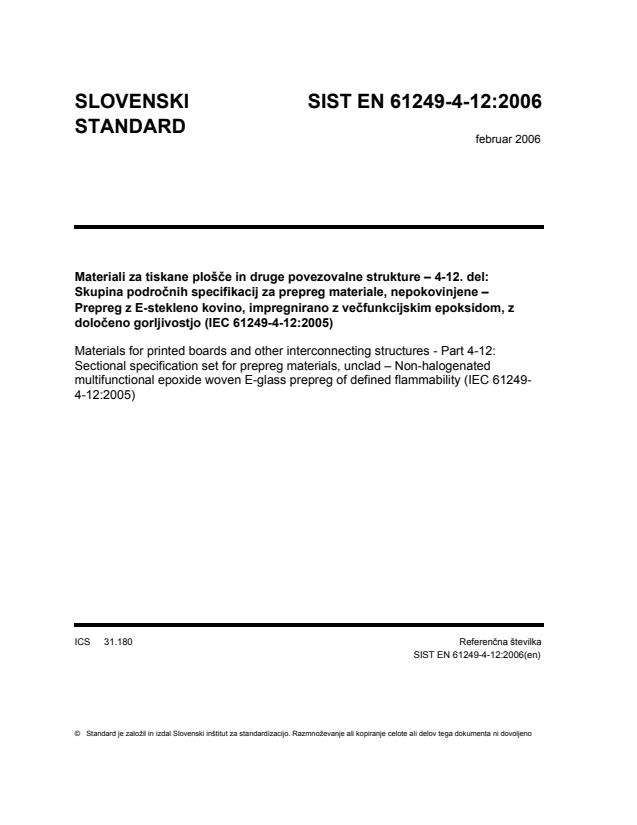
SIST EN 61249-4-12:2006
(Main)Materials for printed boards and other interconnecting structures -- Part 4-12: Sectional specification set for prepreg materials, unclad - Non-halogenated multifunctional epoxide woven E-glass prepreg of defined flammability
- Abstract
This part of EN 61249 gives requirements for properties of prepreg that is mainly intended to be used as bonding sheets in connection with laminates according EN 61249-2-7 when manufacturing multilayer boards in conformity with EN 62326-4. This material may be also used to bond other types of laminates. Prepreg according to this standard is of defined flammability (vertical burning test). The flammability rating on fully cured prepreg is achieved through the use of brominated fire retardants contained as an integral part of the polymeric structure. After lamination according to the supplier's instructions, the glass transition temperature is defined to be 150 °C minimum.
- Status
- Published
- Publication Date
- 31-Jan-2006
- Technical Committee
- ITIV - Electronics assembly technology and Environmental standardization
- Current Stage
- 6060 - National Implementation/Publication (Adopted Project)
- Start Date
- 01-Feb-2006
- Due Date
- 01-Feb-2006
- Completion Date
- 01-Feb-2006


SIST EN 61249-4-12:2006 is the Slovenian adoption of EN 61249-4-12, published by SIST. It specifies requirements for non-halogenated multifunctional epoxide woven E-glass prepreg of defined flammability for printed boards and other interconnecting structures. In practice, it is mainly used as a bonding sheet with laminates for multilayer boards, and it also covers use with other laminate types.
What does SIST EN 61249-4-12:2006 specify?
SIST EN 61249-4-12:2006 sets requirements for the material, its properties before and after curing, delivery forms, quality assurance, packaging, shelf life, and ordering information. The standard is organized into clauses 1 to 9, plus Annex ZA and a bibliography.
| Annex | What it covers |
|---|---|
| ZA | Normative references to international publications with their corresponding European publications |
The scope is focused on prepreg intended for bonding in multilayer board manufacture to the referenced laminate and board specifications. It also states that the material is of defined flammability by the vertical burning test, and it ties the cured material to a minimum glass transition temperature after lamination according to the supplier’s instructions.
What are the key requirements of SIST EN 61249-4-12:2006?
SIST EN 61249-4-12:2006 is a requirement set for a specific prepreg construction, with test methods for appearance, B-stage properties, cured properties, delivery condition, and quality control. The practical point is that buyers and suppliers must agree on certain order parameters, while the standard fixes the key performance limits and test approach.
Material and construction
Clause 3 defines the prepreg as woven E-glass fabric impregnated with epoxide resin and partially cured to the B-stage. It also states that the resin system is mainly non-halogenated multifunctional epoxide resin and that the flammability performance is part of the material definition.
Appearance and workmanship
Clause 4.1 covers visual quality such as dewetted areas, broken filaments, distortion, creases, and edge conditions. This matters because surface defects, fiber distortion, or resin loss can affect lamination quality and final board reliability.
B-stage properties
Clause 4.2 treats B-stage properties as selectable order parameters such as resin content, treated weight, resin flow, scaled flow thickness, melt viscosity, cured thickness, volatile content, and gel time. The standard expects user and supplier to agree which characteristics are used for qualification and conformance, so the order document must name the chosen parameters clearly.
C-stage properties after curing
Clause 4.3 covers electrical strength, flammability, relative permittivity, dissipation factor, cured thickness, and glass transition temperature after curing. In practice, these are the properties that matter when the prepreg is part of a finished multilayer board, so the tests are performed on bonded and cured specimens.
Delivery, assurance, and traceability
Clauses 5 to 9 cover rolls, sheets, and cut panels; supplier quality system expectations; inspection responsibility; certificate of conformance; safety data sheet; packaging and marking; shelf life; and ordering information. This gives the buyer a clear basis for receiving, storing, identifying, and documenting the material.
What terms does SIST EN 61249-4-12:2006 define?
Prepreg is an unclad reinforcement material that has been impregnated with resin and partially cured for later lamination.
B-stage prepreg is prepreg in the partially cured condition, where it can still flow and bond during lamination.
C stage prepreg is prepreg after full curing, when the final electrical and thermal properties are measured.
Reinforcement is the woven E-glass fabric that gives the prepreg its structural base.
Resin system is the epoxide resin part of the material that controls bonding, flow, and cured performance.
Flammability in this document refers to the vertical burning test classification of the cured prepreg.
Certificate of conformance is the supplier’s statement that the delivered material meets this standard.
Safety data sheet is the product safety document prepared in the format required by ISO 11014-1.
Who uses SIST EN 61249-4-12:2006?
SIST EN 61249-4-12:2006 is used by prepreg manufacturers, laminate suppliers, multilayer printed board manufacturers, and purchasing or quality teams that specify insulating and bonding materials. It is also used by test laboratories that verify material properties and by auditors who review qualification and conformance records. The standard is relevant to printed boards and other interconnecting structures where defined flammability and controlled cured properties are needed.
What changed in SIST EN 61249-4-12:2006 from the previous edition?
SIST EN 61249-4-12:2006 is based on IEC 61249-4-12:2005 and was approved by CENELEC without modification. CENELEC added Annex ZA.
Which standards are used with SIST EN 61249-4-12:2006?
- IEC 61189-2 - provides the test methods used for material properties and cured properties.
- IEC 61249-2-7 - covers the related reinforced base material for laminated sheet of defined flammability used in multilayer board manufacture.
- IEC 61249-6-3 - provides the sectional specification for woven E-glass reinforcement materials.
- IEC 62326-4 - gives the sectional specification for rigid multilayer printed boards with interlayer connections.
- ISO 9000 - supplies the quality management system vocabulary referenced for supplier quality systems.
- ISO 11014-1 - gives the required content and order for the safety data sheet.
What does the SIST EN 61249-4-12:2006 document contain?
The document contains clause-by-clause requirements for prepreg construction, appearance, B-stage properties, cured electrical and thermal properties, delivery forms, quality assurance, packaging, shelf life, and ordering information. It also includes Table 1 for vertical burning flammability classification and Annex ZA for the linked European references. The procedures and test conditions are aimed at qualification, quality conformance inspection, and supplier-customer agreement on order parameters.
Relations
- Refers
SIST EN ISO 9000:2004 - Quality management systems - Fundamentals and vocabulary (ISO 9000:2000) - Effective Date
- 09-Feb-2026
- Effective Date
- 03-Feb-2026
- Effective Date
- 03-Feb-2026
- Effective Date
- 03-Feb-2026
- Effective Date
- 03-Feb-2026
- Referred By
SIST EN 115-1:2017 - Safety of escalators and moving walks - Part 1: Construction and installation - Effective Date
- 09-Feb-2026
- Effective Date
- 09-Feb-2026
Frequently Asked Questions
SIST EN 61249-4-12:2006 is a standard published by the Slovenian Institute for Standardization (SIST). Its full title is "Materials for printed boards and other interconnecting structures -- Part 4-12: Sectional specification set for prepreg materials, unclad - Non-halogenated multifunctional epoxide woven E-glass prepreg of defined flammability". This standard covers: This part of EN 61249 gives requirements for properties of prepreg that is mainly intended to be used as bonding sheets in connection with laminates according EN 61249-2-7 when manufacturing multilayer boards in conformity with EN 62326-4. This material may be also used to bond other types of laminates. Prepreg according to this standard is of defined flammability (vertical burning test). The flammability rating on fully cured prepreg is achieved through the use of brominated fire retardants contained as an integral part of the polymeric structure. After lamination according to the supplier's instructions, the glass transition temperature is defined to be 150 °C minimum.
This part of EN 61249 gives requirements for properties of prepreg that is mainly intended to be used as bonding sheets in connection with laminates according EN 61249-2-7 when manufacturing multilayer boards in conformity with EN 62326-4. This material may be also used to bond other types of laminates. Prepreg according to this standard is of defined flammability (vertical burning test). The flammability rating on fully cured prepreg is achieved through the use of brominated fire retardants contained as an integral part of the polymeric structure. After lamination according to the supplier's instructions, the glass transition temperature is defined to be 150 °C minimum.
SIST EN 61249-4-12:2006 is classified under the following ICS (International Classification for Standards) categories: 31.180 - Printed circuits and boards. The ICS classification helps identify the subject area and facilitates finding related standards.
SIST EN 61249-4-12:2006 has the following relationships with other standards: It is inter standard links to SIST EN ISO 9000:2004, SIST EN 62326-4:2001, SIST EN 61189-2:2001, SIST EN 61189-2:2002 + A1:2002, SIST EN 61249-2-7:2003, SIST EN 115-1:2017, SIST EN 115-1:2009+A1:2010. Understanding these relationships helps ensure you are using the most current and applicable version of the standard.
SIST EN 61249-4-12:2006 is available in PDF format for immediate download after purchase. The document can be added to your cart and obtained through the secure checkout process. Digital delivery ensures instant access to the complete standard document.
Standards Content (Sample)
Contents
- 1 Scope
- 2 Normative references
- 3 Materials and construction
- 3.1 Reinforcement
- 3.2 Resin system
- 4 Properties
- 4.1 Properties related to the appearance of the prepreg
- 4.2 Properties related to B-stage prepreg
- 4.3 Properties related to C stage prepreg after curing
- 1. Flaming combustion time after each application of the flame 2C06 ≤10 s ≤30 s
- 2. Total flaming combustion time for the 10 flame applications
- 3. Glowing combustion time after the second removal of the
- 4. Flaming or glowing combustion up to the holding clamp
- 5. Dripping flaming particles that ignite the tissue paper
- 5 Delivery form
- 5.1 Rolls
- 5.2 Sheets
- 5.3 Cut panels
- 6 Quality assurance
- 6.1 Quality system
- 6.2 Responsibility for inspection
- 6.3 Qualification inspection
- 6.4 Quality conformance inspection
- 6.5 Certificate of conformance
- 6.6 Safety data sheet
- 7 Packaging and marking
- 8 Shelf life
- 9 Ordering Information
- Bibliography
1 Scope
This part of IEC 61249 gives requirements for properties of prepreg that is mainly intended to be used as bonding sheets in connection with laminates according IEC 61249-2-7 when manufacturing multilayer boards in conformity with IEC 62326-4. This material may be also used to bond other types of laminates.
Prepreg according to this standard is of defined flammability (vertical burning test). The flammability rating on fully cured prepreg is achieved through the use of brominated fire retardants contained as an integral part of the polymeric structure. After lamination according to the supplier’s instructions, the glass transition temperature is defined to be 150 °C minimum.
2 Normative references
The following referenced documents are indispensable for the application of this document. For dated references, only the edition cited applies. For undated references, the latest edition of the referenced document (including any amendments) applies.
IEC 61189-2:1997, Test methods for electrical materials, interconnection structures and assemblies – Part 2: Test methods for materials for interconnection structures Amendment 1 (2000) IEC 61249-2-7:2002, Materials for printed boards and other interconnecting structures – Part 2-7: Reinforced base materials clad and unclad - Epoxide woven E-glass laminated sheet of defined flammability (vertical burning test), copper-clad IEC 61249-6-3, Material for printed boards and other interconnecting structures – Part 6-3:
Sectional specification set for reinforcement materials – Woven E-glass (for the manufacture of
prepregs and copper-clad base materials IEC 62326-4, Printed boards – Part 4: Rigid multilayer printed boards with interlayer connections - Sectional specification ISO 9000:2000, Quality management systems – Fundamentals and vocabulary ISO 11014-1:1994, Safety data sheet for chemical products – Part 1: Content and order of sections
In preparation.
61249-4-12 IEC:2005 – 11 –
3 Materials and construction
The prepreg consists of a reinforcing E-glass fabric which is impregnated with epoxide resin and partially cured to the B-stage.
3.1 Reinforcement
The reinforcement consists of woven E-glass as specified in IEC 61249-6: Woven E-glass fabric (for the manufacture of prepreg and copper-clad laminate.
3.2 Resin system
The resin system consists of a majority non-halogenated multifunctional epoxide resin with a glass transition temperature of ≥150 °C when cured according to the manufacturer’s recommendation. The maximum total halogens contained in the resin plus reinforcement matrix –6 –6 –6 is 1 500 with a maximum chlorine of 900 and maximum bromine being 900 . Contrast agents may be added to enhance processing such as optical inspection. Its flame resistance is defined in terms of the flammability requirements of 4.3.2.
4 Properties
4.1 Properties related to the appearance of the prepreg
The prepreg shall be substantially free from defects that may have an impact on the material’s fitness for use for the intended purpose.
4.1.1 Dewetted areas (fish eyes)
Dewetted areas with a diameter >10 mm are not permissible.
Dewetted areas with a diameter ≤10 mm are permitted to an extent of a maximum 10 fish eyes in any 300 mm x 300 mm area of the prepreg.
4.1.2 Broken filaments
When judging the presence of broken filaments their sizes and frequency of occurrence are important for assessing acceptability but also the flow characteristic of the prepreg shall be taken into consideration. The acceptance conditions for broken filaments shall be as agreed upon between the user and supplier.
4.1.3 Distortion
When the prepreg is tested in accordance with test method 2M29 (under consideration) of IEC 61189-2, the distortion of the fill yarns in the glass fabric shall not exceed 10 % measured over any 300 mm test distance.
4.1.4 Creases
Creases caused by handling of the prepreg where only a negligible loss of resin has occurred are permitted.
Creases where the glass yarns are exposed due to loss of resin are not permitted.
61249-4-12 IEC:2005 – 13 –
4.1.5 Edge conditions
Cut-to-size panels shall have even edges and shall not show loss of resin at the edge due to the cutting process of more than 8 mm. Excessive occurrence of resin dust released during the cutting shall be removed before packaging for shipment.
...