

oSIST prEN 16256:2026
(Main)Pyrotechnic articles - Theatrical pyrotechnic articles
- Abstract
This document defines various terms relating to the design, construction, primary packaging and testing of theatrical pyrotechnic articles and specifies their generic types.
It defines the procedures for placing generic types, subtypes or individual items of theatrical pyrotechnic articles into the appropriate Categories, T1 or T2 and lists them.
It specifies minimum labelling requirements for the article and primary packaging and for the instructions for use.
Specific test methods for theatrical pyrotechnic articles of the generic types are defined.
- Status
- Not Published
- Public Enquiry End Date
- 02-Sep-2026
- Technical Committee
- IEKS - Explosives
- Current Stage
- 4020 - Public enquire (PE) (Adopted Project)
- Start Date
- 19-Jun-2026
- Due Date
- 06-Nov-2026
- Completion Date
- 03-Sep-2026

oSIST prEN 16256:2026 is a draft European Standard from the European Committee for Standardization (CEN) for theatrical pyrotechnic articles. It defines the terms, generic types, categories, labelling, test methods and acceptance rules used for articles intended for stage, film and television productions or similar use.
What does oSIST prEN 16256:2026 specify?
oSIST prEN 16256:2026 specifies the technical framework for theatrical pyrotechnic articles: how they are named, grouped into generic types, classified into Category T1 or T2, labelled, tested and packaged. It also gives the test environment, apparatus and calculation methods needed to measure performance and safety-related properties in practice.
The document is organized into clauses on scope, references, terms and definitions, generic types, categories, construction, pyrotechnic composition, means of ignition, performance, primary packs, type testing, batch testing, labelling, T1 and T2 articles, test environment, apparatus and test methods. Its annexes support the main text with coding, conditioning, calculation methods and the link to EU law.
| Annex | What it covers |
|---|---|
| Annex A | Mandatory and optional parameters and their codes |
| Annex B | Mechanical conditioning with the shock apparatus |
| Annex C | Calculation methods for angle of ascent, effect height, rising height and drop height |
| Annex D | Calculation method for minimum safety distance |
| Annex ZA | Relationship with Directive 2013/29/EU |
What are the key requirements of oSIST prEN 16256:2026?
oSIST prEN 16256:2026 sets the product rules that matter most for classification, safe use and market placement. In practice, a manufacturer or importer uses these clauses to decide the category, prove performance, prepare labels and assemble the test evidence for conformity assessment.
Generic types and categories - Clause 4 lists the theatrical pyrotechnic generic types, and Clause 5 splits them into Category T1 and Category T2. T1 is for low-hazard stage use and may be used indoors or outdoors, while T2 is for use only by persons with specialist knowledge. This matters because the category controls what type of user may handle the article and which labelling and safety-distance rules apply.
Construction and permitted materials - Clause 6 covers dimensions, tolerances, handle lengths, casing materials, comets and mines, and the use of detonative explosives. For T1 maroons, brittle casing materials such as glass, ceramics, metal and wood are not allowed. Clause 6.7 also forbids lead, arsenic and mercury compounds unless a separate check is needed. This matters because the physical design and material choice are part of the safety case, not just the effect.
Pyrotechnic composition and NEC - Clause 7 limits the net explosive content (NEC) for T1 articles by generic type and gives no fixed NEC limits for T2. NEC is the mass of pyrotechnic composition in the article, excluding the fuse and ignition parts. In practice, NEC is one of the main inputs to safety distance and category choice.
Means of ignition - Clause 8 requires a visible or clearly indicated ignition method, protection against accidental ignition, a clear sign that ignition has started, and no delay before the first effect, except where the generic type allows it. T1 articles are limited to the ignition methods listed in Table 6, while T2 may use all forms of ignition. This matters because the ignition system must match the user’s expected handling and the article’s hazard level.
Performance and safety distances - Clause 9 checks principal effects, functioning, stability, effect dimensions, sound pressure level, debris, incandescent matter and flame extinguishing. For T1, maximum effect distances are limited by generic type, and the minimum safety distance is calculated from the measured maximum length and rounded according to the article type. For T2, the label and instructions provide the data needed for the specialist user to validate or adjust the safety distance. This matters because the standard ties the real effect on site to the distance the audience or operator must keep.
Type testing and batch testing - Clause 11 requires type tests for each new article during EU-type examination, using specified sample numbers and conditioning states. Clause 12 sets batch testing with ISO 2859-1 sampling, including double sampling and a simplified plan for smaller lots, and classifies non-conformities as critical, major or minor. This matters because type testing proves the design, while batch testing checks production consistency.
Labelling and user information - Clause 13 gives the minimum label content, including the word “Pyrotechnic”, the generic type, category, registration number, product or batch or serial number, NEC, CE marking, notified body identification and instructions for use. Clause 14 adds T1 label content such as minimum age limits and safety distances, and Clause 15 requires T2 labels to show the key parameters A, B, C, D and T. In practice, the label carries the information the user needs to select, place and fire the article safely.
What terms does oSIST prEN 16256:2026 define?
- Critical non-conformity - A defect likely to create hazardous or unsafe conditions.
- Net explosive content (NEC) - The mass of pyrotechnic composition in the article, excluding fuse and ignition compositions.
- Primary pack - A retail package containing one or more articles of the same category and generic type.
- Selection pack - A retail package containing more than one type and/or more than one category of article.
- Pyrotechnic composition - A substance or mixture designed to produce a visual and/or aural effect and/or gas on ignition.
- Type test - A representative test of a sample to demonstrate compliance with the essential safety requirements.
- Batch test - A random test from a production batch to check conformity to a given specification.
- Safety distance - The minimum distance needed to reduce risk to as low as reasonably practicable.
Who uses oSIST prEN 16256:2026?
oSIST prEN 16256:2026 is used by manufacturers, importers, test laboratories, notified bodies and quality managers working with theatrical pyrotechnic articles. It is also relevant to stage, film and television production teams, especially when a product is intended for use by persons with specialist knowledge.
In practice, these users rely on the standard to classify a product as T1 or T2, prepare labels and instructions, run type and batch tests, and document safety distances for the venue and audience. Buyers and specifiers use it to check that the article type, packaging and user information fit the intended production setting.
What changed in oSIST prEN 16256:2026 from the previous edition?
oSIST prEN 16256:2026 states that it will supersede EN 16256-1:2012, EN 16256-2:2012, EN 16256-3:2012, EN 16256-4:2012 and EN 16256-5:2012. The draft lists these significant technical changes:
- new terms added for detonation, detonative explosion, effect dimensions, effect charge, bursting charge, propellant charge, type test and batch test
- revised descriptions for comet and mine, with a new specific clause for both
- revised clauses on detonative explosives and forbidden substances
- an added ESD-related requirement for electric igniters in type testing
- new distinctions for effect dimensions, sound pressure level, burning or incandescent matter and projected debris
- added rounding rule for T1 minimum safety distance calculations
- expanded test-report content and batch-test provisions
- added product, batch or serial number to the label
- added the sentence limiting use to stage, film and television productions or similar use
- new indoor test-area requirements, clearer microphone setup guidance and an added detonative-explosives test
Which standards are used with oSIST prEN 16256:2026?
- EN 16265:2015 - Used for ignition devices and for the ESD test mention in Clause 8.
- EN 61672-1:2013 - Specifies the class 1 sound level meter used for sound-pressure measurements.
- EN ISO 13385-1:2019 - Sets the metrological characteristics of calipers used in dimensional checks.
- ISO 2859-1:2026 - Provides the acceptance-sampling plans used for batch testing.
- ISO 21948:2001 and ISO 6344-3:2021 - Specify the abrasive sheet used for the friction-head and abrasive-surface tests.
- ISO 22863-1:2020, ISO 22863-3:2020, ISO 22863-4:2021, ISO 22863-5:2021, ISO 22863-8:2021, ISO 22863-9:2021 - Provide methods for checking lead, arsenic and mercury compounds when substance verification is needed.
- EN 13763-1:2025 - Provides the reference detonators used in one of the detonative-explosives test methods.
What does the oSIST prEN 16256:2026 document contain?
oSIST prEN 16256:2026 contains tables of generic types, T1 permissions, NEC limits, effect-distance limits, non-conformity classes and batch-sampling plans. It also contains apparatus specifications, visual and audible inspection steps, conditioning tests, function tests and formulas for safety-distance and effect-height calculations.
The annexes add practical coding rules, shock-conditioning setup, calculation methods for aerial effects, and a sound-based safety-distance method. Clause 18 includes detailed procedures such as construction checks, sound-pressure measurement, debris and incandescent-matter checks, thermal and mechanical conditioning, striking-surface testing, function testing and two methods for checking whether a design can detonate secondary explosives.
Relations
- Effective Date
- 15-Apr-2026
- Revises
SIST EN 16256-5:2013 - Pyrotechnic articles - Theatrical pyrotechnic articles - Part 5: Test methods - Effective Date
- 15-Apr-2026
- Revises
SIST EN 16256-1:2013 - Pyrotechnic articles - Theatrical pyrotechnic articles - Part 1: Terminology - Effective Date
- 15-Apr-2026
- Effective Date
- 15-Apr-2026
- Effective Date
- 15-Apr-2026
Get Certified
Connect with accredited certification bodies for this standard

ECOCERT
Organic and sustainability certification.

Eurofins Food Testing Global
Global leader in food, environment, and pharmaceutical product testing.

Intertek Bangladesh
Intertek certification and testing services in Bangladesh.
Sponsored listings
Frequently Asked Questions
oSIST prEN 16256:2026 is a draft published by the Slovenian Institute for Standardization (SIST). Its full title is "Pyrotechnic articles - Theatrical pyrotechnic articles". This standard covers: This document defines various terms relating to the design, construction, primary packaging and testing of theatrical pyrotechnic articles and specifies their generic types. It defines the procedures for placing generic types, subtypes or individual items of theatrical pyrotechnic articles into the appropriate Categories, T1 or T2 and lists them. It specifies minimum labelling requirements for the article and primary packaging and for the instructions for use. Specific test methods for theatrical pyrotechnic articles of the generic types are defined.
This document defines various terms relating to the design, construction, primary packaging and testing of theatrical pyrotechnic articles and specifies their generic types. It defines the procedures for placing generic types, subtypes or individual items of theatrical pyrotechnic articles into the appropriate Categories, T1 or T2 and lists them. It specifies minimum labelling requirements for the article and primary packaging and for the instructions for use. Specific test methods for theatrical pyrotechnic articles of the generic types are defined.
oSIST prEN 16256:2026 is classified under the following ICS (International Classification for Standards) categories: 71.100.30 - Explosives. Pyrotechnics and fireworks; 97.200.10 - Theatre, stage and studio equipment. The ICS classification helps identify the subject area and facilitates finding related standards.
oSIST prEN 16256:2026 has the following relationships with other standards: It is inter standard links to SIST EN 16256-3:2013, SIST EN 16256-5:2013, SIST EN 16256-1:2013, SIST EN 16256-2:2013, SIST EN 16256-4:2013. Understanding these relationships helps ensure you are using the most current and applicable version of the standard.
oSIST prEN 16256:2026 is associated with the following European legislation: EU Directives/Regulations: 2013/29/EU; Standardization Mandates: M/583. When a standard is cited in the Official Journal of the European Union, products manufactured in conformity with it benefit from a presumption of conformity with the essential requirements of the corresponding EU directive or regulation.
oSIST prEN 16256:2026 is available in PDF format for immediate download after purchase. The document can be added to your cart and obtained through the secure checkout process. Digital delivery ensures instant access to the complete standard document.
Standards Content (Sample)
SLOVENSKI STANDARD
01-september-2026
Pirotehnični izdelki - Pirotehnični izdelki za gledališče
Pyrotechnic articles - Theatrical pyrotechnic articles
Pyrotechnische Gegenstände - Pyrotechnische Gegenstände für Bühne und Theater
Articles pyrotechniques - Articles pyrotechniques destinés au théâtre
Ta slovenski standard je istoveten z: prEN 16256
ICS:
71.100.30 Eksplozivi. Pirotehnika in Explosives. Pyrotechnics and
ognjemeti fireworks
97.200.10 Gledališka, odrska in Theatre, stage and studio
studijska oprema ter delovne equipment
postaje
2003-01.Slovenski inštitut za standardizacijo. Razmnoževanje celote ali delov tega standarda ni dovoljeno.
DRAFT
EUROPEAN STANDARD
NORME EUROPÉENNE
EUROPÄISCHE NORM
June 2026
ICS 71.100.30
English Version
Pyrotechnic articles - Theatrical pyrotechnic articles
Articles pyrotechniques - Articles pyrotechniques Pyrotechnische Gegenstände - Pyrotechnische
destinés au théâtre Gegenstände für Bühne und Theater
This draft European Standard is submitted to CEN members for enquiry. It has been drawn up by the Technical Committee
CEN/TC 212.
If this draft becomes a European Standard, CEN members are bound to comply with the CEN/CENELEC Internal Regulations
which stipulate the conditions for giving this European Standard the status of a national standard without any alteration.
This draft European Standard was established by CEN in three official versions (English, French, German). A version in any other
language made by translation under the responsibility of a CEN member into its own language and notified to the CEN-CENELEC
Management Centre has the same status as the official versions.
CEN members are the national standards bodies of Austria, Belgium, Bulgaria, Croatia, Cyprus, Czech Republic, Denmark, Estonia,
Finland, France, Germany, Greece, Hungary, Iceland, Ireland, Italy, Latvia, Lithuania, Luxembourg, Malta, Netherlands, Norway,
Poland, Portugal, Republic of North Macedonia, Romania, Serbia, Slovakia, Slovenia, Spain, Sweden, Switzerland, Türkiye and
United Kingdom.
Recipients of this draft are invited to submit, with their comments, notification of any relevant patent rights of which they are
aware and to provide supporting documentation.
Warning : This document is not a European Standard. It is distributed for review and comments. It is subject to change without
notice and shall not be referred to as a European Standard.
EUROPEAN COMMITTEE FOR STANDARDIZATION
COMITÉ EUROPÉEN DE NORMALISATION
EUROPÄISCHES KOMITEE FÜR NORMUNG
CEN-CENELEC Management Centre: Rue de la Science 23, B-1040 Brussels
© 2026 CEN All rights of exploitation in any form and by any means reserved Ref. No. prEN 16256:2026 E
worldwide for CEN national Members.
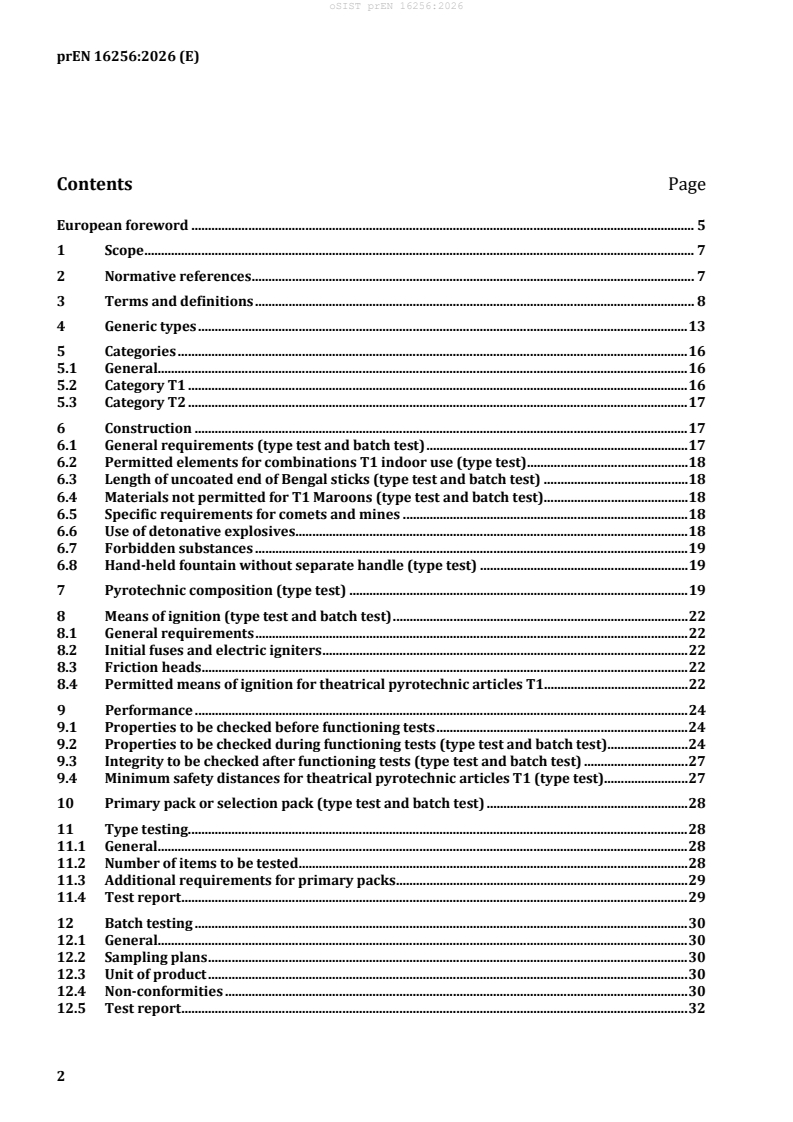
Contents Page
European foreword . 5
1 Scope . 7
2 Normative references . 7
3 Terms and definitions . 8
4 Generic types . 13
5 Categories . 16
5.1 General. 16
5.2 Category T1 . 16
5.3 Category T2 . 17
6 Construction . 17
6.1 General requirements (type test and batch test) . 17
6.2 Permitted elements for combinations T1 indoor use (type test) . 18
6.3 Length of uncoated end of Bengal sticks (type test and batch test) . 18
6.4 Materials not permitted for T1 Maroons (type test and batch test) . 18
6.5 Specific requirements for comets and mines . 18
6.6 Use of detonative explosives . 18
6.7 Forbidden substances . 19
6.8 Hand-held fountain without separate handle (type test) . 19
7 Pyrotechnic composition (type test) . 19
8 Means of ignition (type test and batch test) . 22
8.1 General requirements . 22
8.2 Initial fuses and electric igniters . 22
8.3 Friction heads . 22
8.4 Permitted means of ignition for theatrical pyrotechnic articles T1. 22
9 Performance . 24
9.1 Properties to be checked before functioning tests . 24
9.2 Properties to be checked during functioning tests (type test and batch test) . 24
9.3 Integrity to be checked after functioning tests (type test and batch test) . 27
9.4 Minimum safety distances for theatrical pyrotechnic articles T1 (type test). 27
10 Primary pack or selection pack (type test and batch test) . 28
11 Type testing . 28
11.1 General. 28
11.2 Number of items to be tested . 28
11.3 Additional requirements for primary packs . 29
11.4 Test report . 29
12 Batch testing . 30
12.1 General. 30
12.2 Sampling plans . 30
12.3 Unit of product . 30
12.4 Non-conformities . 30
12.5 Test report . 32
12.6 Acceptance or rejection of a batch . 33
13 Minimum labelling requirements. 33
13.1 General . 33
13.2 Name and type of article . 33
13.3 Category, registration number, product, batch or serial number . 34
13.4 Net explosive content . 34
13.5 Printing. 34
13.6 Marking of very small items . 34
13.7 Minimum Age limits and Safety Distances . 34
13.8 Identification number of the notified body . 34
13.9 Instructions for use, safety and disposal information . 35
14 Category T1 Articles . 35
15 Category T2 Articles . 35
16 Test environment . 37
16.1 General . 37
16.2 Indoor . 37
16.3 Outdoor . 37
17 Apparatus . 38
17.1 General . 38
17.2 Timing device . 38
17.3 Calliper . 38
17.4 Ruler . 38
17.5 Measuring tape . 38
17.6 Wind speed meter . 38
17.7 Masses including clamping device . 38
17.8 Balance . 38
17.9 Abrasive sheet. 38
17.10 Temperature chamber . 38
17.11 Clamping device . 38
17.12 Devices for measuring of Effect-, Rising/Bursting-, Drop Height . 39
17.13 Sound level meter . 39
17.14 Shock apparatus . 39
17.15 Goniometer . 39
17.16 Frame . 39
17.17 Ignition source . 39
17.18 Transparent type size sheet . 40
17.19 Striking surface . 40
17.20 Burning time measurement – mould device . 40
18 Test methods . 40
18.1 Construction and stability . 40
18.2 Design – Verification . 42
18.3 Angle of ascent, effect-, rising/bursting-, drop height. 43
18.4 Measurement of sound pressure level . 43
18.5 Timing measurement . 43
18.6 Measuring of labelling . 44
18.7 Extinguishing of flames . 44
18.8 Burning rate of composition . 44
18.9 Projected Debris . 45
18.10 Incandescent matter . 45
18.11 Visual and Audible Inspections . 45
18.12 Mechanical conditioning . 45
18.13 Thermal conditioning . 46
18.14 Striking surface test . 46
18.15 Function test . 46
18.16 Determination of tube angle . 47
18.17 Use of detonative explosives . 48
Annex A (normative) List of mandatory and optional parameters and corresponding codes . 52
Annex B (informative) Mechanical Conditioning (Shock Apparatus) . 54
Annex C (informative) Calculation methods for the angle of ascent, effect-, rising-, drop
height . 57
C.1 Method 1 . 57
C.2 Method 2 . 59
Annex D (informative) Calculation method for minimum safety distance . 61
Annex ZA (informative) Relationship between this European Standard and the essential
safety requirements of Directive 2013/29/EU aimed to be covered . 62
Bibliography . 64
European foreword
This document (prEN 16256:2026) has been prepared by Technical Committee CEN/TC 212
“Pyrotechnic articles”, the secretariat of which is held by NEN.
This document is currently submitted to the CEN Enquiry.
This document will supersede EN 16256-1:2012, EN 16256-2:2012, EN 16256-3:2012,
EN 16256-4:2012 and EN 16256-5:2012.
EN 16256-2:2012, EN 16256-3:2012, EN 16256-4:2012 and EN 16256-5:2012:
— Clause 3 deleted ‘Continuous effect’ and added 3.6 ‘detonation’, 3.7 ‘detonative explosion’ and 3.41-
3.46 ‘effect dimensions’, ‘effect charge’, ‘bursting charge’, ‘propellant charge’, ‘type test’ and ‘batch
test’;
— Clause 3.5 and 3.36 added: Note 1 to entry: Materials such as confetti etc. are not considered as effect;
— Clause 3.37 added: Note 1 to entry: There might be different safety distances for persons who are
protected from the effects by protective equipment and those without protective equipment;
— Clause 4, Table 1 description and effect of ‘comet’ and ‘mine’ are revised;
— Clause 5.2, Table 2 added for comet a note: only when the pyrotechnic unit is preloaded into the firing
tube (see 6.5);
— Clause 6.5 “Specific requirements for comets and mines” has been added;
— Clause 6.6 “Use of detonative explosives” and Clause 6.7 “Forbidden substances” have been revised
and be brought in line with WG 2;
— Clause 8.2 “Initial fuses and electrical igniters” requirement added on conformation to EN 16265
regarding ESD test only;
— Clause 9.2.4 “Effect dimensions”: for batch test a distinction is made between articles of category T1
and articles of category T2;
— Clause 9.2.5 “Sound pressure level” requirement added for articles where the parameter B is given
on the label or in the instructions for use.;
— Clause 9.2.7 “Burning or incandescent matter” added: Additionally, for articles where the parameter
D is given and is not given with a “+” in the labelling, no burning or incandescent matter shall fall to
the ground, see Table A.1.;
— Clause 9.2.9 “Projected debris” requirement added for articles where the parameter C is given on the
label or in the instructions for use;
— Clause 9.4 “Minimum safety distances for theatrical pyrotechnic articles T1 (Type test)” requirement
added for rounding up the calculated value for T1 line rockets and T1 airbursts to the next metre.;
— Clause 11.4 “Test report” added 4 items.
— Clause 12.1 “General” requirement added for batch tests;
— Clause 12.4 “Non-conformities” Table 8: effect dimensions is extended in more detail;
— Clause 13.4 “Category, registration number, product, batch or serial number” added: product, batch
or serial number;
— Clause 13.10 “Instructions for use, safety and disposal information” added the sentence: “This
pyrotechnic article is for stage, film and television productions or similar use only”;
— Clause 16.2 “Indoor”; Requirement added with regard to the test area;
— Clause 18.4.2 “Procedure” the setup of the microphone of the sound level meter is better specified;
— Clause 18.17 “Use of detonative explosives” describes an extra added test for detonative explosives
This document has been prepared under a standardization request addressed to CEN by the European
Commission. The Standing Committee of the EFTA States subsequently approves these requests for its
Member States.
For the relationship with EU Legislation, see informative Annex ZA, which is an integral part of this
document.
1 Scope
This document defines various terms and specific requirements relating to the design, construction,
performance, primary packaging and testing of theatrical pyrotechnic articles and specifies their generic
types.
It defines the procedures for placing generic types, subtypes or individual items of theatrical pyrotechnic
articles into the appropriate Categories, T1 or T2 and lists them.
It specifies minimum labelling requirements for the article and primary packaging and for the
instructions for use. Specific test methods for theatrical pyrotechnic articles of the generic types are
defined.
NOTE “Theatrical pyrotechnic article(s)” is abbreviated by “article(s)” in this document.
2 Normative references
The following documents are referred to in the text in such a way that some or all of their content
constitutes requirements of this document. For dated references, only the edition cited applies. For
undated references, the latest edition of the referenced document (including any amendments) applies.
EN 16265:2015, Pyrotechnic articles - Other pyrotechnic articles - Ignition devices
EN 61672-1:2013, Electroacoustics - Sound level meters - Part 1: Specifications
EN ISO 13385-1:2019, Geometrical product specifications (GPS) - Dimensional measuring equipment - Part
1: Design and metrological characteristics of callipers (ISO 13385-1:2019)
ISO 2859-1:2026, Sampling procedures for inspection by attributes — Part 1: Sampling schemes indexed by
acceptance quality limit (AQL) for lot-by-lot inspection
ISO 6344-3:2021, Coated abrasives — Determination and designation of grain size distribution — Part 3:
Microgrit sizes P240 to P5000
ISO 21948:2001, Coated abrasives — Plain sheets
ISO 22863-1:2020, Fireworks — Test methods for determination of specific chemical substances — Part 1:
General
ISO 22863-3:2020, Fireworks — Test methods for determination of specific chemical substances — Part 3:
Lead and lead compounds by atomic absorption
ISO 22863-4:2021, Fireworks — Test methods for determination of specific chemical substances — Part 4:
Analysis of lead and lead compounds by X-ray fluorescence spectrometry (XRF)
ISO 22863-5:2021, Fireworks — Test methods for determination of specific chemical substances — Part 5:
Analysis of lead and lead compounds by inductively coupled plasma spectrometry (ICP)
ISO 22863-8:2021, Fireworks — Test methods for determination of specific chemical substances — Part 8:
Arsenic content by hydride generation atomic fluorescence spectrometry
ISO 22863-9:2021, Fireworks — Test methods for determination of specific chemical substances — Part 9:
Mercury content by hydride generation atomic fluorescence spectrometry
EN 10025-2:2019, Hot rolled products of structural steels - Part 2: Technical delivery conditions for non-
alloy structural steels
EN 13763-1:2025, Explosives for civil uses - Detonators and detonating cord relays - Part 1: Requirements
3 Terms and definitions
For the purposes of this document, the following terms and definitions apply.
ISO and IEC maintain terminology databases for use in standardization at the following addresses:
— ISO Online browsing platform: available at https://www.iso.org/obp
— IEC Electropedia: available at https://www.electropedia.org
3.1
acceptance quality limit
quality level that is the worst tolerable process average when a continuing series of lots is submitted for
acceptance sampling
[SOURCE: ISO 2859-1:2026, definition 3.1.26]
3.2
critical non-conforming unit
non-conforming unit with one or more critical non-conformities, with or without major or minor non-
conformities
3.3
critical non-conformity
non-conformity that judgement and experience indicate is likely to result in hazardous or unsafe
conditions
Note 1 to entry: This type of non-conformity is referred to as a ‘class A non-conformity’ in ISO 2859-1:2026.
3.4
debris
any part of the article which remains after the article has ceased to function
3.5
effect distance
maximum distance of the effect in the direction of firing measured from the base of the article
Note 1 to entry: Materials such as confetti etc. are not considered as effect.
3.6
detonation
reaction which propagates through an explosive at supersonic velocity in the reacting explosive
[SOURCE: EN 16265:2015, definition 3.2.15]
3.7
detonative explosive
substance or mixture of substances which can undergo a fast internal decomposition reaction leading to
a detonation in normal use
[SOURCE: EN 16265:2015, definition 3.2.16]
3.8
electric igniter
article containing explosive substance(s) used to initiate combustion or deflagration which is actuated by
electrical means (e.g. a fusehead)
Note 1 to entry: Such articles are often equipped with leading wires which supply the electric power to their
sensitive element.
3.9
electrical ignition
any method of generating heat/sparks by electrical means
3.10
explosion
sudden release of energy accompanied by a report with or without a flash
3.11
friction head
ignition head designed to be initiated by friction
3.12
functioning length
distance over which the audible or visual effects of a line rocket are produced
3.13
fusehead
component of an electric igniter consisting of a bridgewire coated in a pyrotechnic composition and
protected by a layer of lacquer
3.14
hazardous debris
any debris capable of causing personal injury including but not limited to, sharp fragments, heavy casing
fragments and any burning and/or incandescent material
Note 1 to entry: Materials such as confetti etc. are not considered as hazardous debris.
3.15
initial fuse time
burning time of the initial fuse
3.16
initial fuse
component of an article which once ignited provides a delay to the start of the functioning of the article
3.17
lifting cup
means of separating the lift charge at the base of an article from effects above it by means of a membrane
often made of card/paper
3.18
major non-conforming unit
non-conforming unit with one or more major non-conformities, with or without minor non-conformities,
but with no critical non-conformities
3.19
major non-conformity
non-conformity, other than a critical non-conformity, which is likely to result in failure, to reduce
materially the usability of the article, or to increase the potential hazard
Note 1 to entry: This type of non-conformity is referred to as a ‘class B non-conformity’ in ISO 2859-1:2026.
3.20
minor non-conforming unit
non-conforming unit with one or more minor non-conformities, but with no critical or major non-
conformities
3.21
minor non-conformity
non-conformity that is not likely to reduce materially the usability of the article
Note 1 to entry: This type of non-conformity is referred to as a ‘class C non-conformity’ in ISO 2859-1:2026.
3.22
net explosive content
NEC
mass of pyrotechnic composition in the article, excluding the pyrotechnic composition in the initial fuse,
transmitting fuses and friction or ignition heads
Note 1 to entry: Net equivalent quantity (NEQ), net explosive mass (NEM), or net explosive weight (NEW) are often
used to convey the same meaning.
3.23
nitrocellulose cloth
nitrated cellulose material with less than 12,6 % nitrogen content that has the appearance of a woven
cloth and which burns rapidly when ignited
3.24
nitrocellulose cotton
nitrated cellulose material with less than 12,6 % nitrogen content that has the appearance of the raw
cotton as taken from around the cotton seed and which burns rapidly when ignited
3.25
nitrocellulose floss
nitrated cellulose material with less than 12,6 % nitrogen content that has the appearance of chopped
flock/felt, which burns rapidly when ignited
3.26
nitrocellulose string
nitrated cellulose material with less than 12,6 % nitrogen content that has the appearance of string,
which burns rapidly when ignited
3.27
nitrocellulose paper
nitrated cellulose material with less than 12,6 % nitrogen content with the appearance of sheet paper,
which burns rapidly when ignited
3.28
non-conforming unit
article or a primary pack with one or more non-conformities
3.29
non-conformity
non-fulfilment of a requirement
[SOURCE: ISO 9000:2015, definition 3.6.9]
3.30
preliminary effect
visual effect which follows the initial fuse burning and precedes the first principal effect of an article
3.31
primary pack
package of one or more articles of the same category and generic type, offered for retail sale as a single
unit
3.32
principal effect
any of the effects listed in Table 1 for the particular type of article
3.33
pyrotechnic composition
substance or mixture of substances which is designed, on ignition or initiation, to produce an aural and/or
visual effect and/or to evolve gas
3.34
pyrotechnic star
unit consisting solely of consolidated pyrotechnic material
3.35
pyrotechnic unit
discrete pyrotechnic construction that is assembled into or on an article and which, upon functioning,
will react to produce a visual and/or aural effect
Note 1 to entry: The effect produced by a pyrotechnic unit is normally part of a combination of effects produced by
the article.
3.36
radial effect distance
maximum distance of the effect in any direction except in the direction of firing
Note 1 to entry: Materials such as confetti etc. are not considered as effect.
3.37
radial safety distance
minimum distance from the article to persons or flammable materials in any direction except the firing
direction, to reduce risk to as low as reasonably practicable
Note 1 to entry: There might be different safety distances for persons who are protected from the effects by
protective equipment and those without protective equipment.
3.38
safety distance
minimum distance of persons or flammable materials or obstructions from the article in the direction of
the effect to reduce the risk to as low as reasonably practicable
Note 1 to entry: There might be different safety distances for persons who are protected from the effects by
protective equipment and those without protective equipment.
3.39
selection pack
package of articles of more than one type and/or more than one category, offered for retail sale as a single
unit
Note 1 to entry: A selection pack may contain primary packs as well as individual articles.
3.40
transmitting fuse
component of an article which is intended to transmit ignition from one part of an article to another, with
or without a delay
3.41
effect dimensions
dimensions of the visual effect in space length, width and height
Note 1 to entry: Dimensional effects do not apply to smoke, confetti and streamers.
3.42
effect charge
pyrotechnic composition, other than propellant charge or bursting charge, which upon functioning will
react to produce a visual and/or aural effect
3.43
bursting charge
pyrotechnic composition which is intended to burst open the article case, in order to expel one or more
pyrotechnic units, which can also transmit ignition
3.44
propellent charge
pyrotechnic composition which will burn to evolve gas which, in turn, is intended to propel the
pyrotechnic article as a whole or to expel one or more pyrotechnic units without bursting the pyrotechnic
article case(s), and which can also transmit ignition
3.45
type test
test performed on a sample of products, representative of the production envisaged, in order to
demonstrate their compliance with the essential safety requirements of Annex I and the relevant
provisions of Directive 2013/29/EU
Note 1 to entry: The successful submission to type tests leads to the attribution of an EU-type examination
certificate.
3.46
batch test
test performed on one or more sample(s) of products taken at random from a production batch to check
compliance with a given specification
Note 1 to entry: Batch testing needs all products in the production batch to comply with the characteristics the
standard requires to ensure homogeneity of the whole batch. It aims at proving all products which are placed on
the market are in conformity with the type which is described in the EU-type examination certificate and have been
successfully submitted to type tests determined by the standard.
4 Generic types
Table 1 lists generic types of theatrical pyrotechnic articles and describes their principal effects.
Table 1 — Description and primary effects of generic types
Generic type Description Principal effect/comments
An article containing pyrotechnic composition(s)
Production of visual and/or aural
Airburst which is suspended in the air and functions to
effects.
produce a visual and/or aural effect.
A pyrotechnic composition or an article
containing pyrotechnic composition(s) which Production of coloured flame (and
Bengal flame
produces a (coloured) light or flame where the smoke).
effect is not instantaneous.
An article containing consolidated pyrotechnic
Production of coloured flame (and
Bengal flare composition(s) which produces a (coloured) light
smoke).
or flame where the effect is not instantaneous.
A stick partially coated with slow-burning
Emission of a bright light for a
Bengal stick pyrotechnic composition(s), designed to be held
stated duration.
in the hand.
Various effects including but not
Binary Separate non-pyrotechnic composition(s) which
limited to report, coloured flashes
mixture form a pyrotechnic composition, when combined.
of light, fire, smoke, sparks.
An article containing pressed or consolidated
pyrotechnic composition(s) producing light and
sparks in a directed manner, and which can Produces light, sparks and, if any, a
Carretilla
culminate in the production of a report, report.
manufactured with an integral fitting designed to
be mounted on a rod.
An assembly including several elements, either
containing the same type or several types, each
corresponding to one of the types of pyrotechnic
articles listed in this table, with one or multiple
Combination points of ignition and in which the initial fuse As per individual elements.
transmits fire from one element to the next to fire
the articles sequentially or in some other pattern,
and where not all the elements of the
combination are type approved.
Generic type Description Principal effect/comments
Tube with or without a propellant charge and (a)
Single ejection of the pyrotechnic
pyrotechnic unit(s), with or without a bursting
Comet unit(s) producing a visual or aural
charge, of which at least one unit has a diameter
effect in the air
of at least half of the inner diameter of the tube
A pyrotechnic substance which is insensitive to
Desensitized
ignition by virtue of an additive when supplied Produces light, sparks, flames,
pyrotechnic
but is converted to a pyrotechnic substance at the sound or smoke.
composition
point of use by removal of the additive.
An article that contains pyrotechnic
Dropping composition(s) and/or pyrotechnic stars and/or Produces visual and/or aural
effect pyrotechnic units, designed to produce its effect effects.
in a downward direction.
An article containing a pyrotechnic
An explosion effect generating
composition(s) and/or pyrotechnic stars and/or
Explosion noise with or without coloured fire,
pyrotechnic units and/or flammable materials
simulator smoke, sparks or other visual
and/or inert material to simulate a small or large
and/or aural effects.
explosion.
An article containing a pyrotechnic propellent
charge, pyrotechnic composition(s) and/or non-
Produces a Ball of fire with or
pyrotechnic compositions but not containing
Fireball without smoke and/or sparks
discrete unit, which can produce an
and/or aural effect.
instantaneous ball of fire with or without smoke
and/or sparks and/or aural effect.
An article containing pyrotechnic composition(s) Generates a column of flame with
Flame
producing a flame or a projected column of flame or without other visual and/or
projector
with or without other visual and/or aural effects. aural effects.
Production of sparks and /or other
An article containing pyrotechnic composition(s)
Fountain visual or aural effects in a directed
producing effects in a directed manner.
manner.
An article containing pyrotechnic composition(s)
Generates a Jet of sparks and/or
Jet to produce a jet of sparks and/or (coloured)
(coloured) flames.
flames over a short duration.
An article containing pyrotechnic composition(s) Emits light and/or aural effects and
Line rocket that is designed to be attached to a wire and has a or sparks and/or coloured smoke
controlled trajectory. while being propelled along a wire.
A single sealed unit containing pyrotechnic
Produces instantaneous report
composition(s) whose principle function is to
Maroon with or without coloured light
produce a loud report with the complete
and/or sparks.
fragmentation of the casing.
Tube containing pyrotechnic units of diameters Single ejection of the content
less than half the inner diameter of the tube with producing a widely dispersed
Mine
or without a propellent charge. visual and/or aural effect in the air.
Generic type Description Principal effect/comments
A single tube containing pyrotechnic Instantaneous ejection of inert
Projection
composition(s) and inert items (e.g. confetti and paper or novelty effects. May
device
streamer) which are projected from the article. produce noise and/or smoke.
An article consisting of a single tube, containing a
Roman series of pyrotechnic units with alternate Emits units sequentially producing
candle payloads and propellant charges and a directional visual effects.
transmitting fuse.
An article containing pyrotechnic composition(s) Rotational effect emitting coloured
Rotating
and functions in such a way that the article light and or sparks with or without
effect
rotates. an aural effect.
Self- An article comprising of only pyrotechnic
Produces light, smoke, sparks or
consuming substance(s), leaving no debris after the article
noise.
article has ceased to function.
A pyrotechnic composition that is ignited in a
Smoke
suitable container (e.g. open flame-bowl) or in a Produces smoke.
device
preformed shape or cartridge to produce smoke.
An article containing pyrotechnic composition(s)
Produces a curtain of flame and
Split tube which is designed to produce a two-dimensional
sparks.
curtain of sparks or other pyrotechnic effects.
An article containing pyrotechnic composition(s), Generates an eruption of smoke,
Squib principally designed to disrupt inert material to flame or sparks from a point
mimic a bullet/puncture wound. source.
A low smoke pyrotechnic composition that is
ignited in a suitable container (e.g. open flame-
Theatrical
bowl) or in a preformed cartridge and is Production of coloured flame.
fire
predominantly designed for indoor use to
produce a (coloured) light and flame effect.
An article containing pyrotechnic composition(s) Generates an instantaneous flash of
Theatrical
where the effect is instantaneous, directed and light. May be accompanied by
flash
the primary effect is a flash of light. smoke, sparks and an aural effect.
A single sealed unit containing pyrotechnic
composition(s) whose principle function is to Produces instantaneous report
Theatrical
produce a loud report where only one surface of with or without coloured light
report
the casing ruptures/opens in the direction of the and/or sparks.
effect.
An article containing pyrotechnic composition(s)
Produces a whistle with or without
Whistle that produces an aural whistling effect and may
sparks.
produce a visual effect.
5 Categories
5.1 General
Articles are categorized into two categories as follows:
Category T1: Articles for stage use which present a low hazard and which are intended for indoor and
outdoor use.
NOTE 1 Some T1 articles are restricted for outdoor use only and denoted as T1 ‘for outdoor use only’.
Category T2: Articles for stage use which are intended for use only by persons with specialist knowledge.
NOTE 2 The term ‘stage use’ includes film and television productions or similar use.
5.2 Category T1
According to their Generic type, not all types are permissible in all categories.
The types permitted for T1 or T1 ‘for
...