

SIST EN 12516-3:2003
(Main)Valves - Shell design strength - Part 3: Experimental method
- Abstract
This standard specifies requirements for an experimental method, to prove by type test that the design of shells and their body ends, made in cast iron, steel or copper alloy materials, possess the required pressure containing capability, with an adequate margin of safety. This standard is not applicable to valves designed on the basis of time dependent strength values. e.g. pulsating pressure applications and/or creep range temperatures.
- Status
- Published
- Publication Date
- 30-Jun-2003
- Technical Committee
- TLP - Pressure vessels
- Current Stage
- 6060 - National Implementation/Publication (Adopted Project)
- Start Date
- 01-Jul-2003
- Due Date
- 01-Jul-2003
- Completion Date
- 01-Jul-2003
- Directive
- 2014/68/EU - Directive 2014/68/EU of the European Parliament and of the Council of 15 May 2014 on the harmonisation of the laws of the Member States relating to the making available on the market of pressure equipmentOJ Ref: C 293/01 OJ Date: 12-Aug-2016
97/23/EC - Pressure equipmentOJ Ref: C 118 OJ Date: 15-Apr-2011

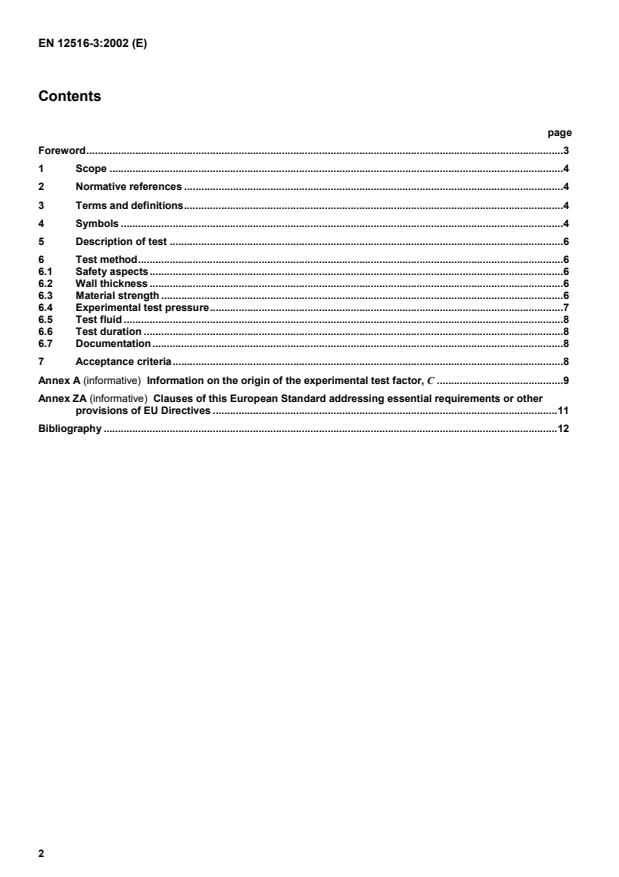
SIST EN 12516-3:2003 is the Slovenian adoption of EN 12516-3:2002 from CEN. It specifies an experimental hydrostatic test method for proving the shell design strength of valves, including shells and body ends made in cast iron, steel or copper alloy materials. In practice, it is used by valve manufacturers, test labs and certifiers to check pressure-containing capability with a defined safety margin.
What does SIST EN 12516-3:2003 specify?
SIST EN 12516-3:2003 specifies how to verify valve shell strength by type testing at elevated hydrostatic pressure. The standard applies to representative samples and is intended as an alternative to the tabulation method and calculation method used in the other parts of EN 12516.
It excludes valves designed on time-dependent strength values, such as creep range temperatures, and valves designed for pulsating pressure applications. The document is organized into scope, normative references, terms and definitions, symbols, description of test, test method, acceptance criteria, and two informative annexes.
| Annex | What it covers |
|---|---|
| Annex A | The origin and rationale of the experimental test factor, C |
| Annex ZA | Clauses addressing essential requirements of EU Directive 97/23/EC (PED) |
What are the key requirements of SIST EN 12516-3:2003?
SIST EN 12516-3:2003 requires an elevated hydrostatic pressure test at room temperature, using water as the test fluid and a minimum test duration of 10 minutes. That means the strength check is based on a controlled pressure test, not just on calculations.
Test setup and specimen condition
The valve body ends must be closed with suitable sealing components that match the body-end type, and the test arrangement must not add external loads or reinforcement that would affect the result. In practice, the setup must represent the valve shell itself, not the support hardware.
Wall thickness must match the minimum drawing requirements, and the measured thickness is used to determine the ratio X. The test specimen must be checked at all specified thickness locations, because local wall variations affect the stress level reached during the test.
Material verification
The material test certificates for each component must be checked against the material specification. The actual proof strength is compared with the minimum specified proof strength to determine the ratio Y. This ensures the test pressure reflects the actual material properties of the specific component being tested.
Test pressure determination
The experimental test pressure is calculated from the experimental test factor C, the wall-thickness ratio X, the material-strength ratio Y, and the maximum allowable pressure at room temperature, PSRT. The standard gives different C values for grey cast iron, spheroidal graphite cast iron, steel and copper alloy, with separate values for castings and wrought products where applicable. In practice, this means the required test pressure depends on both geometry and material class.
For body and bonnet or cover, separate pressures may be calculated. The lower pressure is applied first, then the higher pressure, unless the higher pressure is used for the full minimum duration. If a component has already been shown to meet the required pressure-containing capability by another part of EN 12516, it does not need to be tested again under this method.
Acceptance criteria and records
There must be no visible leakage through any metallic part of the shell. Leakage at a gasket between two components is not a rejection criterion unless it prevents assessment of shell leakage. The performance of the test and all parameters and results must be fully documented, which matters for quality records and conformity assessment.
What terms does SIST EN 12516-3:2003 define?
- Maximum allowable pressure (PS) - the pressure limit used in the standard’s pressure-related calculations.
- Maximum allowable pressure at room temperature (PSRT) - the pressure limit at room temperature used for the experimental test pressure.
- Experimental test pressure (pt, exp) - the pressure applied during the hydrostatic strength test.
- Experimental test factor (C) - the material-dependent factor used to set the test pressure.
- Component - in this standard, the body, bonnet and cover.
- Ratio X - the measured wall thickness divided by the minimum specified drawing wall thickness.
- Ratio Y - the actual proof strength divided by the minimum specified proof strength.
Who uses SIST EN 12516-3:2003?
SIST EN 12516-3:2003 is used by valve manufacturers, design engineers, testing laboratories, inspection bodies and quality managers. It is especially relevant for industrial valves made from cast iron, steel or copper alloy materials.
It also supports buyers and technical teams who need evidence that a valve shell has been type-tested for pressure containment. For regulated products, it is relevant to conformity assessment work linked to the PED.
What changed in SIST EN 12516-3:2003 from the previous edition?
SIST EN 12516-3:2003 is identical to EN 12516-3:2002.
Which standards are used with SIST EN 12516-3:2003?
- EN 736-2 - provides the valve component definitions used by the standard.
- EN 736-3 - provides the valve term definitions used by the standard.
What does the SIST EN 12516-3:2003 document contain?
The document contains the scope, normative references, terms and definitions, a symbol list, the test description, the detailed test method and the acceptance criteria. Clause 6 sets out how wall thickness, material strength and test pressure are determined, and Clause 7 states the leakage acceptance rules.
It also includes a table of experimental test factor values, the equations used to derive the test pressure, and practical conditions for test fluid, duration and documentation. Annex A explains the background to the factor C, and Annex ZA links the standard to essential requirements of the PED.
Relations
- Effective Date
- 28-Jan-2026
- Effective Date
- 28-Jan-2026
- Effective Date
- 28-Jan-2026
- Effective Date
- 28-Jan-2026
- Effective Date
- 28-Jan-2026
- Effective Date
- 28-Jan-2026
- Effective Date
- 28-Jan-2026
- Effective Date
- 28-Jan-2026
- Effective Date
- 28-Jan-2026
- Effective Date
- 28-Jan-2026
- Effective Date
- 28-Jan-2026
- Effective Date
- 28-Jan-2026
- Effective Date
- 28-Jan-2026
- Effective Date
- 28-Jan-2026
- Effective Date
- 28-Jan-2026
Get Certified
Connect with accredited certification bodies for this standard

Institut za varilstvo d.o.o. (Welding Institute)
Slovenia's leading welding institute since 1952. ISO 3834, EN 1090, pressure equipment certification, NDT personnel, welder qualification. Only IIW Au
Sponsored listings
Frequently Asked Questions
SIST EN 12516-3:2003 is a standard published by the Slovenian Institute for Standardization (SIST). Its full title is "Valves - Shell design strength - Part 3: Experimental method". This standard covers: This standard specifies requirements for an experimental method, to prove by type test that the design of shells and their body ends, made in cast iron, steel or copper alloy materials, possess the required pressure containing capability, with an adequate margin of safety. This standard is not applicable to valves designed on the basis of time dependent strength values. e.g. pulsating pressure applications and/or creep range temperatures.
This standard specifies requirements for an experimental method, to prove by type test that the design of shells and their body ends, made in cast iron, steel or copper alloy materials, possess the required pressure containing capability, with an adequate margin of safety. This standard is not applicable to valves designed on the basis of time dependent strength values. e.g. pulsating pressure applications and/or creep range temperatures.
SIST EN 12516-3:2003 is classified under the following ICS (International Classification for Standards) categories: 23.060.01 - Valves in general. The ICS classification helps identify the subject area and facilitates finding related standards.
SIST EN 12516-3:2003 has the following relationships with other standards: It is inter standard links to SIST EN 736-2:2016, SIST EN 736-3:2008, SIST EN 12480:2015, SIST EN 13789:2011, SIST EN 16678:2022, SIST EN 12288:2011, SIST EN 14433:2023, SIST EN ISO 4126-1:2004, SIST EN 14433:2015, SIST EN 16668:2016+A1:2018, SIST-TS CEN/TS 13547:2007, SIST EN 1983:2014, SIST EN 12480:2026, SIST EN 13709:2011, SIST EN 676:2020. Understanding these relationships helps ensure you are using the most current and applicable version of the standard.
SIST EN 12516-3:2003 is associated with the following European legislation: EU Directives/Regulations: 2014/68/EU, 97/23/EC, EUR-PUB; Standardization Mandates: M/071. When a standard is cited in the Official Journal of the European Union, products manufactured in conformity with it benefit from a presumption of conformity with the essential requirements of the corresponding EU directive or regulation.
SIST EN 12516-3:2003 is available in PDF format for immediate download after purchase. The document can be added to your cart and obtained through the secure checkout process. Digital delivery ensures instant access to the complete standard document.
Standards Content (Sample)
2003-01.Slovenski inštitut za standardizacijo. Razmnoževanje celote ali delov tega standarda ni dovoljeno.Valves - Shell design strength - Part 3: Experimental methodVentili - Trdnost ohišja - 3. del: Eksperimentalna metodaAppareils de robinetterie - Résistance mécanique des enveloppes - Partie 3: Méthode expérimentaleArmaturen - Gehäusefestigkeit - Teil 3: Experimentelles VerfahrenTa slovenski standard je istoveten z:EN 12516-3:2002SIST EN 12516-3:2003en23.060.01ICS:SLOVENSKI
STANDARDSIST EN 12516-3:200301-julij-2003
EUROPEAN STANDARDNORME EUROPÉENNEEUROPÄISCHE NORMEN 12516-3October 2002ICS 23.060.01English versionValves - Shell design strength - Part 3: Experimental methodAppareils de robinetterie - Résistance mécanique desenveloppes - Partie 3: Méthode expérimentaleArmaturen - Gehäusefestigkeit - Teil 3: ExperimentellesVerfahrenThis European Standard was approved by CEN on 1 August 2002.CEN members are bound to comply with the CEN/CENELEC Internal Regulations which stipulate the conditions for giving this EuropeanStandard the status of a national standard without any alteration. Up-to-date lists and bibliographical references concerning such nationalstandards may be obtained on application to the Management Centre or to any CEN member.This European Standard exists in three official versions (English, French, German). A version in any other language made by translationunder the responsibility of a CEN member into its own language and notified to the Management Centre has the same status as the officialversions.CEN members are the national standards bodies of Austria, Belgium, Czech Republic, Denmark, Finland, France, Germany, Greece,Iceland, Ireland, Italy, Luxembourg, Malta, Netherlands, Norway, Portugal, Spain, Sweden, Switzerland and United Kingdom.EUROPEAN COMMITTEE FOR STANDARDIZATIONCOMITÉ EUROPÉEN DE NORMALISATIONEUROPÄISCHES KOMITEE FÜR NORMUNGManagement Centre: rue de Stassart, 36
B-1050 Brussels© 2002 CENAll rights of exploitation in any form and by any means reservedworldwide for CEN national Members.Ref. No. EN 12516-3:2002 E
Information on the origin of the experimental test factor, C.9Annex ZA (informative)
Clauses of this European Standard addressing essential requirements or otherprovisions of EU Directives.11Bibliography.12
...