

SIST EN 81-31:2025
(Main)Safety rules for the construction and installation of lifts - Lifts for the transport of goods only - Part 31: Accessible goods only lifts
General Information
- Abstract
1.1 This document specifies the safety rules for new accessible goods only lifts with traction, positive or hydraulic drive, permanently installed and only used by users (see 3.57), serving fixed and permanent landing levels, having a carrier made of a single load carrying area, designed for the transportation of goods only, moving along a fixed path by rigid guide rails and inclined not more than 15° to the vertical, with rated speed not exceeding 1 m/s.
This document covers accessible goods only lifts with rated load exceeding 300 kg and not intended to transport persons.
1.2 For the purpose of this document, a goods only lift carrier is regarded as accessible where one of the following conditions is satisfied:
a) floor area of the carrier is greater than 1,0 m2;
b) depth of the carrier is greater than 1,0 m;
c) clear height of the carrier is greater than 1,20 m.
In case the carrier is without a roof, it is considered accessible when the clear height of the landing doors is greater than 1,20 m.
1.3 Two types of accessible goods only lifts are addressed:
a) Type A, where the intended use is bound to the maximum rated speed of 0,30 m/s;
b) Type B, where the intended use is bound to the maximum rated speed of 1,0 m/s.
1.4 In addition to the requirements of this document, supplementary requirements are to be considered in special cases (operation subject to ATEX rules, operational in ambiental condition not addressed by this standard, seismic conditions, transporting dangerous goods, etc.).
1.5 This document does not cover:
a) accessible goods only lifts:
1) with more than one lift machine;
i) where loading and unloading is automated, or the carrier floor is fitted with mobile devices (e.g. rollers) for loading and unloading purposes;
ii) intended to carry bulk loads (such as loose sand, gravel, etc.);
iii) with drive systems other than those stated in 4.8;
b) lifting tables according to EN 1570-1 and EN 1570-2;
c) lifting appliances, such as appliances with more than one carrier, skips, goods only lifts for construction sites, for underground applications, mine winding gear, goods only lifts on seagoing vessels and mobile offshore units, construction and maintenance appliances in wind turbines, goods only lifts specially designed and constructed for research purposes for temporary use in laboratories, goods only lifts specially designed and constructed for military or police purposes;
d) safety during operation of transport, erection, repairs and dismantling of accessible goods only lifts;
e) the use of translucent material for the walls of the well and machinery spaces, for the carrier with the exception of the landing doors vision panels;
f) the use of programmable electronic systems in safety related applications for lifts (PESSRAL);
g) hydraulic lifts where the setting of the pressure relief valve exceeds 50 MPa;
h) any form of radiation except EMC;
i) fire propagation;
j) energy dissipation type buffers;
k) the possibility of two simultaneous acts of imprudence and/or the abuse of instructions for use.
l) ambient temperature in the well and machinery spaces lower than +5 °C and higher than +40 °C;
m) health and safety of animals.
However, this document can usefully be taken as a basis.
Noise and vibrations are not dealt with in this document as they are not considered a significant nor relevant hazard for the actual type of the accessible goods only lifts.
1.6 The requirements of this document are such that the possibility of a failure of an electric safety device or a safety component complying with all the requirements of this document needs not to be taken into consideration.
1.7 This document is not applicable to accessible goods only lifts which were manufactured before the date of its publication as EN.
- Status
- Published
- Public Enquiry End Date
- 14-Sep-2022
- Publication Date
- 08-Apr-2025
- Technical Committee
- DTN - Lift and transport appliances
- Current Stage
- 6060 - National Implementation/Publication (Adopted Project)
- Start Date
- 20-Nov-2024
- Due Date
- 25-Jan-2025
- Completion Date
- 09-Apr-2025
- Directive
- 2006/42/EC - Directive 2006/42/EC of the European Parliament and of the Council of 17 May 2006 on machinery, and amending Directive 95/16/EC (recast)OJ Ref: 2025/1740, OJ L, OJ L 14.8.2025 OJ Date: 14-Aug-2025

Overview
SIST EN 81-31:2025 (identical to EN 81-31:2024) is the European safety standard that specifies requirements for the design, construction, installation and verification of accessible goods only lifts. It applies to permanently installed lifts for goods (not intended to transport persons) with traction, positive or hydraulic drive, moving on rigid guide rails at inclinations up to 15° and with a rated speed not exceeding 1 m/s. The standard covers accessible carriers with rated loads above 300 kg and defines accessibility by carrier dimensions (floor area, depth or clear height).
Keywords: SIST EN 81-31:2025, accessible goods only lifts, lift safety standard, traction drive, hydraulic drive
Key topics and technical requirements
The standard consolidates safety rules across the lift lifecycle and includes detailed provisions for:
- Scope & definitions - criteria for an accessible goods only lift (floor area > 1.0 m², depth > 1.0 m, clear height > 1.20 m).
- Types and speeds - Type A (max 0.30 m/s) and Type B (max 1.0 m/s).
- Well and machinery spaces - enclosure, access doors, headroom, pit requirements and lighting.
- Landing doors & carrier openings - dimensions, locking, emergency unlocking and electric door-proving devices.
- Carrier, counterweight & protection - carrier construction, protection of sheaves, pulleys and machinery.
- Suspension and overspeed protection - suspension means, safety gear, overspeed governors and anti-free-fall measures.
- Guiding systems & mechanical stops - guide rails, fixed stops, buffers and final limit switches.
- Lift machine & drives - requirements for traction, positive and hydraulic machines (within the drives defined by the standard).
- Electrical installations & safety circuits - wiring, components, failure analysis and device priorities.
- Verification, tests and documentation - design verifications, commissioning tests, periodic checks, instruction handbook and logbook.
- Annexes - test procedures for safety components (safety gear, overspeed governor, buffers), technical documentation and verification checklists.
Exclusions are explicitly listed (e.g., automated loading systems, lifting tables per EN 1570, PESSRAL, hydraulic systems >50 MPa, certain special appliances and conditions).
Practical applications and users
SIST EN 81-31:2025 is used for:
- Designing and specifying goods only lifts for warehouses, workshops, industrial plants and service areas.
- Manufacturing and installing compliant lift equipment (lift makers, contractors).
- Commissioning, inspection and certification (notified bodies, conformity assessors).
- Building owners, facility managers and maintenance teams for safe operation and periodic verification.
- Safety engineers assessing risks and compliance with European lift regulations.
Related standards
- EN 81 series (other parts addressing passenger lifts and general safety principles)
- EN 1570-1 / EN 1570-2 (lifting tables) - explicitly excluded from this part
- ATEX, seismic or other specialist rules may require supplementary requirements beyond EN 81-31
SIST EN 81-31:2025 provides the technical baseline for safe, compliant design and operation of accessible goods only lifts across Europe.
Relations
- Effective Date
- 09-Feb-2026
- Effective Date
- 09-Feb-2026
- Effective Date
- 09-Feb-2026
- Effective Date
- 09-Feb-2026
- Effective Date
- 09-Feb-2026
- Effective Date
- 09-Feb-2026
- Effective Date
- 09-Feb-2026
- Refers
SIST EN 60068-2-6:2008 - Environmental testing - Part 2-6: Tests - Test Fc: Vibration (sinusoidal) - Effective Date
- 09-Feb-2026
- Refers
SIST EN 60068-2-27:2009 - Environmental testing -- Part 2-27: Tests - Test Ea and guidance: Shock - Effective Date
- 09-Feb-2026
- Effective Date
- 09-Feb-2026
- Effective Date
- 09-Feb-2026
- Effective Date
- 09-Feb-2026
- Effective Date
- 09-Feb-2026
- Effective Date
- 09-Feb-2026
- Effective Date
- 09-Feb-2026
Get Certified
Connect with accredited certification bodies for this standard

DIBt (Deutsches Institut für Bautechnik)
German Institute for Building Technology.
DIN CERTCO
DIN Group product certification.

Aboma Certification B.V.
Specialized in construction, metal, and transport sectors.
Sponsored listings
Frequently Asked Questions
SIST EN 81-31:2025 is a standard published by the Slovenian Institute for Standardization (SIST). Its full title is "Safety rules for the construction and installation of lifts - Lifts for the transport of goods only - Part 31: Accessible goods only lifts". This standard covers: 1.1 This document specifies the safety rules for new accessible goods only lifts with traction, positive or hydraulic drive, permanently installed and only used by users (see 3.57), serving fixed and permanent landing levels, having a carrier made of a single load carrying area, designed for the transportation of goods only, moving along a fixed path by rigid guide rails and inclined not more than 15° to the vertical, with rated speed not exceeding 1 m/s. This document covers accessible goods only lifts with rated load exceeding 300 kg and not intended to transport persons. 1.2 For the purpose of this document, a goods only lift carrier is regarded as accessible where one of the following conditions is satisfied: a) floor area of the carrier is greater than 1,0 m2; b) depth of the carrier is greater than 1,0 m; c) clear height of the carrier is greater than 1,20 m. In case the carrier is without a roof, it is considered accessible when the clear height of the landing doors is greater than 1,20 m. 1.3 Two types of accessible goods only lifts are addressed: a) Type A, where the intended use is bound to the maximum rated speed of 0,30 m/s; b) Type B, where the intended use is bound to the maximum rated speed of 1,0 m/s. 1.4 In addition to the requirements of this document, supplementary requirements are to be considered in special cases (operation subject to ATEX rules, operational in ambiental condition not addressed by this standard, seismic conditions, transporting dangerous goods, etc.). 1.5 This document does not cover: a) accessible goods only lifts: 1) with more than one lift machine; i) where loading and unloading is automated, or the carrier floor is fitted with mobile devices (e.g. rollers) for loading and unloading purposes; ii) intended to carry bulk loads (such as loose sand, gravel, etc.); iii) with drive systems other than those stated in 4.8; b) lifting tables according to EN 1570-1 and EN 1570-2; c) lifting appliances, such as appliances with more than one carrier, skips, goods only lifts for construction sites, for underground applications, mine winding gear, goods only lifts on seagoing vessels and mobile offshore units, construction and maintenance appliances in wind turbines, goods only lifts specially designed and constructed for research purposes for temporary use in laboratories, goods only lifts specially designed and constructed for military or police purposes; d) safety during operation of transport, erection, repairs and dismantling of accessible goods only lifts; e) the use of translucent material for the walls of the well and machinery spaces, for the carrier with the exception of the landing doors vision panels; f) the use of programmable electronic systems in safety related applications for lifts (PESSRAL); g) hydraulic lifts where the setting of the pressure relief valve exceeds 50 MPa; h) any form of radiation except EMC; i) fire propagation; j) energy dissipation type buffers; k) the possibility of two simultaneous acts of imprudence and/or the abuse of instructions for use. l) ambient temperature in the well and machinery spaces lower than +5 °C and higher than +40 °C; m) health and safety of animals. However, this document can usefully be taken as a basis. Noise and vibrations are not dealt with in this document as they are not considered a significant nor relevant hazard for the actual type of the accessible goods only lifts. 1.6 The requirements of this document are such that the possibility of a failure of an electric safety device or a safety component complying with all the requirements of this document needs not to be taken into consideration. 1.7 This document is not applicable to accessible goods only lifts which were manufactured before the date of its publication as EN.
1.1 This document specifies the safety rules for new accessible goods only lifts with traction, positive or hydraulic drive, permanently installed and only used by users (see 3.57), serving fixed and permanent landing levels, having a carrier made of a single load carrying area, designed for the transportation of goods only, moving along a fixed path by rigid guide rails and inclined not more than 15° to the vertical, with rated speed not exceeding 1 m/s. This document covers accessible goods only lifts with rated load exceeding 300 kg and not intended to transport persons. 1.2 For the purpose of this document, a goods only lift carrier is regarded as accessible where one of the following conditions is satisfied: a) floor area of the carrier is greater than 1,0 m2; b) depth of the carrier is greater than 1,0 m; c) clear height of the carrier is greater than 1,20 m. In case the carrier is without a roof, it is considered accessible when the clear height of the landing doors is greater than 1,20 m. 1.3 Two types of accessible goods only lifts are addressed: a) Type A, where the intended use is bound to the maximum rated speed of 0,30 m/s; b) Type B, where the intended use is bound to the maximum rated speed of 1,0 m/s. 1.4 In addition to the requirements of this document, supplementary requirements are to be considered in special cases (operation subject to ATEX rules, operational in ambiental condition not addressed by this standard, seismic conditions, transporting dangerous goods, etc.). 1.5 This document does not cover: a) accessible goods only lifts: 1) with more than one lift machine; i) where loading and unloading is automated, or the carrier floor is fitted with mobile devices (e.g. rollers) for loading and unloading purposes; ii) intended to carry bulk loads (such as loose sand, gravel, etc.); iii) with drive systems other than those stated in 4.8; b) lifting tables according to EN 1570-1 and EN 1570-2; c) lifting appliances, such as appliances with more than one carrier, skips, goods only lifts for construction sites, for underground applications, mine winding gear, goods only lifts on seagoing vessels and mobile offshore units, construction and maintenance appliances in wind turbines, goods only lifts specially designed and constructed for research purposes for temporary use in laboratories, goods only lifts specially designed and constructed for military or police purposes; d) safety during operation of transport, erection, repairs and dismantling of accessible goods only lifts; e) the use of translucent material for the walls of the well and machinery spaces, for the carrier with the exception of the landing doors vision panels; f) the use of programmable electronic systems in safety related applications for lifts (PESSRAL); g) hydraulic lifts where the setting of the pressure relief valve exceeds 50 MPa; h) any form of radiation except EMC; i) fire propagation; j) energy dissipation type buffers; k) the possibility of two simultaneous acts of imprudence and/or the abuse of instructions for use. l) ambient temperature in the well and machinery spaces lower than +5 °C and higher than +40 °C; m) health and safety of animals. However, this document can usefully be taken as a basis. Noise and vibrations are not dealt with in this document as they are not considered a significant nor relevant hazard for the actual type of the accessible goods only lifts. 1.6 The requirements of this document are such that the possibility of a failure of an electric safety device or a safety component complying with all the requirements of this document needs not to be taken into consideration. 1.7 This document is not applicable to accessible goods only lifts which were manufactured before the date of its publication as EN.
SIST EN 81-31:2025 is classified under the following ICS (International Classification for Standards) categories: 91.140.90 - Lifts. Escalators. The ICS classification helps identify the subject area and facilitates finding related standards.
SIST EN 81-31:2025 has the following relationships with other standards: It is inter standard links to SIST HD 60364-6:2016, SIST EN 61800-5-2:2017, SIST EN IEC 60947-4-1:2019, SIST EN 60947-5-1:2018, SIST EN 61310-3:2008, SIST EN 60947-5-5:1999/A2:2017, SIST EN 60529:1997/A2:2014, SIST EN 60068-2-6:2008, SIST EN 60068-2-27:2009, SIST EN IEC 60112:2021, SIST EN 61810-1:2015/A1:2021, SIST HD 60364-4-42:2011, SIST EN 61810-1:2015, SIST HD 60364-4-42:2011/A11:2022, SIST EN IEC 60664-1:2020. Understanding these relationships helps ensure you are using the most current and applicable version of the standard.
SIST EN 81-31:2025 is associated with the following European legislation: EU Directives/Regulations: 2006/42/EC; Standardization Mandates: M/008, M/396. When a standard is cited in the Official Journal of the European Union, products manufactured in conformity with it benefit from a presumption of conformity with the essential requirements of the corresponding EU directive or regulation.
SIST EN 81-31:2025 is available in PDF format for immediate download after purchase. The document can be added to your cart and obtained through the secure checkout process. Digital delivery ensures instant access to the complete standard document.
Standards Content (Sample)
SLOVENSKI STANDARD
01-maj-2025
Varnostna pravila za konstruiranje in vgradnjo dvigal (liftov) - Dvigala, namenjena
samo za prevoz tovora - 31. del: Dostopna tovorna dvigala
Safety rules for the construction and installation of lifts - Lifts for the transport of goods
only - Part 31: Accessible goods only lifts
Sicherheitsregeln für die Konstruktion und den Einbau von Aufzügen - Aufzüge für den
Gütertransport - Teil 31: Betretbare Güteraufzüge
Règles de sécurité pour la construction et l'installation des élévateurs - Élévateurs pour
le transport d'objets seulement - Partie 31 : Monte-charges accessibles
Ta slovenski standard je istoveten z: EN 81-31:2024
ICS:
91.140.90 Dvigala. Tekoče stopnice Lifts. Escalators
2003-01.Slovenski inštitut za standardizacijo. Razmnoževanje celote ali delov tega standarda ni dovoljeno.
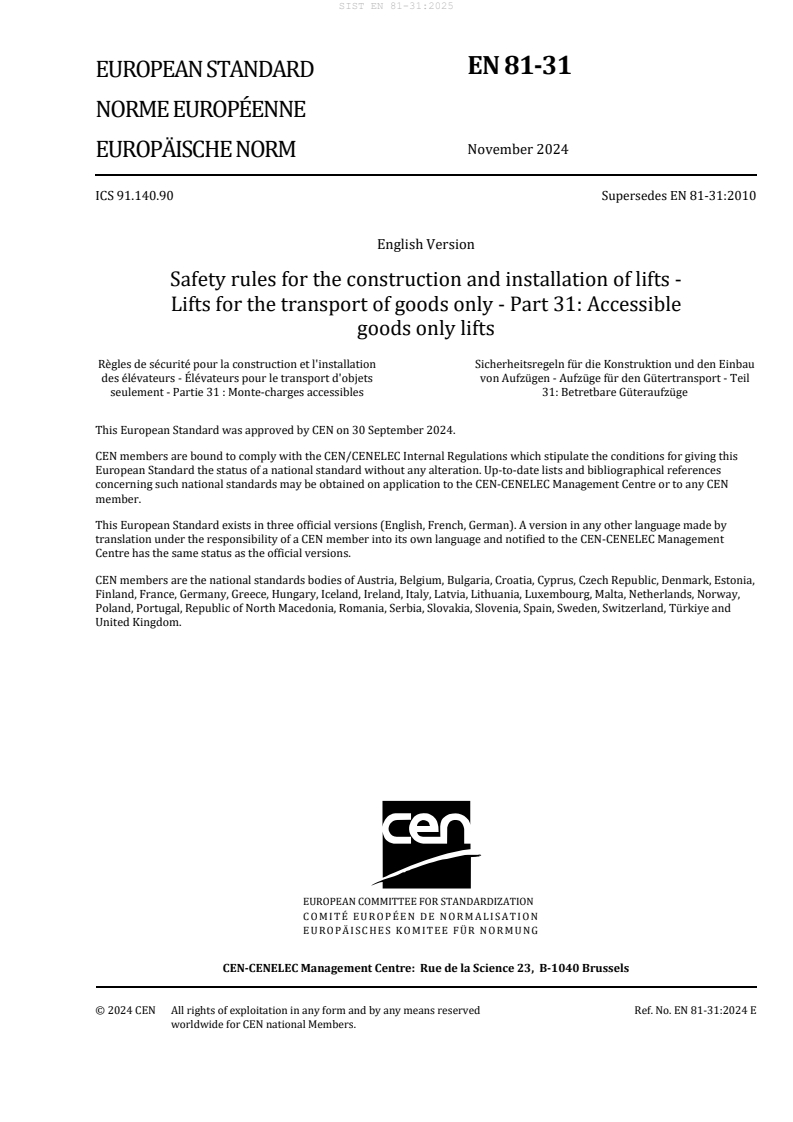
EN 81-31
EUROPEAN STANDARD
NORME EUROPÉENNE
November 2024
EUROPÄISCHE NORM
ICS 91.140.90 Supersedes EN 81-31:2010
English Version
Safety rules for the construction and installation of lifts -
Lifts for the transport of goods only - Part 31: Accessible
goods only lifts
Règles de sécurité pour la construction et l'installation Sicherheitsregeln für die Konstruktion und den Einbau
des élévateurs - Élévateurs pour le transport d'objets von Aufzügen - Aufzüge für den Gütertransport - Teil
seulement - Partie 31 : Monte-charges accessibles 31: Betretbare Güteraufzüge
This European Standard was approved by CEN on 30 September 2024.
CEN members are bound to comply with the CEN/CENELEC Internal Regulations which stipulate the conditions for giving this
European Standard the status of a national standard without any alteration. Up-to-date lists and bibliographical references
concerning such national standards may be obtained on application to the CEN-CENELEC Management Centre or to any CEN
member.
This European Standard exists in three official versions (English, French, German). A version in any other language made by
translation under the responsibility of a CEN member into its own language and notified to the CEN-CENELEC Management
Centre has the same status as the official versions.
CEN members are the national standards bodies of Austria, Belgium, Bulgaria, Croatia, Cyprus, Czech Republic, Denmark, Estonia,
Finland, France, Germany, Greece, Hungary, Iceland, Ireland, Italy, Latvia, Lithuania, Luxembourg, Malta, Netherlands, Norway,
Poland, Portugal, Republic of North Macedonia, Romania, Serbia, Slovakia, Slovenia, Spain, Sweden, Switzerland, Türkiye and
United Kingdom.
EUROPEAN COMMITTEE FOR STANDARDIZATION
COMITÉ EUROPÉEN DE NORMALISATION
EUROPÄISCHES KOMITEE FÜR NORMUNG
CEN-CENELEC Management Centre: Rue de la Science 23, B-1040 Brussels
© 2024 CEN All rights of exploitation in any form and by any means reserved Ref. No. EN 81-31:2024 E
worldwide for CEN national Members.
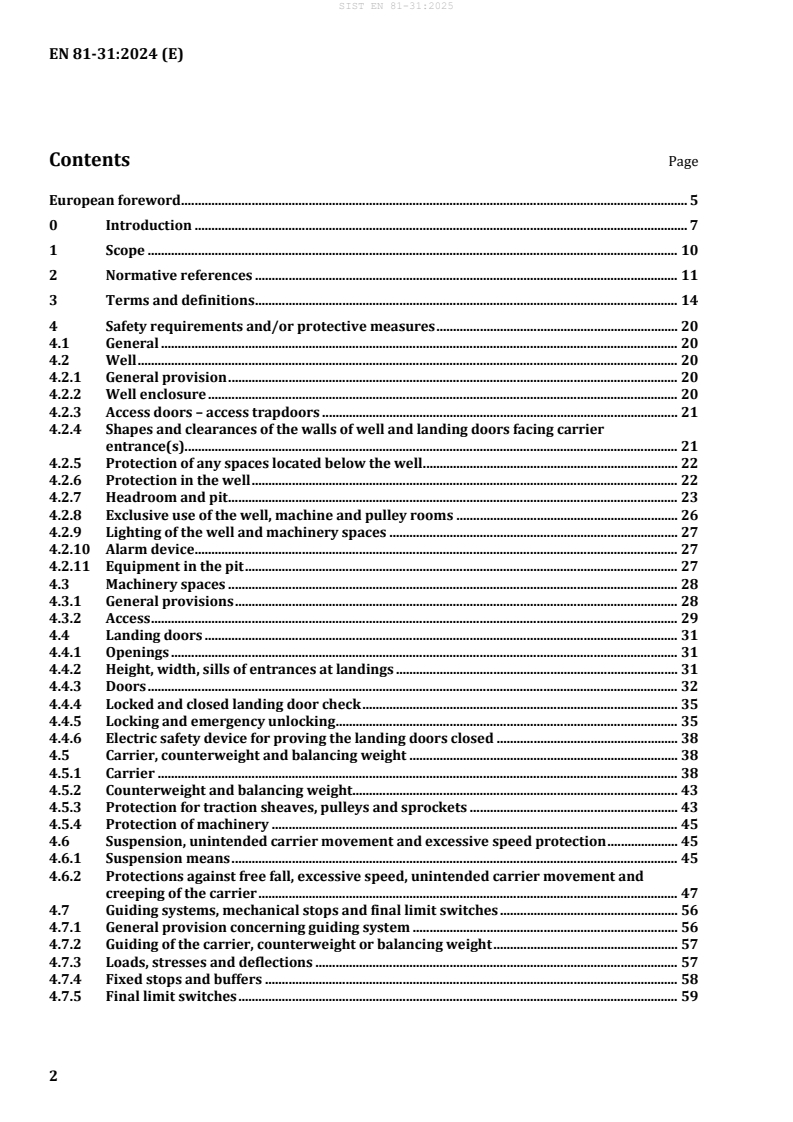
Contents Page
European foreword . 5
0 Introduction . 7
1 Scope . 10
2 Normative references . 11
3 Terms and definitions . 14
4 Safety requirements and/or protective measures . 20
4.1 General . 20
4.2 Well . 20
4.2.1 General provision . 20
4.2.2 Well enclosure . 20
4.2.3 Access doors – access trapdoors . 21
4.2.4 Shapes and clearances of the walls of well and landing doors facing carrier
entrance(s). 21
4.2.5 Protection of any spaces located below the well . 22
4.2.6 Protection in the well . 22
4.2.7 Headroom and pit . 23
4.2.8 Exclusive use of the well, machine and pulley rooms . 26
4.2.9 Lighting of the well and machinery spaces . 27
4.2.10 Alarm device . 27
4.2.11 Equipment in the pit . 27
4.3 Machinery spaces . 28
4.3.1 General provisions . 28
4.3.2 Access . 29
4.4 Landing doors . 31
4.4.1 Openings . 31
4.4.2 Height, width, sills of entrances at landings . 31
4.4.3 Doors . 32
4.4.4 Locked and closed landing door check . 35
4.4.5 Locking and emergency unlocking . 35
4.4.6 Electric safety device for proving the landing doors closed . 38
4.5 Carrier, counterweight and balancing weight . 38
4.5.1 Carrier . 38
4.5.2 Counterweight and balancing weight. 43
4.5.3 Protection for traction sheaves, pulleys and sprockets . 43
4.5.4 Protection of machinery . 45
4.6 Suspension, unintended carrier movement and excessive speed protection . 45
4.6.1 Suspension means . 45
4.6.2 Protections against free fall, excessive speed, unintended carrier movement and
creeping of the carrier . 47
4.7 Guiding systems, mechanical stops and final limit switches . 56
4.7.1 General provision concerning guiding system . 56
4.7.2 Guiding of the carrier, counterweight or balancing weight . 57
4.7.3 Loads, stresses and deflections . 57
4.7.4 Fixed stops and buffers . 58
4.7.5 Final limit switches . 59
4.8 Lift machine and associated equipment . 60
4.8.1 General provisions . 60
4.8.2 Lift machines for traction and positive drive . 60
4.8.3 Lift machine for hydraulic drive . 65
4.9 Electric installations and appliances . 75
4.9.1 General provision . 75
4.9.2 Contactors, contactor relays, components of safety circuits . 76
4.9.3 Protection of electrical equipment . 77
4.9.4 Main switches . 77
4.9.5 Electric wiring . 78
4.10 Protection against electric faults; failure analysis; controls; priorities . 80
4.10.1 Failure analysis and electric safety devices . 80
4.10.2 Controls; priorities . 85
5 Verification of the safety requirements and/or protective measures . 89
5.1 Verification and tests . 89
5.2 Verification of design . 90
5.3 Verification tests before putting into use . 107
6 Information for use . 107
6.1 General . 107
6.2 Notices, markings and operating instructions . 107
6.2.1 General provisions . 107
6.2.2 Rating plate . 107
6.2.3 Carrier . 108
6.2.4 Landings . 108
6.2.5 Machinery spaces . 108
6.2.6 Well . 109
6.2.7 Safety components . 109
6.2.8 Electrical identification . 110
6.2.9 Alarm device . 110
6.2.10 More than one lifts in one machine room . 110
6.2.11 Emergency lowering valve . 110
6.2.12 Hand pump . 110
6.2.13 Reduced headroom clearances . 110
6.2.14 Reduced clearances in the pit . 111
6.3 Instruction handbook . 112
6.3.1 General . 112
6.3.2 Minimum contents of the instruction handbook . 112
6.3.3 Verifications and tests . 117
6.3.4 Verifications and tests after accidents . 117
6.4 Logbook . 117
Annex A (normative) List of electric safety devices . 119
Annex B (informative) Technical documentation . 121
B.1 General . 121
B.2 Technical details and plans . 121
B.3 Electric diagrams and hydraulic diagrams . 122
Annex C (normative) Verifications and tests before putting into use . 123
C.1 General . 123
C.2 Tests and verifications . 123
C.3 Tests and verifications in case of reduced clearances in pit and/or headroom . 127
Annex D (informative) Periodical verifications and tests, verifications and tests after an
accident . 129
D.1 Periodical verifications and tests . 129
D.2 Verifications and tests after an accident . 129
Annex E (normative) Safety components and safety devices – Test procedures for
verification . 130
E.1 General provisions . 130
E.2 Landing door locking devices . 131
E.3 Safety gear . 135
E.4 Overspeed governor . 141
E.5 Safety circuits containing electronic components . 143
E.6 Rupture valve/one-way restrictor . 146
E.7 Buffers . 150
E.8 Pre-triggered stopping system . 153
Annex F (informative) Construction of walls of accessible goods only lift well and landing
doors facing a carrier entrance . 157
Annex G (normative) Calculations of rams, cylinders, rigid pipes and fittings . 158
G.1 Calculations against over pressure . 158
G.2 Calculations of the jacks against buckling . 159
Annex H (informative) Information to the user/owner of an accessible goods only lift . 164
H.1 General . 164
H.2 Means of access to machinery space entrance of the accessible goods only lift . 164
H.3 Maintenance work carried out from a step of a ladder . 164
Annex I (normative) Electronic components – Failure exclusion . 165
Annex J (normative) Headroom and pit . 172
J.1 General . 172
J.2 Reduced clearances in the headroom . 172
J.3 Reduced clearances in the pit . 177
Annex K (informative) Building interfaces . 182
K.1 General provisions . 182
K.2 Support of guide rails . 184
K.3 Ventilation of well and machinery spaces . 184
Annex L (informative) List of significant hazards . 186
Annex ZA (informative) Relationship between this European Standard and the essential
requirements of Directive 2006/42/EC aimed to be covered . 189
Bibliography . 195
European foreword
This document (EN 81-31:2024) has been prepared by Technical Committee CEN/TC 10 “Lifts, escalators
and moving walks”, the secretariat of which is held by AFNOR.
This European Standard shall be given the status of a national standard, either by publication of an
identical text or by endorsement, at the latest by May 2025 and conflicting national standards shall be
withdrawn at the latest by November 2026.
Attention is drawn to the possibility that some of the elements of this document may be the subject of
patent rights. CEN shall not be held responsible for identifying any or all such patent rights.
This document supersedes EN 81-31:2010.
The main changes with respect to the previous edition EN 81-31:2010 are listed below:
— Requirements have been updated, taking into account EN 81-20:2020, EN 81-50:2020 and
EN 81-21:2022. Specifically: definitions; strength of the doors, screens, partitions; unintended
carrier movement; refuge spaces; inspection operation; rope's retainers; balustrade; lighting.
— The scope has been amended. Specifically: excluded overlapping with EN 1570, by use of rigid guide
rails only; excluded scissor lifts; removed travel limit for Type A; non-addressed energy dissipation
type buffers.
— Requirements and verifications have been added for: refuge spaces; clamping devices; pawl devices;
automatic power operated doors; progressive safety gears.
— Improvements have been made for: dimensions of working areas; electrical equipment; emergency
electrical operation; performance levels; ropes and terminations; existing buildings; impact factors;
buffer with non-linear characteristics; alarm system.
— The reported errors have been eliminated. Specifically: hydraulic formulae;
— The text has been clarified. Specifically: pulley room; extreme position of the carrier in the well; use
in limited / not limited access area; ingress in / egress from the well;
— The references to other standards have been updated, according to the progress in that field. All
normatively referenced standards now are dated;
— Wording has been amended. Specifically: from “uncontrolled movement” to “unintended movement”;
from “manual operation” to “emergency operation”; from “safety space” to “refuge space”; from “load
carrying unit” to “carrier”; from “vendor” to “manufacturer”; from “laboratory” to “examiner”;
— The informative Annex “List of significant hazards” has been added;
— The informative Annex “Building interface” has been added;
— Annex ZA has been updated with regard to the European Commission mandate M/396.
This document has been prepared under a standardization request addressed to CEN by the European
Commission. The Standing Committee of the EFTA States subsequently approves these requests for its
Member States.
For the relationship with EU Legislation, see informative Annex ZA, which is an integral part of this
document.
This document is part of the EN 81 series of standards “Safety rules for the construction and installation
of lifts”. This is the second edition.
Any feedback and questions on this document should be directed to the users’ national standards body.
A complete listing of these bodies can be found on the CEN website.
According to the CEN-CENELEC Internal Regulations, the national standards organizations of the
following countries are bound to implement this European Standard: Austria, Belgium, Bulgaria, Croatia,
Cyprus, Czech Republic, Denmark, Estonia, Finland, France, Germany, Greece, Hungary, Iceland, Ireland,
Italy, Latvia, Lithuania, Luxembourg, Malta, Netherlands, Norway, Poland, Portugal, Republic of North
Macedonia, Romania, Serbia, Slovakia, Slovenia, Spain, Sweden, Switzerland, Türkiye and the United
Kingdom.
0 Introduction
0.1 General
This document is a type-C standard as stated in EN ISO 12100:2010.
This document is of relevance, in particular, for the following stakeholder groups representing the market
players with regard to machinery safety:
— machine manufacturers (small, medium and large enterprises);
— health and safety bodies (regulators, accident prevention organizations, market surveillance, etc.).
Others can be affected by the level of machinery safety achieved with the means of the document by the
above-mentioned stakeholder groups:
— machine users/employers (small, medium and large enterprises);
— machine users/employees (e.g. trade unions, organizations for people with special needs);
— service providers, e.g. for maintenance (small, medium and large enterprises);
— consumers (in case of machinery intended for use by consumers).
The above-mentioned stakeholder groups have been given the possibility to participate in the drafting
process of this document.
The accessible goods only lift installation concerned and the extent to which hazards, hazardous
situations and events are covered are indicated in the scope of this document.
When provisions of this type-C standard are different from those which are stated in type-A or -B
standards, the provisions of this type-C standard take precedence over the provisions of the other
standards, for machines that have been designed and built according to the provisions of this type-C
standard.
0.2 General provision
0.2.1 The object of this document is to define safety rules related to the construction and installation of
accessible goods only lifts, with a view to safeguarding persons and objects against the risk of accidents
associated with the use, inspection, maintenance and emergency operation of accessible goods only lifts.
a) Persons to be safeguarded:
1) users;
2) maintenance and inspection personnel;
3) persons at the landings of the accessible goods only lift and in the machinery space(s) and pulley
room(s), if any.
Within CEN/TC 10 an interpretation committee has been established to answer questions about the spirit in
which the experts have drafted the various clauses of this standard. All such interpretations are published
within CEN/TS 81-11:2011 until incorporated by amendment into the standards concerned.
b) Property to be safeguarded:
1) loads in carrier;
2) components of the accessible goods only lift installation;
3) building in which the accessible goods only lift is installed.
0.2.2 A study has been made of the various possible hazards concerning accessible goods only lifts, see
Annex L.
0.3 Principles used
0.3.1 This document does not repeat all the general technical rules applicable to every electrical,
mechanical, or building construction including the protection of building elements against fire.
It has, however, seemed necessary to establish certain requirements of good construction, either because
they are peculiar to accessible goods only lifts manufacture or because in the case of accessible goods
only lifts utilization the requirements may be more stringent than elsewhere.
0.3.2 As far as possible this document sets out only the requirements that materials and equipment
have to meet in the interests of safe operation of accessible goods only lifts.
0.3.3 This document considers a building that has characteristics in accordance with Annex K.
0.4 Assumption
0.4.1 Relevant risks have been considered for each component that may be incorporated in a complete
accessible goods only lift installation.
Rules have been drawn up accordingly.
Components are:
a) designed in accordance with usual engineering practice and calculation codes, taking into account all
failure modes;
b) of sound mechanical and electrical construction;
c) made of materials with adequate strength and of sound quality;
d) free of defects;
e) free from harmful materials, e.g. asbestos.
0.4.2 Components are selected and installed so that foreseeable environmental influences and special
working conditions do not affect the safe operation of the accessible goods only lift.
0.4.3 Users have to be safeguarded against their own negligence and unwitting carelessness when
using the accessible goods only lift in the intended way.
0.4.4 The accessible goods only lifts are not intended to transport persons inside the carrier.
0.4.5 With the exception of the items listed below, a mechanical device built according to good practice
and the requirements of this document will not deteriorate to a point of creating hazard without the
possibility of detection, provided that all of the instructions given by the manufacturer have been duly
applied.
The following mechanical failures are considered:
a) breakage of the suspension;
b) uncontrolled slipping of the ropes on the traction sheave;
c) breakage and slackening of all linkage by auxiliary ropes, chains and belts;
d) failure of one of the mechanical components of the machine brake which takes part in the application
of the braking action on the drum or disk;
e) failure of a component associated with the main drive elements and the traction sheave;
f) rupture in the hydraulic system (jack excluded);
g) small leakage in the hydraulic system (jack included).
0.4.6 The possibility of devices providing protection against free fall or descent with excessive speed
not engaging, should the carrier free fall from a stationary position at the lowest landing, before the
carrier strikes the buffer(s) or fixed stop(s) is considered acceptable.
0.4.7 When the speed of the carrier is linked to the electrical frequency of the mains, the speed is
assumed not to exceed 115 % of the rated speed or a corresponding lower speed where specified in this
document for inspection operation, re-levelling, emergency operation.
0.4.8 The location of the accessible goods only lift to be such that users using the accessible goods only
lift have means available to them, to access the different landing levels served, either a staircase or a
means for the transportation of persons.
1 Scope
1.1 This document specifies the safety rules for new accessible goods only lifts with traction, positive
or hydraulic drive, permanently installed and only used by users (see 3.57), serving fixed and permanent
landing levels, having a carrier made of a single load carrying area, designed for the transportation of
goods only, moving along a fixed path by rigid guide rails and inclined not more than 15° to the vertical,
with rated speed not exceeding 1 m/s.
This document covers accessible goods only lifts with rated load exceeding 300 kg and not intended to
transport persons.
1.2 For the purpose of this document, a goods only lift carrier is regarded as accessible where one of
the following conditions is satisfied:
a) floor area of the carrier is greater than 1,0 m ;
b) depth of the carrier is greater than 1,0 m;
c) clear height of the carrier is greater than 1,20 m.
In case the carrier is without a roof, it is considered accessible when the clear height of the landing doors
is greater than 1,20 m.
1.3 Two types of accessible goods only lifts are addressed:
a) Type A, where the intended use is bound to the maximum rated speed of 0,30 m/s;
b) Type B, where the intended use is bound to the maximum rated speed of 1,0 m/s.
1.4 In addition to the requirements of this document, supplementary requirements are to be
considered in special cases (operation subject to ATEX rules, operational in environmental conditions not
addressed by this standard, seismic conditions, transporting dangerous goods, etc.).
1.5 This document does not cover:
a) accessible goods only lifts:
1) with more than one lift machine;
2) where loading and unloading is automated, or the carrier floor is fitted with mobile devices (e.g.
rollers) for loading and unloading purposes;
3) intended to carry bulk loads (such as loose sand, gravel, etc.);
4) with drive systems other than those stated in 4.8;
b) lifting tables according to EN 1570-1 and EN 1570-2;
c) lifting appliances, such as appliances with more than one carrier, skips, goods only lifts for
construction sites, for underground applications, mine winding gear, goods only lifts on seagoing
vessels and mobile offshore units, construction and maintenance appliances in wind turbines, goods
only lifts specially designed and constructed for research purposes for temporary use in laboratories,
goods only lifts specially designed and constructed for military or police purposes;
d) safety during operation of transport, erection, repairs and dismantling of accessible goods only lifts;
e) the use of translucent material for the walls of the well and machinery spaces, for the carrier with
the exception of the landing doors vision panels;
f) the use of programmable electronic systems in safety related applications for lifts (PESSRAL);
g) hydraulic lifts where the setting of the pressure relief valve exceeds 50 MPa;
h) any form of radiation except EMC;
i) fire propagation;
j) energy dissipation type buffers;
k) the possibility of two simultaneous acts of imprudence and/or the abuse of instructions for use.
l) ambient temperature in the well and machinery spaces lower than +5 °C and higher than +40 °C;
m) health and safety of animals.
However, this document can usefully be taken as a basis.
Noise and vibrations are not dealt with in this document as they are not considered a significant nor
relevant hazard for the actual type of the accessible goods only lifts.
1.6 The requirements of this document are such that the possibility of a failure of an electric safety
device or a safety component complying with all the requirements of this document needs not to be taken
into consideration.
1.7 This document is not applicable to accessible goods only lifts which were manufactured before the
date of its publication as EN.
2 Normative references
The following documents are referred to in the text in such a way that some or all of their content
constitutes requirements of this document. For dated references, only the edition cited applies. For
undated references, the latest edition of the referenced document (including any amendments) applies.
EN 81-28:2022, Safety rules for the construction and installation of lifts — Lifts for the transport of persons
and goods — Part 28: Remote alarm on passenger and goods passenger lifts
EN 81-50:2020, Safety rules for the construction and installation of lifts — Examinations and tests —
Part 50: Design rules, calculations, examinations and tests of lift components
EN 1005-3:2002+A1:2008, Safety of machinery — Human physical performance — Part 3: Recommended
force limits for machinery operation
EN 10305-1:2016, Steel tubes for precision applications — Technical delivery conditions — Part 1:
Seamless cold drawn tubes
EN 10305-2:2016, Steel tubes for precision applications — Technical delivery conditions — Part 2: Welded
cold drawn tubes
EN 10305-3:2023, Steel tubes for precision applications — Technical delivery conditions — Part 3: Welded
cold sized tubes
EN 10305-4:2016, Steel tubes for precision applications — Technical delivery conditions — Part 4:
Seamless cold drawn tubes for hydraulic and pneumatic power systems
EN 10305-6:2016, Steel tubes for precision applications — Technical delivery conditions — Part 6: Welded
cold drawn tubes for hydraulic and pneumatic power systems
EN 12015:2020, Electromagnetic compatibility — Product family standard for lifts, escalators and moving
walks — Emission
EN 12016:2013, Electromagnetic compatibility — Product family standard for lifts, escalators and moving
walks — Immunity
EN 12385-4:2002+A1:2008, Steel wire ropes — Safety — Part 4: Stranded ropes for general lifting
applications
EN 12385-5:2021, Steel wire ropes — Safety — Part 5: Stranded ropes for lifts
EN 13015:2001+A1:2008, Maintenance for lifts and escalators — Rules for maintenance instructions
EN 13411-3:2022, Terminations for steel wire ropes — Safety — Part 3: Ferrules and ferrule-securing
EN 13411-5:2003+A1:2008, Terminations for steel wire ropes — Safety — Part 5: U-bolt wire rope grips
EN 13411-6:2004+A1:2008, Terminations for steel wire ropes — Safety — Part 6: Asymmetric wedge
socket
EN 13411-7:2021, Terminations for steel wire ropes — Safety — Part 7: Symmetric wedge socket
EN 13411-8:2011, Terminations for steel wire ropes — Safety — Part 8: Swage terminals and swaging
EN 13501-1:2018, Fire classification of construction products and building elements — Part 1:
Classification using data from reaction to fire tests
EN 50214:2006, Flat polyvinyl chloride sheathed flexible cables
EN 60068-2-6:2008, Environmental testing — Part 2-6: Tests — Test Fc: Vibration (sinusoidal)
EN 60068-2-27:2009, Environmental testing — Part 2-27: Tests — Test Ea and guidance: Shock
EN IEC 60112:2020, Method for the determination of the proof and the comparative tracking indices of solid
insulating materials (IEC 60112:2020)
EN 60204-1:2018, Safety of machinery — Electrical equipment of machines — Part 1: General requirements
EN 60529:1991, Degrees of protection provided by enclosures (IP code) (IEC 60529:1989)
EN IEC 60664-1:2020, Insulation coordination for equipment within low-voltage supply systems — Part 1:
Principles, requirements and tests (IEC 60664-1:2020)
EN 60947-5-1:2017, Low-voltage switchgear and controlgear — Part 5-1: Control circuit devices and
switching elements — Electromechanical control circuit devices (IEC 60947-5-1:2016)
As impacted by EN 50214:2006/Corrigendum Dec. 2007.
As impacted by EN 60529:1991/A2:2013.
As impacted by EN 60947-5-1:2017/AC:2020-05.
EN 60947-5-5:1997, Low-voltage switchgear and controlgear — Part 5-5: Control circuit devices and
switching elements — Electrical emergency stop device with mechanical latching function
(IEC 60947-5-5:1997)
EN 61310-3:2008, Safety of machinery — Indication, marking and actuation — Part 3: Requirements for
the location and operation of actuators (IEC 61310-3:2007)
EN 61800-5-2:2017, Adjustable speed electrical power drive systems — Part 5-2: Safety requirements —
Functional (IEC 61800-5-2:2016)
EN 61810-1:2015, Electromechanical elementary relays — Part 1: General and safety requirements
(IEC 61810-1:2015)
EN 61810-3:2015, Electromechanical elementary relays — Part 3: Relays with forcibly guided
(mechanically linked) contacts (IEC 61810-3:2015)
EN ISO 6743-4:2015, Lubricants, industrial oils and related products (class L) — Classification — Part 4:
Family H (Hydraulic systems) (ISO 6743-4:2015)
EN ISO 12100:2010, Safety of machinery — General principles for design — Risk assessment and risk
reduction (ISO 12100:2010)
EN ISO 13849-1:2023, Safety of machinery — Safety-related parts of control systems — Part 1: General
principles for design (ISO 13849-1:2023)
EN ISO 13857:2019, Safety of machinery — Safety distances to prevent hazard zones being reached by
upper and lower limbs (ISO 13857:2019)
EN IEC 60947-4-1:2019, Low-voltage switchgear and controlgear — Part 4-1: Contactors and motor-
starters — Electromechanical contactors and motor-starters (IEC 60947-4-1:2018)
HD 60364-6:2016, Low-voltage electrical installations — Part 6: Verification (IEC 60364-6:2016)
HD 60364-4-42:2011, Low voltage electrical installations — Part 4-42: Protection for safety — Protection
against thermal effects (IEC 60364-4-42:2010, modified)
ISO 1219-1:2012, Fluid power systems and components — Graphical symbols and circuit diagrams —
Part 1: Graphical symbols for conventional use and data-processing applications
IEC 60227-6:2001, Polyvinyl chloride insulated cables of rated voltages up to and including 450/750 V —
Part 6: Lift cables and cables for flexible connections
IEC 60617:2024, Graphical symbols for diagrams
As impacted by EN 60947-5-5:1997/A2:2017.
As impacted by EN 61810-1:2015/A1:2020.
As impacted by EN IEC 60947-4-1:2019/AC:2020-05 and EN IEC 60947-4-1:2019/AC:2021-04.
As impacted by HD 60364-4-42:2011/A11:2021.
3 Terms and definitions
For the purposes of this document, the terms and definitions given in EN ISO 12100:2010 and the
following apply.
ISO and IEC maintain terminology databases for use in standardization at the following addresses:
— IEC Electropedia: available at https://www.electropedia.org/
— ISO Online browsing platform: available at https://www.iso.org/obp/
3.1
accessible goods only lift
permanently installed lifting appliance intended for the transport of goods only, serving fixed and
permanent landing levels, comprising a carrier accessible for loading and unloading, running along a fixed
travel, inclined not more than 15° to the vertical, for use only by users (see 3.57)
3.2
apron
smooth vertical part extending downwards from the sill of the landing or carrier entrance
3.3
available carrier area
area of the carrier measured at floor level, available for goods during operation of the lift
3.4
balancing weight
mass which saves energy by balancing all or part of the mass of the carrier
3.5
buffer
resilient stop at the end of travel, and comprising a means of braking using fluids or springs (or other
similar means)
3.6
carrier
part of the accessible goods only lift which carries the load
3.7
clamping device
mechanical device which when activated stop
...