

SIST EN 81-41:2025
(Main)Safety rules for the construction and installation of lifts - Special lifts for the transport of persons and goods - Part 41: Vertical lifting platforms intended for use by persons with impaired mobility
General Information
- Abstract
1.1 This draft European Standard deals with safety requirements for construction, manufacturing, installation, maintenance and dismantling of electrically powered vertical lifting platforms affixed to a building structure intended for use by persons with impaired mobility:
- travelling vertically between predefined levels along a guided path whose inclination to the vertical does not exceed 15°;
- intended for use by persons with or without a wheelchair;
- supported or sustained by rack and pinion, rope traction drive, noncircular elastomeric-coated steel suspension members (hereafter called flat belt) traction drive, rope positive drive, chains, toothed belts, screw and nut, guided chain, scissors mechanism or hydraulic jack (direct or indirect);
- with enclosed liftways;
- with a speed not greater than 0,15 m/s;
- with platforms where the carrier is not completely enclosed.
1.2 This draft European Standard deals with all significant hazards relevant to lifting platforms, when they are used as intended and under the conditions foreseen by the manufacturer (see Clause 4).
1.3 This draft European Standard does not specify the additional requirements for:
- operation in severe conditions (e.g. extreme climates, strong magnetic fields);
- lightning protection;
- operation subject to special rules (e.g. potentially explosive atmospheres);
- handling of materials, the nature of which could lead to dangerous situations;
- vertical lifting platforms whose primary function is the transportation of goods;
- vertical lifting platforms whose carriers are completely enclosed;
- vertical lifting platforms prone to vandalism;
- hazards occurring during manufacture;
- earthquakes, flooding;
- firefighting, evacuation and behaviour during a fire;
- noise and vibrations;
- the design of concrete, hard core, timber or other foundation or building arrangement;
- the design of anchorage bolts to the supporting structure;
- type C wheelchairs as defined in EN 12183 and/or EN 12184.
NOTE For the actual type of machinery, noise is not considered a significant nor relevant hazard.
1.4 This draft European Standard is not applicable to Vertical Lifting Platforms intended for use by persons with impaired mobility which are manufactured before the date of its publication as an EN.
- Status
- Published
- Public Enquiry End Date
- 07-Aug-2016
- Publication Date
- 08-Apr-2025
- Technical Committee
- DTN - Lift and transport appliances
- Current Stage
- 6060 - National Implementation/Publication (Adopted Project)
- Start Date
- 04-Dec-2024
- Due Date
- 08-Feb-2025
- Completion Date
- 09-Apr-2025
- Directive
- 2006/42/EC - Directive 2006/42/EC of the European Parliament and of the Council of 17 May 2006 on machinery, and amending Directive 95/16/EC (recast)OJ Ref: 2025/1740, OJ L, OJ L 14.8.2025 OJ Date: 14-Aug-2025

Overview
SIST EN 81-41:2025 (aligned with EN 81-41:2024) specifies safety rules for the construction, installation, maintenance and dismantling of electrically powered vertical lifting platforms intended for use by persons with impaired mobility. The standard covers platforms affixed to a building that travel vertically along a guided path (inclination to the vertical ≤ 15°), with enclosed liftways, a maximum speed of 0.15 m/s, and carriers that are not completely enclosed. It applies to platforms used by people with or without wheelchairs and to a wide range of drive systems (rack & pinion, rope traction, flat belt, screw-and-nut, guided chain, scissors mechanism, hydraulic jack, etc.). SIST EN 81-41:2025 addresses all significant hazards when the equipment is used as intended and under manufacturer-foreseen conditions.
Key Topics and Requirements
- Scope & hazards: Defines intended use, limits (incl. speed, enclosure type) and excluded risks (extreme climates, explosive atmospheres, fire evacuation, earthquakes, vandalism, manufacture hazards, etc.).
- Carrier & enclosure requirements: Dimensions, mechanical strength, guarding, toe protection, sensitive edges, light curtains, and ventilation for safe operation and user accessibility.
- Drive systems & safety gear: Requirements for braking systems, overspeed protection, safety gears, and specific provisions for different drive methods (rack-and-pinion, rope, screw, hydraulic, scissors).
- Guide and support systems: Guide rails, horizontal clearances, tilting limits and materials to ensure stable, guided vertical travel.
- Electrical & control systems: Wiring, insulation, EMC, emergency alarms, battery supply, control devices and protective measures for electric/electronic safety devices.
- Landing doors & access: Construction, locking, emergency unlocking, protection during door operation and requirements for enclosed liftway entrances.
- Verification & testing: Design verification, functional and safety tests (overspeed devices, stopping devices, locking systems) and maintenance provisions.
- Exclusions: Not applicable to platforms manufactured before publication date or those whose primary function is goods transport or have completely enclosed carriers.
Practical Applications & Who Uses It
SIST EN 81-41:2025 is essential for:
- Lift manufacturers and designers specifying vertical lifting platforms for accessibility.
- Building architects and engineers integrating accessible vertical platforms into structures.
- Installers, maintenance and service providers following safe installation, inspection and maintenance procedures.
- Facility managers and building owners ensuring compliance and safe operation.
- Conformity assessors, safety inspectors and procurers who evaluate compliance with European lift safety rules.
Use cases include design and procurement of accessible lifts, risk assessment during installation, commissioning tests, routine maintenance procedures, and compliance documentation for accessibility and safety.
Related Standards
- Part of the EN 81 family (lift safety standards).
- References to wheelchair standards (EN 12183 / EN 12184) and other EN 81 parts for complementary requirements.
Relations
- Effective Date
- 25-Aug-2026
- Effective Date
- 25-Aug-2026
- Effective Date
- 09-Feb-2026
- Effective Date
- 09-Feb-2026
- Effective Date
- 09-Feb-2026
- Effective Date
- 09-Feb-2026
- Effective Date
- 09-Feb-2026
- Effective Date
- 09-Feb-2026
- Effective Date
- 09-Feb-2026
- Effective Date
- 09-Feb-2026
- Effective Date
- 09-Feb-2026
- Effective Date
- 09-Feb-2026
- Effective Date
- 09-Feb-2026
- Effective Date
- 09-Feb-2026
- Effective Date
- 09-Feb-2026
Get Certified
Connect with accredited certification bodies for this standard

BSI Group
BSI (British Standards Institution) is the business standards company that helps organizations make excellence a habit.

TÜV Rheinland
TÜV Rheinland is a leading international provider of technical services.

TÜV SÜD
TÜV SÜD is a trusted partner of choice for safety, security and sustainability solutions.
Sponsored listings
Frequently Asked Questions
SIST EN 81-41:2025 is a standard published by the Slovenian Institute for Standardization (SIST). Its full title is "Safety rules for the construction and installation of lifts - Special lifts for the transport of persons and goods - Part 41: Vertical lifting platforms intended for use by persons with impaired mobility". This standard covers: 1.1 This draft European Standard deals with safety requirements for construction, manufacturing, installation, maintenance and dismantling of electrically powered vertical lifting platforms affixed to a building structure intended for use by persons with impaired mobility: - travelling vertically between predefined levels along a guided path whose inclination to the vertical does not exceed 15°; - intended for use by persons with or without a wheelchair; - supported or sustained by rack and pinion, rope traction drive, noncircular elastomeric-coated steel suspension members (hereafter called flat belt) traction drive, rope positive drive, chains, toothed belts, screw and nut, guided chain, scissors mechanism or hydraulic jack (direct or indirect); - with enclosed liftways; - with a speed not greater than 0,15 m/s; - with platforms where the carrier is not completely enclosed. 1.2 This draft European Standard deals with all significant hazards relevant to lifting platforms, when they are used as intended and under the conditions foreseen by the manufacturer (see Clause 4). 1.3 This draft European Standard does not specify the additional requirements for: - operation in severe conditions (e.g. extreme climates, strong magnetic fields); - lightning protection; - operation subject to special rules (e.g. potentially explosive atmospheres); - handling of materials, the nature of which could lead to dangerous situations; - vertical lifting platforms whose primary function is the transportation of goods; - vertical lifting platforms whose carriers are completely enclosed; - vertical lifting platforms prone to vandalism; - hazards occurring during manufacture; - earthquakes, flooding; - firefighting, evacuation and behaviour during a fire; - noise and vibrations; - the design of concrete, hard core, timber or other foundation or building arrangement; - the design of anchorage bolts to the supporting structure; - type C wheelchairs as defined in EN 12183 and/or EN 12184. NOTE For the actual type of machinery, noise is not considered a significant nor relevant hazard. 1.4 This draft European Standard is not applicable to Vertical Lifting Platforms intended for use by persons with impaired mobility which are manufactured before the date of its publication as an EN.
1.1 This draft European Standard deals with safety requirements for construction, manufacturing, installation, maintenance and dismantling of electrically powered vertical lifting platforms affixed to a building structure intended for use by persons with impaired mobility: - travelling vertically between predefined levels along a guided path whose inclination to the vertical does not exceed 15°; - intended for use by persons with or without a wheelchair; - supported or sustained by rack and pinion, rope traction drive, noncircular elastomeric-coated steel suspension members (hereafter called flat belt) traction drive, rope positive drive, chains, toothed belts, screw and nut, guided chain, scissors mechanism or hydraulic jack (direct or indirect); - with enclosed liftways; - with a speed not greater than 0,15 m/s; - with platforms where the carrier is not completely enclosed. 1.2 This draft European Standard deals with all significant hazards relevant to lifting platforms, when they are used as intended and under the conditions foreseen by the manufacturer (see Clause 4). 1.3 This draft European Standard does not specify the additional requirements for: - operation in severe conditions (e.g. extreme climates, strong magnetic fields); - lightning protection; - operation subject to special rules (e.g. potentially explosive atmospheres); - handling of materials, the nature of which could lead to dangerous situations; - vertical lifting platforms whose primary function is the transportation of goods; - vertical lifting platforms whose carriers are completely enclosed; - vertical lifting platforms prone to vandalism; - hazards occurring during manufacture; - earthquakes, flooding; - firefighting, evacuation and behaviour during a fire; - noise and vibrations; - the design of concrete, hard core, timber or other foundation or building arrangement; - the design of anchorage bolts to the supporting structure; - type C wheelchairs as defined in EN 12183 and/or EN 12184. NOTE For the actual type of machinery, noise is not considered a significant nor relevant hazard. 1.4 This draft European Standard is not applicable to Vertical Lifting Platforms intended for use by persons with impaired mobility which are manufactured before the date of its publication as an EN.
SIST EN 81-41:2025 is classified under the following ICS (International Classification for Standards) categories: 11.180.10 - Aids and adaptation for moving; 91.140.90 - Lifts. Escalators. The ICS classification helps identify the subject area and facilitates finding related standards.
SIST EN 81-41:2025 has the following relationships with other standards: It is inter standard links to SIST ISO 6336-1:2020, SIST ISO 7000:2020, SIST EN IEC 61558-1:2019, SIST EN 60204-1:2018, SIST EN IEC 60747-5-5:2020, SIST EN 50214:2007, SIST EN 60529:1997/A1:2000, SIST EN IEC 60947-4-1:2019, SIST EN 62326-1:2003, SIST EN 60947-5-1:2018, SIST EN IEC 60664-1:2020, SIST EN 60529:1997, SIST EN 61800-5-2:2017, SIST EN 60529:1997/A2:2014, SIST EN 60204-32:2009. Understanding these relationships helps ensure you are using the most current and applicable version of the standard.
SIST EN 81-41:2025 is associated with the following European legislation: EU Directives/Regulations: 2006/42/EC; Standardization Mandates: M/396. When a standard is cited in the Official Journal of the European Union, products manufactured in conformity with it benefit from a presumption of conformity with the essential requirements of the corresponding EU directive or regulation.
SIST EN 81-41:2025 is available in PDF format for immediate download after purchase. The document can be added to your cart and obtained through the secure checkout process. Digital delivery ensures instant access to the complete standard document.
Standards Content (Sample)
SLOVENSKI STANDARD
01-maj-2025
Varnostna pravila za konstruiranje in vgradnjo dvigal (liftov) - Posebna dvigala za
prevoz oseb in blaga - 41. del: Navpične dvižne ploščadi za osebe z omejenimi
gibalnimi sposobnostmi
Safety rules for the construction and installation of lifts - Special lifts for the transport of
persons and goods - Part 41: Vertical lifting platforms intended for use by persons with
impaired mobility
Sicherheitsregeln für die Konstruktion und den Einbau von Aufzügen - Spezielle Aufzüge
für den Personen- und Gütertransport - Teil 41: Vertikale Plattformaufzüge für Personen
mit eingeschränkter Beweglichkeit
Règles de sécurité pour la construction et l'installation des élévateurs - Élévateurs
spéciaux pour le transport des personnes et des charges - Partie 41: Plates-formes
élévatrices verticales à l'usage des personnes à mobilité réduite
Ta slovenski standard je istoveten z: EN 81-41:2024
ICS:
11.180.10 Pripomočki in prilagoditve za Aids and adaptation for
gibanje moving
91.140.90 Dvigala. Tekoče stopnice Lifts. Escalators
2003-01.Slovenski inštitut za standardizacijo. Razmnoževanje celote ali delov tega standarda ni dovoljeno.
EN 81-41
EUROPEAN STANDARD
NORME EUROPÉENNE
November 2024
EUROPÄISCHE NORM
ICS 11.180.10; 91.140.90 Supersedes EN 81-41:2010
English Version
Safety rules for the construction and installation of lifts -
Special lifts for the transport of persons and goods - Part
41: Vertical lifting platforms intended for use by persons
with impaired mobility
Règles de sécurité pour la construction et l'installation Sicherheitsregeln für die Konstruktion und den Einbau
des élévateurs - Élévateurs spéciaux pour le transport von Aufzügen - Spezielle Aufzüge für den Personen-
des personnes et des charges - Partie 41: Plates-formes und Gütertransport - Teil 41: Vertikale
élévatrices verticales à l'usage des personnes à Plattformaufzüge für Personen mit eingeschränkter
mobilité réduite Beweglichkeit
This European Standard was approved by CEN on 2 September 2024.
CEN members are bound to comply with the CEN/CENELEC Internal Regulations which stipulate the conditions for giving this
European Standard the status of a national standard without any alteration. Up-to-date lists and bibliographical references
concerning such national standards may be obtained on application to the CEN-CENELEC Management Centre or to any CEN
member.
This European Standard exists in three official versions (English, French, German). A version in any other language made by
translation under the responsibility of a CEN member into its own language and notified to the CEN-CENELEC Management
Centre has the same status as the official versions.
CEN members are the national standards bodies of Austria, Belgium, Bulgaria, Croatia, Cyprus, Czech Republic, Denmark, Estonia,
Finland, France, Germany, Greece, Hungary, Iceland, Ireland, Italy, Latvia, Lithuania, Luxembourg, Malta, Netherlands, Norway,
Poland, Portugal, Republic of North Macedonia, Romania, Serbia, Slovakia, Slovenia, Spain, Sweden, Switzerland, Türkiye and
United Kingdom.
EUROPEAN COMMITTEE FOR STANDARDIZATION
COMITÉ EUROPÉEN DE NORMALISATION
EUROPÄISCHES KOMITEE FÜR NORMUNG
CEN-CENELEC Management Centre: Rue de la Science 23, B-1040 Brussels
© 2024 CEN All rights of exploitation in any form and by any means reserved Ref. No. EN 81-41:2024 E
worldwide for CEN national Members.
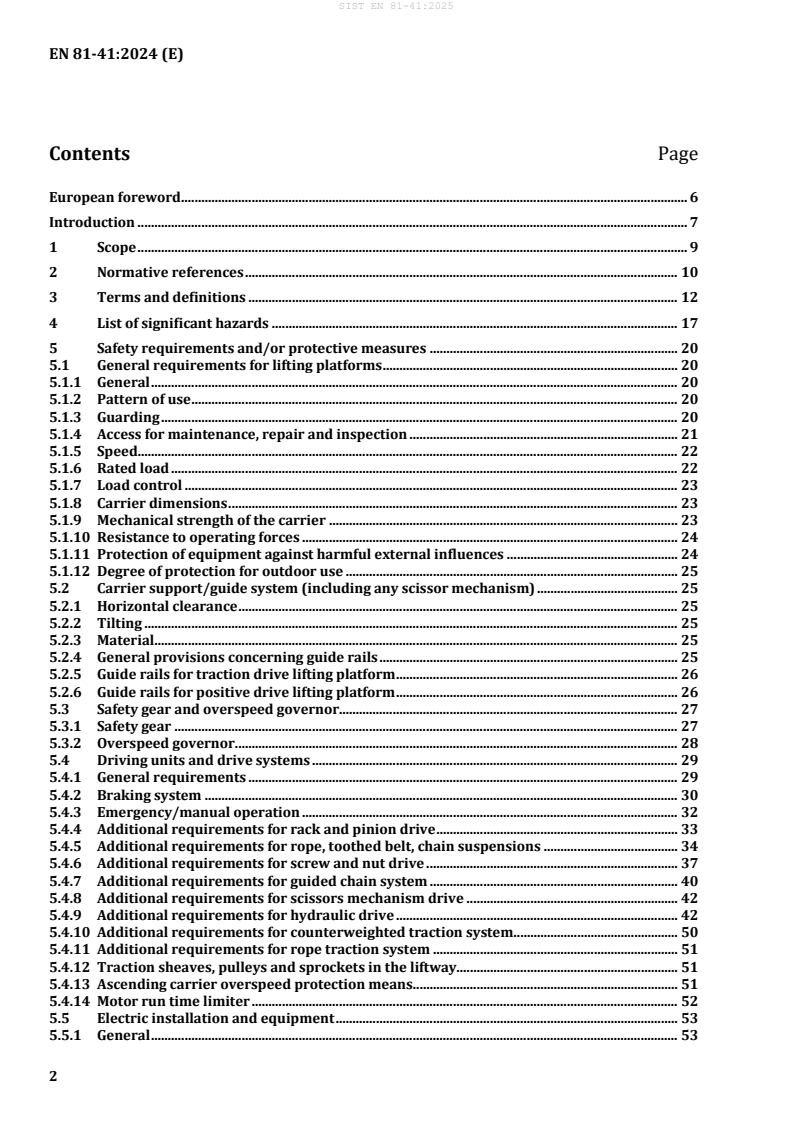
Contents Page
European foreword . 6
Introduction . 7
1 Scope . 9
2 Normative references . 10
3 Terms and definitions . 12
4 List of significant hazards . 17
5 Safety requirements and/or protective measures . 20
5.1 General requirements for lifting platforms . 20
5.1.1 General . 20
5.1.2 Pattern of use . 20
5.1.3 Guarding . 20
5.1.4 Access for maintenance, repair and inspection . 21
5.1.5 Speed. 22
5.1.6 Rated load . 22
5.1.7 Load control . 23
5.1.8 Carrier dimensions . 23
5.1.9 Mechanical strength of the carrier . 23
5.1.10 Resistance to operating forces . 24
5.1.11 Protection of equipment against harmful external influences . 24
5.1.12 Degree of protection for outdoor use . 25
5.2 Carrier support/guide system (including any scissor mechanism) . 25
5.2.1 Horizontal clearance . 25
5.2.2 Tilting . 25
5.2.3 Material . 25
5.2.4 General provisions concerning guide rails . 25
5.2.5 Guide rails for traction drive lifting platform . 26
5.2.6 Guide rails for positive drive lifting platform . 26
5.3 Safety gear and overspeed governor. 27
5.3.1 Safety gear . 27
5.3.2 Overspeed governor . 28
5.4 Driving units and drive systems . 29
5.4.1 General requirements . 29
5.4.2 Braking system . 30
5.4.3 Emergency/manual operation . 32
5.4.4 Additional requirements for rack and pinion drive . 33
5.4.5 Additional requirements for rope, toothed belt, chain suspensions . 34
5.4.6 Additional requirements for screw and nut drive . 37
5.4.7 Additional requirements for guided chain system . 40
5.4.8 Additional requirements for scissors mechanism drive . 42
5.4.9 Additional requirements for hydraulic drive . 42
5.4.10 Additional requirements for counterweighted traction system . 50
5.4.11 Additional requirements for rope traction system . 51
5.4.12 Traction sheaves, pulleys and sprockets in the liftway. 51
5.4.13 Ascending carrier overspeed protection means . 51
5.4.14 Motor run time limiter . 52
5.5 Electric installation and equipment . 53
5.5.1 General . 53
5.5.2 Conductors of different circuits . 54
5.5.3 Insulation resistance of the electric installation . 54
5.5.4 Lighting . 55
5.5.5 Socket outlet . 55
5.5.6 Drive contactors . 55
5.5.7 Electric supply to the motors. 56
5.5.8 Creepage and clearance distances and enclosure requirements . 56
5.5.9 Electromagnetic compatibility . 57
5.5.10 Protection against electric faults . 57
5.5.11 Electric/Electronic safety devices . 57
5.5.12 Protection of the driving motor . 61
5.5.13 Electric wiring . 62
5.5.14 Additional requirements for battery powered supply . 62
5.5.15 Control devices . 64
5.5.16 Emergency alarm devices . 66
5.5.17 Cable-less controls . 66
5.5.18 Control of inspection operation . 66
5.6 Specific requirements for lifting platform enclosures . 67
5.6.1 General . 67
5.6.2 Top clearance . 67
5.6.3 Risks for persons working in the liftway . 67
5.6.4 Enclosure construction . 68
5.6.5 Glass . 70
5.6.6 Inspection doors and traps . 71
5.6.7 Ventilation . 71
5.7 Fire protection . 71
5.8 Enclosed liftway entrances . 72
5.8.1 General . 72
5.8.2 Swing hinged landing doors . 72
5.8.3 Height of landing doors . 72
5.8.4 Construction of landing doors . 73
5.8.5 Door locking . 74
5.8.6 Emergency unlocking . 75
5.8.7 Protection during door operation . 76
5.9 Carrier . 76
5.9.1 Construction . 76
5.9.2 Sensitive edges, photocells and light curtains. . 76
5.9.3 Toe guard . 78
5.9.4 Floor covering . 78
5.9.5 Ceilings . 79
5.9.6 Control panel . 79
5.9.7 Handrail . 79
5.9.8 Glass . 79
5.9.9 Tip up seat . 79
5.9.10 Structure, floor, wall, ceiling and decorative materials. 79
6 Verification of safety requirements and/or protective measures . 80
6.1 Verification of design . 80
6.2 Verification tests . 83
6.2.1 Overspeed safety device . 83
6.2.2 Ascending overspeed protection . 83
6.2.3 Rupture valve/Restrictor . 83
6.2.4 Safety gear . 83
6.2.5 Self-sustaining system . 83
6.2.6 Stopping safety device . 83
6.2.7 Landing door locking devices . 84
6.2.8 Safety circuits containing electronic components . 84
6.2.9 Self-monitoring . 84
6.3 Verification tests on each vertical lifting platform before first use . 84
7 Information for use . 85
7.1 Introduction . 85
7.2 General . 85
7.3 Signals and warning devices . 85
7.3.1 Information to be displayed . 85
7.3.2 Rated load . 85
7.3.3 Function devices . 85
7.3.4 Emergency alarm device . 85
7.3.5 Disabled persons symbol . 85
7.4 Emergency manual operation . 86
7.5 Main electric switch . 86
7.6 Fragile roof . 86
7.7 No goods . 86
7.8 Operating instructions . 86
7.9 Accompanying documents (in particular: Instruction handbook) . 87
7.9.1 General . 87
7.9.2 Instruction manual . 89
7.9.3 Marking . 89
7.9.4 Building clearance requirements . 89
Annex A (normative) Electronic components: failure exclusion . 90
Annex B (informative) Guidance in selection of lifting platforms . 96
B.1 Introduction . 96
B.2 Selection of lifting platforms . 96
B.2.1 Suitability . 96
B.2.2 Control devices . 96
B.2.3 Location of the lifting platform . 96
B.2.4 Duty cycle . 97
B.3 Electric supply and lighting . 97
B.4 Maintenance . 97
Annex C (informative) Recommendations for the provisions and use of specially adapted
control devices, switches and sensors . 98
C.1 Control devices . 98
C.2 Assistance . 98
C.3 Specially adapted switches . 98
Annex D (informative) In-use periodic examination, tests and servicing . 99
D.1 Periodic examinations and tests . 99
D.2 Servicing . 99
Annex E (normative) Safety components – Tests procedures for verification of conformity . 100
E.1 General provisions . 100
E.2 Screw and nut (not self-sustaining system) stopping safety device . 100
E.2.1 General provisions . 100
E.2.2 Check on the characteristic of the stopping safety device . 100
E.2.3 Comments . 102
E.2.4 Test report . 103
E.3 Self-sustaining system . 103
Annex F (informative) Building interfaces . 104
F.1 General provisions . 104
F.2 Support of Guide Rails. 104
F.3 Ventilation of the enclosed liftway . 104
F.3.1 General . 104
F.3.2 Ventilation of the enclosed liftway . 105
Annex ZA (informative) Relationship between this European Standard and the essential
requirements of Directive 2006/42/EC aimed to be covered . 107
Bibliography . 111
European foreword
This document (EN 81-41:2024) has been prepared by Technical Committee CEN/TC 10 “Lifts,
escalators and moving walks”, the secretariat of which is held by AFNOR.
This European Standard shall be given the status of a national standard, either by publication of an
identical text or by endorsement, at the latest by May 2025, and conflicting national standards shall be
withdrawn at the latest by November 2026.
Attention is drawn to the possibility that some of the elements of this document may be the subject of
patent rights. CEN shall not be held responsible for identifying any or all such patent rights.
This document supersedes EN 81-41:2010.
This document constitutes a full revision of the standard. The main technical changes with respect to
EN 81-41:2010 are:
— requirement for a means for detection of a person on the carrier has been added;
— friction roller drive has been removed;
— traction drive requirements have been introduced;
— screw and nut drive requirements have been strengthened (inspection, safety nut, fixing
requirements);
— landing door lock release requirements have been revised;
— power door contact forces have been reduced;
— toothed belts drive has been added;
— use of the word “carrier” vs “platform” has been revised;
— all normative references to other standards have been dated;
— a new Annex ZA, including a detailed Table ZA.1, has been developed.
This document has been prepared under a Standardization Request given to CEN by the European
Commission and the European Free Trade Association, and supports essential requirements of EU
Directive(s).
For relationship with EU Directive(s), see informative Annex ZA, which is an integral part of this
document.
Any feedback and questions on this document should be directed to the users’ national standards body.
A complete listing of these bodies can be found on the CEN website.
According to the CEN-CENELEC Internal Regulations, the national standards organisations of the
following countries are bound to implement this European Standard: Austria, Belgium, Bulgaria,
Croatia, Cyprus, Czech Republic, Denmark, Estonia, Finland, France, Germany, Greece, Hungary, Iceland,
Ireland, Italy, Latvia, Lithuania, Luxembourg, Malta, Netherlands, Norway, Poland, Portugal, Republic of
North Macedonia, Romania, Serbia, Slovakia, Slovenia, Spain, Sweden, Switzerland, Türkiye and the
United Kingdom.
Introduction
The population of Europe is ageing and the prevalence of disability, including disability associated with
the ageing process, is increasing. Older people and people with disabilities at present are estimated to
number some 80 million people – a large and growing proportion of the European Union population.
The changing demography presents both opportunities and challenges for the Union. The economic,
social and cultural potential of older people and people with disabilities is underexploited at present.
However, there is a growing recognition that society needs to exploit this potential for the economic
and social benefit of society generally.
This is one of the reasons that led to this standard on vertical lifting platforms for people with impaired
mobility being one means to provide accessibility to buildings.
This standard is a type-C standard as stated in EN ISO 12100:2010.
This document is of relevance, in particular, for the following stakeholder groups representing the
market players with regard to machinery safety:
— machine manufacturers (small, medium and large enterprises);
— health and safety bodies (regulators, accident prevention organizations, market surveillance, etc.).
Others can be affected by the level of machinery safety achieved with the means of this document by the
above-mentioned stakeholder groups:
— machine users/employers (small, medium and large enterprises);
— machine users/employees (e.g. trade unions, organizations for people with special needs);
— service providers, e.g. for maintenance (small, medium and large enterprises);
— consumers (in case of machinery intended for use by consumers).
The above-mentioned stakeholder groups have been given the possibility to participate at the drafting
process of this document.
The machinery concerned and the extent to which hazards, hazardous situations or hazardous events
are covered are indicated in the Scope of this document.
When requirements of this type-C standard are different from those which are stated in type-A or type-
B standards, the requirements of this type-C standard take precedence over the requirements of the
other standards for machines that have been designed and built according to the requirements of this
type-C standard.
The lifting platforms defined in this standard are suitable for type-A and type-B wheelchairs as defined
in EN 12183:2022 and/or EN 12184:2022. The lifting platforms are equally suitable for persons either
with or without impaired mobility.
Those items relevant to lifting platforms referenced within EN 81-70:2021+A1:2022 have been
included within this standard.
This standard does not only address the essential health and safety requirements of the Machinery
Directive, but additionally states minimum rules for the installation of lifting platforms into
buildings/constructions. There may be additional national regulations for the construction of vertical
lifting platforms in building, in some countries which cannot be ignored.
It is essential that minimum passageways conform to national building regulations and are not
obstructed by any open door or trap and/or any protection means provided for working areas outside
of the enclosed liftway where fitted according to the maintenance instructions.
Assumptions
With the aim of clarifying the intentions of the standard and avoiding doubts when applying it, the
following assumptions were made when producing it:
a) Vertical lifting platforms are installed in both new and existing buildings.
b) Liftways contain only that equipment associated with a specific lifting platform. All counterweights
or balance weights are in the same liftway as the carrier.
c) Drive and control equipment is installed in a machinery space.
d) General hazards due to hydraulic, pneumatic, etc. equipment are dealt with according to relevant
B level standards for common use.
e) Components are kept in good repair and working order, in accordance with the maintenance
manual, so that the required characteristics remain despite wear.
f) To ensure the safe functioning, the operating temperature range of the equipment will take into
account the conditions of the place of use of the machinery, inside the maximum range of ambient
temperature between +5 °C and +40 °C. For very hot or cold environments extra requirements may
be necessary.
g) Negotiations have been made between the customer and the manufacturer about:
— environmental conditions;
— civil engineering conditions;
— other aspects related to the place of installation;
— the use and places of use of the machinery;
— the place of installation allows a safe use for the machine;
— any additional fire protection requirements;
— suitability for the user (see Annex B);
— pattern of use.
1 Scope
1.1 This document deals with safety requirements for construction, installation, maintenance and
dismantling of electrically powered vertical lifting platforms affixed to a building structure intended for
use by persons with impaired mobility:
— travelling vertically between predefined levels along a guided path whose inclination to the vertical
does not exceed 15°;
— intended for use by persons with or without a wheelchair;
— supported or sustained by rack and pinion, rope traction drive, traction drive, rope positive drive,
chains, toothed belts, screw and nut, guided chain, scissors mechanism or hydraulic jack (direct or
indirect);
— with enclosed liftways;
— with a rated speed not greater than 0,15 m/s;
— with carrier not completely enclosed.
1.2 This document deals with all significant hazards relevant to lifting platforms, when they are used as
intended and under the conditions foreseen by the manufacturer (see Clause 4).
Those hazards have been considered for each component that may be incorporated in a complete lift
installation and rules have been drawn up accordingly. Components are:
a) designed in accordance with the usual engineering practice and calculation codes, including all
failure modes;
b) of sound mechanical and electric construction.
1.3 This document does not specify the additional requirements for:
— operation in severe conditions (e.g. extreme climates, strong magnetic fields);
— lightning protection;
— operation subject to special rules (e.g. potentially explosive atmospheres);
— handling of materials, the nature of which could lead to dangerous situations;
— vertical lifting platforms whose primary function is the transportation of goods;
— vertical lifting platforms whose carriers are completely enclosed;
— vertical lifting platforms prone to vandalism;
— hazards occurring during manufacture;
— earthquakes, flooding;
— firefighting, evacuation and behaviour during a fire;
— noise and vibrations;
— the design of concrete, hard core, timber or other foundation or building arrangement;
— the design of anchorage bolts to the supporting structure;
— type C wheelchairs as defined in EN 12183:2022 and/or EN 12184:2022.
NOTE For the actual type of machinery, noise is not considered a significant nor relevant hazard.
1.4 This document is not applicable to vertical lifting platforms intended for use by persons with
impaired mobility which are manufactured before the date of its publication as an EN.
2 Normative references
The following documents are referred to in the text in such a way that some or all of their content
constitutes requirements of this document. For dated references, only the edition cited applies. For
undated references, the latest edition of the referenced document (including any amendments) applies.
EN 81-20:2020, Safety rules for the construction and installation of lifts - Lifts for the transport of persons
and goods - Part 20: Passenger and goods passenger lifts
EN 81-50:2020, Safety rules for the construction and installation of lifts - Examinations and tests - Part
50: Design rules, calculations, examinations and tests of lift components
EN 81-58:2022, Safety rules for the construction and installation of lifts - Examination and tests - Part 58:
Landing doors fire resistance test
EN 1993-1-1:2022, Eurocode 3 - Design of steel structures - Part 1-1: General rules and rules for buildings
EN 12015:2020, Electromagnetic compatibility - Product family standard for lifts, escalators and moving
walks - Emission
EN 12016:2013, Electromagnetic compatibility - Product family standard for lifts, escalators and moving
walks - Immunity
EN 12183:2022, Manual wheelchairs - Requirements and test methods
EN 12184:2022, Electrically powered wheelchairs, scooters and their chargers - Requirements and test
methods
EN 12385-5:2021, Steel wire ropes - Safety - Part 5: Stranded ropes for lifts
EN 12600:2002, Glass in building - Pendulum test - Impact test method and classification for flat glass
EN 13015:2001+A1:2008, Maintenance for lifts and escalators - Rules for maintenance instructions
EN 13411-3:2022, Terminations for steel wire ropes - Safety - Part 3: Ferrules and ferrule-securing
EN 13411-6:2004+A1:2008, Terminations for steel wire ropes - Safety - Part 6: Asymmetric wedge socket
EN 13411-7:2021, Terminations for steel wire ropes - Safety - Part 7: Symmetric wedge socket
EN 13411-8:2011, Terminations for steel wire ropes - Safety - Part 8: Swage terminals and swaging
EN 16005:2023+A1:2024, Power operated pedestrian doorsets - Safety in use - Requirements and test
methods
EN 50214:2006 , Flat polyvinyl chloride sheathed flexible cables
EN 60204-1:2018, Safety of machinery - Electrical equipment of machines - Part 1: General requirements
EN 60204-32:2008, Safety of machinery - Electrical equipment of machines - Part 32: Requirements for
hoisting machines
EN 60529:1991 , Degrees of protection provided by enclosures (IP Code) (IEC 60529:1989)
EN IEC 60664-1:2020, Insulation coordination for equipment within low-voltage supply systems - Part 1:
Principles, requirements and tests
EN IEC 60747-5-5:2020, Semiconductor devices - Part 5-5: Optoelectronic devices - Photocouplers
EN IEC 60947-4-1:2019, Low-voltage switchgear and controlgear - Part 4-1: Contactors and motor-
starters - Electromechanical contactors and motor-starters
EN 60947-5-1:2017 , Low-voltage switchgear and controlgear — Part 5-1: Control circuit devices and
switching elements — Electromechanical control circuit devices (IEC 60947-5-1:2016)
EN IEC 61558-1:2019, Safety of transformers, reactors, power supply units and combinations thereof -
Part 1: General requirements and tests
EN 61800-5-2:2017, Adjustable speed electrical power drive systems - Part 5-2: Safety requirements -
Functional
EN 62326-1:2002, Printed boards - Part 1: Generic specification
EN ISO 7010:2020, Graphical symbols - Safety colours and safety signs - Registered safety signs (ISO
7010:2019, Corrected version 2020-06)
EN ISO 12100:2010, Safety of machinery - General principles for design - Risk assessment and risk
reduction (ISO 12100:2010)
EN ISO 13850:2015, Safety of machinery - Emergency stop function - Principles for design (ISO
13850:2015)
EN ISO 13854:2019, Safety of machinery - Minimum gaps to avoid crushing of parts of the human body
(ISO 13854:2017)
EN ISO 13857:2019, Safety of machinery - Safety distances to prevent hazard zones being reached by
upper and lower limbs (ISO 13857:2019)
EN ISO 14120:2015, Safety of machinery - Guards - General requirements for the design and construction
of fixed and movable guards (ISO 14120:2015)
This document is impacted by EN 50214:2006/Corrigendum Dec. 2007.
This document is impacted by EN 60529:1991/A1:2000, EN 60529:1991/A2:2013 and EN
60529:1991/AC:2016.
This document is impacted by EN 60947-5-1:2017/AC:2020.
ISO 606:2015, Short-pitch transmission precision roller and bush chains, attachments and associated
chain sprockets
ISO 6336-1:2019, Calculation of load capacity of spur and helical gears — Part 1: Basic principles,
introduction and general influence factors
ISO 7000:2019, Graphical symbols for use on equipment — Registered symbols
ISO 13050:2022, Synchronous belt drives — Metric pitch, curvilinear profile systems G, H, R and S, belts
and pulleys
IEC 60417:2024, Graphical symbols for use on equipment
3 Terms and definitions
For the purposes of this document, the terms and definitions given in EN ISO 12100:2010 and the
following apply.
ISO and IEC maintain terminological databases for use in standardization at the following addresses:
— ISO Online browsing platform: available at https://www.iso.org/obp
— IEC Electropedia: available at https://www.electropedia.org/
3.1
balancing weight
mass which saves energy by balancing all or part of the mass of the unloaded carrier
3.2
carrier
part of the lifting platform by which persons are supported in order to be lifted or lowered
3.3
competent person
person, suitably trained and qualified by knowledge and practical experience, and provided with the
necessary instructions to enable the required work
...