


oSIST prEN ISO 25712:2025
(Main)Chemicals for the leather tanning industry - Determination of the total content of melamine (ISO/DIS 25712:2025)
Chemicals for the leather tanning industry - Determination of the total content of melamine (ISO/DIS 25712:2025)
This document specifies a method for the determination of melamine in chemicals used in the tanning industry
Chemikalien für die Ledergerbereiindustrie - Bestimmung des Gesamtmelamingehalts (ISO/DIS 25712:2025)
Produits chimiques pour l'industrie du tannage du cuir - Détermination de la teneur totale en mélamine (ISO/DIS 25712:2025)
Kemikalije za industrijo strojenja usnja - Določevanje celotne vsebnosti melamina (ISO/DIS 25712:2025)
General Information
- Status
- Not Published
- Public Enquiry End Date
- 30-Jul-2025
- Technical Committee
- IUSN - Leather
- Current Stage
- 4020 - Public enquire (PE) (Adopted Project)
- Start Date
- 16-Jun-2025
- Due Date
- 03-Nov-2025
- Completion Date
- 04-Aug-2025
Overview
oSIST prEN ISO 25712:2025 is a forthcoming international standard specifying the determination of total melamine content in chemicals used for the leather tanning industry. Set for release in 2025 by CEN in collaboration with ISO and IULTCS, it establishes a reliable, validated method leveraging liquid chromatography (LC) coupled with advanced detection systems such as LC-MS/MS, LC-MS, LC-UV, and LC-DAD. This standard aims to ensure the accurate analysis of melamine residues in tanning chemicals, vital for regulatory compliance and quality control within leather manufacturing.
Melamine, often present as a residual monomer in melamine-formaldehyde resins used during the retanning process, is a substance of high regulatory concern due to its classification by the European Chemicals Agency (ECHA) as a Substance of Very High Concern (SVHC) and suspected carcinogen. The standardization of its quantitative determination is essential for managing potential health and environmental risks.
Key Topics
Scope and Purpose: Defines methods to measure solvent-extractable melamine in tanning industry chemicals, supporting safety and regulatory monitoring.
Analytical Principle: Uses extraction in a 50:50 acetonitrile-water solvent followed by chromatographic separation. Two approaches include:
- Hydrophilic Interaction Liquid Chromatography (HILIC) for high polar substance separation
- Reversed-phase chromatography (C8 or C18 columns) as an alternative for broader laboratory applicability
Instrumentation:
- Liquid Chromatography coupled with Triple Quadrupole Mass Spectrometry (LC-MS/MS) for high sensitivity
- Alternative detection methods: standard LC-MS, ultraviolet (UV), or diode array detector (DAD) options
Sample Preparation: Standardized extraction and dissolution processes to ensure solubility and representative sampling of melamine.
Reagents and Calibration: Specifications for reagent grades, preparation of mobile phases and calibration solutions, including internal standards to correct for matrix effects.
Precision and Reporting: Method validation parameters and guidance on how to calculate melamine concentration and document results.
Applications
Leather Tanning Industry: Ensures chemicals used in retanning stages adhere to safety standards regarding melamine content.
Regulatory Compliance: Supports conformity with EU regulations concerning persistent and toxic substances and aids in meeting ECHA requirements.
Quality Assurance Laboratories: Laboratories testing chemical formulations can use this standard for routine analysis and certification.
Environmental and Health Monitoring: Facilitates risk assessment and control of melamine exposure in industrial processes.
Related Standards
ISO/DIS 25712:2025 integrates with broader leather industry chemical testing methods developed by IULTCS.
EU Chemical Regulations: Complements frameworks such as REACH and ECHA candidate listing requirements on substances of very high concern.
Liquid Chromatography Standards: Relies on general LC method validation and reagent standards compliant with ISO and IEC norms for physicochemical analysis.
Other Leather Testing Standards: Aligns with CEN/TC 289 leather and leather products standards to ensure comprehensive quality and safety assessments.
By adopting oSIST prEN ISO 25712:2025, stakeholders within the leather tanning ecosystem can employ a standardized, scientifically rigorous approach to monitor melamine content in processing chemicals, reinforcing safe production practices and regulatory adherence globally.

Frequently Asked Questions
oSIST prEN ISO 25712:2025 is a draft published by the Slovenian Institute for Standardization (SIST). Its full title is "Chemicals for the leather tanning industry - Determination of the total content of melamine (ISO/DIS 25712:2025)". This standard covers: This document specifies a method for the determination of melamine in chemicals used in the tanning industry
This document specifies a method for the determination of melamine in chemicals used in the tanning industry
oSIST prEN ISO 25712:2025 is classified under the following ICS (International Classification for Standards) categories: 59.140.10 - Processes and auxiliary materials; 71.040.50 - Physicochemical methods of analysis. The ICS classification helps identify the subject area and facilitates finding related standards.
oSIST prEN ISO 25712:2025 is available in PDF format for immediate download after purchase. The document can be added to your cart and obtained through the secure checkout process. Digital delivery ensures instant access to the complete standard document.
Standards Content (Sample)
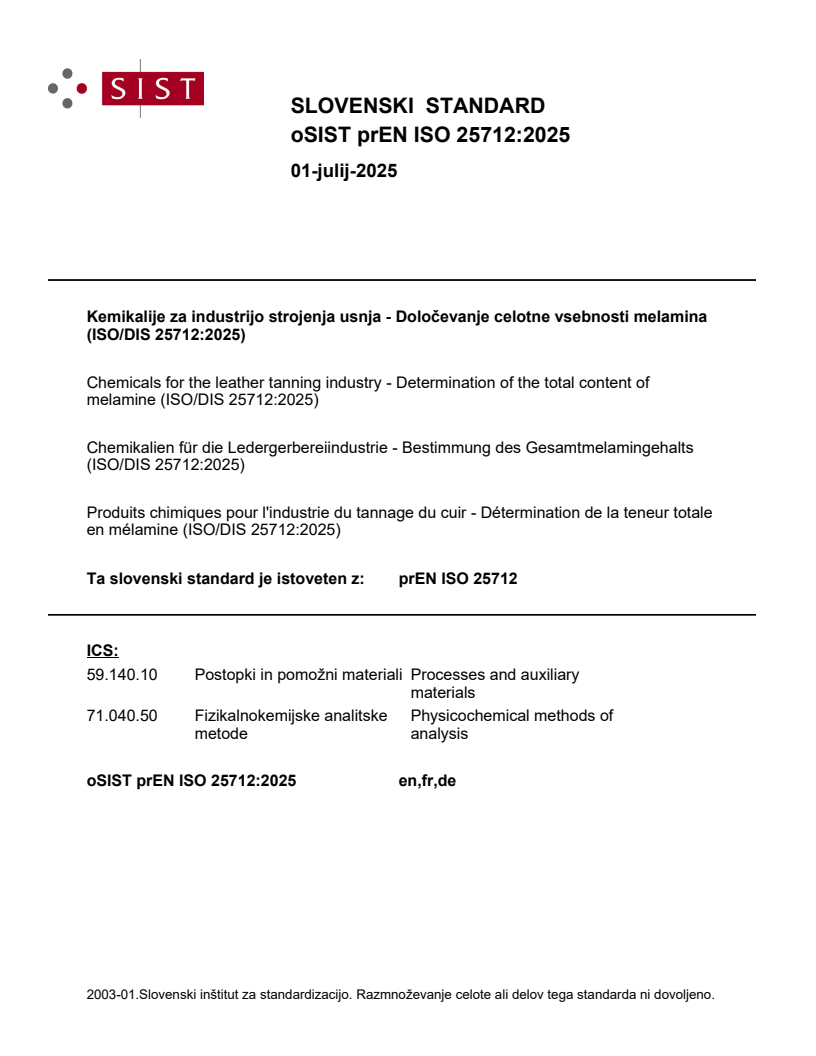
SLOVENSKI STANDARD
01-julij-2025
Kemikalije za industrijo strojenja usnja - Določevanje celotne vsebnosti melamina
(ISO/DIS 25712:2025)
Chemicals for the leather tanning industry - Determination of the total content of
melamine (ISO/DIS 25712:2025)
Chemikalien für die Ledergerbereiindustrie - Bestimmung des Gesamtmelamingehalts
(ISO/DIS 25712:2025)
Produits chimiques pour l'industrie du tannage du cuir - Détermination de la teneur totale
en mélamine (ISO/DIS 25712:2025)
Ta slovenski standard je istoveten z: prEN ISO 25712
ICS:
59.140.10 Postopki in pomožni materiali Processes and auxiliary
materials
71.040.50 Fizikalnokemijske analitske Physicochemical methods of
metode analysis
2003-01.Slovenski inštitut za standardizacijo. Razmnoževanje celote ali delov tega standarda ni dovoljeno.
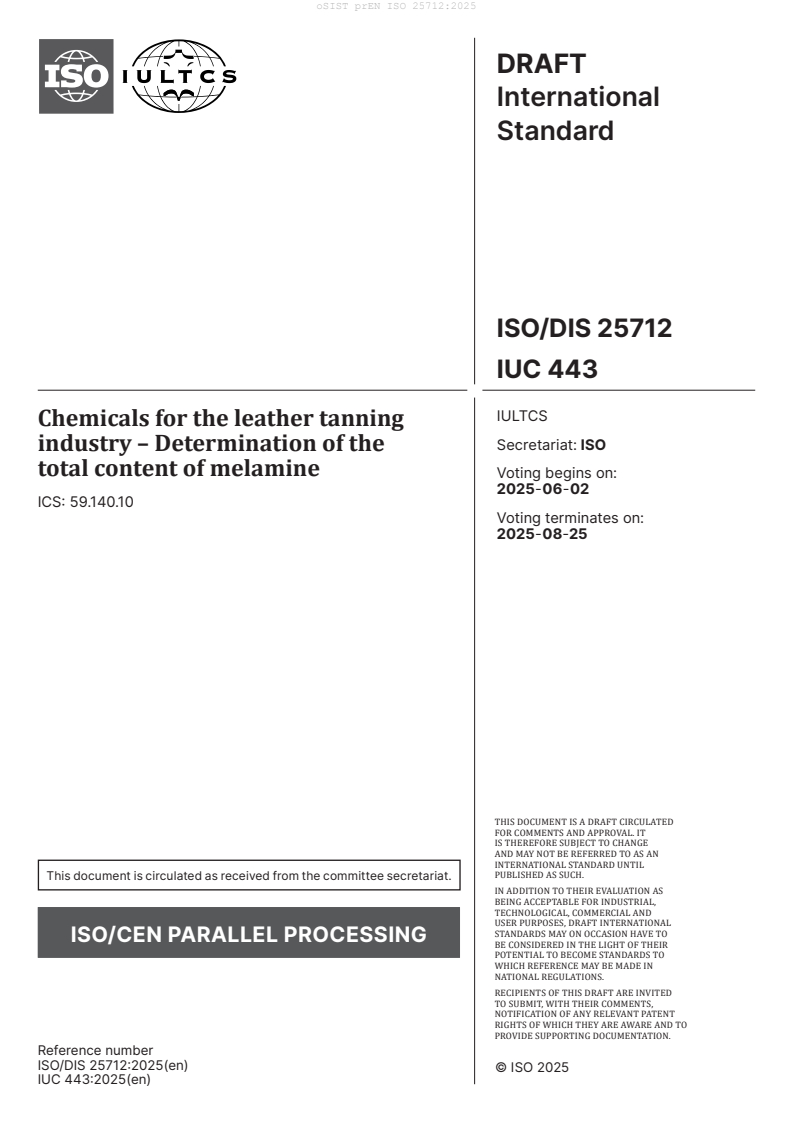
DRAFT
International
Standard
ISO/DIS 25712
IUC 443
IULTCS
Chemicals for the leather tanning
Secretariat: ISO
industry – Determination of the
total content of melamine
Voting begins on:
2025-06-02
ICS: 59.140.10
Voting terminates on:
2025-08-25
THIS DOCUMENT IS A DRAFT CIRCULATED
FOR COMMENTS AND APPROVAL. IT
IS THEREFORE SUBJECT TO CHANGE
AND MAY NOT BE REFERRED TO AS AN
INTERNATIONAL STANDARD UNTIL
PUBLISHED AS SUCH.
This document is circulated as received from the committee secretariat.
IN ADDITION TO THEIR EVALUATION AS
BEING ACCEPTABLE FOR INDUSTRIAL,
TECHNOLOGICAL, COMMERCIAL AND
USER PURPOSES, DRAFT INTERNATIONAL
STANDARDS MAY ON OCCASION HAVE TO
ISO/CEN PARALLEL PROCESSING
BE CONSIDERED IN THE LIGHT OF THEIR
POTENTIAL TO BECOME STANDARDS TO
WHICH REFERENCE MAY BE MADE IN
NATIONAL REGULATIONS.
RECIPIENTS OF THIS DRAFT ARE INVITED
TO SUBMIT, WITH THEIR COMMENTS,
NOTIFICATION OF ANY RELEVANT PATENT
RIGHTS OF WHICH THEY ARE AWARE AND TO
PROVIDE SUPPORTING DOCUMENTATION.
Reference number
ISO/DIS 25712:2025(en)
IUC 443:2025(en)
DRAFT
ISO/DIS 25712:2025(en)
International
Standard
ISO/DIS 25712
IUC 443
IULTCS
Chemicals for the leather tanning
Secretariat: ISO
industry – Determination of the
total content of melamine
Voting begins on:
ICS: 59.140.10
Voting terminates on:
THIS DOCUMENT IS A DRAFT CIRCULATED
FOR COMMENTS AND APPROVAL. IT
IS THEREFORE SUBJECT TO CHANGE
AND MAY NOT BE REFERRED TO AS AN
INTERNATIONAL STANDARD UNTIL
PUBLISHED AS SUCH.
This document is circulated as received from the committee secretariat.
IN ADDITION TO THEIR EVALUATION AS
BEING ACCEPTABLE FOR INDUSTRIAL,
© ISO 2025
TECHNOLOGICAL, COMMERCIAL AND
USER PURPOSES, DRAFT INTERNATIONAL
All rights reserved. Unless otherwise specified, or required in the context of its implementation, no part of this publication may
STANDARDS MAY ON OCCASION HAVE TO
ISO/CEN PARALLEL PROCESSING
be reproduced or utilized otherwise in any form or by any means, electronic or mechanical, including photocopying, or posting on
BE CONSIDERED IN THE LIGHT OF THEIR
the internet or an intranet, without prior written permission. Permission can be requested from either ISO at the address below
POTENTIAL TO BECOME STANDARDS TO
WHICH REFERENCE MAY BE MADE IN
or ISO’s member body in the country of the requester.
NATIONAL REGULATIONS.
ISO copyright office
RECIPIENTS OF THIS DRAFT ARE INVITED
CP 401 • Ch. de Blandonnet 8
TO SUBMIT, WITH THEIR COMMENTS,
CH-1214 Vernier, Geneva
NOTIFICATION OF ANY RELEVANT PATENT
Phone: +41 22 749 01 11
RIGHTS OF WHICH THEY ARE AWARE AND TO
PROVIDE SUPPORTING DOCUMENTATION.
Email: copyright@iso.org
Website: www.iso.org
Reference number
Published in Switzerland ISO/DIS 25712:2025(en)
IUC 443:2025(en)
ii
ISO/DIS 25712:2025(en)
IUC 443:2025(en)
Contents Page
Foreword .iv
Introduction .v
1 Scope . 1
2 Normative references . 1
3 Terms and definitions . 1
4 Principle . 1
5 Apparatus . 1
6 Reagents . 2
7 Sampling and sample preparation . 4
8 Procedure . 4
8.1 Extraction .4
8.2 Instrumental analysis .4
9 Expression of results . 5
9.1 Calculation without internal standard .5
9.2 Calculation with internal standard .5
10 Precision . 6
11 Test report . 6
Annex A (informative) Chromatographic analysis operating parameters for LC-MS/MS . 7
Annex B (informative) Chromatographic analysis operating parameters for LC-UV or LC-DAD . 9
Annex C (informative) Precision . 10
Bibliography .11
iii
ISO/DIS 25712:2025(en)
IUC 443:2025(en)
Foreword
ISO (the International Organization for Standardization) is a worldwide federation of national standards
bodies (ISO member bodies). The work of preparing International Standards is normally carried out through
ISO technical committees. Each member body interested in a subject for which a technical committee
has been established has the right to be represented on that committee. International organizations,
governmental and non-governmental, in liaison with ISO, also take part in the work. ISO collaborates closely
with the International Electrotechnical Commission (IEC) on all matters of electrotechnical standardization.
The procedures used to develop this document and those intended for its further maintenance are described
in the ISO/IEC Directives, Part 1. In particular, the different approval criteria needed for the different types
of ISO documents should be noted. This document was drafted in accordance with the editorial rules of the
ISO/IEC Directives, Part 2 (see www.iso.org/directives).
ISO draws attention to the possibility that the implementation of this document may involve the use of (a)
patent(s). ISO takes no position concerning the evidence, validity or applicability of any claimed patent
rights in respect thereof. As of the date of publication of this document, ISO had not received notice of (a)
patent(s) which may be required to implement this document. However, implementers are cautioned that
this may not represent the latest information, which may be obtained from the patent database available at
www.iso.org/patents. ISO shall not be held responsible for identifying any or all such patent rights.
Any trade name used in this document is information given for the convenience of users and does not
constitute an endorsement.
For an explanation of the voluntary nature of standards, the meaning of ISO specific terms and expressions
related to conformity assessment, as well as information about ISO's adherence to the World Trade
Organization (WTO) principles in the Technical Barriers to Trade (TBT), see www.iso.org/iso/foreword.html.
IULTCS, originally formed in 1897, is a world-wide organization of professional leather societies to further
the advancement of leather science and technology. IULTCS has three Commissions, which are responsible
for establishing international methods for the sampling and testing of leather. ISO recognizes IULTCS as an
international standardizing body for the preparation of test methods for leather.
This document was prepared by the Chemical Test Commission of the International Union of Leather
Technologists and Chemists Societies (IUC Commission, IULTCS), in collaboration with the European
Committee for Standardization (CEN) Technical Committee CEN/TC 289, Leather, in accordance with the
Agreement on technical cooperation between ISO and CEN (Vienna Agreement).
Any feedback or questions on this document should be directed to the user’s national standards body. A
complete listing of these bodies can be found at www.iso.org/members.html.
iv
ISO/DIS 25712:2025(en)
IUC 443:2025(en)
Introduction
This document includes a procedure for analysing melamine in leather tanning chemicals using liquid
chromatography (LC) equipment.
In the leather industry, melamine can be present as a residual monomer in resins based on the polymerisation
of melamine, where melamine-formaldehyde resin is the more typical. This type of resin is present in
chemical products such as melamine-formaldehyde resin or compound products and is used in the retanning
stage of the tanning process.
At present, the official European Chemicals Agency (ECHA) classification recognized in the European Union
(EU) for Melamine is the following:
[1]
— Substance of very high concern (SVHC) and included in the candidate list for authorisation ;
[2]
— Suspected to be Carcinogenic ;
[2]
— Under assessment as Persistent, Bioaccumulative and Toxic ;
[2]
— Under assessment as Endocrine Disrupting .
v
ISO/DIS 25712:2025(en)
DRAFT International Standard
IUC 443:2025(en)
Chemicals for the leather tanning industry – Determination of
the total content of melamine
1 Scope
This document specifies a method for determining the total content (solvent extractable) of melamine in
chemicals for the leather tanning industry.
This method requires the use of liquid chromatography (LC) with a triple quadrupole mass spectrometer
(MS/MS), an ultraviolet (UV) detector, or diode array detector (DAD) to identify and quantify the melamine.
2 Normative references
There are no normative references in this document.
3 Terms and definitions
No terms and definitions are listed in this document.
ISO and IEC maintain terminology databases for use in standardization at the following addresses:
— ISO Online browsing platform: available at https:// www .iso .org/ obp
— IEC Electropedia: available at https:// www .electropedia .org/
4 Principle
The chemical sample is extracted in a 50:50 (v/v) mixture of acetonitrile and water. Subsequently, an aliq
...
Questions, Comments and Discussion
Ask us and Technical Secretary will try to provide an answer. You can facilitate discussion about the standard in here.
Loading comments...