


kSIST FprEN IEC 63223-1:2026
(Main)Management of network assets in power systems - Part 1: Overview, principles and terminology
Management of network assets in power systems - Part 1: Overview, principles and terminology
Management von Betriebsmitteln und Anlagen in elektrischen Energieversorgungssystemen - Überblick, Grundsätze und Terminologie
Gestion des actifs des réseaux d’énergie électrique - Aperçu général, principes et terminologie
Upravljanje omrežnih sredstev v elektroenergetskih sistemih - 1. del: Pregled, načela in terminologija
General Information
- Status
- Not Published
- Public Enquiry End Date
- 31-Jul-2025
- Technical Committee
- I11 - Imaginarni 11
- Current Stage
- 5020 - Formal vote (FV) (Adopted Project)
- Start Date
- 23-Feb-2026
- Due Date
- 13-Apr-2026
- Completion Date
- 27-Feb-2026
Overview
kSIST FprEN IEC 63223-1:2026 – "Management of network assets in power systems - Part 1: Overview, principles and terminology" – is an international standard developed by CLC and IEC TC 123. This standard provides a foundational overview of asset management activities, principles, and terminology specific to power system networks. It forms the cornerstone for organizations seeking to implement structured and effective management of power transmission and distribution assets. By addressing the unique challenges of electricity networks as critical infrastructure, this document supports value creation, risk mitigation, and sustainable asset performance across the entire asset life cycle.
Key Topics
- Asset Management Principles for Power Networks
- Emphasis on long-term strategic planning, life cycle management, and improved decision-making.
- Focus on balancing cost, risk, and performance while achieving organizational goals and regulatory compliance.
- Critical Infrastructure and Complex Systems
- Recognition of power systems as essential societal infrastructure, requiring robust risk management due to structural and dynamic complexities.
- Decision-Making in Asset Management
- Key areas include grid development, operation, portfolio management, and resource allocation.
- Processes span planning, investment, modernization, and adaptation to future energy transition needs.
- Value Creation Options
- Strategies for value creation extend beyond risk reduction and include:
- Asset life cycle management (maintenance, refurbishment, replacement)
- Asset specification (life cycle cost analysis, sustainability)
- New asset construction (to address new demand and renewables integration)
- Effective utilization and multi-use of existing network assets
- Implementation of network solutions and integration of innovative technologies
- Strategies for value creation extend beyond risk reduction and include:
Applications
The principles and terminology established in kSIST FprEN IEC 63223-1:2026 are applicable to:
- Power Network Operators (TSOs/DSOs):
- Support for structured asset management systems that ensure reliability, compliance, and optimal resource use.
- Guidance to harmonize investment planning, grid modernization, and sustainability initiatives.
- Regulators and Stakeholders:
- Provides a common language and reference framework to evaluate asset management practices and justify expenditures or regulatory decisions.
- Service Providers and Asset Owners:
- Offers methods to improve the efficiency, sustainability, and performance of managed assets over their full life cycle.
- Strategic Alignment and Risk-Informed Decision-Making:
- Integration of stakeholder requirements, societal impact, and environmental consideration into asset-related decisions.
- Foundation for systematic risk identification and mitigation, including quantitative and qualitative approaches.
Related Standards
Adoption of kSIST FprEN IEC 63223-1:2026 is enhanced by understanding its relation to other international standards relevant for power system asset management:
- IEC 60050-693 – International Electrotechnical Vocabulary: Provides standardized terminology for network asset management.
- ISO 55000 Series – Asset Management:
- ISO 55000:2024 – Vocabulary, overview, principles
- ISO 55001:2024 – Management system requirements
- ISO 55002 – Guidelines for application
- IEC TS 63224 – Management aspects and case studies for asset management in power systems.
- IEC 63223-2 – In development, focusing on risk-informed decision-making processes specific to network asset management.
- CIGRÉ Technical Brochures – Reference materials for best practices in transmission asset management and risk analysis.
Practical Value
- Improved Financial Performance: Asset management aligned with this standard supports cost optimization and enhanced return on investment.
- Better Decision-Making: Enables evidence-based, transparent, and defensible decisions regarding capital, maintenance, and risk mitigation.
- Stakeholder Confidence: Demonstrates compliance, supports regulatory engagement, and strengthens reputation through structured management.
- Operational Excellence: Facilitates efficient resource allocation, maintenance planning, and adaptation to emerging technologies or market requirements.
- Sustainability: Encourages practices that support environmental responsibility, resilience, and long-term service reliability.
By adopting the principles and terminology of kSIST FprEN IEC 63223-1:2026, organizations in the power sector will be positioned to maximize the value of their network assets and meet the evolving demands of modern energy systems.


Get Certified
Connect with accredited certification bodies for this standard

IMQ S.p.A. (Certification)
Italian electrical product certification.

SLG Prüf- und Zertifizierungs GmbH
German testing and certification body.

UL Solutions
Global safety science company with testing, inspection and certification.
Sponsored listings
Frequently Asked Questions
kSIST FprEN IEC 63223-1:2026 is a draft published by the Slovenian Institute for Standardization (SIST). Its full title is "Management of network assets in power systems - Part 1: Overview, principles and terminology". This standard covers: Management of network assets in power systems - Part 1: Overview, principles and terminology
Management of network assets in power systems - Part 1: Overview, principles and terminology
kSIST FprEN IEC 63223-1:2026 is classified under the following ICS (International Classification for Standards) categories: 29.240.01 - Power transmission and distribution networks in general. The ICS classification helps identify the subject area and facilitates finding related standards.
kSIST FprEN IEC 63223-1:2026 is available in PDF format for immediate download after purchase. The document can be added to your cart and obtained through the secure checkout process. Digital delivery ensures instant access to the complete standard document.
Standards Content (Sample)
SLOVENSKI STANDARD
oSIST prEN IEC 63223-1:2025
01-julij-2025
Upravljanje omrežnih sredstev v elektroenergetskih sistemih - Pregled, načela in
terminologija
Management of network assets in power systems - Overview, principles and terminology
Ta slovenski standard je istoveten z: prEN IEC 63223-1:2025
ICS:
29.240.01 Omrežja za prenos in Power transmission and
distribucijo električne energije distribution networks in
na splošno general
oSIST prEN IEC 63223-1:2025 en
2003-01.Slovenski inštitut za standardizacijo. Razmnoževanje celote ali delov tega standarda ni dovoljeno.
oSIST prEN IEC 63223-1:2025
oSIST prEN IEC 63223-1:2025
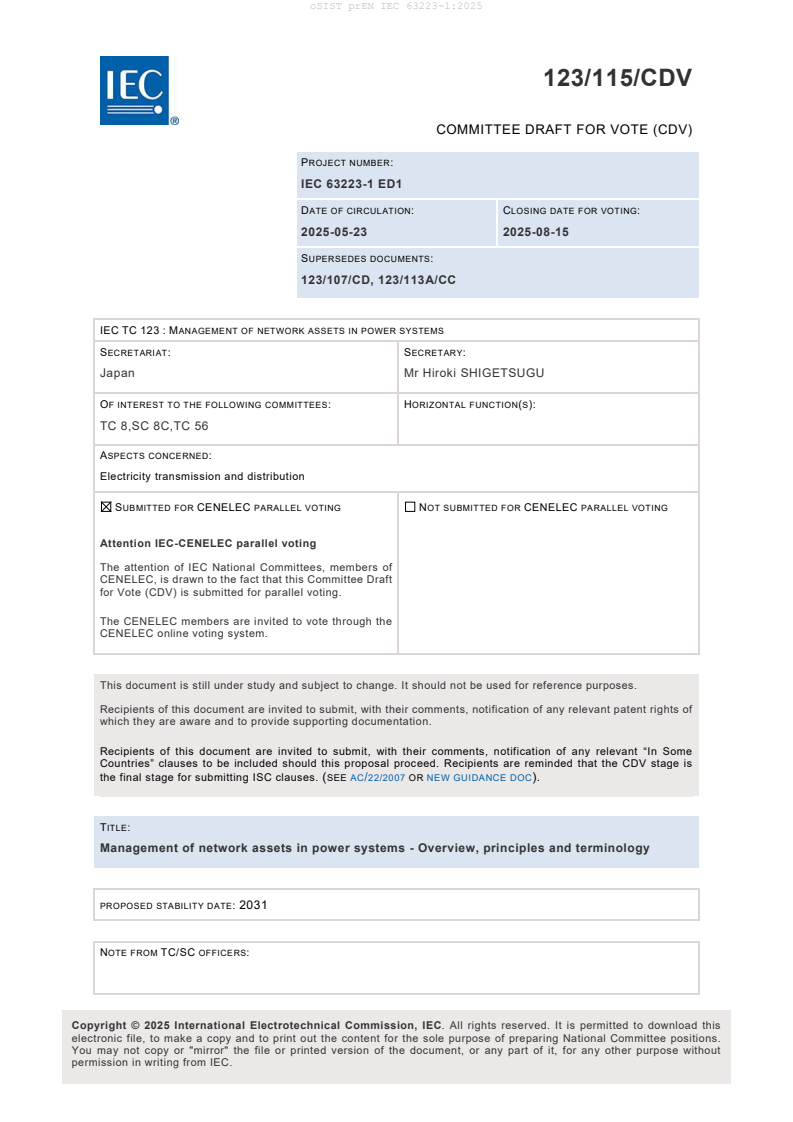
123/115/CDV
COMMITTEE DRAFT FOR VOTE (CDV)
PROJECT NUMBER:
IEC 63223-1 ED1
DATE OF CIRCULATION: CLOSING DATE FOR VOTING:
2025-05-23 2025-08-15
SUPERSEDES DOCUMENTS:
123/107/CD, 123/113A/CC
IEC TC 123 : MANAGEMENT OF NETWORK ASSETS IN POWER SYSTEMS
SECRETARIAT: SECRETARY:
Japan Mr Hiroki SHIGETSUGU
OF INTEREST TO THE FOLLOWING COMMITTEES: HORIZONTAL FUNCTION(S):
TC 8,SC 8C,TC 56
ASPECTS CONCERNED:
Electricity transmission and distribution
SUBMITTED FOR CENELEC PARALLEL VOTING NOT SUBMITTED FOR CENELEC PARALLEL VOTING
Attention IEC-CENELEC parallel voting
The attention of IEC National Committees, members of
CENELEC, is drawn to the fact that this Committee Draft
for Vote (CDV) is submitted for parallel voting.
The CENELEC members are invited to vote through the
CENELEC online voting system.
This document is still under study and subject to change. It should not be used for reference purposes.
Recipients of this document are invited to submit, with their comments, notification of any relevant patent rights of
which they are aware and to provide supporting documentation.
Recipients of this document are invited to submit, with their comments, notification of any relevant “In Some
Countries” clauses to be included should this proposal proceed. Recipients are reminded that the CDV stage is
the final stage for submitting ISC clauses. (SEE AC/22/2007 OR NEW GUIDANCE DOC).
TITLE:
Management of network assets in power systems - Overview, principles and terminology
PROPOSED STABILITY DATE: 2031
NOTE FROM TC/SC OFFICERS:
electronic file, to make a copy and to print out the content for the sole purpose of preparing National Committee positions.
You may not copy or "mirror" the file or printed version of the document, or any part of it, for any other purpose without
permission in writing from IEC.
oSIST prEN IEC 63223-1:2025
Link to Committee Draft for Vote (CDV) online document:
https://osd.iec.ch/#/editor/archive/2d7c80a1-b7eb-05c6-e063-6d13000a6b0e/en/CCDV/1
How to access
This link leads you to the Online Standards Development (OSD) platform for National Mirror
Committee’s (NMC) comments. The project draft may be found further down this document.
Resource materials
We recommend NCs to review the available materials to better understand the member commenting
on the OSD platform. This includes the:
• OSD NC roles overview: here
• How to add and submit comments to the IEC: here
Contact
Should you require any assistance, please contact the IEC IT Helpdesk at helpdesk@iec.ch.
oSIST prEN IEC 63223-1:2025
IEC 63223-1 ED1 © IEC 2025 3
CONTENTS
FOREWORD . 4
INTRODUCTION . 6
1 Scope . 9
2 Normative references . 9
3 Terms, definitions and abbreviated terms . 9
3.1 Terms and definitions. 9
3.2 Abbreviated terms . 9
4 Principles for asset management of power systems . 9
4.1 Asset management overview. 9
4.2 Principles for management of power systems . 10
4.3 Main decisions for the management of power systems . 11
5 Value creation options . 12
5.1 General . 12
5.2 Risk-informed decision-making process . 12
5.3 Value creation options from power network assets . 12
5.3.1 Asset life cycle management . 12
5.3.2 Asset specification . 13
5.3.3 New asset construction . 13
5.3.4 Effective utilization of assets . 13
5.3.5 Network solution . 14
5.3.6 Active infrastructure management . 14
5.3.7 Non-network solution or supply and demand management . 14
5.3.8 Resilience. 15
5.3.9 Data and information . 15
Annex A (informative) Examples of value creation options . 16
A.1 General . 16
A.2 Asset life cycle management . 16
A.3 Asset specification . 16
A.4 New asset construction . 17
A.5 Effective utilization of assets . 17
A.6 Network solution . 18
A.7 Active infrastructure management . 18
A.8 Non-network solution or supply and demand management . 18
A.9 Resilience . 19
A.10 Data and information . 19
Annex B (informative) Structure of IEC TC 123 standards . 20
B.1 Structure . 20
B.2 Core standard . 20
B.3 Process standard . 20
B.4 Support standard . 20
B.5 Associated standard . 21
Bibliography . 22
Figure B.1 – Framework for IEC TC 123 standards . 20
oSIST prEN IEC 63223-1:2025
4 IEC 63223-1 ED1 © IEC 2025
INTERNATIONAL ELECTROTECHNICAL COMMISSION
____________
Management of network assets in power systems - Overview, principles
and terminology –
FOREWORD
1) The International Electrotechnical Commission (IEC) is a worldwide organization for standardization
comprising all national electrotechnical committees (IEC National Committees). The object of IEC is to
promote international co-operation on all questions concerning standardization in the electrical and
electronic fields. To this end and in addition to other activities, IEC publishes International Standards,
Technical Specifications, Technical Reports, Publicly Available Specifications (PAS) and Guides
(hereafter referred to as "IEC Publication(s)"). Their preparation is entrusted to technical committees;
any IEC National Committee interested in the subject dealt with may participate in this preparatory
work. International, governmental and non-governmental organizations liaising with the IEC also
participate in this preparation. IEC collaborates closely with the International Organization for
Standardization (ISO) in accordance with conditions determined by agreement between the two
organizations.
2) The formal decisions or agreements of IEC on technical matters express, as nearly as possible, an
international consensus of opinion on the relevant subjects since each technical committee has
representation from all interested IEC National Committees.
3) IEC Publications have the form of recommendations for international use and are accepted by IEC
National Committees in that sense. While all reasonable efforts are made to ensure that the technical
content of IEC Publications is accurate, IEC cannot be held responsible for the way in which they are
used or for any misinterpretation by any end user.
4) In order to promote international uniformity, IEC National Committees undertake to apply IEC
Publications transparently to the maximum extent possible in their national and regional publications.
Any divergence between any IEC Publication and the corresponding national or regional publication
shall be clearly indicated in the latter.
5) IEC itself does not provide any attestation of conformity. Independent certification bodies provide
conformity assessment services and, in some areas, access to IEC marks of conformity. IEC is not
responsible for any services carried out by independent certification bodies.
6) All users should ensure that they have the latest edition of this publication.
7) No liability shall attach to IEC or its directors, employees, servants or agents including individual
experts and members of its technical committees and IEC National Committees for any personal
injury, property damage or other damage of any nature whatsoever, whether direct or indirect, or for
costs (including legal fees) and expenses arising out of the publication, use of, or reliance upon, this
IEC Publication or any other IEC Publications.
8) Attention is drawn to the Normative references cited in this publication. Use of the referenced
publications is indispensable for the correct application of this publication.
9) IEC draws attention to the possibility that the implementation of this document may involve the use
of (a) patent(s). IEC takes no position concerning the evidence, validity or applicability of any claimed
patent rights in respect thereof. As of the date of publication of this document, IEC [had/had not]
received notice of (a) patent(s), which may be required to implement this document. However,
implementers are cautioned that this may not represent the latest information, which may be obtained
from the patent database available at https://patents.iec.ch. IEC shall not be held responsible for
identifying any or all such patent rights.
oSIST prEN IEC 63223-1:2025
IEC 63223-1 ED1 © IEC 2025 5
IEC 63223-1 has been prepared by IEC technical committee 123: Management of network assets in
power systems. It is an International Standard.
The text of this International Standard is based on the following documents:
Draft Report on voting
XX/XX/FDIS XX/XX/RVD
Full information on the voting for its approval can be found in the report on voting indicated in the
above table.
The language used for the development of this International Standard is English.
This document was drafted in accordance with ISO/IEC Directives, Part 2, and developed in
accordance with ISO/IEC Directives, Part 1 and ISO/IEC Directives, IEC Supplement, available at
www.iec.ch/members_experts/refdocs. The main document types developed by IEC are described in
greater detail at www.iec.ch/publications.
The committee has decided that the contents of this document will remain unchanged until the stability
date indicated on the IEC website under webstore.iec.ch in the data related to the specific document.
At this date, the document will be
– reconfirmed,
– withdrawn, or
– revised.
oSIST prEN IEC 63223-1:2025
6 IEC 63223-1 ED1 © IEC 2025
INTRODUCTION
Background
The IEC white paper "Strategic asset management of power networks" was published in 2015 [1]
and TC 123 was established the following year to develop a management standard covering power
network assets.
This white paper and power network sector specific Asset Management (AM) standards (TC 123, IEC
63223 series [2]) were initiated by the CEO of a power network company who found that some
sections of AM management system standards (ISO 55000 series [3]) were very generic and as such
the requirements were not easy to follow and to discuss with the country's regulator.
The scope of TC 123 is "standardisation to deliver, in co-operation with other TC/SCs and international
organizations, common methods and guidelines for coordinated lifetime management of network
assets in power systems to support good asset management". This possibly includes the development
of new methods and guidelines. Asset management is defined as "coordinated activity of an
organization to realize value from assets" in ISO 55000 series [3](ISO 55000:2024, ISO 55001:2024
and ISO 55002:2018 [4]).
In TC 123, three projects have delivered Committee Drafts (CDs) on terminology (IEC 60050-693), on
practice and case studies for management aspects (IEC TS 63224 [5]), and on the risk-informed
decision-making process IEC 63223-2 [6], based on the approved new work item proposal (NP)
123/47/NP [7].
One of the comments on the NP 123/47/NP and on the CD of IEC TS 63224 [5] was: "The scope is
supposed to be about realizing value from power network assets, but it is biased towards only
reducing the risk of existing assets. TC 123 should have a broader scope". Therefore, it was decided
at the 2022 plenary meeting to create a new project, IEC 63223-1, to present an overall picture that
includes value creation as well as asset risk mitigation.
The purpose of this document, IEC 63223-1, is to provide an overview of the scope of the whole IEC
63223 series [2], with principles and terminologies. The purpose of the IEC 63223 series [2] is to
create power network sector-specific International Standards for the ISO 55000 series [3].
The structure of the deliverables produced by TC 123 is specified in Annex Annex B. In addition to the
present IEC 63223-1 standard, the other standards published or under development include:
– IEC 60050-693 explains the terms to be used and their definitions;
– IEC TS 63224 [5] explains management aspects and provides case studies related to asset
management practices or implementation of an asset management system, in the power
systems sector;
– IEC 63223-2 [6] (under development) , will explain the requirements for development of a
risk-informed decision-making process within asset management.
Users
The main intended users are:
– asset managers of power network companies;
– regulators of the power network companies.
Other assumed readers include:
– asset owners and service providers of power network companies;
– stakeholders of the power network companies.
___________
Numbers in square brackets refer to the Bibliography.
To be published in a separate standard.
oSIST prEN IEC 63223-1:2025
IEC 63223-1 ED1 © IEC 2025 7
It should be noted that this document has been prepared in such a way that the reader can
understand it to some extent by reading this document alone, but it assumes that the reader has a
basic knowledge of the ISO 55000 series [3].
Benefits of asset management
The benefits of asset management are generally summarised as follows, which are not specific to
power network assets:
– Improved financial performance;
– Better decision-making;
– Managed risks and opportunities;
– Improved efficiency and effectiveness;
– Greater stakeholder confidence through demonstrated compliance and enhanced
reputation.
Structure of this document
This document consists of three major parts after the scope in Clause 1 and the normative references
in Clause 2:
– Clause 3: Terms, definitions and abbreviated terms:
While IEC 60050-693 specifies terms for management of network assets in power systems for the
whole IEC. Terms used only in the IEC 63223 series [2] and not in IEC 60050-693 should be
described in IEC 63223-1. Terms in IEC 63223-1 may be integrated in IEC 60050-693 later, if
appropriate.
– Clause 4: Principles for asset management of power systems:
The ISO 55000 series [3] specifies an asset management system, i.e., the general requirements for
value creation. This chapter describes the principles for asset management of power network assets.
– Clause 5: Value creation options:
There are various options of value-creating activities for power network assets, including reducing risk
and taking advantage of opportunities. This chapter describes those options. The risk-informed
decision-making process associated with asset risk mitigation, is described in another standard: IEC
63223-2 [6].
– Annex Annex A gives examples of value creation options;
– Annex Annex B shows the structure of the TC 123 standards.
Further reading
ISO/TS 55010:2024, Asset management - Guidance on the alignment of financial and non-financial
functions in asset management ISO/TS 55010:2024 [8]
SRA, Risk Analysis: Fundamental Principles. Society for Risk Analysis, 2018 [9]
GFMAM, The asset management landscape, Second edition [10]
ISO, Managing Assets in the context of Asset Management, ISO TC251 WG4, 1st ed, 2017 [11]
CIGRÉ Technical Brochure 309, Asset Management of Transmission systems and associated CIGRÉ
activities, CIGRÉ Working Group C1.1, 2006 [12]
CIGRÉ Technical Brochure 422, Transmission Asset Risk Management, CIGRÉ Working Group
C1.16, 2010 [13]
CIGRÉ Technical Brochure 541, Asset Management Decision Making using different Risk Assessment
Methodologies, CIGRÉ Working Group C1.25, 2013 [14]
oSIST prEN IEC 63223-1:2025
8 IEC 63223-1 ED1 © IEC 2025
CIGRÉ Technical Brochure 597, Transmission Asset Risk Management - Progress in Application,
CIGRÉ Working Group C1.25, 2014 [15]
oSIST prEN IEC 63223-1:2025
IEC 63223-1 ED1 © IEC 2025 9
Management of network assets in power systems - Overview, principles
and terminology –
1 Scope
This International Standard provides an overview of asset management, its principles and value
creation options for the management of network assets in power systems.
This International Standard can be applied to all types of network assets and by all types and sizes of
organizations.
2 Normative references
The following documents are referred to in the text in such a way that some or all of their content
constitutes requirements of this document. For dated references, only the edition cited applies. For
undated references, the latest edition of the referenced document (including any amendments)
applies.
IEC 60050-693, International Electrotechnical Vocabulary - Part 693: Management of network
assets in power systems - Terminology
ISO 55000:2024, Asset management - Vocabulary, overview and principles
ISO 55001:2024, Asset management – Management system – Requirements
3 Terms, definitions and abbreviated terms
3.1 Terms and definitions
For the purposes of this document, the terms and definitions given in IEC 60050-693 apply.
ISO and IEC maintain terminology databases for use in standardization at the following addresses:
– IEC Electropedia: available at https://www.electropedia.org/
– ISO Online browsing platform: available at https://www.iso.org/obp
3.2 Abbreviated terms
AM Asset management
BESS Battery energy storage system
CIGRÉ Conseil international des grands réseaux électriques; international council on large
electric systems
DSO Distribution system operator
GIS Gas insulated substation
RIDM Risk-informed decision-making
TSO Transmission system operator
VPP Virtual power plant
4 Principles for asset management of power systems
4.1 Asset management overview
CIGRÉ Technical Brochure 787 summarizes asset management for power networks [16]. As in the
ISO 55000:2024 standard, the key principles of asset management are:
oSIST prEN IEC 63223-1:2025
10 IEC 63223-1 ED1 © IEC 2025
a) value;
b) alignment;
c) leadership.
Three key characteristics differentiate asset management from other management systems:
d) the need for a long-term strategy;
e) the attention applied to the entire life cycle of assets;
f) an approach allowing for improved decision-making.
Asset management involves the balancing of costs, opportunities and risks against the desired
performance of assets, to achieve the organizational objectives. The balancing might need to be
considered over different timeframes." [17].
Therefore, focusing solely on cost and short-term performance may be misleading.
4.2 Principles for management of power systems
Electric power systems are identified as critical infrastructures [18] defined with the following
characteristics [19]:
a) Large scale systems for transmission and distribution of electricity (considered as an
essential good). Electricity is now essential for the operation of all other infrastructures,
such as water supply, telecommunications, railways, or airports. Electric power systems'
criticality will continuously increase with the replacement of fossil energy consumption by
low-carbon electricity consumption. The main missions of a power network company can
include, but are not limited to the following:
1) connect any new power generation plant to the grid to open and increase the generation
mix;
2) supply any consumer;
3) manage supply-demand balance.
b) The failure or destruction of the infrastructure can lead to significant damages to the
concerned society in several domains such as safety, health, economy, environment, social
well-being. Transnational infrastructures such as interconnected power systems and
industries may also be impacted. The capacity and the reliability of the transmission and
distribution network are key to reach the objective of a very high quality of service.
c) Electric power systems are also complex systems characterized by:
1) structural complexity: a large number of heterogeneous interconnected assets, with
different roles and technologies and connected to other systems such as power plants,
distributed energy sources, storage components and industries. The power system is
made of assets in real time interaction. The supply-demand balance must be achieved
on a second-by-second basis;
2) dynamic complexity: local failures evolving to cascade failures leading to catastrophic
consequences.
d) Power systems are vulnerable to a variety of challenges such as natural hazardous events
and ageing components. Power system companies are facing several uncertainties and
associated unwanted consequences when managing power system assets. One classic
example of uncertainty is the lifetime of a component. Transmission system operators may
rely on the rule of N-1 security to preserve the quality of service that can be considered as
an example of a risk mitigation option: the failure of one asset has no consequence on
energy supply, limiting the potential for catastrophic electrical disturbances. Nevertheless,
this does not mitigate other types of consequences (environmental, safety, financial, etc.).
e) The power system is a regulated system with a geographic monopoly: the strategic
objectives are discussed by the regulator and the power network company, but an increasing
pressure is placed on power network companies to justify their asset management
decisions, the corresponding expenditures, and the needed human resources. Cost
management is the everyday challenge in the asset management trade-off in between cost,
risk, and performance.
oSIST prEN IEC 63223-1:2025
IEC 63223-1 ED1 © IEC 2025 11
f) Being a critical infrastructure of general interest implies consideration of external factors to
make decisions that maximize the value for the whole society, such as public acceptance,
public safety, local and global environment protection (e.g., natural area, CO generation,
raw material consumption) and local employment, and not only the profit for the power
network company.
The asset management of critical infrastructures with many uncertainties should rely on a relevant risk
management process, based on the state-of-the-art risk theory. Particular attention is required to
consider both the physical phenomena in a causal chain of events, and to go beyond the probabilistic
calculations based on simplified models to respond effectively in case of surprising events.
4.3 Main decisions for the management of power systems
Asset management decisions are usually made on activities such as grid development, operation,
resource allocation and portfolio management, as well as life cycle management:
a) grid development:
1) grid planning: The grid is designed to connect available generation plants and supply
consumer needs. Long-term trends in generation and consumption are uncertain, with
scenarios published by national energy agencies providing reference ranges. The
precise location and capacity of large new generators (e.g., wind farms) or consumers
(e.g., data centres, factories) may not be known at the planning stage.
2) investment planning: Grid planning relies on models and hypotheses of generation and
consumption to develop investment plans. These plans typically cover onshore and
offshore development, as well as interconnection projects.
3) network restructuring: Network restructuring addresses issues caused by ageing or
obsolescence and provides an opportunity to align with energy transition goals. Studies
should synchronise the renewal of existing assets with the development of new
infrastructure to support increased electricity demand.
4) implementation of investment plans: Key steps for implementing investment plans
include technology selection, engineering studies, procurement, construction, and
commissioning. TSOs and DSOs are encouraged to share their investment plans with
service providers to allow alignment of resources and competencies.
5) modernization and upgrading of the existing assets: The replacement of the existing
assets which they are not at their end of service life in order for modernizing and/or
upgrading of the existing systems.
b) operation: Operation of the power system considers the network topology, health and safety,
the reliability of existing assets, the interconnection capacities, the climate hazards, etc.
The operators continuously take corrective actions through control systems to balance the
supply and demand for electricity in real-time, and to maintain the reliability and the stability
of the grid to prevent disruptions, such as blackouts. The inadequacy of the capacity of the
network may generate high re-dispatching costs, penalty costs and unplanned outages. Grid
planning objective is to mitigate and prevent inadequacy of capacity, to ensure the good
operation of the network over time.
c) life cycle management on the existing assets: Maintain, repair, refurbish, replace, reuse or
scrap are possible actions for managing assets. Asset life cycle management (including life
cycle assessment) coordinates and optimizes these actions over the entire lifespan. It offers
a wide range of benefits that go beyond just cost savings. It contributes to improved
efficiency, compliance, sustainability, and overall organizational effectiveness. Asset life
cycle management should be implemented to manage assets. Moreover, for degraded or
obsolescent networks, or when the limits of allowed resources generate higher risk and/or
lower performance, it is time to complement the asset-oriented approach with a risk-
informed approach.
d) resources allocation and portfolio management: The organization should evaluate the total
resources required to implement all asset management plans, including those related to
existing assets and grid development. In situations where available resources are
insufficient to meet the total needs, strategies for managing these constraints should be
considered. This may include assessing whether to adjust performance objectives or to
allocate additional resources. When the value creation is driven by risk mitigation, the
oSIST prEN IEC 63223-1:2025
12 IEC 63223-1 ED1 © IEC 2025
potential consequences of prioritizing certain actions over others should be analysed with
respect to asset management objectives and the criteria used for decision-making.
In the context of a power network company, resources may include budgets, internal and external
workforce, planned outage capacities, and capacities of power system equipment suppliers.
5 Value creation options
5.1 General
Value is defined as the outcome of meeting the needs and expectations expressed by internal or
external stakeholders. As such, value is specific to each organization. IEC TS 63224 [5] provides
examples of stakeholder expectations in the context of electrical networks. Value creation is either
related to develop new opportunities for stakeholders or to mitigate risks in relation to unwanted
consequences on value.
The risk management process is briefly introduced in 5.2 and will be further detailed in IEC 63223-2
[6]. Options to realize value for a power network include but are not limited to the items in this 5.3.
5.2 Risk-informed decision-making process
The risk-informed decision-making (RIDM) process is the backbone for justifying the decided actions
for mitigating the risks. The collaboration of many entities of the organization is essential for the
implementation and for the performance of the process.
The RIDM process consists of four specific steps:
a) risk decision-making context: context clarification, qualitative description of risks,
knowledge characterization, stakeholders' concerns identification;
b) risk management strategies: depending on the risk decision-making context, three main risk
management strategies c
...
Questions, Comments and Discussion
Ask us and Technical Secretary will try to provide an answer. You can facilitate discussion about the standard in here.
Loading comments...