


SIST EN 1953:2014
(Main)Atomising and spraying equipment for coating materials - Safety requirements
Atomising and spraying equipment for coating materials - Safety requirements
This European Standard deals with all significant hazards, hazardous situations and events which are relevant for both manual and automatic atomising and spraying equipment for application of coating materials on workpieces.
In this standard, the term “machine” is used equivalently to “atomising and spraying equipment” and “applicator”.
Together with this standard, EN 50050, EN 50059, EN 50176, EN 50177 or EN 50348 give requirements for electrostatic applicators.
The specific significant risks related to the use of this machinery with foodstuffs and pharmaceutical products are not dealt with in this standard.
This standard is only applicable to machinery which is used as intended. It also covers hazards arising from conditions which are reasonably foreseeable by the manufacturer.
Applicators can consist of the following parts:
- atomising or spraying system;
- trigger;
- filter;
- swivel joint;
- safety and control systems;
- non-pressurised gravity or siphon feed cup.
This European Standard is not applicable to:
- applicators designed for operating pneumatic pressure above 15 bar;
- non-atomising equipment (e.g. extruding equipment, dispenser);
- fluidized bed powder coating machinery;
- equipment for the automated application of flock;
- spray guns covered by EN 50580;
- supply hoses and ducts;
- high-pressure cleaner equipped with high pressure water jet machines according to EN 1829 1;
- airbrushes for graphic and artistic works;
- machinery for the supply and circulation of coating materials under pressure according to EN 12621;
- water-jet cutters;
- automated devices like robots or reciprocators (EN ISO 10218 1).
This standard is not applicable to machinery manufactured before the date of its publication as a European Standard.
Spritz- und Sprühgeräte für Beschichtungsstoffe - Sicherheitsanforderungen
Diese Europäische Norm behandelt alle signifikanten Gefährdungen, Gefährdungssituationen und Gefährdungsereignisse handgeführter und automatischer Spritz- und Sprühgeräte zum Auftragen von Beschichtungsstoffen auf Werkstücken.
Der Begriff „Maschine“ wird in dieser Norm äquivalent zu den Begriffen „Spritz- und Sprühgeräte“ und „Auftragseinrichtung“ verwendet.
Zusammen mit dieser Norm, geben EN 50050, EN 50059, EN 50176, EN 50177 oder EN 50348 Anforderungen für elektrostatische Auftragseinrichtungen.
Die spezifischen signifikanten Risiken in Zusammenhang mit der Verwendung dieser Maschine mit Lebensmitteln und pharmazeutischen Erzeugnissen werden in dieser Norm nicht behandelt.
Diese Norm gilt ausschließlich für Maschinen, die bestimmungsgemäß verwendet werden. Die Norm berücksichtigt auch Gefährdungen die unter Bedingungen entstehen die vom Hersteller vernünftigerweise vorhersehbar sind.
Auftragseinrichtungen können aus folgenden Teilen bestehen:
- Spritz- oder Sprühsystem,
- Abzugshebel oder -bügel,
- Filter,
- Drehgelenk,
- Sicherheitssysteme und Steuerungen,
- Drucklose Fließ- oder Saugbecher.
Diese Europäische Norm gilt nicht für:
- Auftragseinrichtungen, die für pneumatische Betriebsdrücke von mehr als 15 bar ausgelegt sind,
- nicht zerstäubende Spritzgeräte (z.B. Extrudiergeräte, Dispenser),
- elektrostatische Fluidisierbett-Pulverbeschichtungsanlagen,
- Geräte für automatisches Beflocken,
- durch EN 50580 abgedeckte Spritzpistolen,
- Versorgungsschläuche und -leitungen,
- Hochdruckreiniger mit Hochdruckwasserstrahlmaschinen nach EN 1829-1,
- Air-Brush Pistolen für grafische und künstlerische Arbeiten,
- Förder- und Umlaufanlagen für Beschichtungsstoffe unter Druck nach EN 12621,
- Wasserstrahlschneidgeräte,
- Automatisierungseinrichtungen wie Roboter oder Bewegungseinrichtungen (EN ISO 10218-1).
Diese Norm gilt nicht für Maschinen, die vor Veröffentlichung dieser Europäischen Norm hergestellt wurden.
Equipements d'atomisation et de pulvérisation pour produits de revêtement - Exigences de sécurité
La présente Norme européenne traite de tous les phénomènes dangereux, situations et événements dangereux significatifs pertinents pour les équipements d'atomisation et de pulvérisation manuels et automatiques pour l'application de produits de revêtement sur des pièces.
Dans la présente norme, le terme « machine » est utilisé de manière équivalente à « équipement d'atomisation et de pulvérisation » et « applicateur ».
Outre cette norme, l'EN 50050, l'EN 50059, l'EN 50176, l'EN 50177 ou l'EN 50348 fournissent des prescriptions pour les applicateurs électrostatiques.
Les risques significatifs spécifiques relatifs à l’utilisation de ces machines pour les produits pharmaceutiques et les aliments ne sont pas traités dans la présente norme.
La présente norme s'applique uniquement aux machines qui sont utilisées selon l’usage prévu. Elle couvre également les phénomènes dangereux pouvant survenir de conditions raisonnablement prévisibles par le fabricant.
Les applicateurs peuvent être constitués des pièces suivantes :
- système d'atomisation ou de pulvérisation ;
- gâchette ;
- filtre ;
- raccord tournant ;
- systèmes de sécurité et de commande ;
- godet pour alimentation sans pression, par siphon ou gravité.
La présente Norme européenne ne s’applique pas aux machines suivantes :
- applicateurs conçus pour une pression pneumatique de service supérieure à 15 bar ;
- équipements non atomisants (par exemple équipement d'extrusion, distributeur) ;
- machines d'enduit à lit fluidisé de poudre ;
- équipements à floquer ;
- pistolets couverts par l'EN 50580 ;
- tuyaux et conduites d'alimentation ;
- nettoyeurs haute-pression équipés de machines à jet d'eau à haute pression conformes à l'EN 1829 1 ;
- pistolets aérostyles pour artistes et graphistes ;
- équipements pour l'alimentation et la circulation de produit de revêtement sous pression conformes à l'EN 12621 ;
- machines de découpe à jet d'eau ;
- dispositifs automatisés tels que robots ou appareils à mouvement de va-et-vient (EN ISO 10218-1).
La présente norme ne s'applique pas aux machines fabriquées avant la date de sa publication en tant que Norme européenne.
Razprševalna in brizgalna oprema za prekrivne materiale - Varnostne zahteve
Ta evropski standard obravnava vse večje nevarnosti, nevarne razmere in dogodke, ki so pomembni tako za ročno kot tudi za avtomatsko opremo za razprševanje in pršenje premaznih sredstev na obdelovance. V tem standardu se izraz »stroj« uporablja enakovredno za »opremo za razprševanje in pršenje« in za »naprave za nanašanje«. Skupaj s tem standardom standardi EN 50050, EN 50059, EN 50176, EN 50177 ali EN 50348 določajo zahteve za elektrostatične naprave za nanašanje. Ta standard ne zajema posebnih znatnih tveganj, povezanih z uporabo teh strojev z živili in farmacevtskimi izdelki. Ta standard se uporablja le za stroje, ki se uporabljajo v skladu z njihovim namenom. Prav tako zajema nevarnosti, ki se pojavijo ob pogojih, ki jih proizvajalec upravičeno pričakuje. Naprave za nanašanje so sestavljene iz naslednjih delov: – sistem za razprševanje ali pršenje; – sprožilec; – filter; – vrtljiv zglob; – varnostni in kontrolni sistemi; – gravitacijska posoda za barvo, ki ni pod tlakom, ali sifonska posoda za barvo. Ta evropski standard se ne uporablja za: – naprave za nanašanje, zasnovane za delovanje pri pnevmatskem tlaku nad 15 barov; – opremo, ki ni namenjena razprševanju (npr. oprema za iztiskanje, točilne naprave); – stroje za barvanje s potapljanjem v prah; – opremo za samodejno kosmičenje; – pištole za barvanje, ki jih zajema standard EN 50580; – oskrbne cevi in vode; – visokotlačne čistilce, opremljene s stroji za visokotlačne vodne curke v skladu s standardom EN 1829-1; – zračne čopiče za grafiko ali umetniška dela; – stroje za dobavo in kroženje premaznih materialov pod tlakom v skladu s standardom EN 12621; – rezalnike za rezanje z vodnim curkom. Ta standard se ne uporablja za stroje, proizvedene pred datumom objave tega standarda kot evropskega standarda; – avtomatizirane naprave, kot so roboti ali robotske naprave (EN ISO 10218-1). Ta standard se ne uporablja za stroje, ki so bili proizvedeni pred objavo tega dokumenta kot evropskega standarda.
General Information
- Status
- Withdrawn
- Public Enquiry End Date
- 19-Nov-2011
- Publication Date
- 11-Dec-2013
- Withdrawal Date
- 12-May-2025
- Technical Committee
- VSN - Safety of machinery
- Current Stage
- 9900 - Withdrawal (Adopted Project)
- Start Date
- 09-May-2025
- Due Date
- 01-Jun-2025
- Completion Date
- 13-May-2025
Relations
- Effective Date
- 01-Feb-2014
- Effective Date
- 17-Jul-2019


Frequently Asked Questions
SIST EN 1953:2014 is a standard published by the Slovenian Institute for Standardization (SIST). Its full title is "Atomising and spraying equipment for coating materials - Safety requirements". This standard covers: This European Standard deals with all significant hazards, hazardous situations and events which are relevant for both manual and automatic atomising and spraying equipment for application of coating materials on workpieces. In this standard, the term “machine” is used equivalently to “atomising and spraying equipment” and “applicator”. Together with this standard, EN 50050, EN 50059, EN 50176, EN 50177 or EN 50348 give requirements for electrostatic applicators. The specific significant risks related to the use of this machinery with foodstuffs and pharmaceutical products are not dealt with in this standard. This standard is only applicable to machinery which is used as intended. It also covers hazards arising from conditions which are reasonably foreseeable by the manufacturer. Applicators can consist of the following parts: - atomising or spraying system; - trigger; - filter; - swivel joint; - safety and control systems; - non-pressurised gravity or siphon feed cup. This European Standard is not applicable to: - applicators designed for operating pneumatic pressure above 15 bar; - non-atomising equipment (e.g. extruding equipment, dispenser); - fluidized bed powder coating machinery; - equipment for the automated application of flock; - spray guns covered by EN 50580; - supply hoses and ducts; - high-pressure cleaner equipped with high pressure water jet machines according to EN 1829 1; - airbrushes for graphic and artistic works; - machinery for the supply and circulation of coating materials under pressure according to EN 12621; - water-jet cutters; - automated devices like robots or reciprocators (EN ISO 10218 1). This standard is not applicable to machinery manufactured before the date of its publication as a European Standard.
This European Standard deals with all significant hazards, hazardous situations and events which are relevant for both manual and automatic atomising and spraying equipment for application of coating materials on workpieces. In this standard, the term “machine” is used equivalently to “atomising and spraying equipment” and “applicator”. Together with this standard, EN 50050, EN 50059, EN 50176, EN 50177 or EN 50348 give requirements for electrostatic applicators. The specific significant risks related to the use of this machinery with foodstuffs and pharmaceutical products are not dealt with in this standard. This standard is only applicable to machinery which is used as intended. It also covers hazards arising from conditions which are reasonably foreseeable by the manufacturer. Applicators can consist of the following parts: - atomising or spraying system; - trigger; - filter; - swivel joint; - safety and control systems; - non-pressurised gravity or siphon feed cup. This European Standard is not applicable to: - applicators designed for operating pneumatic pressure above 15 bar; - non-atomising equipment (e.g. extruding equipment, dispenser); - fluidized bed powder coating machinery; - equipment for the automated application of flock; - spray guns covered by EN 50580; - supply hoses and ducts; - high-pressure cleaner equipped with high pressure water jet machines according to EN 1829 1; - airbrushes for graphic and artistic works; - machinery for the supply and circulation of coating materials under pressure according to EN 12621; - water-jet cutters; - automated devices like robots or reciprocators (EN ISO 10218 1). This standard is not applicable to machinery manufactured before the date of its publication as a European Standard.
SIST EN 1953:2014 is classified under the following ICS (International Classification for Standards) categories: 87.100 - Paint coating equipment. The ICS classification helps identify the subject area and facilitates finding related standards.
SIST EN 1953:2014 has the following relationships with other standards: It is inter standard links to SIST EN 1953:2000+A1:2010, SIST EN 1953:2025. Understanding these relationships helps ensure you are using the most current and applicable version of the standard.
SIST EN 1953:2014 is associated with the following European legislation: EU Directives/Regulations: 2006/42/EC, 2014/34/EU, 94/9/EC. When a standard is cited in the Official Journal of the European Union, products manufactured in conformity with it benefit from a presumption of conformity with the essential requirements of the corresponding EU directive or regulation.
You can purchase SIST EN 1953:2014 directly from iTeh Standards. The document is available in PDF format and is delivered instantly after payment. Add the standard to your cart and complete the secure checkout process. iTeh Standards is an authorized distributor of SIST standards.
Standards Content (Sample)
2003-01.Slovenski inštitut za standardizacijo. Razmnoževanje celote ali delov tega standarda ni dovoljeno.Razprševalna in brizgalna oprema za prekrivne materiale - Varnostne zahteveSpritz- und Sprühgeräte für Beschichtungsstoffe - SicherheitsanforderungenEquipements d'atomisation et de pulvérisation pour produits de revêtement - Exigences de sécuritéAtomising and spraying equipment for coating materials - Safety requirements87.100Oprema za nanašanje premazovPaint coating equipmentICS:Ta slovenski standard je istoveten z:EN 1953:2013SIST EN 1953:2014en,fr,de01-januar-2014SIST EN 1953:2014SLOVENSKI
STANDARDSIST EN 1953:2000+A1:20101DGRPHãþD
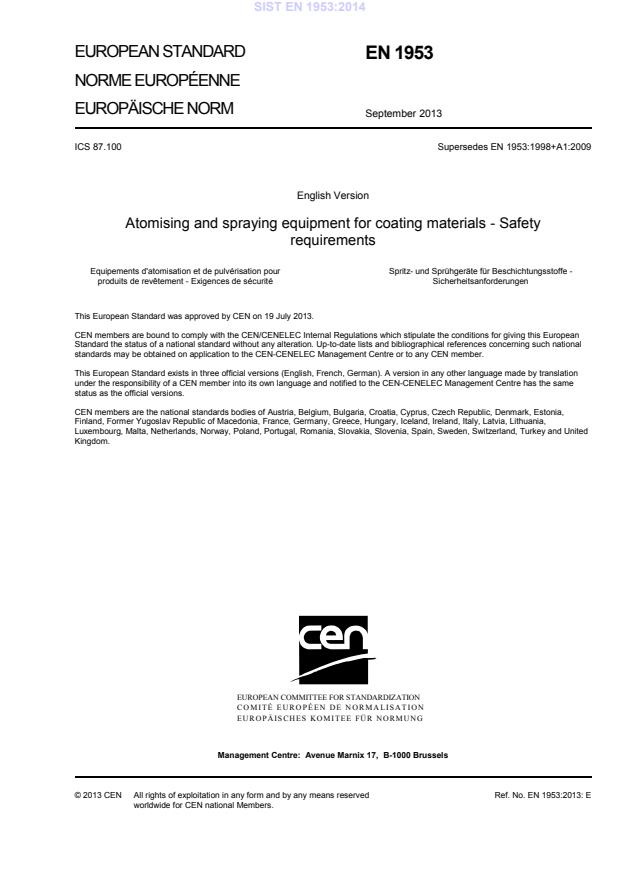
EUROPEAN STANDARD NORME EUROPÉENNE EUROPÄISCHE NORM
EN 1953
September 2013 ICS 87.100 Supersedes EN 1953:1998+A1:2009English Version
Atomising and spraying equipment for coating materials - Safety requirements
Equipements d'atomisation et de pulvérisation pour produits de revêtement - Exigences de sécurité
Spritz- und Sprühgeräte für Beschichtungsstoffe - Sicherheitsanforderungen This European Standard was approved by CEN on 19 July 2013.
CEN members are bound to comply with the CEN/CENELEC Internal Regulations which stipulate the conditions for giving this European Standard the status of a national standard without any alteration. Up-to-date lists and bibliographical references concerning such national standards may be obtained on application to the CEN-CENELEC Management Centre or to any CEN member.
This European Standard exists in three official versions (English, French, German). A version in any other language made by translation under the responsibility of a CEN member into its own language and notified to the CEN-CENELEC Management Centre has the same status as the official versions.
CEN members are the national standards bodies of Austria, Belgium, Bulgaria, Croatia, Cyprus, Czech Republic, Denmark, Estonia, Finland, Former Yugoslav Republic of Macedonia, France, Germany, Greece, Hungary, Iceland, Ireland, Italy, Latvia, Lithuania, Luxembourg, Malta, Netherlands, Norway, Poland, Portugal, Romania, Slovakia, Slovenia, Spain, Sweden, Switzerland, Turkey and United Kingdom.
EUROPEAN COMMITTEE FOR STANDARDIZATION
COMITÉ EUROPÉEN DE NORMALISATION EUROPÄISCHES KOMITEE FÜR NORMUNG
Management Centre:
Avenue Marnix 17,
B-1000 Brussels © 2013 CEN All rights of exploitation in any form and by any means reserved worldwide for CEN national Members. Ref. No. EN 1953:2013: ESIST EN 1953:2014
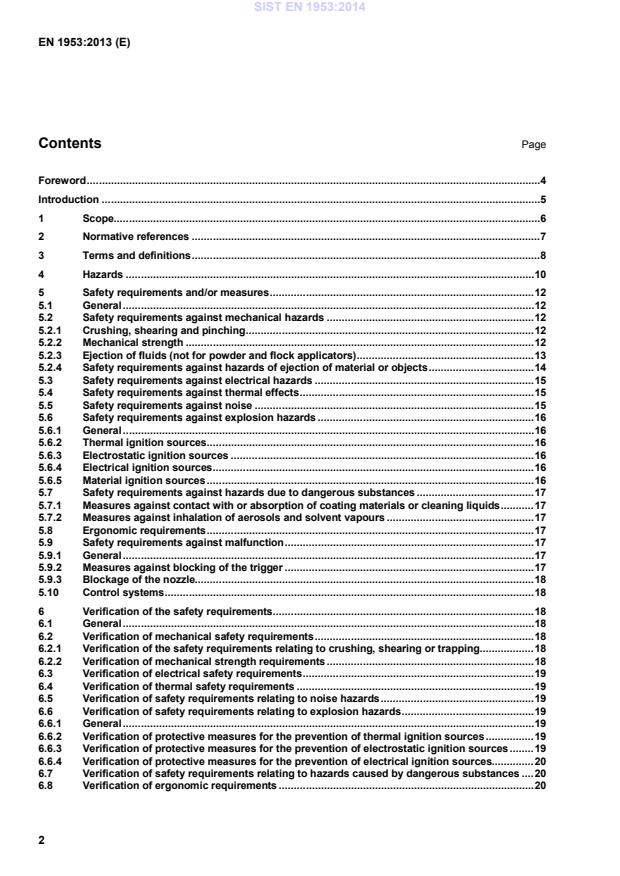
Relationship of this European Standard and the Essential Requirements of the EU Directive 2006/42/EC . 24 Annex ZB (informative)
Relationship between this European Standard and the Essential Requirements of EU Directive 94/9/EC . 25 Bibliography . 26
Applicable clauses of this standard
4.1 General This clause contains all hazards, hazardous situations and events as far as they are dealt with in this document, identified by risk assessment significant for this type of machinery and which require action to eliminate or reduce the risk. NOTE EN ISO 12100:2010 contains information for the procedure of risk assessment. 5.1 4, 5, 6 4.2 Mechanical hazards
4.2.1 Hazards by shearing, crushing, drawing-in During actuation of the applicators. 5.2.1 6.2.2.2 4.2.2 Hazards related to inadequate mechanical strength Caused by insufficient design and construction of fixing and joints between applicators and pressurised liquid supply hoses. 5.2.2 6.2.3, 6.2.10 4.2.3 Hazards by ejection of liquids Caused by leakages at or bursting of the applicator. Caused by uncontrolled discharge (unintended actuation of the applicator) and injection into the body tissues. NOTE The injection hazard increases with rising hydraulic pressure, smaller distance to skin, greater nozzle diameter and smaller spraying angles also resulting from wear of the nozzle. 5.2.3 6.2.10 4.2.4 Hazards by ejection of material or other objects Caused by inappropriate design and construction of the applicator and of the joint to the liquid supply hoses. 5.2.4 6.2.3, 6.2.10 SIST EN 1953:2014
Applicable clauses of this standard
4.3 Electrical hazards Caused by direct or indirect contact of the operator with electrically live parts. Caused by electric shock caused by electrostatic discharges of energies > 350 mJ, for instance by flow friction of the coating material. 5.3 6.2.9 4.4 Thermal hazards Caused by burns and/or scalds during handling the applicator, for instance: — during application of the heated coating material; — during use of heated pressurised air or steam; — due to leakage or bursting of the applicator. 5.4 6.2.8 c) 4.5 Noise hazards Due to noise emissions (for instance resulting from flow or vibration) which can cause hearing loss and/or physiological effects. 5.5 6.2.2.3 6.2.3 c) 6.2.8 c) 6.3.2.1 b) 6.3.2.5.1 6.3.3.2.1 6.3.4.2 4.6 Explosion hazards Caused by the generation of an explosive atmosphere due to concentrations equal or higher than the LEL during atomising or spraying of ignitable coating materials Caused by presence of an effective ignition source e.g. by electrostatic discharge, electrical sparks, hot surfaces. 5.6 6.2.4 6.3.3.2.1 6.4.4 4.7 Hazards by dangerous substances Caused by contact with or inhalation of atomised coating and/or auxiliary materials occurring as aerosol, vapour or gas. Caused by absorption of coating materials and/or cleaning liquids. 5.7.1 5.7.2 5.2.3 6.2.2.3 6.2.3 b) 6.2.3 c) 6.3.3.2.1 6.3.4.4 6.4.5.1 g) 4.8 Hazards by lack of ergonomics Caused by, for instance, too heavy equipment, inappropriate balance point, design of handle and trigger equipment not appropriate to shape of the hands, too high trigger force of manual applicator. 5.8 6.2.8 6.2.11.8 6.3.2.1 6.3.3.2.1 SIST EN 1953:2014
Applicable clauses of this standard
4.9 Hazards caused by malfunctions Caused by unexpected discharge of coating materials after a short interruption in the supply, e.g. by nozzle blockage. Caused by uncontrolled discharge of coating materials due to e.g. malfunction of the trigger mechanism. 5.9 5.9.2 5.9.3 6.2.12.2 6.3.2.1 4.10 Hazards by failure of the control system
5.10 6.2.12.2 6.3.2.1 Hygiene Not dealt with
5 Safety requirements and/or measures 5.1 General Applicators shall comply with the safety requirements and/or protective measures of this clause. In addition, applicators shall be designed according to the principles of EN ISO 12100:2010 for relevant but not significant hazards (for instance sharp edges), which are not dealt with by this standard. 5.2 Safety requirements against mechanical hazards 5.2.1 Crushing, shearing and pinching The distances between movable and fixed parts of applicators shall be wide enough to prevent injuries of parts of the human body due to crushing or pinching. 5.2.2 Mechanical strength Applicators, their fixing elements and the joints for pressurised liquid supply hoses shall be designed and constructed in such a way to wi
...
Questions, Comments and Discussion
Ask us and Technical Secretary will try to provide an answer. You can facilitate discussion about the standard in here.
Loading comments...