

SIST EN 361:2002
(Main)Personal protective equipment against falls from a height - Full body harnesses
- Abstract
This European Standard specifies the requirements, test methods, marking, information supplied by the manufacturer and packaging for full body harnesses. Other types of body support, specified in other European Standards, e. g. EN 358, EN 813 or EN 1497, may be incorporated into the full body harness. Fall arrest systems are specified in prEN 363.
- Status
- Published
- Publication Date
- 31-Oct-2002
- Technical Committee
- OVP - Personal protecting equipment
- Current Stage
- 6060 - National Implementation/Publication (Adopted Project)
- Start Date
- 01-Nov-2002
- Due Date
- 01-Nov-2002
- Completion Date
- 01-Nov-2002
- Directive
- 2016/425 - Regulation (EU) 2016/425 of the European Parliament and of the Council of 9 March 2016 on personal protective equipment and repealing Council Directive 89/686/EECOJ Ref: C 113 OJ Date: 27-Mar-2018
89/686/EEC - Personal protective equipment (PPE)OJ Ref: C 203 OJ Date: 28-Aug-2003 Conflicting Date: 28-Aug-2003

SIST EN 361:2002 is the Slovenian adoption of EN 361:2002 from CEN for personal protective equipment against falls from a height. It specifies the requirements, test methods, marking, manufacturer information and packaging for full body harnesses used as body support in fall arrest systems.
What does SIST EN 361:2002 specify?
SIST EN 361:2002 covers full body harnesses intended to support the whole body during a fall and after fall arrest. It also allows other body support types, such as those covered by EN 358, EN 813 or EN 1497, to be incorporated into the harness.
The document is organized into clauses on scope, normative references, terms and definitions, requirements, test methods, marking, manufacturer information and packaging. It also includes Annex ZA, which links the standard to EU Directive 89/686/EEC, and a bibliography entry for EN 1497.
What are the key requirements of SIST EN 361:2002?
SIST EN 361:2002 focuses on how the harness is built, how it is tested, and what users must be told before use. In practice, the standard is about making sure the harness can be identified, checked, fitted, and used safely in a fall arrest system.
Materials and construction
SIST EN 361:2002 requires webbing and sewing threads to be made from virgin filament or multifilament synthetic fibres suitable for the intended use. The synthetic fibre breaking tenacity must be at least 0.6 N/tex, and sewing threads must be visually distinguishable from the webbing so inspection is easier.
The harness must have straps or similar elements in the pelvic area and on the shoulders, fit the wearer, and prevent straps from migrating or loosening by themselves. Primary straps must be at least 40 mm wide and secondary straps at least 20 mm wide. Buckles must assemble correctly, and metallic fittings must meet the corrosion protection requirement taken from EN 362:1992.
Strength and fall performance
SIST EN 361:2002 requires static strength testing at each attachment element according to EN 364:1992, using forces of 15 kN and 10 kN. The harness must not release the torso dummy during these tests.
For dynamic performance, the harness is tested at each fall arrest attachment element with a 100 kg torso dummy. It must withstand two successive drop tests with an adjusted free fall distance of 4 m - one feet first and one head first - without releasing the dummy. After each drop, the dummy must end up head-up, with the dorsal plane within 50° of vertical.
Compatibility with other functions
If the full body harness also includes elements for work positioning or restraint, those elements must comply with EN 358 and/or EN 813. That matters because a single product may be used in more than one way, but each function still has to meet the relevant standard.
Marking, instructions and packaging
Marking must follow EN 365:1992 and include a pictogram telling the user to read the manufacturer information, a capital A at each fall arrest attachment element, the model or type identification, and the number EN 361. Manufacturer information must also follow EN 365:1992 and cover fitting, use conditions, anchor points, connection to other components, compatibility, rescue, cleaning, lifespan, transport, hazards and training needs.
Full body harnesses must be supplied wrapped in material that gives some resistance to moisture. This helps protect the product before first use and during storage or transport.
What terms does SIST EN 361:2002 define?
- Full body harness - a body support mainly used for fall arrest, designed to support the whole body and restrain the wearer during and after a fall.
- Primary straps - straps intended by the manufacturer to carry the body or exert pressure on it during and after a fall.
- Secondary straps - the other straps in the harness that are not primary straps.
- Attachment element - a specific connecting point for components or subsystems.
- Fall arrest system - the system context for the harness, as used in EN 363.
- Work positioning - a use mode where the harness may be combined with positioning elements covered by EN 358.
- Restraint system - a use mode where the harness may be combined with restraint elements covered by EN 358.
Who uses SIST EN 361:2002?
SIST EN 361:2002 is used by harness manufacturers, test laboratories, conformity assessment bodies, and suppliers of personal protective equipment against falls from a height. It is also used by buyers, safety managers, and employers who need to specify or check full body harnesses for work at height.
In practice, these users rely on the standard when designing products, testing prototypes, checking markings, writing user instructions, and selecting harnesses that fit a fall arrest system.
What changed in SIST EN 361:2002 from the previous edition?
SIST EN 361:2002 supersedes EN 361:1992. The foreword says this edition keeps the old text of the standard and adds urgent amendments intended to provide additional information and clarify inconsistencies.
Which standards are used with SIST EN 361:2002?
- EN 358 - covers belts and lanyards for work positioning and restraint; it applies when those elements are incorporated into the harness.
- EN 362:1992 - covers connectors and supplies the corrosion protection requirement used for metallic fittings.
- EN 363:2002 - covers fall arrest systems and provides the general design and ergonomics requirements referenced in Clause 4.1.
- EN 364:1992 - covers test methods and supplies the static strength and dynamic test apparatus and procedures.
- EN 365:1992 - covers general requirements for instructions for use and marking.
- EN 813 - covers sit harnesses, which may be incorporated into the full body harness.
- EN 892 - covers dynamic mountaineering ropes and is used for the dynamic performance test rope.
- EN 1497 - covers rescue harnesses and is listed as another body support standard that may be incorporated.
What does the SIST EN 361:2002 document contain?
The document contains two example figures showing full body harness layouts, including harnesses with back attachment and with front and back attachment for fall arrest. It also contains the static strength and dynamic performance test setups and methods, so the same checks can be applied in testing.
Annex ZA maps clauses of the standard to essential requirements of EU Directive 89/686/EEC. That makes the relationship between the product requirements in the standard and the directive clear for compliance work, technical files, and conformity assessment.
Relations
- Replaces
SIST EN 361:1996 - Personal protective equipment against falls from a height - Full body harnesses - Effective Date
- 01-Nov-2002
- Effective Date
- 28-Jan-2026
- Effective Date
- 28-Jan-2026
- Refers
SIST EN 363:2002 - Personal protective equipment against falls from a height - Fall arrest systems - Effective Date
- 28-Jan-2026
- Effective Date
- 28-Jan-2026
- Effective Date
- 28-Jan-2026
- Effective Date
- 28-Jan-2026
- Effective Date
- 28-Jan-2026
- Effective Date
- 28-Jan-2026
- Effective Date
- 28-Jan-2026
- Effective Date
- 28-Jan-2026
- Effective Date
- 28-Jan-2026
- Effective Date
- 28-Jan-2026
- Effective Date
- 28-Jan-2026
- Effective Date
- 28-Jan-2026
Get Certified
Connect with accredited certification bodies for this standard

CIS Institut d.o.o.
Personal Protective Equipment (PPE) certification body. Notified Body NB-2890 for EU Regulation 2016/425 PPE.

Kiwa BDA Testing
Building and construction product certification.
Kmetijski inštitut Slovenije
Agricultural Institute of Slovenia. Soil testing, plant health, agricultural product analysis.
Sponsored listings
Frequently Asked Questions
SIST EN 361:2002 is a standard published by the Slovenian Institute for Standardization (SIST). Its full title is "Personal protective equipment against falls from a height - Full body harnesses". This standard covers: This European Standard specifies the requirements, test methods, marking, information supplied by the manufacturer and packaging for full body harnesses. Other types of body support, specified in other European Standards, e. g. EN 358, EN 813 or EN 1497, may be incorporated into the full body harness. Fall arrest systems are specified in prEN 363.
This European Standard specifies the requirements, test methods, marking, information supplied by the manufacturer and packaging for full body harnesses. Other types of body support, specified in other European Standards, e. g. EN 358, EN 813 or EN 1497, may be incorporated into the full body harness. Fall arrest systems are specified in prEN 363.
SIST EN 361:2002 is classified under the following ICS (International Classification for Standards) categories: 13.340.60 - Protection against falling and slipping. The ICS classification helps identify the subject area and facilitates finding related standards.
SIST EN 361:2002 has the following relationships with other standards: It is inter standard links to SIST EN 361:1996, SIST EN 813:2024, SIST EN 365:1996, SIST EN 363:2002, SIST EN 892:2012+A3:2023, SIST EN 362:1996, SIST EN 358:2019, SIST EN ISO 10703:2016, SIST EN 15567-1:2015, SIST EN 12151:2009, SIST EN 528:2021+A1:2022, SIST EN 360:2024, SIST EN 528:2021, SIST EN 353-2:2002, SIST EN 358:2000. Understanding these relationships helps ensure you are using the most current and applicable version of the standard.
SIST EN 361:2002 is associated with the following European legislation: EU Directives/Regulations: 2016/425, 89/686/EEC, 93/68/EEC, 93/95/EEC, 96/58/EC; Standardization Mandates: M/BC/CEN/88/12. When a standard is cited in the Official Journal of the European Union, products manufactured in conformity with it benefit from a presumption of conformity with the essential requirements of the corresponding EU directive or regulation.
SIST EN 361:2002 is available in PDF format for immediate download after purchase. The document can be added to your cart and obtained through the secure checkout process. Digital delivery ensures instant access to the complete standard document.
Standards Content (Sample)
2003-01.Slovenski inštitut za standardizacijo. Razmnoževanje celote ali delov tega standarda ni dovoljeno.Persönliche Schutzausrüstung gegen Absturz - AuffanggurteEquipement de protection individuelle contre les chutes de hauteur - Harnais d'antichutePersonal protective equipment against falls from a height - Full body harnesses13.340.60Protection against falling and slippingICS:Ta slovenski standard je istoveten z:EN 361:2002SIST EN 361:2002en01-november-2002SIST EN 361:2002SLOVENSKI
STANDARDSIST EN 361:19961DGRPHãþD
EUROPEAN STANDARDNORME EUROPÉENNEEUROPÄISCHE NORMEN 361May 2002ICS 13.340.99Supersedes EN 361:1992English versionPersonal protective equipment against falls from a height - Fullbody harnessesEquipement de protection individuelle contre les chutes dehauteur - Harnais d'antichutePersönliche Schutzausrüstung gegen Absturz -AuffanggurteThis European Standard was approved by CEN on 15 March 2002.CEN members are bound to comply with the CEN/CENELEC Internal Regulations which stipulate the conditions for giving this EuropeanStandard the status of a national standard without any alteration. Up-to-date lists and bibliographical references concerning such nationalstandards may be obtained on application to the Management Centre or to any CEN member.This European Standard exists in three official versions (English, French, German). A version in any other language made by translationunder the responsibility of a CEN member into its own language and notified to the Management Centre has the same status as the officialversions.CEN members are the national standards bodies of Austria, Belgium, Czech Republic, Denmark, Finland, France, Germany, Greece,Iceland, Ireland, Italy, Luxembourg, Malta, Netherlands, Norway, Portugal, Spain, Sweden, Switzerland and United Kingdom.EUROPEAN COMMITTEE FOR STANDARDIZATIONCOMITÉ EUROPÉEN DE NORMALISATIONEUROPÄISCHES KOMITEE FÜR NORMUNGManagement Centre: rue de Stassart, 36
B-1050 Brussels© 2002 CENAll rights of exploitation in any form and by any means reservedworldwide for CEN national Members.Ref. No. EN 361:2002 ESIST EN 361:2002
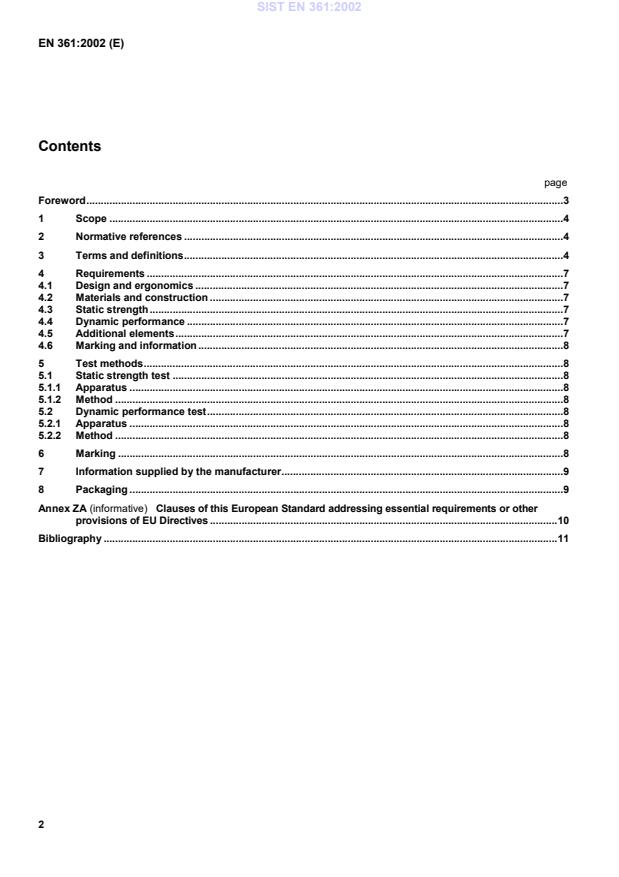
Clauses of this European Standard addressing essential requirements or otherprovisions of EU Directives.10Bibliography.11SIST EN 361:2002
...