

kSIST FprEN 878:2026
(Main)Chemicals used for treatment of water intended for human consumption - Aluminium sulfate
- Abstract
This document is applicable to aluminium sulfate used for treatment of water intended for human consumption. It describes the characteristics of aluminium sulfate and specifies the requirements for aluminium sulfate and gives reference to the analytical methods. It gives information on its use in water treatment. It also specifies the rules relating to safe handling (Annex B) and describes the use of aluminium sulfate (see Annex A).
- Status
- Not Published
- Public Enquiry End Date
- 15-Oct-2025
- Technical Committee
- IOVO - Water supply and waste water engineering
- Current Stage
- 5020 - Formal vote (FV) (Adopted Project)
- Start Date
- 28-Aug-2026
- Due Date
- 16-Oct-2026
- Completion Date
- 02-Sep-2026

kSIST FprEN 878:2026 is a CEN standard for aluminium sulfate used to treat water intended for human consumption. It describes the product, sets purity and test-related requirements, and gives guidance on use, safe handling, transport and storage for water-treatment operators, suppliers and laboratories.
What does kSIST FprEN 878:2026 specify?
kSIST FprEN 878:2026 applies to aluminium sulfate used for treatment of water intended for human consumption. It covers the product description, minimum purity criteria, analytical references, and practical information for use in water treatment.
The document is organized into clauses for scope, normative references, terms, description, purity criteria, test methods, and labelling, transportation and storage. Annex A gives general information on aluminium sulfate and Annex B gives normative safety rules.
The introduction also states that conformity with the document does not itself mean the product is approved for use in any EU or EFTA country; national control still applies.
| Annex | What it covers |
|---|---|
| Annex A | General information on aluminium sulfate, including origin, quality and use |
| Annex B | General rules relating to safety, including first aid and emergency procedures |
What are the key requirements of kSIST FprEN 878:2026?
Product description and identification
Clause 4 identifies aluminium sulfate by name, common synonyms, molecular data, formulae, CAS Registry Numbers and an EINECS reference. It also describes the main commercial forms, which include solid hydrated forms and aqueous solutions.
In practice, this helps buyers and laboratories confirm that the material being delivered is the intended treatment chemical and not a different alum or aluminium salt.
Clause 4 also gives key physical and chemical properties such as appearance, density, solubility, crystallization behaviour and viscosity. That matters because these properties affect pumping, dissolution, storage temperature and dosing stability.
Purity criteria
Clause 5 sets minimum purity requirements for the product used in drinking water treatment. The concentration of active matter, expressed as aluminium content, shall stay within the declared tolerance, so purchasers can check that the delivered product matches the supplier’s stated grade.
Clause 5 also limits impurities such as iron and insoluble matter, and it gives chemical parameter limits for arsenic, cadmium, chromium, mercury, nickel, lead, antimony and selenium in three product types. In practice, the user selects a suitable grade based on raw water quality, target treated-water quality and local regulatory expectations.
Annex A explains that these three types reflect commercially available product qualities and shows their possible impact on trace metals in treated water. That helps utilities choose a grade that fits their water quality objectives and dosing conditions.
Testing, delivery and storage
Clause 6 directs users to EN 1302 for sampling and analysis. This means acceptance testing and compliance checks are tied to a named analytical method set rather than to ad hoc laboratory practice.
Clause 7 covers delivery, labelling, transport, marking and storage. It requires suitable corrosion-resistant delivery and storage materials, EU labelling, product marking, and storage above 0 °C, which matters for preserving product quality and avoiding equipment damage.
Clause 7 also distinguishes the transport picture for solids and solutions and notes that the solution form is corrosive for transport purposes. For operators and carriers, that affects packaging choice, routing documents and handling controls.
Use and safety
Annex A describes aluminium sulfate as a coagulant, notes typical application as a liquid solution, and says positive displacement metering pumps are usually used. It also lists expected secondary effects such as lower pH, lower alkalinity and increased sulfate, so plant operators can plan downstream process control.
Annex B gives the safety actions for handling incidents, spills and fire. This is the section to use for site procedures, training and emergency planning.
Who uses kSIST FprEN 878:2026?
kSIST FprEN 878:2026 is used by drinking water suppliers, water treatment plant operators, chemical manufacturers, distributors, laboratories and procurement teams. It is relevant when selecting a grade, checking incoming deliveries, setting dosing conditions, writing specifications, or documenting conformity for treatment chemicals.
It is also useful for transport and safety personnel because it links product form to packaging, labelling, storage and emergency handling.
What changed in kSIST FprEN 878:2026 from the previous edition?
kSIST FprEN 878:2026 replaces EN 878:2016. The foreword states that the significant technical update is related to the Drinking Water Directive.
Which standards are used with kSIST FprEN 878:2026?
The normative reference in kSIST FprEN 878:2026 is EN 1302, which provides the analytical methods used for sampling and analysis of aluminium-based coagulants. That is the document readers need when they want to test the product.
The bibliography also cites Directive (EU) 2020/2184 for drinking water quality context and Regulation (EC) No 1272/2008 for classification, labelling and packaging. These references support the product’s water-quality and hazard-labelling context.
What does the kSIST FprEN 878:2026 document contain?
kSIST FprEN 878:2026 contains identity data for aluminium sulfate, including names, formulae, registry numbers and commercial forms. It also includes a structured physical-property section with tables for density, solubility and viscosity, which are useful for process design and storage planning.
The purity section contains tables for impurities and chemical parameters, grouped by product type. These tables support specification writing, supplier qualification and receipt inspection.
Clause 7 contains delivery, marking, transport and storage guidance, while Annex B gives first aid, spill response and fire guidance. Annex A adds application information, including typical dosing, application method and the effects of excess product removal, which is useful for plant operation and commissioning.
Relations
- Effective Date
- 19-Jan-2023
Get Certified
Connect with accredited certification bodies for this standard

ECOCERT
Organic and sustainability certification.

CIS Institut d.o.o.
Personal Protective Equipment (PPE) certification body. Notified Body NB-2890 for EU Regulation 2016/425 PPE.

Eurofins Food Testing Global
Global leader in food, environment, and pharmaceutical product testing.
Sponsored listings
Frequently Asked Questions
kSIST FprEN 878:2026 is a draft published by the Slovenian Institute for Standardization (SIST). Its full title is "Chemicals used for treatment of water intended for human consumption - Aluminium sulfate". This standard covers: This document is applicable to aluminium sulfate used for treatment of water intended for human consumption. It describes the characteristics of aluminium sulfate and specifies the requirements for aluminium sulfate and gives reference to the analytical methods. It gives information on its use in water treatment. It also specifies the rules relating to safe handling (Annex B) and describes the use of aluminium sulfate (see Annex A).
This document is applicable to aluminium sulfate used for treatment of water intended for human consumption. It describes the characteristics of aluminium sulfate and specifies the requirements for aluminium sulfate and gives reference to the analytical methods. It gives information on its use in water treatment. It also specifies the rules relating to safe handling (Annex B) and describes the use of aluminium sulfate (see Annex A).
kSIST FprEN 878:2026 is classified under the following ICS (International Classification for Standards) categories: 13.060.20 - Drinking water; 71.100.80 - Chemicals for purification of water. The ICS classification helps identify the subject area and facilitates finding related standards.
kSIST FprEN 878:2026 has the following relationships with other standards: It is inter standard links to SIST EN 878:2016. Understanding these relationships helps ensure you are using the most current and applicable version of the standard.
kSIST FprEN 878:2026 is available in PDF format for immediate download after purchase. The document can be added to your cart and obtained through the secure checkout process. Digital delivery ensures instant access to the complete standard document.
Standards Content (Sample)
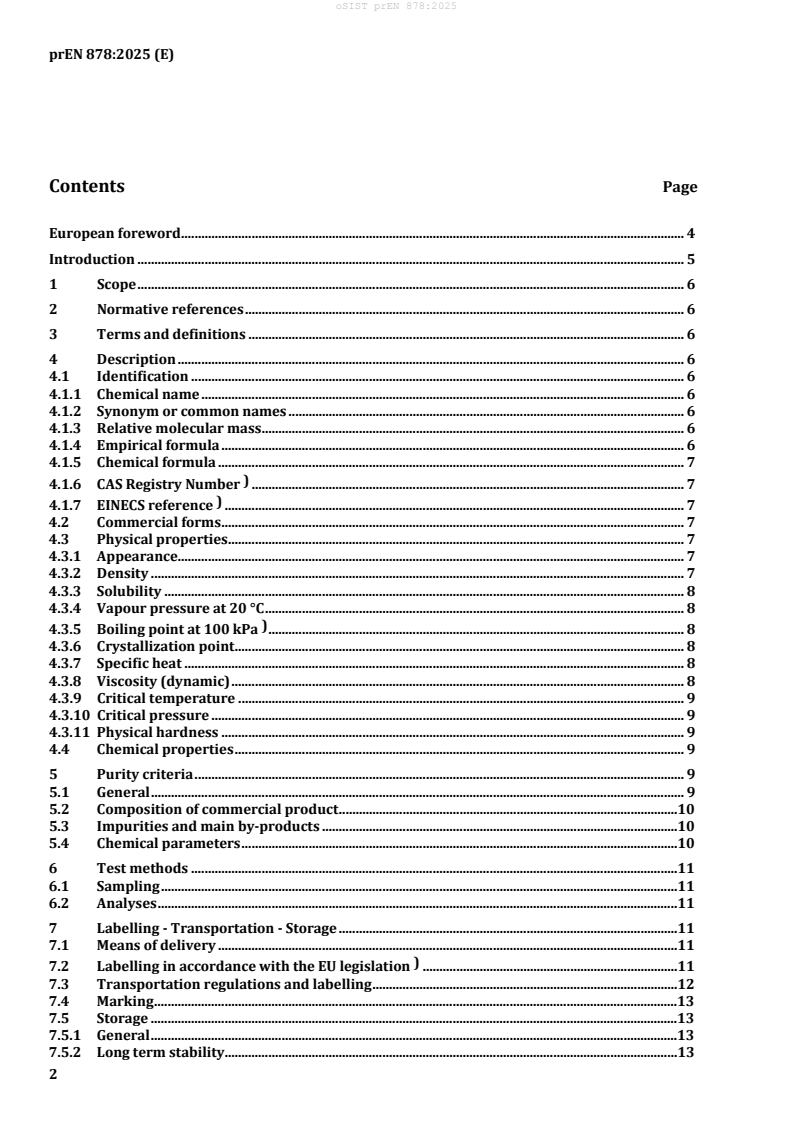
Contents
- Introduction
- 1 Scope
- 2 Normative references
- 3 Terms and definitions
- 4 Description
- 4.1 Identification
- 4.2 Commercial forms
- 4.3 Physical properties
- 4.4 Chemical properties
- 5 Purity criteria
- 5.1 General
- 5.2 Composition of commercial product
- 5.3 Impurities and main by-products
- 5.4 Chemical parameters
- 6 Test methods
- 6.1 Sampling
- 6.2 Analyses
- 7 Labelling - Transportation - Storage
- 7.1 Means of delivery
- 7.2 Labelling in accordance with the EU legislation
- 7.3 Transportation regulations and labelling
- 7.4 Marking
- 7.5 Storage
- Annex A
- Annex B
- Bibliography
Introduction
In respect of potential adverse effects on the quality of water intended for human consumption, caused by the product covered by this document:
1) this document provides no information as to whether the product may be used without restriction in any of the Member States of the EU or EFTA; 2) it should be noted that, while awaiting the adoption of verifiable European criteria, existing national regulations concerning the use and/or the characteristics of this product remain in force. NOTE Conformity with this document does not confer or imply acceptance or approval of the product in any of the Member States of the EU or EFTA. The use of the product covered by this document is subject to regulation or control by National Authorities.
oSIST prEN 878:2025 prEN 878:2025 (E)
1 Scope
This document is applicable to aluminium sulfate used for treatment of water intended for human consumption. It describes the characteristics of aluminium sulfate and specifies the requirements for aluminium sulfate and gives reference to the analytical methods. It gives information on its use in water treatment. It also determines the rules relating to safe handling (Annex B) and use of aluminium sulfate (see Annex A).
2 Normative references
The following documents, in whole or in part, are normatively referenced in this document and are indispensable for its application. For dated references, only the edition cited applies. For undated references, the latest edition of the referenced document (including any amendments) applies. EN 1302, Chemicals used for treatment of water intended for human consumption — Aluminium-based coagulants — Analytical methods
3 Terms and definitions
No terms and definitions are listed in this document.
ISO and IEC maintain terminology databases for use in standardization at the following addresses:
- ISO Online browsing platform: available at https://www.iso.org/obp
- IEC Electropedia: available at https://www.electropedia.org/
4 Description
4.1 Identification
4.1.1 Chemical name
Aluminium sulfate.
4.1.2 Synonym or common names
Aluminium sulfate, cake alum, alum.
NOTE In English the generic term “alum” is imprecise and is deprecated and in German the term “Alaun” is misleading, as “alumn”/”Alaun” is a kalium aluminium sulfate salt.
4.1.3 Relative molecular mass
342,14 for Al (SO ) .
2 4 3
4.1.4 Empirical formula
a) Al (SO ) .
2 4 3 b) Al (SO ) ·nH O.
2 4 3 2
oSIST prEN 878:2025 prEN 878:2025 (E)
4.1.5 Chemical formula
a) Al (SO ) .
2 4 3 b) Al (SO ) ·nH O.
2 4 3 2 1)
4.1.6 CAS Registry Number
Al (SO ) : 10043-01-3.
2 4 3 Al (SO ) ·14H O: 16828-12-9.
2 4 3 2 Al (SO ) ·16H O: 16828-11-8.
2 4 3 2 Al (SO ) ·18H O: 7784-31-8.
2 4 3 2 2)
4.1.7 EINECS reference
Al (SO ) : 233-135-0.
2 4 3
4.2 Commercial forms
Aluminium sulfate is available in solid hydrated forms, with different particle sizes (slabs, kibbled, ground, granulated) and as aqueous solutions.
4.3 Physical properties
4.3.1 Appearance
The product is a white solid or colourless to yellow, clear liquid.
4.3.2 Density
The density of a typical aluminium sulfate solution is given in Table 1 and varies depending on the concentration of the active matter (aluminium content), expressed in grams per kilogram of solution (Al g/kg). Table 1 — Density of solution Al g/kg of solution Density at 15 °C g/ml 40,8 1,310 41,6 1,315 42,5 1,320 43,3 1,325 44,2 1,330 45,0 1,335
1) Chemical Abstracts Service Registry Number.
2) European Inventory of Existing Commercial Chemical Substances.
oSIST prEN 878:2025 prEN 878:2025 (E)
4.3.3 Solubility
The theoretical limit of active matter content for a typical solution is given in Table 2. Table 2 — Solubility Temperature Active matter in °C Al g/kg of solution - 1 44,7 24 44,8
The practical limit of solubility depends on the temperature and the device used for solubilization of the solid form (slabs, kibbled, ground or granulated).
An indication of practical limits is given in Table 3.
Table 3 — Indication of practical limits of solubility Temperature Active matter Al g/kg of Solubility in grams solid solution form (containing Al °C 90 g/kg of solid) per kilogram of solution 15 37 410
4.3.4 Vapour pressure at 20 °C
Not known.
3)
4.3.5 Boiling point at 100 kPa
Not known.
4.3.6 Crystallization point
The crystallization point of aluminium sulfate varies, depending on the concentration of the active matter. For example:
- - 7 °C for a typical solution of aluminium content of 42,4 g/kg of solution.
- Solution stored at low temperatures (below 0 °C) can spontaneously form a solid mass of crystal hydrate.
4.3.7 Specific heat
Not known.
4.3.8 Viscosity (dynamic)
The viscosity of aluminium sulfate solution varies greatly, depending on the concentration of the active matter.
3) 100 kPa = 1 bar.
oSIST prEN 878:2025 prEN 878:2025 (E) For a typical solution of aluminium content of 42,4 g/kg of solution, the viscosity is given in Table 4. Table 4 — Viscosity Temperature Viscosity °C mPa.s 0 40,0 10 26,5 20 18,6 30 13,2 40 8,8
4.3.9 Critical temperature
Not applicable.
4.3.10 Critical pressure
Not applicable.
4.3.11 Physical hardness
Not applicable.
4.4 Chemical properties
Aluminium sulfate is an acidic hydrated salt or solution. Very dilute solutions hydrolyse and form a precipitate of aluminium hydroxide.
NOTE Since aluminium compounds are amphoteric in nature, the solubility of aluminium depends on the pH value and it is advised to use the product within an appropriate pH range.
...