

SIST EN 10333:2025
(Main)Steel for packaging - Flat steel products intended for use in contact with foodstuffs, products and beverages for human and animal consumption - Tin coated steel (tinplate)
General Information
- Abstract
This document specifies the composition of the base steel used for the production of tinplate for use in direct contact with foodstuffs or products for human and animal consumption as well as the composition of tin used to coat it. Tinplate can be produced with or without an organic coating.
The main examples of use are:
- drinks cans,
- food cans,
- packaging of dry foods,
- aerosol cans.
The material is chosen in accordance with the conditions for its use.
This document does not apply to categories of steel other than steel for packaging intended for use in contact with foodstuffs, products or beverages for human or animal consumption.
- Status
- Published
- Public Enquiry End Date
- 30-Jul-2024
- Publication Date
- 11-Dec-2024
- Technical Committee
- IFEK - Ferrous metals
- Current Stage
- 6060 - National Implementation/Publication (Adopted Project)
- Start Date
- 10-Dec-2024
- Due Date
- 14-Feb-2025
- Completion Date
- 12-Dec-2024

Overview
SIST EN 10333:2025 is the European standard developed by SIST for steel used in packaging applications, specifically flat steel products-tin coated steel (commonly known as tinplate)-intended for direct contact with foodstuffs, beverages, and other products for human and animal consumption. Tinplate provides a durable, protective barrier against contamination, preserving product integrity and extending the shelf life of contents. This standard outlines requirements for the composition of both the base steel and the tin coating, covering products with or without an additional organic coating.
The scope is limited to steel for packaging in food-contact applications, excluding other categories of steel products.
Key Topics
Material Composition
The standard defines strict chemical composition limits for the base steel, minimizing levels of elements such as lead (Pb), cadmium (Cd), and mercury (Hg), to ensure suitability for use with food and beverages.Tin Coating Specification
Specifies the purity requirements for tin used in coating, referencing EN 610, and mandates a lead content of less than 0.010% in the tin layer for consumer safety.Surface Treatment
Outlines optional passivation and oiling processes to improve corrosion resistance and aid in lacquering or printing. Oils must be suitable for contact with foodstuffs.Dimensional Tolerances
Refers to EN 10202:2022 for dimensions and tolerances, ensuring consistency and performance in packaging lines.Testing and Compliance
Provides guidelines for verifying compliance, including specified test methods such as the electrochemical methodology for assessing lead in tin coatings.Labelling and Traceability
Requires clear marking of batches for traceability, essential for quality assurance and supply chain management.
Applications
Tinplate packaging is essential in industries where food safety and product preservation are paramount. Common uses include:
- Food cans: Hermetically sealed containers for fruits, vegetables, meats, and ready meals.
- Drinks cans: Beverage packaging for soft drinks, juices, and energy drinks.
- Dry food packaging: Tins for powdered or granular foods (e.g., coffee, milk powders).
- Aerosol cans: Pressurized packaging for edible sprays or pet food.
Manufacturers select tinplate in accordance with the specific conditions and regulatory requirements of food and beverage contact to prevent contamination, maintain taste, and comply with legislation.
Related Standards
Compliance with SIST EN 10333:2025 is often part of a broader regulatory framework. Relevant standards and directives include:
- EN 10202:2022: Cold reduced tinmill products-Electrolytic tinplate and electrolytic chromium/chromium oxide coated steel.
- EN 10334: Steel for packaging-Non-coated steel (blackplate) for food contact.
- EN 10335: Steel for packaging-Non-alloyed electrolytic chromium/chromium oxide coated steel.
- EN 610: Tin and tin alloys-Ingot tin requirements.
- Regulation (EC) No 1935/2004: Materials and articles in contact with food.
- Directive 94/62/EC: Packaging and packaging waste requirements for environmental and consumer safety.
Practical Value
Adhering to SIST EN 10333:2025 helps manufacturers meet stringent food safety regulations, access international markets, and reassure consumers about the safety and quality of packaged food and beverages. Consistent product specifications ensure compatibility with automated packaging systems and efficient logistics, while robust testing methods guarantee ongoing compliance and traceability. This delivers practical value across the supply chain-from steel producers and canmakers to food brands and retailers-where legal compliance, consumer protection, and product preservation are business-critical.
Relations
- Effective Date
- 28-Jan-2026
- Effective Date
- 28-Jan-2026
- Effective Date
- 19-Jan-2023
Get Certified
Connect with accredited certification bodies for this standard

BSI Group
BSI (British Standards Institution) is the business standards company that helps organizations make excellence a habit.

Bureau Veritas
Bureau Veritas is a world leader in laboratory testing, inspection and certification services.

DNV
DNV is an independent assurance and risk management provider.
Sponsored listings
Frequently Asked Questions
SIST EN 10333:2025 is a standard published by the Slovenian Institute for Standardization (SIST). Its full title is "Steel for packaging - Flat steel products intended for use in contact with foodstuffs, products and beverages for human and animal consumption - Tin coated steel (tinplate)". This standard covers: This document specifies the composition of the base steel used for the production of tinplate for use in direct contact with foodstuffs or products for human and animal consumption as well as the composition of tin used to coat it. Tinplate can be produced with or without an organic coating. The main examples of use are: - drinks cans, - food cans, - packaging of dry foods, - aerosol cans. The material is chosen in accordance with the conditions for its use. This document does not apply to categories of steel other than steel for packaging intended for use in contact with foodstuffs, products or beverages for human or animal consumption.
This document specifies the composition of the base steel used for the production of tinplate for use in direct contact with foodstuffs or products for human and animal consumption as well as the composition of tin used to coat it. Tinplate can be produced with or without an organic coating. The main examples of use are: - drinks cans, - food cans, - packaging of dry foods, - aerosol cans. The material is chosen in accordance with the conditions for its use. This document does not apply to categories of steel other than steel for packaging intended for use in contact with foodstuffs, products or beverages for human or animal consumption.
SIST EN 10333:2025 is classified under the following ICS (International Classification for Standards) categories: 55.120 - Cans. Tins. Tubes; 55.130 - Aerosol containers; 67.250 - Materials and articles in contact with foodstuffs; 77.140.50 - Flat steel products and semi-products. The ICS classification helps identify the subject area and facilitates finding related standards.
SIST EN 10333:2025 has the following relationships with other standards: It is inter standard links to SIST EN 610:1998, SIST EN 10202:2022, SIST EN 10333:2005. Understanding these relationships helps ensure you are using the most current and applicable version of the standard.
SIST EN 10333:2025 is available in PDF format for immediate download after purchase. The document can be added to your cart and obtained through the secure checkout process. Digital delivery ensures instant access to the complete standard document.
Standards Content (Sample)
SLOVENSKI STANDARD
01-februar-2025
Jekla za embalažiranje – Ploščati jekleni izdelki, namenjeni stiku s hrano, pijačami
in drugimi izdelki za ljudi in živali - Jeklo, prevlečeno s kositrom (pločevina)
Steel for packaging - Flat steel products intended for use in contact with foodstuffs,
products and beverages for human and animal consumption - Tin coated steel (tinplate)
Verpackungsblech - Flacherzeugnisse aus Stahl für die Verwendung in Berührung mit
Lebensmitteln, Produkten und Getränken für den menschlichen und tierischen Verzehr -
Verzinnter Stahl (Weißblech)
Acier pour emballage - Produits plats en acier destiné à entrer au contact des denrées,
produits et boissons pour l'alimentation de l'homme et des animaux - Acier revêtu d'étain
(fer blanc ou fer étamé)
Ta slovenski standard je istoveten z: EN 10333:2024
ICS:
67.250 Materiali in predmeti v stiku z Materials and articles in
živili contact with foodstuffs
77.140.50 Ploščati jekleni izdelki in Flat steel products and semi-
polizdelki products
2003-01.Slovenski inštitut za standardizacijo. Razmnoževanje celote ali delov tega standarda ni dovoljeno.
EN 10333
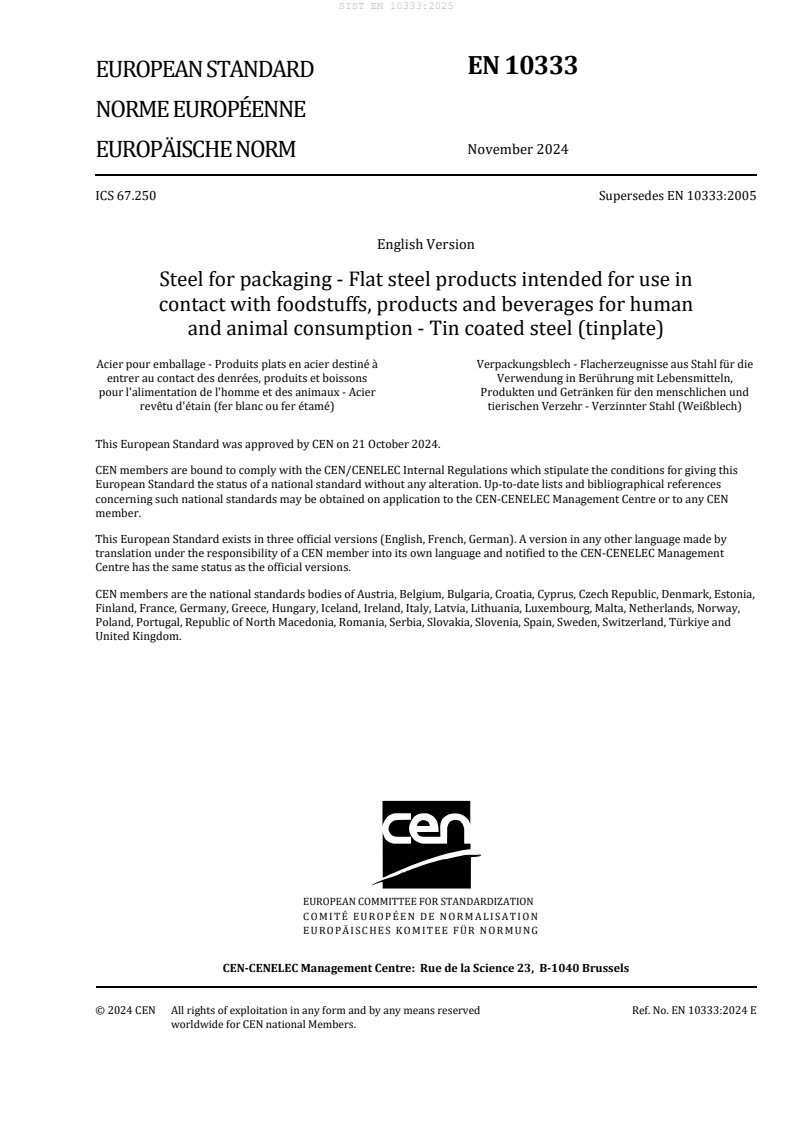
EUROPEAN STANDARD
NORME EUROPÉENNE
November 2024
EUROPÄISCHE NORM
ICS 67.250 Supersedes EN 10333:2005
English Version
Steel for packaging - Flat steel products intended for use in
contact with foodstuffs, products and beverages for human
and animal consumption - Tin coated steel (tinplate)
Acier pour emballage - Produits plats en acier destiné à Verpackungsblech - Flacherzeugnisse aus Stahl für die
entrer au contact des denrées, produits et boissons Verwendung in Berührung mit Lebensmitteln,
pour l'alimentation de l'homme et des animaux - Acier Produkten und Getränken für den menschlichen und
revêtu d'étain (fer blanc ou fer étamé) tierischen Verzehr - Verzinnter Stahl (Weißblech)
This European Standard was approved by CEN on 21 October 2024.
CEN members are bound to comply with the CEN/CENELEC Internal Regulations which stipulate the conditions for giving this
European Standard the status of a national standard without any alteration. Up-to-date lists and bibliographical references
concerning such national standards may be obtained on application to the CEN-CENELEC Management Centre or to any CEN
member.
This European Standard exists in three official versions (English, French, German). A version in any other language made by
translation under the responsibility of a CEN member into its own language and notified to the CEN-CENELEC Management
Centre has the same status as the official versions.
CEN members are the national standards bodies of Austria, Belgium, Bulgaria, Croatia, Cyprus, Czech Republic, Denmark, Estonia,
Finland, France, Germany, Greece, Hungary, Iceland, Ireland, Italy, Latvia, Lithuania, Luxembourg, Malta, Netherlands, Norway,
Poland, Portugal, Republic of North Macedonia, Romania, Serbia, Slovakia, Slovenia, Spain, Sweden, Switzerland, Türkiye and
United Kingdom.
EUROPEAN COMMITTEE FOR STANDARDIZATION
COMITÉ EUROPÉEN DE NORMALISATION
EUROPÄISCHES KOMITEE FÜR NORMUNG
CEN-CENELEC Management Centre: Rue de la Science 23, B-1040 Brussels
© 2024 CEN All rights of exploitation in any form and by any means reserved Ref. No. EN 10333:2024 E
worldwide for CEN national Members.
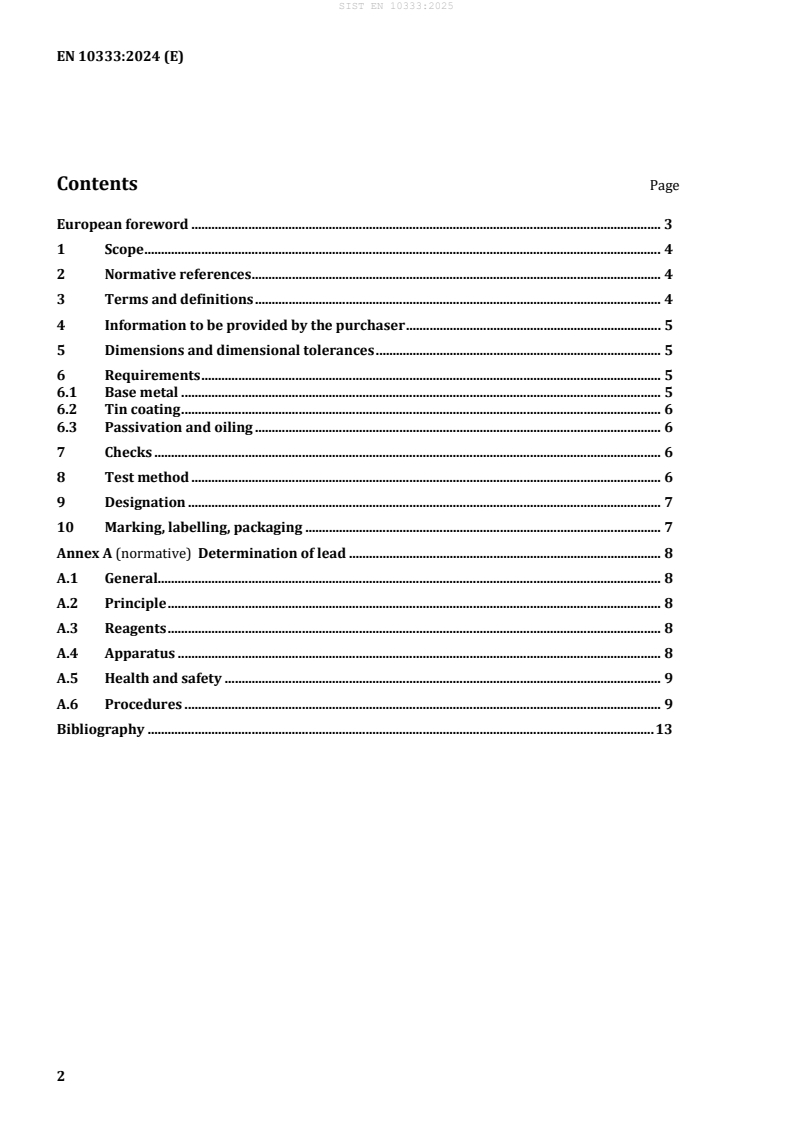
Contents Page
European foreword . 3
1 Scope . 4
2 Normative references . 4
3 Terms and definitions . 4
4 Information to be provided by the purchaser . 5
5 Dimensions and dimensional tolerances . 5
6 Requirements . 5
6.1 Base metal . 5
6.2 Tin coating . 6
6.3 Passivation and oiling . 6
7 Checks . 6
8 Test method . 6
9 Designation . 7
10 Marking, labelling, packaging . 7
Annex A (normative) Determination of lead . 8
A.1 General. 8
A.2 Principle . 8
A.3 Reagents . 8
A.4 Apparatus . 8
A.5 Health and safety . 9
A.6 Procedures . 9
Bibliography . 13
European foreword
This document (EN 10333:2024) has been prepared by Technical Committee CEN/TC 459 “ECISS -
European Committee for Iron and Steel Standardization” , the secretariat of which is held by AFNOR.
This European Standard shall be given the status of a national standard, either by publication of an
identical text or by endorsement, at the latest by May 2025, and conflicting national standards shall be
withdrawn at the latest by May 2025.
Attention is drawn to the possibility that some of the elements of this document may be the subject of
patent rights. CEN shall not be held responsible for identifying any or all such patent rights.
This document supersedes EN 10333:2005.
— The normative references have been updated;
— Annex A has been revised.
Any feedback and questions on this document should be directed to the users’ national standards body.
A complete listing of these bodies can be found on the CEN website.
According to the CEN-CENELEC Internal Regulations, the national standards organisations of the
following countries are bound to implement this European Standard: Austria, Belgium, Bulgaria, Croatia,
Cyprus, Czech Republic, Denmark, Estonia, Finland, France, Germany, Greece, Hungary, Iceland, Ireland,
Italy, Latvia, Lithuania, Luxembourg, Malta, Netherlands, Norway, Poland, Portugal, Republic of North
Macedonia, Romania, Serbia, Slovakia, Slovenia, Spain, Sweden, Switzerland, Türkiye and the United
Kingdom.
Through its sub-committee CEN/TC 459/SC 9 “Coated and uncoated flat products to be used for cold forming”
(secretariat: AFNOR).
1 Scope
This document specifies the composition of the base steel used for the production of tinplate for use in
direct contact with foodstuffs or products for human and animal consumption as well as the composition
of tin used to coat it. Tinplate can be produced with or without an organic coating.
The main examples of use are:
— drinks cans,
— food cans,
— packaging of dry foods,
— aerosol cans.
The material is chosen in accordance with the conditions for its use.
This document does not apply to categories of steel other than steel for packaging intended for use in
contact with foodstuffs, products or beverages for human or animal consumption.
2 Normative references
The following documents are referred to in the text in such a way that some or all of their content
constitutes requirements of this document. For dated references, only the edition cited applies. For
undated references, the latest edition of the referenced document (including any amendments) applies.
EN 610, Tin and tin alloys — Ingot tin
EN 10202:2022, Cold reduced tinmill products — Electrolytic tinplate and electrolytic
chromium/chromium oxide coated steel
3 Terms and definitions
For the purposes of this document, the following terms and definitions apply.
ISO and IEC maintain terminology databases for use in standardization at the following addresses:
— IEC Electropedia: available at https://www.electropedia.org/
— ISO Online browsing platform: available at https://www.iso.org/obp
3.1
tinplate
cold-rolled blackplate coated on at least one side with a layer of tin
Note 1 to entry: The mass of the coating can reach up to 15,1 g/m .
3.2
blackplate
low-carbon mild steel which has been subjected to cold reduction, is used mainly in the manufacture of
tinplate and electrolytic chromium/chromium oxide coated steel and has a minimum iron content greater
than 95% by mass
3.3
passivation
surface treatment designed to improve resistance to oxidation, resistance to sulphurizing and ease of
lacquering or printing on the tin coating
3.4
steel for packaging
alloyed/non-alloyed steel flat product intended for manufacturing cans and other packaging components
for drinks or food products
Note 1 to entry: According to the applications considered, this steel can be covered with a metal coating or with an
additional organic coating.
4 Information to be provided by the purchaser
The information, which shall be provided by the purchaser at the time of enquiry and order, shall satisfy
the requirements of EN 10202:2022.
NOTE Furthermore, the purchaser can specify the type of oil suitable for food contact to be used when the
product is delivered oiled.
5 Dimensions and dimensional tolerances
The nominal dimensions shall be agreed at the time of enquiry and order.
Dimensional tolerances shall meet the requirements of EN 10202:2022, Clause 9.
6 Requirements
6.1 Base metal
The composition of the base metal shall meet the requirements of Table 1.
NOTE This table is identical in EN 10333, EN 10334 and EN 10335.
a, b
Table 1 — Chemical composition
Specified elements Max. Content in % (of mass)
Al Aluminium 1,0
As Arsenic 0,030
B Boron 0,05
C Carbon 0,30
b
Cd + Pb + Hg 0,0100
b
Cd Cadmium
...