

SIST EN ISO 7405:2025
(Main)Dentistry - Evaluation of biocompatibility of medical devices used in dentistry (ISO 7405:2025)
General Information
- Abstract
This document specifies test methods for the evaluation of biological effects of medical devices used in dentistry. It includes testing of pharmacological agents that are an integral part of the device under test.
This document does not cover testing of materials and devices that do not come into direct or indirect contact with the patient's body.
- Status
- Published
- Public Enquiry End Date
- 30-May-2024
- Publication Date
- 20-Jul-2025
- Technical Committee
- VAZ - Healthcare
- Current Stage
- 6060 - National Implementation/Publication (Adopted Project)
- Start Date
- 18-Jul-2025
- Due Date
- 22-Sep-2025
- Completion Date
- 21-Jul-2025

Overview
EN ISO 7405:2025 - Dentistry: Evaluation of biocompatibility of medical devices used in dentistry (ISO 7405:2025) is the latest CEN-adopted edition for biological evaluation of dental medical devices. Approved by CEN in June 2025 and published as a European standard, it specifies test methods and procedures to assess biological effects of dental devices - including devices that contain pharmacological agents integral to the device. The standard explicitly excludes materials and devices that do not come into direct or indirect contact with the patient.
Key topics and requirements
- Device categorization: Guidance on categorizing devices by nature of contact (non-contact, surface-contacting, external communicating, implantable) and by duration of contact (limited, prolonged, long-term).
- Biological evaluation process: Framework for selecting appropriate tests, overall assessment, and re-evaluation when design, materials or manufacturing change.
- Test groups and methods:
- Physical and chemical characterization: Baseline data to inform biological testing.
- Group I / II / III tests: Structured classification to determine in vitro and in vivo testing needs.
- Specific dental test procedures: Detailed methods for dental-relevant assays such as agar diffusion test, filter diffusion test, pulp and dentine usage test, pulp capping test, and endodontic usage test.
- Sample preparation: Recommendations for preparing test specimens, including light-curing and chemically setting materials, and use of positive control materials.
- Reporting and assessment: Requirements for documenting methods, controls, assessment parameters and test reports to support regulatory or conformity claims.
Practical applications and users
EN ISO 7405:2025 is intended for:
- Dental device manufacturers - to plan preclinical biocompatibility testing and support regulatory submissions.
- Biomedical and materials test laboratories - to implement standardized in vitro and in vivo dental-specific assays.
- Regulatory affairs and quality teams - to assess compliance and prepare technical files for market approval.
- R&D and product development - to guide material selection, risk assessment and safety verification.
- Notified bodies and conformity assessors - to evaluate evidence of biological safety for dental devices and integrated pharmacological agents.
Practical uses include design verification, risk management, preclinical safety testing, and re-evaluation after formulation or process changes.
Related standards
- The standard aligns with broader biological evaluation frameworks used in medical device regulation. For comprehensive program design, organizations commonly reference complementary biological evaluation standards and national regulatory guidance when preparing submissions.
Keywords: EN ISO 7405, ISO 7405:2025, biocompatibility, dental devices, dentistry standard, agar diffusion test, pulp capping, endodontic usage test, biological evaluation.
Relations
- Effective Date
- 01-Sep-2025
- Effective Date
- 28-Jan-2026
- Effective Date
- 28-Jan-2026
- Effective Date
- 28-Jan-2026
- Effective Date
- 28-Jan-2026
- Effective Date
- 28-Jan-2026
- Effective Date
- 28-Jan-2026
- Effective Date
- 28-Jan-2026
- Effective Date
- 28-Jan-2026
- Effective Date
- 28-Jan-2026
- Refers
SIST EN 15624:2021/kFprA1:2024 - Railway applications - Braking - Empty-loaded changeover devices - Effective Date
- 28-Jan-2026
- Effective Date
- 28-Jan-2026
- Effective Date
- 28-Jan-2026
- Effective Date
- 28-Jan-2026
Get Certified
Connect with accredited certification bodies for this standard

BSI Group
BSI (British Standards Institution) is the business standards company that helps organizations make excellence a habit.

TÜV Rheinland
TÜV Rheinland is a leading international provider of technical services.

TÜV SÜD
TÜV SÜD is a trusted partner of choice for safety, security and sustainability solutions.
Sponsored listings
Frequently Asked Questions
SIST EN ISO 7405:2025 is a standard published by the Slovenian Institute for Standardization (SIST). Its full title is "Dentistry - Evaluation of biocompatibility of medical devices used in dentistry (ISO 7405:2025)". This standard covers: This document specifies test methods for the evaluation of biological effects of medical devices used in dentistry. It includes testing of pharmacological agents that are an integral part of the device under test. This document does not cover testing of materials and devices that do not come into direct or indirect contact with the patient's body.
This document specifies test methods for the evaluation of biological effects of medical devices used in dentistry. It includes testing of pharmacological agents that are an integral part of the device under test. This document does not cover testing of materials and devices that do not come into direct or indirect contact with the patient's body.
SIST EN ISO 7405:2025 is classified under the following ICS (International Classification for Standards) categories: 11.060.01 - Dentistry in general; 11.060.10 - Dental materials; 11.100.20 - Biological evaluation of medical devices; 11.100.99 - Other standards related to laboratory medicine. The ICS classification helps identify the subject area and facilitates finding related standards.
SIST EN ISO 7405:2025 has the following relationships with other standards: It is inter standard links to SIST EN ISO 7405:2019, SIST EN 18052:2026, kSIST FprEN 13121-3:2026, SIST EN 12905:2013, SIST EN 1793-2:2018, SIST EN ISO 23411:2021, SIST EN 1527:2019/oprA1:2021, SIST EN 12301:2020/AC:2021, SIST EN 17703:2025, SIST EN ISO 3826-1:2019/A1:2023, SIST EN 15624:2021/kFprA1:2024, oSIST prEN ISO 16383-2:2026, SIST EN 1642:2012, SIST EN 1641:2010. Understanding these relationships helps ensure you are using the most current and applicable version of the standard.
SIST EN ISO 7405:2025 is available in PDF format for immediate download after purchase. The document can be added to your cart and obtained through the secure checkout process. Digital delivery ensures instant access to the complete standard document.
Standards Content (Sample)
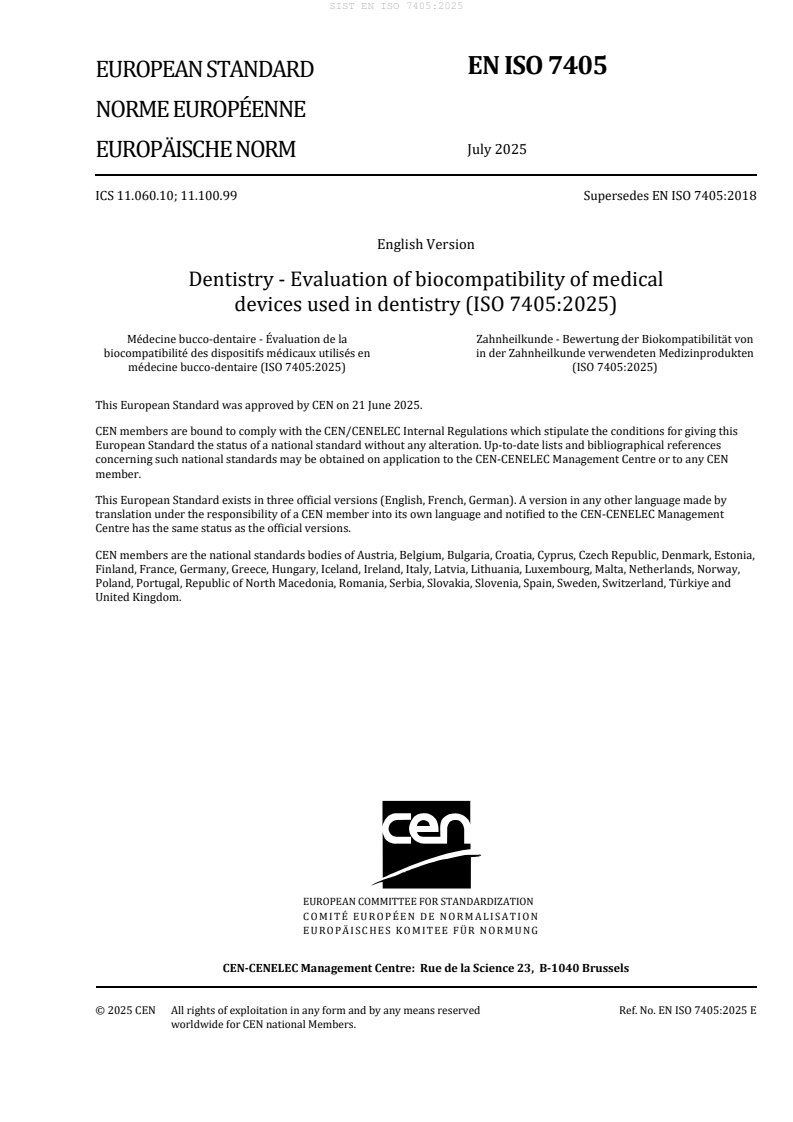
SLOVENSKI STANDARD
01-september-2025
Nadomešča:
SIST EN ISO 7405:2019
Zobozdravstvo - Ovrednotenje biokompatibilnosti medicinskih pripomočkov v
zobozdravstvu (ISO 7405:2025)
Dentistry - Evaluation of biocompatibility of medical devices used in dentistry (ISO
7405:2025)
Zahnheilkunde - Bewertung der Biokompatibilität von in der Zahnheilkunde verwendeten
Medizinprodukten (ISO 7405:2025)
Médecine bucco-dentaire - Évaluation de la biocompatibilité des dispositifs médicaux
utilisés en médecine bucco-dentaire (ISO 7405:2025)
Ta slovenski standard je istoveten z: EN ISO 7405:2025
ICS:
11.060.01 Zobozdravstvo na splošno Dentistry in general
11.100.20 Biološko ovrednotenje Biological evaluation of
medicinskih pripomočkov medical devices
2003-01.Slovenski inštitut za standardizacijo. Razmnoževanje celote ali delov tega standarda ni dovoljeno.
EN ISO 7405
EUROPEAN STANDARD
NORME EUROPÉENNE
July 2025
EUROPÄISCHE NORM
ICS 11.060.10; 11.100.99 Supersedes EN ISO 7405:2018
English Version
Dentistry - Evaluation of biocompatibility of medical
devices used in dentistry (ISO 7405:2025)
Médecine bucco-dentaire - Évaluation de la Zahnheilkunde - Bewertung der Biokompatibilität von
biocompatibilité des dispositifs médicaux utilisés en in der Zahnheilkunde verwendeten Medizinprodukten
médecine bucco-dentaire (ISO 7405:2025) (ISO 7405:2025)
This European Standard was approved by CEN on 21 June 2025.
CEN members are bound to comply with the CEN/CENELEC Internal Regulations which stipulate the conditions for giving this
European Standard the status of a national standard without any alteration. Up-to-date lists and bibliographical references
concerning such national standards may be obtained on application to the CEN-CENELEC Management Centre or to any CEN
member.
This European Standard exists in three official versions (English, French, German). A version in any other language made by
translation under the responsibility of a CEN member into its own language and notified to the CEN-CENELEC Management
Centre has the same status as the official versions.
CEN members are the national standards bodies of Austria, Belgium, Bulgaria, Croatia, Cyprus, Czech Republic, Denmark, Estonia,
Finland, France, Germany, Greece, Hungary, Iceland, Ireland, Italy, Latvia, Lithuania, Luxembourg, Malta, Netherlands, Norway,
Poland, Portugal, Republic of North Macedonia, Romania, Serbia, Slovakia, Slovenia, Spain, Sweden, Switzerland, Türkiye and
United Kingdom.
EUROPEAN COMMITTEE FOR STANDARDIZATION
COMITÉ EUROPÉEN DE NORMALISATION
EUROPÄISCHES KOMITEE FÜR NORMUNG
CEN-CENELEC Management Centre: Rue de la Science 23, B-1040 Brussels
© 2025 CEN All rights of exploitation in any form and by any means reserved Ref. No. EN ISO 7405:2025 E
worldwide for CEN national Members.
Contents Page
European foreword . 3
European foreword
This document (EN ISO 7405:2025) has been prepared by Technical Committee ISO/TC 106 "Dentistry"
in collaboration with Technical Committee CEN/TC 55 “Dentistry” the secretariat of which is held by
DIN.
This European Standard shall be given the status of a national standard, either by publication of an
identical text or by endorsement, at the latest by January 2026, and conflicting national standards shall
be withdrawn at the latest by January 2026.
Attention is drawn to the possibility that some of the elements of this document may be the subject of
patent rights. CEN shall not be held responsible for identifying any or all such patent rights.
This document supersedes EN ISO 7405:2018.
Any feedback and questions on this document should be directed to the users’ national standards
body/national committee. A complete listing of these bodies can be found on the CEN website.
According to the CEN-CENELEC Internal Regulations, the national standards organizations of the
following countries are bound to implement this European Standard: Austria, Belgium, Bulgaria,
Croatia, Cyprus, Czech Republic, Denmark, Estonia, Finland, France, Germany, Greece, Hungary, Iceland,
Ireland, Italy, Latvia, Lithuania, Luxembourg, Malta, Netherlands, Norway, Poland, Portugal, Republic of
North Macedonia, Romania, Serbia, Slovakia, Slovenia, Spain, Sweden, Switzerland, Türkiye and the
United Kingdom.
Endorsement notice
The text of ISO 7405:2025 has been approved by CEN as EN ISO 7405:2025 without any modification.
International
Standard
ISO 7405
Fourth edition
Dentistry — Evaluation of
2025-06
biocompatibility of medical devices
used in dentistry
Médecine bucco-dentaire — Évaluation de la biocompatibilité des
dispositifs médicaux utilisés en médecine bucco-dentaire
Reference number
ISO 7405:2025(en) © ISO 2025
ISO 7405:2025(en)
© ISO 2025
All rights reserved. Unless otherwise specified, or required in the context of its implementation, no part of this publication may
be reproduced or utilized otherwise in any form or by any means, electronic or mechanical, including photocopying, or posting on
the internet or an intranet, without prior written permission. Permission can be requested from either ISO at the address below
or ISO’s member body in the country of the requester.
ISO copyright office
CP 401 • Ch. de Blandonnet 8
CH-1214 Vernier, Geneva
Phone: +41 22 749 01 11
Email: copyright@iso.org
Website: www.iso.org
Published in Switzerland
ii
ISO 7405:2025(en)
Contents Page
Foreword .v
Introduction .vi
1 Scope . 1
2 Normative references . 1
3 Terms and definitions . 2
4 Categorization of medical devices. 3
4.1 Categorization by nature of contact .3
4.1.1 General .3
4.1.2 Non-contact devices .3
4.1.3 Surface-contacting devices .3
4.1.4 External communicating devices .3
4.1.5 Implant devices used in dentistry .3
4.2 Categorization by duration of contact .4
4.2.1 General .4
4.2.2 Limited exposure devices .4
4.2.3 Prolonged exposure devices .4
4.2.4 Long-term exposure devices .4
5 Biological evaluation process . 4
5.1 General .4
5.2 Selection of tests and overall assessment .5
5.3 Selection of test methods .5
5.4 Types of test .5
5.4.1 General .5
5.4.2 Physical and chemical characterization .5
5.4.3 Group I .5
5.4.4 Group II .6
5.4.5 Group III .6
5.5 Re-evaluation of biocompatibility .6
6 Test procedures specific to dental materials . 7
6.1 Recommendations for sample preparation.7
6.1.1 General .7
6.1.2 General recommendations for sample preparation .7
6.1.3 Specific recommendations for light curing materials .7
6.1.4 Specific recommendations for chemically setting materials .8
6.1.5 Positive control material .8
6.2 Agar diffusion test .8
6.2.1 Objective .8
6.2.2 Cell line .8
6.2.3 Culture medium, reagents and equipment .8
6.2.4 Sample preparation .9
6.2.5 Control materials .9
6.2.6 Test procedure.9
6.2.7 Parameters of assessment .10
6.2.8 Assessment of results .11
6.2.9 Test report .11
6.3 Filter diffusion test .11
6.3.1 Objective .11
6.3.2 Cell line .11
6.3.3 Culture medium, reagents and equipment . 12
6.3.4 Sample preparation . 12
6.3.5 Control materials . 12
6.3.6 Test procedure. 12
6.3.7 Assessment of cell damage . 13
iii
ISO 7405:2025(en)
6.3.8 Assessment of results . 13
6.3.9 Test report .14
6.4 Pulp and dentine usage test .14
6.4.1 Objective .14
6.4.2 Animals and animal welfare .14
6.4.3 Test procedure.14
6.4.4 Assessment of results . 20
6.4.5 Test report . 20
6.5 Pulp capping test . 20
6.5.1 Objective . 20
6.5.2 Animals and animal welfare . 20
6.5.3 Test procedure. 20
6.5.4 Assessment of results . 22
6.5.5 Test report . 22
6.6 Endodontic usage test . 22
6.6.1 Objective . 22
6.6.2 Animals and animal welfare . 23
6.6.3 Test procedure. 23
6.6.4 Assessment of results . 25
6.6.5 Test report . 25
Annex A (informative) Types of test to be considered for evaluation of biocompatibility of
medical devices used in dentistry .26
Annex B (informative) Dentine barrier cytotoxicity test .28
Annex C (informative) Endosseous dental implant usage test .35
Annex D (informative) Antioxidant responsive element (ARE) reporter assay oxidative stress
test .39
Annex E (informative) Margin of safety (MoS) for medical devices used in dentistry .48
Bibliography .57
iv
ISO 7405:2025(en)
Foreword
ISO (the International Organization for Standardization) is a worldwide federation of national standards
bodies (ISO member bodies). The work of preparing International Standards is normally carried out through
ISO technical committees. Each member body interested in a subject for which a technical committee
has been established has the right to be represented on that committee. International organizations,
governmental and non-governmental, in liaison with ISO, also take part in the work. ISO collaborates closely
with the International Electrotechnical Commission (IEC) on all matters of electrotechnical standardization.
The procedures used to develop this document and those intended for its further maintenance are described
in the ISO/IEC Directives, Part 1. In particular, the different approval criteria needed for the different types
of ISO document should be noted. This document was drafted in accordance with the editorial rules of the
ISO/IEC Directives, Part 2 (see www.iso.org/directives).
ISO draws attention to the possibility that the implementation of this document may involve the use of (a)
patent(s). ISO takes no position concerning the evidence, validity or applicability of any claimed patent
rights in respect thereof. As of the date of publication of this document, ISO had not received notice of (a)
patent(s) which may be required to implement this document. However, implementers are cautioned that
this may not represent the latest information, which may be obtained from the patent database available at
www.iso.org/patents. ISO shall not be held responsible for identifying any or all such patent rights.
Any trade name used in this document is information given for the convenience of users and does not
constitute an endorsement.
For an explanation of the voluntary nature of standards, the meaning of ISO specific terms and expressions
related to conformity assessment, as well as information about ISO's adherence to the World Trade
Organization (WTO) principles in the Technical Barriers to Trade (TBT), see www.iso.org/iso/foreword.html.
This document was prepared by Technical Committee ISO/TC 106, Dentistry, in collaboration with the
European Committee for Standardization (CEN) Technical Committee CEN/TC 55, Dentistry, in accordance
with the Agreement on technical cooperation between ISO and CEN (Vienna Agreement).
This fourth edition cancels and replaces ISO 7405:2018 which has been technically revised.
The main changes compared to the previous edition are as follows:
— update on normative references (e.g. replacement of ISO 6344-1 with ISO 6344-3);
— clarification on text of definitions and addition of definition for dentine barrier (3.8);
— for the agar diffusion test (6.2) the criteria for assessment of decolorization zone (Table 1) and qualitative
morphological/lysis index (Table 2) were harmonized with ISO 10993-5;
— addition of Annex D with an antioxidant responsive element (ARE) reporter assay cytotoxicity test.
— addition of Annex E “Margin of safety (MoS) for medical devices used in dentistry”.
Any feedback or questions on this document should be directed to the user’s national standards body. A
complete listing of these bodies can be found at www.iso.org/members.html.
v
ISO 7405:2025(en)
Introduction
This document describes the evaluation of the biocompatibility of medical devices used in dentistry. It is
intended to be used in conjunction with the ISO 10993 series. This document contains special tests, for
which ample experience exists in dentistry and which acknowledge the special needs of dentistry.
Only the test methods for which the members of the committee considered there was sufficient published
data have been included. In recommending test methods, the need to minimize the number and exposure of
test animals was given a high priority. It is essential that the decision to undertake tests involving animals
be reached only after a full and careful review of the evidence indicating that a similar outcome cannot be
achieved by other types of test. In order to keep the number of animals required for tests to an absolute
minimum, consistent with achieving the objective indicated, it can be appropriate to conduct more than
one type of test on the same animal at the same time, e.g. pulp and dentine usage test and pulp capping
test. However, in accordance with ISO 10993-2, these tests are performed both in an efficient and humane
way. On all occasions when animal testing is undertaken, such tests are conducted empathetically and in
accordance with standardized procedures as described for each test.
This document does not explicitly describe test methods for occupationally related risks.
Annex B is included to encourage the development of in vitro and ex vivo test methods which will further
reduce the use of animals in the evaluation of the biocompatibility of medical devices used in dentistry.
Annex C is based on and replaces ISO/TS 22911.
vi
International Standard ISO 7405:2025(en)
Dentistry — Evaluation of biocompatibility of medical devices
used in dentistry
1 Scope
This document specifies test methods for the evaluation of biological effects of medical devices used in
dentistry. It includes testing of pharmacological agents that are an integral part of the device under test.
This document does not cover testing of materials and devices that do not come into direct or indirect
contact with the patient's body.
2 Normative references
The following documents are referred to in the text in such a way that some or all of their content constitutes
requirements of this document. For dated references, only the edition cited applies. For undated references,
the latest edition of the referenced document (including any amendments) applies.
ISO 1942, Dentistry — Vocabulary
ISO 6344-3, Coated abrasives — Determination and designation of grain size distribution — Part 3: Microgrit
sizes P240 to P5000
ISO 10993-1, Biological evaluation of medical devices — Part 1: Evaluation and testing within a risk
management process
ISO 10993-2, Biological evaluation of medical devices — Part 2: Animal welfare requirements
ISO 10993-3, Biological evaluation of medical devices — Part 3: Tests for genotoxicity, carcinogenicity and
reproductive toxicity
ISO 10993-5:2009, Biological evaluation of medical devices — Part 5: Tests for in vitro cytotoxicity
ISO 10993-6, Biological evaluation of medical devices — Part 6: Tests for local effects after implantation
ISO 10993-10, Biological evaluation of medical devices — Part 10: Tests for skin sensitization
ISO 10993-11, Biological evaluation of medical devices — Part 11: Tests for systemic toxicity
ISO 10993-12:2021, Biological evaluation of medical devices — Part 12: Sample preparation and reference
materials
ISO 10993-17:2023, Biological evaluation of medical devices — Part 17: Toxicological risk assessment of medical
device constituents
ISO 10993-18:2020, Biological evaluation of medical devices — Part 18: Chemical characterization of medical
device materials within a risk management process
ISO/TS 10993-19, Biological evaluation of medical devices — Part 19: Physico-chemical, morphological and
topographical characterization of materials
ISO 10993-23, Biological evaluation of medical devices — Part 23: Tests for irritation
ISO 14971, Medical devices — Application of risk management to medical devices
ISO 16443, Dentistry — Vocabulary for dental implants systems and related procedure
ISO 7405:2025(en)
CIE S 017, ILV: International Lighting Vocabulary
3 Terms and definitions
For the purposes of this document, the terms and definitions given in ISO 1942, ISO 10993-1, ISO 10993-12,
ISO 10993-17, ISO 10993-18, ISO 16443, CIE S 017 and the following apply.
ISO and IEC maintain terminology databases for use in standardization at the following addresses:
— ISO Online browsing platform: available at https:// www .iso .org/ obp
— IEC Electropedia: available at https:// www .electropedia .org/
3.1
dental material
substance or combination of substances specially formulated and prepared for use in the practice of
dentistry and/or associated procedures
Note 1 to entry: Material is included within substance in this definition.
[SOURCE: ISO 1942: 2020, 3.1.4.8, modified — Note 1 to entry has been added]
3.2
final product
medical device or device component that includes all manufacturing processes for the “to be marketed”
device including packaging and sterilization, if applicable, and that includes processes prior to intended use,
such as mixing, preconditioning and preparation
[SOURCE: ISO 10993-1:2018, 3.8, modified — Wording from “and that includes processes prior to intended
use…” has been added.]
3.3
positive control material
well characterized material or substance that, when evaluated by a specific test method, demonstrates the
suitability of the test system to yield a reproducible, appropriately positive or reactive response in the test system
3.4
negative control material
well characterized material or substance that, when evaluated by a specific test method, demonstrates
the suitability of the test system to yield a reproducible, appropriately negative, non-reactive or minimal
response in the test system
Note 1 to entry: In practice, negative control materials include blanks, vehicles or solvents and reference materials (3.5).
3.5
reference material
material with one or more property values that are sufficiently reproducible and well established to enable
use of the material or substance for the calibration of an apparatus, the assessment of a measurement
method or for the assignment of values to materials
Note 1 to entry: For the purpose of this document, a reference material is any well characterized material or substance
that, when tested by the procedure described, demonstrates the suitability of the procedure to yield a reproducible,
predictable response. The response can be negative or positive.
3.6
in vitro pulp chamber
device that holds a thin slice of dentine between two chambers and allows fluid and molecules to filter or to
diffuse across the dentine barrier (3.8)
ISO 7405:2025(en)
3.7
diffusion
establishment of passive movement of solutes (solubilized constituents) by means of a diffusion gradient
through the dentine barrier (3.8)
3.8
dentine barrier
barrier made out of a slice of dentine from human or animal origin
4 Categorization of medical devices
4.1 Categorization by nature of contact
4.1.1 General
For the purposes of this document, the classification of medical devices used in dentistry is derived from
ISO 10993-1. If a device or material can be placed in more than one category, the more rigorous testing
requirements shall apply. With multiple exposures, the decision into which category a device is placed
shall take into account the potential cumulative effect, bearing in mind the period of time over which these
exposures occur.
NOTE For the purposes of this document, the term dentistry includes the oromaxillofacial environment.
4.1.2 Non-contact devices
These devices do not contact the patient's body directly or indirectly and are not included in ISO 10993-1.
4.1.3 Surface-contacting devices
These devices include those that contact the surface of intact or breached or otherwise compromised skin,
the surface of intact or breached or otherwise compromised oral mucosa, and those that contact the external
surfaces of dental hard tissue, including enamel, dentine and cementum.
NOTE In some circumstances, dentine and cementum are considered as surfaces, e.g. after gingival recession.
4.1.4 External communicating devices
These devices include dental devices that penetrate and are in contact with oral mucosa, dental hard tissues,
dental pulp tissue or bone, or any combination of these, and are exposed to the oral environment.
NOTE 1 This group also includes any kind of lining or base material to be used under a restoration.
NOTE 2 This group does not include implant devices used in dentistry (see 4.1.5).
4.1.5 Implant devices used in dentistry
These devices include dental implants and other dental devices that are partially or fully embedded in one
or more of the following:
a) soft tissue, e.g. subperiosteal implants and subdermal implants;
b) bone, e.g. endosteal implants and bone substitutes;
c) pulpodentinal system of the tooth, e.g. endodontic materials;
d) any combination of these, e.g. transosteal implants.
ISO 7405:2025(en)
4.2 Categorization by duration of contact
4.2.1 General
For the purposes of this document, medical devices used in dentistry are classified by duration of contact as
described in ISO 10993-1 and listed in 4.2.2 to 4.2.4.
With multiple exposures to the device, the decision into which category a device is placed shall take into
account the potential cumulative effect, bearing in mind the period of time over which these exposures occur.
NOTE When calculating the duration of exposure for contact categorization of repeat use devices, the total
exposure period in days between the first and last use of the medical device can be considered. For instance, the same
device can be reused intermittently over a number of days, or replacement devices can be used over a number of days.
If the treatment intervals are expected to be long relative to the elimination time of any leachable toxins from the
body, this infrequent use can be considered as for a single treatment episode.
4.2.2 Limited exposure devices
Devices whose cumulative sum of single, multiple or repeated duration of contact is up to 24 h.
4.2.3 Prolonged exposure devices
Devices whose cumulative sum of single, multiple or repeated duration of contact time is likely to exceed
24 h but not 30 days.
4.2.4 Long-term exposure devices
Devices whose cumulative sum of single, multiple or repeated contact time exceeds 30 days.
5 Biological evaluation process
5.1 General
Each medical device used in dentistry shall be subjected to a structured biological evaluation programme
within a risk management process (see ISO 10993-1). The implementation of this programme shall be in
accordance with ISO 14971 and ISO 10993-1.
The biological evaluation programme shall include the review of data sets concerning the biological
properties of each medical device used in dentistry. When this part of the biological evaluation programme
indicates that one or more data sets are incomplete and that further testing is necessary, the tests shall be
selected from the methods described in the ISO 10993 series, in this document or in both. If tests that are
not included in these International Standards are selected, a statement shall be made that indicates that the
tests described in these International Standards have been considered and shall include a justification for
the selection of other tests.
For combination products, the final product shall be evaluated in accordance with this document in
conjunction with any applicable standards.
NOTE 1 In this context, combination products are dental devices of any kind that incorporate, or are intended to
incorporate, as an integral part, a substance that:
a) if used separately, would be a medicine or a biological product;
b) is liable to affect the patient’s body by an ancillary action.
EXAMPLE A bone filling/augmentation device containing a growth factor (i.e. a biological product).
For combination products, where the device and pharmacological components are packaged separately, it
can be informative to test the device components alone.
ISO 7405:2025(en)
All tests shall be conducted in accordance with recognized current/valid best laboratory/quality practices,
where applicable.
NOTE 2 Examples of relevant guidance include the principles of Good Laboratory Practice or ISO/IEC 17025.
5.2 Selection of tests and overall assessment
The selection of tests and the overall assessment of the results shall be carried out by an expert who has the
appropriate chemical, physical and biological data concerning the device and who is aware of the intended
conditions of use.
5.3 Selection of test methods
The selection of test methods shall be based upon consideration of:
a) the intended use of the medical device;
b) the tissue(s) which the medical device may contact;
c) the duration of the contact.
If more than one test method in the same category is recommended by the standards mentioned in 5.1, the
selection of one test over the others shall be justified.
5.4 Types of test
5.4.1 General
In accordance with the categorization of the device, tests shall be considered for use as summarized
in Table A.1. This table indicates which types of test method shall be considered, but not that they are
necessarily required to be carried out. A decision not to carry out a type of test identified in Table A.1 shall
be justified in the test report on each device. The types of test listed are regarded as a framework for the
evaluation of the biocompatibility of medical devices used in dentistry. For most types of test, particular
methods are identified, although for some devices it is recognized that alternative methods not included in
the International Standards listed can be more appropriate.
5.4.2 Physical and chemical characterization
Material characterization of the medical device or component (see Table A.1) is a crucial first step in biological
evaluation. Material characterization, if performed, shall be conducted in accordance with ISO 10993-18 and
ISO/TS 10993-19. For nanomaterials, see ISO/TR 10993-22.
The types of biological tests are listed in three groups.
Toxicological risk assessment of chemical constituents should be performed according to ISO 10993-17. The
margin of safety (MoS) should be considered within the toxicological risk assessment. For guidance on the
MoS, see Annex E.
5.4.3 Group I
This group comprises in vitro tests of cytotoxicity. General guidance for in vitro cytotoxicity tests is
presented in ISO 10993-5 and shall be followed. Detailed test protocols for the agar or agarose diffusion
and filter diffusion methods, appropriate to dental materials, are included in this document. The in vitro
cytotoxicity methods include:
a) agar diffusion test (see 6.2);
b) filter diffusion test (see 6.3);
c) direct contact or extract tests in accordance with ISO 10993-5;
ISO 7405:2025(en)
d) dentine barrier cytotoxicity test (see Annex B);
e) antioxidant responsive element (ARE) reporter assay cytotoxicity test (see Annex D).
NOTE 1 The order of listing does not indicate any preference for one method over another.
NOTE 2 This list does not indicate that all cytotoxicity tests mentioned need to be performed for each medical
device under consideration.
NOTE 3 The use of the dentine barrier cytotoxicity test is encouraged and a description of the test is presented in
Annex B. See References [21] to [23] and [29] to [32].
NOTE 4 The use of ARE reporter assay cytotoxicity test is encouraged, if measurement of the oxidative stress of
cells after exposure to test and control materials via metabolic activity is either applicable or justified or both.
5.4.4 Group II
This group comprises tests in accordance with the ISO 10993 series and particular tests, which shall be
considered, where appropriate:
a) acute systemic toxicity — oral application — in accordance with ISO 10993-11;
b) acute systemic toxicity — application by inhalation — in accordance with ISO 10993-11;
c) subacute and subchronic systemic toxicity — oral application — in accordance with ISO 10993-11;
d) skin sensitization in accordance with ISO 10993-10;
e) genotoxicity in accordance with ISO 10993-3;
f) local effects after implantation in accordance with ISO 10993-6;
g) irritation in accordance with ISO 10993-23.
When evaluating materials following local implantation with mineralized tissues in accordance with
ISO 10993-6, it is recommended to examine undemineralized sections, in addition to routine demineralized
sections.
NOTE If appropriate, the local effects after implantation are evaluated in accordance with the endosseous dental
implant usage test instead of ISO 10993-6 [see 5.4.5, d)].
5.4.5 Group III
This group comprises tests that are specific for medical devices used in dentistry and that are not referred
to in the ISO 10993 series:
a) pulp and dentine usage test (see 6.4);
b) pulp capping test (see 6.5);
c) endodontic usage test (see 6.6);
d) endosseous dental implant usage test (see Annex C).
The endosseous dental implant usage test is not required but is recommended if applicable.
5.5 Re-evaluation of biocompatibility
In accordance with ISO 10993-1, a device shall be considered for re-evaluation of its biocompatibility
as described in 5.4 when revisions or modifications to the formula, the quality or the performance
specifications, or combination of them, are made.
NOTE See also ISO 10993-1:2018, B.4.5.1, which provides indications on when to commence a re-evaluation.
ISO 7405:2025(en)
6 Test procedures specific to dental materials
6.1 Recommendations for sample preparation
6.1.1 General
These recommendations have been designed for in vitro testing, but can also be used for other purposes, if
suitable.
6.1.2 General recommendations for sample preparation
For the preparation of test samples, consult either the respective product standards or the manufacturer’s
instructions, or both, and follow those descriptions as closely as possible. Justify any deviation from the
manufacturer's instructions. A detailed description of the sample preparation shall be included in the test
report. Take the following (e.g. environmental) factors into account, considering the final
...