

SIST EN 12961:2002
(Main)Adhesives for leather and footwear materials - Determination of optimum activation temperatures and maximum activation life of solvent-based and dispersion adhesives
General Information
- Abstract
This European Standard describes the determination of optimum heat activation temperature and maximum activation life of solvent-based or dispersion adhesives coated onto adherends, primarily based on the requirements for sole attaching adhesives. Optimum heat activation temperature and maximum heat activation life depend mainly on the type, composition and colour of the adhesive as well as the footwear material used.
- Status
- Published
- Publication Date
- 31-Jan-2002
- Technical Committee
- IPMA - Polimer materials and products
- Current Stage
- 6060 - National Implementation/Publication (Adopted Project)
- Start Date
- 01-Feb-2002
- Due Date
- 01-Feb-2002
- Completion Date
- 01-Feb-2002

Overview
SIST EN 12961:2002 is a European standard developed by the Slovenski inštitut za standardizacijo (SIST) that specifies procedures for determining the optimum activation temperature and maximum activation life of solvent-based and dispersion adhesives when used with leather and footwear materials. The standard focuses on adhesives widely used in shoe manufacturing, particularly those for sole attachment. It establishes repeatable test methods to ensure adhesives perform effectively under practical conditions, directly impacting footwear product quality and durability.
Key Topics
- Optimum Activation Temperature: The specific heat activation range in which adhesives provide satisfactory bond strength when joining footwear materials, such as leather, rubber, and synthetic uppers and soles.
- Maximum Activation Life: The longest interval after adhesive application where heat activation still produces bonds with minimal reduction in strength, ensuring manufacturing flexibility and process efficiency.
- Adhesive Types: Covers both solvent-based and dispersion (water-based) adhesives, accommodating industry shifts towards safer, environmentally friendly formulations.
- Test Procedures: Includes preparation of test samples, adhesive application, controlled drying, heat activation, and peel resistance testing to assess performance.
- Material Identification: Provides guidelines for reporting detailed information about adhesives and test materials (e.g., composition, origin, and physical characteristics).
- Safety Considerations: Stresses adherence to laboratory safety practices and compliance with national safety regulations in adhesive testing and handling.
Applications
SIST EN 12961:2002 is primarily intended for:
- Footwear Manufacturers: Ensuring adhesives used for attaching soles to uppers meet strength and reliability requirements throughout production and shelf life.
- Adhesive Producers: Supporting research, development, and quality control for adhesive formulations tailored to footwear and leather industry needs.
- Quality Assurance Laboratories: Standardizing test methods across manufacturers, providing comparable results for regulatory and customer requirements.
- Product Developers: Evaluating new adhesives or materials for compatibility and performance during product innovation cycles.
Benefits of implementing this standard include:
- Enhanced consistency and quality in shoe assembly
- Reduction in adhesive failures or premature bond degradation
- Improved product safety and regulatory compliance
- Efficient identification of optimum process windows for heat-activated bonding
Related Standards
For comprehensive quality management and compatibility, SIST EN 12961:2002 refers to or interfaces with several related European and international standards:
- EN 522: Specifies minimum bond strength requirements and adhesive classification for leather and footwear.
- EN 923: Provides standardized terms and definitions for adhesives, ensuring common understanding in technical documentation.
- EN 1066 / EN 1067: Outlines procedures for adhesive sampling and sample preparation.
- EN 1392: Details test methods for measuring bond strength under controlled conditions, which is directly referenced for peel strength measurements.
- ISO 554: Describes standard atmospheres for conditioning and testing, essential for reproducibility of results.
- ISO 868: Covers the determination of Shore hardness for plastic and rubber materials, often relevant for footwear components.
Conclusion
By following SIST EN 12961:2002, organizations involved in adhesive formulation, footwear production, and quality control can assure their products meet critical performance standards. This fosters market trust, streamlines quality claims, and supports innovation in both materials and processes within the global footwear industry.
Relations
- Effective Date
- 03-Jun-2026
- Effective Date
- 09-Feb-2026
- Effective Date
- 28-Jan-2026
- Effective Date
- 28-Jan-2026
- Effective Date
- 28-Jan-2026
- Effective Date
- 28-Jan-2026
- Effective Date
- 28-Jan-2026
- Effective Date
- 28-Jan-2026
- Effective Date
- 28-Jan-2026
- Effective Date
- 22-Dec-2008
Get Certified
Connect with accredited certification bodies for this standard

DIN CERTCO
DIN Group product certification.

Smithers Quality Assessments
US management systems and product certification.
Sponsored listings
Frequently Asked Questions
SIST EN 12961:2002 is a standard published by the Slovenian Institute for Standardization (SIST). Its full title is "Adhesives for leather and footwear materials - Determination of optimum activation temperatures and maximum activation life of solvent-based and dispersion adhesives". This standard covers: This European Standard describes the determination of optimum heat activation temperature and maximum activation life of solvent-based or dispersion adhesives coated onto adherends, primarily based on the requirements for sole attaching adhesives. Optimum heat activation temperature and maximum heat activation life depend mainly on the type, composition and colour of the adhesive as well as the footwear material used.
This European Standard describes the determination of optimum heat activation temperature and maximum activation life of solvent-based or dispersion adhesives coated onto adherends, primarily based on the requirements for sole attaching adhesives. Optimum heat activation temperature and maximum heat activation life depend mainly on the type, composition and colour of the adhesive as well as the footwear material used.
SIST EN 12961:2002 is classified under the following ICS (International Classification for Standards) categories: 61.060 - Footwear; 83.180 - Adhesives. The ICS classification helps identify the subject area and facilitates finding related standards.
SIST EN 12961:2002 has the following relationships with other standards: It is inter standard links to SIST ISO 554:1995, SIST ISO 868:1996, SIST EN 15062:2006, SIST EN 1067:2006, SIST EN 915:1996, SIST EN ISO 15605:2004, SIST EN 923:2016, SIST EN 15307:2015, SIST EN 1392:2006, SIST EN 12961:2002/A1:2005. Understanding these relationships helps ensure you are using the most current and applicable version of the standard.
SIST EN 12961:2002 is available in PDF format for immediate download after purchase. The document can be added to your cart and obtained through the secure checkout process. Digital delivery ensures instant access to the complete standard document.
Standards Content (Sample)
2003-01.Slovenski inštitut za standardizacijo. Razmnoževanje celote ali delov tega standarda ni dovoljeno.WHPSHUDWXUHKlebstoffe für Leder und Schuhwerkstoffe - Bestimmung der optimalen Aktiviertemperatur und der maximalen Dauer der Aktivierbarkeit von Lösemittel- und DispersionsklebstoffenAdhésifs pour cuir et matériaux pour articles chaussants - Détermination de la température optimale d'activation et de la durée maximale d'activation des adhésifs a base de solvant et en dispersionAdhesives for leather and footwear materials - Determination of optimum activation temperatures and maximum activation life of solvent-based and dispersion adhesives83.180LepilaAdhesives61.060ObuvalaFootwearICS:Ta slovenski standard je istoveten z:EN 12961:2001SIST EN 12961:2002en01-februar-2002SIST EN 12961:2002SLOVENSKI
STANDARD
EUROPEAN STANDARDNORME EUROPÉENNEEUROPÄISCHE NORMEN 12961March 2001ICS 83.180English versionAdhesives for leather and footwear materials - Determination ofoptimum activation temperatures and maximum activation life ofsolvent-based and dispersion adhesivesAdhésifs pour cuir et matériaux pour articles chaussants -Détermination de la température optimale d'activation et dela durée maximale d'activation des adhésifs à base desolvant et en dispersionKlebstoffe für Leder und Schuhwerkstoffe - Bestimmungder optimalen Aktiviertemperatur und der maximalen Dauerder Aktivierbarkeit von Lösemittel- undDispersionsklebstoffenThis European Standard was approved by CEN on 4 February 2001.CEN members are bound to comply with the CEN/CENELEC Internal Regulations which stipulate the conditions for giving this EuropeanStandard the status of a national standard without any alteration. Up-to-date lists and bibliographical references concerning such nationalstandards may be obtained on application to the Management Centre or to any CEN member.This European Standard exists in three official versions (English, French, German). A version in any other language made by translationunder the responsibility of a CEN member into its own language and notified to the Management Centre has the same status as the officialversions.CEN members are the national standards bodies of Austria, Belgium, Czech Republic, Denmark, Finland, France, Germany, Greece,Iceland, Ireland, Italy, Luxembourg, Netherlands, Norway, Portugal, Spain, Sweden, Switzerland and United Kingdom.EUROPEAN COMMITTEE FOR STANDARDIZATIONCOMITÉ EUROPÉEN DE NORMALISATIONEUROPÄISCHES KOMITEE FÜR NORMUNGManagement Centre: rue de Stassart, 36
B-1050 Brussels© 2001 CENAll rights of exploitation in any form and by any means reservedworldwide for CEN national Members.Ref. No. EN 12961:2001 ESIST EN 12961:2002
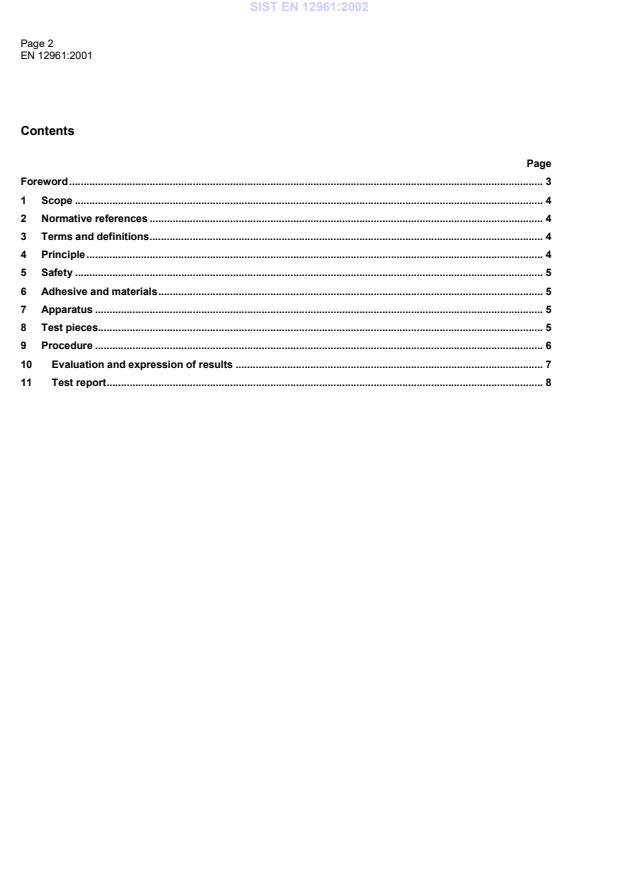
Page 2EN 12961:2001ContentsPageForeword.31Scope.42Normative references.43Terms and definitions.44Principle.45Safety.56Adhesive and materials.57Apparatus.58Test pieces.59Procedure.610Evaluation and expression of results.711Test report.8SIST EN 12961:2002
Page 3EN 12961:2001ForewordThis European Standard has been prepared by Technical Committee CEN/TC 193, "Adhesives", the secretariat ofwhich is held by AENOR.This European Standard shall be given the status of a national standard, either by publication of an identical text orby endorsement, at the latest by September 2001, and conflicting national standards shall be withdrawn at thelatest by September 2001.According to the CEN/CENELEC Internal Regulations, the national standards organizations of the followingcountries are bound to implement this European Standard: Austria, Belgium, Czech Republic, Denmark, Finland,France, Germany, Greece, Iceland, Ireland, Italy, Luxembourg, Netherlands, Norway, Portugal, Spain, Sweden,Switzerland and the United Kingdom.SIST EN 12961:2002
Page 4EN 12961:20011 ScopeThis European Standard specifies the determination of optimum heat activation temperatures and maximumactivation life of solvent-based or dispersion adhesives coated onto adherends, primarily based on therequirements for sole attaching adhesives. Optimum heat activation temperatures and maximum heat activation lifedepend mainly on the type, composition and colour of the adhesive as well as the footwear material used.2 Normative referencesThis European Standard incorporates by dated or undated reference, provisions from other publications. Thesenormative references are cited at the appropriate places in the text and the publications are listed hereafter. Fordated references, subsequent amendments to or revisions of any of these publications apply to this EuropeanStandard only when incorporated in it by amendment or revision. For undated references the latest edition of thepublication referred to applies(including amendments).EN 522Adhesives for leather and footwear materials – Bond strength –Minimum requirements and adhesive classificationEN 923Adhesives — Terms and definitionsEN 1066Adhesives —
SamplingEN 1067Adhesives —
Examination and preparation of samples for testingEN 1392Adhesives for leather and footwear materials — Solvent-basedand dispersion adhesives —Test methods for measuring the bondstrength under specified conditionsISO 554Standard atmospheres for conditioning and/or testing —SpecificationsISO 868Plastics and ebonite — Determination of indentation hardness bymeans of a durometer (Shore hardness)3 Terms and definitionsFor the purpose of this standard, the definitions in accordance with EN 923, EN 1392, and the following definitions,apply:3.1optimum activation temperaturesrange of surface temperatures of a heat activated adhesive coat at which a bond is produced which on peel testinghas satisfactory strength with a proportion of non-coalescence of less than 10 %.3.2maximum activation lifelongest time interval, beginning with adhesive application, at the end of which, compared to bonds obtained afterdrying without storing, heat activation at an optimum activation temperature produces bonds of less than 10 %reduction in peel strength with non-coalescence of less than 10%.4 PrincipleThe surfaces of the upper and the sole materials used for testing are treated specifically to the type of material.Strips of specified size and form are cut from the treated materials and coated with the adhesive under test. Thecoats applied are dried for a specified period of time under specified conditions.For determination of the optimum activation temperatures coats on sole material strips are heat activated to varioussurface temperatures at intervals of 10 C from 50 C to 90 C, unless otherwise specified, and immediatelyassembled with dried but not activated coats on strips cut from upper material. The test pieces produced are storedfor a specified time under specified conditions before their strength is determined in a peel test in accordance withEN 1392.SIST EN 12961:2002
Page 5EN 12961:2001For determination of the maximum activation life coats on sole material strips are dried and heat activated, aftervarious specified time intervals, to a determined optimum activation temperature and immediately assembled withdried but not activated coats on strips cut from upper material. The test pieces obtained are stored for a specifiedtime under specified conditions before their strength is determined in a peel test in accordance with EN 1392.5 SafetyPersons using this standard shall be familiar with normal laboratory practice.This standard does not purport to address all the safety problems, if any, associated with its use.It is the respons
...