

SIST EN 15460:2007
Water quality - Guidance standard for the surveying of macrophytes in lakes
General Information
- Abstract
This guidance standard defines a method for surveying aquatic macrophytes in lakes - primarily for the purpose of assessing ecological status, using these organisms as an element of biological quality. The information provided by this method includes the composition and abundance of the aquatic macrophyte flora.
For a complete assessment of ecological status, other elements of biological quality should also be assessed.
The general principle of the approach described in this European Standard may also form the basis for the monitoring and assessment of macrophytes in lakes, for example, for conservation purposes.
- Status
- Published
- Publication Date
- 06-Nov-2007
- Technical Committee
- KAV - Water quality
- Current Stage
- 6060 - National Implementation/Publication (Adopted Project)
- Start Date
- 29-Oct-2007
- Due Date
- 03-Jan-2008
- Completion Date
- 07-Nov-2007



Overview
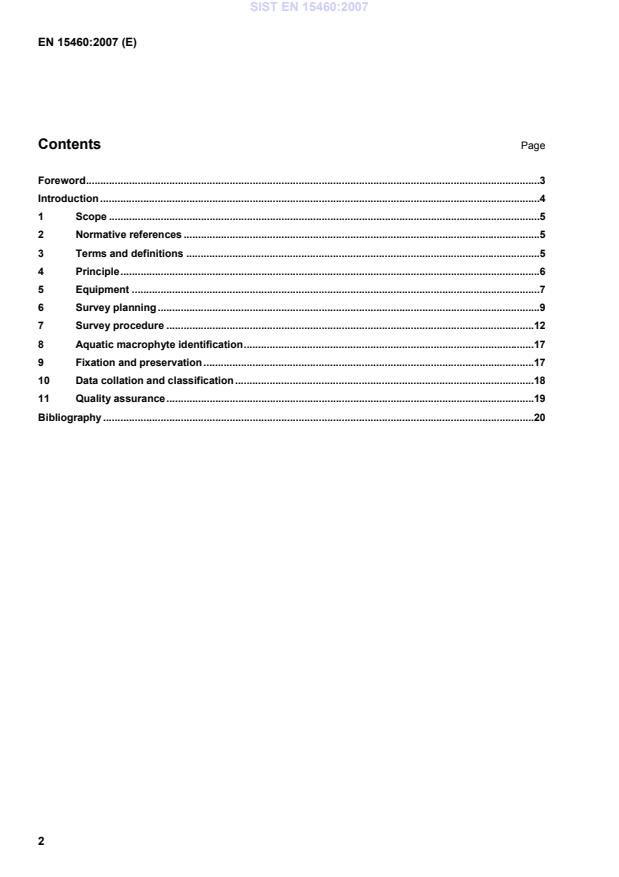
EN 15460:2007 - Water quality: Guidance standard for the surveying of macrophytes in lakes (CEN) provides a standardized method for surveying aquatic macrophytes in fresh water lakes. Its primary purpose is to support the assessment of ecological status using macrophytes as a biological quality element. The standard describes what to record (species composition and abundance), how surveys can be planned and executed, and how results are collated for ecological classification. It is applicable to natural and artificial lakes and can form the basis for monitoring, conservation surveys and lake management.
Key topics and requirements
- Scope and purpose: Methodology for surveying macrophytes to assess lake ecological status; macrophytes include vascular plants, bryophytes, stoneworts (Characeae) and macro-algae.
- Survey planning: Defining lake type, selecting monitoring sites and establishing reference conditions (field sites, historical data, modelling or expert judgement).
- Survey procedure: Field sampling approaches (belt transects, representative samples), depth limits, and metrics for composition and abundance (spatial extent, cover, biomass where applicable).
- Equipment: Recommended field gear such as GPS, maps, boats, rakes/grapnels, diving or snorkelling equipment, underwater viewing aids/cameras, Secchi disc and basic water chemistry meters.
- Identification & preservation: Guidance on in-field identification, specimen collection, fixation and laboratory preservation for taxa verification.
- Data handling: Data collation, classification against reference conditions and use of numerical metrics to determine deviation from natural type-specific conditions.
- Quality assurance: Procedures to ensure consistency and comparability of surveys between years and locations.
- Safety note: The standard warns that working in or around water is inherently dangerous and users must implement appropriate health and safety measures (the standard does not prescribe these).
Applications and users
Who uses EN 15460:2007:
- Environmental agencies and water authorities conducting Water Framework Directive (WFD) lake monitoring
- Ecologists and limnologists performing biological assessments
- Conservation organisations and protected-area managers
- Consultants and contractors doing lake condition surveys and impact assessments
- Research teams monitoring habitat change, restoration outcomes or long-term trends
Practical uses:
- Routine monitoring of macrophyte communities to classify ecological status
- Establishing baseline and reference conditions for lake types
- Informing management actions, restoration planning and conservation prioritisation
Related standards
Standards and directives referenced or relevant in the document:
- Water Framework Directive (2000/60/EC)
- EN 14184 (macrophyte-related definitions/terms)
- EN 13946, EN 14407, EN 14707 (related habitat, sampling and taxonomic guidance)
Keywords: EN 15460:2007, macrophytes, lakes, water quality, ecological status, macrophyte survey, CEN, lake monitoring, biological quality element.
Get Certified
Connect with accredited certification bodies for this standard

CIS Institut d.o.o.
Personal Protective Equipment (PPE) certification body. Notified Body NB-2890 for EU Regulation 2016/425 PPE.

Kiwa BDA Testing
Building and construction product certification.
Kmetijski inštitut Slovenije
Agricultural Institute of Slovenia. Soil testing, plant health, agricultural product analysis.
Sponsored listings
Frequently Asked Questions
SIST EN 15460:2007 is a standard published by the Slovenian Institute for Standardization (SIST). Its full title is "Water quality - Guidance standard for the surveying of macrophytes in lakes". This standard covers: This guidance standard defines a method for surveying aquatic macrophytes in lakes - primarily for the purpose of assessing ecological status, using these organisms as an element of biological quality. The information provided by this method includes the composition and abundance of the aquatic macrophyte flora. For a complete assessment of ecological status, other elements of biological quality should also be assessed. The general principle of the approach described in this European Standard may also form the basis for the monitoring and assessment of macrophytes in lakes, for example, for conservation purposes.
This guidance standard defines a method for surveying aquatic macrophytes in lakes - primarily for the purpose of assessing ecological status, using these organisms as an element of biological quality. The information provided by this method includes the composition and abundance of the aquatic macrophyte flora. For a complete assessment of ecological status, other elements of biological quality should also be assessed. The general principle of the approach described in this European Standard may also form the basis for the monitoring and assessment of macrophytes in lakes, for example, for conservation purposes.
SIST EN 15460:2007 is classified under the following ICS (International Classification for Standards) categories: 13.060.10 - Water of natural resources; 13.060.70 - Examination of biological properties of water. The ICS classification helps identify the subject area and facilitates finding related standards.
SIST EN 15460:2007 is associated with the following European legislation: EU Directives/Regulations: 2009-01-0312, EUR-PUB. When a standard is cited in the Official Journal of the European Union, products manufactured in conformity with it benefit from a presumption of conformity with the essential requirements of the corresponding EU directive or regulation.
SIST EN 15460:2007 is available in PDF format for immediate download after purchase. The document can be added to your cart and obtained through the secure checkout process. Digital delivery ensures instant access to the complete standard document.
Standards Content (Sample)
2003-01.Slovenski inštitut za standardizacijo. Razmnoževanje celote ali delov tega standarda ni dovoljeno.Kakovost vode - Navodilo za preiskave višjih vodnih rastlin jezerWasserbeschaffenheit - Anleitung zur Erfassung von Makrophyten in SeenQualité de l'eau -
Guide pour l'étude des macrophytes dans les lacsWater quality - Guidance standard for the surveying of macrophytes in lakes13.060.70Preiskava bioloških lastnosti vodeExamination of biological properties of water13.060.10Voda iz naravnih virovWater of natural resourcesICS:Ta slovenski standard je istoveten z:EN 15460:2007SIST EN 15460:2007en01-december-2007SIST EN 15460:2007SLOVENSKI
STANDARD
EUROPEAN STANDARDNORME EUROPÉENNEEUROPÄISCHE NORMEN 15460October 2007ICS 13.060.70 English VersionWater quality - Guidance standard for the surveying ofmacrophytes in lakesQualité de l'eau -
Guide pour l'étude des macrophytesdans les lacsWasserbeschaffenheit - Anleitung zur Erfassung vonMakrophyten in SeenThis European Standard was approved by CEN on 1 September 2007.CEN members are bound to comply with the CEN/CENELEC Internal Regulations which stipulate the conditions for giving this EuropeanStandard the status of a national standard without any alteration. Up-to-date lists and bibliographical references concerning such nationalstandards may be obtained on application to the CEN Management Centre or to any CEN member.This European Standard exists in three official versions (English, French, German). A version in any other language made by translationunder the responsibility of a CEN member into its own language and notified to the CEN Management Centre has the same status as theofficial versions.CEN members are the national standards bodies of Austria, Belgium, Bulgaria, Cyprus, Czech Republic, Denmark, Estonia, Finland,France, Germany, Greece, Hungary, Iceland, Ireland, Italy, Latvia, Lithuania, Luxembourg, Malta, Netherlands, Norway, Poland, Portugal,Romania, Slovakia, Slovenia, Spain, Sweden, Switzerland and United Kingdom.EUROPEAN COMMITTEE FOR STANDARDIZATIONCOMITÉ EUROPÉEN DE NORMALISATIONEUROPÄISCHES KOMITEE FÜR NORMUNGManagement Centre: rue de Stassart, 36
B-1050 Brussels© 2007 CENAll rights of exploitation in any form and by any means reservedworldwide for CEN national Members.Ref. No. EN 15460:2007: ESIST EN 15460:2007
Not applicable 3 Terms and definitions For the purposes of this document, the following terms and definitions apply. 3.1 amphiphyte plant that can grow submerged in the water up to completely above the water, typically under fluctuating water level conditions 3.2 aquatic macrophytes larger plants of fresh water which are easily seen with the naked eye, including all aquatic vascular plants, bryophytes, stoneworts (Characeae) and macro-algal growths (see EN 14184)
NOTE For this method, this term is taken to include macrophytes growing in the water and in the wash zone, including hydrophytes, helophytes, amphiphytes, as well as supra-littoral species in the wash zone (such as Carex). 3.3 belt transect band of defined width oriented at right angles to the shoreline or bank, which starts at the water line including the wash and inundation zones starting at the highest seasonal waterline and in lakes extends to the lowermost limit of the aquatic macrophyte vegetation NOTE 1 The aquatic vegetation (species composition, abundance, cover) is analysed within this transect. The transect can be virtual or physically delineated. NOTE 2 The lowermost limit can change over years, either the belt transect is then extended to the lowermost limit that can be expected ever, or the lowermost limit or the belt transect is left variable through the years. 3.4 ecological status expression of the quality of the structure and functioning of aquatic ecosystems, expressed by comparing the prevailing conditions with reference conditions (see EN 14184) NOTE As classified in accordance with Annex V of the EC Water Framework Directive (2000/60/EC). SIST EN 15460:2007
5 Equipment: the following equipment list is suggested. 5.1 Equipment common to all surveys 5.1.1 High resolution maps of survey area, preferably laminated. 5.1.2 Range of plastic bags and hard plastic containers, for retaining specimens or the temporary storage of macrophytes requiring laboratory identification. NOTE Mosquito netting or lace bags are easier to use than plastic bags in water. 5.1.3 Waterproof labels 5.1.4 Pencils or pens, with indelible ink. 5.1.5 Field data recording system, using either waterproof sheets, a small cassette recorder or water-resistant portable computer;
5.1.6 Floras, relevant field keys and identification guides, and iconographs (illustrations), appropriate to the habitats under consideration; 5.1.7 Records from any previous macrophyte surveys of the lakeunder survey 5.1.8 Personal protective clothing 5.1.9 First aid kit 5.1.10 Notebook, preferable with hard back and water repellent paper. NOTE A pre-prepared pro forma is helpful in the field. This can be a pro forma count sheet with a list of taxon names and space beside each on which the abundance estimates can be made, or a notebook organised in such a way that taxon identities and numbers can be clearly recorded, or a computer program with facilities for direct entry of data. It is recommendable that design of the recording sheets or programs takes into account the requirements of any Quality Assurance programmes that are in place. Alternatively, field notes can be dictated into a small cassette recorder or digital dictaphone with flash memory. 5.2 Additional equipment for diving surveys 5.2.1 Wet-suit, snorkelling or SCUBA equipment; 5.2.2 Sinkable measuring tape, with concrete weight (or leaded line graduated along its length at appropriate points e.g. 5 m distances) to mark survey transects. 5.2.3 Dive (Alpha) flag, to attach to boat or buoy. SIST EN 15460:2007
The use of an experienced boat handler familiar with local conditions or as a minimum detailed bathymetric maps for the survey area is recommended for safe surveying. Accurate bathymetric data are crucial in delineating littoral zones, bed slopes etc. Where the data are not available, it should be an integral part of any vegetation survey. At a practical level, the use of transducer depth finders is recommended, which will operate to depths of up to approximately 73 m. 5.3.2 Double-sided rake grapnel and/or multi-point grapnel, attached to a suitable length of rope. NOTE 1 The double-sided rake grapnel is preferable on relatively smooth, uniform substrates. On stony terrain with large interstices, the multi-point grapnel will tend to be more effective as it can slip into areas that a double rake cannot access. However, grapnels and rakes are inefficient for sampling smaller aquatic macrophyte species, a grab and netting techniques can be more effective. NOTE 2 Double rake grapnels can be fabricated from two 32 cm garden rakes with 6 cm prongs at 2 cm intervals welded back to back with an attachment point for a rope. Rakes with longer prongs at smaller intervals can be preferred as they can be more efficient in sampling some situations. So called ‘grass rakes’ with 10 cm prongs transversely mounted are more suitable than ordinary garden rakes, especially for smaller specimen on soft sediments. NOTE 3 The efficiency of rakes can be increased by folding fine maze wire netting around the rake teeth; in very soft sediments and with only very tiny plants a grab and handnet can be used as effective alternatives. The rope should be of sufficient length to allow the deployment and recovery of the rake/grapnel. It should be of a sufficiently heavy gauge to allow pressure to be applied when the grapnel is snagged but not of excessive thickness that will lead to problems with deployment and recovery. Hemp ropes are less prone to kinking. Alternatively, extendable handles can be used that are effective to depths of approximately 3,5 m [3]. 5.3.3 Rake, with rigid extendable handle. 5.3.4 Graduated floating line and weighted mooring buoy 5.4 Additional equipment 5.4.1 Geographical Positioning System (GPS) 5.4.2 Polarising sunglasses 5.4.3 Underwater viewing aid/bathyscope, viewing tube, bucket or box with clear Perspex base. 5.4.4 Camera with polarising lens 5.4.5 Underwater ‘drop’ camera, waterproof camera mounted to a cable or pole, that can lowered into the water. 5.4.6 Sanitised wipes 5.4.7 Binoculars 5.4.8 Hand lens, ×10 and ×20 magnification. 5.4.9 White plastic trays 5.4.10 Equipment to measure water depth, e.g. rod marked with intervals of 1 cm to 2 cm; or for deep, less vegetated areas, a hand-held echo-sounder. SIST EN 15460:2007
5.5.1 Conductitivity meter 5.5.2 Depth meter 5.5.3 pH meter 5.5.4 Secchi disc NOTE A secchi-disc to indicate the depth of light penetration, and equipment to measure the depth and level of the water can be useful in interpreting the resulting data. A hand-held conductivity and pH meter can also be useful, especially if surveying lakes with different water chemistry. 6 Survey planning 6.1 General Survey planning is very much dependent on the purpose of the study and the procedure described here is primarily for the purpose of assessing ecological status. At the beginning of a survey the geographic region(s), the hydromorphological lake typology and the expected reference conditions characteristic for the type of lake under investigation should be defined. 6.2 Establishing reference conditions Ecological reference conditions for each hydromorphological lake type need to be established before the ecological status of a monitoring site can be assessed. This can be achieved either by surveying reference sites (RefS) within a specific type or, where suitable RefS cannot be found, by modelling or expert opinion. Historical data from unimpacted sites may also be invaluable. Reference sites (lakes, or bodies of water within a lake), should be as close as possible to natural conditions with respect to their species composition and the abundance of each species, physical and chemical variables and hydromorphological background. Hazardous substances should either be totally absent or close to the limit of detection. Nutrient concentrations and the levels of acidification should be close to background levels taking into account the influences of the local geology and geographical location. Catchment pressures from, for example, agriculture and forestry should be low and significant point-discharges should be absent. The selection of reference sites (RefS) should be based on information from regional or national surveys that have data on the species composition, distribution and diversity of the aquatic vegetation. 6.3 Monitoring sites The ecological status of a lake or body of water within a lake (a monitoring site) is measured in terms of the deviation of the aquatic macrophyte flora from the reference conditions for the same lake type. For most practical purposes the lake is the waterbody unit and not the individual areas surveyed for macrophytes. Where the concentration of lakes is high, as for example in Scandinavia, it is impractical and unnecessary to survey macrophytes in all lakes. In these circumstances a representative subset of monitoring sites can be surveyed to reflect the range of lake types represented and the extent to which these are influenced by specific human pressures. When selecting representative lakes from lake clusters use similar criteria to those listed in Clause 6.2. SIST EN 15460:2007
ii) multipoint transects, or longer lengths of shoreline as a means of defining the best positioning for survey locations under approach (i); or
iii) contiguous transects or stretches of shoreline; or iv) complete surveys of the lake (or body of water within a lake) to produce species inventories and in the selection of representative transects.
The survey protocol may vary between these different approaches depending on the purpose of the survey. For example, less intensive data collection may be appropriate for preliminary (quick) surveys designed to locate representative survey locations. The first two approaches require relatively little time and may be useful for the routine assessment of ecological status. They allow only representative survey locations to be described, but they can be useful for spatial and temporal monitoring. A longer stretch of a shoreline is surveyed first, using the second approach to demonstrate the “evenness” of a) physical and b) biological variables. Representative survey locations are then selected within those stretches, and surveyed using the first approach. Contiguous survey stretches cover the full length of the shoreline, but are labour intensive and so may not be suitable for routine use. The last approach fulfils more specialist needs. For example, this can be part of the procedure to find reference sites (RefS) for different ecological lake types such as those with acute inclines into deep water but also those with shallower littoral areas.
It is a labour-intensive approach not to be applied for routine surveys. It is for use in special cases, e.g. long-term monitoring and for detailed background information for ecological classification.
The procedure described in this guidance standard relates to the first approach, using belt transects. If using alternative approaches, such as shoreline (walk-around) surveys, care should be taken to demonstrate that the resulting data are as representative as possible
of the flora and conditions present. 6.5 Transect surveys The most widely used method for surveying macrophytes in lakes is based on belt transects (3.3). This approach allows mapping of the distribution of individual species and abundance of aquatic macrophytes, it provides robust data sets that can be used to generate indices and metrics, and it is a cost effective means of data collection. The number and positioning of survey locations at which belt transects are surveyed should allow a representative flora and the extent of colonisation to be recorded, reflecting the extent of human impact on the lake. These decisions should be made, as far as is possible, before the initiation of fieldwork. SIST EN 15460:2007
...