

SIST EN 15505:2009
(Main)Foodstuffs - Determination of trace elements - Determination of sodium and magnesium by flame atomic absorption spectrometry (AAS) after microwave digestion
General Information
- Abstract
This document specifies methods for the determination of sodium and magnesium in foodstuffs by flame atomic absorption spectrometry (AAS) after microwave digestion. Collaborative studies have been carried out (Annex A). The method is suitable for the determination of sodium not less than 1 500 mg/kg and magnesium not less than 250 mg/kg. Data for calcium is included for information (Annex B). The method is not applicable to wheat bran.
- Status
- Published
- Publication Date
- 18-Feb-2009
- Technical Committee
- KŽP - Agricultural food products
- Current Stage
- 6060 - National Implementation/Publication (Adopted Project)
- Start Date
- 12-Feb-2009
- Due Date
- 19-Apr-2009
- Completion Date
- 19-Feb-2009

Overview
EN 15505:2008 (CEN) defines a harmonised laboratory method for the determination of sodium (Na) and magnesium (Mg) in foodstuffs using flame atomic absorption spectrometry (AAS) following microwave digestion. The standard covers sample digestion in closed microwave vessels with nitric acid and hydrogen peroxide, subsequent dilution and analysis by flame-AAS using matrix modifiers. Collaborative (inter‑laboratory) studies are reported in Annex A, and additional information on calcium is provided in Annex B. The method is suitable for sodium ≥ 1 500 mg/kg and magnesium ≥ 250 mg/kg and is not applicable to wheat bran.
Key Topics and Requirements
- Scope & applicability: Limits of quantification and matrices validated (see Annex A). Not applicable to wheat bran.
- Sample preparation: Closed‑vessel microwave digestion with HNO3 + H2O2 per EN 13805; homogenisation/drying guidance referenced to EN 13804.
- Reagents: High-purity nitric acid, hydrogen peroxide, cesium chloride (CsCl) for sodium, and lanthanum oxide (La2O3) solution for magnesium as matrix modifiers.
- Instrumentation: Flame AAS with element-specific lamps (examples: Na λ = 589.0 nm, Mg λ = 285.2 nm), appropriate acetylene/air supply, and routine instrument optimisation.
- Calibration & ranges: Example working standards shown (Na: 0.1–1.0 mg/L; Mg: 0.05–0.4 mg/L) prepared from certified stock solutions in dilute nitric acid.
- Calculation: Results expressed as mg/kg using the supplied equation relating measured concentration, final digest volume, dilution factor and sample mass.
- Quality & precision: Repeatability (r) and reproducibility (R) performance data from collaborative trials are provided for representative food matrices (e.g., broccoli, carrot, bread, milk powder, simulated diets).
Applications and Users
EN 15505:2008 is intended for:
- Food testing laboratories performing routine elemental analysis for nutrition labelling and composition data.
- Regulatory and public‑health laboratories monitoring sodium and magnesium in foods.
- Food industry quality control and R&D departments verifying product composition or reformulation (e.g., low‑salt products).
- Reference laboratories conducting method validation, proficiency testing, or producing certified reference materials.
Practical uses include nutritional compliance, formulation checks, survey studies of dietary mineral intake, and analytical method harmonisation across laboratories.
Related Standards
- EN 13805 - Pressure/microwave digestion procedures for trace element analysis (referenced for sample digestion).
- EN 13804 - General test and sample preparation guidance for trace elements in foodstuffs.
- CEN/TC 275 publications and NMKL procedures referenced in Annex A for inter‑laboratory evaluation.
Keywords: EN 15505:2008, flame AAS, microwave digestion, foodstuffs, determination of sodium, determination of magnesium, trace elements, CEN.
Relations
- Effective Date
- 28-Jan-2026
- Effective Date
- 28-Jan-2026
Get Certified
Connect with accredited certification bodies for this standard

BSI Group
BSI (British Standards Institution) is the business standards company that helps organizations make excellence a habit.

Bureau Veritas
Bureau Veritas is a world leader in laboratory testing, inspection and certification services.

DNV
DNV is an independent assurance and risk management provider.
Sponsored listings
Frequently Asked Questions
SIST EN 15505:2009 is a standard published by the Slovenian Institute for Standardization (SIST). Its full title is "Foodstuffs - Determination of trace elements - Determination of sodium and magnesium by flame atomic absorption spectrometry (AAS) after microwave digestion". This standard covers: This document specifies methods for the determination of sodium and magnesium in foodstuffs by flame atomic absorption spectrometry (AAS) after microwave digestion. Collaborative studies have been carried out (Annex A). The method is suitable for the determination of sodium not less than 1 500 mg/kg and magnesium not less than 250 mg/kg. Data for calcium is included for information (Annex B). The method is not applicable to wheat bran.
This document specifies methods for the determination of sodium and magnesium in foodstuffs by flame atomic absorption spectrometry (AAS) after microwave digestion. Collaborative studies have been carried out (Annex A). The method is suitable for the determination of sodium not less than 1 500 mg/kg and magnesium not less than 250 mg/kg. Data for calcium is included for information (Annex B). The method is not applicable to wheat bran.
SIST EN 15505:2009 is classified under the following ICS (International Classification for Standards) categories: 67.050 - General methods of tests and analysis for food products. The ICS classification helps identify the subject area and facilitates finding related standards.
SIST EN 15505:2009 has the following relationships with other standards: It is inter standard links to SIST EN 13804:2013, SIST EN 13805:2015. Understanding these relationships helps ensure you are using the most current and applicable version of the standard.
SIST EN 15505:2009 is available in PDF format for immediate download after purchase. The document can be added to your cart and obtained through the secure checkout process. Digital delivery ensures instant access to the complete standard document.
Standards Content (Sample)
2003-01.Slovenski inštitut za standardizacijo. Razmnoževanje celote ali delov tega standarda ni dovoljeno.NURYDORYQHPUD]NORSXLebensmittel - Bestimmung von Elementspuren - Bestimmung von Natrium und Magnesium mit Flammen-Atomabsorptionsspektrometrie (AAS) nach MikrowellenaufschlussProduits alimentaires - Dosage des éléments traces - Dosage du sodium et du magnésium par spectrométrie d'absorption atomique de flamme après digestion par micro-ondesFoodstuffs - Determination of trace elements - Determination of sodium and magnesium by flame atomic absorption spectrometry (AAS) after microwave digestion67.050Splošne preskusne in analizne metode za živilske proizvodeGeneral methods of tests and analysis for food productsICS:Ta slovenski standard je istoveten z:EN 15505:2008SIST EN 15505:2009en,fr,de01-april-2009SIST EN 15505:2009SLOVENSKI
STANDARD
EUROPEAN STANDARDNORME EUROPÉENNEEUROPÄISCHE NORMEN 15505March 2008ICS 67.050 English VersionFoodstuffs - Determination of trace elements - Determination ofsodium and magnesium by flame atomic absorptionspectrometry (AAS) after microwave digestionProduits alimentaires - Dosage des éléments traces -Dosage du sodium et du magnésium par spectrométried'absorption atomique de flamme après digestion parmicro-ondesLebensmittel - Bestimmung von Elementspuren -Bestimmung von Natrium und Magnesium mit Flammen-Atomabsorptionsspektrometrie (AAS) nachMikrowellenaufschlussThis European Standard was approved by CEN on 7 February 2008.CEN members are bound to comply with the CEN/CENELEC Internal Regulations which stipulate the conditions for giving this EuropeanStandard the status of a national standard without any alteration. Up-to-date lists and bibliographical references concerning such nationalstandards may be obtained on application to the CEN Management Centre or to any CEN member.This European Standard exists in three official versions (English, French, German). A version in any other language made by translationunder the responsibility of a CEN member into its own language and notified to the CEN Management Centre has the same status as theofficial versions.CEN members are the national standards bodies of Austria, Belgium, Bulgaria, Cyprus, Czech Republic, Denmark, Estonia, Finland,France, Germany, Greece, Hungary, Iceland, Ireland, Italy, Latvia, Lithuania, Luxembourg, Malta, Netherlands, Norway, Poland, Portugal,Romania, Slovakia, Slovenia, Spain, Sweden, Switzerland and United Kingdom.EUROPEAN COMMITTEE FOR STANDARDIZATIONCOMITÉ EUROPÉEN DE NORMALISATIONEUROPÄISCHES KOMITEE FÜR NORMUNGManagement Centre: rue de Stassart, 36
B-1050 Brussels© 2008 CENAll rights of exploitation in any form and by any means reservedworldwide for CEN national Members.Ref. No. EN 15505:2008: ESIST EN 15505:2009
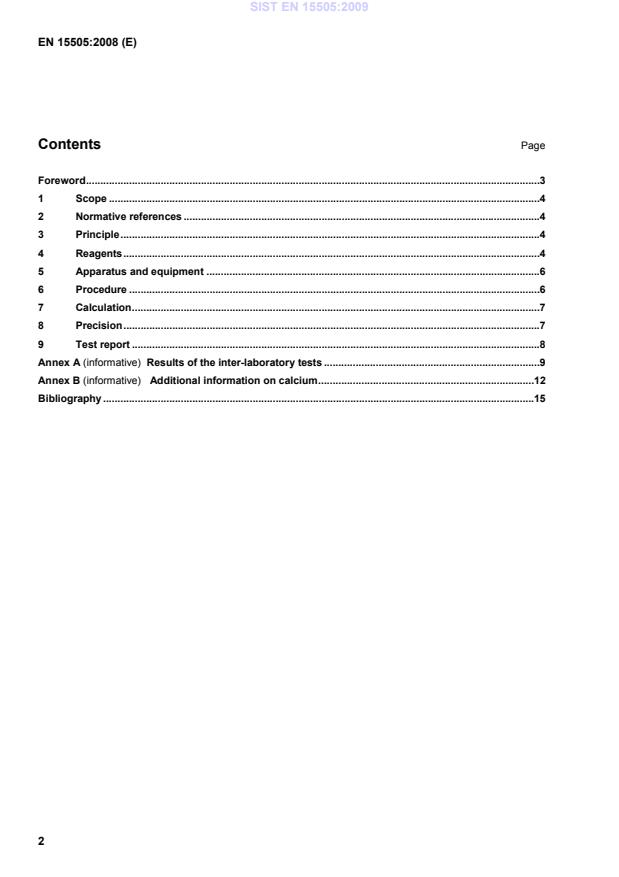
Results of the inter-laboratory tests.9 Annex B (informative)
Additional information on calcium.12 Bibliography.15
WARNING — The use of this standard may involve hazardous materials, operations and equipment. This standard does not purport to address all the safety problems associated with its use. It is the responsibility of the user of this standard to establish appropriate safety and health practices and determine the applicability of regulatory limitations prior to use. 4 Reagents 4.1 General Use only reagents and water, which shall have an element level low enough not to affect results. The use of certified stock solutions is advisable. 4.2 Nitric acid 4.2.1 Nitric acid, not less than 65 % of approximately mass concentration ρ(HNO3) = 1,4 g/ml.
In case of insufficient purity, it is necessary to purify the nitric acid in a distillation apparatus as described in EN 13805. 4.2.2 Diluted nitric acid solution 1, mass fraction w = 2,7 %
Dilute 42 ml nitric acid (4.2.1) to 1 000 ml with water. 4.2.3 Diluted nitric acid solution 2, mass fraction w = 0,65 %
Mix nitric acid (4.2.1) and water in a proportion minimum of 1 + 99 parts by volume. SIST EN 15505:2009
4.4 Hydrogen peroxide, mass fraction w = 30 % 4.5 Cesium chloride solution (CsCl), for use in AAS analysis Dissolve 31,75 g of cesium chloride in water and dilute to 250 ml. The solution will be stable in a refrigerator for at least 6 months. 4.6 Lanthanum(III)oxide (La2O3) solution, for use in AAS analysis, 5 % (weight/volume) Weigh 14,66 g of lanthanum(III)oxide into a 250 ml beaker, moisten with 10 ml of water and add 62,5 ml of HCl (4.3). Transfer to a 250 ml volumetric flask and fill up with water. The solution will be stable in a refrigerator for one month. 4.7 Sodium solution 4.7.1 Sodium stock solution, mass concentration ρ(Na) = 1 000 mg/l
4.7.2 Sodium standard solution, mass concentration ρ(Na) = 10 mg/l
Dilute 1 ml of sodium stock solution (4.7.1) to 100 ml in a volumetric flask with 2,7 % nitric acid (4.2.2). The solution will remain stable for one month at room temperature. 4.8 Magnesium solution 4.8.1 Magnesium stock solution, mass concentration ρ(Mg) = 1 000 mg/l 4.8.2 Magnesium standard solution, mass concentration ρ(Mg) = 10 mg/l
Dilute 1 ml of magnesium stock solution (4.8.1) to 100 ml in a volumetric flask with 0,65 % nitric acid (4.2.3). The solution will remain stable for one month at room temperature. SIST EN 15505:2009
6.3 Dilution Pipette a suitable volume of the sample solution, add 5 % La-solution (4.6) and dilute this volume with 0,65 % nitric acid (4.2.3) so that the final concentration of Mg is within the linear range of measurement of the elements. In this example, the following ranges are selected for the standard curves; for Mg, 0,05 mg/l to 0,4 mg/l. The lowest point may be lower, if required by the concentrations of the sample solutions. Add 5 % of La-solution (4.6) to a final mass fraction of La of 1 % (e.g. 2 ml 5 % is diluted to 10 ml). Pipette a suitable volume of the sample solution, add 1 ml of Cs-solution (4.5) and dilute this volume with 2,7 % nitric acid (4.2.2) so that the final concentration of Na is within the range of measurement of the element. In this example, the following range is selected for the standard curve: 0,1 mg/l to 1,0 mg/l. The lowest point may be lower required by concentration of the sample solution. SIST EN 15505:2009
...