

SIST EN 18054:2025
(Main)Food authenticity - Determination of C and/or N isotope ratios in food by Elemental Analyser - Isotope Ratio Mass Spectrometry (EA-IRMS)
General Information
- Abstract
This document covers instrumental analysis by elemental analyser-isotope ratio mass spectrometry (EA-IRMS) of food materials to determine C and/or N isotope ratios.
The isotope ratios obtained by following this document are expressed as δ13C and/or δ15N values relative to international measurement standards.
Sample preparation is not included within this document. It is assumed that the food sample has been pre-treated as necessary and homogenized.
Similarly, the interpretation of the obtained isotope delta values is not covered by this document. Following this protocol will result only in isotope delta values for the sample materials.
Solid and/or liquid sample materials can be analysed following this document.
Although other instrumental techniques can be applied to determine δ13C and/or δ15N values in food materials, these other techniques are not covered by this document.
- Status
- Published
- Public Enquiry End Date
- 23-Apr-2024
- Publication Date
- 18-Aug-2025
- Technical Committee
- KŽP - Agricultural food products
- Current Stage
- 6060 - National Implementation/Publication (Adopted Project)
- Start Date
- 13-Jun-2025
- Due Date
- 18-Aug-2025
- Completion Date
- 19-Aug-2025

Overview
EN 18054:2025 - "Food authenticity: Determination of C and/or N isotope ratios in food by Elemental Analyser - Isotope Ratio Mass Spectrometry (EA-IRMS)" is a CEN European standard that specifies instrumental procedures for measuring carbon and nitrogen stable isotope ratios in food materials. The method yields isotope delta values expressed as δ13C and/or δ15N relative to international measurement standards. The standard covers EA‑IRMS instrumentation, measurement principle, sequence design, instrumental tests, corrections and data processing. Sample preparation and interpretation of isotope delta results are explicitly excluded.
Key topics and technical requirements
- Scope and principle: Measurement of C and N isotope ratios by EA‑IRMS; sample gas produced in an elemental analyser (CO2 for C, N2 for N) is introduced to the mass spectrometer.
- Normalization and traceability: Results must be reported on recognized international scales - VPDB for carbon and Air‑N2 for nitrogen - using two or more reference materials for scale normalization.
- Instrumental setup and tests: Requirements and checks for sample introduction, flash‑combustion/reduction, gas separation and mass spectrometer operation.
- Sequence design and quality control: Guidance on sequence composition (standards, blanks, samples), and instrumental tests including backgrounds, working‑gas stability, linearity, and magnet “jump” calibration for dual isotope measurements.
- Data processing and corrections: Procedures for raw data evaluation, rejection criteria for runs/samples/sequences, corrections to initial isotope delta values, and documentation of data to record.
- Performance metrics: Sections on precision (repeatability, reproducibility) and uncertainty, plus annexes with inter‑laboratory validation and a worked data processing example.
Applications and users
EN 18054:2025 is intended for laboratories and organizations performing isotope analysis for food authenticity and forensic investigations. Typical users include:
- Accredited food testing laboratories implementing EA‑IRMS methods.
- Regulatory and enforcement agencies verifying origin, adulteration or labeling claims.
- Food manufacturers and quality assurance teams conducting authenticity screening (e.g., detection of sugar adulteration in honey, feed‑related isotopic signatures in meat).
- Research institutions studying isotopic markers in food chains.
Note: The standard produces calibrated δ13C / δ15N values; interpretation (e.g., origin attribution, adulteration thresholds) requires separate domain expertise and reference databases.
Related standards and references
- Uses international reference scales VPDB (carbon) and Air‑N2 (nitrogen) for traceability.
- EN 18054:2025 complements other analytical standards and laboratory accreditation requirements for isotope ratio mass spectrometry and food authenticity testing.
Get Certified
Connect with accredited certification bodies for this standard

BSI Group
BSI (British Standards Institution) is the business standards company that helps organizations make excellence a habit.

Bureau Veritas
Bureau Veritas is a world leader in laboratory testing, inspection and certification services.

DNV
DNV is an independent assurance and risk management provider.
Sponsored listings
Frequently Asked Questions
SIST EN 18054:2025 is a standard published by the Slovenian Institute for Standardization (SIST). Its full title is "Food authenticity - Determination of C and/or N isotope ratios in food by Elemental Analyser - Isotope Ratio Mass Spectrometry (EA-IRMS)". This standard covers: This document covers instrumental analysis by elemental analyser-isotope ratio mass spectrometry (EA-IRMS) of food materials to determine C and/or N isotope ratios. The isotope ratios obtained by following this document are expressed as δ13C and/or δ15N values relative to international measurement standards. Sample preparation is not included within this document. It is assumed that the food sample has been pre-treated as necessary and homogenized. Similarly, the interpretation of the obtained isotope delta values is not covered by this document. Following this protocol will result only in isotope delta values for the sample materials. Solid and/or liquid sample materials can be analysed following this document. Although other instrumental techniques can be applied to determine δ13C and/or δ15N values in food materials, these other techniques are not covered by this document.
This document covers instrumental analysis by elemental analyser-isotope ratio mass spectrometry (EA-IRMS) of food materials to determine C and/or N isotope ratios. The isotope ratios obtained by following this document are expressed as δ13C and/or δ15N values relative to international measurement standards. Sample preparation is not included within this document. It is assumed that the food sample has been pre-treated as necessary and homogenized. Similarly, the interpretation of the obtained isotope delta values is not covered by this document. Following this protocol will result only in isotope delta values for the sample materials. Solid and/or liquid sample materials can be analysed following this document. Although other instrumental techniques can be applied to determine δ13C and/or δ15N values in food materials, these other techniques are not covered by this document.
SIST EN 18054:2025 is classified under the following ICS (International Classification for Standards) categories: 67.050 - General methods of tests and analysis for food products. The ICS classification helps identify the subject area and facilitates finding related standards.
SIST EN 18054:2025 is available in PDF format for immediate download after purchase. The document can be added to your cart and obtained through the secure checkout process. Digital delivery ensures instant access to the complete standard document.
Standards Content (Sample)
SLOVENSKI STANDARD
01-september-2025
Pristnost živil - Določevanje razmerja izotopov C in/ali N v živilih z elementnim
analizatorjem - Masna spektrometrija izotopskega razmerja (EA-IRMS)
Food authenticity - Determination of C and/or N isotope ratios in food by Elemental
Analyser - Isotope Ratio Mass Spectrometry (EA-IRMS)
Lebensmittelauthentizität - Bestimmung von C- und/oder N-Isotopenverhältnissen in
Lebensmitteln mittels Elementaranalyse mit Isotopenverhältnis-Massenspektrometrie
(EA‑IRMS)
Authenticité des aliments - Détermination des rapports isotopiques du carbone et/ou de
l’azote dans les aliments au moyen d’un analyseur élémentaire couplé à un
spectromètre de masse de rapports isotopiques (AE-SMRI)
Ta slovenski standard je istoveten z: EN 18054:2025
ICS:
67.050 Splošne preskusne in General methods of tests and
analizne metode za živilske analysis for food products
proizvode
2003-01.Slovenski inštitut za standardizacijo. Razmnoževanje celote ali delov tega standarda ni dovoljeno.
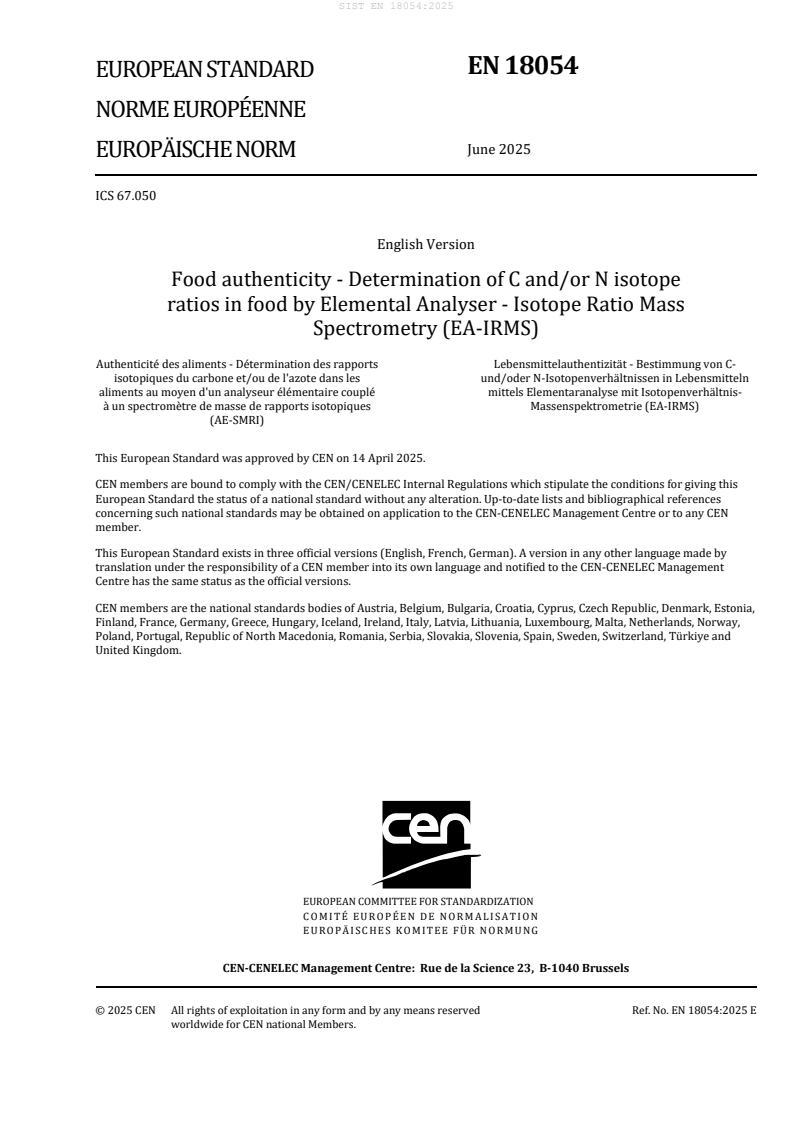
EN 18054
EUROPEAN STANDARD
NORME EUROPÉENNE
June 2025
EUROPÄISCHE NORM
ICS 67.050
English Version
Food authenticity - Determination of C and/or N isotope
ratios in food by Elemental Analyser - Isotope Ratio Mass
Spectrometry (EA-IRMS)
Authenticité des aliments - Détermination des rapports Lebensmittelauthentizität - Bestimmung von C-
isotopiques du carbone et/ou de l'azote dans les und/oder N-Isotopenverhältnissen in Lebensmitteln
aliments au moyen d'un analyseur élémentaire couplé mittels Elementaranalyse mit Isotopenverhältnis-
à un spectromètre de masse de rapports isotopiques Massenspektrometrie (EA-IRMS)
(AE-SMRI)
This European Standard was approved by CEN on 14 April 2025.
CEN members are bound to comply with the CEN/CENELEC Internal Regulations which stipulate the conditions for giving this
European Standard the status of a national standard without any alteration. Up-to-date lists and bibliographical references
concerning such national standards may be obtained on application to the CEN-CENELEC Management Centre or to any CEN
member.
This European Standard exists in three official versions (English, French, German). A version in any other language made by
translation under the responsibility of a CEN member into its own language and notified to the CEN-CENELEC Management
Centre has the same status as the official versions.
CEN members are the national standards bodies of Austria, Belgium, Bulgaria, Croatia, Cyprus, Czech Republic, Denmark, Estonia,
Finland, France, Germany, Greece, Hungary, Iceland, Ireland, Italy, Latvia, Lithuania, Luxembourg, Malta, Netherlands, Norway,
Poland, Portugal, Republic of North Macedonia, Romania, Serbia, Slovakia, Slovenia, Spain, Sweden, Switzerland, Türkiye and
United Kingdom.
EUROPEAN COMMITTEE FOR STANDARDIZATION
COMITÉ EUROPÉEN DE NORMALISATION
EUROPÄISCHES KOMITEE FÜR NORMUNG
CEN-CENELEC Management Centre: Rue de la Science 23, B-1040 Brussels
© 2025 CEN All rights of exploitation in any form and by any means reserved Ref. No. EN 18054:2025 E
worldwide for CEN national Members.
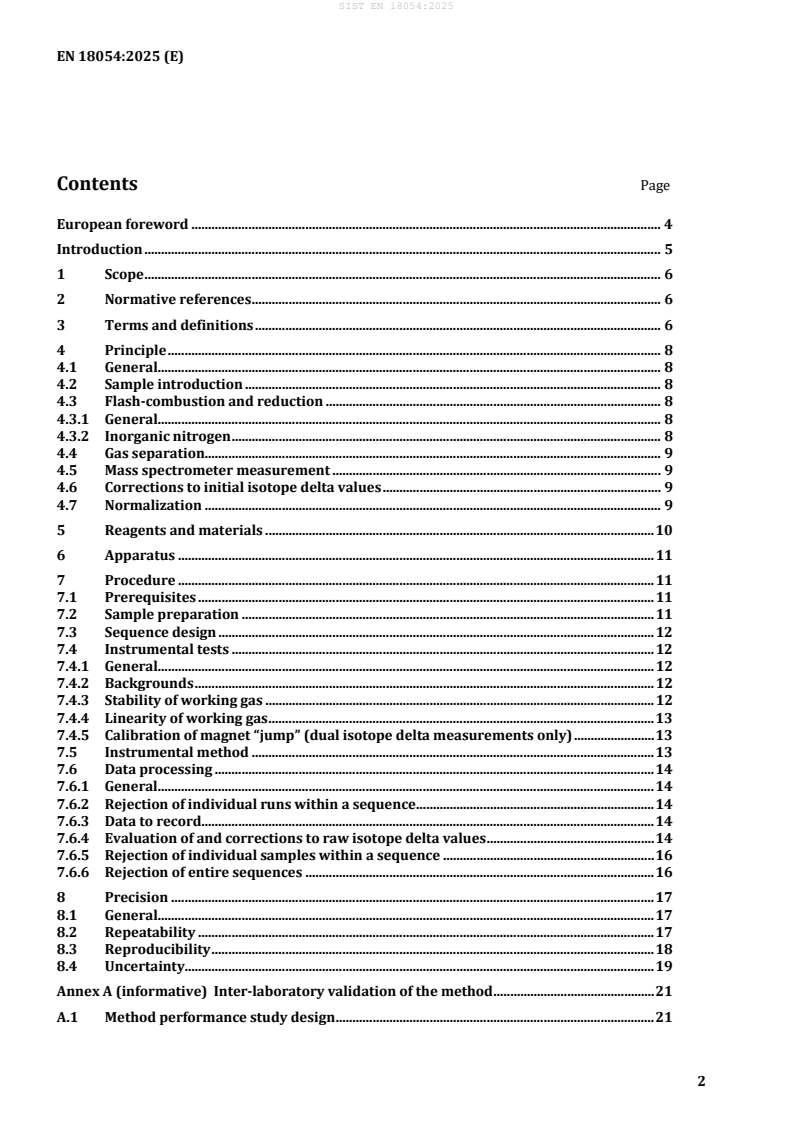
Contents Page
European foreword . 4
Introduction . 5
1 Scope . 6
2 Normative references . 6
3 Terms and definitions . 6
4 Principle . 8
4.1 General. 8
4.2 Sample introduction . 8
4.3 Flash-combustion and reduction . 8
4.3.1 General. 8
4.3.2 Inorganic nitrogen . 8
4.4 Gas separation. 9
4.5 Mass spectrometer measurement . 9
4.6 Corrections to initial isotope delta values . 9
4.7 Normalization . 9
5 Reagents and materials . 10
6 Apparatus . 11
7 Procedure . 11
7.1 Prerequisites . 11
7.2 Sample preparation . 11
7.3 Sequence design . 12
7.4 Instrumental tests . 12
7.4.1 General. 12
7.4.2 Backgrounds . 12
7.4.3 Stability of working gas . 12
7.4.4 Linearity of working gas . 13
7.4.5 Calibration of magnet “jump” (dual isotope delta measurements only) . 13
7.5 Instrumental method . 13
7.6 Data processing . 14
7.6.1 General. 14
7.6.2 Rejection of individual runs within a sequence . 14
7.6.3 Data to record. 14
7.6.4 Evaluation of and corrections to raw isotope delta values . 14
7.6.5 Rejection of individual samples within a sequence . 16
7.6.6 Rejection of entire sequences . 16
8 Precision . 17
8.1 General. 17
8.2 Repeatability . 17
8.3 Reproducibility . 18
8.4 Uncertainty. 19
Annex A (informative) Inter-laboratory validation of the method . 21
A.1 Method performance study design . 21
A.2 Data processing . 21
A.3 δ C results . 21
VPDB
A.4 δ N results . 23
Air-N2
Annex B (informative) Data processing example. 26
B.1 General . 26
B.2 Requirements . 26
B.3 Description . 26
B.4 Test data set . 26
B.5 Initial data screening. 28
B.6 Data processing . 29
B.7 Example results . 31
Bibliography . 32
European foreword
This document (EN 18054:2025) has been prepared by Technical Committee CEN/TC 460 “Food
authenticity”, the secretariat of which is held by DIN.
This European Standard shall be given the status of a national standard, either by publication of an
identical text or by endorsement, at the latest by December 2025, and conflicting national standards shall
be withdrawn at the latest by December 2025.
Attention is drawn to the possibility that some of the elements of this document may be the subject of
patent rights. CEN shall not be held responsible for identifying any or all such patent rights.
This document provides the base for the analytical methods. The setup of the required apparatus depends
to a large extent on its design principles and the specific recommendations of the manufacturers have to
be followed. It is intended to serve as a frame in which the analysts can define their own analytical work
in accordance with the standard procedure.
Any feedback and questions on this document should be directed to the users’ national standards body.
A complete listing of these bodies can be found on the CEN website.
According to the CEN-CENELEC Internal Regulations, the national standards organisations of the
following countries are bound to implement this European Standard: Austria, Belgium, Bulgaria, Croatia,
Cyprus, Czech Republic, Denmark, Estonia, Finland, France, Germany, Greece, Hungary, Iceland, Ireland,
Italy, Latvia, Lithuania, Luxembourg, Malta, Netherlands, Norway, Poland, Portugal, Republic of North
Macedonia, Romania, Serbia, Slovakia, Slovenia, Spain, Sweden, Switzerland, Türkiye and the United
Kingdom.
Introduction
Stable isotope ratios of carbon and nitrogen are often expressed as isotope delta values (δ) these are
ratios of the heavier to the lighter isotope of the element in a particular sample relative to the same ratio
within an agreed reference.
Carbon stable isotope ratios can provide information regarding the photosynthetic pathway that forms
the base of the food chain for the biological material in question. For example, the difference between the
Calvin-Benson cycle used by C plants and the Hatch-Slack pathway used by C plants during
3 4
13 12
photosynthesis results in a measurable difference in the ratio of C to C for the sugars and other
subsequent molecules in biosynthesis.
15 14
Nitrogen stable isotope ratios also vary between food groups. The ratio of N to N increases with
trophic level due to preferential excretion of N depleted molecules such as urea or uric acid. Nitrogen
isotope ratios in plant material are also affected by the fertilization regime.
Analysis of stable isotope ratios within foodstuffs has the potential to reveal information regarding origin,
both biological and geographical, adulteration and authenticity. For example, adulteration of honey from
C plants with refined sugars of C origin can be detected, as can the difference between maize-fed (corn,
3 4
a C plant) and wheat- or other grain-fed chicken.
This document concerns instrumental methods for determination of carbon and/or nitrogen isotope
delta values in foodstuffs.
1 Scope
This document specifies a method for instrumental analysis by elemental analyser-isotope ratio mass
spectrometry (EA-IRMS) of food materials to determine C and/or N isotope ratios.
13 15
The isotope ratios obtained by following this document are expressed as δ C and/or δ N values relative
to international measurement standards.
This document does not apply to sample preparation. It is assumed that the food sample has been pre-
treated as necessary and homogenized.
Similarly, the interpretation of the obtained isotope delta values is not covered by this document.
Following this protocol will result only in isotope delta values for the sample materials.
Solid and/or liquid sample materials can be analysed following this document.
13 15
Although other instrumental techniques can be applied to determine δ C and/or δ N values in food
materials, these other techniques are not covered by this document.
2 Normative references
There are no normative references in this document.
3 Terms and definitions
For the purposes of this document, the following terms and definitions apply.
ISO and IEC maintain terminology databases for use in standardization at the following addresses:
— ISO Online browsing platform: available at https://www.iso.org/obp/
— IEC Electropedia: available at https://www.electropedia.org/
3.1
isotope delta
δ
stable isotope ratio of a material expressed relative to a reference
Note 1 to entry: For carbon, this expression is given in Formula (1):
13 12
R C/ C
( )
sample
13 12
δ C/ C − 1 (1)
( )
ref
13 12
R C/ C
( )
ref
Note 2 to entry: ref is the reference.
15 14 13 12
Note 3 to entry: A similar expression can be constructed for nitrogen isotope delta using N/ N in place of C/ C.
13 12
Note 4 to entry: 𝛿𝛿ref( C/ C) is the normalized delta value of the sample
13 12 15 14 13
Note 5 to entry: The terms δ ( C/ C) and δ ( N/ N) are often changed from the correct IUPAC format to δ C
ref ref ref
and δ Nref. This document uses the latter expressions for familiarity.
Note 6 to entry: To ensure international comparability of isotope delta values, a common reference is used for each
isotope ratio. This reference is an international measurement standard assigned by convention with isotope delta
value exactly equal to zero.
=
Note 7 to entry: Isotope delta values reported against the same common reference are said to be on the same scale.
The name of the scale is usually the same as that of the reference.
Note 8 to entry: Carbon and nitrogen isotope delta values for natural isotopic abundance food materials are small
and expressed in permille (‰) rather than in their native form.
3.2
Vienna Peedee belemnite
VPDB
international measurement standard for δ C
Note 1 to entry: VPDB is a virtual carbonate.
Note 2 to entry: The carbon isotopic composition of VPDB is defined by the exact isotope delta value assigned to
the calcium carbonate reference material NBS 19 of δ C = +1,95 ‰.
VPDB
Note 3 to entry: To ensure traceability to the VPDB scale, carbon isotope delta values are normalized using two or
more reference materials to account for scale effects during measurement [1].
3.3
atmospheric nitrogen
Air-N
international measurement standard for δ N
Note 1 to entry: The Air-N nitrogen isotope delta scale is defined by the exact isotope delta values assigned to
atmospheric nitrogen and the potassium nitrate reference material USGS32 of δ NAir-N2 = 0 and +180 ‰,
respectively [1], [2].
Note 2 to entry: To ensure traceability to the Air-N scale, nitrogen isotope delta values are normalized using two
or more reference materials to account for scale effects during measurement [1].
3.4
sample gas
gas obtained by conversion of the sample material within the elemental analyser
13 15
Note 1 to entry: The sample gas is carbon dioxide (CO ) for δ C determination and nitrogen gas (N ) for δ N
2 2
determination.
3.5
working gas
cylinder gas
monitoring gas
DEPRECATED: reference gas
gas consisting of the same molecule as the sample gas (i.e. CO or N ) but introduced directly into the
2 2
mass spectrometer from a high-pressure cylinder rather than being created from a solid/liquid sample
material within the elemental analyser
Note 1 to entry: An isotope delta value with a working gas within its traceability chain to the international
measurement standard will require normalization using reference materials of known isotope delta analysed in the
same sequence before the isotope delta value lies on the international scale.
3.6
sequence
batch
continuous set of analyses including reference materials for normalization, QA/QC materials, procedural
blanks and samples prepared and analysed together
4 Principle
4.1 General
A sector field mass analyser (Isotope Ratio Mass Spectrometer, IRMS) allows measurement of isotope
ratios with very high precision in simple gases.
Prior determining the carbon and nitrogen isotope signature of solid or liquid samples they shall be
converted into CO and/or N gas.
2 2
This happens in an elemental analyser (EA) via high temperature combustion and subsequent
conversion, cleaning and separation steps.
4.2 Sample introduction
Homogenized sample material shall be weighed into tin capsules, boats or foil, sealed and then loaded
into the carousel of an autosampler. Autosamplers shall allow contamination-free introduction of the
capsules into the combustion reactor. Liquid samples up to a certain viscosity can be injected by liquid
autosampler via airtight septa. Those of higher viscosity can be weighed into smooth walled tin capsules
and sealed with appropriate devices.
4.3 Flash-combustion and reduction
4.3.1 General
In the EA the sample material is quantitatively oxidized to avoid isotope fractionation. This happens in a
reactor made of quartz or steel, which is continually flushed with high purity He carrier gas. The reactor
temperature is typically maintained between 900 °C to 1 200 °C according to the manufacturer’s
specifications.
To ensure full sample combustion, O gas is injected into the helium stream (“O pulse”). The O shall be
2 2 2
in stoichiometric excess to archive full oxidation of the sample. However, the unused O shall be
eliminated by reduction to prevent O from entering the separation system, and/or the IRMS.
Full oxidation is facilitated by an oxidation catalyst. The reactor typically contains copper (II), chromium
(III) or tungsten (VI) oxides and a scavenger to bind sulphur and halogens, e.g. cobalt (II, III) oxide and/or
silver, although many variations are recommended by manufacturers for specific applications.
The heat of the reaction is supported by the oxidation of the tin capsules, boats or foils which increases
the temperature to about 1800 °C (flash burning).
Combustion results in the following gases: N , NO , CO and H O. Other by-products such as halogens and
2 x 2 2
sulfur oxides are eliminated with a scavenger material as mentioned before.
Incombustible materials remain in the reactor in the form of ash.
The reduction of the NO to N takes place at lower temperatures, either in a cooler part of a single tube
x 2
or in a separate furnace, typically maintained at between 500 °C and 850 °C. Excess oxygen will also be
removed in this way. The reduction process typically relies on high purity elemental copper or tungsten
and, again, variations are recommended for specific applications.
Following the combustion/reduction reactor(s) there shall be a water trap to remove the moisture
evolved during combustion.
4.3.2 Inorganic nitrogen
Traditional combustion methods, used to produce N for isotopic measurements, are not quantitative for
materials containing nitrogen in high oxidation states, specifically nitrates [3][4].
This can lead to bias in nitrogen isotope ratio results and conversion via thermal decomposition as
opposed to combustion is recommended.
The EA configuration for analysis of nitrates is the same as for combustion except it is recommended that
the “O pulse” is disabled and the method timing is changed slightly such that samples decompose at high
temperature rather than combust.
The net effect is a decrease in the amount of NO versus N produced during thermal conversion of
x 2
samples to gas.
4.4 Gas separation
The N and CO gases are separated by either a gas chromatography (GC) column or using a “purge-and-
2 2
trap” system to achieve separation [5].
With purge-and-trap nitrogen passes directly through the system while other evolved gases (CO , etc.)
are collected on one or more adsorption tubes (effectively short GC columns). These traps are then
sequentially heated to liberate the gases into the mass spectrometer.
When only nitrogen isotope ratios are to be determined, CO can be removed from the gas stream using
a chemical trap containing soda lime or sodium hydroxide on a silica substrate. These reagents produce
water when absorbing CO and should be positioned between two water traps.
The sample gases, in particular CO , may be diluted by an additional flow of helium gas within the carrier
flow prior to transfer to the IRMS.
4.5 Mass spectrometer measurement
The gas molecules are ionized in an electron impact (EI) ion source and the major isotopologue ions of
the molecular ion are measured.
After acceleration by a static electric field, ions are separated by momentum. The separator is usually an
electromagnet, although permanent magnets have also been used.
The ions are detected in a set of detectors (mostly Faraday cups), which simultaneously collect the ions
of interest.
NOTE The Faraday cups collect ions with m/z values of 44, 45 and 46 when measuring carbon isotope ratios
of CO2 and ions with m/z values of 28, 29 and 30 when measuring nitrogen isotope ratios of N2.
Typically, the IRMS instrument software automatically calculates raw isotope-delta values that can be
used for subsequent data processing. This process will involve the integration of the sample and working
gas peak signals from the Faraday collectors; calculation of ratios of these integrated ion currents,
12 17 16
correction for isobaric interferences where necessary (e.g. correction for the contribution of C O O to
the m/z 45 signal) and conversion of the corrected ratios to raw isotope delta values. The user may need
to specify various parameters such as known/assigned isotope delta value(s) of the working gas.
4.6 Corrections to initial isotope delta values
Several effects may be present within initial isotope delta values. These include blank contributions; drift
in isotope delta with time within a sequence; a mass (or linearity effect) whereby the isotope delta value
obtained for a material depends on the amount of the element of interest analysed; or memory effects.
The need to apply these corrections shall be determined by including procedural blanks and quality
control materials within each analytical sequence. Further details regarding these corrections can be
found in 7.6.4.
4.7 Normalization
The analysis of reference materials within the same sequence as samples allows the linking of the
measured isotope delta values for the samples to the international measurement standard of the isotope
delta scale. Where scale contraction effects occur, these also need to be corrected for using reference
materials of widely different isotope ratios – a process termed “normalization.” More details can be found
in 7.6.4.5.
Normalized isotope delta values are the output of following this document.
NOTE Normalization can also be referred to as calibration.
5 Reagents and materials
Unless otherwise stated, use only reagents of recognized analytical grade.
5.1 Helium carrier gas
NOTE 1 Required helium purity is given by instrumentation manufacturer.
NOTE 2 Lower purity He gas can be purified online before introduction to the EA-IRMS instrumentation.
5.2 Oxygen gas
NOTE Required oxygen purity is given by instrumentation manufacturer.
5.3 Oxidation and reduction reagents for EA reactors
Typically copper (II), chromium (III) or tungsten (VI) oxides, cobalt (II, III) oxide (with/without silver),
elemental copper.
5.4 Trapping materials for gas purification
Typically magnesium perchlorate or phosphorous pentoxide for trapping water; soda lime or sodium
hydroxide on a silica substrate when trapping CO .
5.5 Tin capsules, boats or foils
NOTE For liquids, “smooth-wall” tin capsules are used.
5.6 Reference materials (RMs) for normalization and quality control/assurance (QA/QC)
Each analytical sequence shall include replicates of at least two different RMs to be used for normalization
of measurement results to the reporting scale.
RMs used for normalization shall be traceable to the reporting scale. IUPAC maintains a list of RMs with
proven traceability to the isotope delta international measurement standards [1]. As the IUPAC list is not
frequently updated, other RMs can be used which have demonstrable traceability either directly to the
international measurement standard, or to other RMs within the IUPAC report.
Where possible, normalization RMs should be matrix-matched to the samples being analysed following
the principle of identical treatment (PIT) [6]. If matrix-matched RMs are not available, then organic RMs
shall be used for normalization of organic samples, inorganic RMs for inorganic samples.
Where possible, RMs should span the range of isotope delta expected for samples such that normalization
can be applied by interpolation rather than extrapolation.
NOTE If this is not possible, then the wider the range of isotope delta covered, the smaller the additional
uncertainty introduced by extrapolation.
For quality control (QC) and quality assurance (QA), additional RMs are needed within each
measurement sequence. These should include an exactly matrix-matched material for each different
sample material. These RMs can be commercially available, if not, then they will need to be characterized
in-house [7].
6 Apparatus
6.1 High precision micro-balance
The balance shall be able to precisely weigh out tens to hundreds of micrograms of material and shall
have a precision of at least 0,1 mg.
6.2 Capsule handling tools (e.g. forceps)
6.3 Sample handling tools (e.g. spatulas)
6.4 EA-IRMS instrument
7 Procedure
7.1 Prerequisites
— Sufficient homogenized sample material to allow at least duplicate analysis of each element of
interest:
— Typically, at least 40 μg of the element of interest (C or N) is required for each replicate. The exact amount
depends on instrument configuration, dilution factor and tune state.
— If the elemental composition of the sample material is not known, then several test portions
should be analysed to determine the amount of material required.
13 15
— If there is insufficient material to allow separate analysis of δ C and δ N, then both isotope delta
values can be determined from a single analysis, rather than separate ones.
— Dual isotope delta analysis can exhibit lower precision and requires careful calibration of the
magnet jump between gas configurations (see 7.4.5).
— Reference materials (RMs) available for normalization, QC and QA (see 5.6).
7.2 Sample preparation
The homogeneous sample material, RMs for normalization and for QC/QA shall be weighed into tin
capsules, boats or foils such that each material is present in an approximately equal amount in terms of
the element(s) of interest (C or N).
Tools used to handle both tin capsules and sample materials shall be cleaned before use and between
each different material.
The tin capsules shall then be tightly crimped into a cube or ball shape to protect the material within.
Crimping can be achieved with forceps or other similar tools.
The amount of the element required will vary between instrument configurations, with applied dilution
factor, with instrument tune state, etc. but generally at least 40 μg to a few hundred micrograms of the
element will suffice. The amount of the element shall result in signal amplitudes within the validated
range.
Procedural blanks shall be prepared. For materials weighed into tin capsules, boats or foils, this will
simply be empty tin containers. All tin capsules, boats or foils used within a single sequence should be
derived from a single batch such that blanks are representative.
If a liquid handling autosampler is available, then some liquid samples can be directly injected into the
EA-IRMS and need not be transferred into tin capsules. Liquids that are too viscous for direct introduction
can be transferred to smooth-wall tin capsules.
7.3 Sequence design
Each sequence shall include procedural blanks, reference materials for normalization, QC/QA materials
spaced regularly throughout the sequence and sample materials.
Each material (RM, sample, QC, etc.) shall be analysed in (at least) duplicate. Replicates of sample
materials should be adjacent within the sequence.
RMs for normalization should be included at the beginning and end of each sequence.
Materials used for QC/QA purposes should be interspersed within the sequence as though they were
samples. At least one such material should be analysed regularly throughout the sequence to allow
determination of instrument performance and detection of drift.
All materials within a single analytical sequence should be treated following the principle of identical
treatment [6,8].
NOTE An example sequence can be found in [9].
7.4 Instrumental tests
7.4.1 General
The following set of instrumental tests should be satisfactorily performed regularly (for example prior to
each analytical sequence). Generally, the instrument manufacturer’s specifications should be met. Where
there is no guidance available, thresholds for acceptable performance should be established during
method verification.
7.4.2 Backgrounds
As noted in the FIRMS Good Practice Guide for Isotope Ratio Mass Spectrometry [9], background levels
of various gases in the instrumentation should be monitored and recorded. These include the intensities
of m/z 18, 28, 32, 40 and 44, corresponding to water, nitrogen/carbon monoxide, oxygen, argon and
carbon dioxide ions, respectively.
As background levels for these signals vary between laboratories, instruments, gas purities, etc. the
acceptable threshold values for these signals shall be established during method verification.
7.4.3 Stability of working gas
An internal precision or stability check shall be carried out before sample analyses take place. Gas from
a pressurized cylinder is let into the ion source by an appropriate interface to produce multiple
measurable peaks. This usually takes the form of an acquisition of 10 pulses of gas.
The standard deviation of the isotope delta values of these gas pulses shall be determined and checked
against thresholds either obtained from instrument manufacturer recommendations, or from method
verification.
13 15
Typically, standard deviations of ± 0,1 ‰ or better for both δ C and δ N values will be required.
7.4.4 Linearity of working gas
Similarly, the linearity test should be performed after the stability test to establish if a change in peak
13 15
intensity significantly alters the measured δ C and/or δ N values.
This is achieved by altering the intensity of the cylinder gas during an acquisition of 10 pulses of gas so
that it covers the expected intensity range of the samples to be analysed. Alternatively increasing
amounts of a single material that cover the expected amounts of sample can be analysed.
Ideally the measurement standard deviation during the linearity check should be the same as the stability
check i.e. of the order of ± 0,1 ‰. Instrument manufacturers may specify a threshold linearity.
If the linearity check produces a larger standard deviation, this should be corrected (e.g. by source tuning,
see [9] for other suggestions) before a sequence of analyses is performed.
Careful weighing out of all materials in the same sequence such there approximately the same amount of
the element of interest in each tin capsule will minimize the manifestation of the linearity effect during
analyses.
7.4.5 Calibration of magnet “jump” (dual isotope delta measurements only)
13 15
To measure δ C and/or δ N values within a single analysis, the IRMS instrument shall switch between
two suites of ions during the measurement. This is achieved by changing either the magnetic field
strength (magnet “jump”) or the accelerating voltage to focus the required ions into the Faraday cup
collectors. The process is usually automated within instrumental software and different systems have
different solutions.
Some systems perform peak centring for one gas e.g. that of N before each measurement. When changing
to the other element, a magnet “jump” is performed. The calibration of this magnet “jump” shall be
checked according to the manufacturer’s recommendations (e.g. before each sequence).
Other systems determine the peak centre of both elements before every measurement, thus the magnet
“jump” is calibrated before every run. Even is this case, the linearity of the peaks centres vs. magnetic
field shall be evaluated (i.e. the mass calibration) following the manufacturer’s recommendations (e.g.
weekly).
7.5 Instrumental method
EA-IRMS instrumental set-up should follow the manufacturer’s recommendations, including:
— Temperature and amount of reagents within combustion and/or reduction reactors;
— Packing of gas purification traps;
— Duration and timing of oxygen pulses (except for analysis of inorganic N where such pulses should
be disabled);
— Helium carrier gas flow rate.
The oxidation reactor shall be pre-conditioned: working conditions (temperature, flow) shall be achieved
and time shall be given to flush out trapped air bubbles and to achieve steady-state (equilibration).
For each element analysed within a sequence, the dilution system for the sample gases (i.e. CO2 and N2)
shall be fractionation free.
The intensity of the working gas pulses should be matched to within ± 20 % of the expected intensity of
the sample gas peaks.
Working gas pulses should be introduced before and/or after the sample gas peaks.
The prepared tin capsules should be loaded into the autosampler following the analytical sequence
design and the analytical sequence begun.
7.6 Data processing
7.6.1 General
An example data processing template has been provided in Annex B.
7.6.2 Rejection of individual runs within a sequence
7.6.2.1 Poor chromatography
Analyses that result in sample gas peaks which exhibit fronting, tailing, overloaded signals on any of the
monitored m/z values (i.e. m/z = 44, 45 or 46 for CO and m/z = 28 or 30 for N ), or an unstable baseline
2 2
shall be discarded. Working gas peaks that have a poor peak shape shall also be excluded.
7.6.2.2 Peak area
Where the elemental composition of the material is known, the obtained peak area should be compared
to the area expected based upon the amount of the element of interest. If the peak area falls below 90 %
of the expected value, this is an indication of incomplete conversion of sample material to sample gas. As
incomplete conversion will result in fractionation, the affected analyses should be discarded.
NOTE Peak areas can be obtained either from the detector of the EA or from the mass spectrometer signals.
7.6.3 Data to record
For each analysis within a sequence the following data shall be recorded for subsequent calculations:
— Isotope delta value against a working standard (working gas or in-house RM), i.e. “raw” isotope delta
value
— Where the working gas is used to derive the “raw” isotope delta the number of working gas peaks
used should follow manufacturer’s guidelines.
NOTE This “raw” isotope delta value is typically determined by instrumental software and, for carbon isotope
delta, will include a correction for the presence of O. The correction algorithm and applied parameters are
recorded.
— Peak area for sample gas and amount of additional dilution
— Position within sequence
— Identity and assigned values and uncertainties for RMs used for normalization and for QC or QA.
7.6.4 Evaluation of and corrections to raw isotope delta values
7.6.4.1 Blank
The results from the procedural blanks within each analytical sequence should be examined to determine
the peak area and isotope delta of the blank.
Alternatively, two RMs with widely different isotope delta values can be analysed at varying amount
levels within the sequence and two simultaneous equations can be solved to determine both the isotopic
composition and amount of the blank [8, 9].
Thresholds for blank should be established during method verification. If the blank contribution is below
a lower threshold the sample gas, then blank correction is unnecessary.
For blank contributions between the lower and upper thresholds where the δ value of the blank has been
determined reliably, a blank correction should be applied to all analyses within the sequence. This should
be done using the mass balance approach described in [9].
(δ ×AA)-(δ ×)
meas(sample) meas(sample) meas(blk) meas(blk)
(2)
δ =
blkcorr(sample)
(A ×)A
meas(sample) meas(blk)
where
δ is the blank corrected isotope delta value of the sample;
blk corr(sample)
δmeas(sample) is the measured isotope delta value of the sample;
δ is the measured isotope delta value of the blank;
meas(blk)
A is the peak area of the sample gas;
meas(sample)
A is the peak area of the blank.
meas(blk)
For blank contributions above the upper threshold, the entire sequence shall be rejected as excessive
blank is usually an indication of contamination.
If varying amounts of dilution have been applied to different analysis within the same sequence, obtained
peak areas shall be normalized to a common dilution level prior to examination of the blank.
7.6.4.2 Linearity
The sample gas peak areas should be examined.
Provided materials have been analysed in equal amounts in terms of the element of interest (7.2), even
where a significant linearity effect is manifest within QC materials run at different amount levels, there
should be no significant effect on results.
If there is a large linearity effect, and there are outlying analytical results in terms of peak area, these
should be discarded.
7.6.4.3 Memory
EA-IRMS analyses using the sequence design described in 7.3 should not exhibit any sample-to-sample
memory.
Memory effects are most apparent when two sequential sample materials either exhibit a large difference
in isotope delta (e.g. between two reference materials used for normalization) or a large difference in
sample mass (e.g. when a blank follows any other type of material). The memory effect is then most
clearly seen in the results of the second sample material.
If a significant memory effect is seen throughout the sequence, the entire sequence should be rejected.
7.6.4.4 Drift
Drift typically results from changes in the environmental conditions of the ion source of the mass
spectrometer, changes to relative amounts of background gases and changes to combustion efficiency
(e.g. caused by ash build-up within the reactor).
The isotope delta values obtained for QC materials run throughout the sequence should be examined for
any signs of drift.
EA-IRMS analyses using the sequence design described in 7.3 should not exhibit any drift in isotope delta
value for analyses of the same material at different positions within the sequence, particularly if
normalization RMs are placed at the beginning and end of the sequence.
If there is significant drift such that the isotope delta value of the QC material changes by more than the
associated uncertainty, then either (1) the sequence could be rejected; or (2) a drift correction could be
determined from the QC material results and applied to all analyses within the sequence. Drift within a
sequence need not exhibit linear behaviour. Any model fitted to QC results shall be tested for significance.
7.6.4.5 Normalization
The expected/assigned isotope delta values for the RMs to be used for normalization within the sequence,
together with the obtained measurement results for those materials shall be used to correct all measured
isotope delta values within the sequence to the appropriate isotope delta scale.
This is achieved by determining the slope and intercept of the regression line linking the true (i.e. known
or expected values) and measured isotope delta values for the RMs. These parameters are then applied
to the meas
...