

SIST ISO 24614-2:2014
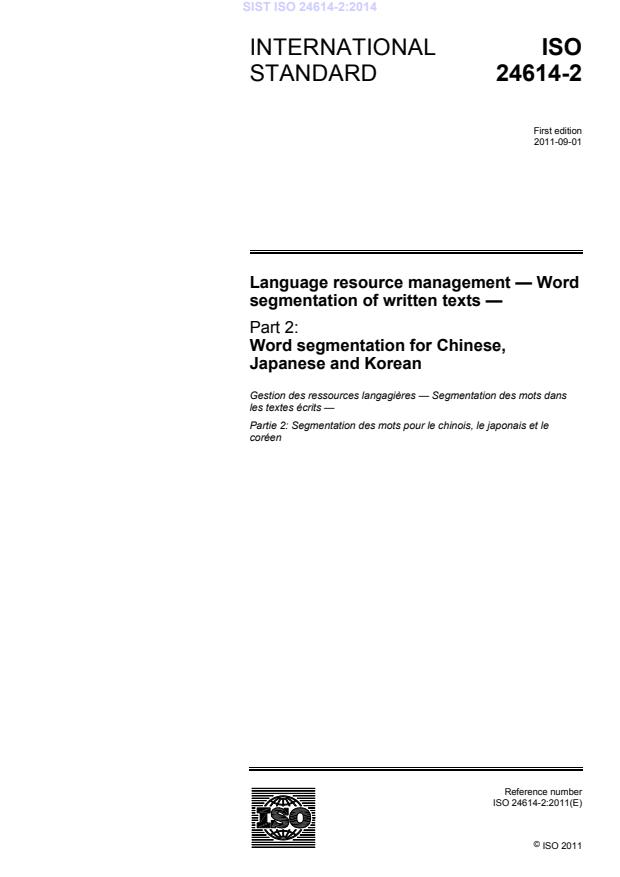
(Main)Language resource management - Word segmentation of written texts - Part 2: Word segmentation for Chinese, Japanese and Korean
General Information
- Abstract
The basic concepts and general principles of word segmentation as defined in ISO 24614-1 apply to Chinese, Japanese and Korean. Text needs to be segmented into tokens, words, phrases or some other types of smaller textual units in order to perform certain computational applications on language resources, such as natural language processing, information retrieval and machine translation. ISO 24614-2:2011 is restricted to the segmentation of a text into words or other word segmentation units (WSUs). This task is distinct from morphological or syntactic analysis per se, although it greatly depends on morphosyntactic analysis. It is also different from the task of laying out a framework for constructing a lexicon and identifying its lexical entries, namely lemmas and lexemes. The frameworks for the latter tasks are provided by ISO 24611, ISO 24613 and ISO 24615.
ISO 24614-2:2011 specifies rules for delineating WSUs for Chinese, Japanese and Korean. Some rules are common to all three languages, though each language also has its own distinct rules for identifying WSUs. The common features are discussed, then the distinct rules are laid out for Chinese, for Japanese and for Korean.
- Status
- Published
- Publication Date
- 30-Jun-2014
- Technical Committee
- IDT - Information, documentation, language and terminology
- Current Stage
- 6060 - National Implementation/Publication (Adopted Project)
- Start Date
- 05-Feb-2014
- Due Date
- 12-Apr-2014
- Completion Date
- 01-Jul-2014




Overview
SIST ISO 24614-2:2014 - Language resource management - Word segmentation of written texts - Part 2: Word segmentation for Chinese, Japanese and Korean - defines rules for segmenting running text into word segmentation units (WSUs) for CJK languages. The standard focuses on delineating WSUs (tokens, words, sub-word units) required for computational processing and is explicitly limited to segmentation - not full morphological or syntactic analysis, nor lexicon design. It documents features common to the three languages and then provides language-specific rules (Chinese, Japanese, Korean), plus terms, markup conventions and examples (e.g., Japanese bunsetsu, Korean eojeol).
Key topics and technical requirements
- Scope and purpose: Applies ISO 24614-1 basic concepts and general principles to CJK word segmentation; restricted to segmentation tasks needed by NLP, IR and MT.
- Common rules: General criteria for identifying WSUs shared across Chinese, Japanese and Korean (compound formation, derivation, fixed expressions, abbreviations, loanwords, foreign-character strings).
- Language‑specific rules: Detailed segmentation rules for:
- Chinese (including handling of suffixes like 儿 (r) and parts of speech such as nouns, verbs, adjectives, numerals and measure words)
- Japanese (concepts such as bunsetsu, particles, verb/adjective endings)
- Korean (eojeol handling, grammatical affixes and agglutination)
- Terminology & markup: Definitions (adnoun, bunsetsu, eojeol, WSU) and recommended markup conventions to annotate segmentation consistently.
- Annex and bibliography: Comparative tables and references to support interoperable annotation.
Practical applications
SIST ISO 24614-2:2014 provides a standardized basis for:
- Training and evaluating tokenizers and segmenters for NLP, machine translation, speech processing, and information retrieval.
- Creating interoperable, annotated corpora and language resources (corpus linguistics, lexicon alignment).
- Improving search indexing, text mining and data preparation in CJK languages where white-space tokenization is not sufficient.
- Ensuring consistent preprocessing in multilingual pipelines that include Chinese, Japanese or Korean.
Who should use this standard
- NLP engineers and data scientists building tokenization and preprocessing modules.
- Corpus linguists, annotators and standards implementers producing CJK annotated datasets.
- MT and IR system developers, lexicographers and localization teams requiring consistent segmentation.
- Academic researchers and software vendors working on language resources for Chinese, Japanese or Korean.
Related standards
- ISO 24614-1:2010 - Basic concepts and general principles (word segmentation)
- ISO 24611 - Morpho-syntactic annotation framework
- ISO 24613:2008 - Lexical markup framework (LMF)
- ISO 24615 - (related lexical/morpho-syntactic standards)
Keywords: SIST ISO 24614-2:2014, word segmentation, Chinese word segmentation, Japanese word segmentation, Korean word segmentation, language resource management, WSU, NLP, machine translation, information retrieval.
Frequently Asked Questions
SIST ISO 24614-2:2014 is a standard published by the Slovenian Institute for Standardization (SIST). Its full title is "Language resource management - Word segmentation of written texts - Part 2: Word segmentation for Chinese, Japanese and Korean". This standard covers: The basic concepts and general principles of word segmentation as defined in ISO 24614-1 apply to Chinese, Japanese and Korean. Text needs to be segmented into tokens, words, phrases or some other types of smaller textual units in order to perform certain computational applications on language resources, such as natural language processing, information retrieval and machine translation. ISO 24614-2:2011 is restricted to the segmentation of a text into words or other word segmentation units (WSUs). This task is distinct from morphological or syntactic analysis per se, although it greatly depends on morphosyntactic analysis. It is also different from the task of laying out a framework for constructing a lexicon and identifying its lexical entries, namely lemmas and lexemes. The frameworks for the latter tasks are provided by ISO 24611, ISO 24613 and ISO 24615. ISO 24614-2:2011 specifies rules for delineating WSUs for Chinese, Japanese and Korean. Some rules are common to all three languages, though each language also has its own distinct rules for identifying WSUs. The common features are discussed, then the distinct rules are laid out for Chinese, for Japanese and for Korean.
The basic concepts and general principles of word segmentation as defined in ISO 24614-1 apply to Chinese, Japanese and Korean. Text needs to be segmented into tokens, words, phrases or some other types of smaller textual units in order to perform certain computational applications on language resources, such as natural language processing, information retrieval and machine translation. ISO 24614-2:2011 is restricted to the segmentation of a text into words or other word segmentation units (WSUs). This task is distinct from morphological or syntactic analysis per se, although it greatly depends on morphosyntactic analysis. It is also different from the task of laying out a framework for constructing a lexicon and identifying its lexical entries, namely lemmas and lexemes. The frameworks for the latter tasks are provided by ISO 24611, ISO 24613 and ISO 24615. ISO 24614-2:2011 specifies rules for delineating WSUs for Chinese, Japanese and Korean. Some rules are common to all three languages, though each language also has its own distinct rules for identifying WSUs. The common features are discussed, then the distinct rules are laid out for Chinese, for Japanese and for Korean.
SIST ISO 24614-2:2014 is classified under the following ICS (International Classification for Standards) categories: 01.020 - Terminology (principles and coordination); 01.140.10 - Writing and transliteration. The ICS classification helps identify the subject area and facilitates finding related standards.
SIST ISO 24614-2:2014 is available in PDF format for immediate download after purchase. The document can be added to your cart and obtained through the secure checkout process. Digital delivery ensures instant access to the complete standard document.
Standards Content (Sample)
SLOVENSKI STANDARD
01-september-2014
Upravljanje z jezikovnimi viri - Besedna razčlenitev pisanega besedila - 2. del:
Besedna razčlenitev za kitajski, japonski in korejski jezik
Language resource management - Word segmentation of written texts - Part 2: Word
segmentation for Chinese, Japanese and Korean
Gestion des ressources langagières - Segmentation des mots dans les textes écrits -
Partie 2: Segmentation des mots pour le chinois, le japonais et le coréen
Ta slovenski standard je istoveten z: ISO 24614-2:2011
ICS:
01.020 Terminologija (načela in Terminology (principles and
koordinacija) coordination)
01.140.10 Pisanje in prečrkovanje Writing and transliteration
2003-01.Slovenski inštitut za standardizacijo. Razmnoževanje celote ali delov tega standarda ni dovoljeno.
INTERNATIONAL ISO
STANDARD 24614-2
First edition
2011-09-01
Language resource management — Word
segmentation of written texts —
Part 2:
Word segmentation for Chinese,
Japanese and Korean
Gestion des ressources langagières — Segmentation des mots dans
les textes écrits —
Partie 2: Segmentation des mots pour le chinois, le japonais et le
coréen
Reference number
©
ISO 2011
© ISO 2011
All rights reserved. Unless otherwise specified, no part of this publication may be reproduced or utilized in any form or by any means,
electronic or mechanical, including photocopying and microfilm, without permission in writing from either ISO at the address below or
ISO's member body in the country of the requester.
ISO copyright office
Case postale 56 CH-1211 Geneva 20
Tel. + 41 22 749 01 11
Fax + 41 22 749 09 47
E-mail copyright@iso.org
Web www.iso.org
Published in Switzerland
ii © ISO 2011 – All rights reserved
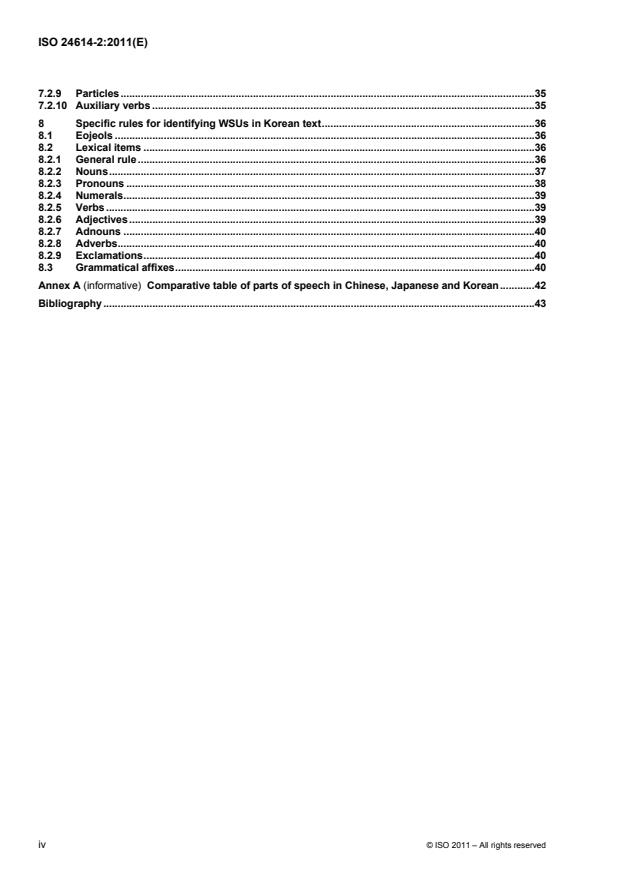
Contents Page
Foreword . v
Introduction . vi
1 Scope . 1
2 Normative references . 1
3 Terms and definitions . 2
4 Overview . 4
4.1 Introduction . 4
4.2 Markup convention . 4
4.3 Review of the concept of word segmentation unit . 5
4.4 Features common to Chinese, Japanese and Korean . 5
5 General rules for identifying WSUs in Chinese, Japanese and Korean . 6
5.1 Words . 6
5.2 Derivationally formed words . 6
5.3 Word compounds . 7
5.4 Phrasal compounds . 8
5.5 Idioms . 8
5.6 Fixed expressions . 9
5.7 Abbreviations . 10
5.8 Transliterated loanwords . 10
5.9 Strings of foreign or special characters . 11
5.10 Components of a WSU . 11
6 Specific rules for identifying WSUs in Chinese . 12
6.1 Lexical items followed by the suffix儿(r) . 12
6.2 Lexical items . 12
6.2.1 Nouns . 12
6.2.2 Verbs . 17
6.2.3 Adjectives . 20
6.2.4 Pronouns . 22
6.2.5 Numerals . 23
6.2.6 Measure words . 25
6.2.7 Adverbs . 25
6.2.8 Prepositions . 26
6.2.9 Conjunctions . 26
6.2.10 Auxiliary words . 26
6.2.11 Modal words . 27
6.2.12 Exclamations . 27
6.2.13 Imitative words . 27
7 Specific rules for identifying WSUs in Japanese text . 27
7.1 Bunsetsus . 27
7.2 Lexical items . 27
7.2.1 General rule . 27
7.2.2 Nouns . 28
7.2.3 Verbs . 32
7.2.4 Adjectives . 33
7.2.5 Adnouns . 34
7.2.6 Adverbs . 34
7.2.7 Conjunctions . 35
7.2.8 Exclamations . 35
7.2.9 Particles .35
7.2.10 Auxiliary verbs .35
8 Specific rules for identifying WSUs in Korean text .36
8.1 Eojeols .36
8.2 Lexical items .36
8.2.1 General rule .36
8.2.2 Nouns .37
8.2.3 Pronouns .38
8.2.4 Numerals .39
8.2.5 Verbs .39
8.2.6 Adjectives .39
8.2.7 Adnouns .40
8.2.8 Adverbs .40
8.2.9 Exclamations .40
8.3 Grammatical affixes .40
Annex A (informative) Comparative table of parts of speech in Chinese, Japanese and Korean .42
Bibliography .43
iv © ISO 2011 – All rights reserved
Foreword
ISO (the International Organization for Standardization) is a worldwide federation of national standards bodies
(ISO member bodies). The work of preparing International Standards is normally carried out through ISO
technical committees. Each member body interested in a subject for which a technical committee has been
established has the right to be represented on that committee. International organizations, governmental and
non-governmental, in liaison with ISO, also take part in the work. ISO collaborates closely with the
International Electrotechnical Commission (IEC) on all matters of electrotechnical standardization.
International Standards are drafted in accordance with the rules given in the ISO/IEC Directives, Part 2.
The main task of technical committees is to prepare International Standards. Draft International Standards
adopted by the technical committees are circulated to the member bodies for voting. Publication as an
International Standard requires approval by at least 75 % of the member bodies casting a vote.
Attention is drawn to the possibility that some of the elements of this document may be the subject of patent
rights. ISO shall not be held responsible for identifying any or all such patent rights.
ISO 24614-2 was prepared by Technical Committee ISO/TC 37, Terminology and other language and content
resources, Subcommittee SC 4, Language resource management.
ISO 24614 consists of the following parts, under the general title Language resource management — Word
segmentation of written texts:
Part 1: Basic concepts and general principles
Part 2: Word segmentation for Chinese, Japanese and Korean
Introduction
This part of ISO 24614 focuses on word segmentation in Chinese, Japanese and Korean written texts. As far
as typography is concerned, there is no white space between words in Chinese, Japanese or pre-modern
Korean texts. This makes it hard to segment a text into words, unless there is a consistent way of identifying
word segmentation units for those languages. On the other hand, in modern-day Korean text, word forms or
verbal stems that are agglutinated with grammatical affixes, called ‘eojeol’ or ‘malmadi’, are separated by
white space as in English written texts. Hence, it is much easier to identify words or other word segmentation
units in a Korean text. Nevertheless, a large number of words in Korean as well as in Japanese are borrowed
or derived from Chinese words; their internal structures are also based on the word formation principles of
Chinese. As a consequence, general rules for identifying word segmentation units (WSUs) in Chinese,
especially internal WSUs embedded in larger WSUs, are also applicable to some extent to the processing of
Japanese and Korean texts.
The use of characters does not play a real role in identifying WSUs in a text. Many Korean words can be
written either in Chinese or in Korean characters, but the same principles of analysing Chinese-derived words
and identifying sub-WSUs of those words apply. A newspaper published in Beijing is written in simplified
Chinese characters, while a Hong Kong newspaper may be written in traditional Chinese characters. Here
again, the same principles of identifying WSUs apply to both newspapers.
This part of ISO 24614 first sets out the general rules for identifying WSUs in Chinese, Japanese and Korean,
then addresses the specific rules for each language.
vi © ISO 2011 – All rights reserved
INTERNATIONAL STANDARD ISO 24614-2:2011(E)
Language resource management — Word segmentation of
written texts —
Part 2:
Word segmentation for Chinese, Japanese and Korean
1 Scope
The basic concepts and general principles of word segmentation as defined in ISO 24614-1 apply to Chinese,
Japanese and Korean. Text needs to be segmented into tokens, words, phrases or some other types of
smaller textual units in order to perform certain computational applications on language resources, such as
natural language processing, information retrieval (IR) and machine translation (MT). This part of ISO 24614 is
restricted to the segmentation of a text into words or other word segmentation units (WSUs). This task is
distinct from morphological or syntactic analysis per se, although it greatly depends on morphosyntactic
analysis. It is also different from the task of laying out a framework for constructing a lexicon and identifying its
lexical entries, namely lemmas and lexemes. The frameworks for the latter tasks are provided by ISO 24611,
ISO 24613 and ISO 24615.
The main objective of this part of ISO 24614 is to specify rules for delineating WSUs for Chinese, Japanese
and Korean. Some rules are common to all three languages, though each language also has its own distinct
rules for identifying WSUs. The common features are discussed in Clause 5, then the distinct rules are laid out
in Clause 6 for Chinese, Clause 7 for Japanese and Clause 8 for Korean.
2 Normative references
The following referenced documents are indispensable for the application of this document. For dated
references, only the edition cited applies. For undated references, the latest edition of the referenced
document (including any amendments) applies.
ISO 24611, Language resource management — Morpho-syntactic annotation framework
ISO 24613:2008, Language resource management — Lexical markup framework (LMF)
ISO 24614-1:2010, Language resource management — Word segmentation of written texts — Part 1: Basic
concepts and general principles
3 Terms and definitions
For the purposes of this document, the terms and definitions given in ISO 24611, ISO 24613 and ISO 24614-1
and the following apply.
3.1
adnoun
ADN
non-conjugating word that modifies a noun
NOTE Adnouns modify nouns, as adverbs modify verbs.
EXAMPLE 1
a. あらゆる 国
arayuru kuni
ADN N
‘every country’
b. 好きな 花
suki+na hana
ADNst+SX N
‘favourite flower’
EXAMPLE 2
a. 새 옷
sae ot
ADN noun
‘new clothes’
b. 빨간 옷
bbalga+n ot
ADJst+GX N
‘red clothes’
3.2
bunsetsu
phrase (3.8) without internal modifying relations
EXAMPLE The sentence 私は学校へ早く行きました(I went to school early) consists of four bunsetsus:
私は(watashiwa), 学校へ (gakkoue), 早く(hayaku) and 行きました(ikimashita) in which
私(watashi) is a pronoun,
は(wa) is a particle,
学校(gakkou) is a noun,
へ(e) is a particle,
早く(hayaku) is an adjective in adverbial usage,
行き(iki) is a verbal stem followed by
まし(mashi) is an auxiliary verb denoting politeness, and
た(ta) is an auxiliary verb indicating the past tense.
NOTE A bunsetsu normally consists of a noun plus its particle(s) or a verb plus its ending(s), auxiliary verb(s) or
particle(s) as shown in the example above.
2 © ISO 2011 – All rights reserved
3.3
ending
agglutinative affix of a verb or adjective
NOTE Verbs and adjectives end with agglutinative forms, called “endings”. These endings may be a negative form,
an adverbial form, a base form, an adnominal form, an assumption form or an imperative form.
3.4
eojeol
malmaldi
word or its variant word form agglutinated with grammatical affixes
NOTE 1 White space (space between characters) helps to segment text into eojeols.
EXAMPLE
내가 사과를 먹었다
nae+ga sagwa+reul meok+eot+da
pronoun+GX noun+GX Vst+GX+GX
‘I’+SBJ ‘apple’+OBJ ‘eat’+PST+DCL = ‘I ate (an) apple’
NOTE 2 This sentence consists of three eojeols: 내가, 사과를 and 먹었다, each of which is separated by white space.
The acronyms GX, SBJ, OBJ, PST and DCL in the example above stand for grammatical affix, subject, object, past tense
and declarative sentential type, respectively. The pronoun 내 is a variant form of the pronoun 나 referring to the speaker.
먹었다 is an eojeol and at the same time is a word form agglutinated with two grammatical affixes 었 and 다 to a verb
stem .
먹
3.5
lexical item
entry in a lexicon that is a lexeme or one of its variant forms
NOTE Headed by a lemma, each lexical item may be either a free-standing word (or one of its variant word forms) or
a bound (non-free-standing) form such as stems and affixes. See ISO 24614-1:2010 for the definitions of lexeme, lemma
and lexicon.
3.6
measure word
part of speech defining, along with numbers, the quantity of a given object, or identifying
specific objects with demonstrative pronouns such as “this” and “that”
NOTE 1 Whereas English speakers say “one person” or “this person”, Chinese speakers say respectively 一个人(yi ge
ren; numeral + measure word + noun; one person) or 这个人 (zhe ge ren; demonstrative pronoun + measure word +
person; this person), where 个 (ge) is a measure word.
NOTE 2 A set of “verbal measure words” is used to count the number of times an action occurs, rather than the
number of items. For example, in the sentence 我去过三次北京(wo qu guo san ci Beijing; pronoun + verb + auxiliary word
+ numeral + measure word + proper noun; I have been to Beijing three times), the 次(ci) functions as a measure word to
combine with a numeral 三 to derive the adverb三次 (sanci) that modifies the verb 去(qu).
3.7
particle
grammatical affix agglutinated mostly to nominal forms but sometimes to other free-standing
lexical items (3.5)
NOTE The grammatical category particle can be treated as a part of speech.
EXAMPLE The noun phrase 学校へ(gakkoue) is analysed into a noun 学校 (gakkou) and a particle へ(e). The verb
phrase 寒いね(samuine, ‘It is very cold, isn't it?’) is analysed into a verb 寒い (samui) and a particle ね(ne) which
corresponds to the tag ‘isn't it ?’.
3.8
phrase
group of words that perform a grammatical function and that form a conceptual unit within a sentence
4 Overview
4.1 Introduction
This clause first introduces a markup convention for word segmentation units, then reviews the concept of
word segmentation unit (WSU) which was introduced in ISO 24614-1. Some features shared by Chinese,
Japanese and Korean are discussed in 4.3. A comparative table of parts of speech is given in Annex A.
4.2 Markup convention
The following clauses contain a very large number of examples of WSUs. A simple way of representing WSUs
is introduced here.
NOTE This markup convention is introduced here just for the sake of simple illustration in this part of ISO 24614.
First, a stand-off annotation is adopted; this allows primary data to be kept intact from markup notations.
(More information on linguisitic annotation can be found in ISO 24612.) Exceptions are made concerning this
requirement when primary data in Chinese or some other language are not provided with a romanized version
or when the identification of syllables is not easy.
Second, a citation format consisting of four lines is adopted.
Line 1 introduces primary text fragment in its original script.
Line 2 represents annotated fragment in romanized form.
Line 3 assigns morpho-syntactic descriptions.
Line 4 provides an English equivalent.
The following symbols are used (optionally) for marking up primary data in a romanized form:
1) the dot ‘.’ for syllable boundaries, if ambiguity arises;
2) the sign ‘+’ (plus) for boundaries between a word and an affix;
3) the underscore ‘_’ for word segmentation units (WSUs);
4) the square brackets ‘[ ]’ for WSUs, if ambiguity arises;
5) the parentheses ‘( )’ for non-WSUs;
6) the symbol ‘:=’ represents combined resultant information.
EXAMPLE
헛돌다
[(heot)+dol]_da
prefix + verbStem_GX := verb
‘in vain’ ‘spin’ := ‘to spin in vain’
4 © ISO 2011 – All rights reserved
The verb 헛돌다 consists of a prefix 헛 (heot) and a verb 돌다 (dol+da). The verb 돌다 is then analysed into a stem 돌
(dol) and a verbal grammatical affix 다 (da). The example 헛돌다 as a whole is a WSU, while its subpart 돌다 is also a
WSU embedded in it. In Korean, as will be discussed, the prefix 헛 (heot) is not treated as a WSU.
For computational purposes, namely character encoding schemes, the characters in Chinese, Japanese and
Korean are all treated as being syllabic. Hence, each of the characters in primary data can easily be identified
with its corresponding romanized string of alphabetic characters. The word given in the above example, for
instance, consists of three syllable characters: 헛, 돌 and 다, while its corresponding romanized version
‘heotdolda’ also consists of three syllables, ‘heot’, ‘dol’ and ‘da’. As a result, we can identify the first syllable
‘heot’ in the romanized version as corresponding to the first syllable 헛 in the Korean example and also the
following sequence of the two syllables in the romanized version as corresponding to the sequence of two
syllable characters 돌다. This indicates that there is no need to mark up primary data, but to keep them intact
in order to show how they are analysed into WSUs or other morphological units.
In Japanese, however, a single Chinese character may be pronounced as more than one syllable: for example,
the noun consisting of one character桜 is pronounced as a three-syllable string ‘sakura’. In such a case,
primary data are marked up.
4.3 Review of the concept of word segmentation unit
Word segmentation is the process of dividing a text into meaningful units called word segmentation units
(WSUs). Each WSU corresponds to a single concept: for example, ‘the White House’ consists of three words
but designates a single concept referring to the residence of the US President. It follows that ‘the White
House’ corresponds to one WSU. In other words, word count and concept do not necessarily correspond, and
may differ from one language to the next. The single English word ‘pork’ is translated by two words that mean
‘pig meat’ in Chinese 猪肉 (zhu_rou), in Japanese豚肉 (buta_niku), and in Korean 돼지고기 (doeji_gogi). So
although English uses only one word and the other languages use two, in all four languages there is just one
WSU.
A unit that carries a meaning that is useful for any linguistic processing can be defined as a WSU. A WSU can
be an entry in a lexicon or any other type of lexical resource insofar as such an entry is leveraged in some
natural language processing application. In other words, the WSU's dimension is more or less fixed, but
linguistic interferences between compounds inside a WSU are not allowed. Such an extensive, open definition
of WSU is useful for further linguistic processing because some WSUs that frequently occur in corpora are not
systematically decomposable by syntactic or any other linguistic processing.
4.4 Features common to Chinese, Japanese and Korean
Two basic features that are common to Chinese, Japanese and Korean derive from a common cultural
heritage in Far East Asia.
Firstly, Chinese characters have long been used, and continue to be used, in this part of the world
notwithstanding some differences in their degree of use: Chinese utilizes all of these characters, while
Japanese also uses them in addition to Kana characters. On the other hand, Korean has its own writing
system, but sometimes uses Chinese characters, especially for scholarly purposes in humanities such as
classical studies.
Secondly, many words and phrases of Chinese origin are used in both Japanese and Korean; they
include 四面楚歌 and 第二次世界大战. Note, however, that the non-simplified or original shapes of
Chinese characters are retained in these languages; in the case of Korean, they may simply be written
using the characters of the Korean writing system. The phrase 四面楚歌 written in Chinese characters, for
instance, is written as사면초가 in Korean.
Because of this historical background, some principles of Chinese word segmentation apply significantly to
Chinese-derived words found in Japanese and Korean. If the word is derived from Chinese characters, the
three languages have common properties. If the word is a noun and consists of two or more Chinese
characters, it will constitute a single WSU as long as the characters are “tightly combined and steadily used” in
accordance with the principles set out in ISO 24614-1; for example, ‘each country’ in English is not a single
WSU, but two WSUs unlike its Chinese equivalent 各国. However, if the final character is productive in a
limited manner, it forms a single WSU with the preceding word; for example, 東京都 (Tokyo Metropolitan), 8月
(August) and 加速器(accelerator) are single WSUs without being analysed into two WSUs, say 東京 and 都.
Because the motivation for a word segmentation standard is to recommend which WSUs should be listed in a
given type of lexicon (i.e. not a linguistics lexicon but any kind of practical, indexed container of WSUs), there
may be conflicting principles; for example, principles of non-productivity, frequency and granularity could
trigger conflicts because they are marked by different perspectives for defining WSUs.
Nouns derived from Chinese characters may be shared for the purposes of establishing the WSU structure of
the three languages, but not in every respect. However, Korean and Japanese do have certain features in
common; for example, some Korean verbal affixes and Japanese auxiliary verbs perform the same functions.
Word segmentation in each language varies in line with existing word segmentation rules, and sometimes
even breaches one or more principles of word segmentation. This will be a starting point for recommending a
more synchronized concept of “word segmentation unit” (WSU) in a multilingual environment. The aim of the
concept of “word segmentation unit” is to broaden our view about what could be contained in a lexicon used
for natural language processing purposes, and with little linguistic representation.
5 General rules for identifying WSUs in Chinese, Japanese and Korean
5.1 Words
All words and their variant word forms are WSUs.
5.2 Derivationally formed words
All derivationally formed words or their variant word forms are treated as WSUs.
Derivational affixes (AX), which can be either prefixes or suffixes, are also treated as WSUs in Chinese, but
not in Japanese or Korean.
EXAMPLE 1
Two examples of WSUs, 科学家 ‘scientist’ and 物理学家 ‘physicist’, are shown below.
a. 科学家
kexue_jia
N AX
‘science’ ‘expert’ := ‘scientist’
b. 物理学家
[wuli_xue]_jia
N AX AX
‘physics’ ‘discipline’ ‘expert’ := ‘physicist’
The first Chinese example consists of two WSUs, 科学 ‘science’ and 家 ‘expert’, while the second consists of four WSUs,
物理学 (wuli.xue) ‘physics’, 物理 (wuli) ‘physics’, 学 (xue) ‘science’ and 家 (jia) ‘expert’.
EXAMPLE 2
a. 非常勤
(hi)_jouikin
AX N := noun
‘non-’ ‘full-time working’ := ‘part-time work’
6 © ISO 2011 – All rights reserved
b. 音楽家
ongaku_(ga)
N AX := noun
‘music’ ‘professional person’ := ‘musician’
Both of the Japanese examples are derived nouns. The noun 非常勤 is derived by adding the prefix 非 to the noun 常勤.
The derived noun as a whole is a WSU and so is the noun 常勤, while the prefix 非 by itself is not a WSU. Likewise, the
noun 音楽家 is also a derived noun that consists of a noun 音楽 and a suffix 家. Here again, the derived noun 音楽家 and
its component noun 音楽 are treated as WSUs, but the suffix 家 is not a WSU.
EXAMPLE 3
a. 음악가
eumak+(ga)
N _ AX := noun
‘music’ ‘professional’ := ‘musician’
b. 헛돌다
[(heot)+dol]_da
AX_V := verb
‘false’ ‘spin’ := ‘to spin without any result’
The Korean examples contain four WSUs: 음악가, 헛돌다, while 음악 and 돌다 are also treated as WSUs if they occur
independently in a text. Neither the suffix 가 nor the prefix 헛 in isolation is treated as a WSU. No derivational affixes are
treated as WSUs in Korean, mainly because they are not words.
5.3 Word compounds
All word compounds are treated as single WSUs.
NOTE The term “word compound” is defined in ISO 24614-1:2010, 2.28. Unlike a phrasal compound, the meaning of
a word compound is only partially predictable from the meanings of its constituent words.
EXAMPLE 1
白菜
baikcai
noun
‘white’ ‘vegetable’ := ‘Chinese cabbage’
The word 白菜 above is a noun, consisting of two words 白(baik) ‘white’ and 菜 (cai) ‘vegetable’. It is a compound noun
and is treated as a single WSU, for the meaning of its component words is only partially preserved in the process of
compounding. The noun 白菜 refers to a kind of vegetable that may in fact not be white, but green with green leaves.
EXAMPLE 2
海外旅行
kaigai_ryokou
noun noun := noun
‘abroad’ ‘travel’ := ‘traveling abroad’
The WSU 海外旅行 as a compound noun consists of two nouns 海外(kaigai) and 旅行(ryokou); both of them are also
WSUs.
EXAMPLE 3
a. 손목
son_ mok
noun noun := noun
‘hand’ ‘neck’ := ‘wrist’
b. 바로잡다
baro_jabda
adverb verb := verb
‘rightly’ ‘hold’ := ‘to correct’
Here both of the compounds, 손목 and 바로잡다, are WSUs, as are their component words, 손 ‘hand’, 목 ‘neck’,
바로 ‘rightly’ and 잡다 ‘to hold’ if they occur independently in a text.
5.4 Phrasal compounds
All phrasal compounds are treated as single WSUs.
NOTE The term “phrasal compound” is defined in ISO 24614-1:2010, 2.20. Unlike a word compound, the meaning of
a phrasal compound is predictable from the meaning of each of its constituents.
EXAMPLE 1
a. 猪肉
zhu_rou
noun noun := noun
‘pig’ ‘meat’ := ‘pork’
b. 发电厂
fadian_chang
verb noun := noun
‘to generate electricity’ ‘plant’ := ‘power plant’
The phrasal compounds 猪肉 and 发电厂 are WSUs and so are their components, 猪 ‘pig’, 肉 ‘meat’, 发电 ‘to generate
electricity’ and 厂 ‘place’.
EXAMPLE 2
豚肉
buta_niku
noun noun := noun
‘pig’ ‘meat’ := ‘pork’
EXAMPLE 3
돼지고기
doeji_gogi
noun noun := noun
‘pig’ ‘meat’ := ‘pork’
In both Japanese and Korean, these compounds are treated as WSUs and so are their component words.
5.5 Idioms
Idioms are treated as single WSUs.
NOTE An idiom is a kind of multiword expression (MWE) defined in ISO 24614-1:2010, 2.19. Like some other types
of MWE, the parts of speech of idioms vary, e.g. from noun to verb.
EXAMPLE 1
a. 胸有成竹
xion you cheng zhu
‘to have a well-thought-out plan’
8 © ISO 2011 – All rights reserved
b. 欣欣向荣
xin xin xiang rong
‘to be prosperous’
NOTE Most idioms in Chinese are four-character phrases.
EXAMPLE 2
腹が立つ
[hara _(ga)] _atatsu
noun particle verb := idiom
‘stomach’ nominative ‘occur’ := ‘I am upset’
The string of words 腹が立つ of a sentential form is a WSU because it is an idiom. Their components, except for the
particle が (ga), are also WSUs.
EXAMPLE 3
a. 수박겉핥기
subak_[geot_halgi]
noun noun verb := idiom
‘watermelon’ ‘surface’ ‘licking’ := ‘superficial knowledge’
b. 함흥차사 (咸興差使)
hamheung _chasa
proper noun noun := idiom
‘Hamhung’ ‘messenger’ := ‘no news’
The string of characters 수박겉핥기 in a. is an idiom and thus treated as a WSU. Its components, 수박 (subak), 겉 (geot)
and 핥기 (halgi) are also WSUs.
The character string 함흥 as a proper name can be treated as a WSU, as can the character string 차사 which refers to a
messenger.
5.6 Fixed expressions
Fixed expressions such as proverbs and mottos are treated as single WSUs.
EXAMPLE 1
a. 对不起
dui bu qi
‘sorry’
b. 春夏秋冬
chun xia qiu dong
‘spring summer autumn winter’
c. 由此可见
you ci ke jian
‘this shows’
d. 不管三七二十 一
bu quan san qi er shi yi
‘no matter three seven two ten one’
e. 失败是成功之母
shibai shi chengong zhi mu
‘Failure is the mother of success’
EXAMPLE 2
時は金なり
toki +wa _kane +nari
noun particle noun auxiliary := sentence
‘time’ topic-marker ‘money’ copula := ‘Time is money’
EXAMPLE 3
a. 천리 길도 한 걸음부터
cheol+li gil+do han georum+buteo
measure noun+affix adnoun noun suffix
‘thousand li’ ‘road’ ‘one’ ‘walk’ ‘from’ := ‘step by step’
b. 다시 말하여
dasi_malha+yeo
adv verb + GX
‘again’ ‘speaking’ := ‘In other words’
The idioms as a whole are treated as single WSUs, while their components are also treated as WSUs. Note
that the occurrences of white space between these expressions indicate that each constituent word is a WSU
as well as an eojeol.
5.7 Abbreviations
Abbreviations are treated as single WSUs.
EXAMPLE 1
a. 科技
keji
‘science and technology’
b. 工农业
gongnongye
‘industry and agriculture’
NOTE Abbreviations in Chinese texts usually consist of two, three or four characters.
EXAMPLE 2
特急 (tokkyuu, noun: super express): 特別 (super) + 急行 (express)
EXAMPLE 3
의대[醫大] (uidae, noun, ‘medical college’ : 의과 (uigwa; ‘medical area’) + 대학 (daehak; ‘college’)
5.8 Transliterated loanwords
Transliterated loanwords, namely those foreign words that keep pronunciations in their original languages, are
treated as single WSUs.
EXAMPLE 1
a.吉普
jipu
‘Jeep’
10 © ISO 2011 – All rights reserved
b.巧克力
giaokeli
‘chocolate’
EXAMPLE 2
a. ジープ (jeep)
b. チョコレート (chocolate)
Transliterated loanwords in Japanese are normally written in kata kana.
EXAMPLE 3
a. 피아노 (piano)
b. 바이올린 (violin)
5.9 Strings of foreign or special characters
A string of foreign or special characters such as foreign language characters, Arabic numerals, and
mathematical and chemical symbols are treated as WSUs.
EXAMPLE 1
a. Chomsky
b. F16
c. X-Ray
d. 1298
e. +
f. CO
These strings may be mixed with Chinese, Japanese or Korean characters in the text.
EXAMPLE 2
Chomsky 는 언어학자이다. ‘Chomsky is a linguist.’
5.10 Components of a WSU
Some components of a WSU can themselves be WSUs.
As has been discussed, many WSUs have an internal structure that organizes several WSUs hierarchically.
Structures of this type can be manipulated at different granularity levels in the process of word segmentation
according to the requirements of various applications. For example, 猪肉 in Chinese can be treated as a
single WSU for machine translation (MT), which translates it into a single word ‘pork’ in English, whereas it
can be treated as two WSUs for the purposes of information retrieval (IR), which looks for two different
ontological entities (‘pig’ and ‘meat’).
6 Specific rules for identifying WSUs in Chinese
6.1 Lexical items followed by the suffix儿(r)
Lexical items followed by the suffix 儿, a retroflex r, which has a discourse function for marking prominence in
an informal speech or text, are treated as single WSUs. The suffix (SX) 儿 is often attached to nouns (N), and
sometimes to verbs (V) or adverbs (ADV) to make these items displayed more vividly in informal speech or
writing of Mandarin Chinese. The suffix has no meaning in itself except for such a discourse function.
EXAMPLE
a. 花儿
hua_(r)
N SX := noun
‘flower’ emphasis := ‘flower’
b. 玩儿
wan_(r)
V SX := verb
‘to play’ emphasis := ‘to play’
c. 悄悄儿
qiaogiao_(r)
ADV SX := adverb
‘quietly’ emphasis := ‘quietly’
The noun 花儿 as a whole, for instance, is a WSU, as is the first character花. The suffix 儿, however, is not a
WSU. It is thus put into parentheses.
6.2 Lexical items
6.2.1 Nouns
6.2.1.1 General
Nouns (N) are WSUs. They are subcategorized into common nouns (CN) and proper nouns (PN).
6.2.1.2 Common nouns
A common noun (CN) modified by an adjective (ADJ) is segmented into two WSUs, while the meaning of the
modifying adjective contributes to the meaning of the modified noun as a whole.
EXAMPLE 1
a. 小床
xiao_chuang
ADJ CN := noun phrase
‘small’ ‘bed’ := ‘small bed’
b. 小媳妇
xiao.xiwu
ADJ CN := noun
‘small wife’ := ‘(young) wife’
Example 1 a. is segmented into two WSUs, 小 (xiao) and 床 (chuang), for the meaning of the adjective 小 ‘small’ is
preserved, whereas example 1 b. is treated as a single WSU because the meaning of the adjective 小 ‘small’ is not
preserved. The wife referred to may be a big woman.
12 © ISO 2011 – All rights reserved
Common nouns (CN) that are combined with an expression referring to a direction (DIR) or location (LOC) are
treated as two WSUs.
EXAMPLE 2
a. 桌子上
zuozi_shang
N LOC
‘table’ ‘above’ := ‘on the table’
b. 长江以北
N LOC
‘Yangtzi River’ ‘north’ := ‘north of the Yangtzi River’
Each of these character strings constitutes two WSUs.
Common nouns with the plural suffix (SX) 们 (men) are treated as two WSUs. The character string 朋友们
‘friends’, for instance, is segmented into two WSUs, 朋友 (noun) and 们 (plural suffix).
EXAMPLE 3
朋友们
penyou_men
CN_SX := noun
‘friend’plural := ‘friends’
However, the following nouns are treated as single WSUs because the character 们 is understood to be an
inseparable part.
EXAMPLE 4
a. 人们 renmen, ‘people’
b. 哥儿们 germen, ‘pals’
c. 爷儿们 yiermen, ‘guys’
Each of the names of months and days as a whole is a single WSU.
EXAMPLE 5
a. 元月
yuanyue
‘first’ ‘month’ := ‘January’
b. 3月
sanyue
‘three month’ := ‘March’
c. 五月
wuyue
‘five month’ := ‘May’
d. 礼拜三
libaisan
‘week three’ := ‘Wednesday’
e. 星期日
xinqiri
‘week day’ := ‘Sunday’
Each temporal expression referring to a year, day, hour, minute or second is also treated as a single WSU.
EXAMPLE 6
1988 年 3月 15日
1998nian_sanyue_15 ri
‘year 1998’ ‘March’ ‘day fifteen’ := ‘15 March 1998’
11时42分 8秒
11shi_42fen_8miao
‘11 o'clock’ ‘42 minutes’ ‘8 seconds’ := ‘11:42:08 sec’
Temporal expressions that are combined with affixes such as 上 (last), 下 (next), 前 (before last), 后 (after
next), 大前 (before before last), and大后 (after after next) are single WSUs.
EXAMPLE 7
a. 上星期 shangxingqi ‘last week’
b. 下月 xiayue ‘next month’
c. 前天 qiantian ‘the day before yesterday’
d. 后年 hounian ‘the year after next’
e. 大前天 daqiantian ‘the day before the day before yesterday, three days ago’
f. 大后年 dahounian ‘the year after the year after next, three years later’
The temporal nouns referring to the first ten days of each month, starting from 初一 (the first day) to 初十 (the
tenth day) in the Chinese lunar calendar, are WSUs.
6.2.1.3 Proper nouns
Personal names that consist of a surname (family name) and a given name are WSUs. Each of these WSUs
can be further segmented into two WSUs, corresponding to a surname and a given name.
EXAMPLE 1
a. 张胜利
zhang_shengli
surname given name
‘Zhang Shengli’
b. 欧阳志华
ouyang_zhihua
surname given name
‘Ouyang Zhihua’
NOTE In Chinese as well as in Japanese and Korean, surnames are written first before given names.
The surname with a title is segmented into two WSUs.
EXAMPLE 2
a.
...
INTERNATIONAL ISO
STANDARD 24614-2
First edition
2011-09-01
Language resource management — Word
segmentation of written texts —
Part 2:
Word segmentation for Chinese,
Japanese and Korean
Gestion des ressources langagières — Segmentation des mots dans
les textes écrits —
Partie 2: Segmentation des mots pour le chinois, le japonais et le
coréen
Reference number
©
ISO 2011
© ISO 2011
All rights reserved. Unless otherwise specified, no part of this publication may be reproduced or utilized in any form or by any means,
electronic or mechanical, including photocopying and microfilm, without permission in writing from either ISO at the address below or
ISO's member body in the country of the requester.
ISO copyright office
Case postale 56 CH-1211 Geneva 20
Tel. + 41 22 749 01 11
Fax + 41 22 749 09 47
E-mail copyright@iso.org
Web www.iso.org
Published in Switzerland
ii © ISO 2011 – All rights reserved
Contents Page
Foreword . v
Introduction . vi
1 Scope . 1
2 Normative references . 1
3 Terms and definitions . 2
4 Overview . 4
4.1 Introduction . 4
4.2 Markup convention . 4
4.3 Review of the concept of word segmentation unit . 5
4.4 Features common to Chinese, Japanese and Korean . 5
5 General rules for identifying WSUs in Chinese, Japanese and Korean . 6
5.1 Words . 6
5.2 Derivationally formed words . 6
5.3 Word compounds . 7
5.4 Phrasal compounds . 8
5.5 Idioms . 8
5.6 Fixed expressions . 9
5.7 Abbreviations . 10
5.8 Transliterated loanwords . 10
5.9 Strings of foreign or special characters . 11
5.10 Components of a WSU . 11
6 Specific rules for identifying WSUs in Chinese . 12
6.1 Lexical items followed by the suffix儿(r) . 12
6.2 Lexical items . 12
6.2.1 Nouns . 12
6.2.2 Verbs . 17
6.2.3 Adjectives . 20
6.2.4 Pronouns . 22
6.2.5 Numerals . 23
6.2.6 Measure words . 25
6.2.7 Adverbs . 25
6.2.8 Prepositions . 26
6.2.9 Conjunctions . 26
6.2.10 Auxiliary words . 26
6.2.11 Modal words . 27
6.2.12 Exclamations . 27
6.2.13 Imitative words . 27
7 Specific rules for identifying WSUs in Japanese text . 27
7.1 Bunsetsus . 27
7.2 Lexical items . 27
7.2.1 General rule . 27
7.2.2 Nouns . 28
7.2.3 Verbs . 32
7.2.4 Adjectives . 33
7.2.5 Adnouns . 34
7.2.6 Adverbs . 34
7.2.7 Conjunctions . 35
7.2.8 Exclamations . 35
7.2.9 Particles .35
7.2.10 Auxiliary verbs .35
8 Specific rules for identifying WSUs in Korean text .36
8.1 Eojeols .36
8.2 Lexical items .36
8.2.1 General rule .36
8.2.2 Nouns .37
8.2.3 Pronouns .38
8.2.4 Numerals .39
8.2.5 Verbs .39
8.2.6 Adjectives .39
8.2.7 Adnouns .40
8.2.8 Adverbs .40
8.2.9 Exclamations .40
8.3 Grammatical affixes .40
Annex A (informative) Comparative table of parts of speech in Chinese, Japanese and Korean .42
Bibliography .43
iv © ISO 2011 – All rights reserved
Foreword
ISO (the International Organization for Standardization) is a worldwide federation of national standards bodies
(ISO member bodies). The work of preparing International Standards is normally carried out through ISO
technical committees. Each member body interested in a subject for which a technical committee has been
established has the right to be represented on that committee. International organizations, governmental and
non-governmental, in liaison with ISO, also take part in the work. ISO collaborates closely with the
International Electrotechnical Commission (IEC) on all matters of electrotechnical standardization.
International Standards are drafted in accordance with the rules given in the ISO/IEC Directives, Part 2.
The main task of technical committees is to prepare International Standards. Draft International Standards
adopted by the technical committees are circulated to the member bodies for voting. Publication as an
International Standard requires approval by at least 75 % of the member bodies casting a vote.
Attention is drawn to the possibility that some of the elements of this document may be the subject of patent
rights. ISO shall not be held responsible for identifying any or all such patent rights.
ISO 24614-2 was prepared by Technical Committee ISO/TC 37, Terminology and other language and content
resources, Subcommittee SC 4, Language resource management.
ISO 24614 consists of the following parts, under the general title Language resource management — Word
segmentation of written texts:
Part 1: Basic concepts and general principles
Part 2: Word segmentation for Chinese, Japanese and Korean
Introduction
This part of ISO 24614 focuses on word segmentation in Chinese, Japanese and Korean written texts. As far
as typography is concerned, there is no white space between words in Chinese, Japanese or pre-modern
Korean texts. This makes it hard to segment a text into words, unless there is a consistent way of identifying
word segmentation units for those languages. On the other hand, in modern-day Korean text, word forms or
verbal stems that are agglutinated with grammatical affixes, called ‘eojeol’ or ‘malmadi’, are separated by
white space as in English written texts. Hence, it is much easier to identify words or other word segmentation
units in a Korean text. Nevertheless, a large number of words in Korean as well as in Japanese are borrowed
or derived from Chinese words; their internal structures are also based on the word formation principles of
Chinese. As a consequence, general rules for identifying word segmentation units (WSUs) in Chinese,
especially internal WSUs embedded in larger WSUs, are also applicable to some extent to the processing of
Japanese and Korean texts.
The use of characters does not play a real role in identifying WSUs in a text. Many Korean words can be
written either in Chinese or in Korean characters, but the same principles of analysing Chinese-derived words
and identifying sub-WSUs of those words apply. A newspaper published in Beijing is written in simplified
Chinese characters, while a Hong Kong newspaper may be written in traditional Chinese characters. Here
again, the same principles of identifying WSUs apply to both newspapers.
This part of ISO 24614 first sets out the general rules for identifying WSUs in Chinese, Japanese and Korean,
then addresses the specific rules for each language.
vi © ISO 2011 – All rights reserved
INTERNATIONAL STANDARD ISO 24614-2:2011(E)
Language resource management — Word segmentation of
written texts —
Part 2:
Word segmentation for Chinese, Japanese and Korean
1 Scope
The basic concepts and general principles of word segmentation as defined in ISO 24614-1 apply to Chinese,
Japanese and Korean. Text needs to be segmented into tokens, words, phrases or some other types of
smaller textual units in order to perform certain computational applications on language resources, such as
natural language processing, information retrieval (IR) and machine translation (MT). This part of ISO 24614 is
restricted to the segmentation of a text into words or other word segmentation units (WSUs). This task is
distinct from morphological or syntactic analysis per se, although it greatly depends on morphosyntactic
analysis. It is also different from the task of laying out a framework for constructing a lexicon and identifying its
lexical entries, namely lemmas and lexemes. The frameworks for the latter tasks are provided by ISO 24611,
ISO 24613 and ISO 24615.
The main objective of this part of ISO 24614 is to specify rules for delineating WSUs for Chinese, Japanese
and Korean. Some rules are common to all three languages, though each language also has its own distinct
rules for identifying WSUs. The common features are discussed in Clause 5, then the distinct rules are laid out
in Clause 6 for Chinese, Clause 7 for Japanese and Clause 8 for Korean.
2 Normative references
The following referenced documents are indispensable for the application of this document. For dated
references, only the edition cited applies. For undated references, the latest edition of the referenced
document (including any amendments) applies.
ISO 24611, Language resource management — Morpho-syntactic annotation framework
ISO 24613:2008, Language resource management — Lexical markup framework (LMF)
ISO 24614-1:2010, Language resource management — Word segmentation of written texts — Part 1: Basic
concepts and general principles
3 Terms and definitions
For the purposes of this document, the terms and definitions given in ISO 24611, ISO 24613 and ISO 24614-1
and the following apply.
3.1
adnoun
ADN
non-conjugating word that modifies a noun
NOTE Adnouns modify nouns, as adverbs modify verbs.
EXAMPLE 1
a. あらゆる 国
arayuru kuni
ADN N
‘every country’
b. 好きな 花
suki+na hana
ADNst+SX N
‘favourite flower’
EXAMPLE 2
a. 새 옷
sae ot
ADN noun
‘new clothes’
b. 빨간 옷
bbalga+n ot
ADJst+GX N
‘red clothes’
3.2
bunsetsu
phrase (3.8) without internal modifying relations
EXAMPLE The sentence 私は学校へ早く行きました(I went to school early) consists of four bunsetsus:
私は(watashiwa), 学校へ (gakkoue), 早く(hayaku) and 行きました(ikimashita) in which
私(watashi) is a pronoun,
は(wa) is a particle,
学校(gakkou) is a noun,
へ(e) is a particle,
早く(hayaku) is an adjective in adverbial usage,
行き(iki) is a verbal stem followed by
まし(mashi) is an auxiliary verb denoting politeness, and
た(ta) is an auxiliary verb indicating the past tense.
NOTE A bunsetsu normally consists of a noun plus its particle(s) or a verb plus its ending(s), auxiliary verb(s) or
particle(s) as shown in the example above.
2 © ISO 2011 – All rights reserved
3.3
ending
agglutinative affix of a verb or adjective
NOTE Verbs and adjectives end with agglutinative forms, called “endings”. These endings may be a negative form,
an adverbial form, a base form, an adnominal form, an assumption form or an imperative form.
3.4
eojeol
malmaldi
word or its variant word form agglutinated with grammatical affixes
NOTE 1 White space (space between characters) helps to segment text into eojeols.
EXAMPLE
내가 사과를 먹었다
nae+ga sagwa+reul meok+eot+da
pronoun+GX noun+GX Vst+GX+GX
‘I’+SBJ ‘apple’+OBJ ‘eat’+PST+DCL = ‘I ate (an) apple’
NOTE 2 This sentence consists of three eojeols: 내가, 사과를 and 먹었다, each of which is separated by white space.
The acronyms GX, SBJ, OBJ, PST and DCL in the example above stand for grammatical affix, subject, object, past tense
and declarative sentential type, respectively. The pronoun 내 is a variant form of the pronoun 나 referring to the speaker.
먹었다 is an eojeol and at the same time is a word form agglutinated with two grammatical affixes 었 and 다 to a verb
stem .
먹
3.5
lexical item
entry in a lexicon that is a lexeme or one of its variant forms
NOTE Headed by a lemma, each lexical item may be either a free-standing word (or one of its variant word forms) or
a bound (non-free-standing) form such as stems and affixes. See ISO 24614-1:2010 for the definitions of lexeme, lemma
and lexicon.
3.6
measure word
part of speech defining, along with numbers, the quantity of a given object, or identifying
specific objects with demonstrative pronouns such as “this” and “that”
NOTE 1 Whereas English speakers say “one person” or “this person”, Chinese speakers say respectively 一个人(yi ge
ren; numeral + measure word + noun; one person) or 这个人 (zhe ge ren; demonstrative pronoun + measure word +
person; this person), where 个 (ge) is a measure word.
NOTE 2 A set of “verbal measure words” is used to count the number of times an action occurs, rather than the
number of items. For example, in the sentence 我去过三次北京(wo qu guo san ci Beijing; pronoun + verb + auxiliary word
+ numeral + measure word + proper noun; I have been to Beijing three times), the 次(ci) functions as a measure word to
combine with a numeral 三 to derive the adverb三次 (sanci) that modifies the verb 去(qu).
3.7
particle
grammatical affix agglutinated mostly to nominal forms but sometimes to other free-standing
lexical items (3.5)
NOTE The grammatical category particle can be treated as a part of speech.
EXAMPLE The noun phrase 学校へ(gakkoue) is analysed into a noun 学校 (gakkou) and a particle へ(e). The verb
phrase 寒いね(samuine, ‘It is very cold, isn't it?’) is analysed into a verb 寒い (samui) and a particle ね(ne) which
corresponds to the tag ‘isn't it ?’.
3.8
phrase
group of words that perform a grammatical function and that form a conceptual unit within a sentence
4 Overview
4.1 Introduction
This clause first introduces a markup convention for word segmentation units, then reviews the concept of
word segmentation unit (WSU) which was introduced in ISO 24614-1. Some features shared by Chinese,
Japanese and Korean are discussed in 4.3. A comparative table of parts of speech is given in Annex A.
4.2 Markup convention
The following clauses contain a very large number of examples of WSUs. A simple way of representing WSUs
is introduced here.
NOTE This markup convention is introduced here just for the sake of simple illustration in this part of ISO 24614.
First, a stand-off annotation is adopted; this allows primary data to be kept intact from markup notations.
(More information on linguisitic annotation can be found in ISO 24612.) Exceptions are made concerning this
requirement when primary data in Chinese or some other language are not provided with a romanized version
or when the identification of syllables is not easy.
Second, a citation format consisting of four lines is adopted.
Line 1 introduces primary text fragment in its original script.
Line 2 represents annotated fragment in romanized form.
Line 3 assigns morpho-syntactic descriptions.
Line 4 provides an English equivalent.
The following symbols are used (optionally) for marking up primary data in a romanized form:
1) the dot ‘.’ for syllable boundaries, if ambiguity arises;
2) the sign ‘+’ (plus) for boundaries between a word and an affix;
3) the underscore ‘_’ for word segmentation units (WSUs);
4) the square brackets ‘[ ]’ for WSUs, if ambiguity arises;
5) the parentheses ‘( )’ for non-WSUs;
6) the symbol ‘:=’ represents combined resultant information.
EXAMPLE
헛돌다
[(heot)+dol]_da
prefix + verbStem_GX := verb
‘in vain’ ‘spin’ := ‘to spin in vain’
4 © ISO 2011 – All rights reserved
The verb 헛돌다 consists of a prefix 헛 (heot) and a verb 돌다 (dol+da). The verb 돌다 is then analysed into a stem 돌
(dol) and a verbal grammatical affix 다 (da). The example 헛돌다 as a whole is a WSU, while its subpart 돌다 is also a
WSU embedded in it. In Korean, as will be discussed, the prefix 헛 (heot) is not treated as a WSU.
For computational purposes, namely character encoding schemes, the characters in Chinese, Japanese and
Korean are all treated as being syllabic. Hence, each of the characters in primary data can easily be identified
with its corresponding romanized string of alphabetic characters. The word given in the above example, for
instance, consists of three syllable characters: 헛, 돌 and 다, while its corresponding romanized version
‘heotdolda’ also consists of three syllables, ‘heot’, ‘dol’ and ‘da’. As a result, we can identify the first syllable
‘heot’ in the romanized version as corresponding to the first syllable 헛 in the Korean example and also the
following sequence of the two syllables in the romanized version as corresponding to the sequence of two
syllable characters 돌다. This indicates that there is no need to mark up primary data, but to keep them intact
in order to show how they are analysed into WSUs or other morphological units.
In Japanese, however, a single Chinese character may be pronounced as more than one syllable: for example,
the noun consisting of one character桜 is pronounced as a three-syllable string ‘sakura’. In such a case,
primary data are marked up.
4.3 Review of the concept of word segmentation unit
Word segmentation is the process of dividing a text into meaningful units called word segmentation units
(WSUs). Each WSU corresponds to a single concept: for example, ‘the White House’ consists of three words
but designates a single concept referring to the residence of the US President. It follows that ‘the White
House’ corresponds to one WSU. In other words, word count and concept do not necessarily correspond, and
may differ from one language to the next. The single English word ‘pork’ is translated by two words that mean
‘pig meat’ in Chinese 猪肉 (zhu_rou), in Japanese豚肉 (buta_niku), and in Korean 돼지고기 (doeji_gogi). So
although English uses only one word and the other languages use two, in all four languages there is just one
WSU.
A unit that carries a meaning that is useful for any linguistic processing can be defined as a WSU. A WSU can
be an entry in a lexicon or any other type of lexical resource insofar as such an entry is leveraged in some
natural language processing application. In other words, the WSU's dimension is more or less fixed, but
linguistic interferences between compounds inside a WSU are not allowed. Such an extensive, open definition
of WSU is useful for further linguistic processing because some WSUs that frequently occur in corpora are not
systematically decomposable by syntactic or any other linguistic processing.
4.4 Features common to Chinese, Japanese and Korean
Two basic features that are common to Chinese, Japanese and Korean derive from a common cultural
heritage in Far East Asia.
Firstly, Chinese characters have long been used, and continue to be used, in this part of the world
notwithstanding some differences in their degree of use: Chinese utilizes all of these characters, while
Japanese also uses them in addition to Kana characters. On the other hand, Korean has its own writing
system, but sometimes uses Chinese characters, especially for scholarly purposes in humanities such as
classical studies.
Secondly, many words and phrases of Chinese origin are used in both Japanese and Korean; they
include 四面楚歌 and 第二次世界大战. Note, however, that the non-simplified or original shapes of
Chinese characters are retained in these languages; in the case of Korean, they may simply be written
using the characters of the Korean writing system. The phrase 四面楚歌 written in Chinese characters, for
instance, is written as사면초가 in Korean.
Because of this historical background, some principles of Chinese word segmentation apply significantly to
Chinese-derived words found in Japanese and Korean. If the word is derived from Chinese characters, the
three languages have common properties. If the word is a noun and consists of two or more Chinese
characters, it will constitute a single WSU as long as the characters are “tightly combined and steadily used” in
accordance with the principles set out in ISO 24614-1; for example, ‘each country’ in English is not a single
WSU, but two WSUs unlike its Chinese equivalent 各国. However, if the final character is productive in a
limited manner, it forms a single WSU with the preceding word; for example, 東京都 (Tokyo Metropolitan), 8月
(August) and 加速器(accelerator) are single WSUs without being analysed into two WSUs, say 東京 and 都.
Because the motivation for a word segmentation standard is to recommend which WSUs should be listed in a
given type of lexicon (i.e. not a linguistics lexicon but any kind of practical, indexed container of WSUs), there
may be conflicting principles; for example, principles of non-productivity, frequency and granularity could
trigger conflicts because they are marked by different perspectives for defining WSUs.
Nouns derived from Chinese characters may be shared for the purposes of establishing the WSU structure of
the three languages, but not in every respect. However, Korean and Japanese do have certain features in
common; for example, some Korean verbal affixes and Japanese auxiliary verbs perform the same functions.
Word segmentation in each language varies in line with existing word segmentation rules, and sometimes
even breaches one or more principles of word segmentation. This will be a starting point for recommending a
more synchronized concept of “word segmentation unit” (WSU) in a multilingual environment. The aim of the
concept of “word segmentation unit” is to broaden our view about what could be contained in a lexicon used
for natural language processing purposes, and with little linguistic representation.
5 General rules for identifying WSUs in Chinese, Japanese and Korean
5.1 Words
All words and their variant word forms are WSUs.
5.2 Derivationally formed words
All derivationally formed words or their variant word forms are treated as WSUs.
Derivational affixes (AX), which can be either prefixes or suffixes, are also treated as WSUs in Chinese, but
not in Japanese or Korean.
EXAMPLE 1
Two examples of WSUs, 科学家 ‘scientist’ and 物理学家 ‘physicist’, are shown below.
a. 科学家
kexue_jia
N AX
‘science’ ‘expert’ := ‘scientist’
b. 物理学家
[wuli_xue]_jia
N AX AX
‘physics’ ‘discipline’ ‘expert’ := ‘physicist’
The first Chinese example consists of two WSUs, 科学 ‘science’ and 家 ‘expert’, while the second consists of four WSUs,
物理学 (wuli.xue) ‘physics’, 物理 (wuli) ‘physics’, 学 (xue) ‘science’ and 家 (jia) ‘expert’.
EXAMPLE 2
a. 非常勤
(hi)_jouikin
AX N := noun
‘non-’ ‘full-time working’ := ‘part-time work’
6 © ISO 2011 – All rights reserved
b. 音楽家
ongaku_(ga)
N AX := noun
‘music’ ‘professional person’ := ‘musician’
Both of the Japanese examples are derived nouns. The noun 非常勤 is derived by adding the prefix 非 to the noun 常勤.
The derived noun as a whole is a WSU and so is the noun 常勤, while the prefix 非 by itself is not a WSU. Likewise, the
noun 音楽家 is also a derived noun that consists of a noun 音楽 and a suffix 家. Here again, the derived noun 音楽家 and
its component noun 音楽 are treated as WSUs, but the suffix 家 is not a WSU.
EXAMPLE 3
a. 음악가
eumak+(ga)
N _ AX := noun
‘music’ ‘professional’ := ‘musician’
b. 헛돌다
[(heot)+dol]_da
AX_V := verb
‘false’ ‘spin’ := ‘to spin without any result’
The Korean examples contain four WSUs: 음악가, 헛돌다, while 음악 and 돌다 are also treated as WSUs if they occur
independently in a text. Neither the suffix 가 nor the prefix 헛 in isolation is treated as a WSU. No derivational affixes are
treated as WSUs in Korean, mainly because they are not words.
5.3 Word compounds
All word compounds are treated as single WSUs.
NOTE The term “word compound” is defined in ISO 24614-1:2010, 2.28. Unlike a phrasal compound, the meaning of
a word compound is only partially predictable from the meanings of its constituent words.
EXAMPLE 1
白菜
baikcai
noun
‘white’ ‘vegetable’ := ‘Chinese cabbage’
The word 白菜 above is a noun, consisting of two words 白(baik) ‘white’ and 菜 (cai) ‘vegetable’. It is a compound noun
and is treated as a single WSU, for the meaning of its component words is only partially preserved in the process of
compounding. The noun 白菜 refers to a kind of vegetable that may in fact not be white, but green with green leaves.
EXAMPLE 2
海外旅行
kaigai_ryokou
noun noun := noun
‘abroad’ ‘travel’ := ‘traveling abroad’
The WSU 海外旅行 as a compound noun consists of two nouns 海外(kaigai) and 旅行(ryokou); both of them are also
WSUs.
EXAMPLE 3
a. 손목
son_ mok
noun noun := noun
‘hand’ ‘neck’ := ‘wrist’
b. 바로잡다
baro_jabda
adverb verb := verb
‘rightly’ ‘hold’ := ‘to correct’
Here both of the compounds, 손목 and 바로잡다, are WSUs, as are their component words, 손 ‘hand’, 목 ‘neck’,
바로 ‘rightly’ and 잡다 ‘to hold’ if they occur independently in a text.
5.4 Phrasal compounds
All phrasal compounds are treated as single WSUs.
NOTE The term “phrasal compound” is defined in ISO 24614-1:2010, 2.20. Unlike a word compound, the meaning of
a phrasal compound is predictable from the meaning of each of its constituents.
EXAMPLE 1
a. 猪肉
zhu_rou
noun noun := noun
‘pig’ ‘meat’ := ‘pork’
b. 发电厂
fadian_chang
verb noun := noun
‘to generate electricity’ ‘plant’ := ‘power plant’
The phrasal compounds 猪肉 and 发电厂 are WSUs and so are their components, 猪 ‘pig’, 肉 ‘meat’, 发电 ‘to generate
electricity’ and 厂 ‘place’.
EXAMPLE 2
豚肉
buta_niku
noun noun := noun
‘pig’ ‘meat’ := ‘pork’
EXAMPLE 3
돼지고기
doeji_gogi
noun noun := noun
‘pig’ ‘meat’ := ‘pork’
In both Japanese and Korean, these compounds are treated as WSUs and so are their component words.
5.5 Idioms
Idioms are treated as single WSUs.
NOTE An idiom is a kind of multiword expression (MWE) defined in ISO 24614-1:2010, 2.19. Like some other types
of MWE, the parts of speech of idioms vary, e.g. from noun to verb.
EXAMPLE 1
a. 胸有成竹
xion you cheng zhu
‘to have a well-thought-out plan’
8 © ISO 2011 – All rights reserved
b. 欣欣向荣
xin xin xiang rong
‘to be prosperous’
NOTE Most idioms in Chinese are four-character phrases.
EXAMPLE 2
腹が立つ
[hara _(ga)] _atatsu
noun particle verb := idiom
‘stomach’ nominative ‘occur’ := ‘I am upset’
The string of words 腹が立つ of a sentential form is a WSU because it is an idiom. Their components, except for the
particle が (ga), are also WSUs.
EXAMPLE 3
a. 수박겉핥기
subak_[geot_halgi]
noun noun verb := idiom
‘watermelon’ ‘surface’ ‘licking’ := ‘superficial knowledge’
b. 함흥차사 (咸興差使)
hamheung _chasa
proper noun noun := idiom
‘Hamhung’ ‘messenger’ := ‘no news’
The string of characters 수박겉핥기 in a. is an idiom and thus treated as a WSU. Its components, 수박 (subak), 겉 (geot)
and 핥기 (halgi) are also WSUs.
The character string 함흥 as a proper name can be treated as a WSU, as can the character string 차사 which refers to a
messenger.
5.6 Fixed expressions
Fixed expressions such as proverbs and mottos are treated as single WSUs.
EXAMPLE 1
a. 对不起
dui bu qi
‘sorry’
b. 春夏秋冬
chun xia qiu dong
‘spring summer autumn winter’
c. 由此可见
you ci ke jian
‘this shows’
d. 不管三七二十 一
bu quan san qi er shi yi
‘no matter three seven two ten one’
e. 失败是成功之母
shibai shi chengong zhi mu
‘Failure is the mother of success’
EXAMPLE 2
時は金なり
toki +wa _kane +nari
noun particle noun auxiliary := sentence
‘time’ topic-marker ‘money’ copula := ‘Time is money’
EXAMPLE 3
a. 천리 길도 한 걸음부터
cheol+li gil+do han georum+buteo
measure noun+affix adnoun noun suffix
‘thousand li’ ‘road’ ‘one’ ‘walk’ ‘from’ := ‘step by step’
b. 다시 말하여
dasi_malha+yeo
adv verb + GX
‘again’ ‘speaking’ := ‘In other words’
The idioms as a whole are treated as single WSUs, while their components are also treated as WSUs. Note
that the occurrences of white space between these expressions indicate that each constituent word is a WSU
as well as an eojeol.
5.7 Abbreviations
Abbreviations are treated as single WSUs.
EXAMPLE 1
a. 科技
keji
‘science and technology’
b. 工农业
gongnongye
‘industry and agriculture’
NOTE Abbreviations in Chinese texts usually consist of two, three or four characters.
EXAMPLE 2
特急 (tokkyuu, noun: super express): 特別 (super) + 急行 (express)
EXAMPLE 3
의대[醫大] (uidae, noun, ‘medical college’ : 의과 (uigwa; ‘medical area’) + 대학 (daehak; ‘college’)
5.8 Transliterated loanwords
Transliterated loanwords, namely those foreign words that keep pronunciations in their original languages, are
treated as single WSUs.
EXAMPLE 1
a.吉普
jipu
‘Jeep’
10 © ISO 2011 – All rights reserved
b.巧克力
giaokeli
‘chocolate’
EXAMPLE 2
a. ジープ (jeep)
b. チョコレート (chocolate)
Transliterated loanwords in Japanese are normally written in kata kana.
EXAMPLE 3
a. 피아노 (piano)
b. 바이올린 (violin)
5.9 Strings of foreign or special characters
A string of foreign or special characters such as foreign language characters, Arabic numerals, and
mathematical and chemical symbols are treated as WSUs.
EXAMPLE 1
a. Chomsky
b. F16
c. X-Ray
d. 1298
e. +
f. CO
These strings may be mixed with Chinese, Japanese or Korean characters in the text.
EXAMPLE 2
Chomsky 는 언어학자이다. ‘Chomsky is a linguist.’
5.10 Components of a WSU
Some components of a WSU can themselves be WSUs.
As has been discussed, many WSUs have an internal structure that organizes several WSUs hierarchically.
Structures of this type can be manipulated at different granularity levels in the process of word segmentation
according to the requirements of various applications. For example, 猪肉 in Chinese can be treated as a
single WSU for machine translation (MT), which translates it into a single word ‘pork’ in English, whereas it
can be treated as two WSUs for the purposes of information retrieval (IR), which looks for two different
ontological entities (‘pig’ and ‘meat’).
6 Specific rules for identifying WSUs in Chinese
6.1 Lexical items followed by the suffix儿(r)
Lexical items followed by the suffix 儿, a retroflex r, which has a discourse function for marking prominence in
an informal speech or text, are treated as single WSUs. The suffix (SX) 儿 is often attached to nouns (N), and
sometimes to verbs (V) or adverbs (ADV) to make these items displayed more vividly in informal speech or
writing of Mandarin Chinese. The suffix has no meaning in itself except for such a discourse function.
EXAMPLE
a. 花儿
hua_(r)
N SX := noun
‘flower’ emphasis := ‘flower’
b. 玩儿
wan_(r)
V SX := verb
‘to play’ emphasis := ‘to play’
c. 悄悄儿
qiaogiao_(r)
ADV SX := adverb
‘quietly’ emphasis := ‘quietly’
The noun 花儿 as a whole, for instance, is a WSU, as is the first character花. The suffix 儿, however, is not a
WSU. It is thus put into parentheses.
6.2 Lexical items
6.2.1 Nouns
6.2.1.1 General
Nouns (N) are WSUs. They are subcategorized into common nouns (CN) and proper nouns (PN).
6.2.1.2 Common nouns
A common noun (CN) modified by an adjective (ADJ) is segmented into two WSUs, while the meaning of the
modifying adjective contributes to the meaning of the modified noun as a whole.
EXAMPLE 1
a. 小床
xiao_chuang
ADJ CN := noun phrase
‘small’ ‘bed’ := ‘small bed’
b. 小媳妇
xiao.xiwu
ADJ CN := noun
‘small wife’ := ‘(young) wife’
Example 1 a. is segmented into two WSUs, 小 (xiao) and 床 (chuang), for the meaning of the adjective 小 ‘small’ is
preserved, whereas example 1 b. is treated as a single WSU because the meaning of the adjective 小 ‘small’ is not
preserved. The wife referred to may be a big woman.
12 © ISO 2011 – All rights reserved
Common nouns (CN) that are combined with an expression referring to a direction (DIR) or location (LOC) are
treated as two WSUs.
EXAMPLE 2
a. 桌子上
zuozi_shang
N LOC
‘table’ ‘above’ := ‘on the table’
b. 长江以北
N LOC
‘Yangtzi River’ ‘north’ := ‘north of the Yangtzi River’
Each of these character strings constitutes two WSUs.
Common nouns with the plural suffix (SX) 们 (men) are treated as two WSUs. The character string 朋友们
‘friends’, for instance, is segmented into two WSUs, 朋友 (noun) and 们 (plural suffix).
EXAMPLE 3
朋友们
penyou_men
CN_SX := noun
‘friend’plural := ‘friends’
However, the following nouns are treated as single WSUs because the character 们 is understood to be an
inseparable part.
EXAMPLE 4
a. 人们 renmen, ‘people’
b. 哥儿们 germen, ‘pals’
c. 爷儿们 yiermen, ‘guys’
Each of the names of months and days as a whole is a single WSU.
EXAMPLE 5
a. 元月
yuanyue
‘first’ ‘month’ := ‘January’
b. 3月
sanyue
‘three month’ := ‘March’
c. 五月
wuyue
‘five month’ := ‘May’
d. 礼拜三
libaisan
‘week three’ := ‘Wednesday’
e. 星期日
xinqiri
‘week day’ := ‘Sunday’
Each temporal expression referring to a year, day, hour, minute or second is also treated as a single WSU.
EXAMPLE 6
1988 年 3月 15日
1998nian_sanyue_15 ri
‘year 1998’ ‘March’ ‘day fifteen’ := ‘15 March 1998’
11时42分 8秒
11shi_42fen_8miao
‘11 o'clock’ ‘42 minutes’ ‘8 seconds’ := ‘11:42:08 sec’
Temporal expressions that are combined with affixes such as 上 (last), 下 (next), 前 (before last), 后 (after
next), 大前 (before before last), and大后 (after after next) are single WSUs.
EXAMPLE 7
a. 上星期 shangxingqi ‘last week’
b. 下月 xiayue ‘next month’
c. 前天 qiantian ‘the day before yesterday’
d. 后年 hounian ‘the year after next’
e. 大前天 daqiantian ‘the day before the day before yesterday, three days ago’
f. 大后年 dahounian ‘the year after the year after next, three years later’
The temporal nouns referring to the first ten days of each month, starting from 初一 (the first day) to 初十 (the
tenth day) in the Chinese lunar calendar, are WSUs.
6.2.1.3 Proper nouns
Personal names that consist of a surname (family name) and a given name are WSUs. Each of these WSUs
can be further segmented into two WSUs, corresponding to a surname and a given name.
EXAMPLE 1
a. 张胜利
zhang_shengli
surname given name
‘Zhang Shengli’
b. 欧阳志华
ouyang_zhihua
surname given name
‘Ouyang Zhihua’
NOTE In Chinese as well as in Japanese and Korean, surnames are written first before given names.
The surname with a title is segmented into two WSUs.
EXAMPLE 2
a. 张教授
zhang _ jiaoshou
surname title
‘Zhang’ ‘professor’ := ‘Professor Zhang’
14 © ISO 2011 – All rights reserved
b. 王部长
wang_buzhang
surname title
‘Wang Minister’ := ‘Minister Wang’
c. 李师傅
li_shifu
surname title
‘Li’ ‘master’ := ‘Master Li’
Whether a title comes before or after, surnames with a title are, however, treated as single WSUs, if the title
consists of only one character.
EXAMPLE 3
a. 老张
laozhang
title surname
‘Venerable Zhang’
b. 陈总
chenzong
surname title
‘Manager Chen’
The kinship terms with titles are single WSUs. They each have an internal structure.
EXAMPLE 4
a. 三叔
sanshu
‘three uncle’:= ‘the third younger uncle’
b. 大女儿
danyer
‘big daughter’ := ‘the eldest daughter’
The geopolitical expressions such as 族 (nationality), 省 (province), 市 (city), 州 (prefecture), 县 (county),
乡 (twon), 区(district), 江(river), 河(bigger river) and 山(mountain) that are suffixed to proper names are treated
as separate WSUs, unless these proper names are single character names (e.g. 汉族 the Han nationality or
忻县 Qi County).
EXAMPLE 5
a. 哈萨克族 the Kazakstan nationality
b. 北京市 Beijing Municipality
c. 浙江省 Zhejiang Province
d. 正定县 Zhengding County
These names are each segmented into two WSUs: Example 5 a., for instance, is segmented into 哈萨克 ‘Kazakstan’ and
族 ‘nationality’
...