

oSIST prEN 16640:2026
(Main)Bio-based products - Bio-based carbon content - Determination of the bio-based carbon content using the radiocarbon method
General Information
- Abstract
This document specifies a method for the determination of the bio-based carbon content in products, based on the 14C content measurement.
This document also specifies three test methods to be used for the determination of the 14C content from which the bio-based carbon content is calculated:
— method A: Liquid scintillation-counter (LSC);
— method B: Accelerator mass spectrometry (AMS); and
— method C: Saturated-absorption cavity ring-down (SCAR) spectroscopy.
The bio-based carbon content is expressed by a fraction of sample mass or as a fraction of the total carbon content. This calculation method is applicable to any product containing carbon, including bio-composites.
NOTE This document does not provide the methodology for the calculation of the biomass content of a sample, see EN 16785 1 and EN 16785 2.
- Status
- Not Published
- Public Enquiry End Date
- 09-Mar-2026
- Technical Committee
- I13 - Imaginarni 13
- Current Stage
- 4020 - Public enquire (PE) (Adopted Project)
- Start Date
- 16-Jan-2026
- Due Date
- 05-Jun-2026
- Completion Date
- 16-Mar-2026

Overview
oSIST prEN 16640:2026 is a European draft standard developed by CEN/TC 411 that specifies a reliable method for the determination of bio-based carbon content in products. This is achieved by measuring the amount of radiocarbon (^14C) present in a test sample. The standard outlines three analytical methods to quantify the ^14C content, providing a basis for calculating both the bio-based carbon content as a fraction of total carbon and as a fraction of sample mass. This methodology is applicable to all carbon-containing products, including bio-composites. The standard is an essential reference for laboratories, producers, suppliers, and authorities seeking to support innovation and transparency within the fast-growing sector of bio-based products.
Keywords: bio-based products, bio-based carbon content, radiocarbon method, ^14C analysis, CEN, carbon quantification, sustainable materials
Key Topics
Radiocarbon (^14C) Measurement:
- ^14C is present in recently synthesized materials from atmospheric CO₂ but nearly absent in fossil-based products due to radioactive decay over thousands of years.
- The analysis of ^14C enables precise distinction between contemporary bio-based carbon and fossil-derived carbon.
Analytical Test Methods:
oSIST prEN 16640:2026 specifies three scientific methods for ^14C detection:- Method A: Liquid Scintillation Counting (LSC)
- Method B: Accelerator Mass Spectrometry (AMS)
- Method C: Saturated-Absorption Cavity Ring-Down (SCAR) Spectroscopy
Calculation and Expression of Results:
- Bio-based carbon content can be stated as a fraction of the total sample mass or as a percentage of total carbon (TC).
- Reference values are based on internationally recognized standards, ensuring consistency in reporting.
Sample Preparation and Reporting:
- The standard provides clear requirements for representative sampling, sample preparation, and test reporting to ensure accuracy and reproducibility.
Limitations:
- oSIST prEN 16640:2026 does not provide guidance for calculating total biomass content; for this, EN 16785-1 and EN 16785-2 should be consulted.
Applications
oSIST prEN 16640:2026 finds practical application across a wide range of sectors involved in the development, certification, and trade of bio-based products. Key uses include:
- Product Certification: Enables independent verification of bio-based carbon content for labelling and certification schemes, enhancing market credibility.
- Research & Development: Supports innovation by allowing new materials and composites to be characterized accurately for their bio-based carbon contributions.
- Regulatory Compliance: Assists manufacturers and importers in meeting legislative requirements and voluntary initiatives aimed at reducing fossil resource dependence.
- Supply Chain Transparency: Facilitates clear and unambiguous communication of bio-based content in product documentation, declarations, and sustainability reporting.
- Market Differentiation: Provides a competitive edge by enabling businesses to demonstrate conformity to recognized standards for environmental claims.
Related Standards
Aligning your processes with oSIST prEN 16640:2026 may also require consideration of other relevant standards:
- EN 16575: Bio-based products - Vocabulary (provides key definitions and terminology)
- ASTM D6866: Standard Test Methods for Determining the Biobased Content of Solid, Liquid, and Gaseous Samples Using Radiocarbon Analysis (internationally recognized reference for radiocarbon testing)
- EN 16785-1 / EN 16785-2: Methods for determining the bio-based content in products, including comprehensive approaches for total biomass calculation.
By implementing oSIST prEN 16640:2026, organizations ensure objective, reproducible assessment of bio-based carbon content, supporting sustainable production and transparent supply chains across the bioeconomy sector.
Relations
- Effective Date
- 15-May-2024
Get Certified
Connect with accredited certification bodies for this standard

BSI Group
BSI (British Standards Institution) is the business standards company that helps organizations make excellence a habit.

Bureau Veritas
Bureau Veritas is a world leader in laboratory testing, inspection and certification services.

DNV
DNV is an independent assurance and risk management provider.
Sponsored listings
Frequently Asked Questions
oSIST prEN 16640:2026 is a draft published by the Slovenian Institute for Standardization (SIST). Its full title is "Bio-based products - Bio-based carbon content - Determination of the bio-based carbon content using the radiocarbon method". This standard covers: This document specifies a method for the determination of the bio-based carbon content in products, based on the 14C content measurement. This document also specifies three test methods to be used for the determination of the 14C content from which the bio-based carbon content is calculated: — method A: Liquid scintillation-counter (LSC); — method B: Accelerator mass spectrometry (AMS); and — method C: Saturated-absorption cavity ring-down (SCAR) spectroscopy. The bio-based carbon content is expressed by a fraction of sample mass or as a fraction of the total carbon content. This calculation method is applicable to any product containing carbon, including bio-composites. NOTE This document does not provide the methodology for the calculation of the biomass content of a sample, see EN 16785 1 and EN 16785 2.
This document specifies a method for the determination of the bio-based carbon content in products, based on the 14C content measurement. This document also specifies three test methods to be used for the determination of the 14C content from which the bio-based carbon content is calculated: — method A: Liquid scintillation-counter (LSC); — method B: Accelerator mass spectrometry (AMS); and — method C: Saturated-absorption cavity ring-down (SCAR) spectroscopy. The bio-based carbon content is expressed by a fraction of sample mass or as a fraction of the total carbon content. This calculation method is applicable to any product containing carbon, including bio-composites. NOTE This document does not provide the methodology for the calculation of the biomass content of a sample, see EN 16785 1 and EN 16785 2.
oSIST prEN 16640:2026 is classified under the following ICS (International Classification for Standards) categories: 13.020.55 - Biobased products; 71.040.40 - Chemical analysis; 83.040.01 - Raw materials for rubber and plastics in general. The ICS classification helps identify the subject area and facilitates finding related standards.
oSIST prEN 16640:2026 has the following relationships with other standards: It is inter standard links to SIST EN 16640:2017. Understanding these relationships helps ensure you are using the most current and applicable version of the standard.
oSIST prEN 16640:2026 is associated with the following European legislation: Standardization Mandates: M/492. When a standard is cited in the Official Journal of the European Union, products manufactured in conformity with it benefit from a presumption of conformity with the essential requirements of the corresponding EU directive or regulation.
oSIST prEN 16640:2026 is available in PDF format for immediate download after purchase. The document can be added to your cart and obtained through the secure checkout process. Digital delivery ensures instant access to the complete standard document.
Standards Content (Sample)
SLOVENSKI STANDARD
01-marec-2026
Bioizdelki - Delež bioogljika - Ugotavljanje deleža bioogljika z radioogljično
metodo
Bio-based products - Bio-based carbon content - Determination of the bio-based carbon
content using the radiocarbon method
Biobasierte Produkte - Gehalt an biobasiertem Kohlenstoff - Bestimmung des Gehalts an
biobasiertem Kohlenstoff mittels Radiokarbonmethode
Produits biosourcés - Teneur en carbone biosourcé - Détermination de la teneur en
carbone biosourcé par la méthode au radiocarbone
Ta slovenski standard je istoveten z: prEN 16640
ICS:
13.020.55 Biološki izdelki Biobased products
71.040.40 Kemijska analiza Chemical analysis
2003-01.Slovenski inštitut za standardizacijo. Razmnoževanje celote ali delov tega standarda ni dovoljeno.
DRAFT
EUROPEAN STANDARD
NORME EUROPÉENNE
EUROPÄISCHE NORM
December 2025
ICS 13.020.55 Will supersede EN 16640:2017
English Version
Bio-based products - Bio-based carbon content -
Determination of the bio-based carbon content using the
radiocarbon method
Produits biosourcés - Teneur en carbone biosourcé - Biobasierte Produkte - Gehalt an biobasiertem
Détermination de la teneur en carbone biosourcé par la Kohlenstoff - Bestimmung des Gehalts an biobasiertem
méthode au radiocarbone Kohlenstoff mittels Radiokarbonmethode
This draft European Standard is submitted to CEN members for enquiry. It has been drawn up by the Technical Committee
CEN/TC 411.
If this draft becomes a European Standard, CEN members are bound to comply with the CEN/CENELEC Internal Regulations
which stipulate the conditions for giving this European Standard the status of a national standard without any alteration.
This draft European Standard was established by CEN in three official versions (English, French, German). A version in any other
language made by translation under the responsibility of a CEN member into its own language and notified to the CEN-CENELEC
Management Centre has the same status as the official versions.
CEN members are the national standards bodies of Austria, Belgium, Bulgaria, Croatia, Cyprus, Czech Republic, Denmark, Estonia,
Finland, France, Germany, Greece, Hungary, Iceland, Ireland, Italy, Latvia, Lithuania, Luxembourg, Malta, Netherlands, Norway,
Poland, Portugal, Republic of North Macedonia, Romania, Serbia, Slovakia, Slovenia, Spain, Sweden, Switzerland, Türkiye and
United Kingdom.
Recipients of this draft are invited to submit, with their comments, notification of any relevant patent rights of which they are
aware and to provide supporting documentation.
Warning : This document is not a European Standard. It is distributed for review and comments. It is subject to change without
notice and shall not be referred to as a European Standard.
EUROPEAN COMMITTEE FOR STANDARDIZATION
COMITÉ EUROPÉEN DE NORMALISATION
EUROPÄISCHES KOMITEE FÜR NORMUNG
CEN-CENELEC Management Centre: Rue de la Science 23, B-1040 Brussels
© 2025 CEN All rights of exploitation in any form and by any means reserved Ref. No. prEN 16640:2025 E
worldwide for CEN national Members.
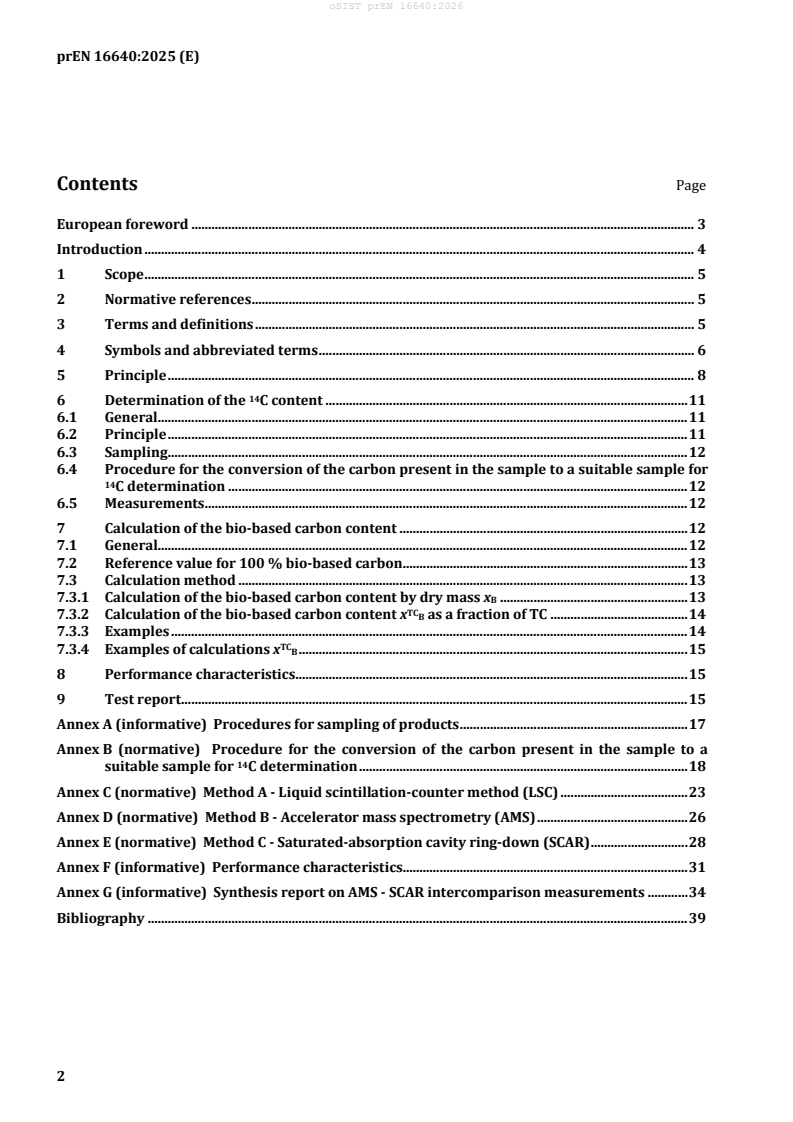
Contents Page
European foreword . 3
Introduction . 4
1 Scope . 5
2 Normative references . 5
3 Terms and definitions . 5
4 Symbols and abbreviated terms . 6
5 Principle . 8
6 Determination of the C content . 11
6.1 General. 11
6.2 Principle . 11
6.3 Sampling . 12
6.4 Procedure for the conversion of the carbon present in the sample to a suitable sample for
C determination . 12
6.5 Measurements . 12
7 Calculation of the bio-based carbon content . 12
7.1 General. 12
7.2 Reference value for 100 % bio-based carbon . 13
7.3 Calculation method . 13
7.3.1 Calculation of the bio-based carbon content by dry mass x . 13
B
TC
7.3.2 Calculation of the bio-based carbon content x as a fraction of TC . 14
B
7.3.3 Examples . 14
TC
7.3.4 Examples of calculations x . 15
B
8 Performance characteristics. 15
9 Test report . 15
Annex A (informative) Procedures for sampling of products . 17
Annex B (normative) Procedure for the conversion of the carbon present in the sample to a
suitable sample for C determination . 18
Annex C (normative) Method A - Liquid scintillation-counter method (LSC) . 23
Annex D (normative) Method B - Accelerator mass spectrometry (AMS) . 26
Annex E (normative) Method C - Saturated-absorption cavity ring-down (SCAR) . 28
Annex F (informative) Performance characteristics. 31
Annex G (informative) Synthesis report on AMS - SCAR intercomparison measurements . 34
Bibliography . 39
European foreword
This document (prEN 16640:2025) has been prepared by Technical Committee CEN/TC 411 “Bio-based
products”, the secretariat of which is held by SIS.
This document is currently submitted to the CEN Enquiry.
This document will supersede EN 16640:2017.
— The saturated-absorption cavity ring-down spectroscopy (SCAR) method has been added. This
includes an annex comparing the SCAR method to the accelerator mass spectrometry (AMS) method
— The beta-ionization (BI) method has been removed.
— Reference value for 100 % bio-based carbon is now taken from an ASTM standard.
This document has been prepared under a standardization request addressed to CEN by the European
Commission. The Standing Committee of the EFTA States subsequently approves these requests for its
Member States.
Introduction
Bio-based products from forestry and agriculture have a long history of application, such as paper, board
and various chemicals and materials. The last decades have seen the emergence of new bio-based
products in the market. Some of the reasons for the increased interest lie in the benefits of bio-based
products in relation to the depletion of fossil resources and climate change. Bio-based products can also
provide additional product functionalities. These developments have triggered a wave of innovation with
the development of knowledge and technologies allowing new transformation processes and product
development.
Acknowledging the need for common standards for bio-based products, the European Commission issued
mandate M/492 , resulting in a series of standards developed by CEN/TC 411 during 2012-2017, with a
focus on bio-based products other than food, feed and biomass for energy applications. The previous
version of this document (EN 16640:2017) was developed under the mandate, but this revised version
was developed after the expiration of the mandate, upon the initiative of the stakeholders in CEN/TC 411.
The standards of CEN/TC 411 “Bio-based products” provide a common basis on the following aspects:
— common terminology;
— bio-based content determination;
— life cycle assessment (LCA);
— sustainability aspects; and
— declaration tools.
It is important to understand what the term bio-based product covers and how it is being used. The term
‘bio-based’ means 'derived from biomass'. Bio-based products (bottles, insulation materials, wood and
wood products, paper, solvents, chemical intermediates, composite materials, etc.) are products which
are wholly or partly derived from biomass. It is essential to characterize the amount of biomass contained
in the product by, for instance, its bio-based content or bio-based carbon content.
The bio-based content of a product does not provide information on its environmental impact or
sustainability, which can be assessed through LCA and sustainability criteria. In addition, transparent and
unambiguous communication within bio-based value chains is facilitated by a harmonized framework for
certification and declaration.
This document has been developed with the aim to specify the method for the determination of bio-based
carbon content in bio-based products using the C method. This method is based on the analytical test
methods used for the determination of the age of objects containing carbon.
This document provides the reference test methods for laboratories, producers, suppliers and purchasers
of bio-based product materials and products. It can be also useful for authorities and inspection
organizations.
Part of the research leading to the previous version of this document has been performed under the
European Union Seventh Framework Programme (see
https://www.biobasedeconomy.eu/research/kbbpps/).
The analytical test methods specified in this document are compatible with those described in
ASTM D6866.
A mandate is a standardization task embedded in European trade laws. Mandate M/492 was addressed to the
European Standardization bodies, CEN, CENELEC and ETSI, for the development of horizontal European Standards
for bio-based products.
1 Scope
This document specifies a method for the determination of the bio-based carbon content in products,
based on the C content measurement.
This document also specifies three test methods to be used for the determination of the C content from
which the bio-based carbon content is calculated:
— method A: Liquid scintillation-counter (LSC);
— method B: Accelerator mass spectrometry (AMS); and
— method C: Saturated-absorption cavity ring-down (SCAR) spectroscopy.
The bio-based carbon content is expressed by a fraction of sample mass or as a fraction of the total carbon
content. This calculation method is applicable to any product containing carbon, including bio-
composites.
NOTE This document does not provide the methodology for the calculation of the biomass content of a sample,
see EN 16785-1 and EN 16785-2.
2 Normative references
The following documents are referred to in the text in such a way that some or all of their content
constitutes requirements of this document. For dated references, only the edition cited applies. For
undated references, the latest edition of the referenced document (including any amendments) applies.
EN 16575, Bio-based products - Vocabulary
ASTM D6866, Standard Test Methods for Determining the Biobased Content of Solid, Liquid, and Gaseous
Samples Using Radiocarbon Analysis
3 Terms and definitions
For the purposes of this document, the terms and definitions given in EN 16575 and the following apply.
ISO and IEC maintain terminology databases for use in standardization at the following addresses:
— ISO Online browsing platform: available at https://www.iso.org/obp/
— IEC Electropedia: available at https://www.electropedia.org/
3.1
organic material
material containing carbon-based compound in which the element carbon is attached to other carbon
atoms, hydrogen, oxygen, or other elements in a chain, ring, or three-dimensional structure
3.2
isotope abundance
fraction of atoms of a particular isotope of an element
3.3
percentage modern carbon
pMC
normalized and standardized value for the amount of the C isotope in a sample, calculated relative to
the standardized and normalized C isotope amount of oxalic acid standard reference material NIST
SRM 4990c
Note 1 to entry: In 2020, the value of 100 % bio-based carbon was set at (100,0 ± 0,5) pMC.
Note 2 to entry: SRM 4990c, is the trade name of product supplied by the US National Institute of Standards and
Technology. This information is given for the convenience of users of this document and does not constitute an
endorsement by CEN of this product. Equivalent products may be used if they can be shown to lead to the same
results.
3.4
laboratory sample
sub-quantity of a sample suitable for laboratory tests
3.5
sample
quantity of material, representative of a larger quantity for which the property is to be determined
3.6
sample preparation
all the actions taken to obtain representative analysis samples or test portions from the original sample
3.7
beta particle
electron emitted during radioactive decay
4 Symbols and abbreviated terms
For the purposes of this document, the following symbols and abbreviations apply:
13 13
δ standardized value for isotope fractionation δ = - 0,025 (relative to VPDB)
N N
measured isotope fractionation value of the sample. It is obtained by measuring the
δ
sample
13 12 13 12
C/ C ratio of the sample, relative to the measured C/ C ratio of a reference standard
with known isotope fractionation value related to VPDB
standardized isotope fractionation value of the oxalic acid reference standard (HOx-II,
δ
OX 2
SRM 4990c). δ = - 0,0176 (relative to VPDB).
OX 2
14 S 14 S
a standardized and normalized C amount of the measured sample; a ⋅=100% pMC
N N
14 S
normalized C signal (isotope concentration or activity) of the measured sample
A
N
14 0 standardized and normalized C amount of the primary reference standard, oxalic acid
A
RN
(HOx-II, SRM 4990c).
measured C signal (isotope concentration or activity) of the sample
A
sample
measured C signal (isotope concentration or activity) of the background sample/blank
A
bg
sample
sample, measured in the same batch as the sample and represents the background C
signal of the measured samples
measured (average) C signal (isotope concentration or activity) of oxalic acid reference
A
OX 2
standard samples (HOx-II, SRM 4990c), measured in the same batch as the unknown
samples
measured (average) C signal (isotope concentration or activity) of background samples,
A
bg
OX 2
which represent the background signal of the measured oxalic acid reference standard
(HOx-II, SRM 4990c), measured in the same batch as the oxalic acid samples
C carbon isotope with an atomic mass of 14
14 C value (in pMC) of the investigated CO sample
measured 2
C
sampleC
AMS accelerator mass spectrometry
ASD absolute standard deviation
Bq bequerel (disintegrations per second)
C carbon
cpm counts per minute
dpm disintegrations per minute
F C content of the sample, expressed in pMC
LLD lower limit of detection
LSC liquid scintillation counter or liquid scintillation counting
m dry mass of a sample expressed in grams
N number of counted beta-decayed C atoms
measuring efficiency of the used measurement technique
η
meas
PE polyethylene
PLA polylactic acid
pMC percentage of modern carbon
REF reference value, expressed in pMC, of 100 % bio-based carbon depending on the origin
of organic carbon
RMS root-mean-square
RSD relative standard deviation
SCAR saturated-absorption cavity ring-down
t duration of the measurement
TC total carbon
x bio-based carbon content by mass, expressed as a percentage of the mass of the sample
B
(dry)
TC
x total carbon content, expressed as a percentage of the mass of the sample (dry)
TC
bio-based carbon content by total carbon content, expressed as a percentage of the total
x
B
carbon content
5 Principle
The C is present in products is originating from recent atmospheric CO . Due to its radioactive decay, it
is almost absent from fossil products older than 40 000 years. The C content can thus be considered as
a tracer of products recently synthesized from atmospheric CO and particularly of recently produced
bio-based products.
The determination of the bio-based carbon content is based on the measurement of C in bio-based
products, which allows the calculation of the bio-based carbon fraction.
Extensive experience in C determination and reference samples is available from dating of
archaeological objects, on which the three methods described in this document are based:
— Method A: Liquid scintillation-counter (LSC);
— Method B: Accelerator mass spectrometry (AMS);
— Method C: Saturated-absorption cavity ring-down (SCAR) spectroscopy.
NOTE The corresponding sampling methods are described in Annex A.
The advantages and disadvantages of these test methods are given in Table 1. In particular, the typical
representative values of the absolute standard deviation (ASD) and the relative standard deviation (RSD),
for 1h-long measurement of a modern sample (F = 100 pMC), are given, together with their dependence
on the C-level in the sample (F). For all methods, both ASD and RSD scale with 1/√t, where t is the
duration of the measurement. Based on the above general scaling laws, the typical range of measurement
duration for practical use is also reported, together with the typical required carbon mass.
Table 1 — Advantages and disadvantages of the methods
Method Additional ASD RSD Duration needed Typical Equipment
requests for measurement carbon costs
mass
needed
Method A - Normal 5 pMC 10 %
2 h to 24 h > 1g Low
(LSC) laboratory ∝ √F ∝ 1/√F
- Large installation
Method B 0,3 pMC 0,3 %
- Graphite
10 min to 30 min < 1 mg High
(AMS) ∝ √F ∝ 1/√F
conversion
a
device
- Normal
laboratory
Method C 1 pMC 1 % 1 mg to
10 min to 6 h Intermediate
(SCAR) constant ∝ 1/F 10 mg
- Gas purification
device
a
A few years ago, compact new AMS equipment became available. In a number of cases, no graphite conversion
is required anymore.
For method A (LSC) a low-level counter shall be used. The statistical scattering of the radioactive decay
sets a limit for method A. Indeed, since this method relies on counting, its precision is ruled by Poisson
statistics and depends on the C level. The statistical uncertainty scales as sqrt(N), where N is the number
14 14
of counted beta-decayed C atoms. Since the C level in the sample (F) is proportional to N, the absolute
statistical uncertainty (ASD) will scale also with √F, and consequently the RSD will scale with 1/√F.
Moreover, this method needs a purified carbon dioxide, otherwise nitrogen oxides from the combustion
in the calorific bomb will result in counting losses by quenching and adulteration of the cocktail in case
of LSC measurement. When using method A, samples with low bio-based carbon content (<10 %) can
only be measured with sufficient precision using the benzene conversion procedure or, if applicable,
direct LSC measurement, as described in B.4.3.
Since method B relies on counting C ions, its uncertainty is ruled by Poisson statistics, similarly to
method A.
For method C (SCAR), differently from methods A and B, the absolute precision (ASD) is independent of
the C level, as it depends only on the fixed instrumental sensitivity of the SCAR spectroscopic technique.
Moreover, the carbon dioxide shall be sufficiently pure to avoid systematic errors in the C measurement.
In particular, an overall purity from non-interfering gases of > 99,9 % is required. A few molecules (e.g.
N O and SO ) can directly interfere with the measurement, and their mole fraction shall be kept below
2 2
the level of a few part-per-billion. Commercial elemental analysers are available ensuring a combusted
CO gas with these purity levels.
Especially for methods A and C, the duration needed for measurement spans over quite wide ranges, since
it is related to the required measurement precision. Actually, in the best case of statistical uncertainty
ruled by white noise, the precision always scales as 1/√ (t), where t is the averaging time.
NOTE Table 1 allows to quickly retrieve a rough estimate of the expected ASD and RSD for a measurement of a
given duration (t) on a sample with a given C level (F). Four practical examples (see Tables 2 to 5) are reported
below, showing longer and shorter measurement times and samples with higher and lower pMC.
Table 2 — Example 1: 30 min-long measurement of a 5 pMC sample
LSC AMS SCAR
ASD @ 100 pMC - 1h 5 pMC 0,3 pMC 1 pMC
scaling factor for F √(5 pMC/100 pMC) = 0,22 1
scaling factor for t 1/√(1/2) = 1,4
5 pMC × 0,22 × 1,4 = 0,3 pMC × 0,22 × 1,4 = 1 pMC × 1 × 1,4 =
Resulting ASD
1,5 pMC 0,092 pMC 1,4 pMC
1,5 pMC / 5 pMC = 0,092 pMC / 5 pMC = 1,4 pMC / 5 pMC =
Resulting RSD
30 % 1,8 % 28 %
Table 3 — Example 2: 2 h-long measurement of a 5 pMC sample
LSC AMS SCAR
ASD @ 100 pMC - 1h 5 pMC 0,3 pMC 1 pMC
scaling factor for F √(5 pMC/100 pMC) = 0,22 1
scaling factor for t 1/√2 = 0,71
5 pMC × 0,22 × 0,71 = 0,3 pMC × 0,22 × 0,71 = 1 pMC × 1 × 0,71 =
Resulting ASD
0,078 pMC 0,47 pMC 0,71 pMC
0,078 pMC / 5 pMC = 0,47 pMC / 5 pMC = 0,71 pMC / 5 pMC =
Resulting RSD
16 % 0,94 % 14 %
Table 4 — Example 3: 30 min-long measurement of a 75 pMC sample
LSC AMS SCAR
ASD @ 100 pMC - 1h 5 pMC 0,3 pMC 1 pMC
scaling factor for F √(75 pMC/100 pMC) = 0,87 1
scaling factor for t 1/√(1/2) = 1,4
5 pMC × 0,87 × 1,4 = 0,3 pMC × 0,87 × 1,4 = 1 pMC × 1 × 1,4 =
Resulting ASD
6,1 pMC 0,37 pMC 1,4 pMC
6,1 pMC / 75 pMC = 0,37 pMC / 75 pMC = 1,4 pMC / 75 pMC =
Resulting RSD
8,1 % 0,49 % 1,9 %
Table 5 — Example 4: 2 h-long measurement of a 75 pMC sample
LSC AMS SCAR
ASD @ 100 pMC - 1h 5 pMC 0,3 pMC 1 pMC
scaling factor for F √(75 pMC/100 pMC) = 0,87 1
scaling factor for t 1/√2 = 0,71
5 pMC × 0,87 × 0,71 = 0,3 pMC × 0,87 × 0,71 = 1 pMC × 1 × 0,71 =
Resulting ASD
3,1 pMC 0,18 pMC 0,71 pMC
3,1 pMC / 75 pMC = 0,18 pMC / 75 pMC = 0,71 pMC / 75 pMC =
Resulting RSD
4,1 % 0,25 % 0,95 %
6 Determination of the C content
6.1 General
A general sample preparation and three test methods for the determination of the C content are
described in this document. With this modular approach, it will be possible for laboratories with standard
14 14
equipment to prepare samples for the C content and determine the C content with own equipment or
to outsource the determination of the C content to laboratories that are specialized in this technique.
For the collection of the C content from the sample, generally accepted methods for the conversion of
the carbon present in the sample to CO are described in Annex B.
For the measurement of the C content, two methods (LSC and AMS) that are already generally accepted
as methods for the determination of the age of objects are selected. A third method (SCAR) is also selected,
which has been specifically developed for the purpose of bio-based carbon measurements.
6.2 Principle
The amount of bio-based carbon in the bio-based product is proportional to its C content.
Complete combustion (see Annex B) shall comply with the requirements of the subsequent measurement
of the C content. It shall ensure the quantitative recovery of all carbon present in the sample as CO in
order to yield valid results.
This measurement shall be carried out according to one of the three following methods:
— Method A: Liquid scintillation counter (LSC): indirect determination of the isotope abundance of C,
through its emission of beta particles (interaction with scintillation molecules), in accordance with
Annex C;
— Method B: Accelerator mass spectrometry (AMS): direct determination of the isotope abundance of
C, in accordance with Annex D; or
— Method C: Saturated-absorption cavity ring-down (SCAR) spectroscopy: indirect determination of the
14 14
isotope abundance of C, through absorption of infrared photons from CO molecules, in
accordance with Annex E.
6.3 Sampling
In Annex A sampling methods for products that are mentioned in the scope are given.
For any sampling procedure, the samples shall be representative of the material or product and the
quantity or mass of the sample shall be accurately established.
6.4 Procedure for the conversion of the carbon present in the sample to a suitable
sample for C determination
The conversion of the carbon present in the sample to a suitable sample for the determination of the C
content shall be carried out according to Annex B.
6.5 Measurements
The measurement of the C content of the sample shall be performed according to one of the methods as
described in Annexes C, D and E.
When CO captured in an absorption solution is sent to specialized laboratories, this shall be stored in a
way that no CO from air can enter the absorption solution. A check on the leak of CO from air shall be
2 2
performed by preparing laboratory blanks during the sampling stage.
For the determination of the 0 % bio-based carbon fraction the combustion of a fossil reference material
(such as coal or ancient Kauri wood) shall be used.
NOTE There are several certified reference materials available, e.g. IAEA-C1 and IAEA-C9.
For validation of the 100 % bio-based carbon fraction, oxalic acid standard reference material
NIST SRM 4990c shall be used. Mixing reference material NIST 4990c with a known amount of fossil
combustion aid improves its combustion behaviour, as oxalic acid is difficult to combust due to its low
calorific value. For routine checks, a fresh wood sample calibrated against the standard reference
material is sufficient.
7 Calculation of the bio-based carbon content
7.1 General
The calculation of the bio-based carbon content includes the following steps:
TC
a) the determination of the total carbon content of the sample, x , expressed as a percentage of the total
dry mass (for method A);
b) the calculation of the bio-based carbon content by mass, x , using the C content value, determined
B
by calculation from one of the test methods specified in 7.3, and applying the correction factors
detailed in 7.2 (for method A);
TC
c) the calculation of the bio-based carbon content as a fraction of the total carbon content, x (see
B
7.3.2) (for methods A, B and C).
7.2 Reference value for 100 % bio-based carbon
Before the above-ground hydrogen bomb testing (started around 1955 and terminated in 1962), the
atmospheric C level had been constant to within a few percent for the past millennium. Hence, a sample
grown during this time has a well-defined “modern” activity, and the fossil contribution could be
determined in a straightforward way. However, C created during the weapons testing increased the
14 14
atmospheric C level to up to 200 pMC in 1962, with a decline to 100 pMC in 2020. The C activity of a
sample grown since year 1962 is elevated according to the average C level over the growing interval. In
addition, the large emission of fossil C during the last decades contributes to the decrease of the
14 12
atmospheric C/ C ratio.
The 100 % bio-based C reference value shall be taken from ASTM D6866, which is updated yearly. Other
values may be used if evidence can be given on the pMC value of the bio-based part of the material.
7.3 Calculation method
7.3.1 Calculation of the bio-based carbon content by dry mass x
B
7.3.1.1 Calculation of C content by method A (LSC)
Calculate the bio-based carbon content by dry mass, x , expressed as a percentage, using Formula (1):
B
C
activity
x × 100 (1)
B
REF
13,56×× m
where
14 14
C is the C activity, expressed in dpm, of the sample obtained by calculation when using
activity
method A (see Annex C);
REF is the reference value, expressed in pMC, of 100 % bio-based carbon of the biomass from
which the sample is constituted;
m is the mass, expressed in grams, of the sample.
NOTE The pMC value of NIST SRM 4990c is set at 134,07, being 100 pMC equivalent to a C activity of
13,56 dpm/g C.
7.3.1.2 Calculation of C content by method B (AMS) or method C (SCAR)
Calculate the bio-based carbon content by dry mass, x , expressed as a percentage, using Formula (2):
B
pMC()s
pMC()s
TC 100 TC
xx x (2)
B
REF REF
where
TC
x is the total carbon content, expressed as a percentage, of the total dry mass of the sample;
pMC(s) is the measured value, expressed in pMC, of the sample;
REF is the reference value, expressed in pMC, of 100 % bio-based carbon of the biomass from
which the sample is constituted.
==
=
TC
7.3.2 Calculation of the bio-based carbon content x as a fraction of TC
B
TC
Calculate the bio-based carbon content as a fraction of the total carbon content, x , expressed as a
B
percentage, using Formula (3):
x
TC B
x × 100 (3)
B
TC
x
where
x is the bio-based carbon content by dry mass, expressed as a percentage;
B
TC
x is the total carbon content, expressed as a percentage, of the sample.
Formula (3), though valid for all methods, can be simplified in case of methods B and C as shown in
Formula (4) below:
pMC s
( )
TC
x × 100 (4)
B
REF
TC
The independent measurement of x is not necessary for these methods.
7.3.3 Examples
EXAMPLE 1 Measurement according to method A
TC
Sample made from pure wood (REF = 112 pMC, x = 48,0 %)
Dry mass of sample: m = 1,010 g
C activity = 7,34 dpm
7,34
x 100 47,%8
B
13,,56×× 1 01
47, 8
TC
x ×=100 99,%6
B
48,0
EXAMPLE 2 Measurement according to method B and method C
TC
Sample made from bark (REF = 112 pMC, x = 52,0 %)
pMC(s) (measured C value) = 61,7 pMC
61,7
x 52 28,%6
B
28,6
TC
x= ×=100 55,%0
B
52,0
==
=
×= =
=
=
EXAMPLE 3 Calculation of bio-based carbon content as a fraction of TC
Pure bio-based polymer material
TC
Sample made from PLA material: (x = 50,0 %; xB = 50 %)
50,0
TC
x= ×=100 100%
B
50,0
TC
7.3.4 Examples of calculations x
B
TC
Table 6 gives examples of calculations of x for different materials.
B
Table 6 — Examples
Biomass
TC
TC
Material x x x
B
a B
content
% % % %
Wood 100 48 48 100
Polymer containing 50 % fossil PE and
50 90 45 50
50 % bio-based PE
Polymer containing 40 % fossil calcium
carbonate, 30 % fossil PE and 30 % bio- 30 47 15 32
based PLA
a
Fraction of the product that is derived from biomass, expressed as a percentage
of the total mass of the product.
8 Performance characteristics
See Annex F.
9 Test report
The test report shall contain at least the following information:
a) a dated reference to this document (EN 16640:202x);
b) all information necessary for complete identification of the bio-based material or product tested;
c) identification of the laboratory performing the test;
d) sample preparation;
e) storage conditions;
f) test method used for the determination of the C content (method A, B or C , see Annex C, D or E);
g) results of the test including the basis on which they are expressed and application of the isotope
correction, including a precision statement;
h) method for the conversion of the carbon (see Annex B);
14 14
i) C activity, expressed in dpm, of the sample (for method A) or C value, expressed in pMC (for
methods B and C);
j) either:
TC
1) total carbon content, x , expressed as a percentage, of the sample and bio-based carbon content
by dry mass, x , expressed as a percentage, of the sample (for method A); or
B
TC
2) bio-based carbon content by total carbon content, x , expressed as a percentage, of the sample
B
(for methods B and C);
k) any additional information, including details of any deviations from the test methods and any
operations not specified in this document which could have had an influence on the results;
l) date of receipt of laboratory sample and dates of the test (beginning and end).
Annex A
(informative)
Procedures for sampling of products
If available, product-sampling procedures for the determination of the total carbon content shall be used.
If no such standard is available, a list of suitable standards is given in Table A.1 as guidance.
In the case of solid products, the sampling procedures mentioned in Table A.1 shall be used. If the
procedure for solid product sampling is not available, then EN ISO 21645 or EN ISO 21646 shall be used.
Table A.1 — Sampling procedures
Products Sampling methods
Solid products
Plastics, polymers ISO 10210
Ceramics, glass, concrete, ASTM C172/C172M, ASTM C224, ASTM C322,
cement, construction ASTM C1704/C1704M, ASTM D3665
materials / waste
Rubber ISO 1795
ASTM D1485, ASTM D6085
Paper EN ISO 186, EN ISO 7213
ASTM D2915
Leather ISO 2418, ISO 4044
Liquid products
Solvents ASTM D268, ASTM D802, ASTM D3437
Fuels EN ISO 3170, EN ISO 3171, EN ISO 4257
ISO 8943
ASTM D4057, ASTM D4177, ASTM D1265, ASTM D233
Gaseous products EN ISO 13833
ISO 10715
ASTM D7459
Other suitable procedures EN ISO 15528
ISO 5555:2001
ASTM D6866, ASTM D7455, ASTM D7718, ASTM E300
EPA 340/1-91-010
Annex B
(normative)
Procedure for the conversion of the carbon present in the sample to a
suitable sample for C determination
B.1 General
In this annex, all steps are described to prepare samples for C determinations. In this way, a laboratory
that is not equipped for C analysis can prepare their samples for distribution to laboratories that are
equipped for C analysis.
For the determination of the C content, the carbon that is present in the sample has to be converted to
CO .
The conversion is done by combustion in oxygen. If necessary, a combustion aid can be used to ensure
complete oxidation of the carbon to CO .
For a number of liquid samples, no conversion to CO is needed and direct measurement of the C content
can be performed using LSC.
B.2 Sample preparation
For sample preparation procedures the following standards found in Table B.1 can be used:
Table B.1 — Sample preparations
Products Sample preparation methods
Solid products EN ISO 21068-2, EN ISO 21654, EN ISO 21644, ISO 1928, ASTM D6866
Liquid products ASTM D6866, ASTM D7455, ASTM D5291
Gaseous products EN ISO 13833, ASTM D6866
B.3 Preparation for C measurement
B.3.1 General
The C content of a bio-based product is determined on the CO produced by the sample combustion. For
the conversion of the sample to CO , used for the determination of the C content, the following three
methods are allowed:
— combustion in a calorimetric bomb;
— combustion in a tube furnace;
— combustion in a laboratory scale combustion apparatus.
For gaseous samples, combustion in a calorimetric bomb is not applicable.
Conversion of gaseous hydrocarbons to CO can be done at temperatures from 600 °C, using a suitable
catalyst and absorption of the CO in a NaOH solution as described in B.3.2.
In case of combustion, it depends on the method to be used for the determination of C content, how the
formed CO is collected and prepared for the measurement.
In method A (Annex C), three options are possible after combustion:
a) direct absorption of the formed CO in a carbamate solution;
b) absorption of the CO in a 2 M NaOH solution and transfer of CO in NaOH to a carbamate solution;
2 2
c) direct conversion of CO to benzene.
TC
Method A (Annex C) can handle sample sizes down to 1 g, depending on the x values.
When method B (Annex D) is used, there are three CO collection options:
a) direct collection of the formed CO2 in a gas-bag;
b) absorption of CO in a 4 M NaOH solution;
c) absorption in a for this purpose developed solid absorber, usually NaOH or KOH fixed on a silica
carrier or zeolite or adsorbents which can trap and release carbon dioxide to such an extent that this
14 13 12
enables measurement without changing the C/ C/ C isotope ratios.
TC
Method B (Annex D) can handle sample sizes down to a few µg, depending on the x values.
In case of method C (Annex E), there are three CO collection options:
a) direct collection of CO in a glass ampoule;
b) selective adsorption by a zeolite trap;
c) absorption of CO in a 4 M NaOH solution or KOH solution (pH > 13 during the whole adsorption).
TC
Method C can handle sample sizes down to a few mg, depending on the x values.
B.3.2 Reagents and materials
— carbamate solution;
— scintillation medium;
— glass bottles (standard glass sample bottles with plastic screw caps that are resistant to 4 M NaOH);
— 4 M NaOH absorption liquid;
— glass ampoules (standard glass sample ampoules with vacuum-tight polytetrafluoroethylene (PTFE)
valve for gas collection);
— liquid nitrogen (for the cryogenic separation of the CO gas sample from the He carrier gas);
— zeolite pellets.
For the preparation of a carbonate free absorption liquid, preparation using freshly opened NaOH pellet
containers is sufficient. Dissolve the NaOH pellets in a small amount of water (the heat produced during
the dissolution process will enhance the dissolution process). Small amounts of precipitation are an
indication of the presence of Na CO . By decanting the clear phase the almost carbonate free solution is
2 3
diluted to the desired volume. As the dissolution of NaOH is an exothermic process extra care shall be
taken as boiling of the concentrated solution during dilution can occur.
B.4 Combustion of the sample
B.4.1 Combustion of the sample in a calorimetric bomb
For the combustion of the sample in a calorimetric bomb, any suitable test method, such as EN ISO 1716,
ISO 1928 or EN ISO 21654, shall be used.
After the complete combustion in the oxygen bomb the combustion gases are collected in a gas bag.
For products that are difficult to combust, use a combustion aid to obtain complete combustion. Examples
of combustion aids are polyethylene combustion bags, benzoic acid and glucose. Take care not to exceed
the maximum amount of organic material allowable for the oxygen bomb that is used. Determine the
amount of C present in the combustion aid and correct for the contribution of the use of the combustion
C content and total carbon content).
aid (
Determination of the carbonate content in the solution that is collected after combustion can be used to
determine the yield of conversion. The carbonate content shall be equivalent to the amount of total
carbon present in the combusted sample (including combustion aid).
When method A is used, the CO shall be collected in a 4 M NaOH solution prior to the conversion to
benzene or collected in a cooled mixture of carbamate solution and a suitable scintillation liquid.
For the collection of CO in 4 M NaOH solution, use a 250 ml washing bottle filled with 200 ml 4 M NaOH
solution, apply a flow of 50 ml/min.
For the collection of CO in a carbamate solution the gas sample bag is connected to a pump with a
connection line into a 20 ml glass vial, filled with a mixture of 10 ml of the carbamate sorption liquid and
10 ml of the scintillation cocktail, placed in an ice bath, to remove the heat of the exothermic carbamate
−1 −1
formation reaction. The pumping speed is low, typically 50 ml × min to 60 ml × min . The transfer of
the gas from the bag takes about 2 h to 3 h. After the sample has been collected, it is ready to be counted
on a liquid scintillation counter. Blank samples shall also be counted at the same time to allow that small
day-to-day variations in the background can be accounted for.
Measurements shall be done as soon as possible after collection, at the latest within one week after
sampling. There are strong indications that the NO formed during the combustion reacts with the
x
absorption mixture resulting in yet unexplained errors after a few days of storage. If the one week limit
cannot be realized, collection of the CO in a 4 M NaOH solution is a good alternative.
When method B is used, the carbon dioxide shall be collected in a 4 M NaOH solution or on a suitable solid
absorber.
For method B, alternatively ca 2 ml of the CO gas can be taken from the bag using a glass syringe and the
gas can be transferred to the AMS target preparations system. As the bomb volume is released to
atmospheric pressure, there will be a residual amount left over in the bomb that is directly related to the
pressu
...