

SIST EN IEC 62217:2026
(Main)Polymeric HV insulators for indoor and outdoor use - General definitions, test methods and acceptance criteria (IEC 62217:2025)
General Information
- Abstract
IEC 62217:2025 is applicable to polymeric insulators for AC systems with a nominal voltage greater than 1 000 V (frequency less than 100 Hz) and DC systems with a nominal voltage greater than 1 500 V whose insulating body consists of one or various organic materials. Polymeric insulators covered by this document are intended for use both on HV overhead lines and in substations, in both indoor and outdoor applications. They include composite insulators with solid and hollow core and resin insulators. Hybrid insulators with ceramic core and polymeric housing are also included, while coated insulators (e.g. with RTV silicone rubber coatings) are not included in this standard. Electrical tests described in this document are done under AC voltage and are in general applicable to insulators to be used in DC systems too. Tests under DC voltage are intended to reflect up-to-date knowledge and experience. Only polymeric housing materials of hybrid insulators are specified in this document. Tests for core materials and the interfaces between housing and core of hybrid insulators are not included.
The object of this document is
- to define the common terms used for polymeric insulators;
- to prescribe common test methods for design tests on polymeric insulators;
- to prescribe acceptance or failure criteria, if applicable;
These tests, criteria and recommendations are intended to ensure a satisfactory lifetime under normal operating and environmental conditions. This document includes design tests intended to reject materials or designs which are inadequate under normal operating and environmental conditions. This document defines test methods and acceptance criteria. The applicable tests are given in the relevant product standard. This third edition cancels and replaces the second edition published in 2012. This edition constitutes a technical revision.
This edition includes the following significant technical changes with respect to the previous edition:
a) The scope of the document is specified to comprise composite insulators with solid and hollow core and resin insulators used for both AC and DC systems in indoor and outdoor applications of HV overhead lines and substations; hybrid insulators (defined in IEC TS 62896) with ceramic core and polymeric housing are also included, while coated insulators (e.g. with Room Temperature Vulcanized (RTV) silicone rubber coatings) are not considered in this document;
b) Steep-front impulse voltage test is modified to avoid unwanted flashovers between the leads of the electrodes;
c) Differences between hydrophobicity transfer material (HTM) and non-HTM housing materials are specified and relevant test methods and acceptance criteria for polymeric insulators with HTM housing are introduced;
d) The previous water diffusion test on core materials with or without housing is split into two tests. One is on core materials without housing, the other is on core materials with housing. The acceptance criteria are modified;
e) Stress corrosion test for core materials is introduced;
f) Annex B summarizes the test application for evaluating the quality of interfaces and connections of end fittings, housing materials and core materials;
g) Annex E is introduced to emphasize the need for control of electric fields of polymeric insulators for AC. The control of electric fields of polymeric insulators for DC is still under consideration.
- Status
- Published
- Public Enquiry End Date
- 29-Feb-2024
- Publication Date
- 19-Jan-2026
- Technical Committee
- IZL - Insulators
- Current Stage
- 6060 - National Implementation/Publication (Adopted Project)
- Start Date
- 11-Mar-2025
- Due Date
- 16-May-2025
- Completion Date
- 20-Jan-2026

Overview
EN IEC 62217:2025 (CLC adoption of IEC 62217) specifies general definitions, test methods and acceptance criteria for polymeric high-voltage (HV) insulators used indoors and outdoors. It applies to polymeric insulators for AC systems (nominal voltage > 1 000 V, frequency < 100 Hz) and DC systems (nominal voltage > 1 500 V). Covered designs include composite insulators (solid and hollow core), resin insulators, and hybrid insulators with a ceramic core and polymeric housing. Coated insulators (e.g., RTV silicone coatings) are excluded.
Key topics and requirements
- Scope and definitions: Common terminology for polymeric HV insulators to unify product and test language.
- Design tests: Grouped tests intended to eliminate unsuitable designs or materials and to ensure satisfactory lifetime under normal operating and environmental conditions.
- Test methods and acceptance criteria: Standardized procedures and pass/fail criteria for housing, core, interfaces and connections - the applicable tests are referenced in relevant product standards.
- Housing/material tests: Hardness, accelerated weathering, tracking & erosion, flammability, and hydrophobicity transfer material (HTM) specific tests and criteria.
- Core material tests: Porosity (dye penetration), water diffusion (separate tests for core alone and core with housing), and newly introduced stress corrosion test.
- Interfaces and end fittings: Guidance and recommended test applications for connections and sealing (summarized in Annex B).
- Electric field control: Annex E emphasizes the need for controlling electric fields for AC applications; DC control is under consideration.
- AC/DC testing: Electrical tests are mainly under AC but generally applicable to DC; specific DC tests are included to reflect current experience.
- Significant updates from the previous (2012) edition: clarified scope, modified impulse test to avoid flashovers, introduced HTM distinctions, split water-diffusion tests, added stress corrosion testing, and new informative annexes.
Applications and who uses it
This standard is used by:
- Insulator manufacturers for design validation and quality control
- Independent test laboratories performing type and design tests
- Power utilities and transmission operators for procurement specifications
- Standards engineers, R&D teams and certification bodies for compliance and product development
- Consultants and specifiers preparing tender documents for substations and HV overhead lines
Related standards
- IEC TS 62896 (reference for hybrid insulator definition)
- Relevant product standards (referenced in EN IEC 62217) for specific test application and type-test lists
EN IEC 62217:2025 provides the common baseline of definitions, robust test methods and clear acceptance criteria essential for reliable performance of polymeric HV insulators in both AC and DC high-voltage networks.
Relations
- Effective Date
- 20-Feb-2026
- Effective Date
- 09-Feb-2026
- Effective Date
- 09-Feb-2026
- Effective Date
- 09-Feb-2026
- Effective Date
- 09-Feb-2026
- Effective Date
- 03-Feb-2026
- Effective Date
- 03-Feb-2026
- Effective Date
- 03-Feb-2026
- Effective Date
- 03-Feb-2026
- Effective Date
- 03-Feb-2026
- Effective Date
- 03-Feb-2026
- Effective Date
- 03-Feb-2026
- Effective Date
- 03-Feb-2026
- Effective Date
- 03-Feb-2026
- Effective Date
- 03-Feb-2026
Get Certified
Connect with accredited certification bodies for this standard

IMQ S.p.A. (Certification)
Italian electrical product certification.

SLG Prüf- und Zertifizierungs GmbH
German testing and certification body.

UL Solutions
Global safety science company with testing, inspection and certification.
Sponsored listings
Frequently Asked Questions
SIST EN IEC 62217:2026 is a standard published by the Slovenian Institute for Standardization (SIST). Its full title is "Polymeric HV insulators for indoor and outdoor use - General definitions, test methods and acceptance criteria (IEC 62217:2025)". This standard covers: IEC 62217:2025 is applicable to polymeric insulators for AC systems with a nominal voltage greater than 1 000 V (frequency less than 100 Hz) and DC systems with a nominal voltage greater than 1 500 V whose insulating body consists of one or various organic materials. Polymeric insulators covered by this document are intended for use both on HV overhead lines and in substations, in both indoor and outdoor applications. They include composite insulators with solid and hollow core and resin insulators. Hybrid insulators with ceramic core and polymeric housing are also included, while coated insulators (e.g. with RTV silicone rubber coatings) are not included in this standard. Electrical tests described in this document are done under AC voltage and are in general applicable to insulators to be used in DC systems too. Tests under DC voltage are intended to reflect up-to-date knowledge and experience. Only polymeric housing materials of hybrid insulators are specified in this document. Tests for core materials and the interfaces between housing and core of hybrid insulators are not included. The object of this document is - to define the common terms used for polymeric insulators; - to prescribe common test methods for design tests on polymeric insulators; - to prescribe acceptance or failure criteria, if applicable; These tests, criteria and recommendations are intended to ensure a satisfactory lifetime under normal operating and environmental conditions. This document includes design tests intended to reject materials or designs which are inadequate under normal operating and environmental conditions. This document defines test methods and acceptance criteria. The applicable tests are given in the relevant product standard. This third edition cancels and replaces the second edition published in 2012. This edition constitutes a technical revision. This edition includes the following significant technical changes with respect to the previous edition: a) The scope of the document is specified to comprise composite insulators with solid and hollow core and resin insulators used for both AC and DC systems in indoor and outdoor applications of HV overhead lines and substations; hybrid insulators (defined in IEC TS 62896) with ceramic core and polymeric housing are also included, while coated insulators (e.g. with Room Temperature Vulcanized (RTV) silicone rubber coatings) are not considered in this document; b) Steep-front impulse voltage test is modified to avoid unwanted flashovers between the leads of the electrodes; c) Differences between hydrophobicity transfer material (HTM) and non-HTM housing materials are specified and relevant test methods and acceptance criteria for polymeric insulators with HTM housing are introduced; d) The previous water diffusion test on core materials with or without housing is split into two tests. One is on core materials without housing, the other is on core materials with housing. The acceptance criteria are modified; e) Stress corrosion test for core materials is introduced; f) Annex B summarizes the test application for evaluating the quality of interfaces and connections of end fittings, housing materials and core materials; g) Annex E is introduced to emphasize the need for control of electric fields of polymeric insulators for AC. The control of electric fields of polymeric insulators for DC is still under consideration.
IEC 62217:2025 is applicable to polymeric insulators for AC systems with a nominal voltage greater than 1 000 V (frequency less than 100 Hz) and DC systems with a nominal voltage greater than 1 500 V whose insulating body consists of one or various organic materials. Polymeric insulators covered by this document are intended for use both on HV overhead lines and in substations, in both indoor and outdoor applications. They include composite insulators with solid and hollow core and resin insulators. Hybrid insulators with ceramic core and polymeric housing are also included, while coated insulators (e.g. with RTV silicone rubber coatings) are not included in this standard. Electrical tests described in this document are done under AC voltage and are in general applicable to insulators to be used in DC systems too. Tests under DC voltage are intended to reflect up-to-date knowledge and experience. Only polymeric housing materials of hybrid insulators are specified in this document. Tests for core materials and the interfaces between housing and core of hybrid insulators are not included. The object of this document is - to define the common terms used for polymeric insulators; - to prescribe common test methods for design tests on polymeric insulators; - to prescribe acceptance or failure criteria, if applicable; These tests, criteria and recommendations are intended to ensure a satisfactory lifetime under normal operating and environmental conditions. This document includes design tests intended to reject materials or designs which are inadequate under normal operating and environmental conditions. This document defines test methods and acceptance criteria. The applicable tests are given in the relevant product standard. This third edition cancels and replaces the second edition published in 2012. This edition constitutes a technical revision. This edition includes the following significant technical changes with respect to the previous edition: a) The scope of the document is specified to comprise composite insulators with solid and hollow core and resin insulators used for both AC and DC systems in indoor and outdoor applications of HV overhead lines and substations; hybrid insulators (defined in IEC TS 62896) with ceramic core and polymeric housing are also included, while coated insulators (e.g. with Room Temperature Vulcanized (RTV) silicone rubber coatings) are not considered in this document; b) Steep-front impulse voltage test is modified to avoid unwanted flashovers between the leads of the electrodes; c) Differences between hydrophobicity transfer material (HTM) and non-HTM housing materials are specified and relevant test methods and acceptance criteria for polymeric insulators with HTM housing are introduced; d) The previous water diffusion test on core materials with or without housing is split into two tests. One is on core materials without housing, the other is on core materials with housing. The acceptance criteria are modified; e) Stress corrosion test for core materials is introduced; f) Annex B summarizes the test application for evaluating the quality of interfaces and connections of end fittings, housing materials and core materials; g) Annex E is introduced to emphasize the need for control of electric fields of polymeric insulators for AC. The control of electric fields of polymeric insulators for DC is still under consideration.
SIST EN IEC 62217:2026 is classified under the following ICS (International Classification for Standards) categories: 29.080.10 - Insulators. The ICS classification helps identify the subject area and facilitates finding related standards.
SIST EN IEC 62217:2026 has the following relationships with other standards: It is inter standard links to SIST IEC 60050-471:2017, SIST EN ISO 21920-2:2022, SIST EN ISO 4892-2:2013, SIST EN ISO 868:2003, SIST EN ISO 862:1997, SIST EN IEC 60060-1:2025, SIST EN 60695-11-10:2014, SIST EN 60721-1:2001, SIST EN 60507:2014, SIST EN 60099-8:2011, SIST EN 60099-9:2014, SIST EN IEC 61109:2025, SIST EN 50345:2009, SIST EN IEC 62772:2024, SIST EN 60099-4:2014. Understanding these relationships helps ensure you are using the most current and applicable version of the standard.
SIST EN IEC 62217:2026 is available in PDF format for immediate download after purchase. The document can be added to your cart and obtained through the secure checkout process. Digital delivery ensures instant access to the complete standard document.
Standards Content (Sample)
SLOVENSKI STANDARD
01-februar-2026
Polimerni visokonapetostni izolatorji za notranjo in zunanjo uporabo - Splošne
definicije, preskusne metode in prevzemna merila (IEC 62217:2025)
Polymeric HV insulators for indoor and outdoor use - General definitions, test methods
and acceptance criteria (IEC 62217:2025)
Hochspannungs-Polymerisolatoren für Innenraum- und Freiluftanwendung - Allgemeine
Begriffe, Prüfverfahren und Annahmekriterien (IEC 62217:2025)
Isolateurs polymériques à haute tension pour utilisation à l'intérieur ou à l'extérieur -
Définitions générales, méthodes d'essai et critères d'acceptation (IEC 62217:2025)
Ta slovenski standard je istoveten z: EN IEC 62217:2025
ICS:
29.080.10 Izolatorji Insulators
2003-01.Slovenski inštitut za standardizacijo. Razmnoževanje celote ali delov tega standarda ni dovoljeno.
EUROPEAN STANDARD EN IEC 62217
NORME EUROPÉENNE
EUROPÄISCHE NORM November 2025
ICS 29.080.10 Supersedes EN 62217:2013
English Version
Polymeric HV insulators for indoor and outdoor use - General
definitions, test methods and acceptance criteria
(IEC 62217:2025)
Isolateurs polymériques à haute tension pour usage Hochspannungs-Polymerisolatoren für Innenraum- und
intérieur et extérieur - Définitions générales, méthodes Freiluftanwendung - Allgemeine Begriffe, Prüfverfahren und
d'essai et critères d'acceptation Annahmekriterien
(IEC 62217:2025) (IEC 62217:2025)
This European Standard was approved by CENELEC on 2025-11-10. CENELEC members are bound to comply with the CEN/CENELEC
Internal Regulations which stipulate the conditions for giving this European Standard the status of a national standard without any alteration.
Up-to-date lists and bibliographical references concerning such national standards may be obtained on application to the CEN-CENELEC
Management Centre or to any CENELEC member.
This European Standard exists in three official versions (English, French, German). A version in any other language made by translation
under the responsibility of a CENELEC member into its own language and notified to the CEN-CENELEC Management Centre has the
same status as the official versions.
CENELEC members are the national electrotechnical committees of Austria, Belgium, Bulgaria, Croatia, Cyprus, the Czech Republic,
Denmark, Estonia, Finland, France, Germany, Greece, Hungary, Iceland, Ireland, Italy, Latvia, Lithuania, Luxembourg, Malta, the
Netherlands, Norway, Poland, Portugal, Republic of North Macedonia, Romania, Serbia, Slovakia, Slovenia, Spain, Sweden, Switzerland,
Türkiye and the United Kingdom.
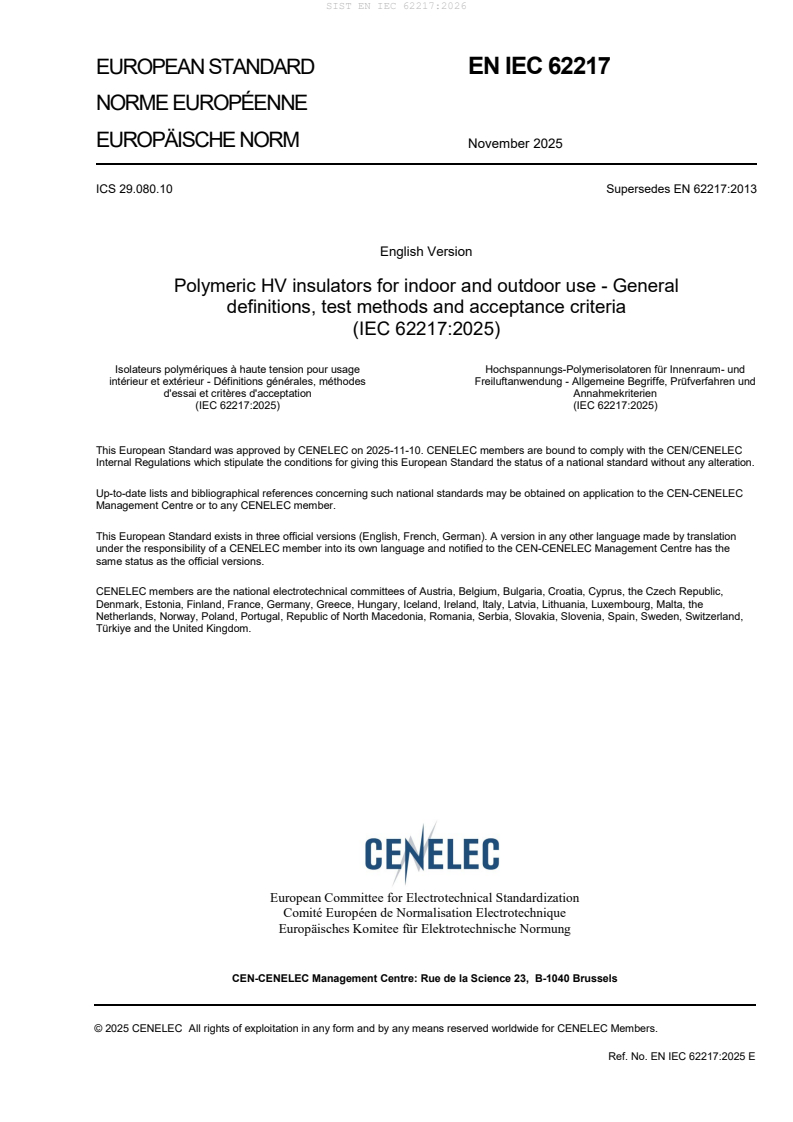
European Committee for Electrotechnical Standardization
Comité Européen de Normalisation Electrotechnique
Europäisches Komitee für Elektrotechnische Normung
CEN-CENELEC Management Centre: Rue de la Science 23, B-1040 Brussels
© 2025 CENELEC All rights of exploitation in any form and by any means reserved worldwide for CENELEC Members.
Ref. No. EN IEC 62217:2025 E
European foreword
The text of document 36/612/FDIS, future edition 3 of IEC 62217, prepared by TC 36 "Insulators" was
submitted to the IEC-CENELEC parallel vote and approved by CENELEC as EN IEC 62217:2025.
The following dates are fixed:
• latest date by which the document has to be implemented at national (dop) 2026-11-30
level by publication of an identical national standard or by endorsement
• latest date by which the national standards conflicting with the (dow) 2028-11-30
document have to be withdrawn
This document supersedes EN 62217:2013 and all of its amendments and corrigenda (if any).
Attention is drawn to the possibility that some of the elements of this document may be the subject of
patent rights. CENELEC shall not be held responsible for identifying any or all such patent rights.
Any feedback and questions on this document should be directed to the users’ national committee. A
complete listing of these bodies can be found on the CENELEC website.
Endorsement notice
The text of the International Standard IEC 62217:2025 was approved by CENELEC as a European
Standard without any modification.
In the official version, for Bibliography, the following notes have to be added for the standard indicated:
IEC 60437 NOTE Approved as EN IEC 60437
IEC 61284 NOTE Approved as EN 61284
Annex ZA
(normative)
Normative references to international publications
with their corresponding European publications
The following documents are referred to in the text in such a way that some or all of their content
constitutes requirements of this document. For dated references, only the edition cited applies. For
undated references, the latest edition of the referenced document (including any amendments)
applies.
NOTE 1 Where an International Publication has been modified by common modifications, indicated by (mod),
the relevant EN/HD applies.
NOTE 2 Up-to-date information on the latest versions of the European Standards listed in this annex is available
here: www.cencenelec.eu.
Publication Year Title EN/HD Year
IEC 60050-471 2007 International Electrotechnical Vocabulary - - -
Part 471: Insulators
IEC 60060-1 - High-voltage test techniques - Part 1: EN IEC 60060-1 -
General terminology and test requirements
IEC 60507 2013 Artificial pollution tests on high-voltage EN 60507 2014
ceramic and glass insulators to be used on
a.c. systems
+ COR1 2018
IEC 60695-11-10 - Fire hazard testing - Part 11-10: Test EN 60695-11-10 -
flames - 50 W horizontal and vertical flame
test methods
IEC 60721-1 - Classification of environmental conditions - EN 60721-1 -
Part 1: Environmental parameters and their
severities
IEC/TS 60815-1 - Selection and dimensioning of high-voltage - -
insulators intended for use in polluted
conditions - Part 1: Definitions, information
and general principles
IEC/TR 62039 2021 Selection guide for polymeric materials for - -
outdoor use under HV stress
ISO 868 - Plastics and ebonite - Determination of EN ISO 868 -
indentation hardness by means of a
durometer (Shore hardness)
ISO 4892-2 - Plastics - Methods of exposure to EN ISO 4892-2 -
laboratory light sources - Part 2: Xenon-arc
lamps
ISO 21920-2 - Geometrical product specifications (GPS) - EN ISO 21920-2 -
Surface texture: Profile - Part 2: Terms,
definitions and surface texture parameters
IEC 62217 ®
Edition 3.0 2025-10
INTERNATIONAL
STANDARD
Polymeric HV insulators for indoor and outdoor use - General definitions, test
methods and acceptance criteria
ICS 29.080.10 ISBN 978-2-8327-0690-9
IEC 62217:2025-10(en)
IEC 62217:2025 © IEC 2025
CONTENTS
FOREWORD . 3
INTRODUCTION . 5
1 Scope . 7
2 Normative references . 7
3 Terms and definitions . 8
4 Identification . 12
5 Environmental conditions . 12
6 Information on transport, storage and installation . 13
7 Classification of tests . 13
7.1 General . 13
7.2 Design tests . 13
7.3 Type tests . 14
7.4 Sample tests . 14
7.5 Routine tests . 14
8 General requirements for insulator test specimens . 14
9 Design tests . 15
9.1 General . 15
9.2 Tests on interfaces and connections of end fittings . 15
9.2.1 General . 15
9.2.2 Test specimens . 15
9.2.3 Reference flashover voltage and reference temperature for verification
tests . 15
9.2.4 Reference flashover voltage test. 16
9.2.5 Product specific pre-stressing . 16
9.2.6 Water immersion pre-stressing . 16
9.2.7 Verification tests . 16
9.3 Tests on housing material . 18
9.3.1 Hardness test . 18
9.3.2 Accelerated weathering test . 19
9.3.3 Tracking and erosion test – 1 000 h salt fog AC voltage test . 20
9.3.4 Flammability test . 22
9.3.5 Hydrophobicity transfer test . 23
9.4 Tests on core material . 24
9.4.1 General . 24
9.4.2 Porosity test (Dye penetration test) . 24
9.4.3 Water diffusion test . 25
9.4.4 Stress corrosion test . 26
9.5 Water diffusion test on core with housing . 26
9.5.1 General . 26
9.5.2 Test specimens . 26
9.5.3 Test procedure . 27
9.5.4 Acceptance criteria . 27
Annex A (informative) Explanation of the concept of classes for the design tests . 28
Annex B (informative) Recommended test application . 29
Annex C (informative) Tests for AC or DC application . 31
IEC 62217:2025 © IEC 2025
Annex D (informative) Difference between the tracking and erosion and accelerated
ageing test on polymeric insulators . 32
Annex E (informative) Consideration of electric field control . 33
Bibliography . 35
Figure 1 – Illustration of different types of insulators . 9
Figure 2 – Illustration of the electrodes position and axial length . 17
Figure 3 – Example of boiling container for the water diffusion test . 19
Figure 4 – Examples of test specimen for core material . 24
Figure 5 – Example of porosity test specimen with certain areas not being allowed to
be sealed . 25
Figure E.1 – Typical sealing area description for composite insulator . 34
Table 1 – Normal environmental conditions . 12
Table 2 – Initial NaCI content of the water as a function of the specimen dimensions . 21
Table 3 – Flammability requirements . 23
Table B.1 – Application on interfaces and connections of end fittings. 29
Table B.2 – Application on housing materials . 29
Table B.3 – Application on core materials . 29
Table B.4 – Application on core with housing . 30
Table C.1 – Tests for AC or DC application . 31
IEC 62217:2025 © IEC 2025
INTERNATIONAL ELECTROTECHNICAL COMMISSION
____________
Polymeric HV insulators for indoor and outdoor use -
General definitions, test methods and acceptance criteria
FOREWORD
1) The International Electrotechnical Commission (IEC) is a worldwide organization for standardization comprising
all national electrotechnical committees (IEC National Committees). The object of IEC is to promote international
co-operation on all questions concerning standardization in the electrical and electronic fields. To this end and
in addition to other activities, IEC publishes International Standards, Technical Specifications, Technical Reports,
Publicly Available Specifications (PAS) and Guides (hereafter referred to as “IEC Publication(s)”). Their
preparation is entrusted to technical committees; any IEC National Committee interested in the subject dealt with
may participate in this preparatory work. International, governmental and non-governmental organizations liaising
with the IEC also participate in this preparation. IEC collaborates closely with the International Organization for
Standardization (ISO) in accordance with conditions determined by agreement between the two organizations.
2) The formal decisions or agreements of IEC on technical matters express, as nearly as possible, an international
consensus of opinion on the relevant subjects since each technical committee has representation from all
interested IEC National Committees.
3) IEC Publications have the form of recommendations for international use and are accepted by IEC National
Committees in that sense. While all reasonable efforts are made to ensure that the technical content of IEC
Publications is accurate, IEC cannot be held responsible for the way in which they are used or for any
misinterpretation by any end user.
4) In order to promote international uniformity, IEC National Committees undertake to apply IEC Publications
transparently to the maximum extent possible in their national and regional publications. Any divergence between
any IEC Publication and the corresponding national or regional publication shall be clearly indicated in the latter.
5) IEC itself does not provide any attestation of conformity. Independent certification bodies provide conformity
assessment services and, in some areas, access to IEC marks of conformity. IEC is not responsible for any
services carried out by independent certification bodies.
6) All users should ensure that they have the latest edition of this publication.
7) No liability shall attach to IEC or its directors, employees, servants or agents including individual experts and
members of its technical committees and IEC National Committees for any personal injury, property damage or
other damage of any nature whatsoever, whether direct or indirect, or for costs (including legal fees) and
expenses arising out of the publication, use of, or reliance upon, this IEC Publication or any other IEC
Publications.
8) Attention is drawn to the Normative references cited in this publication. Use of the referenced publications is
indispensable for the correct application of this publication.
9) IEC draws attention to the possibility that the implementation of this document may involve the use of (a)
patent(s). IEC takes no position concerning the evidence, validity or applicability of any claimed patent rights in
respect thereof. As of the date of publication of this document, IEC had not received notice of (a) patent(s), which
may be required to implement this document. However, implementers are cautioned that this may not represent
the latest information, which may be obtained from the patent database available at https://patents.iec.ch. IEC
shall not be held responsible for identifying any or all such patent rights.
IEC 62217 has been prepared by IEC technical committee 36: Insulators. It is an International
Standard.
This third edition cancels and replaces the second edition published in 2012. This edition
constitutes a technical revision.
This edition includes the following significant technical changes with respect to the previous
edition:
a) The scope of the document is specified to comprise composite insulators with solid and
hollow core and resin insulators used for both AC and DC systems in indoor and outdoor
applications of HV overhead lines and substations; hybrid insulators (defined in
IEC TS 62896) with ceramic core and polymeric housing are also included, while coated
insulators (e.g. with Room Temperature Vulcanized (RTV) silicone rubber coatings) are not
considered in this document;
IEC 62217:2025 © IEC 2025
b) Steep-front impulse voltage test is modified to avoid unwanted flashovers between the leads
of the electrodes;
c) Differences between hydrophobicity transfer material (HTM) and non-HTM housing
materials are specified and relevant test methods and acceptance criteria for polymeric
insulators with HTM housing are introduced;
d) The previous water diffusion test on core materials with or without housing is split into two
tests. One is on core materials without housing, the other is on core materials with housing.
The acceptance criteria are modified;
e) Stress corrosion test for core materials is introduced;
f) Annex B summarizes the test application for evaluating the quality of interfaces and
connections of end fittings, housing materials and core materials;
g) Annex E is introduced to emphasize the need for control of electric fields of polymeric
insulators for AC. The control of electric fields of polymeric insulators for DC is still under
consideration.
The text of this International Standard is based on the following documents:
Draft Report on voting
36/612/FDIS 36/631/RVD
Full information on the voting for its approval can be found in the report on voting indicated in
the above table.
The language used for the development of this International Standard is English.
This document was drafted in accordance with ISO/IEC Directives, Part 2, and developed in
accordance with ISO/IEC Directives, Part 1 and ISO/IEC Directives, IEC Supplement, available
at www.iec.ch/members_experts/refdocs. The main document types developed by IEC are
described in greater detail at www.iec.ch/publications.
The committee has decided that the contents of this document will remain unchanged until the
stability date indicated on the IEC website under webstore.iec.ch in the data related to the
specific document. At this date, the document will be
• reconfirmed,
• withdrawn, or
• revised.
IEC 62217:2025 © IEC 2025
INTRODUCTION
Polymeric insulators consist either of one insulating material (resin insulators) or two or several
insulating materials (composite insulators). The insulating materials are generally cross-linked
organic materials synthesised from carbon or silicon chemistry and form the insulating body.
Insulating materials can be composed from organic materials containing various inorganic and
organic ingredients, such as fillers and extenders. End fittings are often used at the ends of the
insulating body to transmit mechanical loads. Despite these common features, the materials
used and the construction details employed by manufacturers might differ significantly.
The tests given in this document are those which are, in general, common to a majority of
insulator designs and materials, whatever their final application. Considering the increasing
applications of polymeric insulators, the scope of this document specifies technical
requirements for solid core, hollow core and resin insulators used in AC and DC systems, in
indoor and outdoor, in applications of HV overhead lines and substations to ensure proper
insulator performance under normal operating conditions. The technical requirements have
been regrouped in this document to avoid repetition of the relevant product standards and drift
between procedures as the various product standards are drafted or revised.
The majority of these tests have been grouped together as "Design tests", to be performed only
once for insulators of the same design. The design tests are intended to eliminate insulator
designs, materials or manufacturing technologies which are not suitable for high voltage (HV)
applications. The influence of time on the electrical properties of the complete polymeric
insulator and its components (core, housing, interfaces etc.) has been considered in specifying
the design tests in order to ensure a satisfactory lifetime under normal operating and
environmental conditions. To ensure quality and reliable long-term performance of insulators,
the requirements on the modification of certain test procedures as well as the introduction of
new tests were identified.
Pollution tests, according to IEC 60507 or IEC TS 61245 [1] , are not included in this document.
Specific pollution tests for polymeric insulators are under consideration of IEC, indications for
design considering pollution are given in IEC TS 60815-1, IEC TS 60815-3 [2] and
IEC TS 60815-4 [3].
Before the appropriate standard for DC applications will be issued, the majority of tests listed
in this document can also be applied to DC insulators. The 1 000 h AC salt fog tracking and
erosion test is considered as a design test in this document to reject materials in combination
with the design which are inadequate. For the time being, the 1 000 h AC salt fog tracking and
erosion test is used to establish a minimum requirement for the tracking and erosion resistance,
for both AC and DC. For DC applications, a specific DC tracking and erosion test procedure as
a design test has not been developed. Further tracking and erosion test methods such as the
5 000 hour and the tracking wheel test are described in IEC TR 62730 [4] and can be used for
research or other purposes. Tracking and erosion tests are not intended to evaluate long term
performance of insulators in harsh environments by the simulation of multiple environmental
factors. It is therefore necessary to carry out ageing tests for insulator designs under cumulative
service stresses. These aging tests do not form part of this present document.
For polymeric insulators with hydrophobicity transfer property, relevant test procedures are
introduced. In this document the hydrophobicity transfer test is intended to distinguish the HTM
from non-HTM rather than differentiate between different HTMs degrees.
The water diffusion test is divided into two tests. The first one is for the core (as earlier), the
second one is for the core with housing. The water diffusion test on core with housing addresses
the interface between the core and the housing. The acceptance criteria are modified and
harmonized for both tests.
___________
Numbers in square brackets refer to the Bibliography.
IEC 62217:2025 © IEC 2025
Stress corrosion test for insulators mainly subjected to tensile loads is introduced to minimize
the risks of brittle fractures.
Annex B summarizes the test application for evaluating the quality of interfaces and
connections of end fittings, housing materials and core materials.
Annex E is introduced to emphasize the need for the control of electric field of polymeric
insulators under AC voltage.
IEC Guide 111 has been followed wherever possible during the preparation of this document.
IEC 62217:2025 © IEC 2025
1 Scope
This International Standard is applicable to polymeric insulators for AC systems with a nominal
voltage greater than 1 000 V (frequency less than 100 Hz) and DC systems with a nominal
voltage greater than 1 500 V whose insulating body consists of one or various organic materials.
Polymeric insulators covered by this document are intended for use both on HV overhead lines
and in substations, in both indoor and outdoor applications. They include composite insulators
with solid and hollow core and resin insulators. Hybrid insulators with ceramic core and
polymeric housing are also included, while coated insulators (e.g. with RTV silicone rubber
coatings) are not included in this standard. Electrical tests described in this document are done
under AC voltage and are in general applicable to insulators to be used in DC systems too.
Tests under DC voltage are intended to reflect up-to-date knowledge and experience.
NOTE Only polymeric housing materials of hybrid insulators are specified in this document. Tests for core materials
and the interfaces between housing and core of hybrid insulators are not included.
The object of this document is
– to define the common terms used for polymeric insulators;
– to prescribe common test methods for design tests on polymeric insulators;
– to prescribe acceptance or failure criteria, if applicable;
These tests, criteria and recommendations are intended to ensure a satisfactory lifetime under
normal operating and environmental conditions (see Clause 5). This document includes design
tests intended to reject materials or designs which are inadequate under normal operating and
environmental conditions. This document defines test methods and acceptance criteria. The
applicable tests are given in the relevant product standard.
2 Normative references
The following documents are referred to in the text in such a way that some or all of their content
constitutes requirements of this document. For dated references, only the edition cited applies.
For undated references, the latest edition of the referenced document (including any
amendments) applies.
IEC 60050-471:2007, International Electrotechnical Vocabulary (IEV) - Part 471: Insulators
IEC 60060-1, High-voltage test techniques - Part 1: General definitions and test requirements
IEC 60507:2013+COR1:2018, Artificial pollution tests on high-voltage ceramic and glass
insulators to be used on a.c. systems
IEC 60695-11-10, Fire hazard testing - Part 11-10: Test flames - 50 W horizontal and vertical
flame test methods
IEC 60721-1, Classification of environmental conditions - Part 1: Environmental parameters and
their severities
IEC TS 60815-1, Selection and dimensioning of high-voltage insulators intended for use in
polluted conditions - Part 1: Definitions, information and general principles
IEC TR 62039:2021, Selection guidelines for polymeric materials for outdoor use under HV
stress
ISO 868, Plastics and ebonite - Determination of indentation hardness by means of a durometer
(Shore hardness)
IEC 62217:2025 © IEC 2025
ISO 4892-2, Plastics - Methods of exposure to laboratory light sources - Part 2; Xenon-arc
lamps
ISO 21920-2, Geometrical product specifications (GPS) Surface texture: Profile - Part 2: Terms,
definitions and surface texture parameters
3 Terms and definitions
For the purposes of this document, the terms and definitions given in IEC 60050-471:2007 and
the following apply.
ISO and IEC maintain terminology databases for use in standardization at the following
addresses:
• IEC Electropedia: available at https://www.electropedia.org/
• ISO Online browsing platform: available at https://www.iso.org/obp
3.1
high voltage
HV
voltage over 1 000 V AC or over 1 500 V DC or over 1 500 V peak value
3.2
polymeric insulator
insulator whose insulating body consists of at least one organic based material
Note 1 to entry: Polymeric insulators are also known as non-ceramic insulators.
Note 2 to entry: Coupling devices may be attached to the ends of the insulating body.
[SOURCE: IEC 60050-471:2007, 471-01-13]
3.3
resin insulator
polymeric insulator whose insulating body consists of a solid insulator trunk and sheds
protruding from the insulator trunk made from only one organic based housing material (e.g.
cycloaliphatic epoxy)
3.4
composite insulator
insulator made of at least two insulating parts, namely a core and a housing, equipped with end
fittings
Note 1 to entry: Composite insulators, for example, can consist either of individual sheds mounted on the core, with
or without an intermediate sheath, or alternatively, of a housing directly moulded or cast in one or several pieces on
to the core.
[SOURCE: IEC 60050-471:2007, 471-01-02]
3.5
hybrid insulator
insulator that consists of a ceramic core and a polymeric housing, equipped with one or more
metal fittings
IEC 62217:2025 © IEC 2025
Figure 1 – Illustration of different types of insulators
SEE: Figure 1.
Note 1 to entry: According to IEC TS 62896 [5].
Note 2 to entry: The mechanical functions are mainly characterised by the core, the external electrical functions
are mainly characterised by the polymeric housing. The housing may cover the core completely or partly. In the latter
case the exposed portions of the ceramic core are usually covered by glaze.
3.6
composite insulator with fibre reinforced plastic (FRP) solid core
composite insulators of which the core, covered by polymeric housing, is made of solid
insulating polymeric material reinforced by fibres such as glass fibres
3.7
composite hollow insulator
insulator consisting of at least two insulating parts, namely a tube-shaped core, and a housing
Note 1 to entry: The housing may consist either of individual sheds mounted on the tube, with or without an
intermediate sheath, or directly applied in one or several pieces onto the tube. A composite hollow insulator unit is
permanently equipped with fixing devices or end fittings.
3.8
core
central insulating part of an insulator which provides the mechanical characteristics
Note 1 to entry: The housing and sheds are not part of the core.
[SOURCE: IEC 60050-471:2007, 471-01-03]
3.9
insulator trunk
central insulating part of an insulator from which the sheds project
Note 1 to entry: Also known as shank on smaller insulators.
[SOURCE: IEC 60050-471:2007, 471-01-11]
3.10
housing
external insulating part of a composite insulator providing the necessary creepage distance and
protecting core from environment
[SOURCE: IEC 60050-471:2007, 471-01-09]
IEC 62217:2025 © IEC 2025
3.11
sheath
uniform and continuous tubular covering made of insulating material
[SOURCE: IEC 60050-151:2001, 151-12-41]
3.12
shed (of an insulator)
insulating part, projecting from the insulator trunk, intended to increase the creepage distance
Note 1 to entry: The shed can be with or without ribs.
[SOURCE: IEC 60050-471:2007, 471-01-15]
3.13
creepage distance
shortest distance or the sum of the shortest distances along the surface on an insulator between
two conductive parts which normally have the operating voltage between them
Note 1 to entry: The surface of cement or of other non-insulating jointing material is not considered as forming part
of the creepage distance.
[SOURCE: IEC 60050-471:2007, 471-01-04, modified (removal of Note 2 to entry)]
3.14
arcing distance
shortest distance in air external to the insulator between the metallic parts which normally have
the operating voltage between them
[SOURCE: IEC 60050-471:2007, 471-01-01]
3.15
interfaces
surface between the different materials
Note 1 to entry: Various interfaces exist in composite insulators, e.g.:
− between housing and end fittings;
− between various parts of the housing; e.g. between separately manufactured sheds, or between sheath and
sheds;
− between core and housing.
− between sealant and core
− between sealant and end fittings
3.16
end fitting
integral component or formed part of an insulator, intended to connect it to a supporting
structure, or to a conductor, or to an item of equipment, or to another insulator
Note 1 to entry: Where the end fitting is metallic, the term "metal fitting" is normally used.
[SOURCE: IEC 60050-471:2007, 471-01-06, modified by the addition of a synonym]
3.17
coupling
part of the end fitting which transmits load to the hardware external to the insulator
IEC 62217:2025 © IEC 2025
3.18
tracking
progressive formation of conductive paths, which are produced on the surface or within a solid
insulating material, due to the combined effects of electric stress and electrolytic contamination
Note 1 to entry: Tracking paths are conductive even under dry conditions.
[SOURCE: IEC 60050-212:2010, 212-11-56, modified (addition of Note 1 to entry)]
3.19
erosion
loss of material by electrical discharge
Note 1 to entry: Surface traces, commonly tree-shaped, can occur on composite insulators as on ceramic and glass
insulators, after exposure to surface discharges. When they are conductive they are classified as tracking.
3.20
crack
internal fracture or surface fissure of depth greater than 0,1 mm
3.21
puncture
permanent loss of dielectric strength due to a disruptive discharge passing through the solid
insulating material of an insulator
[SOURCE: IEC 60050-471:2007, 471-01-14, modified to define puncture as the result of a
discharge, rather than the discharge itself]
3.22
hydrophobicity
surface of a solid insulating material characterized by its capacity to repel water or aqueous
electrolyte solutions
Note 1 to entry: Hydrophobicity of a polymeric insulating material is, in general, a volume property by means of the
chemical composition of a material at its surface.
Note 2 to entry: Nonetheless, hydrophobicity is strongly affected by surface effects such as:
surface structure (i. e. roughness);
chemical interaction between water and the solid surface (adsorption, absorption, swelling of the solid material
in contact with water);
an accumulated pollution layer.
Note 3 to entry: Furthermore, the conditions during an evaluation of hydrophobicity (temperature, pressure,
humidity), and the method for cleaning or electrostatic charges can affect the measured degree of hydrophobicity.
[SOURCE: IEC TR 62039: 2021, 3.1, modified (deleting of "climatic" in Note 3 to entry)]
3.23
hydrophobicity transfer
phenomenon of a transfer of hydrophobicity from the bulk of the housing material to pollution
layer on its surface
3.24
hydrophobicity transfer material
HTM
polymeric material which exhibits hydrophobicity and the capability to transfer hydrophobicity
onto the layer of pollution, which is a combined dynamic behaviour of retention and transfer of
hydrophobicity specific to different insulator materials
[SOURCE: IEC TS 60815-4:2016 [3], 3.1.4, modified (addition of text from "which is …")]
IEC 62217:2025 © IEC 2025
4 Identification
The manufacturer's drawing shall show the relevant dimensions and information necessary for
identifying and testing the insulator in accordance with this document and the applicable IEC
product standard(s). The drawing shall also show applicable manufacturing tolerances.
Each insulator shall be marked with the name or trademark of the manufacturer and the year of
manufacture. In addition, each insulator shall be marked with the rated characteristics specified
in the relevant IEC product standards. These markings shall be legible, indelible and their
fixings (if any) weather- and corrosion-proof.
5 Environmental conditions
The normal environmental conditions to which insulators are submitted in service are defined
according to Table 1. Terms are defined as follows:
Table 1 – Normal environmental conditions
Indoor insulation Outdoor insulation
Maximum ambient air Does not exceed 40 °C and its average value measured over a period of
a
24 h does not exceed 35 °C
temperature
b
−25 °C −40 °C
Minimum ambient air temperature
Vibration Negligible vibration due to causes external to the insulators or to earth
c
tremors .
d 2
Not applicable
Solar radiation Up to a level of 1 120 W/m
e
No significant pollution by dust, Pollution by dust, smoke, corrosive
Site pollution severity
smoke, corrosive and/or gases, vapors or salt occurs.
flammable gases, vapors, or salt. Pollution does not exceed "heavy"
SPS class as defined in
IEC TS 60815-1.
f
No rain, snow, abnormal humidity, Rain, snow, abnormal humidity,
Humidity
condensation, ice and hoar frost condensation, ice and hoar frost
occur.
a
If exceeded, follow the recommendations of IEC TR 62039 for the core and adhesive materials (like glue) in
"glass transition temperature" section.
b
In general, temperatures below −40 °C are non-critical for service. However, for handling and installation the
crystallization temperature of the polymeric housing is to be considered. For line installations during wintertime
with temperatures below −20 °C, special steel grades with low ductile transition temperature can be specified.
c
Vibration due to external causes can be dealt with in accordance with IEC 60721-1.
d 2
For outdoor application, the influence of deviation from the assumed level of 1 120 W/m depends on the
insulator material. If service conditions of polymeric insulators deviate significantly from the parameters in
Table 1, the insulator is to be designed/evaluated taking into account relevant service experience. In the
absence of significant service experience, special tests simulating the solar radiation condition of the
installation area have to be carried out.
e
In general, pollution is not an issue for indoor insulators. In particular cases, such as DC indoor conditions,
the insulators can accumulate some contamination due to DC electric field. However, the pollution flashover
phenomena cannot develop when the humidity is controlled. For outdoor conditions the requirements of this
document are specified for stresses arising in relatively harsh but not extreme environments (see e.g. for
hydrophobicity verification and tracking and erosion tests for which criteria are provided in IEC TR 62039).
f
Insulator for indoor applications can also be used in presence of limited deviations from the above conditions
if sufficient proven field experience is available and condensation occurs only occasionally. To limit
condensation-related phenomena, the average value of the relative humidity condition, measured over a period
of 24 h, shall not exceed 95 % and when measured over a period of one month, shall not exceed 90 %.
Exceeding these values is considered as abnormal humidity condition.
IEC 62217:2025 © IEC 2025
• Indoor environment: installation within a building or other construction where the insulators
are protected against wind, rain, snow, periodical fast-built pollution deposits, abnormal
condensation, ice and hoar frost.
• Outdoor environment: installation in open air outside any building or shelter, where the
insulators are capable to withstand wind, rain, snow, periodical fast-built pollution deposits,
high condensation, ice and hoar frost.
If service conditions of polymeric insulators deviate significantly from the parameters in Table 1,
the insulator is to be designed or evaluated according to agreement between the customer and
manufacturer. Alternatively, if positive service experience is available for a specific environment
and specific insulator design (including material and profile), the insulator can be used for this
specific environment, deviating from normal environmental conditions.
6 Information on transport, storage and installation
Manufacturers of insulators shall provide appropriate instructions and information covering
general conditions during transport, storage and installation of the insulators. These instructions
can include recommendations for cleaning or maintenance and correct positioning and
installation of the corona rings.
7 Classification of tests
7.1 General
The tests are divided into four groups as follows:
7.2 Design tests
The design tests are intended to verify the suitability of the design, materials and method of
manufacturing (technology).
A polymeric insulator design is generally defined by:
• materials of the core, housing and manufacturing method;
• material of the end fittings, their design, and method of attachment;
• layer thickness of the housing over the core (including a sheath where used).
Additional parameters defining design may be given in the relevant product standard.
When changes in the design of a polymeric insulator occur, re-qualification shall be carried out
according to the prescriptions of the relevant product standard. Typically, only part of the tests
is repeated. Explanation of the concept of classes for the design tests is provided in Annex A.
When a polymeric insulator is submitted to the design tests, it becomes a parent insulator for a
design class and the results shall be considered valid for the whole class. This tested parent
insulator defines a design class of insulators which have the following characteristics:
– same materials for the core and housing and same manufacturing method;
– same material of the end fittings, the same design and the same method of attachment;
– same or greater minimum layer thickness of the housing over the core (including a sheath
where used).
Additional parameters defining
...