

SIST IEC 60050-103:2026
(Main)International Electrotechnical Vocabulary (IEV) - Part 103: Mathematics - Functions
General Information
- Abstract
IEC 60050-103:2009 gives the terminology relative to functions of one or more variables. Together with IEC 60050-102, it covers the mathematical terminology used in the fields of electricity, electronics and telecommunications. It maintains a clear distinction between mathematical concepts and physical concepts, even if some terms are used in both cases. Mathematical symbols are generally in accordance with IEC 60027-1 and ISO 80000-2. This standard cancels and replaces Sections 101-13, 101-14 and 101-15 of International Standard IEC 60050-101:1998.
It has the status of a horizontal standard in accordance with IEC Guide 108.
- Status
- Published
- Publication Date
- 07-Dec-2025
- Technical Committee
- TRM - Terminology
- Current Stage
- 6060 - National Implementation/Publication (Adopted Project)
- Start Date
- 02-Dec-2025
- Due Date
- 06-Feb-2026
- Completion Date
- 08-Dec-2025

Overview
SIST IEC 60050-103:2026, titled International Electrotechnical Vocabulary (IEV) – Part 103: Mathematics – Functions, is a key international standard published by the International Electrotechnical Commission (IEC). This standard provides standardized terminology related to mathematical functions of one or more variables, essential for fields such as electricity, electronics, and telecommunications.
The standard ensures a clear delineation between purely mathematical concepts and their physical applications, even when terminology overlaps. It aligns mathematical symbols with established standards such as IEC 60027-1 and ISO 80000-2, promoting consistency in technical communication worldwide.
SIST IEC 60050-103:2026 replaces previous sections of IEC 60050-101:1998, demonstrating its role as an updated, authoritative source within the IEC International Electrotechnical Vocabulary series. Its horizontal status, as per IEC Guide 108, emphasizes the wide relevance of this vocabulary across multiple disciplines and standards.
Key Topics
IEC 60050-103 is organized into comprehensive sections covering a broad range of mathematical function concepts, including:
- General Concepts: Fundamental definitions and principles related to mathematical functions.
- Means and Distributions: Mathematical averages and distribution functions foundational to data analysis.
- Integral Transformations: Key mathematical techniques critical for signal processing and analysis.
- Functions of One Variable: Especially time-dependent quantities, essential in electrical engineering.
- Periodic and Sinusoidal Quantities: Core mathematical descriptions for alternating currents and waves.
- Probability: Stochastic modeling vital for reliability and communication theory.
- Spectrum and Wave Mathematics: Concepts underpinning frequency analysis and wave mechanics.
Each section includes precise definitions and terminology harmonized across multiple languages, supporting global understanding and implementation.
Applications
SIST IEC 60050-103:2026 serves as a vital reference for professionals and organizations working in:
- Electrical and Electronic Engineering: Providing a consistent vocabulary for mathematical functions used in circuit analysis, signal processing, and system design.
- Telecommunications: Standardizing terms related to wave functions, spectra, and probabilistic models used in data transmission and communication protocols.
- Standards Development: Assisting committees and organizations in aligning terminology when drafting or revising technical standards.
- Multilingual Technical Communication: Facilitating clear and accurate translation of mathematical concepts across diverse languages in technical documentation and educational materials.
By adopting this vocabulary, industries enhance interoperability, reduce ambiguities, and improve efficiency in technical collaboration globally.
Related Standards
- IEC 60050-102: Covers mathematical terminology complementing Part 103, focusing on foundational mathematical concepts in electrotechnology.
- IEC 60027-1: Specifies letter symbols for electrical quantities, which IEC 60050-103 aligns with for consistent notation.
- ISO 80000-2: Provides symbols and units in mathematics, harmonizing the symbolic system used in this vocabulary.
- IEC Guide 108: Defines the status of horizontal standards like IEC 60050-103, underpinning its cross-disciplinary relevance.
- Other parts of the IEC 60050 series, such as Part 161 (Electromagnetic compatibility) and Part 411 (Rotating machines), which rely on consistent mathematical terminology for clarity in their specialized applications.
By standardizing the terminology for mathematical functions within electrotechnology and related fields, SIST IEC 60050-103:2026 supports accurate communication, education, and technological innovation worldwide. Adhering to this standard benefits engineers, researchers, and regulatory bodies committed to excellence and international cooperation.
Relations
- Effective Date
- 25-Aug-2026
- Effective Date
- 25-Aug-2026
- Effective Date
- 25-Aug-2026
- Effective Date
- 25-Aug-2026
- Effective Date
- 25-Aug-2026
- Effective Date
- 25-Aug-2026
- Effective Date
- 10-Feb-2026
- Effective Date
- 10-Feb-2026
- Effective Date
- 10-Feb-2026
- Effective Date
- 10-Feb-2026
- Effective Date
- 10-Feb-2026
- Effective Date
- 10-Feb-2026
- Effective Date
- 10-Feb-2026
- Effective Date
- 10-Feb-2026
- Effective Date
- 10-Feb-2026
Frequently Asked Questions
SIST IEC 60050-103:2026 is a standard published by the Slovenian Institute for Standardization (SIST). Its full title is "International Electrotechnical Vocabulary (IEV) - Part 103: Mathematics - Functions". This standard covers: IEC 60050-103:2009 gives the terminology relative to functions of one or more variables. Together with IEC 60050-102, it covers the mathematical terminology used in the fields of electricity, electronics and telecommunications. It maintains a clear distinction between mathematical concepts and physical concepts, even if some terms are used in both cases. Mathematical symbols are generally in accordance with IEC 60027-1 and ISO 80000-2. This standard cancels and replaces Sections 101-13, 101-14 and 101-15 of International Standard IEC 60050-101:1998. It has the status of a horizontal standard in accordance with IEC Guide 108.
IEC 60050-103:2009 gives the terminology relative to functions of one or more variables. Together with IEC 60050-102, it covers the mathematical terminology used in the fields of electricity, electronics and telecommunications. It maintains a clear distinction between mathematical concepts and physical concepts, even if some terms are used in both cases. Mathematical symbols are generally in accordance with IEC 60027-1 and ISO 80000-2. This standard cancels and replaces Sections 101-13, 101-14 and 101-15 of International Standard IEC 60050-101:1998. It has the status of a horizontal standard in accordance with IEC Guide 108.
SIST IEC 60050-103:2026 is classified under the following ICS (International Classification for Standards) categories: 01 - GENERALITIES. TERMINOLOGY. STANDARDIZATION. DOCUMENTATION; 01.040.07 - Natural and applied sciences (Vocabularies); 07.020 - Mathematics. The ICS classification helps identify the subject area and facilitates finding related standards.
SIST IEC 60050-103:2026 has the following relationships with other standards: It is inter standard links to SIST EN 4604-008:2025, SIST EN 4604-007:2025, SIST EN 4604-006:2025, SIST EN 13477-2:2011, SIST EN ISO 15118-1:2015, SIST EN 4604-003:2025, SIST EN IEC 60404-17:2022, SIST EN IEC 61007:2020, SIST EN 60512-29-100:2015, SIST EN 62341-6-2:2012, SIST EN IEC 60938-1:2021, SIST EN 55016-1-2:2014, SIST EN IEC 60455-2:2024, SIST EN 62868:2016, SIST EN 60154-2:2017. Understanding these relationships helps ensure you are using the most current and applicable version of the standard.
SIST IEC 60050-103:2026 is available in PDF format for immediate download after purchase. The document can be added to your cart and obtained through the secure checkout process. Digital delivery ensures instant access to the complete standard document.
Standards Content (Sample)
SLOVENSKI STANDARD
01-januar-2026
Mednarodni elektrotehniški slovar (IEV) - 103. del: Matematika - Funkcije
International Electrotechnical Vocabulary (IEV) - Part 103: Mathematics - Functions
Vocabulaire Electrotechnique International (IEV) - Partie 103: Mathématiques - Fonctions
Ta slovenski standard je istoveten z: IEC 60050-103:2009
ICS:
01.040.07 Naravoslovne in uporabne Natural and applied sciences
vede (Slovarji) (Vocabularies)
07.020 Matematika Mathematics
2003-01.Slovenski inštitut za standardizacijo. Razmnoževanje celote ali delov tega standarda ni dovoljeno.
IEC 60050-103 ®
Edition 1.0 2009-12
INTERNATIONAL
STANDARD
NORME
INTERNATIONALE
HORIZONTAL STANDARD
NORME HORIZONTALE
International Electrotechnical Vocabulary –
Part 103: Mathematics – Functions
Vocabulaire Electrotechnique International –
Partie 103: Mathématiques – Fonctions
INTERNATIONAL
ELECTROTECHNICAL
COMMISSION
COMMISSION
ELECTROTECHNIQUE
PRICE CODE
INTERNATIONALE
XB
CODE PRIX
ICS 01.040.07; 07.020 ISBN 978-2-88910-025-5
– II – 60050-103 © IEC:2009
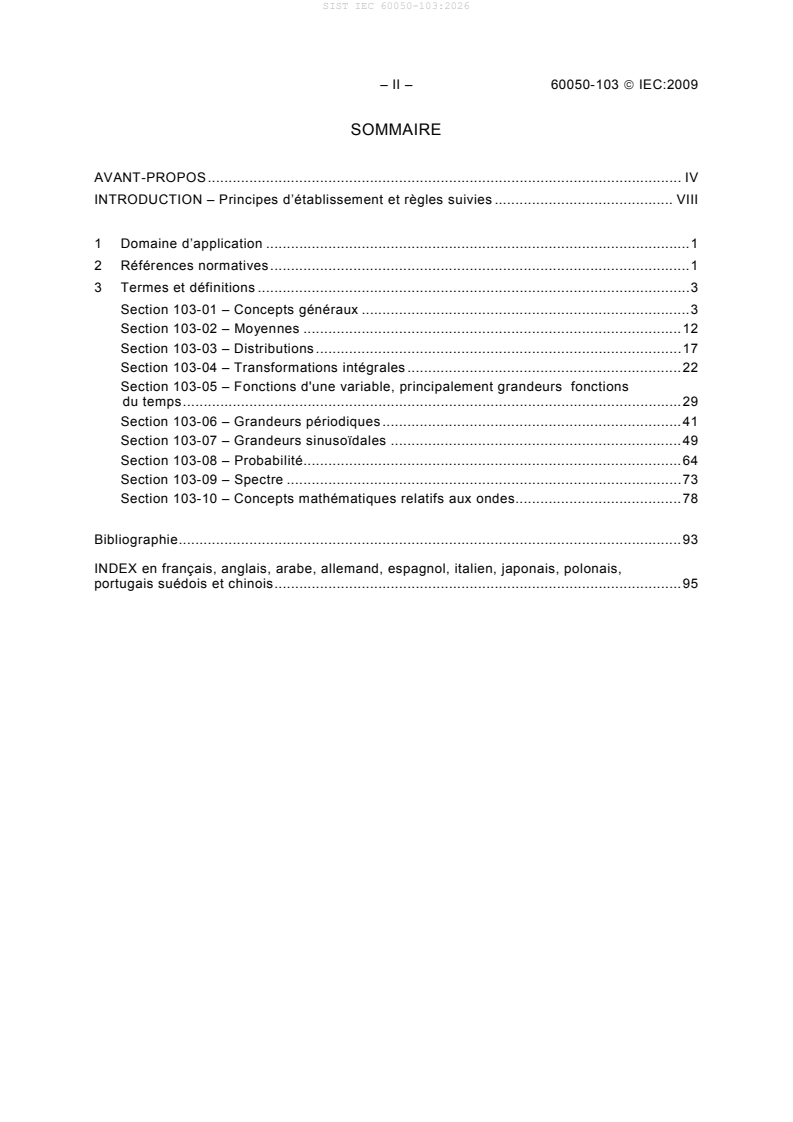
SOMMAIRE
AVANT-PROPOS. IV
INTRODUCTION – Principes d’établissement et règles suivies . VIII
1 Domaine d’application .1
2 Références normatives.1
3 Termes et définitions .3
Section 103-01 – Concepts généraux .3
Section 103-02 – Moyennes .12
Section 103-03 – Distributions.17
Section 103-04 – Transformations intégrales .22
Section 103-05 – Fonctions d'une variable, principalement grandeurs fonctions
du temps.29
Section 103-06 – Grandeurs périodiques.41
Section 103-07 – Grandeurs sinusoïdales .49
Section 103-08 – Probabilité.64
Section 103-09 – Spectre .73
Section 103-10 – Concepts mathématiques relatifs aux ondes.78
Bibliographie.93
INDEX en français, anglais, arabe, allemand, espagnol, italien, japonais, polonais,
portugais suédois et chinois.95
60050-103 © IEC:2009 – III –
CONTENTS
FOREWORD. VI
INTRODUCTION – Principles and rules followed . IX
1 Scope.2
2 Normative references .2
3 Terms and definitions .3
Section 103-01 — General concepts.3
Section 103-02 — Means .12
Section 103-03 — Distributions .17
Section 103-04 — Integral transformations .22
Section 103-05 — Functions of one variable, mainly time-dependent quantities .29
Section 103-06 — Periodic quantities .41
Section 103-07 — Sinusoidal quantities.49
Section 103-08 — Probability .64
Section 103-09 — Spectrum .73
Section 103-10 — Mathematical concepts related to waves.78
Bibliography.94
INDEX in French, English, Arabic, German, Spanish, Italian, Japanese, Polish, Portuguese,
Swedish and Chinese.95
– IV – 60050-103 © IEC:2009
COMMISSION ÉLECTROTECHNIQUE INTERNATIONALE
____________
VOCABULAIRE ÉLECTROTECHNIQUE INTERNATIONAL
PARTIE 103: MATHÉMATIQUES – FONCTIONS
AVANT-PROPOS
1) La Commission Electrotechnique Internationale (CEI) est une organisation mondiale de normalisation
composée de l'ensemble des comités électrotechniques nationaux (Comités nationaux de la CEI). La CEI a
pour objet de favoriser la coopération internationale pour toutes les questions de normalisation dans les
domaines de l'électricité et de l'électronique. A cet effet, la CEI – entre autres activités – publie des Normes
internationales, des Spécifications techniques, des Rapports techniques, des Spécifications accessibles au
public (PAS) et des Guides (ci-après dénommés "Publication(s) de la CEI"). Leur élaboration est confiée à des
comités d'études, aux travaux desquels tout Comité national intéressé par le sujet traité peut participer. Les
organisations internationales, gouvernementales et non gouvernementales, en liaison avec la CEI, participent
également aux travaux. La CEI collabore étroitement avec l'Organisation Internationale de Normalisation (ISO),
selon des conditions fixées par accord entre les deux organisations.
2) Les décisions ou accords officiels de la CEI concernant les questions techniques représentent, dans la mesure
du possible, un accord international sur les sujets étudiés, étant donné que les Comités nationaux de la CEI
intéressés sont représentés dans chaque comité d’études.
3) Les Publications de la CEI se présentent sous la forme de recommandations internationales et sont agréées
comme telles par les Comités nationaux de la CEI. Tous les efforts raisonnables sont entrepris afin que la CEI
s'assure de l'exactitude du contenu technique de ses publications; la CEI ne peut pas être tenue responsable
de l'éventuelle mauvaise utilisation ou interprétation qui en est faite par un quelconque utilisateur final.
4) Dans le but d'encourager l'uniformité internationale, les Comités nationaux de la CEI s'engagent, dans toute la
mesure possible, à appliquer de façon transparente les Publications de la CEI dans leurs publications
nationales et régionales. Toutes divergences entre toutes Publications de la CEI et toutes publications
nationales ou régionales correspondantes doivent être indiquées en termes clairs dans ces dernières.
5) La CEI elle-même ne fournit aucune attestation de conformité. Des organismes de certification indépendants
fournissent des services d'évaluation de conformité et, dans certains secteurs, accèdent aux marques de
conformité de la CEI. La CEI n'est responsable d'aucun des services effectués par les organismes de
certification indépendants.
6) Tous les utilisateurs doivent s'assurer qu'ils sont en possession de la dernière édition de cette publication.
7) Aucune responsabilité ne doit être imputée à la CEI, à ses administrateurs, employés, auxiliaires ou
mandataires, y compris ses experts particuliers et les membres de ses comités d'études et des Comités
nationaux de la CEI, pour tout préjudice causé en cas de dommages corporels et matériels, ou de tout autre
dommage de quelque nature que ce soit, directe ou indirecte, ou pour supporter les coûts (y compris les frais
de justice) et les dépenses découlant de la publication ou de l'utilisation de cette Publication de la CEI ou de
toute autre Publication de la CEI, ou au crédit qui lui est accordé.
8) L'attention est attirée sur les références normatives citées dans cette publication. L'utilisation de publications
référencées est obligatoire pour une application correcte de la présente publication.
9) L’attention est attirée sur le fait que certains des éléments de la présente Publication de la CEI peuvent faire
l’objet de droits de propriété intellectuelle ou de droits analogues. La CEI ne saurait être tenue pour
responsable de ne pas avoir identifié de tels droits de propriété et de ne pas avoir signalé leur existence.
La Norme internationale CEI 60050-103 a été établie par le comité d'études 1 de la CEI:
Terminologie.
Cette norme annule et remplace les sections 101-13, 101-14 et 101-15 de la Norme
internationale CEI 60050-101:1998. Elle a le statut d'une norme horizontale conformément au
Guide 108 de la CEI.
Le texte de cette norme est issu des documents suivants:
FDIS Rapport de vote
1/2081/FDIS 1/62084/RVD
Le rapport de vote indiqué dans le tableau ci-dessus donne toute information sur le vote ayant
abouti à l'approbation de cette norme.
60050-103 © IEC:2009 – V –
Cette publication a été rédigée selon les Directives ISO/CEI, Partie 2.
Dans la présente partie du VEI les termes et définitions sont donnés en français et en anglais:
de plus, les termes sont indiqués en arabe (ar), allemand (de), espagnol (es), italien (it),
japonais (ja), polonais (pl), portugais (pt), suédois (sv) et chinois (zh).
Une liste de toutes les parties de la série CEI 60050, présentées sous le titre général
Vocabulaire Électrotechnique International, peut être consultée sur le site web de la CEI.
Le comité a décidé que le contenu de cette publication ne sera pas modifié avant la date de
maintenance indiquée sur le site web de la CEI sous "http://webstore.iec.ch" dans les
données relatives à la publication recherchée. A cette date, la publication sera
• reconduite,
• supprimée,
• remplacée par une édition révisée, ou
• amendée.
– VI – 60050-103 © IEC:2009
INTERNATIONAL ELECTROTECHNICAL COMMISSION
____________
INTERNATIONAL ELECTROTECHNICAL VOCABULARY
PART 103: MATHEMATICS – FUNCTIONS
FOREWORD
1) The International Electrotechnical Commission (IEC) is a worldwide organization for standardization comprising
all national electrotechnical committees (IEC National Committees). The object of IEC is to promote
international co-operation on all questions concerning standardization in the electrical and electronic fields. To
this end and in addition to other activities, IEC publishes International Standards, Technical Specifications,
Technical Reports, Publicly Available Specifications (PAS) and Guides (hereafter referred to as “IEC
Publication(s)”). Their preparation is entrusted to technical committees; any IEC National Committee interested
in the subject dealt with may participate in this preparatory work. International, governmental and non-
governmental organizations liaising with the IEC also participate in this preparation. IEC collaborates closely
with the International Organization for Standardization (ISO) in accordance with conditions determined by
agreement between the two organizations.
2) The formal decisions or agreements of IEC on technical matters express, as nearly as possible, an international
consensus of opinion on the relevant subjects since each technical committee has representation from all
interested IEC National Committees.
3) IEC Publications have the form of recommendations for international use and are accepted by IEC National
Committees in that sense. While all reasonable efforts are made to ensure that the technical content of IEC
Publications is accurate, IEC cannot be held responsible for the way in which they are used or for any
misinterpretation by any end user.
4) In order to promote international uniformity, IEC National Committees undertake to apply IEC Publications
transparently to the maximum extent possible in their national and regional publications. Any divergence
between any IEC Publication and the corresponding national or regional publication shall be clearly indicated in
the latter.
5) IEC itself does not provide any attestation of conformity. Independent certification bodies provide conformity
assessment services and, in some areas, access to IEC marks of conformity. IEC is not responsible for any
services carried out by independent certification bodies.
6) All users should ensure that they have the latest edition of this publication.
7) No liability shall attach to IEC or its directors, employees, servants or agents including individual experts and
members of its technical committees and IEC National Committees for any personal injury, property damage or
other damage of any nature whatsoever, whether direct or indirect, or for costs (including legal fees) and
expenses arising out of the publication, use of, or reliance upon, this IEC Publication or any other IEC
Publications.
8) Attention is drawn to the Normative references cited in this publication. Use of the referenced publications is
indispensable for the correct application of this publication.
9) Attention is drawn to the possibility that some of the elements of this IEC Publication may be the subject of
patent rights. IEC shall not be held responsible for identifying any or all such patent rights.
International Standard IEC 60050-103 has been prepared by IEC technical committee 1:
Terminology.
This standard cancels and replaces Sections 101-13, 101-14 and 101-15 of International
Standard IEC 60050-101:1998. It has the status of a horizontal standard in accordance with
IEC Guide 108.
The text of this standard is based on the following documents:
FDIS Report on voting
1/2081/FDIS 1/62084/RVD
Full information on the voting for the approval of this standard can be found in the report on
voting indicated in the above table.
This publication has been drafted in accordance with the ISO/IEC Directives, Part 2.
60050-103 © IEC:2009 – VII –
In this part of IEV, the terms and definitions are written in French and English; in addition the
terms are given in Arabic (ar), German (de), Spanish (es), Italian (it), Japanese (ja), Polish
(pl), Portuguese (pt), Swedish (sv) and Chinese (zh).
A list of all parts of the IEC 60050 series, published under the general title International
Electrotechnical Vocabulary, can be found on the IEC website.
The committee has decided that the contents of this publication will remain unchanged until
the maintenance result date indicated on the IEC web site under "http://webstore.iec.ch" in
the data related to the specific publication. At this date, the publication will be
• reconfirmed,
• withdrawn,
• replaced by a revised edition, or
• amended.
– VIII – 60050-103 © IEC:2009
INTRODUCTION
Principes d’établissement et règles suivies
Généralités
Le VEI (série de normes CEI 60050) est un vocabulaire multilingue à usage général couvrant
le champ de l’électrotechnique, de l’électronique et des télécommunications. Il comprend
environ 18 000 articles terminologiques correspondant chacune à une notion. Ces articles
sont répartis dans environ 80 parties, chacune correspondant à un domaine donné.
Exemples:
Partie 161 (CEI 60050-161): Compatibilité électromagnétique
Partie 411 (CEI 60050-411): Machines tournantes
Les articles suivent un schéma de classification hiérarchique Partie/Section/Concept, les
notions étant, au sein des sections, classées par ordre systématique.
Les termes, définitions et notes des articles sont donnés dans les trois langues de la CEI,
c’est-à-dire français, anglais et russe (langues principales du VEI).
Dans chaque article, les termes seuls sont également donnés dans les langues additionnelles
du VEI (arabe, chinois, allemand, grec, espagnol, italien, japonais, polonais, portugais et
suédois).
De plus, chaque partie comprend un index alphabétique des termes inclus dans cette partie,
et ce pour chacune des langues du VEI.
NOTE Certaines langues peuvent manquer.
Constitution d’un article terminologique
Chacun des articles correspond à un concept, et comprend:
– un numéro d’article,
– éventuellement un symbole littéral de grandeur ou d’unité,
puis, pour chaque langue principale du VEI:
– le terme désignant le concept, appelé «terme privilégié», éventuellement accompagné de
synonymes et d’abréviations,
– la définition de la notion,
– éventuellement la source,
– éventuellement des notes,
et enfin, pour les langues additionnelles du VEI, les termes seuls.
Numéro d’article
Le numéro d’article comprend trois éléments, séparés par des traits d’union:
– Numéro de partie: 3 chiffres,
– Numéro de section: 2 chiffres,
– Numéro de la notion: 2 chiffres (01 à 99).
Exemple: 131-13-22
60050-103 © IEC:2009 – IX –
INTRODUCTION
Principles and rules followed
General
The IEV (IEC 60050 series) is a general purpose multilingual vocabulary covering the field of
electrotechnology, electronics and telecommunication. It comprises about 18 000
terminological entries, each corresponding to a concept. These entries are distributed among
about 80 parts, each part corresponding to a given field.
Examples:
Part 161 (IEC 60050-161): Electromagnetic compatibility
Part 411 (IEC 60050-411): Rotating machines
The entries follow a hierarchical classification scheme Part/Section/Concept, the concepts
being, within the sections, organized in a systematic order.
The terms, definitions and notes in the entries are given in the three IEC languages, that is
French, English and Russian (principal IEV languages).
In each entry, the terms alone are also given in the additional IEV languages (Arabic,
Chinese, German, Greek, Spanish, Italian, Japanese, Polish, Portuguese, and Swedish).
In addition, each part comprises an alphabetical index of the terms included in that part, for
each of the IEV languages.
NOTE Some languages may be missing.
Organization of a terminological entry
Each of the entries corresponds to a concept, and comprises:
– an entry number,
– possibly a letter symbol for quantity or unit,
then, for each of the principal IEV languages:
– the term designating the concept, called «preferred term», possibly accompanied by
synonyms and abbreviations,
– the definition of the concept,
– possibly the source,
– possibly notes,
and finally, for the additional IEV languages, the terms alone.
Entry number
The entry number is comprised of three elements, separated by hyphens:
– Part number: 3 digits,
– Section number: 2 digits,
– Concept number: 2 digits (01 to 99).
Example: 131-13-22
– X – 60050-103 © IEC:2009
Symboles littéraux de grandeurs et unités
Ces symboles, indépendants de la langue, sont donnés sur une ligne séparée suivant le
numéro d’article.
Exemple:
131-12-04
symb.: R
résistance, f
Terme privilégié et synonymes
Le terme privilégié est le terme qui figure en tête d’un article; il peut être suivi par des
synonymes. Il est imprimé en gras.
Synonymes:
Les synonymes sont imprimés sur des lignes séparées sous le terme privilégié: ils sont
également imprimés en gras, sauf les synonymes déconseillés, qui sont imprimés en maigre,
et suivis par l’attribut «(déconseillé)».
Parties pouvant être omises:
Certaines parties d’un terme peuvent être omises, soit dans le domaine considéré, soit dans
un contexte approprié. Ces parties sont alors imprimées en gras, entre parenthèses:
Exemple: émission (électromagnétique)
Absence de terme approprié:
Lorsqu’il n’existe pas de terme approprié dans une langue, le terme privilégié est remplacé
par cinq points, comme ceci:
.....
« » (et il n’y a alors bien entendu pas de synonymes).
Attributs
Chaque terme (ou synonyme) peut être suivi d’attributs donnant des informations
supplémentaires; ces attributs sont imprimés en maigre, à la suite de ce terme, et sur la
même ligne.
Exemples d’attributs:
– spécificité d’utilisation du terme:
rang (d’un harmonique)
– variante nationale:
unité de traitement CA
– catégorie grammaticale:
électronique, adj
électronique, f
– abréviation:
CEM (abréviation)
– déconseillé:
déplacement (terme déconseillé)
60050-103 © IEC:2009 – XI –
Letter symbols for quantities and units
These symbols, which are language independent, are given on a separate line following the
entry number.
Example:
131-12-04
symb.: R
résistance, f
Preferred term and synonyms
The preferred term is the term that heads a terminological entry; it may be followed by
synonyms. It is printed in boldface.
Synonyms:
The synonyms are printed on separate lines under the preferred term: they are also printed in
boldface, except for deprecated synonyms, which are printed in lightface, and followed by the
attribute "(deprecated)".
Parts that may be omitted:
Some parts of a term may be omitted, either in the field under consideration or in an
appropriate context. Such parts are printed in boldface type, and placed in parentheses:
Example: (electromagnetic) emission
Absence of an appropriate term:
When no adequate term exists in a given language, the preferred term is replaced by five
.....
dots, like that: " " (and there are of course no synonyms).
Attributes
Each term (or synonym) may be followed by attributes giving additional information, and
printed in lightface on the same line as the corresponding term, following this term.
Examples of attributes:
– specific use of the term:
transmission line (in electric power systems)
– national variant:
lift GB
– grammatical information:
thermoplastic, noun
AC, qualifier
– abbreviation:
EMC (abbreviation)
– deprecated:
choke (deprecated)
– XII – 60050-103 © IEC:2009
Source
Dans certains cas, il a été nécessaire d’inclure dans une partie du VEI un concept pris dans
une autre partie du VEI, ou dans un autre document de terminologie faisant autorité
(VIM, ISO/CEI 2382, etc.), dans les deux cas avec ou sans modification de la définition (ou
éventuellement du terme).
Ceci est indiqué par la mention de cette source, imprimée en maigre et placée entre crochets
à la fin de la définition:
Exemple: [131-03-13 MOD]
(MOD indique que la définition a été modifiée)
Termes dans les langues additionnelles du VEI
Ces termes sont placés à la fin de l’article, sur des lignes séparées (une ligne par langue),
précédés par le code alpha-2 de la langue, défini dans l’ISO 639-1, et dans l’ordre
alphabétique de ce code. Les synonymes sont séparés par des points-virgules.
60050-103 © IEC:2009 – XIII –
Source
In some cases, it has been necessary to include in an IEV part a concept taken from another
IEV part, or from another authoritative terminology document (VIM, ISO/IEC 2382, etc.), in
both cases with or without modification to the definition (and possibly to the term).
This is indicated by the mention of this source, printed in lightface, and placed between
square brackets at the end of the definition.
Example: [131-03-13 MOD]
(MOD indicates that the definition has been modified)
Terms in additional IEV languages
These terms are placed at the end of the entry, on separate lines (one single line for each
language), preceded by the alpha-2 code for the language defined in ISO 639-1, and in the
alphabetic order of this code. Synonyms are separated by semicolons.
60050-103 © IEC:2009 – 1 –
VOCABULAIRE ÉLECTROTECHNIQUE INTERNATIONAL
PARTIE 103: MATHÉMATIQUES – FONCTIONS
1 Domaine d’application
La présente partie de la CEI 60050 donne la terminologie relative aux fonctions d'une ou
plusieurs variables. Conjointement avec la CEI 60050-102, elle couvre la terminologie
mathématique utilisée dans les domaines de l'électricité, de l'électronique et des
télécommunications. Elle maintient une distinction nette entre les concepts mathématiques et
les concepts physiques, même si certains termes sont employés dans les deux cas. Les
symboles mathématiques sont généralement conformes à la CEI 60027-1 et à l'ISO 80000-2.
De nombreux termes mathématiques sont en effet utilisés dans le VEI, dont tous n'ont pas un
sens évident ou ne sont pas compris de façon unique. L'objectif consiste donc à collecter de
tels concepts et à les présenter sous forme de termes et descriptions, dans un ordre logique
mettant en évidence leurs relations. Les descriptions sont des définitions au sens
terminologique, mais ne sont pas toujours des définitions complètes au sens mathématique.
Elles ont principalement pour but de distinguer entre eux les différents concepts. Il convient
par conséquent de ne pas considérer la présente partie comme un manuel de mathématiques,
mais plutôt comme un ensemble de termes avec leurs équivalents dans d'autres langues et
des descriptions dans les langues principales.
Cette terminologie est naturellement en accord avec la terminologie figurant dans les autres
parties spécialisées du VEI.
Cette norme horizontale est essentiellement destinée à l'usage des comités d'études dans la
préparation des normes, conformément aux principes établis dans le Guide 108 de la CEI.
Une des responsabilités d'un comité d'études est, partout où cela est possible, de se servir
des normes horizontales lors de la préparation de ses publications. Le contenu de cette
norme horizontale ne s'appliquera pas, à moins qu'il ne soit spécifiquement désigné ou inclus
dans les publications concernées
2 Références normatives
Les documents de référence suivants sont indispensables pour l'application du présent
document. Pour les références datées, seule l'édition citée s'applique. Pour les références
non datées, la dernière édition du document de référence s'applique (y compris les éventuels
amendements).
IEC Guide 108, Lignes directrices pour assurer la cohérence des publications de la CEI –
Application des normes horizontales
– 2 – 60050-103 © IEC:2009
INTERNATIONAL ELECTROTECHNICAL VOCABULARY
PART 103: MATHEMATICS – FUNCTIONS
1 Scope
This part of IEC 60050 gives the terminology relative to functions of one or more variables.
Together with IEC 60050-102, it covers the mathematical terminology used in the fields of
electricity, electronics and telecommunications. It maintains a clear distinction between
mathematical concepts and physical concepts, even if some terms are used in both cases.
Mathematical symbols are generally in accordance with IEC 60027-1 and ISO 80000-2.
Many mathematical terms are used in IEV, not all of them being self-explaining or uniquely
understood. The target is then to collect such mathematical concepts and to present them by
terms and descriptions given in logical order according to their interdependence. The
descriptions are definitions from the terminological point of view, but they are not always
complete definitions in the mathematical sense. Their main goal is to distinguish among
particular concepts. In consequence, this part of the IEV should not be regarded as a
mathematical textbook, but rather as a set of terms with their equivalents in several
languages and with descriptions in the main IEV languages.
This terminology is of course consistent with the terminology developed in the other
specialized parts of the IEV.
This horizontal standard is primarily intended for use by technical committees in the
preparation of standards in accordance with the principles laid down in IEC Guide 108.
One of the responsibilities of a technical committee is, wherever applicable, to make use of
horizontal standards in the preparation of its publications. The contents of this horizontal
standard will not apply unless specifically referred to or included in the relevant publications.
2 Normative references
The following referenced documents are indispensable for the application of this document.
For dated references, only the edition cited applies. For undated references, the latest edition
of the referenced document (including any amendments) applies.
IEC Guide 108, Guidelines for ensuring the coherency of IEC publications – Application of
horizontal standards
60050-103 © IEC:2009 – 3 –
3 Termes et définitions
3 Terms and definitions
Section 103-01 – Concepts généraux
Section 103-01 – General concepts
103-01-01
fonction, f
relation f telle que, pour toute entité a, il y a exactement une entité b à laquelle a est reliée
par f
[102-01-10 MOD]
NOTE 1 Si a est reliée à b par la fonction f:
f est définie pour a,
• on dit que
• a est un argument de la fonction f,
• b est une valeur de la fonction f, généralement notée f(a).
L’argument peut être une entité élémentaire, telle qu’un nombre, ou un ensemble ordonné d’entités élémentaires,
et de même pour la valeur.
NOTE 2 Le terme fonction peut être qualifié selon la nature de la valeur, par exemple fonction réelle, fonction
complexe, fonction vectorielle, ou selon la nature de la relation, par exemple, fonction algébrique, fonction
trigonométrique, fonction hyperbolique.
function
relation f such that for any entity a there is exactly one entity b to which a is related by f
[102-01-10 MOD]
NOTE 1 If a is related to b by the function f, then:
• f is said to be defined for a,
• a is an argument of the function f,
• b is a value of the function f and is usually denoted by f(a).
The argument may be an elementary entity, such as a number, or an ordered set of elementary entities, and the
same for the value.
NOTE 2 The term function may be qualified according to the nature of the value, e.g. real function, complex
function, vector function, or to the character of the relation, e.g. algebraic function, trigonometric function,
hyperbolic function.
ar ﺔﻟاد
de Funktion, f; Operation, f
es Función
it funzione
ja 関数
pl funkcja
pt função
se funktion
zh 函数
– 4 – 60050-103 © IEC:2009
103-01-02
fonctionnelle, f
fonction dont l'argument est une fonction et la valeur un nombre
t
NOTE Un exemple de fonctionnelle de la fonction f(t) est f (t)dt .
∫
t
functional
function for which the argument is a function and the value a number
t
NOTE An example of a functional of the function f(t) is f (t)dt .
∫
t
ar ﻰﻟاد
de Funktional, n
es funcional
it funzionale
ja 汎関数
pl funkcjonał
pt funcional
se funktional
zh 泛函
103-01-03
distribution, f
fonction généralisée, f
fonctionnelle linéaire continue qui associe un nombre réel ou complexe à toute fonction de
variable réelle ou complexe appartenant à la classe des fonctions indéfiniment dérivables
nulles en dehors d'un intervalle ou domaine borné
NOTE 1 Une fonction D(x) peut être considérée comme une distribution D associant à une fonction f(x) la valeur
+∞
D( f ) = D(x) f (x)d x
∫
−∞
si cette intégrale existe.
NOTE 2 La dérivée d'une distribution D est une autre distribution D′ définie pour toute fonction f(x) par
′
D ( f ) = −D(d f /d x) .
distribution
generalized function
continuous linear functional which assigns a real or complex number to any function of a real
or complex variable belonging to the class of infinitely differentiable functions vanishing
outside a bounded interval or domain
NOTE 1 A function D(x) can be considered as a distribution D assigning to a function f(x) the value
+∞
D( f ) = D(x) f (x)d x
∫
−∞
if this integral exists.
NOTE 2 The derivative of a distribution D is another distribution D′ defined for any function f(x) by
′
D ( f ) = −D(d f /d x) .
ar ﺔﻴﻤﻴﻤﻌﺗ ﺔﻟاد ; ﻊﻳزﻮﺗ
de Distribution, f; verallgemeinerte Funktion, f
es distribución
it distribuzione, funzione generalizzata
ja 分布; 一般関数
pl dystrybucja; funkcja uogólniona
pt distribuição; função generalizada
se distribution; generaliserad funktion
zh 分布;广义函数
60050-103 © IEC:2009 – 5 –
103-01-04
transformation, f
fonction dont à la fois l'argument et la valeur sont des fonctions
NOTE 1 Un exemple de transformation est la transformation de Fourier, où l’argument est une fonction du temps
et la valeur est la transformée de Fourier de cette fonction. Lorsque l’argument, la valeur, ou les deux, sont des
ensembles ordonnés d’entités, une transformation linéaire est souvent représentée par une matrice.
NOTE 2 Pour des raisons historiques, certaines transformations sont appelées opérateurs, par exemple l'opérateur
nabla (CEI 60050-102, 102-05-18).
transformation
function for which both the argument and the value are functions
NOTE 1 An example of transformation is the Fourier transformation, where the argument is a function of time and the value is
the Fourier transform of this function. When the argument, the value, or both, are ordered set of entities, a linear transformation
is often represented by a matrix.
NOTE 2 For historical reasons, some transformations are called operators, e.g. nabla operator (IEC 60050-102,
102-05-18).
ar ﻞﻳﻮﺤﺗ
de Transformation, f
es transformación
it trasformazione
ja 変換
pl transformacja
pt transformação
se transformation
zh 变换
103-01-05
variable, f
entité mathématique indéterminée qui peut être remplacée par tout élément d'un ensemble
donné
NOTE Une variable peut être un argument ou la valeur d'une fonction. Une variable utilisée comme argument est
appelée variable indépendante.
variable
undetermined mathematical entity which can be replaced with any element of a given set
NOTE A variable can be an argument or the value of a function. A variable used as an argument is called an
independent variable.
ar ﺮﻴﻐﺘﻣ
de Variable, f; Veränderliche, f
es Variable
it variabile
ja 変数
pl zmienna
pt variável
se variabel
zh 变量
– 6 – 60050-103 © IEC:2009
103-01-06
fonction de n variables, f
fonction dont l'argument est un ensemble ordonné de n nombres ou grandeurs scalaires
NOTE 1 La valeur d'une fonction f de n variables x , x ,K, x est notée f (x , x ,K, x ) .
1 2 n 1 2 n
NOTE 2 Dans de nombreuses applications en électrotechnique, on utilise des fonctions d'une seule variable. Cette
variable est souvent la durée et la fonction est alors appelée « fonction du temps » et notée f(t). Mais les variables
peuvent aussi être des variables spatiales (par exemple des coordonnées), la fréquence, etc.
function of n variables
function for which the argument is an ordered set of n numbers or scalar quantities
NOTE 1 The value of the function f of n variables x , x ,K, x is denoted by f (x , x ,K, x ) .
1 2 n 1 2 n
NOTE 2 In many practical applications in electrotechnology, functions of one variable are used. This variable is
often the duration and the function is then called "function of time" and denoted by f(t). But the variables may also
be space variables (e.g. coordinates), frequency, etc.
ar تاﺮﻴﻐﺘﻣ n ﻰﻓ ﺔﻟاد
de Funktion von n Variablen, f; Funktion mehrerer Veränderlicher, f
es función de n variables
it funzione di n variabili
ja n変数の関数
pl funkcja n zmiennych
pt função de n variáveis
se funktion av n variable
zh 个自变量的函数
103-01-07
relation fonctionnelle, f
relation entre deux variables ou plus exprimée sous la forme d'une égalité
NOTE F(x, y, z) = 0 est une relation fonctionnelle entre les variables x, y, z . Toute fonction de n variables est
une relation fonctionnelle entre n + 1 variables.
functional relation
relation between two or more variables expressed in the form of an equality
NOTE F(x, y, z) = 0 is a functional relation between the variables x, y, z . Any function of n variables is a
functional relation between n + 1 variables.
ar ﺔﻴﻟاﺪﻟا ﺔﻗﻼﻌﻟا
de funktionale Beziehung, f
es relación funcional
it relazione funzionale
ja 関数関係
pl zależność funkcjonalna
pt relação funcional
se funktional relation
zh 函数关系
60050-103 © IEC:2009 – 7 –
103-01-08
produit interne, m
pour deux fonctions à valeurs complexes, f et g , définies sur l'intervalle [a, b] de ℝ, nombre
b
complexe f ,g = f (x) g*(x)d x où g* est le conjugué de g
∫
a
NOTE 1 Le produit interne a les propriétés suivantes: f , g = g, f * et
α f + β g,h = α f ,h + β g,h où α,β ∈ℂ.
NOTE 2 Le produit interne de deux fonctions complexes est analogue au produit hermitien de deux vecteurs (voir
la CEI 60050-102, 102-03-18). Pour des fonctions réelles, il est analogue au produit scalaire (voir la CEI 60050-
102, 102-03-17).
inner product
for two complex-valued functions, f and g , defined on the interval [a, b] of ℝ, complex
b
number f ,g = f (x) g*(x)d x , where g* is the conjugate of g
∫
a
NOTE 1 The inner product has the following properties: f , g = g, f * and
α f + β g,h = α f ,h + β g,h where α,β ∈ℂ.
NOTE 2 The inner product for complex functions is similar to the Hermitian product for vectors (see IEC 60050-
102, 102-03-18). For real functions, it is similar to the scalar product (see IEC 60050-102, 102-03-17).
ar ﻰﻠﺧاﺪﻟا بﺮﻀﻟا
de inneres Produkt, n
es producto interno
it prodotto interno
ja 内積
pl iloczyn wewnętrzny
pt produto interno
se inre produkt
zh 内积
103-01-09
produit interne pondéré, m
pour deux fonctions à valeurs complexes, f et g , définies sur l'intervalle [a, b] de ℝ, nombre
b
complexe f ,g = f (x) g*(x)w(x)d x , où w(x) est une fonction réelle de x appelée poids
∫
a
weighted inner product
for two complex-valued functions, f and g , defined on the interval [a, b] of ℝ, complex
b
number f ,g = f (x) g*(x)w(x)d x , where w(x) is a real function of x called weight
∫
a
ar ﺔﻧوزﻮﻣ تﺎﻬﺠﺘﻤﻟ ﻰﻠﺧاﺪﻟا بﺮﻀﻟا
de gewichtetes inneres Produkt, n
es producto interno ponderado
it prodotto pesato interno
ja 加重内積
pl iloczyn wewnętrzny ważony
pt produto interno ponderado
se vägd inre produkt
zh 加权内积
– 8 – 60050-103 © IEC:2009
103-01-10
orthogonal, adj
qualifie deux fonctions dont le produit interne, éventuellement pondéré, est nul
NOTE L'orthogonalité de deux fonctions est analogue à celle de deux vecteurs (voir la CEI 60050-102,
102-03-26).
orthogonal, adj
qualifies two functions whose inner product, possibly weighted, is zero
NOTE Orthogonality for functions is similar to orthogonality for vectors (see IEC 60050-102, 102-03-26).
ar ﺪﻣﺎﻌﺘﻣ
de orthogonal, Adj.
es ortogonal
it ortogonale
ja 直交
pl ortogonalny
pt ortogonal, adj
se ortogonal
zh 正交的(1),形容词
60050-103 © IEC:2009 – 9 –
103-01-11
système de fonctions orthogonales, m
ensemble de fonctions dont chacune est orthogonale à toute autre
NOTE Exemples:
• Les polynômes de Legendre P constituent un système de fonctions orthogonales sur l'intervalle [−1, + 1]
+1
parce que P (x)P (x)d x = 0 pour tous entiers k ≠ l .
k l
∫
−1
• Les polynômes de Laguerre L constituent un système de fonctions orthogonales sur l'intervalle [0, + ∞]
+∞
avec le poids exp(−x) parce que L (x)L (x)exp(−x)d x = 0 pour tous entiers k ≠ l .
k l
∫
• Les fonctions trigonométriques sinus et cosinus constituent un système de fonctions orthogonales sur
2π 2π
l'intervalle [0, 2π] parce que sin(kx)sin(lx)d x = 0 et cos(kx)cos(lx)d x = 0 pour tous entiers k ≠ l ,
∫ ∫
0 0
2π
et sin(kx)cos(lx)d x = 0 pour tous entiers k et l.
∫
system of orthogonal functions
orthogonal system
set of functions, such that each of them is orthogonal to any other
NOTE Examples:
• Legendre polynomials P constitute a system of orthogonal functions on the interval [−1, + 1] because
+1
P (x)P (x)d x = 0 for any integers k ≠ l .
k l
∫
−1
• Laguerre polynomials L constitute a system of orthogonal functions on the interval [0, + ∞] with the weight
+∞
exp(−x) because L (x)L (x)exp(−x)d x = 0 for any integers k ≠ l .
k l
∫
• Trigonometric functions sine and cosine constitute a system of orthogonal functions on the interval [0, 2π]
2π 2π
because sin(kx)sin(lx)d x = 0 and cos(kx)cos(lx)d x = 0 for any integers k ≠ l, and
∫ ∫
0 0
2π
sin(kx)cos(lx)d x = 0 for any integer k and l.
∫
ar ﺪﻣﺎﻌﺘﻣ مﺎﻈﻧ ; ةﺪﻣﺎﻌﺘﻤﻟا لاوﺪﻟا ﺔﻋﻮﻤﺠﻣ
de System orthogonaler Funktionen, n; Orthogonalsystem, n
es sistema de funciones ortogonales
it sistema di funzioni ortogonali; sistema ortogonale
ja 直交関数系; 直交系
pl układ funkcji ortogonalnych; układ ortogonalny
pt sistema de funcionais ortogonais; sistema ortogonal
se system av ortogonala funktioner; ortogonalsystem
zh 正交函数系;正交系
– 10 – 60050-103 © IEC:2009
103-01-12
intervalle, m
ensemble de nombres réels tel que, quel que soit le couple (x, y) d'éléments de l'ensemble,
tout nombre réel z compris entre x et y appartient à l'ensemble
NOTE On distingue plusieurs catégories d'intervalles:
• intervalle fermé de a à b: [a, b] ={}x ∈R a ≤ x ≤ b
• intervalle ouvert de a à b: ]a, b[={}x ∈R a < x < b
• intervalles semi-ouverts: ]a, b] ={}x ∈R a < x ≤ b et [a, b[={}x ∈R a ≤ x < b
• intervalle illimité fermé commençant en a ou finissant en b: ] − ∞, b] ={}x ∈R x ≤ b et
[a, + ∞[={}x ∈R a ≤ x
• intervalle illimité ouvert commençant en a ou finissant en b: ] − ∞, b[={}x ∈R x < b et
]a, + ∞[={}x ∈R a < x
interval
set of real numbers such that, for any pair (x, y) of elements of the set, any real number z
between x and y belongs to the set
NOTE There are several kinds of intervals:
• closed interval from a to b: [a, b] ={}x ∈R a ≤ x ≤ b
{}
• open interval from a to b: ]a, b[= x ∈R a < x < b
{} {}
• half-open intervals: ]a, b] = x ∈R a < x ≤ b and [a, b[= x ∈R a ≤ x < b
b or onward from a: ] − ∞, b] ={}x ∈R x ≤ b and [a, + ∞[={}x ∈R a ≤ x
• closed unbounded interval up to
{} {}
• open unbounded interval up to b or onward from a: ] − ∞, b[= x ∈R x < b and ]a, + ∞[= x ∈R a < x
ar ةﺮﺘﻓ
de Intervall, n
es Intervalo
it intervallo
ja 区区
pl przedział; interwał (stosowany w akustyce)
pt intervalo
se intervall
zh 区间
60050-103 © IEC:2009 – 11 –
103-01-13
extrémité, f
pour un intervalle de a à b, chacun des nombres a et b; pour un intervalle illimité commençant
en a, le nombre a
...
IEC 60050-103 ®
Edition 1.0 2009-12
INTERNATIONAL
STANDARD
NORME
INTERNATIONALE
HORIZONTAL STANDARD
NORME HORIZONTALE
International Electrotechnical Vocabulary –
Part 103: Mathematics – Functions
Vocabulaire Electrotechnique International –
Partie 103: Mathématiques – Fonctions
All rights reserved. Unless otherwise specified, no part of this publication may be reproduced or utilized in any form or by
any means, electronic or mechanical, including photocopying and microfilm, without permission in writing from either IEC or
IEC's member National Committee in the country of the requester.
If you have any questions about IEC copyright or have an enquiry about obtaining additional rights to this publication,
please contact the address below or your local IEC member National Committee for further information.
Droits de reproduction réservés. Sauf indication contraire, aucune partie de cette publication ne peut être reproduite
ni utilisée sous quelque forme que ce soit et par aucun procédé, électronique ou mécanique, y compris la photocopie
et les microfilms, sans l'accord écrit de la CEI ou du Comité national de la CEI du pays du demandeur.
Si vous avez des questions sur le copyright de la CEI ou si vous désirez obtenir des droits supplémentaires sur cette
publication, utilisez les coordonnées ci-après ou contactez le Comité national de la CEI de votre pays de résidence.
IEC Central Office
3, rue de Varembé
CH-1211 Geneva 20
Switzerland
Email: inmail@iec.ch
Web: www.iec.ch
About the IEC
The International Electrotechnical Commission (IEC) is the leading global organization that prepares and publishes
International Standards for all electrical, electronic and related technologies.
About IEC publications
The technical content of IEC publications is kept under constant review by the IEC. Please make sure that you have the
latest edition, a corrigenda or an amendment might have been published.
ƒ Catalogue of IEC publications: www.iec.ch/searchpub
The IEC on-line Catalogue enables you to search by a variety of criteria (reference number, text, technical committee,…).
It also gives information on projects, withdrawn and replaced publications.
ƒ IEC Just Published: www.iec.ch/online_news/justpub
Stay up to date on all new IEC publications. Just Published details twice a month all new publications released. Available
on-line and also by email.
ƒ Electropedia: www.electropedia.org
The world's leading online dictionary of electronic and electrical terms containing more than 20 000 terms and definitions
in English and French, with equivalent terms in additional languages. Also known as the International Electrotechnical
Vocabulary online.
ƒ Customer Service Centre: www.iec.ch/webstore/custserv
If you wish to give us your feedback on this publication or need further assistance, please visit the Customer Service
Centre FAQ or contact us:
Email: csc@iec.ch
Tel.: +41 22 919 02 11
Fax: +41 22 919 03 00
A propos de la CEI
La Commission Electrotechnique Internationale (CEI) est la première organisation mondiale qui élabore et publie des
normes internationales pour tout ce qui a trait à l'électricité, à l'électronique et aux technologies apparentées.
A propos des publications CEI
Le contenu technique des publications de la CEI est constamment revu. Veuillez vous assurer que vous possédez
l’édition la plus récente, un corrigendum ou amendement peut avoir été publié.
ƒ Catalogue des publications de la CEI: www.iec.ch/searchpub/cur_fut-f.htm
Le Catalogue en-ligne de la CEI vous permet d’effectuer des recherches en utilisant différents critères (numéro de référence,
texte, comité d’études,…). Il donne aussi des informations sur les projets et les publications retirées ou remplacées.
ƒ Just Published CEI: www.iec.ch/online_news/justpub
Restez informé sur les nouvelles publications de la CEI. Just Published détaille deux fois par mois les nouvelles
publications parues. Disponible en-ligne et aussi par email.
ƒ Electropedia: www.electropedia.org
Le premier dictionnaire en ligne au monde de termes électroniques et électriques. Il contient plus de 20 000 termes et
définitions en anglais et en français, ainsi que les termes équivalents dans les langues additionnelles. Egalement appelé
Vocabulaire Electrotechnique International en ligne.
ƒ Service Clients: www.iec.ch/webstore/custserv/custserv_entry-f.htm
Si vous désirez nous donner des commentaires sur cette publication ou si vous avez des questions, visitez le FAQ du
Service clients ou contactez-nous:
Email: csc@iec.ch
Tél.: +41 22 919 02 11
Fax: +41 22 919 03 00
IEC 60050-103 ®
Edition 1.0 2009-12
INTERNATIONAL
STANDARD
NORME
INTERNATIONALE
HORIZONTAL STANDARD
NORME HORIZONTALE
International Electrotechnical Vocabulary –
Part 103: Mathematics – Functions
Vocabulaire Electrotechnique International –
Partie 103: Mathématiques – Fonctions
INTERNATIONAL
ELECTROTECHNICAL
COMMISSION
COMMISSION
ELECTROTECHNIQUE
PRICE CODE
INTERNATIONALE
XB
CODE PRIX
ICS 01.040.07; 07.020 ISBN 978-2-88910-025-5
– II – 60050-103 © IEC:2009
SOMMAIRE
AVANT-PROPOS. IV
INTRODUCTION – Principes d’établissement et règles suivies . VIII
1 Domaine d’application .1
2 Références normatives.1
3 Termes et définitions .3
Section 103-01 – Concepts généraux .3
Section 103-02 – Moyennes .12
Section 103-03 – Distributions.17
Section 103-04 – Transformations intégrales .22
Section 103-05 – Fonctions d'une variable, principalement grandeurs fonctions
du temps.29
Section 103-06 – Grandeurs périodiques.41
Section 103-07 – Grandeurs sinusoïdales .49
Section 103-08 – Probabilité.64
Section 103-09 – Spectre .73
Section 103-10 – Concepts mathématiques relatifs aux ondes.78
Bibliographie.93
INDEX en français, anglais, arabe, allemand, espagnol, italien, japonais, polonais,
portugais suédois et chinois.95
60050-103 © IEC:2009 – III –
CONTENTS
FOREWORD. VI
INTRODUCTION – Principles and rules followed . IX
1 Scope.2
2 Normative references .2
3 Terms and definitions .3
Section 103-01 — General concepts.3
Section 103-02 — Means .12
Section 103-03 — Distributions .17
Section 103-04 — Integral transformations .22
Section 103-05 — Functions of one variable, mainly time-dependent quantities .29
Section 103-06 — Periodic quantities .41
Section 103-07 — Sinusoidal quantities.49
Section 103-08 — Probability .64
Section 103-09 — Spectrum .73
Section 103-10 — Mathematical concepts related to waves.78
Bibliography.94
INDEX in French, English, Arabic, German, Spanish, Italian, Japanese, Polish, Portuguese,
Swedish and Chinese.95
– IV – 60050-103 © IEC:2009
COMMISSION ÉLECTROTECHNIQUE INTERNATIONALE
____________
VOCABULAIRE ÉLECTROTECHNIQUE INTERNATIONAL
PARTIE 103: MATHÉMATIQUES – FONCTIONS
AVANT-PROPOS
1) La Commission Electrotechnique Internationale (CEI) est une organisation mondiale de normalisation
composée de l'ensemble des comités électrotechniques nationaux (Comités nationaux de la CEI). La CEI a
pour objet de favoriser la coopération internationale pour toutes les questions de normalisation dans les
domaines de l'électricité et de l'électronique. A cet effet, la CEI – entre autres activités – publie des Normes
internationales, des Spécifications techniques, des Rapports techniques, des Spécifications accessibles au
public (PAS) et des Guides (ci-après dénommés "Publication(s) de la CEI"). Leur élaboration est confiée à des
comités d'études, aux travaux desquels tout Comité national intéressé par le sujet traité peut participer. Les
organisations internationales, gouvernementales et non gouvernementales, en liaison avec la CEI, participent
également aux travaux. La CEI collabore étroitement avec l'Organisation Internationale de Normalisation (ISO),
selon des conditions fixées par accord entre les deux organisations.
2) Les décisions ou accords officiels de la CEI concernant les questions techniques représentent, dans la mesure
du possible, un accord international sur les sujets étudiés, étant donné que les Comités nationaux de la CEI
intéressés sont représentés dans chaque comité d’études.
3) Les Publications de la CEI se présentent sous la forme de recommandations internationales et sont agréées
comme telles par les Comités nationaux de la CEI. Tous les efforts raisonnables sont entrepris afin que la CEI
s'assure de l'exactitude du contenu technique de ses publications; la CEI ne peut pas être tenue responsable
de l'éventuelle mauvaise utilisation ou interprétation qui en est faite par un quelconque utilisateur final.
4) Dans le but d'encourager l'uniformité internationale, les Comités nationaux de la CEI s'engagent, dans toute la
mesure possible, à appliquer de façon transparente les Publications de la CEI dans leurs publications
nationales et régionales. Toutes divergences entre toutes Publications de la CEI et toutes publications
nationales ou régionales correspondantes doivent être indiquées en termes clairs dans ces dernières.
5) La CEI elle-même ne fournit aucune attestation de conformité. Des organismes de certification indépendants
fournissent des services d'évaluation de conformité et, dans certains secteurs, accèdent aux marques de
conformité de la CEI. La CEI n'est responsable d'aucun des services effectués par les organismes de
certification indépendants.
6) Tous les utilisateurs doivent s'assurer qu'ils sont en possession de la dernière édition de cette publication.
7) Aucune responsabilité ne doit être imputée à la CEI, à ses administrateurs, employés, auxiliaires ou
mandataires, y compris ses experts particuliers et les membres de ses comités d'études et des Comités
nationaux de la CEI, pour tout préjudice causé en cas de dommages corporels et matériels, ou de tout autre
dommage de quelque nature que ce soit, directe ou indirecte, ou pour supporter les coûts (y compris les frais
de justice) et les dépenses découlant de la publication ou de l'utilisation de cette Publication de la CEI ou de
toute autre Publication de la CEI, ou au crédit qui lui est accordé.
8) L'attention est attirée sur les références normatives citées dans cette publication. L'utilisation de publications
référencées est obligatoire pour une application correcte de la présente publication.
9) L’attention est attirée sur le fait que certains des éléments de la présente Publication de la CEI peuvent faire
l’objet de droits de propriété intellectuelle ou de droits analogues. La CEI ne saurait être tenue pour
responsable de ne pas avoir identifié de tels droits de propriété et de ne pas avoir signalé leur existence.
La Norme internationale CEI 60050-103 a été établie par le comité d'études 1 de la CEI:
Terminologie.
Cette norme annule et remplace les sections 101-13, 101-14 et 101-15 de la Norme
internationale CEI 60050-101:1998. Elle a le statut d'une norme horizontale conformément au
Guide 108 de la CEI.
Le texte de cette norme est issu des documents suivants:
FDIS Rapport de vote
1/2081/FDIS 1/62084/RVD
Le rapport de vote indiqué dans le tableau ci-dessus donne toute information sur le vote ayant
abouti à l'approbation de cette norme.
60050-103 © IEC:2009 – V –
Cette publication a été rédigée selon les Directives ISO/CEI, Partie 2.
Dans la présente partie du VEI les termes et définitions sont donnés en français et en anglais:
de plus, les termes sont indiqués en arabe (ar), allemand (de), espagnol (es), italien (it),
japonais (ja), polonais (pl), portugais (pt), suédois (sv) et chinois (zh).
Une liste de toutes les parties de la série CEI 60050, présentées sous le titre général
Vocabulaire Électrotechnique International, peut être consultée sur le site web de la CEI.
Le comité a décidé que le contenu de cette publication ne sera pas modifié avant la date de
maintenance indiquée sur le site web de la CEI sous "http://webstore.iec.ch" dans les
données relatives à la publication recherchée. A cette date, la publication sera
• reconduite,
• supprimée,
• remplacée par une édition révisée, ou
• amendée.
– VI – 60050-103 © IEC:2009
INTERNATIONAL ELECTROTECHNICAL COMMISSION
____________
INTERNATIONAL ELECTROTECHNICAL VOCABULARY
PART 103: MATHEMATICS – FUNCTIONS
FOREWORD
1) The International Electrotechnical Commission (IEC) is a worldwide organization for standardization comprising
all national electrotechnical committees (IEC National Committees). The object of IEC is to promote
international co-operation on all questions concerning standardization in the electrical and electronic fields. To
this end and in addition to other activities, IEC publishes International Standards, Technical Specifications,
Technical Reports, Publicly Available Specifications (PAS) and Guides (hereafter referred to as “IEC
Publication(s)”). Their preparation is entrusted to technical committees; any IEC National Committee interested
in the subject dealt with may participate in this preparatory work. International, governmental and non-
governmental organizations liaising with the IEC also participate in this preparation. IEC collaborates closely
with the International Organization for Standardization (ISO) in accordance with conditions determined by
agreement between the two organizations.
2) The formal decisions or agreements of IEC on technical matters express, as nearly as possible, an international
consensus of opinion on the relevant subjects since each technical committee has representation from all
interested IEC National Committees.
3) IEC Publications have the form of recommendations for international use and are accepted by IEC National
Committees in that sense. While all reasonable efforts are made to ensure that the technical content of IEC
Publications is accurate, IEC cannot be held responsible for the way in which they are used or for any
misinterpretation by any end user.
4) In order to promote international uniformity, IEC National Committees undertake to apply IEC Publications
transparently to the maximum extent possible in their national and regional publications. Any divergence
between any IEC Publication and the corresponding national or regional publication shall be clearly indicated in
the latter.
5) IEC itself does not provide any attestation of conformity. Independent certification bodies provide conformity
assessment services and, in some areas, access to IEC marks of conformity. IEC is not responsible for any
services carried out by independent certification bodies.
6) All users should ensure that they have the latest edition of this publication.
7) No liability shall attach to IEC or its directors, employees, servants or agents including individual experts and
members of its technical committees and IEC National Committees for any personal injury, property damage or
other damage of any nature whatsoever, whether direct or indirect, or for costs (including legal fees) and
expenses arising out of the publication, use of, or reliance upon, this IEC Publication or any other IEC
Publications.
8) Attention is drawn to the Normative references cited in this publication. Use of the referenced publications is
indispensable for the correct application of this publication.
9) Attention is drawn to the possibility that some of the elements of this IEC Publication may be the subject of
patent rights. IEC shall not be held responsible for identifying any or all such patent rights.
International Standard IEC 60050-103 has been prepared by IEC technical committee 1:
Terminology.
This standard cancels and replaces Sections 101-13, 101-14 and 101-15 of International
Standard IEC 60050-101:1998. It has the status of a horizontal standard in accordance with
IEC Guide 108.
The text of this standard is based on the following documents:
FDIS Report on voting
1/2081/FDIS 1/62084/RVD
Full information on the voting for the approval of this standard can be found in the report on
voting indicated in the above table.
This publication has been drafted in accordance with the ISO/IEC Directives, Part 2.
60050-103 © IEC:2009 – VII –
In this part of IEV, the terms and definitions are written in French and English; in addition the
terms are given in Arabic (ar), German (de), Spanish (es), Italian (it), Japanese (ja), Polish
(pl), Portuguese (pt), Swedish (sv) and Chinese (zh).
A list of all parts of the IEC 60050 series, published under the general title International
Electrotechnical Vocabulary, can be found on the IEC website.
The committee has decided that the contents of this publication will remain unchanged until
the maintenance result date indicated on the IEC web site under "http://webstore.iec.ch" in
the data related to the specific publication. At this date, the publication will be
• reconfirmed,
• withdrawn,
• replaced by a revised edition, or
• amended.
– VIII – 60050-103 © IEC:2009
INTRODUCTION
Principes d’établissement et règles suivies
Généralités
Le VEI (série de normes CEI 60050) est un vocabulaire multilingue à usage général couvrant
le champ de l’électrotechnique, de l’électronique et des télécommunications. Il comprend
environ 18 000 articles terminologiques correspondant chacune à une notion. Ces articles
sont répartis dans environ 80 parties, chacune correspondant à un domaine donné.
Exemples:
Partie 161 (CEI 60050-161): Compatibilité électromagnétique
Partie 411 (CEI 60050-411): Machines tournantes
Les articles suivent un schéma de classification hiérarchique Partie/Section/Concept, les
notions étant, au sein des sections, classées par ordre systématique.
Les termes, définitions et notes des articles sont donnés dans les trois langues de la CEI,
c’est-à-dire français, anglais et russe (langues principales du VEI).
Dans chaque article, les termes seuls sont également donnés dans les langues additionnelles
du VEI (arabe, chinois, allemand, grec, espagnol, italien, japonais, polonais, portugais et
suédois).
De plus, chaque partie comprend un index alphabétique des termes inclus dans cette partie,
et ce pour chacune des langues du VEI.
NOTE Certaines langues peuvent manquer.
Constitution d’un article terminologique
Chacun des articles correspond à un concept, et comprend:
– un numéro d’article,
– éventuellement un symbole littéral de grandeur ou d’unité,
puis, pour chaque langue principale du VEI:
– le terme désignant le concept, appelé «terme privilégié», éventuellement accompagné de
synonymes et d’abréviations,
– la définition de la notion,
– éventuellement la source,
– éventuellement des notes,
et enfin, pour les langues additionnelles du VEI, les termes seuls.
Numéro d’article
Le numéro d’article comprend trois éléments, séparés par des traits d’union:
– Numéro de partie: 3 chiffres,
– Numéro de section: 2 chiffres,
– Numéro de la notion: 2 chiffres (01 à 99).
Exemple: 131-13-22
60050-103 © IEC:2009 – IX –
INTRODUCTION
Principles and rules followed
General
The IEV (IEC 60050 series) is a general purpose multilingual vocabulary covering the field of
electrotechnology, electronics and telecommunication. It comprises about 18 000
terminological entries, each corresponding to a concept. These entries are distributed among
about 80 parts, each part corresponding to a given field.
Examples:
Part 161 (IEC 60050-161): Electromagnetic compatibility
Part 411 (IEC 60050-411): Rotating machines
The entries follow a hierarchical classification scheme Part/Section/Concept, the concepts
being, within the sections, organized in a systematic order.
The terms, definitions and notes in the entries are given in the three IEC languages, that is
French, English and Russian (principal IEV languages).
In each entry, the terms alone are also given in the additional IEV languages (Arabic,
Chinese, German, Greek, Spanish, Italian, Japanese, Polish, Portuguese, and Swedish).
In addition, each part comprises an alphabetical index of the terms included in that part, for
each of the IEV languages.
NOTE Some languages may be missing.
Organization of a terminological entry
Each of the entries corresponds to a concept, and comprises:
– an entry number,
– possibly a letter symbol for quantity or unit,
then, for each of the principal IEV languages:
– the term designating the concept, called «preferred term», possibly accompanied by
synonyms and abbreviations,
– the definition of the concept,
– possibly the source,
– possibly notes,
and finally, for the additional IEV languages, the terms alone.
Entry number
The entry number is comprised of three elements, separated by hyphens:
– Part number: 3 digits,
– Section number: 2 digits,
– Concept number: 2 digits (01 to 99).
Example: 131-13-22
– X – 60050-103 © IEC:2009
Symboles littéraux de grandeurs et unités
Ces symboles, indépendants de la langue, sont donnés sur une ligne séparée suivant le
numéro d’article.
Exemple:
131-12-04
symb.: R
résistance, f
Terme privilégié et synonymes
Le terme privilégié est le terme qui figure en tête d’un article; il peut être suivi par des
synonymes. Il est imprimé en gras.
Synonymes:
Les synonymes sont imprimés sur des lignes séparées sous le terme privilégié: ils sont
également imprimés en gras, sauf les synonymes déconseillés, qui sont imprimés en maigre,
et suivis par l’attribut «(déconseillé)».
Parties pouvant être omises:
Certaines parties d’un terme peuvent être omises, soit dans le domaine considéré, soit dans
un contexte approprié. Ces parties sont alors imprimées en gras, entre parenthèses:
Exemple: émission (électromagnétique)
Absence de terme approprié:
Lorsqu’il n’existe pas de terme approprié dans une langue, le terme privilégié est remplacé
par cinq points, comme ceci:
.....
« » (et il n’y a alors bien entendu pas de synonymes).
Attributs
Chaque terme (ou synonyme) peut être suivi d’attributs donnant des informations
supplémentaires; ces attributs sont imprimés en maigre, à la suite de ce terme, et sur la
même ligne.
Exemples d’attributs:
– spécificité d’utilisation du terme:
rang (d’un harmonique)
– variante nationale:
unité de traitement CA
– catégorie grammaticale:
électronique, adj
électronique, f
– abréviation:
CEM (abréviation)
– déconseillé:
déplacement (terme déconseillé)
60050-103 © IEC:2009 – XI –
Letter symbols for quantities and units
These symbols, which are language independent, are given on a separate line following the
entry number.
Example:
131-12-04
symb.: R
résistance, f
Preferred term and synonyms
The preferred term is the term that heads a terminological entry; it may be followed by
synonyms. It is printed in boldface.
Synonyms:
The synonyms are printed on separate lines under the preferred term: they are also printed in
boldface, except for deprecated synonyms, which are printed in lightface, and followed by the
attribute "(deprecated)".
Parts that may be omitted:
Some parts of a term may be omitted, either in the field under consideration or in an
appropriate context. Such parts are printed in boldface type, and placed in parentheses:
Example: (electromagnetic) emission
Absence of an appropriate term:
When no adequate term exists in a given language, the preferred term is replaced by five
.....
dots, like that: " " (and there are of course no synonyms).
Attributes
Each term (or synonym) may be followed by attributes giving additional information, and
printed in lightface on the same line as the corresponding term, following this term.
Examples of attributes:
– specific use of the term:
transmission line (in electric power systems)
– national variant:
lift GB
– grammatical information:
thermoplastic, noun
AC, qualifier
– abbreviation:
EMC (abbreviation)
– deprecated:
choke (deprecated)
– XII – 60050-103 © IEC:2009
Source
Dans certains cas, il a été nécessaire d’inclure dans une partie du VEI un concept pris dans
une autre partie du VEI, ou dans un autre document de terminologie faisant autorité
(VIM, ISO/CEI 2382, etc.), dans les deux cas avec ou sans modification de la définition (ou
éventuellement du terme).
Ceci est indiqué par la mention de cette source, imprimée en maigre et placée entre crochets
à la fin de la définition:
Exemple: [131-03-13 MOD]
(MOD indique que la définition a été modifiée)
Termes dans les langues additionnelles du VEI
Ces termes sont placés à la fin de l’article, sur des lignes séparées (une ligne par langue),
précédés par le code alpha-2 de la langue, défini dans l’ISO 639-1, et dans l’ordre
alphabétique de ce code. Les synonymes sont séparés par des points-virgules.
60050-103 © IEC:2009 – XIII –
Source
In some cases, it has been necessary to include in an IEV part a concept taken from another
IEV part, or from another authoritative terminology document (VIM, ISO/IEC 2382, etc.), in
both cases with or without modification to the definition (and possibly to the term).
This is indicated by the mention of this source, printed in lightface, and placed between
square brackets at the end of the definition.
Example: [131-03-13 MOD]
(MOD indicates that the definition has been modified)
Terms in additional IEV languages
These terms are placed at the end of the entry, on separate lines (one single line for each
language), preceded by the alpha-2 code for the language defined in ISO 639-1, and in the
alphabetic order of this code. Synonyms are separated by semicolons.
60050-103 © IEC:2009 – 1 –
VOCABULAIRE ÉLECTROTECHNIQUE INTERNATIONAL
PARTIE 103: MATHÉMATIQUES – FONCTIONS
1 Domaine d’application
La présente partie de la CEI 60050 donne la terminologie relative aux fonctions d'une ou
plusieurs variables. Conjointement avec la CEI 60050-102, elle couvre la terminologie
mathématique utilisée dans les domaines de l'électricité, de l'électronique et des
télécommunications. Elle maintient une distinction nette entre les concepts mathématiques et
les concepts physiques, même si certains termes sont employés dans les deux cas. Les
symboles mathématiques sont généralement conformes à la CEI 60027-1 et à l'ISO 80000-2.
De nombreux termes mathématiques sont en effet utilisés dans le VEI, dont tous n'ont pas un
sens évident ou ne sont pas compris de façon unique. L'objectif consiste donc à collecter de
tels concepts et à les présenter sous forme de termes et descriptions, dans un ordre logique
mettant en évidence leurs relations. Les descriptions sont des définitions au sens
terminologique, mais ne sont pas toujours des définitions complètes au sens mathématique.
Elles ont principalement pour but de distinguer entre eux les différents concepts. Il convient
par conséquent de ne pas considérer la présente partie comme un manuel de mathématiques,
mais plutôt comme un ensemble de termes avec leurs équivalents dans d'autres langues et
des descriptions dans les langues principales.
Cette terminologie est naturellement en accord avec la terminologie figurant dans les autres
parties spécialisées du VEI.
Cette norme horizontale est essentiellement destinée à l'usage des comités d'études dans la
préparation des normes, conformément aux principes établis dans le Guide 108 de la CEI.
Une des responsabilités d'un comité d'études est, partout où cela est possible, de se servir
des normes horizontales lors de la préparation de ses publications. Le contenu de cette
norme horizontale ne s'appliquera pas, à moins qu'il ne soit spécifiquement désigné ou inclus
dans les publications concernées
2 Références normatives
Les documents de référence suivants sont indispensables pour l'application du présent
document. Pour les références datées, seule l'édition citée s'applique. Pour les références
non datées, la dernière édition du document de référence s'applique (y compris les éventuels
amendements).
IEC Guide 108, Lignes directrices pour assurer la cohérence des publications de la CEI –
Application des normes horizontales
– 2 – 60050-103 © IEC:2009
INTERNATIONAL ELECTROTECHNICAL VOCABULARY
PART 103: MATHEMATICS – FUNCTIONS
1 Scope
This part of IEC 60050 gives the terminology relative to functions of one or more variables.
Together with IEC 60050-102, it covers the mathematical terminology used in the fields of
electricity, electronics and telecommunications. It maintains a clear distinction between
mathematical concepts and physical concepts, even if some terms are used in both cases.
Mathematical symbols are generally in accordance with IEC 60027-1 and ISO 80000-2.
Many mathematical terms are used in IEV, not all of them being self-explaining or uniquely
understood. The target is then to collect such mathematical concepts and to present them by
terms and descriptions given in logical order according to their interdependence. The
descriptions are definitions from the terminological point of view, but they are not always
complete definitions in the mathematical sense. Their main goal is to distinguish among
particular concepts. In consequence, this part of the IEV should not be regarded as a
mathematical textbook, but rather as a set of terms with their equivalents in several
languages and with descriptions in the main IEV languages.
This terminology is of course consistent with the terminology developed in the other
specialized parts of the IEV.
This horizontal standard is primarily intended for use by technical committees in the
preparation of standards in accordance with the principles laid down in IEC Guide 108.
One of the responsibilities of a technical committee is, wherever applicable, to make use of
horizontal standards in the preparation of its publications. The contents of this horizontal
standard will not apply unless specifically referred to or included in the relevant publications.
2 Normative references
The following referenced documents are indispensable for the application of this document.
For dated references, only the edition cited applies. For undated references, the latest edition
of the referenced document (including any amendments) applies.
IEC Guide 108, Guidelines for ensuring the coherency of IEC publications – Application of
horizontal standards
60050-103 © IEC:2009 – 3 –
3 Termes et définitions
3 Terms and definitions
Section 103-01 – Concepts généraux
Section 103-01 – General concepts
103-01-01
fonction, f
relation f telle que, pour toute entité a, il y a exactement une entité b à laquelle a est reliée
par f
[102-01-10 MOD]
NOTE 1 Si a est reliée à b par la fonction f:
f est définie pour a,
• on dit que
• a est un argument de la fonction f,
• b est une valeur de la fonction f, généralement notée f(a).
L’argument peut être une entité élémentaire, telle qu’un nombre, ou un ensemble ordonné d’entités élémentaires,
et de même pour la valeur.
NOTE 2 Le terme fonction peut être qualifié selon la nature de la valeur, par exemple fonction réelle, fonction
complexe, fonction vectorielle, ou selon la nature de la relation, par exemple, fonction algébrique, fonction
trigonométrique, fonction hyperbolique.
function
relation f such that for any entity a there is exactly one entity b to which a is related by f
[102-01-10 MOD]
NOTE 1 If a is related to b by the function f, then:
• f is said to be defined for a,
• a is an argument of the function f,
• b is a value of the function f and is usually denoted by f(a).
The argument may be an elementary entity, such as a number, or an ordered set of elementary entities, and the
same for the value.
NOTE 2 The term function may be qualified according to the nature of the value, e.g. real function, complex
function, vector function, or to the character of the relation, e.g. algebraic function, trigonometric function,
hyperbolic function.
ar ﺔﻟاد
de Funktion, f; Operation, f
es Función
it funzione
ja 関数
pl funkcja
pt função
se funktion
zh 函数
– 4 – 60050-103 © IEC:2009
103-01-02
fonctionnelle, f
fonction dont l'argument est une fonction et la valeur un nombre
t
NOTE Un exemple de fonctionnelle de la fonction f(t) est f (t)dt .
∫
t
functional
function for which the argument is a function and the value a number
t
NOTE An example of a functional of the function f(t) is f (t)dt .
∫
t
ar ﻰﻟاد
de Funktional, n
es funcional
it funzionale
ja 汎関数
pl funkcjonał
pt funcional
se funktional
zh 泛函
103-01-03
distribution, f
fonction généralisée, f
fonctionnelle linéaire continue qui associe un nombre réel ou complexe à toute fonction de
variable réelle ou complexe appartenant à la classe des fonctions indéfiniment dérivables
nulles en dehors d'un intervalle ou domaine borné
NOTE 1 Une fonction D(x) peut être considérée comme une distribution D associant à une fonction f(x) la valeur
+∞
D( f ) = D(x) f (x)d x
∫
−∞
si cette intégrale existe.
NOTE 2 La dérivée d'une distribution D est une autre distribution D′ définie pour toute fonction f(x) par
′
D ( f ) = −D(d f /d x) .
distribution
generalized function
continuous linear functional which assigns a real or complex number to any function of a real
or complex variable belonging to the class of infinitely differentiable functions vanishing
outside a bounded interval or domain
NOTE 1 A function D(x) can be considered as a distribution D assigning to a function f(x) the value
+∞
D( f ) = D(x) f (x)d x
∫
−∞
if this integral exists.
NOTE 2 The derivative of a distribution D is another distribution D′ defined for any function f(x) by
′
D ( f ) = −D(d f /d x) .
ar ﺔﻴﻤﻴﻤﻌﺗ ﺔﻟاد ; ﻊﻳزﻮﺗ
de Distribution, f; verallgemeinerte Funktion, f
es distribución
it distribuzione, funzione generalizzata
ja 分布; 一般関数
pl dystrybucja; funkcja uogólniona
pt distribuição; função generalizada
se distribution; generaliserad funktion
zh 分布;广义函数
60050-103 © IEC:2009 – 5 –
103-01-04
transformation, f
fonction dont à la fois l'argument et la valeur sont des fonctions
NOTE 1 Un exemple de transformation est la transformation de Fourier, où l’argument est une fonction du temps
et la valeur est la transformée de Fourier de cette fonction. Lorsque l’argument, la valeur, ou les deux, sont des
ensembles ordonnés d’entités, une transformation linéaire est souvent représentée par une matrice.
NOTE 2 Pour des raisons historiques, certaines transformations sont appelées opérateurs, par exemple l'opérateur
nabla (CEI 60050-102, 102-05-18).
transformation
function for which both the argument and the value are functions
NOTE 1 An example of transformation is the Fourier transformation, where the argument is a function of time and the value is
the Fourier transform of this function. When the argument, the value, or both, are ordered set of entities, a linear transformation
is often represented by a matrix.
NOTE 2 For historical reasons, some transformations are called operators, e.g. nabla operator (IEC 60050-102,
102-05-18).
ar ﻞﻳﻮﺤﺗ
de Transformation, f
es transformación
it trasformazione
ja 変換
pl transformacja
pt transformação
se transformation
zh 变换
103-01-05
variable, f
entité mathématique indéterminée qui peut être remplacée par tout élément d'un ensemble
donné
NOTE Une variable peut être un argument ou la valeur d'une fonction. Une variable utilisée comme argument est
appelée variable indépendante.
variable
undetermined mathematical entity which can be replaced with any element of a given set
NOTE A variable can be an argument or the value of a function. A variable used as an argument is called an
independent variable.
ar ﺮﻴﻐﺘﻣ
de Variable, f; Veränderliche, f
es Variable
it variabile
ja 変数
pl zmienna
pt variável
se variabel
zh 变量
– 6 – 60050-103 © IEC:2009
103-01-06
fonction de n variables, f
fonction dont l'argument est un ensemble ordonné de n nombres ou grandeurs scalaires
NOTE 1 La valeur d'une fonction f de n variables x , x ,K, x est notée f (x , x ,K, x ) .
1 2 n 1 2 n
NOTE 2 Dans de nombreuses applications en électrotechnique, on utilise des fonctions d'une seule variable. Cette
variable est souvent la durée et la fonction est alors appelée « fonction du temps » et notée f(t). Mais les variables
peuvent aussi être des variables spatiales (par exemple des coordonnées), la fréquence, etc.
function of n variables
function for which the argument is an ordered set of n numbers or scalar quantities
NOTE 1 The value of the function f of n variables x , x ,K, x is denoted by f (x , x ,K, x ) .
1 2 n 1 2 n
NOTE 2 In many practical applications in electrotechnology, functions of one variable are used. This variable is
often the duration and the function is then called "function of time" and denoted by f(t). But the variables may also
be space variables (e.g. coordinates), frequency, etc.
ar تاﺮﻴﻐﺘﻣ n ﻰﻓ ﺔﻟاد
de Funktion von n Variablen, f; Funktion mehrerer Veränderlicher, f
es función de n variables
it funzione di n variabili
ja n変数の関数
pl funkcja n zmiennych
pt função de n variáveis
se funktion av n variable
zh 个自变量的函数
103-01-07
relation fonctionnelle, f
relation entre deux variables ou plus exprimée sous la forme d'une égalité
NOTE F(x, y, z) = 0 est une relation fonctionnelle entre les variables x, y, z . Toute fonction de n variables est
une relation fonctionnelle entre n + 1 variables.
functional relation
relation between two or more variables expressed in the form of an equality
NOTE F(x, y, z) = 0 is a functional relation between the variables x, y, z . Any function of n variables is a
functional relation between n + 1 variables.
ar ﺔﻴﻟاﺪﻟا ﺔﻗﻼﻌﻟا
de funktionale Beziehung, f
es relación funcional
it relazione funzionale
ja 関数関係
pl zależność funkcjonalna
pt relação funcional
se funktional relation
zh 函数关系
60050-103 © IEC:2009 – 7 –
103-01-08
produit interne, m
pour deux fonctions à valeurs complexes, f et g , définies sur l'intervalle [a, b] de ℝ, nombre
b
complexe f ,g = f (x) g*(x)d x où g* est le conjugué de g
∫
a
NOTE 1 Le produit interne a les propriétés suivantes: f , g = g, f * et
α f + β g,h = α f ,h + β g,h où α,β ∈ℂ.
NOTE 2 Le produit interne de deux fonctions complexes est analogue au produit hermitien de deux vecteurs (voir
la CEI 60050-102, 102-03-18). Pour des fonctions réelles, il est analogue au produit scalaire (voir la CEI 60050-
102, 102-03-17).
inner product
for two complex-valued functions, f and g , defined on the interval [a, b] of ℝ, complex
b
number f ,g = f (x) g*(x)d x , where g* is the conjugate of g
∫
a
NOTE 1 The inner product has the following properties: f , g = g, f * and
α f + β g,h = α f ,h + β g,h where α,β ∈ℂ.
NOTE 2 The inner product for complex functions is similar to the Hermitian product for vectors (see IEC 60050-
102, 102-03-18). For real functions, it is similar to the scalar product (see IEC 60050-102, 102-03-17).
ar ﻰﻠﺧاﺪﻟا بﺮﻀﻟا
de inneres Produkt, n
es producto interno
it prodotto interno
ja 内積
pl iloczyn wewnętrzny
pt produto interno
se inre produkt
zh 内积
103-01-09
produit interne pondéré, m
pour deux fonctions à valeurs complexes, f et g , définies sur l'intervalle [a, b] de ℝ, nombre
b
complexe f ,g = f (x) g*(x)w(x)d x , où w(x) est une fonction réelle de x appelée poids
∫
a
weighted inner product
for two complex-valued functions, f and g , defined on the interval [a, b] of ℝ, complex
b
number f ,g = f (x) g*(x)w(x)d x , where w(x) is a real function of x called weight
∫
a
ar ﺔﻧوزﻮﻣ تﺎﻬﺠﺘﻤﻟ ﻰﻠﺧاﺪﻟا بﺮﻀﻟا
de gewichtetes inneres Produkt, n
es producto interno ponderado
it prodotto pesato interno
ja 加重内積
pl iloczyn wewnętrzny ważony
pt produto interno ponderado
se vägd inre produkt
zh 加权内积
– 8 – 60050-103 © IEC:2009
103-01-10
orthogonal, adj
qualifie deux fonctions dont le produit interne, éventuellement pondéré, est nul
NOTE L'orthogonalité de deux fonctions est analogue à celle de deux vecteurs (voir la CEI 60050-102,
102-03-26).
orthogonal, adj
qualifies two functions whose inner product, possibly weighted, is zero
NOTE Orthogonality for functions is similar to orthogonality for vectors (see IEC 60050-102, 102-03-26).
ar ﺪﻣﺎﻌﺘﻣ
de orthogonal, Adj.
es ortogonal
it ortogonale
ja 直交
pl ortogonalny
pt ortogonal, adj
se ortogonal
zh 正交的(1),形容词
60050-103 © IEC:2009 – 9 –
103-01-11
système de fonctions orthogonales, m
ensemble de fonctions dont chacune est orthogonale à toute autre
...