

SIST EN 15445:2008
Fugitive and diffuse emissions of common concern to industry sectors - Qualification of fugitive dust sources by Reverse Dispersion Modelling
General Information
- Abstract
This standard specifies a Reverse Dispersion Modelling method to qualify the fugitive emission rates of diffuse fine and coarse dust sources of industrial plants or areas. The application needs calculations using a dispersion model, and the definition of a sampling experimental set-up taking into account field data such as number, height and width of diffuse dust sources, sampling distances, and meteorological information.
The RDM method does not allow quantification in absolute figures of the dust emission rates because of an undetermined accuracy depending on various site conditions, but it is a tool which enables each industrial plant to identify its dust sources that emit the most, and then to implement actions reducing their importance by self-control and related improvement process as part of environmental management.
In this framework, the RDM method should not be used to control or verify any compliance with air quality threshold global values which might be contained in an operating permit, or to carry out comparison between different plants belonging to the same industrial sector.
- Status
- Published
- Publication Date
- 12-Feb-2008
- Technical Committee
- KAZ - Air quality
- Current Stage
- 6060 - National Implementation/Publication (Adopted Project)
- Start Date
- 05-Feb-2008
- Due Date
- 11-Apr-2008
- Completion Date
- 13-Feb-2008

Overview
EN 15445:2008 (CEN) defines a Reverse Dispersion Modelling (RDM) method to qualify fugitive and diffuse dust sources at industrial plants or areas. The standard describes how to combine measured dust concentrations, meteorological data and a dispersion model to identify which diffuse dust sources (fine and coarse) contribute most to local particulate levels. It is intended as an operational tool for plant self‑control and environmental management - not as a means to generate absolute emission figures or to demonstrate compliance with regulatory air quality limits.
Key topics and technical requirements
- Reverse Dispersion Modelling (RDM): uses calculated dispersion factors and measured concentrations in multiple sampling locations to estimate relative emission contributions from individual sources.
- Measurement equipment
- Fine dust samplers: hourly resolution, filter collection (quartz or PTFE), separation efficiency > 99.5%; PM10 reference samplers preferred. Conversion factors required when samplers report Dph instead of aerodynamic diameter (Dae).
- Coarse dust samplers: hourly resolution with size-class capability (e.g., Dph 10–30 µm, 30–70 µm, >70 µm). Wind-tunnel/tunnel-impactor tests are used to convert Dph to Dae.
- Sampling design
- Minimum two simultaneous sampling locations for one source; typical sampler distance from sources 50–300 m (site dependent).
- Campaign duration: at least 4 weeks, with hourly records of dust and meteorological data.
- Dispersion model requirements
- Valid for site topology and able to calculate hourly dispersion factors for source locations, heights and particle size classes using hourly wind speed, wind direction and atmospheric stability.
- Data processing
- Calculate dispersion factors with a unit emission (e = 1 g/s).
- Use statistical regression and correlation analysis to separate source contributions and to identify dominant sources.
- Limitations
- RDM does not produce absolutely accurate mass emission rates (undetermined accuracy varies by site).
- Not suitable to verify compliance with air quality thresholds or to compare plants across a sector.
Applications and users
- Practical tool for environmental engineers, air quality consultants, and plant environmental managers to:
- Prioritize fugitive dust mitigation actions (stockpiles, material handling, roadways, workshops).
- Support continuous improvement and self‑control programs under environmental management systems.
- Developed to support the IPPC Directive framework but explicitly not intended for regulatory monitoring or permit compliance enforcement.
Related standards
- EN 12341 - Air Quality: Reference method for determining PM10 (used for sampler equivalence and conversion factors).
- Prepared by CEN/TC 264 (Air quality).
Keywords: EN 15445, fugitive emissions, diffuse dust, Reverse Dispersion Modelling, RDM, PM10, dispersion model, industrial dust sources, emission qualification, environmental management.
Relations
- Effective Date
- 28-Jan-2026
Get Certified
Connect with accredited certification bodies for this standard

CIS Institut d.o.o.
Personal Protective Equipment (PPE) certification body. Notified Body NB-2890 for EU Regulation 2016/425 PPE.

Kiwa BDA Testing
Building and construction product certification.
Kmetijski inštitut Slovenije
Agricultural Institute of Slovenia. Soil testing, plant health, agricultural product analysis.
Sponsored listings
Frequently Asked Questions
SIST EN 15445:2008 is a standard published by the Slovenian Institute for Standardization (SIST). Its full title is "Fugitive and diffuse emissions of common concern to industry sectors - Qualification of fugitive dust sources by Reverse Dispersion Modelling". This standard covers: This standard specifies a Reverse Dispersion Modelling method to qualify the fugitive emission rates of diffuse fine and coarse dust sources of industrial plants or areas. The application needs calculations using a dispersion model, and the definition of a sampling experimental set-up taking into account field data such as number, height and width of diffuse dust sources, sampling distances, and meteorological information. The RDM method does not allow quantification in absolute figures of the dust emission rates because of an undetermined accuracy depending on various site conditions, but it is a tool which enables each industrial plant to identify its dust sources that emit the most, and then to implement actions reducing their importance by self-control and related improvement process as part of environmental management. In this framework, the RDM method should not be used to control or verify any compliance with air quality threshold global values which might be contained in an operating permit, or to carry out comparison between different plants belonging to the same industrial sector.
This standard specifies a Reverse Dispersion Modelling method to qualify the fugitive emission rates of diffuse fine and coarse dust sources of industrial plants or areas. The application needs calculations using a dispersion model, and the definition of a sampling experimental set-up taking into account field data such as number, height and width of diffuse dust sources, sampling distances, and meteorological information. The RDM method does not allow quantification in absolute figures of the dust emission rates because of an undetermined accuracy depending on various site conditions, but it is a tool which enables each industrial plant to identify its dust sources that emit the most, and then to implement actions reducing their importance by self-control and related improvement process as part of environmental management. In this framework, the RDM method should not be used to control or verify any compliance with air quality threshold global values which might be contained in an operating permit, or to carry out comparison between different plants belonging to the same industrial sector.
SIST EN 15445:2008 is classified under the following ICS (International Classification for Standards) categories: 13.040.40 - Stationary source emissions. The ICS classification helps identify the subject area and facilitates finding related standards.
SIST EN 15445:2008 has the following relationships with other standards: It is inter standard links to SIST EN 12341:2023. Understanding these relationships helps ensure you are using the most current and applicable version of the standard.
SIST EN 15445:2008 is associated with the following European legislation: EU Directives/Regulations: 96/61/EC; Standardization Mandates: M/EXP. When a standard is cited in the Official Journal of the European Union, products manufactured in conformity with it benefit from a presumption of conformity with the essential requirements of the corresponding EU directive or regulation.
SIST EN 15445:2008 is available in PDF format for immediate download after purchase. The document can be added to your cart and obtained through the secure checkout process. Digital delivery ensures instant access to the complete standard document.
Standards Content (Sample)
2003-01.Slovenski inštitut za standardizacijo. Razmnoževanje celote ali delov tega standarda ni dovoljeno.Fugitive and diffuse emissions of common concern to industry sectors - Qualification of fugitive dust sources by Reverse Dispersion ModellingUbežne in razpršene emisije skupnega pomena za industrijske sektorje - Ovrednotenje ubežne emisije prahu z reverzno disperznim modeliranjemEmissions fugitives et diffuses concernant divers secteurs industriels - Estimations des taux d’émissions fugitive de poussieres par Modellisation de Dispersion inverseFugitive und diffuse Emissionen von allgemeinem Interesse für Industriebereiche - Berechnung fugitiver Emissionsquellstärken aus Immissionsmessungen mit der RDM (Reverse Dispersion Modelling)-MethodeTa slovenski standard je istoveten z:EN 15445:2008SIST EN 15445:2008en13.040.40ICS:SLOVENSKI
STANDARDSIST EN 15445:200801-marec-2008
EUROPEAN STANDARDNORME EUROPÉENNEEUROPÄISCHE NORMEN 15445January 2008ICS 13.040.40 English VersionFugitive and diffuse emissions of common concern to industrysectors - Qualification of fugitive dust sources by ReverseDispersion ModellingEmissions fugitives et diffuses concernant divers secteursindustriels - Estimations des taux d'émissions fugitive depoussières par Modelisation de Dispersion inverseFugitive und diffuse Emissionen von allgemeinem Interessefür Industriebereiche - Berechnung fugitiverEmissionsquellstärken aus Immissionsmessungen mit derRDM (Reverse Dispersion Modelling)-MethodeThis European Standard was approved by CEN on 30 November 2007.CEN members are bound to comply with the CEN/CENELEC Internal Regulations which stipulate the conditions for giving this EuropeanStandard the status of a national standard without any alteration. Up-to-date lists and bibliographical references concerning such nationalstandards may be obtained on application to the CEN Management Centre or to any CEN member.This European Standard exists in three official versions (English, French, German). A version in any other language made by translationunder the responsibility of a CEN member into its own language and notified to the CEN Management Centre has the same status as theofficial versions.CEN members are the national standards bodies of Austria, Belgium, Bulgaria, Cyprus, Czech Republic, Denmark, Estonia, Finland,France, Germany, Greece, Hungary, Iceland, Ireland, Italy, Latvia, Lithuania, Luxembourg, Malta, Netherlands, Norway, Poland, Portugal,Romania, Slovakia, Slovenia, Spain, Sweden, Switzerland and United Kingdom.EUROPEAN COMMITTEE FOR STANDARDIZATIONCOMITÉ EUROPÉEN DE NORMALISATIONEUROPÄISCHES KOMITEE FÜR NORMUNGManagement Centre: rue de Stassart, 36
B-1050 Brussels© 2008 CENAll rights of exploitation in any form and by any means reservedworldwide for CEN national Members.Ref. No. EN 15445:2008: E
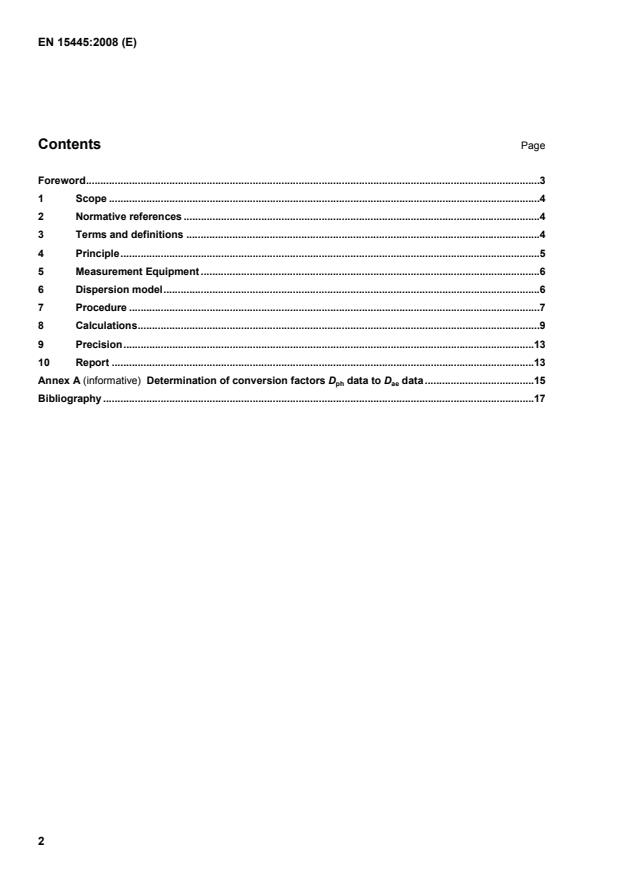
Determination of conversion factors Dph data to Dae data.15 Bibliography.17
1 Scope This standard specifies a Reverse Dispersion Modelling method to qualify the fugitive emission rates of diffuse fine and coarse dust sources of industrial plants or areas. The application needs calculations using a dispersion model, and the definition of a sampling experimental set-up taking into account field data such as number, height and width of diffuse dust sources, sampling distances, and meteorological information.
The RDM method does not allow quantification in absolute figures of the dust emission rates because of an undetermined accuracy depending on various site conditions, but it is a tool which enables each industrial plant to identify its dust sources that emit the most, and then to implement actions reducing their importance by self-control and related improvement process as part of environmental management. In this framework, the RDM method should not be used to control or verify any compliance with air quality threshold global values which might be contained in an operating permit, or to carry out comparison between different plants belonging to the same industrial sector.
2 Normative references The following referenced documents are indispensable for the application of this document. For dated references, only the edition cited applies. For undated references, the latest edition of the referenced document (including any amendments) applies. EN 12341, Air Quality – Determination of the PM10 fraction of suspended particulate matter – Reference method and field test procedure to demonstrate reference equivalence of measurement methods 3 Terms and definitions For the purposes of this document, the following terms and definitions apply. 3.1 fugitive dust emission uncontrolled dust emission to the atmosphere from diffuse emission. EXAMPLE Windblown dust from stock piles, diffuse dust from workshop buildings, dust from handling dry bulk goods, re-suspension by traffic etc. 3.2 suspended particulate matter SPM notion of all particles surrounded by air in a given, undisturbed volume of air 3.3 PM10 fraction of SPM corresponding to a sampling target specification as defined in EN 12341 3.4 aerodynamic diameter (Dae) to any particle, characterized by a physical diameter Dph and a density, corresponds a Dae: it is the diameter of a spherical particle of a specific mass of 1 g/cm3, which would have the same limit falling velocity in undisturbed air 3.5 fine dust fraction of SPM which particles display a physical diameter (Dph) lower than 10 µm
EXAMPLE When a dust sampler is located between two dust sources, for the one located upwind the dispersion factor value ≠is higher than zero (α>0)≠¢—≠ and for the other one downwind the dispersion factor value ≠is zero (α=0). When the wind is blowing from the opposite direction, it is the reverse for α.Then ≠their dispersion factors are not correlated. 3.10 correlation coefficient Rc between two sampling locations correlation coefficient obtained between measured dust concentrations in two sampling locations; the value of Rc indicates the relative contribution of the plant dust sources and background dust 3.11 coefficient R2d of multiple determination coefficient calculated from the multiple determination regression for a source. For each source taken into account, the value of R2d represents the fraction of the variations in measured dust concentrations (source contribution) explained by the dispersion model ()()idirdtiirdirdetctcαΣ=Σ= (2) 3.12 residue difference between a measured dust concentration at a sampling location, and the calculated dust concentration at the same location by using the mean emission rate of each investigated dust source 4 Principle Fugitive dust sources are not emitted at a fixed flow rate and the emitted matter is dispersed in air. In many cases, different dust sources contribute to the dust concentration in a sampling location. Reverse-Dispersion Modelling is a method to obtain the mean emission rate estimation of each source by statistic treatment of: measured dust concentrations in different sampling locations;
is source i emission rate of particles with the aerodynamic diameter d (equal Dae), that we try to find out. The dispersion of emitted matter is influenced by the location and geometry of the dust source, weather conditions, land roughness and the aerodynamic diameter d of particles. With an appropriate dispersion model and default emission rate e of 1 g/s, the dispersion factor . can be calculated in different locations around a dust source. Contributions of different sources can be distinguished by simultaneous sampling in several locations, and calculation of correlation coefficient R. between their sets of dispersion factors. The measurements of dust concentrations comprise a background dust contribution which the exact origin is mostly not well known. Nevertheless areas shall be defined as potential background sources to be taken into account for calculations. 5 Measurement Equipment 5.1 Fine dust sampler Devices used to measure the fine dust concentration at the sampling locations shall provide data with a sampling time resolution of 1 h, and shall collect the dust particles on a filter membrane (quartz fibre or PTFE) with a separation efficiency higher than 99,5 %. If the device is not sampling PM 10 according to EN 12341, but a sampler which determines the proportion of particles with Dph < 10 µm, a comparative measuring campaign with a PM 10 reference sampler shall determine a conversion factor to convert the Dph data to Dae data. (see A.1) 5.2 Coarse dust sampler Devices used to measure the coarse dust concentrations at the sampling locations shall provide data with a sampling time resolution of 1 h, and they shall present a particle size resolution capable of distinguishing between three size fractions, preferably the physical diameter (Dph) classes 10 µm to 30 µm, 30 µm to 70 µm and higher than 70 µm. To obtain the corresponding Dae size fractions data needed for the dispersion model calculations, a wind tunnel test shall be carried out for the dust under consideration, using an appropriate Tunnel Impactor, to determine a conversion factor allowing converting the Dph data to Dae data (see A.2). 6 Dispersion model Dispersion models used to calculate the dispersion factors . shall be valid for the topological environment of the industrial area to be investigated. The minimum requirements for the selection of the model are:
particle size data where a distinction between particle size is required;
locations and heights of the sampling locations; hourly data of wind speed, wind direction, stability of the atmosphere; hourly calculations of dispersion factor . 7 Procedure 7.1 Experimental set-up 7.1.1 Dust sources location The industrial dust sources to be investigated shall be defined (size, heights, nature, label …) and precisely located on a detailed map of the area. Additionally, background sources are defined, inside and surrounding the plant. 7.1.2 Sampling locations The number and the locations of dust sampling depend on the location and number of industrial dust sources to be investigated. A minimum of two sampling locations are required for the emission rate estimation of one dust source. The distance between the plant dust sources and dust samplers should be in the range 50 m to 300 m, depending on the density of the dust particles (chemical compound) of sources under consideration. To distinguish different dust sources, it is highly recommended to select the sampling locations in between the plant dust sources, preferably on the axis of the most frequent wind direction. The experimental set-up (locations of samplers) can be checked before beginning of dust sampling measurements by using the dispersion model and historical mean meteorological data for the measurement period (see 8.2.2 and 8.2.3)1) 7.1.3 Number of samplers and sampling campaigns The number of sampling campaigns depends on the number of plant dust sources to be investigated and number of dust samplers available as one set for simultaneous measurements at different sampling locations. A set of two
...