

SIST ISO 7935:2025
(Main)Stationary source emissions - Determination of the mass concentration of sulfur dioxide in flue gases - Performance characteristics of automated measuring systems
General Information
- Abstract
This document specifies a method for the determination of sulfur dioxide (SO2) in flue gases of stationary sources and describes the fundamental structure and the key performance characteristics of automated measuring systems.
The method allows continuous monitoring with permanently installed measuring systems of SO2 emissions.
This document describes extractive systems and in situ (non-extractive) systems in connection with a range of analysers that operate using, for example, the following principles:
— non-dispersive infrared absorption (NDIR);
— Fourier transform infrared (FTIR) spectroscopy;
— laser spectroscopic technique or tunable laser spectroscopy (TLS);
— non-dispersive ultraviolet absorption (NDUV);
— differential optical absorption spectroscopy (DOAS).
Other equivalent instrumental methods can be used provided they meet the minimum performance requirements specified in this document. The measuring system can be validated with reference materials, according to this document, or comparable methods.
Automated measuring system (AMS) based on the principles listed above has been used successfully in this application for the measuring ranges as shown in Annex E.
- Status
- Published
- Public Enquiry End Date
- 02-Feb-2025
- Publication Date
- 03-Mar-2025
- Technical Committee
- KAZ - Air quality
- Current Stage
- 6060 - National Implementation/Publication (Adopted Project)
- Start Date
- 10-Feb-2025
- Due Date
- 17-Apr-2025
- Completion Date
- 04-Mar-2025
Buy Documents





ISO 7935:2024 - Stationary source emissions — Determination of the mass concentration of sulfur dioxide in flue gases — Performance characteristics of automated measuring systems Released:15. 02. 2024
Overview
ISO 7935:2024 - "Stationary source emissions - Determination of the mass concentration of sulfur dioxide in flue gases - Performance characteristics of automated measuring systems" specifies requirements for continuous monitoring of sulfur dioxide (SO2) in flue gases from stationary sources. The standard defines the fundamental structure, performance characteristics and validation/quality requirements for Automated Measuring Systems (AMS), covering both extractive and in situ (non‑extractive) systems and a range of analyser technologies.
Key topics and technical requirements
- Measurand: Mass concentration of sulfur dioxide (SO2) in flue gas.
- Measuring systems covered: Extractive sampling systems and in situ systems attached to ducts or stacks.
- Analyser principles referenced:
- Non‑dispersive infrared absorption (NDIR)
- Fourier transform infrared spectroscopy (FTIR)
- Laser or tunable laser spectroscopy (TLS)
- Non‑dispersive ultraviolet absorption (NDUV)
- Differential optical absorption spectroscopy (DOAS)
- Other equivalent instrumental methods that meet the standard’s minimum performance requirements
- Performance characteristics: Definitions and criteria for accuracy, lack‑of‑fit, response time, transport time, period of unattended operation (maintenance interval), interferences and cross‑sensitivity.
- Validation and calibration: AMS can be validated using reference materials or comparable methods; procedures for performance testing and ongoing quality control are specified.
- Quality assurance / Quality control (QA/QC): Frequency of checks, calibration/validation, and guidance for calculating measurement uncertainty (see Annex F).
- Supporting material in annexes:
- Annex A/B: Examples and descriptions of extractive and in situ systems
- Annex C: Operational gases
- Annex D: Procedures for determining performance characteristics
- Annex E: Example measurement ranges and assessment results
- Annex F: Uncertainty calculation examples
Practical applications
- Continuous emissions monitoring (CEMS) of SO2 from:
- Power plants (fossil fuel combustion)
- Refineries and petrochemical plants
- Metallurgical and sulfur‑processing industries
- Waste‑to‑energy and incineration facilities
- Uses include regulatory compliance, emissions reporting, process control, and environmental impact assessment.
Who should use this standard
- Environmental and emissions engineers
- CEMS suppliers and instrument manufacturers
- Plant operators and maintenance teams
- Regulatory bodies and compliance auditors
- Testing laboratories and environmental consultants
Related standards
- ISO 9169 - Definition and determination of performance characteristics of an automatic measuring system
- ISO 14956 - Evaluation of suitability of a measurement procedure by comparison with required measurement uncertainty
- Other ISO standards on stack gas measurement are referenced for harmonization and methodology consistency.
Keywords: ISO 7935:2024, SO2 monitoring, sulfur dioxide emissions, flue gas, automated measuring systems, CEMS, extractive measurement, in situ measurement, NDIR, FTIR, TLS, NDUV, DOAS, measurement uncertainty.
Relations
- Effective Date
- 01-Apr-2025
Buy Documents
ISO 7935:2024 - Stationary source emissions — Determination of the mass concentration of sulfur dioxide in flue gases — Performance characteristics of automated measuring systems Released:15. 02. 2024
Get Certified
Connect with accredited certification bodies for this standard

CIS Institut d.o.o.
Personal Protective Equipment (PPE) certification body. Notified Body NB-2890 for EU Regulation 2016/425 PPE.

Kiwa BDA Testing
Building and construction product certification.
Kmetijski inštitut Slovenije
Agricultural Institute of Slovenia. Soil testing, plant health, agricultural product analysis.
Sponsored listings
Frequently Asked Questions
SIST ISO 7935:2025 is a standard published by the Slovenian Institute for Standardization (SIST). Its full title is "Stationary source emissions - Determination of the mass concentration of sulfur dioxide in flue gases - Performance characteristics of automated measuring systems". This standard covers: This document specifies a method for the determination of sulfur dioxide (SO2) in flue gases of stationary sources and describes the fundamental structure and the key performance characteristics of automated measuring systems. The method allows continuous monitoring with permanently installed measuring systems of SO2 emissions. This document describes extractive systems and in situ (non-extractive) systems in connection with a range of analysers that operate using, for example, the following principles: — non-dispersive infrared absorption (NDIR); — Fourier transform infrared (FTIR) spectroscopy; — laser spectroscopic technique or tunable laser spectroscopy (TLS); — non-dispersive ultraviolet absorption (NDUV); — differential optical absorption spectroscopy (DOAS). Other equivalent instrumental methods can be used provided they meet the minimum performance requirements specified in this document. The measuring system can be validated with reference materials, according to this document, or comparable methods. Automated measuring system (AMS) based on the principles listed above has been used successfully in this application for the measuring ranges as shown in Annex E.
This document specifies a method for the determination of sulfur dioxide (SO2) in flue gases of stationary sources and describes the fundamental structure and the key performance characteristics of automated measuring systems. The method allows continuous monitoring with permanently installed measuring systems of SO2 emissions. This document describes extractive systems and in situ (non-extractive) systems in connection with a range of analysers that operate using, for example, the following principles: — non-dispersive infrared absorption (NDIR); — Fourier transform infrared (FTIR) spectroscopy; — laser spectroscopic technique or tunable laser spectroscopy (TLS); — non-dispersive ultraviolet absorption (NDUV); — differential optical absorption spectroscopy (DOAS). Other equivalent instrumental methods can be used provided they meet the minimum performance requirements specified in this document. The measuring system can be validated with reference materials, according to this document, or comparable methods. Automated measuring system (AMS) based on the principles listed above has been used successfully in this application for the measuring ranges as shown in Annex E.
SIST ISO 7935:2025 is classified under the following ICS (International Classification for Standards) categories: 13.040.40 - Stationary source emissions. The ICS classification helps identify the subject area and facilitates finding related standards.
SIST ISO 7935:2025 has the following relationships with other standards: It is inter standard links to SIST ISO 7935:1996. Understanding these relationships helps ensure you are using the most current and applicable version of the standard.
SIST ISO 7935:2025 is available in PDF format for immediate download after purchase. The document can be added to your cart and obtained through the secure checkout process. Digital delivery ensures instant access to the complete standard document.
Standards Content (Sample)
SLOVENSKI STANDARD
01-april-2025
Nadomešča:
SIST ISO 7935:1996
Emisije nepremičnih virov - Določanje masne koncentracije žveplovega dioksida v
odpadnih plinih - Delovne karakteristike avtomatskih merilnih sistemov
Stationary source emissions - Determination of the mass concentration of sulfur dioxide
in flue gases - Performance characteristics of automated measuring systems
Émissions de sources fixes - Détermination de la concentration en masse de dioxyde de
soufre - Caractéristiques de performance des systèmes de mesurage automatiques
Ta slovenski standard je istoveten z: ISO 7935:2024
ICS:
13.040.40 Emisije nepremičnih virov Stationary source emissions
2003-01.Slovenski inštitut za standardizacijo. Razmnoževanje celote ali delov tega standarda ni dovoljeno.
International
Standard
ISO 7935
Second edition
Stationary source emissions —
2024-02
Determination of the mass
concentration of sulfur dioxide
in flue gases — Performance
characteristics of automated
measuring systems
Émissions de sources fixes — Détermination de la concentration
en masse de dioxyde de soufre — Caractéristiques de
performance des systèmes de mesurage automatiques
Reference number
© ISO 2024
All rights reserved. Unless otherwise specified, or required in the context of its implementation, no part of this publication may
be reproduced or utilized otherwise in any form or by any means, electronic or mechanical, including photocopying, or posting on
the internet or an intranet, without prior written permission. Permission can be requested from either ISO at the address below
or ISO’s member body in the country of the requester.
ISO copyright office
CP 401 • Ch. de Blandonnet 8
CH-1214 Vernier, Geneva
Phone: +41 22 749 01 11
Email: copyright@iso.org
Website: www.iso.org
Published in Switzerland
ii
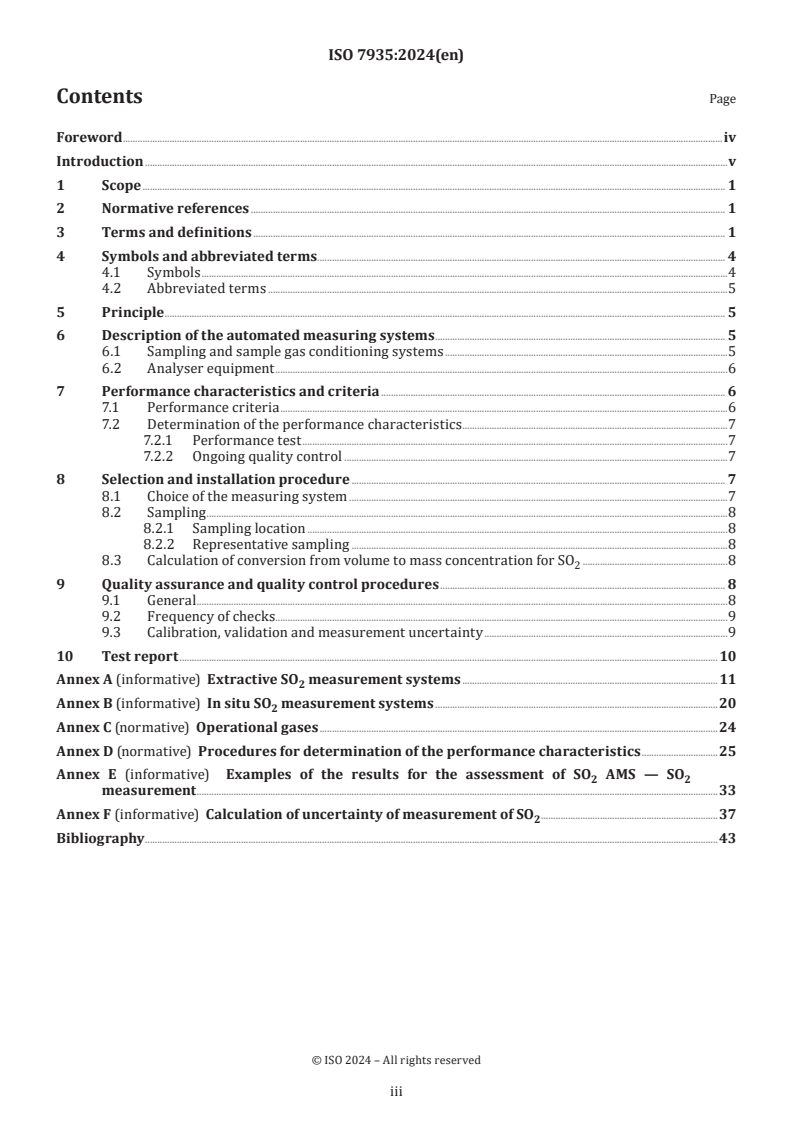
Contents Page
Foreword .iv
Introduction .v
1 Scope . 1
2 Normative references . 1
3 Terms and definitions . 1
4 Symbols and abbreviated terms. 4
4.1 Symbols .4
4.2 Abbreviated terms .5
5 Principle . 5
6 Description of the automated measuring systems . 5
6.1 Sampling and sample gas conditioning systems .5
6.2 Analyser equipment .6
7 Performance characteristics and criteria . 6
7.1 Performance criteria .6
7.2 Determination of the performance characteristics .7
7.2.1 Performance test .7
7.2.2 Ongoing quality control .7
8 Selection and installation procedure . 7
8.1 Choice of the measuring system .7
8.2 Sampling .8
8.2.1 Sampling location .8
8.2.2 Representative sampling .8
8.3 Calculation of conversion from volume to mass concentration for SO .8
9 Quality assurance and quality control procedures . 8
9.1 General .8
9.2 Frequency of checks.9
9.3 Calibration, validation and measurement uncertainty .9
10 Test report . 10
Annex A (informative) Extractive SO measurement systems .11
Annex B (informative) In situ SO measurement systems .20
Annex C (normative) Operational gases .24
Annex D (normative) Procedures for determination of the performance characteristics .25
Annex E (informative) Examples of the results for the assessment of SO AMS — SO
2 2
measurement .33
Annex F (informative) Calculation of uncertainty of measurement of SO .37
Bibliography .43
iii
Foreword
ISO (the International Organization for Standardization) is a worldwide federation of national standards
bodies (ISO member bodies). The work of preparing International Standards is normally carried out through
ISO technical committees. Each member body interested in a subject for which a technical committee
has been established has the right to be represented on that committee. International organizations,
governmental and non-governmental, in liaison with ISO, also take part in the work. ISO collaborates closely
with the International Electrotechnical Commission (IEC) on all matters of electrotechnical standardization.
The procedures used to develop this document and those intended for its further maintenance are described
in the ISO/IEC Directives, Part 1. In particular, the different approval criteria needed for the different types
of ISO document should be noted. This document was drafted in accordance with the editorial rules of the
ISO/IEC Directives, Part 2 (see www.iso.org/directives).
ISO draws attention to the possibility that the implementation of this document may involve the use of (a)
patent(s). ISO takes no position concerning the evidence, validity or applicability of any claimed patent
rights in respect thereof. As of the date of publication of this document, ISO had not received notice of (a)
patent(s) which may be required to implement this document. However, implementers are cautioned that
this may not represent the latest information, which may be obtained from the patent database available at
www.iso.org/patents. ISO shall not be held responsible for identifying any or all such patent rights.
Any trade name used in this document is information given for the convenience of users and does not
constitute an endorsement.
For an explanation of the voluntary nature of standards, the meaning of ISO specific terms and expressions
related to conformity assessment, as well as information about ISO's adherence to the World Trade
Organization (WTO) principles in the Technical Barriers to Trade (TBT), see www.iso.org/iso/foreword.html.
This document was prepared by Technical Committee ISO/TC 146, Air quality, Subcommittee SC 1, Stationary
source emissions.
This second edition cancels and replaces the first edition (ISO 7935:1992), which has been technically
revised.
The main changes are as follows:
— the structure and the components have been updated to be similar to the latest editions of e.g. ISO 10849
(measurement of nitrogen oxides), ISO 12039 (measurement of CO, CO and O ), ISO 17179 (measurement
2 2
of NH ), ISO 13199 (measurement of total VOC), ISO 25140 (measurement of CH ), ISO 21258 (measurement
3 4
of N O);
— Clause 3 has been revised with the addition or deletion and change in terms and definitions;
— a new analytical technique has been added (laser spectroscopic technique or tunable laser spectroscopy)
for measurement of SO ;
— the performance characteristics and criteria as well as QA/QC procedures have been changed to
harmonize with latest ISO standards;
— examples of performance test results and the results of uncertainty calculation have been added for SO
measurement.
Any feedback or questions on this document should be directed to the user’s national standards body. A
complete listing of these bodies can be found at www.iso.org/members.html.
iv
Introduction
Sulfur dioxide (SO ) can arise in considerable quantities from combustion of fossil fuels used for energy
generation, industrial activities processing sulfur or sulfur containing material, and from combustion of
sulfur containing waste. The waste gas from these processes, containing sulfur dioxide, is usually discharged
into the ambient atmosphere, via a duct or a chimney.
For evaluating the mass concentration of sulfur dioxide present in the waste gas of stationary source
emissions, a number of highly developed methods of integrated sampling and subsequent determination by
chemical analysis and automated measuring systems are available.
v
International Standard ISO 7935:2024(en)
Stationary source emissions — Determination of the mass
concentration of sulfur dioxide in flue gases — Performance
characteristics of automated measuring systems
1 Scope
This document specifies a method for the determination of sulfur dioxide (SO ) in flue gases of stationary
sources and describes the fundamental structure and the key performance characteristics of automated
measuring systems.
The method allows continuous monitoring with permanently installed measuring systems of SO emissions.
This document describes extractive systems and in situ (non-extractive) systems in connection with a range
of analysers that operate using, for example, the following principles:
— non-dispersive infrared absorption (NDIR);
— Fourier transform infrared (FTIR) spectroscopy;
— laser spectroscopic technique or tunable laser spectroscopy (TLS);
— non-dispersive ultraviolet absorption (NDUV);
— differential optical absorption spectroscopy (DOAS).
Other equivalent instrumental methods can be used provided they meet the minimum performance
requirements specified in this document. The measuring system can be validated with reference materials,
according to this document, or comparable methods.
Automated measuring system (AMS) based on the principles listed above has been used successfully in this
application for the measuring ranges as shown in Annex E.
2 Normative references
The following documents are referred to in the text in such a way that some or all of their content constitutes
requirements of this document. For dated references, only the edition cited applies. For undated references,
the latest edition of the referenced document (including any amendments) applies.
ISO 9169, Air quality — Definition and determination of performance characteristics of an automatic measuring
system
ISO 14956, Air quality — Evaluation of the suitability of a measurement procedure by comparison with a
required measurement uncertainty
3 Terms and definitions
For the purposes of this document, the following terms and definitions apply.
ISO and IEC maintain terminology databases for use in standardization at the following addresses:
— ISO Online browsing platform: available at https:// www .iso .org/ obp
— IEC Electropedia: available at https:// www .electropedia .org/
3.1
analyser
analytical part in an extractive or in situ automated measuring system (3.3)
[2]
[SOURCE: ISO 12039:2019, 3.1]
3.2
automated measuring system
AMS
measuring system interacting with the flue gas under investigation, returning an output signal proportional
to the physical unit of the measurand (3.9) in unattended operation
Note 1 to entry: For the purposes of this document, an AMS is a system that can be attached to a duct or stack to
continuously or intermittently measure the mass concentration of SO passing through the duct.
[SOURCE: ISO 9169:2006, 2.1.2, modified — Note 1 to entry has been replaced.]
3.3
in situ AMS
non-extractive system that measures the concentration directly in the duct or stack
Note 1 to entry: In situ systems measure either across the stack or duct or at a point within the duct or stack.
3.4
parallel measurements
measurements taken on the same duct in the same sampling plane for the same period of time with the
AMS under test and with the reference method at points a short distance from each other, providing pairs of
measured values
Note 1 to entry: See 3.20.
3.5
independent reading
reading that is not influenced by a previous individual reading by separating two individual readings by at
least four response times
3.6
interference
cross-sensitivity
negative or positive effect upon the response of the measuring system, due to a component of the sample
that is not the measurand
3.7
interferent
interfering substance
substance present in the air mass under investigation, other than the measurand (3.9), that affects the
response of AMS (3.2)
3.8
lack-of-fit
systematic deviation within the range of application, between the accepted value of a reference material
applied to the measuring system and the corresponding result of measurement produced by the measuring
system
Note 1 to entry: Lack-of-fit can be a function of the result of measurement.
Note 2 to entry: The expression “lack-of-fit” is often replaced in everyday language for linear relations by “linearity” or
“deviation from linearity”.
[SOURCE: ISO 9169:2006, 2.2.9, modified — Note 2 to entry has been removed.]
3.9
measurand
particular quantity subject to measurement
[6]
[SOURCE: ISO/IEC Guide 98-3:2008 , B.2.9, modified — Example and Note 1 to entry have been removed.]
3.10
performance characteristic
quantity assigned to equipment in order to define its performance
Note 1 to entry: Performance characteristics can be described by values, tolerances or ranges.
3.11
period of unattended operation
maximum interval of time for which the performance characteristics remain within a predefined range
without external servicing, e.g. refill, adjustment
[SOURCE: ISO 9169:2006, 2.2.11]
Note 1 to entry: The period of unattended operation is often called maintenance interval.
3.12
reference material
substance or mixture of substances with a known concentration within specified limits, or a device of
known characteristics
Note 1 to entry: Normally calibration gases, gas cells, gratings or filters are used.
[3]
[SOURCE: ISO 14385-1:2014, 3.20]
3.13
reference method
measurement method taken as a reference by convention, which gives the accepted reference value of the
measurand
Note 1 to entry: See 3.4.
3.14
transport time in the measuring line
time period for transportation of the sampled gas from the inlet of the probe to the inlet of the measurement
instrument
3.15
response time
time interval between the instant when a stimulus is subjected to bring about a specified abrupt change
and the instant when the response reaches and remains within specified limits around its final stable value,
determined as the sum of the lag time and the rise time in the rising mode, and the sum of the lag time and
the fall time in the falling mode
[SOURCE: ISO 9169:2006, 2.2.4]
Note 1 to entry: Lag time, rise time and fall time are defined in ISO 9169:2006.
3.16
span gas
gas or gas mixture used to adjust and check the span point on the response line of the measuring system
Note 1 to entry: The concentration is often chosen around 70 % to 90 % of full scale.
3.17
span point
value of the output quantity (measured signal) of the automated measuring system for the purpose of
calibration, adjustment, etc. that represents a correct measured value generated by reference gas
3.18
standard uncertainty
uncertainty of the result of a measurement expressed as a standard deviation
[6]
[SOURCE: ISO/IEC Guide 98-3:2008 , 2.3.1]
3.19
uncertainty
parameter associated with the result of a measurement, that characterizes the dispersion of the values that
can reasonably be attributed to the measurand
[6]
[SOURCE: ISO/IEC Guide 98-3:2008 , 2.2.3 modified — Notes 1, 2 and 3 to entry have been removed.]
3.20
validation of an automated measuring system
procedure to check the statistical relationship between values of the measurand indicated by the
automated measuring system and the corresponding values given by parallel measurements implemented
simultaneously at the same measuring point
3.21
zero gas
gas or gas mixture used to establish the zero point (3.22) on a calibration curve within a given concentration
range
[2]
[SOURCE: ISO 12039:2019, 3.20]
3.22
zero point
specified value of the output quantity (measured signal) of the AMS and which, in the absence of the
measured component, represents the zero crossing of the calibration line
4 Symbols and abbreviated terms
4.1 Symbols
e Residual (lack-of-fit) at level i
i
K Coverage factor
N Number of measurements
s Standard deviation of repeatability
r
u(γ ) Combined uncertainty of X (SO ) mass concentration
X 2
U(γ ) Expanded uncertainty of X (SO ) mass concentration
X 2
M Molar mass of X (SO , g/mol)
x 2
V Molar volume (22,4 l/mol at standard conditions, 273,15 K; 101,325 kPa)
M
φ Volume fraction of X (SO )
X 2
γ SO mass concentration at standard conditions in mg/m (273,15 K; 101,325 kPa)
X 2
γ
SO mass concentration at reference conditions in mg/m (273,15 K; 101,325 kPa; H O corrected)
R
2 2
x
Average of the measured values x
i
th
x i measured value
i
x
Average of the measured value at level i
i
x
Value estimated by the regression line at level i
i
4.2 Abbreviated terms
AMS Automated measuring system
FTIR Fourier transform infrared
TLS Tunable laser spectroscopy
NDIR Non-dispersive infrared
NDUV Non-dispersive ultraviolet
DOAS Differential optical absorption spectroscopy
UVF Ultraviolet fluorescence
QA Quality assurance
QC Quality control
5 Principle
This document describes automated measurement systems for sampling, sample conditioning and
determining SO content in flue gas using instrumental methods (analysers).
There are two types of automated measuring systems:
— extractive systems;
— in situ systems.
With extractive systems, a representative sample of gas is taken from the stack with a sampling probe and
conveyed to the analyser through the sample line and sample gas conditioning system.
In situ systems do not require any sampling transfers out of the stack. For the installation of these systems,
a representative place in the stack is to be chosen.
The systems described in this document measure SO concentrations using instrumental methods that shall
meet the minimum performance specifications given.
6 Description of the automated measuring systems
6.1 Sampling and sample gas conditioning systems
Sampling and sample gas conditioning systems for extractive and in situ methods shall conform to
[1]
ISO 10396 .
In extractive sampling, these gases are conditioned to remove aerosols, particulate matter and other
interfering substances before being conveyed to the instruments. Three kinds of extractive systems as well
[1]
as non-extractive systems are described in ISO 10396 :
a) cold-dry,
b) hot-wet, and
c) dilution.
In non-extractive sampling, the measurements are made in situ; therefore, no sample conditioning is
required.
The details of the extractive sampling and sample gas conditioning systems are described in Annex A and
two kinds of in situ system are illustrated in Annex B.
6.2 Analyser equipment
Examples of the typical analytical methods available are described in Annex A and Annex B.
AMS shall meet the performance characteristics as described in Clause 7.
7 Performance characteristics and criteria
7.1 Performance criteria
Table 1 gives the performance characteristics and performance criteria of the analyser and measurement
system to be evaluated during performance test, by means of ongoing QA/QC in the laboratory and during
field operation. Test procedures for the performance test are specified in Annex E.
Table 1 — Performance characteristics and criteria of AMS for measurement of SO
Performance characteristic Performance criterion Test procedure
Response time ≤200 s D.2
Standard deviation of repeatability in labo- ≤2,0 % of the upper limit of the lowest measuring
D.3.2
ratory at zero point range used
Standard deviation of repeatability in labo- ≤2,0 % of the upper limit of the lowest measuring
D.3.3
ratory at span point range used
≤2,0 % of the upper limit of the lowest measuring
Lack-of-fit D.4
range used
≤2,0 % of the upper limit of the lowest measuring
Zero drift within 24 h D.5
range used
≤2,0 % of the upper limit of the lowest measuring
Span drift within 24 h D.5
range used
Zero drift within the period of unattended ≤3,0 % of the upper limit of the lowest measuring
D.6
operation range used
Span drift within the period of unattended ≤3,0 % of the upper limit of the lowest measuring
D.6
operation range used
Sensitivity to ambient temperature, for a
≤5,0 % of the upper limit of the lowest measuring
change of 20 K in the temperature range D.7
range used
specified by the manufacturer
Sensitivity to sample gas pressure, for a ≤2,0 % of the upper limit of the lowest measuring
D.8
pressure change of 3 kPa range used
Sensitivity to sample gas flow for an ex- ≤2,0 % of the upper limit of the lowest measuring
D.9
tractive AMS range used
Sensitivity to electric voltage in the range
≤2,0 % of the upper limit of the lowest measuring
-15 % below or +10 % above from the nom- D.10
range used
inal voltage stated by the manufacturer
≤4,0 % of the upper limit of the lowest measuring
Cross-sensitivity D.11
range used
Losses and leakage in the sampling line
≤2,0 % of the measured value D.12 and D.13
and conditioning system
Excursion of the measurement beam of ≤2 % of the measured value of the lowest meas-
D.14
cross-stack in situ AMS uring range used
7.2 Determination of the performance characteristics
7.2.1 Performance test
The performance characteristics of the AMS shall be determined during the performance test. The values
of the performance characteristics determined shall meet the performance criteria specified in Table 1. The
procedures for the determination of these performance characteristics are specified in Annex D.
The ambient conditions applied during the general performance test shall be documented.
The measurement uncertainty of the AMS measured values shall be calculated in accordance with ISO 14956
on the basis of the performance characteristics determined during the performance test and shall meet the
level of uncertainty appropriate for the intended use. These characteristics may be determined either by the
manufacturer or by the user.
7.2.2 Ongoing quality control
The user shall check specific performance characteristics during ongoing operation of the measuring system
with a periodicity specified in Table 2.
The measurement uncertainty during field application shall be determined by the user of the measuring
system in accordance with applicable international or national standards. For process monitoring, the level
of uncertainty shall be appropriate for the intended use. It can be determined by a direct or an indirect
[5]
approach for uncertainty estimation as described in ISO 20988. The uncertainty of the measured values
under field operation is not only influenced by the performance characteristics of the analyser itself but also
by uncertainty contributions due to:
— the sampling line and conditioning system,
— the site specific conditions, and
— the reference materials used.
8 Selection and installation procedure
8.1 Choice of the measuring system
To choose an appropriate analyser, sampling line and conditioning unit, the following characteristics of flue
gases should be known before the field operation:
— ambient temperature range;
— temperature range of the flue gas;
— water vapour content of the flue gas;
— dust loading of the flue gas;
— expected concentration range of SO ;
— expected concentration of potentially interfering substances.
To avoid long response time and memory effects, the sampling line should be as short as possible. If
necessary, a bypass pump should be used. If there is a high dust loading in the sample gas, an appropriate
heated filter shall be used.
Before monitoring emissions, the user shall verify that the necessary QA/QC procedures have been
performed.
[3] [4]
NOTE Information on QA/QC procedures is provided in ISO 14385-1 and ISO 14385-2 .
8.2 Sampling
8.2.1 Sampling location
The sampling site shall be in an accessible location where a representative measurement can be made. In
addition, the sampling location shall be chosen with regard to the safety of the personnel involved.
8.2.2 Representative sampling
It is necessary to ensure that the gas concentrations measured are representative of the average conditions
inside the flue gas duct.
[1]
NOTE The selection of sampling points for representative sampling is described, for example, in ISO 10396,
where gas stratification, fluctuations in gas velocity, temperature and others are discussed.
8.3 Calculation of conversion from volume to mass concentration for SO
Results of the measurement for SO shall be expressed as mass concentrations at reference conditions.
If the SO concentration is provided as a volume fraction, Formula (1) shall be used to convert volume
−6
fraction of SO (10 ), ∅ , to SO mass concentrations, γ :
2 SO 2 SO
2 2
M
SO
γ =∅ ⋅ (1)
SO SO
V
M
where
γ
is the SO mass concentration in mg/m at standard conditions (273,15 K; 101,325 kPa);
SO
−6
∅
is the volume fraction of SO (by volume, 10 );
SO
2 2
M
is the molar mass of SO (= 64,06 g/mol);
SO
V
is the molar volume (= 22,4 l/mol at 273,15K and 101,325 kPa).
M
If necessary, the SO concentration measured in the wet gas should be corrected to the SO concentration at
2 2
standard conditions (dry gas), using Formula (2):
100 %
γγ =⋅ (2)
RSO
100 % − h
where
γ
is the SO mass concentration at standard conditions in mg/m (273,15 K; 101,325 kPa; H O
R
2 2
corrected);
h is the absolute water vapour content (by volume) (%).
9 Quality assurance and quality control procedures
9.1 General
Quality assurance and quality control (QA/QC) are important in order to ensure that the uncertainty of the
measured values for SO is kept within the limits specified for the measurement task. The results of the QA/
QC procedures shall be documented.
9.2 Frequency of checks
AMS shall be adjusted and checked after the installation and then during continuous operation. Table 2 shows
the minimum required test procedures and frequency of checks. The user shall implement the relevant
procedures for determination of performance characteristics or procedures described in this clause and
Annex D. The results of the QA/QC procedures shall be documented.
Table 2 — Minimum checks and minimum frequency of checks for QA/QC during the operation
Minimum frequency for permanent-
Check Test procedure
ly installed AMS
Response time Once a year D.2
Standard deviation of repeatability at zero point Once a year D.3.2
Standard deviation of repeatability at span point Once a year D.3.3
Once a year and after any major
changes or repair to the AMS, which
Lack-of-fit D.4
will influence the results obtained
significantly
Once a year of after any major changes
or repair to the system which can
Sampling system and leakage check D.12 and D.13
affect the integrity of the sampling
system
According to manufactur-
Beam alignment (in situ AMS only) Once a year
er’s manual
According to manufacturer’s require-
Light intensity attenuation through cleanliness According to manufactur-
ments or period specified by national
and dust load (in situ AMS only) er’s manual
standard
The particulate filters shall be changed
periodically depending on the dust
Cleaning or changing of particulate filters at the According to manufactur-
load at the sampling site. During this
sampling inlet and at the monitor inlet er’s manual
filter change the filter housing shall be
cleaned.
Once in the period of unattended op-
a
Zero drift eration or period specified by national D.6
standard
Once in the period of unattended op-
a
Span drift eration or period specified by national D.6
standard
According to manufacturer’s require- According to manufactur-
Regular maintenance of the analyser
ments er’s manual
a
NOTE Analysers can be checked with internal gas cells or optical filters for this determination.
The user shall implement a procedure to guarantee that the reference materials used meet the uncertainty
requirement specified in Annex C (e.g. by comparison with a reference gas of higher quality).
9.3 Calibration, validation and measurement uncertainty
The calibration and validation of the AMS shall be performed annually and after repair of the analyser in
accordance with applicable national or international standards.
Permanently installed AMS for continuous monitoring shall be calibrated by comparison with
a) an independent method of measurement or
b) a reference material.
In either case, the validation of an automated measuring system shall include the determination of uncertainty
of the measured value obtained by calibrating the AMS. Calculation of uncertainty of measurement of SO
is described in Annex F. The AMS shall be subject to adjustments and functional tests in according with 9.2
before each calibration. This ensures that the measurement uncertainty is representative of the application
at the specific plant.
The validation shall include the determination of the uncertainty of measured values obtained by comparison
between reference gas or reference material with the AMS.
NOTE The determination of the uncertainty of measured values obtained by permanently installed AMS for
continuous monitoring on the basis of a comparison with an independent method of measurement is described, for
[5]
example, in ISO 20988 .
The uncertainty of the measured values shall meet the uncertainty criterion specified for the measurement
objective.
10 Test report
If not specified otherwise, it shall include at least the following information:
a) a reference to this document (i.e. ISO 7935:2024);
b) description of the measurement objective;
c) principle of gas sampling;
d) information about the analyser and description of the sampling and conditioning line;
e) identification of the analyser used, and the performance characteristics of the analyser, listed in Table 1;
f) operating range;
g) sample gas temperature, sample gas pressure and optical path length through an optical cell (it is only
needed for in situ measurement);
h) details of the quality, purity and uncertainty in the concentration of the span gases used;
i) description of plant and process; concentration range of pollutants and potential interferences;
j) the identification and location of the sampling plane;
k) the actions taken to achieve representative samples;
l) a description of the location of the sampling point(s) in the sampling plane;
m) a description of the operating conditions of the plant process;
n) the changes in the plant operations during sampling;
o) the sampling date, time, and duration;
p) the time averaging on relevant periods;
q) the measured values;
r) the measurement uncertainty;
s) the results of any QA/QC checks conducted arising from Table 2;
t) any deviations from this document.
Annex A
(informative)
Extractive SO measurement systems
A.1 General
A.1.1 Cold-dry extractive system
Many variants of this exist and Figure A.1 is just an example of a typical arrangement of a complete measuring
system for SO . This system is suitable for use with most of the analysers that are described in 6.2.
The sampling of gas shall be representative, that is, the sampling location shall be typical of the entire duct
[1]
with the guidelines given in ISO 10396. The sampling points for the measurement require a check for
homogeneity. Prior to installation the uniformity of the gas stream should be checked.
Key
1 gas sampling probe 9 flow meter
2 primary filter 10 analyser
3 heating (for use as necessary) 11 outlet
4 sampling line (heated as necessary) 12 inlet for zero and span gas (preferably in front of the nozzle)
to check the complete system
5 sample cooler with condensate separator 13 inlet for zero and span gas to check the conditioning system and
the analyser
6 sampling pump 14 inlet for zero and span gas to check the analyser
7 secondary filter 15 valve
8 needle valve
Figure A.1 — Example of a cold-dry extractive system
The components described in A.1.2.1 to A.1.2.7 have, for example, proven to be successful for measurements
at gas-, oil- and coal-fired plants. Precautions need be observed because of the high corrosiveness of
condensable acid gases (e.g. HCl, SO or NO ).
3 2
A.1.2 Components for cold-dry extractive system
A.1.2.1 Sampling probe
The sampling probe shall be made of suitable, corrosion-resistant material. For gas temperatures up to 190 °C
polytetrafluoroethylene (PTFE) is an acceptable material. Cooling may need to be considered necessary to
prevent damage to the probe/sample system, but the temperature shall be maintained 10 K to 20 K higher
than the water or acid dew-point of the gases.
A.1.2.2 Filter
The filter is needed to remove the particulate matter, in order to protect the sampling system and the
analyser. The filter shall be made of ceramic, borosilicate glass or sintered metal. The filter shall be heated
above the water or acid dew-point whichever is the higher. A filter that retains particles greater than
2 μm is recommended. The size of the filter shall be determined from the sample flow required and the
manufacturer's data on the flow rate per unit area.
The temperature of the sampling probe and the filter needs to be 10 K to 20 K higher than the water or acid
dew-point whichever is higher.
A.1.2.3 Sampling line
The sampling line shall be made of PTFE, PFA or stainless steel. The lines shall be operated at 10 K to 20 K
above the dew-point of condensable substances (generally the water or acid dew-point). The tube diameter
should be appropriately sized to provide a flow rate that meets the requirements of the analysers, under
selected line length and the degree of pressure drop in the line as well as the performance of the sampling
pump used.
A.1.2.4 Moisture removal system (Sample cooler or permeation dryer)
The moisture removal system shall be used to separate water vapour from the flue gas. The dew point shall
be sufficiently below the ambient temperature to ensure that ambient air temperatures do not affect the
separation of water from the gases. A cooling temperature of 2 °C to 5 °C is suggested. Sufficient cooling is
required for the volume of gas being sampled and the amount of water vapour that it contains.
A.1.2.5 Sampling pump (corrosion-resistant)
A sampling pump is used to withdraw a continuous sample from the duct through the sampling system. This
may be a diaphragm pump, a metal bellows pump, an ejector pump, or other pump types. The pump shall be
constructed of corrosion-resistant material. The performance of the pump shall be such that it can supply
the analyser with the gas flow required. In order to reduce the transport time in the measuring line and the
risk of physicochemical transformation of the sample, the gas flow can be greater than that required for the
analytical units and should be pulseless to ensure constant and even flow.
For the hot-wet extractive system (A.1.3), the pump shall be operated at a minimum of 180 °C, or 10 K to
20 K above the water or acid dew-point of the gases.
A.1.2.6 Secondary filter
The secondary filter is needed to remove the remaining particulate material, in order to protect the pump
and the analyser. A filter that retains particles greater than 1 μm is recommended. Acceptable materials are
PTFE, borosilicate glass or sintered metals. The size of the filter shall be determined from the sample flow
required and the manufacturer's data on the flow rate per unit area.
A.1.2.7 Flow controller and flow meter
The flow controller and flow meter are used to set the required flow rate. They shall be constructed of
corrosion resistant material.
A.1.3 Hot-wet extractive system
When analysers with a hot sample cell are used, the automated measuring system as shown in Figure A.2 is
often applied.
In addition to the cold-dry extractive system, there are automated measuring systems for SO measurement
that ensure the sample gas remains above the water and acid dew-points (or dew-point of other condensable
substances) to avoid losses of SO . In this case, the system can be simplified. It is important that all the
components carrying the sample gas to the analyser are also heated above water and acid dew-points.
Key
1 sampling probe, heated (if necessary)
2 particle filter (in-stack or out-stack)
3 zero and span gas inlet
4 heated sampling line
5 sampling pump, heated
6 analyser with heated sample cell
Figure A.2 — Example of a diagram of hot-wet type of optical measuring system
A.1.4 Dilution extractive system
The dilution technique is an alternative to hot gas monitoring or sample gas drying. The flue gas is diluted
[1]
with a dilution gas which shall be free from the species being measured .
The dilution ratio shall be chosen according to the objectives of the measurement and shall be compatible
with the range of the analytical unit. It shall remain constant throughout the period of the test, because the
calibration frequency of the measurement unit depends, among other things, on the stability of the dilution
ratio. The water dew-point shall be reduced so as to reduce the risks of condensation in the gas monitoring
system. The measured values always refer to the wet gas.
Many types of devices are suitable for use in dilution systems, such as:
— calibrated apertures (capillaries, sonic nozzles, needle valves, etc.);
— flow meters by volume or mass;
— pressure and/or flow regulators;
An example of diagram of the dilution probe is shown in Figure A.3.
Dilution ratios are dependent upon changes in the flue gas density. Changes in the flue gas temperature,
molecular weight and total stack pressure can affect the ratio and resultant concentration measurements
and should be recorded.
Key
1 flue gas
2 dilution probe
3 sample gas (Q : flow rate)
4 particle filter
5 critical orifice
...
International
Standard
ISO 7935
Second edition
Stationary source emissions —
2024-02
Determination of the mass
concentration of sulfur dioxide
in flue gases — Performance
characteristics of automated
measuring systems
Émissions de sources fixes — Détermination de la concentration
en masse de dioxyde de soufre — Caractéristiques de
performance des systèmes de mesurage automatiques
Reference number
© ISO 2024
All rights reserved. Unless otherwise specified, or required in the context of its implementation, no part of this publication may
be reproduced or utilized otherwise in any form or by any means, electronic or mechanical, including photocopying, or posting on
the internet or an intranet, without prior written permission. Permission can be requested from either ISO at the address below
or ISO’s member body in the country of the requester.
ISO copyright office
CP 401 • Ch. de Blandonnet 8
CH-1214 Vernier, Geneva
Phone: +41 22 749 01 11
Email: copyright@iso.org
Website: www.iso.org
Published in Switzerland
ii
Contents Page
Foreword .iv
Introduction .v
1 Scope . 1
2 Normative references . 1
3 Terms and definitions . 1
4 Symbols and abbreviated terms. 4
4.1 Symbols .4
4.2 Abbreviated terms .5
5 Principle . 5
6 Description of the automated measuring systems . 5
6.1 Sampling and sample gas conditioning systems .5
6.2 Analyser equipment .6
7 Performance characteristics and criteria . 6
7.1 Performance criteria .6
7.2 Determination of the performance characteristics .7
7.2.1 Performance test .7
7.2.2 Ongoing quality control .7
8 Selection and installation procedure . 7
8.1 Choice of the measuring system .7
8.2 Sampling .8
8.2.1 Sampling location .8
8.2.2 Representative sampling .8
8.3 Calculation of conversion from volume to mass concentration for SO .8
9 Quality assurance and quality control procedures . 8
9.1 General .8
9.2 Frequency of checks.9
9.3 Calibration, validation and measurement uncertainty .9
10 Test report . 10
Annex A (informative) Extractive SO measurement systems .11
Annex B (informative) In situ SO measurement systems .20
Annex C (normative) Operational gases .24
Annex D (normative) Procedures for determination of the performance characteristics .25
Annex E (informative) Examples of the results for the assessment of SO AMS — SO
2 2
measurement .33
Annex F (informative) Calculation of uncertainty of measurement of SO .37
Bibliography .43
iii
Foreword
ISO (the International Organization for Standardization) is a worldwide federation of national standards
bodies (ISO member bodies). The work of preparing International Standards is normally carried out through
ISO technical committees. Each member body interested in a subject for which a technical committee
has been established has the right to be represented on that committee. International organizations,
governmental and non-governmental, in liaison with ISO, also take part in the work. ISO collaborates closely
with the International Electrotechnical Commission (IEC) on all matters of electrotechnical standardization.
The procedures used to develop this document and those intended for its further maintenance are described
in the ISO/IEC Directives, Part 1. In particular, the different approval criteria needed for the different types
of ISO document should be noted. This document was drafted in accordance with the editorial rules of the
ISO/IEC Directives, Part 2 (see www.iso.org/directives).
ISO draws attention to the possibility that the implementation of this document may involve the use of (a)
patent(s). ISO takes no position concerning the evidence, validity or applicability of any claimed patent
rights in respect thereof. As of the date of publication of this document, ISO had not received notice of (a)
patent(s) which may be required to implement this document. However, implementers are cautioned that
this may not represent the latest information, which may be obtained from the patent database available at
www.iso.org/patents. ISO shall not be held responsible for identifying any or all such patent rights.
Any trade name used in this document is information given for the convenience of users and does not
constitute an endorsement.
For an explanation of the voluntary nature of standards, the meaning of ISO specific terms and expressions
related to conformity assessment, as well as information about ISO's adherence to the World Trade
Organization (WTO) principles in the Technical Barriers to Trade (TBT), see www.iso.org/iso/foreword.html.
This document was prepared by Technical Committee ISO/TC 146, Air quality, Subcommittee SC 1, Stationary
source emissions.
This second edition cancels and replaces the first edition (ISO 7935:1992), which has been technically
revised.
The main changes are as follows:
— the structure and the components have been updated to be similar to the latest editions of e.g. ISO 10849
(measurement of nitrogen oxides), ISO 12039 (measurement of CO, CO and O ), ISO 17179 (measurement
2 2
of NH ), ISO 13199 (measurement of total VOC), ISO 25140 (measurement of CH ), ISO 21258 (measurement
3 4
of N O);
— Clause 3 has been revised with the addition or deletion and change in terms and definitions;
— a new analytical technique has been added (laser spectroscopic technique or tunable laser spectroscopy)
for measurement of SO ;
— the performance characteristics and criteria as well as QA/QC procedures have been changed to
harmonize with latest ISO standards;
— examples of performance test results and the results of uncertainty calculation have been added for SO
measurement.
Any feedback or questions on this document should be directed to the user’s national standards body. A
complete listing of these bodies can be found at www.iso.org/members.html.
iv
Introduction
Sulfur dioxide (SO ) can arise in considerable quantities from combustion of fossil fuels used for energy
generation, industrial activities processing sulfur or sulfur containing material, and from combustion of
sulfur containing waste. The waste gas from these processes, containing sulfur dioxide, is usually discharged
into the ambient atmosphere, via a duct or a chimney.
For evaluating the mass concentration of sulfur dioxide present in the waste gas of stationary source
emissions, a number of highly developed methods of integrated sampling and subsequent determination by
chemical analysis and automated measuring systems are available.
v
International Standard ISO 7935:2024(en)
Stationary source emissions — Determination of the mass
concentration of sulfur dioxide in flue gases — Performance
characteristics of automated measuring systems
1 Scope
This document specifies a method for the determination of sulfur dioxide (SO ) in flue gases of stationary
sources and describes the fundamental structure and the key performance characteristics of automated
measuring systems.
The method allows continuous monitoring with permanently installed measuring systems of SO emissions.
This document describes extractive systems and in situ (non-extractive) systems in connection with a range
of analysers that operate using, for example, the following principles:
— non-dispersive infrared absorption (NDIR);
— Fourier transform infrared (FTIR) spectroscopy;
— laser spectroscopic technique or tunable laser spectroscopy (TLS);
— non-dispersive ultraviolet absorption (NDUV);
— differential optical absorption spectroscopy (DOAS).
Other equivalent instrumental methods can be used provided they meet the minimum performance
requirements specified in this document. The measuring system can be validated with reference materials,
according to this document, or comparable methods.
Automated measuring system (AMS) based on the principles listed above has been used successfully in this
application for the measuring ranges as shown in Annex E.
2 Normative references
The following documents are referred to in the text in such a way that some or all of their content constitutes
requirements of this document. For dated references, only the edition cited applies. For undated references,
the latest edition of the referenced document (including any amendments) applies.
ISO 9169, Air quality — Definition and determination of performance characteristics of an automatic measuring
system
ISO 14956, Air quality — Evaluation of the suitability of a measurement procedure by comparison with a
required measurement uncertainty
3 Terms and definitions
For the purposes of this document, the following terms and definitions apply.
ISO and IEC maintain terminology databases for use in standardization at the following addresses:
— ISO Online browsing platform: available at https:// www .iso .org/ obp
— IEC Electropedia: available at https:// www .electropedia .org/
3.1
analyser
analytical part in an extractive or in situ automated measuring system (3.3)
[2]
[SOURCE: ISO 12039:2019, 3.1]
3.2
automated measuring system
AMS
measuring system interacting with the flue gas under investigation, returning an output signal proportional
to the physical unit of the measurand (3.9) in unattended operation
Note 1 to entry: For the purposes of this document, an AMS is a system that can be attached to a duct or stack to
continuously or intermittently measure the mass concentration of SO passing through the duct.
[SOURCE: ISO 9169:2006, 2.1.2, modified — Note 1 to entry has been replaced.]
3.3
in situ AMS
non-extractive system that measures the concentration directly in the duct or stack
Note 1 to entry: In situ systems measure either across the stack or duct or at a point within the duct or stack.
3.4
parallel measurements
measurements taken on the same duct in the same sampling plane for the same period of time with the
AMS under test and with the reference method at points a short distance from each other, providing pairs of
measured values
Note 1 to entry: See 3.20.
3.5
independent reading
reading that is not influenced by a previous individual reading by separating two individual readings by at
least four response times
3.6
interference
cross-sensitivity
negative or positive effect upon the response of the measuring system, due to a component of the sample
that is not the measurand
3.7
interferent
interfering substance
substance present in the air mass under investigation, other than the measurand (3.9), that affects the
response of AMS (3.2)
3.8
lack-of-fit
systematic deviation within the range of application, between the accepted value of a reference material
applied to the measuring system and the corresponding result of measurement produced by the measuring
system
Note 1 to entry: Lack-of-fit can be a function of the result of measurement.
Note 2 to entry: The expression “lack-of-fit” is often replaced in everyday language for linear relations by “linearity” or
“deviation from linearity”.
[SOURCE: ISO 9169:2006, 2.2.9, modified — Note 2 to entry has been removed.]
3.9
measurand
particular quantity subject to measurement
[6]
[SOURCE: ISO/IEC Guide 98-3:2008 , B.2.9, modified — Example and Note 1 to entry have been removed.]
3.10
performance characteristic
quantity assigned to equipment in order to define its performance
Note 1 to entry: Performance characteristics can be described by values, tolerances or ranges.
3.11
period of unattended operation
maximum interval of time for which the performance characteristics remain within a predefined range
without external servicing, e.g. refill, adjustment
[SOURCE: ISO 9169:2006, 2.2.11]
Note 1 to entry: The period of unattended operation is often called maintenance interval.
3.12
reference material
substance or mixture of substances with a known concentration within specified limits, or a device of
known characteristics
Note 1 to entry: Normally calibration gases, gas cells, gratings or filters are used.
[3]
[SOURCE: ISO 14385-1:2014, 3.20]
3.13
reference method
measurement method taken as a reference by convention, which gives the accepted reference value of the
measurand
Note 1 to entry: See 3.4.
3.14
transport time in the measuring line
time period for transportation of the sampled gas from the inlet of the probe to the inlet of the measurement
instrument
3.15
response time
time interval between the instant when a stimulus is subjected to bring about a specified abrupt change
and the instant when the response reaches and remains within specified limits around its final stable value,
determined as the sum of the lag time and the rise time in the rising mode, and the sum of the lag time and
the fall time in the falling mode
[SOURCE: ISO 9169:2006, 2.2.4]
Note 1 to entry: Lag time, rise time and fall time are defined in ISO 9169:2006.
3.16
span gas
gas or gas mixture used to adjust and check the span point on the response line of the measuring system
Note 1 to entry: The concentration is often chosen around 70 % to 90 % of full scale.
3.17
span point
value of the output quantity (measured signal) of the automated measuring system for the purpose of
calibration, adjustment, etc. that represents a correct measured value generated by reference gas
3.18
standard uncertainty
uncertainty of the result of a measurement expressed as a standard deviation
[6]
[SOURCE: ISO/IEC Guide 98-3:2008 , 2.3.1]
3.19
uncertainty
parameter associated with the result of a measurement, that characterizes the dispersion of the values that
can reasonably be attributed to the measurand
[6]
[SOURCE: ISO/IEC Guide 98-3:2008 , 2.2.3 modified — Notes 1, 2 and 3 to entry have been removed.]
3.20
validation of an automated measuring system
procedure to check the statistical relationship between values of the measurand indicated by the
automated measuring system and the corresponding values given by parallel measurements implemented
simultaneously at the same measuring point
3.21
zero gas
gas or gas mixture used to establish the zero point (3.22) on a calibration curve within a given concentration
range
[2]
[SOURCE: ISO 12039:2019, 3.20]
3.22
zero point
specified value of the output quantity (measured signal) of the AMS and which, in the absence of the
measured component, represents the zero crossing of the calibration line
4 Symbols and abbreviated terms
4.1 Symbols
e Residual (lack-of-fit) at level i
i
K Coverage factor
N Number of measurements
s Standard deviation of repeatability
r
u(γ ) Combined uncertainty of X (SO ) mass concentration
X 2
U(γ ) Expanded uncertainty of X (SO ) mass concentration
X 2
M Molar mass of X (SO , g/mol)
x 2
V Molar volume (22,4 l/mol at standard conditions, 273,15 K; 101,325 kPa)
M
φ Volume fraction of X (SO )
X 2
γ SO mass concentration at standard conditions in mg/m (273,15 K; 101,325 kPa)
X 2
γ
SO mass concentration at reference conditions in mg/m (273,15 K; 101,325 kPa; H O corrected)
R
2 2
x
Average of the measured values x
i
th
x i measured value
i
x
Average of the measured value at level i
i
x
Value estimated by the regression line at level i
i
4.2 Abbreviated terms
AMS Automated measuring system
FTIR Fourier transform infrared
TLS Tunable laser spectroscopy
NDIR Non-dispersive infrared
NDUV Non-dispersive ultraviolet
DOAS Differential optical absorption spectroscopy
UVF Ultraviolet fluorescence
QA Quality assurance
QC Quality control
5 Principle
This document describes automated measurement systems for sampling, sample conditioning and
determining SO content in flue gas using instrumental methods (analysers).
There are two types of automated measuring systems:
— extractive systems;
— in situ systems.
With extractive systems, a representative sample of gas is taken from the stack with a sampling probe and
conveyed to the analyser through the sample line and sample gas conditioning system.
In situ systems do not require any sampling transfers out of the stack. For the installation of these systems,
a representative place in the stack is to be chosen.
The systems described in this document measure SO concentrations using instrumental methods that shall
meet the minimum performance specifications given.
6 Description of the automated measuring systems
6.1 Sampling and sample gas conditioning systems
Sampling and sample gas conditioning systems for extractive and in situ methods shall conform to
[1]
ISO 10396 .
In extractive sampling, these gases are conditioned to remove aerosols, particulate matter and other
interfering substances before being conveyed to the instruments. Three kinds of extractive systems as well
[1]
as non-extractive systems are described in ISO 10396 :
a) cold-dry,
b) hot-wet, and
c) dilution.
In non-extractive sampling, the measurements are made in situ; therefore, no sample conditioning is
required.
The details of the extractive sampling and sample gas conditioning systems are described in Annex A and
two kinds of in situ system are illustrated in Annex B.
6.2 Analyser equipment
Examples of the typical analytical methods available are described in Annex A and Annex B.
AMS shall meet the performance characteristics as described in Clause 7.
7 Performance characteristics and criteria
7.1 Performance criteria
Table 1 gives the performance characteristics and performance criteria of the analyser and measurement
system to be evaluated during performance test, by means of ongoing QA/QC in the laboratory and during
field operation. Test procedures for the performance test are specified in Annex E.
Table 1 — Performance characteristics and criteria of AMS for measurement of SO
Performance characteristic Performance criterion Test procedure
Response time ≤200 s D.2
Standard deviation of repeatability in labo- ≤2,0 % of the upper limit of the lowest measuring
D.3.2
ratory at zero point range used
Standard deviation of repeatability in labo- ≤2,0 % of the upper limit of the lowest measuring
D.3.3
ratory at span point range used
≤2,0 % of the upper limit of the lowest measuring
Lack-of-fit D.4
range used
≤2,0 % of the upper limit of the lowest measuring
Zero drift within 24 h D.5
range used
≤2,0 % of the upper limit of the lowest measuring
Span drift within 24 h D.5
range used
Zero drift within the period of unattended ≤3,0 % of the upper limit of the lowest measuring
D.6
operation range used
Span drift within the period of unattended ≤3,0 % of the upper limit of the lowest measuring
D.6
operation range used
Sensitivity to ambient temperature, for a
≤5,0 % of the upper limit of the lowest measuring
change of 20 K in the temperature range D.7
range used
specified by the manufacturer
Sensitivity to sample gas pressure, for a ≤2,0 % of the upper limit of the lowest measuring
D.8
pressure change of 3 kPa range used
Sensitivity to sample gas flow for an ex- ≤2,0 % of the upper limit of the lowest measuring
D.9
tractive AMS range used
Sensitivity to electric voltage in the range
≤2,0 % of the upper limit of the lowest measuring
-15 % below or +10 % above from the nom- D.10
range used
inal voltage stated by the manufacturer
≤4,0 % of the upper limit of the lowest measuring
Cross-sensitivity D.11
range used
Losses and leakage in the sampling line
≤2,0 % of the measured value D.12 and D.13
and conditioning system
Excursion of the measurement beam of ≤2 % of the measured value of the lowest meas-
D.14
cross-stack in situ AMS uring range used
7.2 Determination of the performance characteristics
7.2.1 Performance test
The performance characteristics of the AMS shall be determined during the performance test. The values
of the performance characteristics determined shall meet the performance criteria specified in Table 1. The
procedures for the determination of these performance characteristics are specified in Annex D.
The ambient conditions applied during the general performance test shall be documented.
The measurement uncertainty of the AMS measured values shall be calculated in accordance with ISO 14956
on the basis of the performance characteristics determined during the performance test and shall meet the
level of uncertainty appropriate for the intended use. These characteristics may be determined either by the
manufacturer or by the user.
7.2.2 Ongoing quality control
The user shall check specific performance characteristics during ongoing operation of the measuring system
with a periodicity specified in Table 2.
The measurement uncertainty during field application shall be determined by the user of the measuring
system in accordance with applicable international or national standards. For process monitoring, the level
of uncertainty shall be appropriate for the intended use. It can be determined by a direct or an indirect
[5]
approach for uncertainty estimation as described in ISO 20988. The uncertainty of the measured values
under field operation is not only influenced by the performance characteristics of the analyser itself but also
by uncertainty contributions due to:
— the sampling line and conditioning system,
— the site specific conditions, and
— the reference materials used.
8 Selection and installation procedure
8.1 Choice of the measuring system
To choose an appropriate analyser, sampling line and conditioning unit, the following characteristics of flue
gases should be known before the field operation:
— ambient temperature range;
— temperature range of the flue gas;
— water vapour content of the flue gas;
— dust loading of the flue gas;
— expected concentration range of SO ;
— expected concentration of potentially interfering substances.
To avoid long response time and memory effects, the sampling line should be as short as possible. If
necessary, a bypass pump should be used. If there is a high dust loading in the sample gas, an appropriate
heated filter shall be used.
Before monitoring emissions, the user shall verify that the necessary QA/QC procedures have been
performed.
[3] [4]
NOTE Information on QA/QC procedures is provided in ISO 14385-1 and ISO 14385-2 .
8.2 Sampling
8.2.1 Sampling location
The sampling site shall be in an accessible location where a representative measurement can be made. In
addition, the sampling location shall be chosen with regard to the safety of the personnel involved.
8.2.2 Representative sampling
It is necessary to ensure that the gas concentrations measured are representative of the average conditions
inside the flue gas duct.
[1]
NOTE The selection of sampling points for representative sampling is described, for example, in ISO 10396,
where gas stratification, fluctuations in gas velocity, temperature and others are discussed.
8.3 Calculation of conversion from volume to mass concentration for SO
Results of the measurement for SO shall be expressed as mass concentrations at reference conditions.
If the SO concentration is provided as a volume fraction, Formula (1) shall be used to convert volume
−6
fraction of SO (10 ), ∅ , to SO mass concentrations, γ :
2 SO 2 SO
2 2
M
SO
γ =∅ ⋅ (1)
SO SO
V
M
where
γ
is the SO mass concentration in mg/m at standard conditions (273,15 K; 101,325 kPa);
SO
−6
∅
is the volume fraction of SO (by volume, 10 );
SO
2 2
M
is the molar mass of SO (= 64,06 g/mol);
SO
V
is the molar volume (= 22,4 l/mol at 273,15K and 101,325 kPa).
M
If necessary, the SO concentration measured in the wet gas should be corrected to the SO concentration at
2 2
standard conditions (dry gas), using Formula (2):
100 %
γγ =⋅ (2)
RSO
100 % − h
where
γ
is the SO mass concentration at standard conditions in mg/m (273,15 K; 101,325 kPa; H O
R
2 2
corrected);
h is the absolute water vapour content (by volume) (%).
9 Quality assurance and quality control procedures
9.1 General
Quality assurance and quality control (QA/QC) are important in order to ensure that the uncertainty of the
measured values for SO is kept within the limits specified for the measurement task. The results of the QA/
QC procedures shall be documented.
9.2 Frequency of checks
AMS shall be adjusted and checked after the installation and then during continuous operation. Table 2 shows
the minimum required test procedures and frequency of checks. The user shall implement the relevant
procedures for determination of performance characteristics or procedures described in this clause and
Annex D. The results of the QA/QC procedures shall be documented.
Table 2 — Minimum checks and minimum frequency of checks for QA/QC during the operation
Minimum frequency for permanent-
Check Test procedure
ly installed AMS
Response time Once a year D.2
Standard deviation of repeatability at zero point Once a year D.3.2
Standard deviation of repeatability at span point Once a year D.3.3
Once a year and after any major
changes or repair to the AMS, which
Lack-of-fit D.4
will influence the results obtained
significantly
Once a year of after any major changes
or repair to the system which can
Sampling system and leakage check D.12 and D.13
affect the integrity of the sampling
system
According to manufactur-
Beam alignment (in situ AMS only) Once a year
er’s manual
According to manufacturer’s require-
Light intensity attenuation through cleanliness According to manufactur-
ments or period specified by national
and dust load (in situ AMS only) er’s manual
standard
The particulate filters shall be changed
periodically depending on the dust
Cleaning or changing of particulate filters at the According to manufactur-
load at the sampling site. During this
sampling inlet and at the monitor inlet er’s manual
filter change the filter housing shall be
cleaned.
Once in the period of unattended op-
a
Zero drift eration or period specified by national D.6
standard
Once in the period of unattended op-
a
Span drift eration or period specified by national D.6
standard
According to manufacturer’s require- According to manufactur-
Regular maintenance of the analyser
ments er’s manual
a
NOTE Analysers can be checked with internal gas cells or optical filters for this determination.
The user shall implement a procedure to guarantee that the reference materials used meet the uncertainty
requirement specified in Annex C (e.g. by comparison with a reference gas of higher quality).
9.3 Calibration, validation and measurement uncertainty
The calibration and validation of the AMS shall be performed annually and after repair of the analyser in
accordance with applicable national or international standards.
Permanently installed AMS for continuous monitoring shall be calibrated by comparison with
a) an independent method of measurement or
b) a reference material.
In either case, the validation of an automated measuring system shall include the determination of uncertainty
of the measured value obtained by calibrating the AMS. Calculation of uncertainty of measurement of SO
is described in Annex F. The AMS shall be subject to adjustments and functional tests in according with 9.2
before each calibration. This ensures that the measurement uncertainty is representative of the application
at the specific plant.
The validation shall include the determination of the uncertainty of measured values obtained by comparison
between reference gas or reference material with the AMS.
NOTE The determination of the uncertainty of measured values obtained by permanently installed AMS for
continuous monitoring on the basis of a comparison with an independent method of measurement is described, for
[5]
example, in ISO 20988 .
The uncertainty of the measured values shall meet the uncertainty criterion specified for the measurement
objective.
10 Test report
If not specified otherwise, it shall include at least the following information:
a) a reference to this document (i.e. ISO 7935:2024);
b) description of the measurement objective;
c) principle of gas sampling;
d) information about the analyser and description of the sampling and conditioning line;
e) identification of the analyser used, and the performance characteristics of the analyser, listed in Table 1;
f) operating range;
g) sample gas temperature, sample gas pressure and optical path length through an optical cell (it is only
needed for in situ measurement);
h) details of the quality, purity and uncertainty in the concentration of the span gases used;
i) description of plant and process; concentration range of pollutants and potential interferences;
j) the identification and location of the sampling plane;
k) the actions taken to achieve representative samples;
l) a description of the location of the sampling point(s) in the sampling plane;
m) a description of the operating conditions of the plant process;
n) the changes in the plant operations during sampling;
o) the sampling date, time, and duration;
p) the time averaging on relevant periods;
q) the measured values;
r) the measurement uncertainty;
s) the results of any QA/QC checks conducted arising from Table 2;
t) any deviations from this document.
Annex A
(informative)
Extractive SO measurement systems
A.1 General
A.1.1 Cold-dry extractive system
Many variants of this exist and Figure A.1 is just an example of a typical arrangement of a complete measuring
system for SO . This system is suitable for use with most of the analysers that are described in 6.2.
The sampling of gas shall be representative, that is, the sampling location shall be typical of the entire duct
[1]
with the guidelines given in ISO 10396. The sampling points for the measurement require a check for
homogeneity. Prior to installation the uniformity of the gas stream should be checked.
Key
1 gas sampling probe 9 flow meter
2 primary filter 10 analyser
3 heating (for use as necessary) 11 outlet
4 sampling line (heated as necessary) 12 inlet for zero and span gas (preferably in front of the nozzle)
to check the complete system
5 sample cooler with condensate separator 13 inlet for zero and span gas to check the conditioning system and
the analyser
6 sampling pump 14 inlet for zero and span gas to check the analyser
7 secondary filter 15 valve
8 needle valve
Figure A.1 — Example of a cold-dry extractive system
The components described in A.1.2.1 to A.1.2.7 have, for example, proven to be successful for measurements
at gas-, oil- and coal-fired plants. Precautions need be observed because of the high corrosiveness of
condensable acid gases (e.g. HCl, SO or NO ).
3 2
A.1.2 Components for cold-dry extractive system
A.1.2.1 Sampling probe
The sampling probe shall be made of suitable, corrosion-resistant material. For gas temperatures up to 190 °C
polytetrafluoroethylene (PTFE) is an acceptable material. Cooling may need to be considered necessary to
prevent damage to the probe/sample system, but the temperature shall be maintained 10 K to 20 K higher
than the water or acid dew-point of the gases.
A.1.2.2 Filter
The filter is needed to remove the particulate matter, in order to protect the sampling system and the
analyser. The filter shall be made of ceramic, borosilicate glass or sintered metal. The filter shall be heated
above the water or acid dew-point whichever is the higher. A filter that retains particles greater than
2 μm is recommended. The size of the filter shall be determined from the sample flow required and the
manufacturer's data on the flow rate per unit area.
The temperature of the sampling probe and the filter needs to be 10 K to 20 K higher than the water or acid
dew-point whichever is higher.
A.1.2.3 Sampling line
The sampling line shall be made of PTFE, PFA or stainless steel. The lines shall be operated at 10 K to 20 K
above the dew-point of condensable substances (generally the water or acid dew-point). The tube diameter
should be appropriately sized to provide a flow rate that meets the requirements of the analysers, under
selected line length and the degree of pressure drop in the line as well as the performance of the sampling
pump used.
A.1.2.4 Moisture removal system (Sample cooler or permeation dryer)
The moisture removal system shall be used to separate water vapour from the flue gas. The dew point shall
be sufficiently below the ambient temperature to ensure that ambient air temperatures do not affect the
separation of water from the gases. A cooling temperature of 2 °C to 5 °C is suggested. Sufficient cooling is
required for the volume of gas being sampled and the amount of water vapour that it contains.
A.1.2.5 Sampling pump (corrosion-resistant)
A sampling pump is used to withdraw a continuous sample from the duct through the sampling system. This
may be a diaphragm pump, a metal bellows pump, an ejector pump, or other pump types. The pump shall be
constructed of corrosion-resistant material. The performance of the pump shall be such that it can supply
the analyser with the gas flow required. In order to reduce the transport time in the measuring line and the
risk of physicochemical transformation of the sample, the gas flow can be greater than that required for the
analytical units and should be pulseless to ensure constant and even flow.
For the hot-wet extractive system (A.1.3), the pump shall be operated at a minimum of 180 °C, or 10 K to
20 K above the water or acid dew-point of the gases.
A.1.2.6 Secondary filter
The secondary filter is needed to remove the remaining particulate material, in order to protect the pump
and the analyser. A filter that retains particles greater than 1 μm is recommended. Acceptable materials are
PTFE, borosilicate glass or sintered metals. The size of the filter shall be determined from the sample flow
required and the manufacturer's data on the flow rate per unit area.
A.1.2.7 Flow controller and flow meter
The flow controller and flow meter are used to set the required flow rate. They shall be constructed of
corrosion resistant material.
A.1.3 Hot-wet extractive system
When analysers with a hot sample cell are used, the automated measuring system as shown in Figure A.2 is
often applied.
In addition to the cold-dry extractive system, there are automated measuring systems for SO measurement
that ensure the sample gas remains above the water and acid dew-points (or dew-point of other condensable
substances) to avoid losses of SO . In this case, the system can be simplified. It is important that all the
components carrying the sample gas to the analyser are also heated above water and acid dew-points.
Key
1 sampling probe, heated (if necessary)
2 particle filter (in-stack or out-stack)
3 zero and span gas inlet
4 heated sampling line
5 sampling pump, heated
6 analyser with heated sample cell
Figure A.2 — Example of a diagram of hot-wet type of optical measuring system
A.1.4 Dilution extractive system
The dilution technique is an alternative to hot gas monitoring or sample gas drying. The flue gas is diluted
[1]
with a dilution gas which shall be free from the species being measured .
The dilution ratio shall be chosen according to the objectives of the measurement and shall be compatible
with the range of the analytical unit. It shall remain constant throughout the period of the test, because the
calibration frequency of the measurement unit depends, among other things, on the stability of the dilution
ratio. The water dew-point shall be reduced so as to reduce the risks of condensation in the gas monitoring
system. The measured values always refer to the wet gas.
Many types of devices are suitable for use in dilution systems, such as:
— calibrated apertures (capillaries, sonic nozzles, needle valves, etc.);
— flow meters by volume or mass;
— pressure and/or flow regulators;
An example of diagram of the dilution probe is shown in Figure A.3.
Dilution ratios are dependent upon changes in the flue gas density. Changes in the flue gas temperature,
molecular weight and total stack pressure can affect the ratio and resultant concentration measurements
and should be recorded.
Key
1 flue gas
2 dilution probe
3 sample gas (Q : flow rate)
4 particle filter
5 critical orifice
6 vacuum gauge
7 dilution air (Q : flow rate)
8 diluted sample gas (Q + Q : flow rate of sample gas)
1 2
Figure A.3 — Example of a diagram of dilution extractive type (details of the dilution probe given on
the right-hand side
NOTE The dilution ratio is calculated according to formula (Q + Q )/Q . The original source concentration is
1 2 2
calculated by multiplying dilution ration by measured concentration.
A.2 Measuring principles of analysers
A.2.1 Infrared absorption technique
A.2.1.1 General
The non-dispersive infrared absorption method is based on the principle that gases consisting of molecules
with different atoms absorb infrared radiation at a unique wavelength. The measurement technique makes
use of the principle as follows:
A.2.1.2 Dual beam method
The radiation emitted from an IR source is divided into two beams and then modulated, one beam passing
through the sample cell and the other through the reference cell containing an IR inactive gas, usually
nitrogen. If the sample gas contains SO , some of the IR energy is absorbed and the difference in IR energy
reaching the detector is proportional to the amount of SO present. The detector is designed so that it is
only sensitive to the SO -specific wavelengths. An example of diagram of a dual-beam type NDIR analyser is
shown in Figure A.4.
----------------------
...