

SIST-TS CEN/TS 18040:2024
(Main)Stationary source emissions - Determination of the mass concentration of formaldehyde - Automatic method
General Information
- Abstract
This document specifies a measurement method based on an automatic method for determination of the mass concentration of formaldehyde in ducts and stacks emitting to the atmosphere. It specifies the sampling and gas conditioning system. Furthermore, it specifies the characteristics to be determined and the performance criteria to be fulfilled by portable automated measuring systems (P-AMS) using appropriate techniques to measure formaldehyde.
This method is intended for intermittent monitoring of formaldehyde emissions as well as for the calibration and validation of automated formaldehyde measuring systems.
The analyser is calibrated using test gases produced by a test gas generator.
- Status
- Published
- Public Enquiry End Date
- 14-May-2024
- Publication Date
- 18-Aug-2024
- Technical Committee
- KAZ - Air quality
- Current Stage
- 6060 - National Implementation/Publication (Adopted Project)
- Start Date
- 12-Aug-2024
- Due Date
- 17-Oct-2024
- Completion Date
- 19-Aug-2024

Overview
CEN/TS 18040:2024 - Stationary source emissions: Determination of the mass concentration of formaldehyde - Automatic method - specifies an automatic, optical measurement method for determining formaldehyde mass concentration in ducts and stacks. The Technical Specification covers sampling, gas conditioning, analyser calibration (using test gases from a test gas generator), performance characteristics and minimum performance criteria for portable automated measuring systems (P‑AMS). It is intended for intermittent monitoring, calibration and validation of automated formaldehyde measuring systems.
Key topics and requirements
- Measuring principle: Automatic analysers using optical techniques for formaldehyde detection (document describes principle without prescribing a single technology).
- Sampling and gas conditioning: Requirements for probe design, filter/pre‑separator, heated sampling line (configuration 1) and conditioning with dilution (configuration 2), sample pump and associated components.
- Performance characteristics: Defined characteristics (e.g., response time, drift, lack of fit, detection limits) and associated minimum performance criteria for P‑AMS; procedures to assess compliance.
- Calibration and checks:
- Calibration using test gases generated by a test gas generator.
- Zero and span checks, preliminary and post‑measurement verification, and frequency of periodic checks.
- Uncertainty and QA/QC:
- Establishment of an uncertainty budget (annexes provide example calculations).
- Guidance on measurement plan, sampling strategy, setting up the analyser on site and validation procedures.
- Documentation: Requirements for measurement reports and traceability to reference methods and normative references.
Applications and users
CEN/TS 18040:2024 is relevant for organizations involved in emissions monitoring, regulatory compliance and instrument testing:
- Environmental regulatory bodies and inspectors performing intermittent emissions checks.
- Industrial operators in sectors that emit formaldehyde (energy/combustion plants, chemical and formaldehyde production, wood and panel industries, food processing/smoking, gas engines).
- Laboratories and field teams performing calibration, validation and QA/QC of automated measuring systems.
- Manufacturers of P‑AMS and continuous emission monitoring systems (CEMS) who must meet performance criteria.
- Consultants and auditors preparing measurement plans or reporting emission data with quantified uncertainty.
Related standards
- EN 15259:2007 - measurement sections, sites and measurement planning for stationary source emissions
- EN 15267‑4:2023 - performance criteria for P‑AMS for periodic emissions measurements
- EN ISO 14956 - evaluation of measurement procedure suitability by comparison with required measurement uncertainty
- CEN/TS 17638 - manual reference method for formaldehyde (absorption and laboratory analysis)
CEN/TS 18040:2024 provides practical, standardized guidance for reliable automatic measurement of formaldehyde emissions, supporting compliance, instrument validation and robust uncertainty estimation.
Relations
- Effective Date
- 28-Jan-2026
- Effective Date
- 28-Jan-2026
- Effective Date
- 28-Jan-2026
Get Certified
Connect with accredited certification bodies for this standard

CIS Institut d.o.o.
Personal Protective Equipment (PPE) certification body. Notified Body NB-2890 for EU Regulation 2016/425 PPE.

Kiwa BDA Testing
Building and construction product certification.
Kmetijski inštitut Slovenije
Agricultural Institute of Slovenia. Soil testing, plant health, agricultural product analysis.
Sponsored listings
Frequently Asked Questions
SIST-TS CEN/TS 18040:2024 is a technical specification published by the Slovenian Institute for Standardization (SIST). Its full title is "Stationary source emissions - Determination of the mass concentration of formaldehyde - Automatic method". This standard covers: This document specifies a measurement method based on an automatic method for determination of the mass concentration of formaldehyde in ducts and stacks emitting to the atmosphere. It specifies the sampling and gas conditioning system. Furthermore, it specifies the characteristics to be determined and the performance criteria to be fulfilled by portable automated measuring systems (P-AMS) using appropriate techniques to measure formaldehyde. This method is intended for intermittent monitoring of formaldehyde emissions as well as for the calibration and validation of automated formaldehyde measuring systems. The analyser is calibrated using test gases produced by a test gas generator.
This document specifies a measurement method based on an automatic method for determination of the mass concentration of formaldehyde in ducts and stacks emitting to the atmosphere. It specifies the sampling and gas conditioning system. Furthermore, it specifies the characteristics to be determined and the performance criteria to be fulfilled by portable automated measuring systems (P-AMS) using appropriate techniques to measure formaldehyde. This method is intended for intermittent monitoring of formaldehyde emissions as well as for the calibration and validation of automated formaldehyde measuring systems. The analyser is calibrated using test gases produced by a test gas generator.
SIST-TS CEN/TS 18040:2024 is classified under the following ICS (International Classification for Standards) categories: 13.040.40 - Stationary source emissions. The ICS classification helps identify the subject area and facilitates finding related standards.
SIST-TS CEN/TS 18040:2024 has the following relationships with other standards: It is inter standard links to SIST EN 15259:2008, SIST EN 15267-4:2024, SIST EN ISO 14956:2003. Understanding these relationships helps ensure you are using the most current and applicable version of the standard.
SIST-TS CEN/TS 18040:2024 is associated with the following European legislation: EU Directives/Regulations: 2008/50/EC. When a standard is cited in the Official Journal of the European Union, products manufactured in conformity with it benefit from a presumption of conformity with the essential requirements of the corresponding EU directive or regulation.
SIST-TS CEN/TS 18040:2024 is available in PDF format for immediate download after purchase. The document can be added to your cart and obtained through the secure checkout process. Digital delivery ensures instant access to the complete standard document.
Standards Content (Sample)
SLOVENSKI STANDARD
01-september-2024
Emisije nepremičnih virov - Določanje masne koncentracije formaldehida -
Avtomatska metoda
Stationary source emissions - Determination of the mass concentration of formaldehyde
- Automatic method
Emissionen aus stationären Quellen - Bestimmung der Massenkonzentration von
Formaldehyd - Automatisches Verfahren
Émissions de sources fixes - Détermination de la concentration massique en
formaldéhyde - Méthode automatique
Ta slovenski standard je istoveten z: CEN/TS 18040:2024
ICS:
13.040.40 Emisije nepremičnih virov Stationary source emissions
2003-01.Slovenski inštitut za standardizacijo. Razmnoževanje celote ali delov tega standarda ni dovoljeno.
CEN/TS 18040
TECHNICAL SPECIFICATION
SPÉCIFICATION TECHNIQUE
May 2024
TECHNISCHE SPEZIFIKATION
ICS 13.040.40
English Version
Stationary source emissions - Determination of the mass
concentration of formaldehyde - Automatic method
Émissions de sources fixes - Détermination de la Emissionen aus stationären Quellen - Bestimmung der
concentration massique en formaldéhyde - Méthode Massenkonzentration von Formaldehyd -
automatique Automatisches Verfahren
This Technical Specification (CEN/TS) was approved by CEN on 8 April 2024 for provisional application.
The period of validity of this CEN/TS is limited initially to three years. After two years the members of CEN will be requested to
submit their comments, particularly on the question whether the CEN/TS can be converted into a European Standard.
CEN members are required to announce the existence of this CEN/TS in the same way as for an EN and to make the CEN/TS
available promptly at national level in an appropriate form. It is permissible to keep conflicting national standards in force (in
parallel to the CEN/TS) until the final decision about the possible conversion of the CEN/TS into an EN is reached.
CEN members are the national standards bodies of Austria, Belgium, Bulgaria, Croatia, Cyprus, Czech Republic, Denmark, Estonia,
Finland, France, Germany, Greece, Hungary, Iceland, Ireland, Italy, Latvia, Lithuania, Luxembourg, Malta, Netherlands, Norway,
Poland, Portugal, Republic of North Macedonia, Romania, Serbia, Slovakia, Slovenia, Spain, Sweden, Switzerland, Türkiye and
United Kingdom.
EUROPEAN COMMITTEE FOR STANDARDIZATION
COMITÉ EUROPÉEN DE NORMALISATION
EUROPÄISCHES KOMITEE FÜR NORMUNG
CEN-CENELEC Management Centre: Rue de la Science 23, B-1040 Brussels
© 2024 CEN All rights of exploitation in any form and by any means reserved Ref. No. CEN/TS 18040:2024 E
worldwide for CEN national Members.
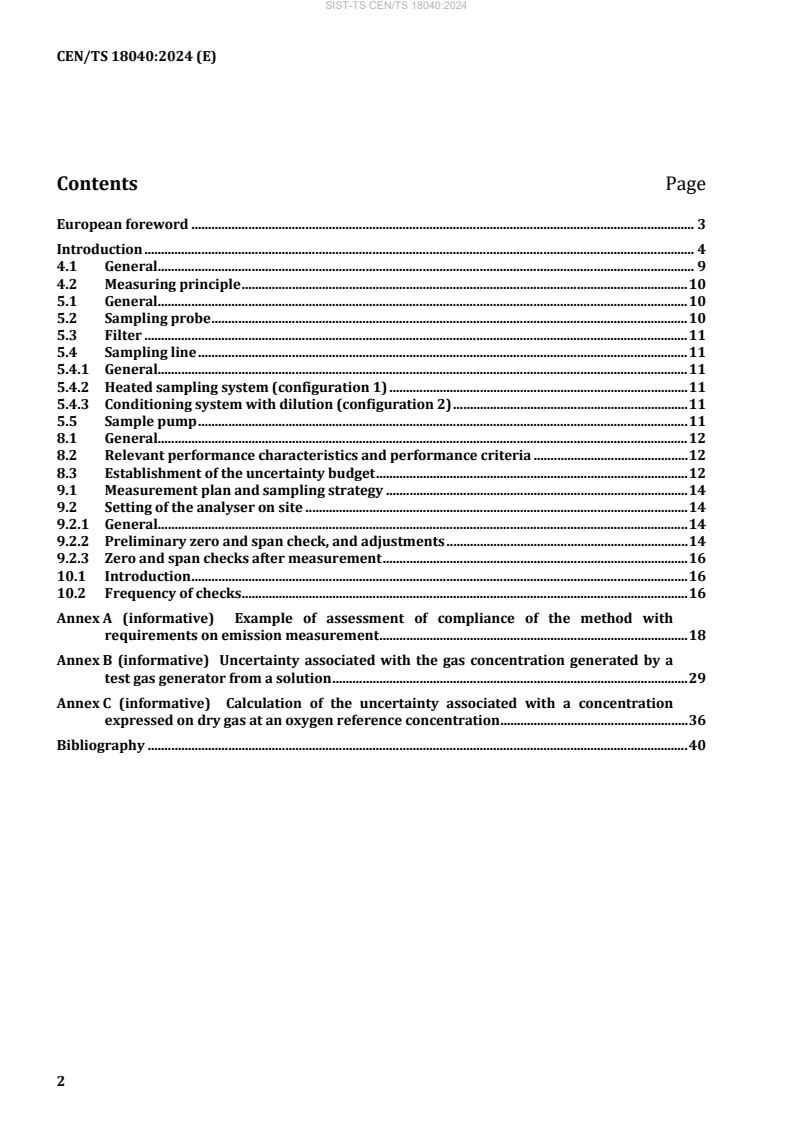
Contents Page
European foreword . 3
Introduction . 4
4.1 General. 9
4.2 Measuring principle . 10
5.1 General. 10
5.2 Sampling probe . 10
5.3 Filter . 11
5.4 Sampling line . 11
5.4.1 General. 11
5.4.2 Heated sampling system (configuration 1) . 11
5.4.3 Conditioning system with dilution (configuration 2) . 11
5.5 Sample pump . 11
8.1 General. 12
8.2 Relevant performance characteristics and performance criteria . 12
8.3 Establishment of the uncertainty budget . 12
9.1 Measurement plan and sampling strategy . 14
9.2 Setting of the analyser on site . 14
9.2.1 General. 14
9.2.2 Preliminary zero and span check, and adjustments . 14
9.2.3 Zero and span checks after measurement . 16
10.1 Introduction . 16
10.2 Frequency of checks . 16
Annex A (informative) Example of assessment of compliance of the method with
requirements on emission measurement . 18
Annex B (informative) Uncertainty associated with the gas concentration generated by a
test gas generator from a solution . 29
Annex C (informative) Calculation of the uncertainty associated with a concentration
expressed on dry gas at an oxygen reference concentration . 36
Bibliography . 40
European foreword
This document (CEN/TS 18040:2024) has been prepared by Technical Committee CEN/TC 264 “Air
quality”, the secretariat of which is held by DIN.
Attention is drawn to the possibility that some of the elements of this document may be the subject of
patent rights. CEN shall not be held responsible for identifying any or all such patent rights.
Any feedback and questions on this document should be directed to the users’ national standards body.
A complete listing of these bodies can be found on the CEN website.
According to the CEN-CENELEC Internal Regulations, the national standards organisations of the
following countries are bound to implement this European Standard: Austria, Belgium, Bulgaria,
Croatia, Cyprus, Czech Republic, Denmark, Estonia, Finland, France, Germany, Greece, Hungary, Iceland,
Ireland, Italy, Latvia, Lithuania, Luxembourg, Malta, Netherlands, Norway, Poland, Portugal, Republic of
North Macedonia, Romania, Serbia, Slovakia, Slovenia, Spain, Sweden, Switzerland, Türkiye and the
United Kingdom.
Introduction
Formaldehyde is a carcinogenic pollutant that is generated in different industrial sectors, like energy
industries (combustion plants (e.g. for wood and gas), combustion engines (gas engines and turbines),
chemical industry (e.g. formaldehyde production), food industry (e.g. smoking plants), wood industry
(e.g. production of wood-based panels or wood pellets) and thus contained in emissions of these
processes.
The manual reference method for the measurement of formaldehyde emissions is specified in
CEN/TS 17638 [1]. This method is based on the absorption of sampled gas in water and the subsequent
analysis of the aqueous samples by spectrophotometry or HPLC.
The results of manual methods and the automatic method showed good agreement for exhaust gas of
combustion engines fuelled with biogas [2; 3]. A full equivalence test has not been carried out so far.
1 Scope
This document specifies a measurement method based on an automatic method for determination of
the mass concentration of formaldehyde in ducts and stacks emitting to the atmosphere. It specifies the
sampling and gas conditioning system. Furthermore, it specifies the characteristics to be determined
and the performance criteria to be fulfilled by portable automated measuring systems (P-AMS) using
appropriate techniques to measure formaldehyde.
This method is intended for intermittent monitoring of formaldehyde emissions as well as for the
calibration and validation of automated formaldehyde measuring systems.
The analyser is calibrated using test gases produced by a test gas generator.
2 Normative references
The following documents are referred to in the text in such a way that some or all of their content
constitutes requirements of this document. For dated references, only the edition cited applies. For
undated references, the latest edition of the referenced document (including any amendments) applies.
EN 15259:2007, Air quality - Measurement of stationary source emissions - Requirements for
measurement sections and sites and for the measurement objective, plan and report
EN 15267-4:2023, Air quality - Assessment of air quality monitoring equipment - Part 4: Performance
criteria and test procedures for portable automated measuring systems for periodic measurements of
emissions from stationary sources
EN ISO 14956, Air quality - Evaluation of the suitability of a measurement procedure by comparison with
a required measurement uncertainty (ISO 14956)
3 Terms and definitions
For the purposes of this document, the following terms and definitions apply.
ISO and IEC maintain terminological databases for use in standardization at the following addresses:
• IEC Electropedia: available at https://www.electropedia.org/
• ISO Online browsing platform: available at https://www.iso.org/obp
3.1
ambient temperature
temperature of the air around the measuring system
[SOURCE: EN 16429:2021] [4]
3.2
automated measuring system
AMS
entirety of all measuring instruments and additional devices for obtaining a result of measurement
Note 1 to entry: The term “automated measuring system” applies to stationary and portable AMS.
Note 2 to entry: Apart from the actual measuring device (the analyser), an AMS includes facilities for taking
samples (e.g. probe, sample gas lines, flow meters and regulator, delivery pump) and for sample conditioning (e.g.
dust filter, pre-separator for interferents, cooler, converter). This definition also includes testing and adjusting
devices that are required for functional checks and QAL3 procedures and, if applicable, for commissioning.
Note 3 to entry: The term “automated measuring system” (AMS) is typically used in Europe. The terms
“continuous emission monitoring system” (CEMS) and “continuous ambient-air-quality monitoring system” (CAM)
are also typically used in the UK and USA.
[SOURCE: EN 15267-1:2023] [5]
3.3
calibration
set of operations that establish, under specified conditions, the relationship between values of
quantities indicated by a measuring method or measuring system, and the corresponding values given
by the applicable reference
Note 1 to entry: In case of automated measuring system (AMS) permanently installed on a stack, the applicable
reference is the standard reference method (SRM) used to establish the calibration function of the AMS.
Note 2 to entry: Calibration should not be confused with adjustment of a measuring system.
[SOURCE: EN 16429:2021] [4]
3.4
drift
difference between two zero (zero drift) or span readings (span drift) at the beginning and at the end of
a measuring period
[SOURCE: EN 16429:2021] [4]
3.5
emission limit value
ELV
limit value given in regulations such as EU Directives, ordinances, administrative regulations, permits,
licences, authorisations or consents
Note 1 to entry: ELV can be stated as concentration limits expressed as half-hourly, hourly and daily averaged
values, or mass flow limits expressed as hourly, daily, weekly, monthly or annually aggregated values.
Note 2 to entry: ELV is mostly stated at standard conditions for dry gas and at a reference oxygen concentration.
3.6
influence quantity
quantity that is not the measurand but that affects the result of the measurement
Note 1 to entry: Influence quantities are e.g. presence of interfering gases, ambient temperature, pressure of the
gas sample.
3.7
interference
negative or positive effect upon the response of the measuring system, due to a component of the
sample that is not the measurand
3.8
lack of fit
systematic deviation, within the measurement range, between the accepted value of a reference
material applied to the measuring system and the corresponding result of measurement produced by
the calibrated measuring system
Note 1 to entry: In common language lack of fit is often called “linearity” or “deviation from linearity”. Lack of fit
test is often called “linearity test”.
[SOURCE: EN 15267-4:2023]
3.9
measurand
particular quantity subject to measurement
Note 1 to entry: The measurand is a quantifiable property of the stack gas under test, for example mass
concentration of a measured component, temperature, velocity, mass flow, oxygen content and water vapour
content.
[SOURCE: EN 15259:2007]
3.10
measurement method
method described in a written procedure containing all the means and procedures required to sample
and analyse, namely field of application, principle and/or reactions, definitions, equipment, procedures,
presentation of results, other requirements and measurement report
[SOURCE: EN 14793:2017] [6]
3.11
measurement plane
plane normal to the centreline of the duct at the sampling position
Note 1 to entry: Measurement plane is also known as sampling plane.
[SOURCE: EN 15259:2007]
3.12
measurement point
position in the measurement plane at which the sample stream is extracted or the measurement data
are obtained directly
Note 1 to entry: Measurement point is also known as sampling point.
[SOURCE: EN 15259:2007]
3.13
performance characteristic
quantity assigned to an instrument in order to define its performance
3.14
portable automated measuring system
P-AMS
automated measuring system which is in a condition or application to be moved from one to another
measurement site to obtain measurement results for a short measurement period
Note 1 to entry: The measurement period is typically 8 h for a day.
Note 2 to entry: The P-AMS can be configured at the measurement site for the special application but can be also
set-up in a van or mobile container. The probe and the sample gas lines are installed often just before the
measurement task is started.
[SOURCE: EN 15267-1:2023] [5]
3.15
reference method
RM
measurement method taken as a reference by convention, which gives the accepted reference value of
the measurand
Note 1 to entry: A reference method is fully described.
Note 2 to entry: A reference method can be a manual or an automated method.
Note 3 to entry: Alternative methods may be used if equivalence to the reference method has been demonstrated.
[SOURCE: EN 15259:2007]
3.16
response time
duration between the instant when an input quantity value of a measuring instrument or measuring
system is subjected to an abrupt change between two specified constant quantity values and the instant
when a corresponding indication settles within specified limits around its final steady value
Note 1 to entry: The response time is also referred to as the 90 % time.
Note 2 to entry: The response time is by convention the time taken for the output signal to pass from 0 % to 90 %
of the final variation of indication.
[SOURCE: EN 15267-4:2023]
3.17
span gas
test gas used to adjust and check a specific point on the response line of the measuring system
Note 1 to entry: This concentration is often chosen around 80 % of the upper limit of the range or around the
emission limit value.
[SOURCE: EN 16429:2021] [4]
3.18
standard reference method
SRM
reference method prescribed by European or national legislation
[SOURCE: EN 15259:2007]
3.19
uncertainty
parameter associated with the result of a measurement, that characterises the dispersion of the values
that could reasonably be attributed to the measurand
[SOURCE: ISO/IEC Guide 98-3:2008] [7]
3.20
standard uncertainty
uncertainty of the result of a measurement expressed as a standard deviation
[SOURCE: ISO/IEC Guide 98-3:2008] [7]
3.21
expanded uncertainty
quantity defining a level of confidence about the result of a measurement that could be expected to
encompass a specific fraction of the distribution of values that could reasonably be attributed to a
measurand
[SOURCE: ISO/IEC Guide 98-3:2008] [7]
Note 1 to entry: The interval about the result of measurement is established for a level of confidence of 95 %.
3.22
combined standard uncertainty
standard uncertainty of the result of a measurement when that result is obtained from the values of a
number of other quantities, equal to the positive square root of a sum of terms, the terms being the
variances or covariances of these other quantities weighted according to how the measurement result
varies with changes in these quantities
[SOURCE: ISO/IEC Guide 98-3:2008] [7]
3.23
uncertainty budget
statement of a measurement uncertainty, of the components of that measurement uncertainty, and of
their calculation and combination
[SOURCE: JCGM 200:2012] [8]
4 Principle
4.1 General
This document specifies a method for the determination of the mass concentration of formaldehyde in
ducts and stacks emitting to atmosphere by means of an automatic analyser using optical techniques. A
number of performance characteristics with associated minimum performance criteria and an
expanded uncertainty of the method are given. Requirements and recommendations for quality
assurance and quality control are given for measurements in the field (see Table 1 in 8.3).
4.2 Measuring principle
The analyser is combined with an extractive sampling system and a gas conditioning system. A
representative sample of gas is taken from the stack with a sampling probe and conveyed to the
analyser through the sampling line and gas conditioning system. The formaldehyde concentration can
be measured, for example, by optical absorption, where the attenuation of light passing through the
sample is related to the concentration via the Lambert-Beer law and calibration.
Calibration is carried out via vaporization of formaldehyde solution of known concentration into the gas
phase. Certified test gases in gas cylinders or test gases produced via permeation tubes may, in
principle, also be used as calibration gases. However, there is still a lack of experience for their
successful application within the scope of this document.
Other species in the stack such as water, carbon dioxide and some hydrocarbons absorb radiation at
similar wavelengths to formaldehyde and may cause interference, resulting in bias in the measured
value. The effects of interference may be suppressed or compensated in terms of the physical design of
the P-AMS and/or the processing of the recorded signals. Hence, the concentration of each potential
interferent in the stack (particularly water and carbon dioxide) and if this is within the concentration
range used in the P-AMS interference testing in accordance with EN 15267-4 is an important
consideration.
5 Sampling system
5.1 General
The P-AMS shall be used only in the field of gas matrices tested during its characterization according to
EN 15267-4.
A representative volume is extracted from the flue gas for a fixed period of time. A filter removes the
dust in the sampled volume before the sample is conditioned and passes to the analyser. Two different
sampling and conditioning configurations can be used in order to avoid uncontrolled water vapour
condensation in the measuring system. These configurations are:
— Configuration 1: maintaining the temperature of the sampling line at a minimum value (one option:
180 °C) up to the heated analyser (see 5.4.1).
— Configuration 2: dilution with dry, clean ambient air or nitrogen of the sampled gas (see 5.4.2).
Components upstream of the point of dilution shall be heated (one option: 180 °C). Heating is not
required post the dilution point.
All parts of the sampling equipment upstream of the analyser shall be made of materials that do not
react with or adsorb formaldehyde.
Conditions and layout of the sampling equipment contribute to the expanded uncertainty. In order to
minimize this contribution performance criteria for the sampling equipment and sampling conditions
are given.
5.2 Sampling probe
In order to access the representative measurement point(s) of the measurement plane, probes of
different lengths and inner diameters may be used. The design and configuration of the probe used shall
ensure the residence time of the sample gas within the probe is minimized in order to reduce the
response time of the measuring system. The probe shall be heated (see 5.1).
5.3 Filter
The filter shall be made of an inert material (e.g. glass-fibre, sintered ceramic, stainless steel or PTFE-
fibre) with an appropriate pore size. Use a heated filter (see 5.1) appropriate to the dust loading that
shall be changed or cleaned periodically depending on the dust loading at the sampling site.
Overloading of the particle filter could increase the pressure drop in the sampling line. If a filter is
placed downstream of a dilution system, heating is not required.
5.4 Sampling line
5.4.1 General
The sampling line shall be heated up to the gas conditioning system, where required (see 5.1). It shall be
made of a suitable material that does not react with or adsorb formaldehyde (e.g. PTFE, PFA, Viton®,
stainless steel).
5.4.2 Heated sampling system (configuration 1)
The temperature of the gas upstream of the heated analyser shall be maintained at a sufficiently high
temperature in order to avoid condensation (see 5.1).
5.4.3 Conditioning system with dilution (configuration 2)
The flue gas is diluted with dry, clean, ambient air or nitrogen. Dilution occurs either in-stack or out-
stack. The dilution ratio shall be chosen according to the objectives of the measurement and shall be
compatible with the range of the analyser. It shall remain constant throughout the period of the test.
NOTE The dilution ratio can be determined by using, for example, 2 mass flow controllers (one before and
one after the dilution gas inlet), or by using the tracer gas method.
Dilution ratios are dependent upon changes in the flue gas density. Changes in the flue gas temperature,
molecular weight and total stack pressure can affect the ratio and resultant concentration
measurements.
5.5 Sample pump
The sample pump shall be capable of operating to the specified flow requirements of the manufacturer
of the analyser and pressure conditions required for the sample cell. The pump shall be resistant to
corrosion. If an external pump is used it shall be compatible with the requirements of the analyser to
which it is connected. If the pump is installed before the sample cell it shall be heated (one option:
180 °C).
6 Test gas generator equipment
The gas generator used to vaporize liquid containing a known amount for formaldehyde and any flow
regulating and mass loss measuring components within the gas generator directly affecting the
delivered concentration shall be calibrated by a competent laboratory.
NOTE The necessary competence can be demonstrated e.g. by an accreditation according to
EN ISO/IEC 17025 [9].
The calibration values provided shall be traceable to SI units and the recognized laboratory shall also
provide associated uncertainties. Other gas generator characteristics that may contribute uncertainty
(e.g. linearity, drift, repeatability, resolution) shall also be considered.
Uncertainties applicable to the calibration, and uncertainties, if considered, from other gas generator
characteristics shall be combined with the uncertainty associated with the concentration of
formaldehyde in the liquid reference material and meet the requirements in 9.2.2.1.
7 Analyser equipment
This document does not prescribe the technique. Instead, this document specifies performance criteria
(see EN 15267-4:2023, Table 1), regardless of the technique used to measure formaldehyde. Additional
requirements described in technique specific methods shall be observed when they exist (e.g. the
spectral residual test for P-AMS based on FTIR technique, see 8.4.4.2 in CEN/TS 17337 [10]).
8 Determination of the characteristics of the method
8.1 General
The user of this document shall demonstrate that
— the performance characteristics of the P-AMS are equal or better than the associated performance
criteria given in EN 15267-4:2023, Table 1; and
— the expanded uncertainty of the method calculated by combining values of standard uncertainties
associated with the performance characteristics is less than 20 % at the daily emission limit value,
on dry basis and before correction to the reference value of O for the process. Below 5 mg/m the
expanded uncertainty shall be not larger than 1 mg/m .
The values of the performance characteristics shall be evaluated by an experienced and independent
laboratory recognized by the competent authority. Laboratory tests and a field test will be implemented
according to EN 15267-4. The P-AMS shall be used only in the field of gas matrices tested during its
characterization according to EN 15267-4.
It is the responsibility of the user to check the performance characteristics with a periodicity given in
Table 2.
8.2 Relevant performance characteristics and performance criteria
The uncertainty of the measured values by the method is not only influenced by the performance
characteristics of the analyser itself but also by
— the sampling line and conditioning system;
— the site-specific conditions;
— the calibration process.
The performance characteristics of the method shall be evaluated in accordance with EN 15267-4.
Table 1 of EN 15267-4:2023 gives an overview of the relevant performance characteristics and
performance criteria, which shall be determined during laboratory and field tests and indicates values
included in the calculation of the expanded uncertainty of the method.
8.3 Establishment of the uncertainty budget
An uncertainty budget shall be established to determine if the analyser and its associated sampling
system fulfil the requirements for a maximum permissible expanded uncertainty of the method.
The method shall have an expanded uncertainty lower than 20 % at the daily emission limit value, or
3 3
1 mg/m for daily emissions limit values below 5 mg/m . This expanded uncertainty of the method is
calculated on a dry basis and before correction to the O reference concentration. If the concentrations
of the automated method are given on a wet basis, a correction to dry basis shall be carried out. The
uncertainty attached to the correction of water vapour content shall be added to the uncertainty
budget. An example of calculation is given in Annex A.
The principle of calculation of the expanded uncertainty of the method is based on the law on
propagation of uncertainty laid down in EN ISO 14956:
— determine the standard uncertainties for each value included in the calculation of the budget
uncertainty by means of laboratory and field tests, and according to EN ISO 14956;
— calculate the uncertainty budget by combining all the standard uncertainties according to
EN ISO 14956. It shall also take variations in the range of influence quantities and interferents of
the specific site conditions into account. If these conditions are unknown, default values defined in
Table 1 shall be applied. When corrections for residual water content in the flue gas are applied, the
uncertainty attached to this correction shall be added to the uncertainty budget;
— values of standard uncertainty that are less than 5 % of the maximum standard uncertainty may be
ignored; and
— calculate the expanded uncertainty of the method at the daily emission limit value, on a dry basis.
Table 1 — Default variations ranges of influence quantities and interferents for the
determination of the uncertainty budget
Influence quantity or component Default variations range on site
Atmospheric pressure ± 3 kPa
In accordance with the manufacturer's
Sample volume flow variation
recommendations
a
Ambient temperature
between 5 °C and 40 °C
at −15 % below and at +10 % above nominal supply
Influence of voltage
voltage
O 3 % to 21 %
H O 1 % to 30 %
3 3
CO
0 mg/m to 300 mg/m
CO 0 % to 15 %
3 3
CH
0 mg/m to 50 mg/m
3 3
HCl
0 mg/m to 50 mg/m
3 3
N O
0 mg/m to 20 mg/m
3 3
N O; fluidised bed combustion
0 mg/m to 100 mg/m
3 3
NO
0 mg/m to 300 mg/m
3 3
NO
0 mg/m to 30 mg/m
3 3
NH
0 mg/m to 20 mg/m
3 3
SO
0 mg/m to 200 mg/m
a
Larger ranges may be specified by the manufacturer.
9 Field operation
9.1 Measurement plan and sampling strategy
The measurement plan and the sampling strategy shall be in accordance with EN 15259 requirements.
If the stack gas emissions contain droplets, then this method shall only be used if the measuring system
has been demonstrated to meet the performance characteristics given in EN 15267-4 under the same
sampling conditions.
The homogeneity can be demonstrated according to EN 15259.
To avoid long response times, the sample line shall be as short as possible. If necessary, a bypass pump
shall be used.
Typically, the following characteristics of flue gases should be considered before a field campaign:
— temperature of exhaust gases;
— exhaust gas moisture content and dew point;
— dust loading;
— expected concentration range of formaldehyde and emission limit values;
— expected concentration of potentially interfering substances, including at least the components
listed in Table 1; and
— flue gas cleaning system.
The full scale shall be chosen as appropriate to the measuring task.
9.2 Setting of the analyser on site
9.2.1 General
The complete measuring system, the sampling line including the conditioning unit, where required and
the analyser, shall be connected according to the manufacturer’s instructions. The probe is inserted so
that its open end is at the representative measurement point(s) in the duct.
The sample gas conditioning system, sampling probe, filter, connection tube and analyser shall be
stabilized at the required temperature. At the same time, a constant pressure shall be achieved in the
measuring cell of the analyser. After pre-heating, the flow passing through the sampling system and the
analyser shall be adjusted to the chosen flow rate to be used during measurement. This flow should be
maintained at a constant level.
Time resolution of the data recording system shall be adapted to the measuring task and to the
response time of the measuring system.
9.2.2 Preliminary zero and span check, and adjustments
9.2.2.1 Test gases
The zero gas shall be a gas free of formaldehyde (for example, nitrogen or purified air).
The span gas shall be produced using a gas generator by vaporization of a liquid containing a known
amount of formaldehyde. Gas phase formaldehyde shall be generated using the gas generator to a
relative expanded uncertainty of ≤ 5 % taking into account uncertainty sources including those from the
calibration of the gas generator and that associated with the concentration of formaldehyde in the
reference material. The uncertainty associated with the generation of the formaldehyde span gas shall
be included in the uncertainty budget for the overall measurement method (Annex A).
When the analyser is used for regulatory purposes, the span gas shall have a known concentration of
approximately the half hourly ELV. For other purposes the span gas may have concentrations from
50 % to 90 % of the selected range of the analyser.
Liquid reference materials can contain other compounds as stabilizers (e.g. methanol in the case of
formaldehyde). It is important to establish if any other compound(s) present will cause cross-
interference with the P-AMS that might bias the span calibration. In some cases, the stabilizer may have
been one of the cross-interferents included in the type testing in accordance with EN 15267-4. Hence, in
this instance the sensitivity is known and can be taken into account by including cross-sensitivity in the
uncertainty budget (Annex A). If this is not the case, another way to demonstrate that the P-AMS is
robust to stabilizer cross-interference would be from correspondence with the P-AMS manufacturer.
Another option is a user could source a sample of only stabilizer and water (i.e. containing no
formaldehyde). If this sample was vapourised the user could then determine the influence (or absence
of) on the formaldehyde reading.
9.2.2.2 Adjustment of the analyser
At the beginning of the measuring period, the zero gas and span gas are supplied to the measurement
port of the analyser. Adjustments are made until the correct zero and span gas values are given by the
data sampling system.
9.2.2.3 Zero gas check of the measuring system
Zero gas shall be passed through the measuring system at the sampling probe, as close as possible to
the end of the nozzle (in front of the filter if possible). A stable reading shall be recorded for each
component channel and each shall not exceed 2,0 % of respective certification range.
9.2.2.4 Check of the sampling system for leaks and losses
The sampling line shall be checked for leakage and losses according to the following procedure. Span
gas shall be passed directly through the analyser and then through the sampling system. The deviation
between the reading obtained upon passing the span gas directly into the analyser and that from
passing it through the sampling system shall not exceed 2,0 %.
NOTE 1 Overpressurizing of the test gases might hide leakages.
For some analysers some pre-heating of the test gases can be required to reduce the risk of the test
gases not being heated to the temperature of the sample cell. This can be achieved by adjusting the
temperature of the gas line connecting the test gas equipment to the analyser to match the temperature
of the analyser measurement cell.
NOTE 2 A passivation time of several minutes could be required to reach a stable formaldehyde reading.
NOTE 3 Measuring oxygen at the entrance and the exit of the sample gas line is a possible method to determine
if the failure is due to a leak (greater oxygen at the bottom of the line) or losses (oxygen remains unchanged). This
method is, however, not applicable if the exhaust gas contains 21 % oxygen.
With some P-AMS using stainless steel (probe, filter, connections) it has been observed desorption
phenomena when the probe is inserted into the duct that could affect the signal for more than 30 min.
The user should evaluate the importance of these phenomena to reduce their impact of this induced
effect and remove data corresponding to this affected period or reducing their importance by extending
the measurement time.
9.2.3 Zero and span checks after measurement
At the end of the measuring period and at least once a day, zero and span checks shall be performed at
the inlet of the sampling probe by supplying test gases. The results of these checks (i.e. deviations
between checks before and after measurement) shall be documented and included in the measurement
report. If the span or zero drifts are greater than 2,0 % of the span value, it is necessary to correct both
for zero and span drifts. The drift of zero and span shall be lower than 5,0 % of the span value;
otherwise, the results shall be rejected.
Linear correction: the concentration C corrected according to time t for the concentration C given by
corr
the analyser shall be calculated according to Formula (1):
C−+Bt( ) Drift()B × t
( )
C = (1)
corr
A(t )+ Drift()A × t
( )
where
B(t ) = result after adjustment at t at zero;
0 0
result during the drift check att at zero− result after adjustment att at zero
end 0
Drift(B)=
tt−
end 0
result after adjustment atttat span− result after adjustment at zero
A()t =
span gas concentration− zero gasconcentration
result during the drift check atttat span− result during the drift check at at zero
end end
Drift(A) − A(t )⋅
0
span gas concentration−−zero gas concentration tt
( )
end 0
t – t = duration of the measurement period in minutes (duration between adjustment and check for drift at
end 0
the end of the measurement period).
10 Ongoing quality control
10.1 Introduction
Quality control is critically important in order to ensure the uncertainty of the measured values for
formaldehyde is kept within the stated limits during monitoring periods in the field. This means
maintenance, as well as zero and span adjustment procedures shall be followed, as they are essential for
obtaining accurate and traceable data.
10.2 Frequency of checks
Table 2 shows the minimum required frequency of checks which are carried out under the
responsibility of the user.
Table 2 — Frequency of checks
Checks Frequency Action criteria
a
Cleaning or changing of particle
Every campaign, if needed
a
filters at the sampling inlet and at
the analyser inlet
Regular maintenance of the As required by manufacturer As required by manufacturer
analyser
=
Leak test Every campaign As specified in 9.2.2.3
Zero and span adjustment Every campaign As specified in 9.2.2.2
Drift Every campaign As specified in 9.2.3
Lack of fit At least every year and after repair As required and when lack of
of the analyser fit > 2 % of the range
Test gas generator maintenance As required by manufacturer As required by manufacturer
and calibration
a
The particle filter shall be changed periodically depending on the dust loading at the measurement site. During this filter
change the filter housing shall be cleaned. Overloading of the particle filter could increase the pressure drop in the sampling
line.
11 Expression of results
The measurement results shall be expressed as mass concentrations.
Usually, the P-AMS detects the concentration as a volume fraction at the current state of the sampled
gas, i.e. at wet conditions (due to a certain amount of H O in the gas) and at the actual concentration of
−6 3 3
oxygen. The volume fraction f (e.g. in 10 m /m which is frequently expressed as ppm) is converted
to a mass concentration C (e.g. in mg/m ) using Formula (2):
M
mol
Cf= (2)
V
mol
where:
C is the mass concentration of the sampled gas (wet) under the current conditions of
temperature and pressure;
M is the molar mass of formaldehyde, taking into account its natural isotopic abundance
mol
(30,021 g/mol);
V is the molar volume occupied by one mole of gas under the current conditions of
mol
temperature and pressure.
If the measurement result is to be converted to standard conditions of temperature and pressure
(273,15 K; 101,3 kPa) and to dry conditions of the sampled gas, the equations corresponding to Annex C
is equal to 22,4 l/mol for all gases.
of EN 15259:2007 shall be used. Under standard conditions V
mol
NOTE The manufacturer of a P-AMS is recommended to ensure that the displayed mass concentrations
clearly show whether they refer to wet or dry conditions of the sampled gas.
12 Measurement report
The measurement report shall provide a comprehensive account of the measurements, a description of
the measurement objectives and measurement plan. It shall provide enough details to enable the results
to be traced back through the calculations to the original data and process operating conditions. The
measurement report shall comply with EN 15259.
Annex A
(informative)
Example of assessment of compliance of the method with requirements on
emission measurement
A.1 Procedure for evaluating uncertainty
A.1.1 Determination of model function
— Define the measurand and all the parameters that influence the result of the measurement, called
input quantities.
— Identify all sources of uncertainty contributing to any of the input quantities or to the measurand
directly.
— Establish the model function (i.e. the relationship between the measurand and the input quantities)
in mathematical equation form. The model function should contain every quantity, including all
corrections that can contribute significantly to the measurement uncertainty.
The model equation for the concentration C can thus be expressed as a sum of individual
CHOH
contributions X according to:
i
N
(A.1)
CX=
CHOH ∑ i
i=1
In the case of the measurement of formaldehyde by means of a P-AMS, X contributions correspond to
i
the volume concentration indicated by the analyser and to the corrections due to the deviations
associated with influence quantities and to the performance characteristics of the analyser.
Whether the corrections are null or not, the associated uncertainties shall be taken into account.
Table A.1 — Influence parameters to the formaldehyde measurement by P-AMS
Influence parameter X Symbol
i
C
Volume concentration indicated by the analyser
read
Corr
Repeatability
r
Corr
Lack-of-fit
lof
Corr
Short-term zero drift
d,z
Corr
Short-term span drift
d,s
Corr
Influence of ambient temperature at zero
t,z
Corr
Influence of ambient temperature at span
t,s
Corr
Influence of sample gas flow
f
Corr
Influence of sample gas pressure
p
Influ
...