

SIST EN 1999-1-1:2007
(Main)Eurocode 9 - Design of aluminium structures - Part 1-1: General structural rules
- Abstract
(1) EN 1999-1-1 gives basic design rules for structures made of wrought aluminium alloys and limited guidance for cast alloys (see section 3).
NOTE Minimum material thickness may be defined in the National Annex. The following limits are recommended – if not otherwise explicitly stated in this standard:
- components with material thickness not less than 0,6 mm;
- welded components with material thickness not less than 1,5 mm;
- connections with:
o steel bolts and pins with diameter not less than 5 mm;
o aluminium bolts and pins with diameter not less than 8 mm;
o rivets and thread forming screws with diameter not less than 4,2 mm
(2) The following subjects are dealt with in EN 1999-1-1:
Section 1: General
Section 2: Basis of design
Section 3: Materials
Section 4: Durability
Section 5: Structural analysis
Section 6: Ultimate limit states for members
Section 7: Serviceability limit states
Section 8: Design of joints
Annex A Execution classes
Annex B Equivalent T-stub in tension
Annex C Materials selection
Annex D Corrosion and surface protection
Annex E Analytical models for stress strain relationship
Annex F Behaviour of cross section beyond elastic limit
Annex G Rotation capacity
Annex H Plastic hinge method for continuous beams
Annex I Lateral torsional buckling of beams and torsional or flexural-torsional buckling of compression members
Annex J Properties of cross sections
Annex K Shear lag effects in member design
Annex L Classification of connections
Annex M Adhesive bonded connections
(3) Sections 1 to 2 provide additional clauses to those given in EN 1990 “Basis of structural design”.
(4) Section 3 deals with material properties of products made of structural aluminium alloys.
(5) Section 4 gives general rules for durability.
(6) Section 5 refers to the structural analysis of structures, in which the members can be modelled with sufficient accuracy as line elements for global analysis.
(7) Section 6 g
- Status
- Published
- Publication Date
- 17-Apr-2007
- Technical Committee
- KON - Structures
- Current Stage
- 6060 - National Implementation/Publication (Adopted Project)
- Start Date
- 12-Apr-2007
- Due Date
- 17-Jun-2007
- Completion Date
- 18-Apr-2007



SIST EN 1999-1-1:2007 is the Slovenian adoption of EN 1999-1-1:2007, published by SIST within the Eurocode 9 series from CEN. It gives general structural rules for the design of aluminium structures, mainly for wrought aluminium alloys and with limited guidance for cast alloys, for designers, constructors, owners, checking bodies and relevant authorities.
What does SIST EN 1999-1-1:2007 specify?
SIST EN 1999-1-1:2007 specifies basic design rules for aluminium buildings and civil engineering works. It covers resistance, serviceability, durability and joint design, and it is intended to be used together with EN 1990 and EN 1991.
The standard is organized into Sections 1 to 8 and Annexes A to M.
| Annex | What it covers |
|---|---|
| A | Execution classes and reliability differentiation |
| B | Equivalent T-stub in tension |
| C | Materials selection |
| D | Corrosion and surface protection |
| E | Analytical models for stress-strain relationship |
| F | Behaviour of cross sections beyond the elastic limit |
| G | Rotation capacity |
| H | Plastic hinge method for continuous beams |
| I | Lateral torsional buckling and torsional buckling of compression members |
| J | Properties of cross sections |
| K | Shear lag effects in member design |
| L | Classification of connections |
| M | Adhesive bonded connections |
A note in the scope points to National Annex choices for minimum material thickness and gives recommended lower limits for thin components, welded components, and several types of fasteners.
What are the key requirements of SIST EN 1999-1-1:2007?
SIST EN 1999-1-1:2007 uses limit state design with the partial factor method. Clause 2 ties the design to EN 1990 basic requirements and to the load combinations in EN 1990 together with actions from EN 1991, so the designer checks both safety and serviceability in a consistent way.
Clause 3 sets the material basis. It gives characteristic properties for wrought and cast aluminium alloys, includes data for connecting devices, and limits the tabulated values to specific service temperature ranges. For welded structures, the standard requires allowance for heat-affected zone (HAZ) softening in strain-hardened or precipitation-hardening alloys, which matters because welds can reduce resistance near the joint.
Clause 4 gives the durability approach. Under normal atmospheric conditions, the listed alloys may be used without surface protection to avoid loss of load-bearing capacity, but aggressive exposure, wear or fatigue call for inspection, maintenance and repair access. The execution specification is expected to state the chosen protective treatment.
Clause 5 governs structural analysis. Members are modelled as line elements for global analysis, with imperfections and deformed geometry taken into account where needed. The text allows equivalent horizontal forces to represent sway and bow imperfections, which matters in frame design because stability effects can govern the forces.
Clauses 6 and 7 cover member resistance and serviceability. Clause 6 deals with cross-section classification, local buckling, tension, compression, bending, shear, torsion, combined actions, built-up members, plates, plate girders and corrugated webs. Clause 7 gives serviceability rules for deflections and dynamic effects in buildings. In practice, the engineer must check both ultimate resistance and usable deformation.
Clause 8 covers joints subject to static loading. It includes bolted, riveted, welded, hybrid and adhesive bonded connections, with rules for hole positions, force distribution, slip-resistant connections, prying forces, long joints, pin connections, HAZ effects and joint classification. That is the part to use when detailing connections and verifying fasteners and welds.
Annex A adds execution classes for reliability management. It distinguishes four execution classes, with class 4 the most stringent, and links the choice to failure consequences, loading type and the planned technology and quality level.
What terms does SIST EN 1999-1-1:2007 define?
- Frame - an assembly of directly connected members designed to act together to resist load, including both moment-resisting and triangulated frames.
- Sub-frame - a frame that forms part of a larger frame but is analysed as an isolated frame.
- Connection - the location where two members are interconnected, including the connection elements.
- Joint - the assembly that transfers internal forces and moment between members.
- Execution class - a reliability-related class for execution requirements; Annex A uses four classes, from less to more stringent.
- Heat-affected zone (HAZ) - the weld-adjacent region where strength properties are reduced.
- Durability rating - the A, B, C categorisation used for aluminium alloys in Annex D to indicate corrosion-related protection needs.
Who uses SIST EN 1999-1-1:2007?
SIST EN 1999-1-1:2007 is used by designers and constructors of aluminium structures, by owners defining project requirements, and by relevant authorities reviewing designs. The foreword also names committees drafting design-related product, testing and execution standards, which makes the document relevant beyond individual project design.
What changed in SIST EN 1999-1-1:2007 from the previous edition?
SIST EN 1999-1-1:2007 supersedes ENV 1999-1-1:1998.
Which standards are used with SIST EN 1999-1-1:2007?
- EN 1990 - provides the basis of structural design, including the general requirements, limit states and partial factor framework.
- EN 1991 - provides actions on structures used in the design combinations.
- EN 1999-1-2 to EN 1999-1-5 - provide the companion parts for fire design, fatigue, cold-formed sheeting and shell structures.
- prEN 1090-1 and prEN 1090-3 - cover conformity assessment and technical execution requirements for aluminium structures.
- EN 573 series, EN 515, EN 485 series, EN 586 series, EN 754 series and EN 755 series - provide designation systems, tempers, delivery conditions, dimensions, tolerances and mechanical properties for aluminium products.
- EN 287-2, EN ISO 4287 and EN ISO 4288 - support welding-related qualification and surface texture assessment.
What does the SIST EN 1999-1-1:2007 document contain?
The document contains tabulated material properties, cross-section classification limits, member resistance formulae, joint resistance rules and figures for imperfections, buckling and load transfer. It also provides annex methods for execution classes, equivalent T-stubs, corrosion protection, stress-strain models, rotation capacity, plastic hinge design, lateral torsional buckling, cross-section properties, shear lag, joint classification and adhesive bonded connections. These parts are used in design calculations, detailing, checking and execution planning.
Relations
- Effective Date
- 01-May-2007
- Effective Date
- 19-Aug-2026
- Refers
kSIST FprEN 1991-1-6:2025 - Eurocode 1 - Actions on structures - Part 1-6: Actions during execution - Effective Date
- 25-Mar-2026
- Effective Date
- 25-Mar-2026
- Effective Date
- 25-Mar-2026
- Effective Date
- 25-Mar-2026
- Effective Date
- 25-Mar-2026
- Effective Date
- 25-Mar-2026
- Refers
SIST ISO 8930:1999 - General principles on reliability for structures -- List of equivalent terms - Effective Date
- 09-Feb-2026
- Effective Date
- 28-Jan-2026
- Effective Date
- 28-Jan-2026
- Effective Date
- 28-Jan-2026
- Effective Date
- 28-Jan-2026
- Effective Date
- 28-Jan-2026
- Effective Date
- 28-Jan-2026
Get Certified
Connect with accredited certification bodies for this standard

DIBt (Deutsches Institut für Bautechnik)
German Institute for Building Technology.

DIN CERTCO
DIN Group product certification.

Aboma Certification B.V.
Specialized in construction, metal, and transport sectors.
Sponsored listings
Frequently Asked Questions
SIST EN 1999-1-1:2007 is a standard published by the Slovenian Institute for Standardization (SIST). Its full title is "Eurocode 9 - Design of aluminium structures - Part 1-1: General structural rules". This standard covers: (1) EN 1999-1-1 gives basic design rules for structures made of wrought aluminium alloys and limited guidance for cast alloys (see section 3). NOTE Minimum material thickness may be defined in the National Annex. The following limits are recommended – if not otherwise explicitly stated in this standard: - components with material thickness not less than 0,6 mm; - welded components with material thickness not less than 1,5 mm; - connections with: o steel bolts and pins with diameter not less than 5 mm; o aluminium bolts and pins with diameter not less than 8 mm; o rivets and thread forming screws with diameter not less than 4,2 mm (2) The following subjects are dealt with in EN 1999-1-1: Section 1: General Section 2: Basis of design Section 3: Materials Section 4: Durability Section 5: Structural analysis Section 6: Ultimate limit states for members Section 7: Serviceability limit states Section 8: Design of joints Annex A Execution classes Annex B Equivalent T-stub in tension Annex C Materials selection Annex D Corrosion and surface protection Annex E Analytical models for stress strain relationship Annex F Behaviour of cross section beyond elastic limit Annex G Rotation capacity Annex H Plastic hinge method for continuous beams Annex I Lateral torsional buckling of beams and torsional or flexural-torsional buckling of compression members Annex J Properties of cross sections Annex K Shear lag effects in member design Annex L Classification of connections Annex M Adhesive bonded connections (3) Sections 1 to 2 provide additional clauses to those given in EN 1990 “Basis of structural design”. (4) Section 3 deals with material properties of products made of structural aluminium alloys. (5) Section 4 gives general rules for durability. (6) Section 5 refers to the structural analysis of structures, in which the members can be modelled with sufficient accuracy as line elements for global analysis. (7) Section 6 g
(1) EN 1999-1-1 gives basic design rules for structures made of wrought aluminium alloys and limited guidance for cast alloys (see section 3). NOTE Minimum material thickness may be defined in the National Annex. The following limits are recommended – if not otherwise explicitly stated in this standard: - components with material thickness not less than 0,6 mm; - welded components with material thickness not less than 1,5 mm; - connections with: o steel bolts and pins with diameter not less than 5 mm; o aluminium bolts and pins with diameter not less than 8 mm; o rivets and thread forming screws with diameter not less than 4,2 mm (2) The following subjects are dealt with in EN 1999-1-1: Section 1: General Section 2: Basis of design Section 3: Materials Section 4: Durability Section 5: Structural analysis Section 6: Ultimate limit states for members Section 7: Serviceability limit states Section 8: Design of joints Annex A Execution classes Annex B Equivalent T-stub in tension Annex C Materials selection Annex D Corrosion and surface protection Annex E Analytical models for stress strain relationship Annex F Behaviour of cross section beyond elastic limit Annex G Rotation capacity Annex H Plastic hinge method for continuous beams Annex I Lateral torsional buckling of beams and torsional or flexural-torsional buckling of compression members Annex J Properties of cross sections Annex K Shear lag effects in member design Annex L Classification of connections Annex M Adhesive bonded connections (3) Sections 1 to 2 provide additional clauses to those given in EN 1990 “Basis of structural design”. (4) Section 3 deals with material properties of products made of structural aluminium alloys. (5) Section 4 gives general rules for durability. (6) Section 5 refers to the structural analysis of structures, in which the members can be modelled with sufficient accuracy as line elements for global analysis. (7) Section 6 g
SIST EN 1999-1-1:2007 is classified under the following ICS (International Classification for Standards) categories: 91.010.30 - Technical aspects; 91.080.17 - Aluminium structures. The ICS classification helps identify the subject area and facilitates finding related standards.
SIST EN 1999-1-1:2007 has the following relationships with other standards: It is inter standard links to SIST ENV 1999-1-1:2002, SIST EN ISO 6892-2:2026, kSIST FprEN 1991-1-6:2025, kSIST FprEN 1991-4:2025, kSIST FprEN 1991-1-4:2025, SIST EN 573-3:2026, kSIST FprEN 1991-1-8:2025, kSIST FprEN 1991-3:2025, SIST ISO 8930:1999, SIST EN ISO 4287:2000, SIST EN 1991-1-4:2005/A1:2010, SIST EN 1991-3:2006, SIST EN ISO 6892-3:2015, SIST EN 485-4:1998, SIST EN 754-8:1999. Understanding these relationships helps ensure you are using the most current and applicable version of the standard.
SIST EN 1999-1-1:2007 is associated with the following European legislation: EU Directives/Regulations: 2003-01-2705, 2005-01-4408, 305/2011, 89/106/EEC; Standardization Mandates: M/265, M/BC/CEN/89/11. When a standard is cited in the Official Journal of the European Union, products manufactured in conformity with it benefit from a presumption of conformity with the essential requirements of the corresponding EU directive or regulation.
SIST EN 1999-1-1:2007 is available in PDF format for immediate download after purchase. The document can be added to your cart and obtained through the secure checkout process. Digital delivery ensures instant access to the complete standard document.
Standards Content (Sample)
2003-01.Slovenski inštitut za standardizacijo. Razmnoževanje celote ali delov tega standarda ni dovoljeno.Eurocode 9 - Design of aluminium structures - Part 1-1: General structural rulesEvrokod 9: Projektiranje konstrukcij iz aluminijevih zlitin - 1-1. del: Splošna pravila za konstrukcijeEurocode 9 - Calcul des structures en aluminium - Partie 1-1: Regles généralesEurocode 9 - Bemessung und Konstruktion von Aluminiumtragwerken - Teil 1-1: Allgemeine BemessungsregelnTa slovenski standard je istoveten z:EN 1999-1-1:2007SIST EN 1999-1-1:2007en;fr;de91.080.10Kovinske konstrukcijeMetal structures91.010.30Technical aspectsICS:SIST ENV 1999-1-1:20021DGRPHãþDSLOVENSKI
STANDARDSIST EN 1999-1-1:200701-maj-2007
EUROPEAN STANDARDNORME EUROPÉENNEEUROPÄISCHE NORMEN 1999-1-1February 2007ICS 91.010.30; 91.080.10Supersedes ENV 1999-1-1:1998
English VersionEurocode 9 - Design of aluminium structures - Part 1-1: Generalstructural rulesEurocode 9 - Calcul des structures en aluminium - Partie 1-1: Règles généralesEurocode 9 - Bemessung und Konstruktion vonAluminiumtragwerken - Teil 1-1: AllgemeineBemessungsregelnThis European Standard was approved by CEN on 18 September 2006.CEN members are bound to comply with the CEN/CENELEC Internal Regulations which stipulate the conditions for giving this EuropeanStandard the status of a national standard without any alteration. Up-to-date lists and bibliographical references concerning such nationalstandards may be obtained on application to the CEN Management Centre or to any CEN member.This European Standard exists in three official versions (English, French, German). A version in any other language made by translationunder the responsibility of a CEN member into its own language and notified to the CEN Management Centre has the same status as theofficial versions.CEN members are the national standards bodies of Austria, Belgium, Bulgaria, Cyprus, Czech Republic, Denmark, Estonia, Finland,France, Germany, Greece, Hungary, Iceland, Ireland, Italy, Latvia, Lithuania, Luxembourg, Malta, Netherlands, Norway, Poland, Portugal,Romania, Slovakia, Slovenia, Spain, Sweden, Switzerland and United Kingdom.EUROPEAN COMMITTEE FOR STANDARDIZATIONCOMITÉ EUROPÉEN DE NORMALISATIONEUROPÄISCHES KOMITEE FÜR NORMUNGManagement Centre: rue de Stassart, 36
B-1050 Brussels© 2007 CENAll rights of exploitation in any form and by any means reservedworldwide for CEN national Members.Ref. No. EN 1999-1-1:2007: E
EN 1999-1-1: 2007 (E)
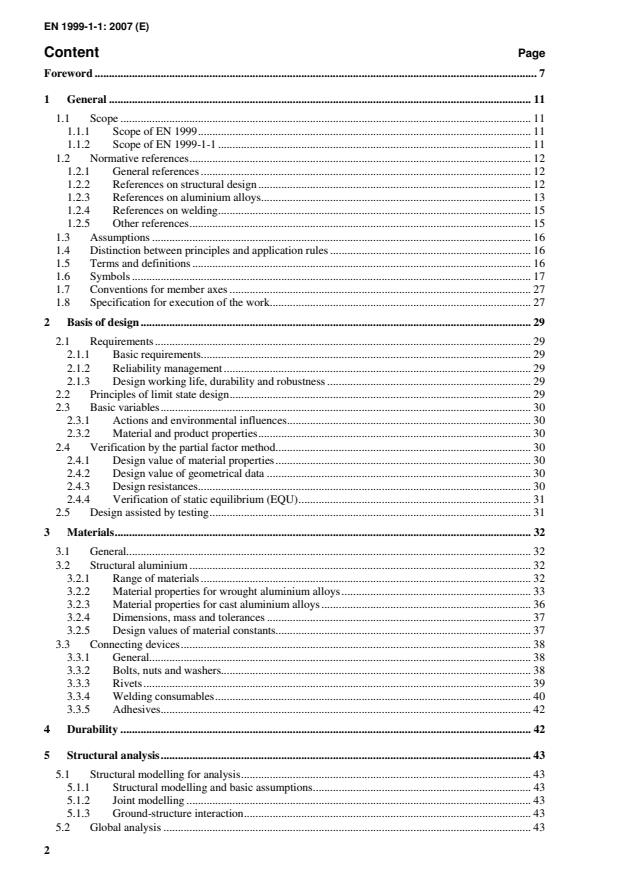
2 Content Page Foreword.7 1 General.11 1.1 Scope.11 1.1.1 Scope of EN 1999.11 1.1.2 Scope of EN 1999-1-1.11 1.2 Normative references.12 1.2.1 General references.12 1.2.2 References on structural design.12 1.2.3 References on aluminium alloys.13 1.2.4 References on welding.15 1.2.5 Other references.15 1.3 Assumptions.16 1.4 Distinction between principles and application rules.16 1.5 Terms and definitions.16 1.6 Symbols.17 1.7 Conventions for member axes.27 1.8 Specification for execution of the work.27 2 Basis of design.29 2.1 Requirements.29 2.1.1 Basic requirements.29 2.1.2 Reliability management.29 2.1.3 Design working life, durability and robustness.29 2.2 Principles of limit state design.29 2.3 Basic variables.30 2.3.1 Actions and environmental influences.30 2.3.2 Material and product properties.30 2.4 Verification by the partial factor method.30 2.4.1 Design value of material properties.30 2.4.2 Design value of geometrical data.30 2.4.3 Design resistances.30 2.4.4 Verification of static equilibrium (EQU).31 2.5 Design assisted by testing.31 3 Materials.32 3.1 General.32 3.2 Structural aluminium.32 3.2.1 Range of materials.32 3.2.2 Material properties for wrought aluminium alloys.33 3.2.3 Material properties for cast aluminium alloys.36 3.2.4 Dimensions, mass and tolerances.37 3.2.5 Design values of material constants.37 3.3 Connecting devices.38 3.3.1 General.38 3.3.2 Bolts, nuts and washers.38 3.3.3 Rivets.39 3.3.4 Welding consumables.40 3.3.5 Adhesives.42 4 Durability.42 5 Structural analysis.43 5.1 Structural modelling for analysis.43 5.1.1 Structural modelling and basic assumptions.43 5.1.2 Joint modelling.43 5.1.3 Ground-structure interaction.43 5.2 Global analysis.43
EN 1999-1-1: 2007 (E)
3 5.2.1 Effects of deformed geometry of the structure.43 5.2.2 Structural stability of frames.44 5.3 Imperfections.45 5.3.1 Basis.45 5.3.2 Imperfections for global analysis of frames.45 5.3.3 Imperfection for analysis of bracing systems.49 5.3.4 Member imperfections.52 5.4 Methods of analysis.52 5.4.1 General.52 5.4.2 Elastic global analysis.52 5.4.3 Plastic global analysis.52 6 Ultimate limit states for members.53 6.1 Basis.53 6.1.1 General.53 6.1.2 Characteristic value of strength.53 6.1.3 Partial safety factors.53 6.1.4 Classification of cross-sections.53 6.1.5 Local buckling resistance.58 6.1.6 HAZ softening adjacent to welds.59 6.2 Resistance of cross-sections.61 6.2.1 General.61 6.2.2 Section properties.62 6.2.3 Tension.63 6.2.4 Compression.64 6.2.5 Bending moment.64 6.2.6 Shear.66 6.2.7 Torsion.67 6.2.8 Bending and shear.69 6.2.9 Bending and axial force.69 6.2.10 Bending, shear and axial force.70 6.2.11 Web bearing.71 6.3 Buckling resistance of members.71 6.3.1 Members in compression.71 6.3.2 Members in bending.75 6.3.3 Members in bending and axial compression.77 6.4 Uniformed built-up members.80 6.4.1 General.80 6.4.2 Laced compression members.82 6.4.3 Battened compression members.83 6.4.4 Closely spaced built-up members.85 6.5 Un-stiffened plates under in-plane loading.85 6.5.1 General.85 6.5.2 Resistance under uniform compression.86 6.5.3 Resistance under in-plane moment.87 6.5.4 Resistance under transverse or longitudinal stress gradient.88 6.5.5 Resistance under shear.88 6.5.6 Resistance under combined action.89 6.6 Stiffened plates under in-plane loading.89 6.6.1 General.89 6.6.2 Stiffened plates under uniform compression.90 6.6.3 Stiffened plates under in-plane moment.92 6.6.4 Longitudinal stress gradient on multi-stiffened plates.92 6.6.5 Multi-stiffened plating in shear.93 6.6.6 Buckling load for orthotropic plates.93 6.7 Plate girders.96 6.7.1 General.96 6.7.2 Resistance of girders under in-plane bending.96 6.7.3 Resistance of girders with longitudinal web stiffeners.97
EN 1999-1-1: 2007 (E)
...