

SIST EN 14585:2024
(Main)Corrugated metal hose assemblies for pressure applications
General Information
- Abstract
This document specifies the requirements for design, manufacture and installation of corrugated metal hose assemblies for pressure applications, i.e. maximum allowable pressure PS greater than 0,5 bar.
- Status
- Published
- Public Enquiry End Date
- 12-Jul-2022
- Publication Date
- 11-Nov-2024
- Technical Committee
- I13 - Imaginarni 13
- Current Stage
- 6060 - National Implementation/Publication (Adopted Project)
- Start Date
- 22-Oct-2024
- Due Date
- 27-Dec-2024
- Completion Date
- 12-Nov-2024

Overview
EN 14585:2024 - published by CEN in 2024 - specifies requirements for the design, manufacture and installation of corrugated metal hose assemblies for pressure applications (maximum allowable pressure PS > 0.5 bar). This European Standard replaces earlier parts (EN 14585-1:2006 and related CEN/TR documents) and covers the full lifecycle from material selection and design methods to testing, documentation and operating instructions.
Key topics and technical requirements
- Scope & classification: Applies to corrugated metal hose assemblies for pressure use and includes classification categories (e.g. Categories I–III and SEP referenced for material documentation).
- Materials: Requirements for suitable materials, corrosion considerations, low-temperature applications, ductility and brittle-fracture aspects; material traceability and documentation are required.
- Design methods: Two main approaches - calculation design (with allowable stresses, fatigue and component calculations for corrugated hoses, braids, end fittings and flanges) and experimental design (type approvals, cyclic tests, validation).
- Manufacture & assembly: Requirements for corrugation forming, braiding, joining methods (welding, brazing), permanent joints, tolerances (inner diameter, ply thickness, corrugation height, overall length), repair/rework, cleaning and additional protection.
- Testing & inspection: In-process and final inspections, non‑destructive testing, leak, proof and pressure tests, cyclic testing and final documentation package.
- Documentation & marking: Final assessment, packaging, labelling, operating and safety instructions; Annexes provide material properties, derating factors and calculation coefficients.
- Regulatory linkage: Informative annex maps the relationship to EU Pressure Equipment Directive (2014/68/EU).
Applications and who uses it
EN 14585:2024 is used by:
- Design engineers and system integrators specifying metal hose assemblies for pressurized piping systems.
- Manufacturers and fabricators producing corrugated hoses, braids and end fittings.
- Quality & inspection personnel conducting tests, NDT and final acceptance.
- Procurement and asset owners requiring compliant components and documentation. Practical applications include flexible connections in pressurized piping where movement, vibration isolation or thermal expansion must be accommodated (industrial plants, process engineering, utilities and other sectors that use pressure-containing flexible metal hoses).
Related standards
- Supersedes EN 14585-1:2006, CEN/TR 14585-2:2006, CEN/TR 14585-3:2017.
- Annex ZA links EN 14585 to the essential requirements of EU Directive 2014/68/EU.
Keywords: EN 14585:2024, corrugated metal hose assemblies, pressure applications, design, manufacture, testing, CEN, pressure hose standard.
Relations
- Effective Date
- 28-Jan-2026
- Effective Date
- 28-Jan-2026
- Effective Date
- 28-Jan-2026
- Effective Date
- 28-Jan-2026
- Effective Date
- 28-Jan-2026
- Effective Date
- 28-Jan-2026
- Effective Date
- 28-Jan-2026
- Effective Date
- 28-Jan-2026
- Effective Date
- 28-Jan-2026
- Refers
SIST EN 1593:2001/A1:2004 - Non-destructive testing - Leak testing - Bubble emission techniques - Effective Date
- 28-Jan-2026
- Effective Date
- 28-Jan-2026
- Effective Date
- 28-Jan-2026
- Effective Date
- 28-Jan-2026
- Effective Date
- 28-Jan-2026
- Refers
SIST EN 10028-7:2016 - Flat products made of steels for pressure purposes - Part 7: Stainless steels - Effective Date
- 28-Jan-2026
Get Certified
Connect with accredited certification bodies for this standard

Element Materials Technology
Materials testing and product certification.

Inštitut za kovinske materiale in tehnologije
Institute of Metals and Technology. Materials testing, metallurgical analysis, NDT.
Institut za varilstvo d.o.o. (Welding Institute)
Slovenia's leading welding institute since 1952. ISO 3834, EN 1090, pressure equipment certification, NDT personnel, welder qualification. Only IIW Au
Sponsored listings
Frequently Asked Questions
SIST EN 14585:2024 is a standard published by the Slovenian Institute for Standardization (SIST). Its full title is "Corrugated metal hose assemblies for pressure applications". This standard covers: This document specifies the requirements for design, manufacture and installation of corrugated metal hose assemblies for pressure applications, i.e. maximum allowable pressure PS greater than 0,5 bar.
This document specifies the requirements for design, manufacture and installation of corrugated metal hose assemblies for pressure applications, i.e. maximum allowable pressure PS greater than 0,5 bar.
SIST EN 14585:2024 is classified under the following ICS (International Classification for Standards) categories: 23.040.70 - Hoses and hose assemblies; 77.140.75 - Steel pipes and tubes for specific use. The ICS classification helps identify the subject area and facilitates finding related standards.
SIST EN 14585:2024 has the following relationships with other standards: It is inter standard links to SIST EN ISO 15610:2023, SIST EN 13184:2002, SIST EN 1779:2000, SIST EN 764-5:2015, SIST EN 10028-2:2017, SIST EN 13184:2002/A1:2004, SIST EN 10088-3:2015, SIST EN ISO 14732:2013, SIST EN ISO 9606-4:1999, SIST EN 1593:2001/A1:2004, SIST EN 1653:2000, SIST EN 1779:2000/A1:2004, SIST EN ISO 15613:2004, SIST EN 10028-4:2017, SIST EN 10028-7:2016. Understanding these relationships helps ensure you are using the most current and applicable version of the standard.
SIST EN 14585:2024 is associated with the following European legislation: EU Directives/Regulations: 2014/68/EU; Standardization Mandates: M/071, M/601. When a standard is cited in the Official Journal of the European Union, products manufactured in conformity with it benefit from a presumption of conformity with the essential requirements of the corresponding EU directive or regulation.
SIST EN 14585:2024 is available in PDF format for immediate download after purchase. The document can be added to your cart and obtained through the secure checkout process. Digital delivery ensures instant access to the complete standard document.
Standards Content (Sample)
SLOVENSKI STANDARD
01-december-2024
Valoviti kovinski cevni sestavi za uporabo v tlačnih cevovodih
Corrugated metal hose assemblies for pressure applications
Gewellte Metallschlauchleitungen für Druckanwendungen
Tuyauteries métalliques flexibles onduleuses pour applications sous pression
Ta slovenski standard je istoveten z: EN 14585:2024
ICS:
77.140.75 Jeklene cevi in cevni profili Steel pipes and tubes for
za posebne namene specific use
2003-01.Slovenski inštitut za standardizacijo. Razmnoževanje celote ali delov tega standarda ni dovoljeno.
EN 14585
EUROPEAN STANDARD
NORME EUROPÉENNE
October 2024
EUROPÄISCHE NORM
ICS 23.040.70 Supersedes EN 14585-1:2006, CEN/TR 14585-2:2006,
CEN/TR 14585-3:2017
English Version
Corrugated metal hose assemblies for pressure
applications
Tuyauteries métalliques flexibles onduleuses pour Gewellte Metallschlauchleitungen für
applications sous pression Druckanwendungen
This European Standard was approved by CEN on 26 August 2024.
CEN members are bound to comply with the CEN/CENELEC Internal Regulations which stipulate the conditions for giving this
European Standard the status of a national standard without any alteration. Up-to-date lists and bibliographical references
concerning such national standards may be obtained on application to the CEN-CENELEC Management Centre or to any CEN
member.
This European Standard exists in three official versions (English, French, German). A version in any other language made by
translation under the responsibility of a CEN member into its own language and notified to the CEN-CENELEC Management
Centre has the same status as the official versions.
CEN members are the national standards bodies of Austria, Belgium, Bulgaria, Croatia, Cyprus, Czech Republic, Denmark, Estonia,
Finland, France, Germany, Greece, Hungary, Iceland, Ireland, Italy, Latvia, Lithuania, Luxembourg, Malta, Netherlands, Norway,
Poland, Portugal, Republic of North Macedonia, Romania, Serbia, Slovakia, Slovenia, Spain, Sweden, Switzerland, Türkiye and
United Kingdom.
EUROPEAN COMMITTEE FOR STANDARDIZATION
COMITÉ EUROPÉEN DE NORMALISATION
EUROPÄISCHES KOMITEE FÜR NORMUNG
CEN-CENELEC Management Centre: Rue de la Science 23, B-1040 Brussels
© 2024 CEN All rights of exploitation in any form and by any means reserved Ref. No. EN 14585:2024 E
worldwide for CEN national Members.
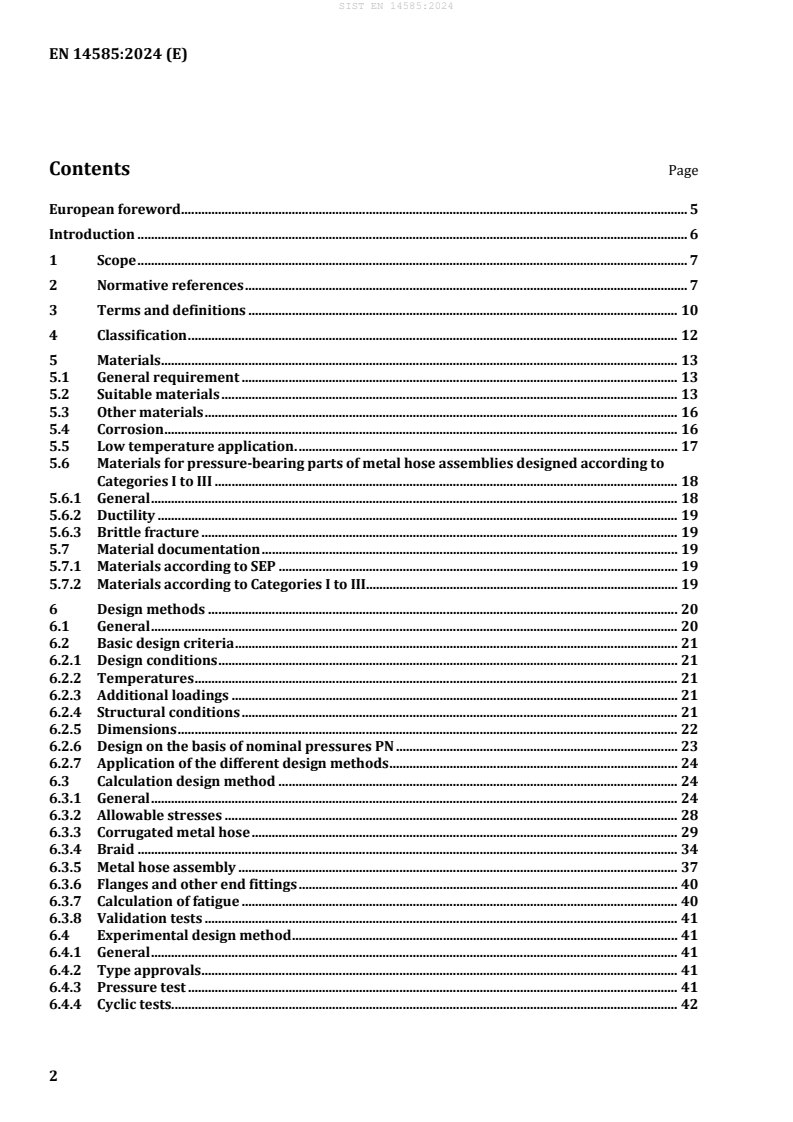
Contents Page
European foreword . 5
Introduction . 6
1 Scope . 7
2 Normative references . 7
3 Terms and definitions . 10
4 Classification . 12
5 Materials . 13
5.1 General requirement . 13
5.2 Suitable materials . 13
5.3 Other materials . 16
5.4 Corrosion . 16
5.5 Low temperature application. . 17
5.6 Materials for pressure-bearing parts of metal hose assemblies designed according to
Categories I to III . 18
5.6.1 General . 18
5.6.2 Ductility . 19
5.6.3 Brittle fracture . 19
5.7 Material documentation . 19
5.7.1 Materials according to SEP . 19
5.7.2 Materials according to Categories I to III . 19
6 Design methods . 20
6.1 General . 20
6.2 Basic design criteria . 21
6.2.1 Design conditions . 21
6.2.2 Temperatures . 21
6.2.3 Additional loadings . 21
6.2.4 Structural conditions . 21
6.2.5 Dimensions . 22
6.2.6 Design on the basis of nominal pressures PN . 23
6.2.7 Application of the different design methods . 24
6.3 Calculation design method . 24
6.3.1 General . 24
6.3.2 Allowable stresses . 28
6.3.3 Corrugated metal hose . 29
6.3.4 Braid . 34
6.3.5 Metal hose assembly . 37
6.3.6 Flanges and other end fittings . 40
6.3.7 Calculation of fatigue . 40
6.3.8 Validation tests . 41
6.4 Experimental design method . 41
6.4.1 General . 41
6.4.2 Type approvals . 41
6.4.3 Pressure test . 41
6.4.4 Cyclic tests. 42
6.5 Application of hose assemblies. 46
6.5.1 General . 46
6.5.2 Allowable pressure . 46
6.5.3 Flow velocity . 46
6.5.4 Pressure drop. 47
6.5.5 Hose configurations . 47
6.5.6 Documentation of the design methods . 53
7 Manufacturing . 54
7.1 General . 54
7.2 Materials . 54
7.2.1 General . 54
7.2.2 Material traceability for hose assemblies . 54
7.3 Permanent joints . 54
7.3.1 General . 54
7.3.2 Welding . 55
7.3.3 Brazing . 55
7.4 Metal hose assembly . 56
7.4.1 Corrugated hose . 56
7.4.2 Hose joining . 56
7.4.3 Braiding . 56
7.4.4 Additional protection . 57
7.5 Tolerances . 59
7.5.1 General . 59
7.5.2 Inner diameter . 59
7.5.3 Ply thickness e . 59
p
7.5.4 Corrugation height w . 59
7.5.5 Overall length . 59
7.5.6 End fittings . 59
7.6 Repair and rework . 59
7.7 Cleaning . 60
8 Testing, inspection and documentation . 60
8.1 Introduction. 60
8.1.1 General . 60
8.1.2 Documents . 60
8.1.3 Documents for category I, II and III hose assemblies . 60
8.2 In-process inspection, testing and documentation . 60
8.2.1 Materials . 60
8.2.2 Non-destructive in-process testing . 61
8.3 Final assessment . 61
8.3.1 General . 61
8.3.2 Final inspection . 61
8.3.3 Non-destructive testing . 61
8.3.4 Visual and dimensional examination . 62
8.3.5 Leak test . 62
8.3.6 Proof test . 62
8.3.7 Final documentation package . 63
8.3.8 Packaging . 64
9 Marking and labelling . 64
10 Operating instructions . 65
10.1 General . 65
10.2 Content of operating instructions . 65
10.3 Content of safety instructions . 66
Annex A (informative) Categories of corrugated metal hose assemblies . 67
Annex B (informative) Information to be supplied to the hose manufacturer . 74
Annex C (normative) Material properties and derating factors . 75
Annex D (informative) Calculation coefficients C , C , . 80
p f
Annex E (informative) Significant technical changes between this document and the
previous edition . 84
Annex ZA (informative) Relationship between this European Standard and the Essential
Requirements of EU Directive 2014/68/EU aimed to be covered. 85
Bibliography . 87
European foreword
This document (FprEN 14585:2024) has been prepared by Technical Committee CEN/TC 342 “Metal
hose, hose assemblies, bellows and expansion joints”, the secretariat of which is held by SNV.
This European Standard shall be given the status of a national standard, either by publication of an
identical text or by endorsement, at the latest by April 2025, and conflicting national standards shall be
withdrawn at the latest by April 2025.
Attention is drawn to the possibility that some of the elements of this document may be the subject of
patent rights. CEN shall not be held responsible for identifying any or all such patent rights.
This document supersedes EN 14585-1:2006, CEN/TR 14585-2:2006, CEN/TR 14585-3:2017.
Annex E provides details of significant technical changes between this document and the previous
edition.
This document has been prepared under a standardization request addressed to CEN by the European
Commission. The Standing Committee of the EFTA States subsequently approves these requests for its
Member States.
For the relationship with EU Legislation, see informative Annex ZA, which is an integral part of this
document.
This document has been produced to address the specific needs of corrugated metal hose assemblies for
pressure applications. For applications outside the scope of EU Directive 2014/68/EU, refer to
EN ISO 10380:2012.
Any feedback and questions on this document should be directed to the users’ national standards body.
A complete listing of these bodies can be found on the CEN website.
According to the CEN-CENELEC Internal Regulations, the national standards organisations of the
following countries are bound to implement this European Standard: Austria, Belgium, Bulgaria, Croatia,
Cyprus, Czech Republic, Denmark, Estonia, Finland, France, Germany, Greece, Hungary, Iceland, Ireland,
Italy, Latvia, Lithuania, Luxembourg, Malta, Netherlands, Norway, Poland, Portugal, Republic of North
Macedonia, Romania, Serbia, Slovakia, Slovenia, Spain, Sweden, Switzerland, Türkiye and the United
Kingdom.
Introduction
Corrugated metal hose assemblies are used as components in piping.
The requirements of this document impact designers, manufacturers, suppliers and importers of
corrugated metal hose assemblies for pressure applications.
The unique nature of a corrugated metal hose assembly is characterized by:
— the opposing requirements of pressure resistance and flexibility;
— the interactive role of its pressure bearing parts: corrugated metal hose, braid, end fittings and its
permanent joints.
As a general rule PED [1] Annex I, Clause 2.2.2 limits the experimental design method for piping to PS · DN
less than 3000. Validation tests are, however, intended to support design of corrugated metal hose
assemblies for all practically achievable values of PS · DN.
Regarding sound engineering practice (SEP), the manufacturer is responsible for its application based on
relevant standards or other professional codes. Corrugated metal hose assemblies according to SEP are
expected to be designed, manufactured, verified and delivered with instructions for use in order to ensure
their safety during their intended life, when used in foreseeable or reasonably foreseeable conditions.
NOTE 1 EN ISO 10380:2012 or relevant professional codes answer sound engineering practice requirements.
NOTE 2 See also PED Guidelines I-01 [5] and I-09 [6].
1 Scope
This document specifies the requirements for design, manufacture and installation of corrugated metal
hose assemblies for pressure applications, i.e. maximum allowable pressure PS greater than 0,5 bar.
2 Normative references
The following documents are referred to in the text in such a way that some or all of their content
constitutes requirements of this document. For dated references, only the edition cited applies. For
undated references, the latest edition of the referenced document (including any amendments) applies.
EN 764-4:2014, Pressure equipment - Part 4: Establishment of technical delivery conditions for metallic
materials
EN 764-5:2014, Pressure equipment - Part 5: Inspection documentation of metallic materials and
compliance with the material specification
EN 1092-1:2018, Flanges and their joints - Circular flanges for pipes, valves, fittings and accessories, PN
designated - Part 1: Steel flanges
EN 1562:2019, Founding - Malleable cast irons
EN 1591-1:2013, Flanges and their joints - Design rules for gasketed circular flange connections - Part 1:
Calculation
EN 1593:1999, Non destructive testing — Leak testing — Bubble emission techniques
EN 1652:1997, Copper and copper alloys - Plate, sheet, strip and circles for general purposes
EN 1653:1997, Copper and copper alloys — Plate, sheet and circles for boilers, pressure vessels and hot
water storage units
EN 1779:1999, Non destructive testing — Leak testing – Criteria for method and technique selection
EN 1982:2017, Copper and copper alloys - Ingots and castings
EN ISO 6892-1:2019, Metallic materials - Tensile testing - Part 1: Method of test at room temperature (ISO
6892-1:2019)
EN ISO 7369:2020, Pipework - Metal hoses and hose assemblies - Vocabulary (ISO 7369:2020)
EN ISO 9445-1:2010, Continuously cold-rolled stainless steel - Tolerances on dimensions and form - Part 1:
Narrow strip and cut lengths (ISO 9445-1:2009)
EN ISO 9445-2:2010, Continuously cold-rolled stainless steel - Tolerances on dimensions and form - Part 2:
Wide strip and plate/sheet (ISO 9445-2:2009)
As impacted by EN 1593:1999/A1:2003.
As impacted by EN 1653:1997/A1:2000.
As impacted by EN 1779:1999/A1:2003.
EN ISO 9606-1:2017, Qualification testing of welders - Fusion welding - Part 1: Steels (ISO 9606-1:2012
including Cor 1:2012 and Cor 2:2013)
EN ISO 9606-4:1999, Approval testing of welders - Fusion welding - Part 4: Nickel and nickel alloys (ISO
9606-4:1999)
EN ISO 9712:2022, Non-destructive testing - Qualification and certification of NDT personnel (ISO
9712:2021)
EN 10028-2:2017, Flat products made of steels for pressure purposes - Part 2: Non-alloy and alloy steels
with specified elevated temperature properties
EN 10028-4:2017, Flat products made of steels for pressure purposes - Part 4: Nickel alloy steels with
specified low temperature properties
EN 10028-7:2016, Flat products made of steels for pressure purposes - Part 7: Stainless steels
EN 10088-3:2014, Stainless steels - Part 3: Technical delivery conditions for semi-finished products, bars,
rods, wire, sections and bright products of corrosion resisting steels for general purposes
EN 10204:2004, Metallic products - Types of inspection documents
EN 10216-1:2013, Seamless steel tubes for pressure purposes - Technical delivery conditions - Part 1: Non-
alloy steel tubes with specified room temperature properties
EN 10216-2:2013+A1:2019, Seamless steel tubes for pressure purposes - Technical delivery conditions -
Part 2: Non-alloy and alloy steel tubes with specified elevated temperature properties
EN 10216-3:2013, Seamless steel tubes for pressure purposes - Technical delivery conditions - Part 3: Alloy
fine grain steel tubes
EN 10216-4:2013, Seamless steel tubes for pressure purposes - Technical delivery conditions - Part 4: Non-
alloy and alloy steel tubes with specified low temperature properties
EN 10216-5:2021, Seamless steel tubes for pressure purposes - Technical delivery conditions - Part 5:
Stainless steel tubes
EN 10217-3:2019, Welded steel tubes for pressure purposes - Technical delivery conditions - Part 3: Electric
welded and submerged arc welded alloy fine grain steel tubes with specified room, elevated and low
temperature properties
EN 10217-4:2019, Welded steel tubes for pressure purposes - Technical delivery conditions - Part 4: Electric
welded non-alloy steel tubes with specified low temperature properties
EN 10217-5:2019, Welded steel tubes for pressure purposes - Technical delivery conditions - Part 5:
Submerged arc welded non-alloy and alloy steel tubes with specified elevated temperature properties
EN 10217-7:2021, Welded steel tubes for pressure purposes - Technical delivery conditions - Part 7:
Stainless steel tubes
EN 10222-2:2017+A1:2021, Steel forgings for pressure purposes - Part 2: Ferritic and martensitic steels
with specified elevated temperatures properties
EN 10222-3:2017, Steel forgings for pressure purposes - Part 3: Nickel steels with specified low temperature
properties
EN 10222-5:2017, Steel forgings for pressure purposes - Part 5: Martensitic, austenitic and austenitic-
ferritic stainless steels
EN 10253-2:2021, Butt-welding pipe fittings - Part 2: Non alloy and ferritic alloy steels with specific
inspection requirements
EN 10253-4:2008, Butt-welding pipe fittings - Part 4: Wrought austenitic and austenitic-ferritic (duplex)
stainless steels with specific inspection requirements
EN ISO 10380:2012, Pipework - Corrugated metal hoses and hose assemblies (ISO 10380:2012)
EN 12164:2016, Copper and copper alloys - Rod for free machining purposes
EN 12165:2016, Copper and copper alloys - Wrought and unwrought forging stock
EN 12166:2016, Copper and copper alloys - Wire for general purposes
EN 12167:2016, Copper and copper alloys - Profiles and bars for general purposes
EN 12168:2016, Copper and copper alloys - Hollow rod for free machining purposes
EN 12449:2023, Copper and copper alloys - Seamless, round tubes for general purposes
EN 13134:2000, Brazing - Procedure approval
EN 13184:2001, Non-destructive testing — Leak testing — Pressure change method
EN 13445-3:2021, Unfired pressure vessels - Part 3: Design
EN 13480-2:2017, Metallic industrial piping - Part 2: Materials
EN 13480-3:2017, Metallic industrial piping - Part 3: Design and calculation
EN ISO 148-1:2016, Metallic materials - Charpy pendulum impact test - Part 1: Test method (ISO 148-
1:2016)
EN ISO 13585:2012, Brazing - Qualification test of brazers and brazing operators (ISO 13585:2012)
EN ISO 14732:2013, Welding personnel - Qualification testing of welding operators and weld setters for
mechanized and automatic welding of metallic materials (ISO 14732:2013)
EN ISO 15610:2023, Specification and qualification of welding procedures for metallic materials —
Qualification based on tested welding consumables (ISO 15610:2023)
EN ISO 15613:2004, Specification and qualification of welding procedures for metallic materials -
Qualification based on pre-production welding test (ISO 15613:2004)
As impacted by EN 13184:2001/A1:2003.
EN ISO 15614-1:2017, Specification and qualification of welding procedures for metallic materials -
Welding procedure test - Part 1: Arc and gas welding of steels and arc welding of nickel and nickel alloys
(ISO 15614-1:2017, Corrected version 2017-10-01)
EN ISO 17637:2016, Non-destructive testing of welds - Visual testing of fusion-welded joints (ISO
17637:2016)
EN ISO 20485:2018, Non-destructive testing - Leak testing - Tracer gas method (ISO 20485:2017)
3 Terms and definitions
For the purposes of this document, the terms and definitions in EN ISO 7369:2020 and the following
apply.
ISO and IEC maintain terminology databases for use in standardization at the following addresses:
— ISO Online browsing platform: available at https://www.iso.org/obp
— IEC Electropedia: available at https://www.electropedia.org/
3.1
metal hose assembly
assembly of a corrugated metal hose with its end fittings
3.2
maximum allowable pressure
PS
maximum pressure at the operating temperature for which the metal hose assembly is designed
Note 1 to entry: See also 6.2.1.
3.3
maximum allowable pressure at 20°C
PS
equivalent maximum pressure at ambient temperature for which the metal hose assembly is designed
3.4
minimum allowable temperature
minimum allowable temperature TS
minimum temperature for which the metal hose assembly is designed
Note 1 to entry: See also 6.2.1.
3.5
maximum allowable temperature
maximum allowable temperature TS
maximum temperature for which the metal hose assembly is designed
Note 1 to entry: See also 6.2.1.
3.6
nominal pressure
PN
dimensionless alphanumerical designation which is a convenient rounded number commonly used for
reference purposes of piping components and stock parts
Note 1 to entry: For this document PN represents the maximum allowable pressure at 20°C as specified by the
metal hose assembly manufacturer.
3.7
test pressure
PT
pressure at which the metal hose assembly is proof tested (normally at ambient temperature)
3.8
main pressure bearing parts
parts, such as corrugated metal hose, braid, pipe ends, the failure of which can result in a sudden
discharge of pressure energy
3.9
pressure bearing parts
parts, such as swivel nuts, flanges, threaded end fittings, that are not main pressure bearing parts defined
in 3.8 and the failure of which can not lead to a sudden discharge of pressure energy
3.10
attachments to pressure parts
parts, such as ferrules, that are directly welded to parts defined in 3.8 or 3.9
3.11
other parts
parts, such as external protection, anti-kink device, braid protecting spiral, which are not parts according
to 3.8 to 3.9
3.12
experimental tests
type testing
tests made to develop an experimental design method
3.13
category
classification of pressure equipment according to ascending level of hazard
Note 1 to entry: See Annex A.
3.14
equipment manufacturer
natural or legal person responsible for the values of the parameters PS and TS
Note 1 to entry: This can be the manufacturer or planner of the piping for which the metal hose assembly is
designed.
3.15
hose manufacturer
natural or legal person responsible for the design and the manufacture of the corrugated metal hose
and/or the metal hose assembly
3.16
purchaser
person or organization that orders products in accordance with this document
Note 1 to entry: The purchaser is not necessarily, but can be, a manufacturer of pressure equipment in
accordance with the EU Directive listed in Annex ZA. Where a purchaser has responsibilities under this EU Directive,
this document will provide a presumption of conformity with the essential requirements of the Directive identified
as such in Annex ZA once the reference of the Standard is published in the Official Journal of the European
Commission
3.17
hydraulic forming
longitudinal welded
corrugating a tube by pressurizing the inside against external tooling which allows this corrugated tube
to be axially shortened during the process
3.18
roll forming
longitudinal welded
corrugating a tube by rolling from the outside to the inside and allowing or forcing this corrugated tube
to be axially shortened during the process
3.19
helical crest welded
resistance welded
profiling a strip, rolling it over helically and finally welding the overlaps
3.20
strand
group of parallel wires used for plain braid or wires woven together to form a braided strand
3.21
braided braid
braid that is manufactured from previously braided strands
3.22
operating instructions
written procedure provided by the manufacturer which include all information regarding installation,
operation, safety and maintenance of the equipment within the manufacturer's scope of supply
4 Classification
For the application of this document, hose assemblies are divided into groups according to ascending
level of hazard: SEP, Category I, and Categories II and III.
The grouping is, according to the requirements of PED [1], depending on their nominal diameter DN, their
maximum allowable pressure PS, and on the type of fluid they convey.
According to the conformity assessment tables of the PED (see also Annex A) the different levels of hazard
lead to:
— SEP, covering the field of sound engineering practice according to Article 4, Clause 3 of PED; i.e.
smallest level of hazard with no CE marking;
— Category I, covering metal hose assemblies designed for a mean level of hazard and being CE marked;
— Categories II and III, covering metal hose assemblies designed for higher levels of hazard and being
CE marked.
5 Materials
5.1 General requirement
Materials for the manufacture of hose assemblies including filler metal shall be selected on the basis of
their suitability for fabrication according to Clause 7, and for the conditions under which they will be
used.
Materials used for hose assemblies according to Categories I to III shall fulfil the additional requirements
specified in 5.6.
When combining different materials, care shall be taken regarding material compatibility (e.g. galvanic
corrosion, welding compatibility).
5.2 Suitable materials
Materials suitable for hoses assemblies are given as follows:
a) Materials suitable for corrugated metal hoses and their temperature limits are given in Table 1;
b) Materials suitable for braid, end fittings, and additional parts are given in Table 2.
Table 1 — Materials for corrugated metal hoses and their temperature limits
Material Temperature °C
Document
Type Number Steel name Minimum Maximum
a
1.4306 X2CrNi19–11 – 273 550
a
1.4401 X5CrNiMo17–12–2 – 196 550
a
1.4404 X2CrNiMo17–12–2 – 273 550
Stainless
a
1.4435 X2CrNiMo18–14–3 – 273 550
austenitic EN 10028-7:2016
a
1.4539 X1NiCrMoCu25–20–5 – 196 550
steels
a
1.4541 X6CrNiTi18–10 – 273 550
a
1.4547 X1CrNiMoCuN20–18–7 – 196 500
a
1.4571 X6CrNiMoTi17–12–2 – 273 550
X10NiCrAlTi32–21 600
Heat resistant
1.4876 – 196 See Table C.2
b
austenitic steels
X10NiCrAlTi32–21 (H) (900)
Nickel 2.4360 NiCu30Fe – 196 425 See Table C.2
alloys
2.4858 NiCr21Mo – 10 540 See Table C.2
(part 1)
2.4610 NiMo16Cr16Ti – 196 400 EAM-0526–28
EAM-0526-43-1,
– 10 450
EAM-0526-43-2
2.4816 NiCr15Fe
Nickel
c b
(– 273) (900) See Table C.3
alloys
(part 2)
2.4819 NiMo16Cr15W – 196 400 EAM-0526–18
– 196 450 EAM-0526–40
2.4856 NiCr22Mo9Nb
c b
(– 273) (900) See Table C.3
a
Minimum temperature in accordance with EN 13445-2:2021, Annex B or EN 13480-2:2017, Annex B.
b
Special care should be exercised due to the risk of embrittlement when using the materials at elevated
temperatures above 550 °C. See 6.2.2 for details.
c
See 5.6.3 a) for details.
Table 2 — Materials for braid, end fittings, ferrules, and additional parts
Component Material No Document
Pressure parts
1.4301, 1.4306, 1.4401, 1.4404, 1.4541,
EN 10088-3:2014
1.4571
Braid 1.4876, 2.4360, 2.4819, 2.4856, 2.4858 Table 1
Cu-based material: CW450K, CW452K,
a
EN 12166:2016
CW508L
EN 10222-2:2017+A1:2021 and
Forged
f
EN 10222-3:2017
Carbon steel
f
Flat products EN 10028-2:2017
EN 10222-5:2017
1.4301, 1.4306, 1.4401, 1.4404, 1.4435,
Fixed flange,
1.4462, 1.4541, 1.4571
EN 10028-7:2016
Weld collar,
1.4876, 2.4360, 2.4816, 2.4819, 2.4856, Table 1
b
Floating flange
2.4858
CW024A EN 1653:1997
Copper-based
a
EN 12164:2016
material:
CW617N
a
EN 12165:2016
f
Carbon steel EN 10253-2:2021
1.4301, 1.4306, 1.4401, 1.4404, 1.4435,
EN 10253-4:2008
1.4462, 1.4541, 1.4571
1.4876, 2.4360, 2.4816, 2.4819, 2.4856,
Table 1
Thread nipple, 2.4858
Taper thread
CW024A EN 1653:1997
nipple,
a
CW602N EN 12164:2016
Threaded
a
CW608N EN 12165:2016
connection,
a
CW614N EN 12167:2016
Copper-based
Threaded fitting,
a
CW617N EN 12168:2016
material:
c
Swivel nut
CC491K
(CuSn5Zn5Pb5-C)
EN 1982:2017
CC499K
(CuSn5Zn5Pb2-C)
Malleable cast iron
EN-JM1030 EN 1562:2019
d
EN 10216-1:2013,
EN 10216-2:2013+A1:2019,
Seamless EN 10216-3:2013 and
Pipe ends Carbon steel
EN 10216-4:2013
welded
EN 10217-3:2019, EN 10217-4:2019
f
and EN 10217-5:2019
Component Material No Document
1.4301, 1.4306, EN 10216-5:2021
Seamless
1.4401, 1.4404,
EN 10217-7:2021
welded
1.4541, 1.4571
1.4876, 2.4360, 2.4816, 2.4819, 2.4856,
See Table 1
2.4858
Copper-based
a
CW024A EN 12449:2023
material:
Parts attached to pressure parts
1.4301, 1.4306, 1.4401, 1.4404, 1.4541,
EN 10028-7:2016
1.4571
Ferrule
1.4876, 2.4360, 2.4816, 2.4819, 2.4856,
See Table 1
(similar to braid
2.4858
material)
Copper-based material: CW450K,
a
EN 12166:2016
CW452K, CW508L
e
Other parts
1.4301, 1.4306, 1.4401, 1.4404, 1.4541,
EN 10028-7:2016
1.4571
End ring,
1.4876, 2.4360, 2.4816, 2.4819, 2.4856,
Protective strip-
See Table 1
2.4858
wound hose,
Anti-kink device
Copper-based material: CW450K,
EN 1652:1997
CW452K, CW508L
Braid protecting 1.4301, 1.4306, 1.4401, 1.4404, 1.4541,
EN 10088-3:2014
helix 1.4571, 1.4310
a
Not harmonized to PED; Particular Material Appraisals (PMA) are necessary for applications within the scope
of the PED.
b
Ferritic floating flanges shall be protected to avoid contamination of adjacent stainless steel parts.
c
Swivel nuts shall be made from free cutting materials.
d
Malleable cast iron parts shall be made weldable by multiple tempering. The carbon content of the welding
zones shall not exceed 0,3 %.
e
Other parts shall be preferably made from materials similar to the braid material.
f
Minimum/maximum temperature limits are indicated in the relevant normative references.
5.3 Other materials
Other materials can be used provided they fulfil the general requirements of 5.1 and conform to a
harmonized standard or comply with a European Approval for Materials (EAM) or have a Particular
Material Appraisal (PMA) as defined in EN 764-4:2014.
5.4 Corrosion
The materials selected for the metal hose assembly shall have adequate resistance to all the corrosive
agents likely to be encountered during the lifetime of the system, i.e. the transported fluid and/or the
environment. Consideration shall be given to all corrosion risks including pitting corrosion, intergranular
corrosion, crevice corrosion, contact corrosion and stress corrosion cracking.
NOTE Corrugated metal hoses generally have a wall thickness substantially less than that of the rest of the
system with which they are used. Hence, they are often manufactured from a material having a higher corrosion
resistance than that used in the associated piping.
5.5 Low temperature application.
End fittings such as weld ends, flanges, and threaded end fittings used for low temperature applications
shall not go below the temperature limits given in Table 3. The lowest allowable working temperature is
depending on the degree of load G which is defined by the maximum quotient of the stress levels
σ
resulting from the calculation of pressure resistance and the allowable stresses related to the regarded
stress components:
G max σσ/,ff/, σ+⋅σ / 1,5 f (1)
( )
( )
σ Θ mm, mm,,mb
where the definitions of terms are indicated in Table 6.
=
Table 3 — Materials for pressure-bearing parts at low temperature application
(Except corrugated hoses and braid)
Lowest allowable
working temperature in
°C
N° Description European Standard
Degree of load G
σ
a a
1,0 0,75 0,25
Non-alloy and alloy steels with
specified properties at elevated
temperatures:
— flat products EN 10028-2:2017
– 85
— seamless pipes EN 10216-2:2013+A1:2019
– 10 – 60
(– 100)
b b b
— steel forgings EN 10222-2:2017+A1:2021 (– 20) (– 70)
Flat products for pressure purpose
c
2 from Nickel alloy steels with specified EN 10028-4:2017 tmin tmin – 50 tmin – 80
low temperature properties
Seamless pipes for pressure purpose,
c
3 from non-alloy steels with specified EN 10216-4:2013 t t – 50 t – 80
min min min
low temperature properties
Forgings for pressure purpose, Nickel
c
4 steels with specified low temperature EN 10222-3:2017 t t – 50 t
...