

kSIST FprEN 1995-3:2025
(Main)Eurocode 5 - Design of timber structures - Part 3: Execution
General Information
- Abstract
1.1 Scope of EN 1995-3
(1) This document gives minimum requirements for execution of timber structures (buildings and bridges) designed in accordance with EN 1995 (all parts) to ensure that what is built meets the requirements for mechanical resistance, serviceability, durability, and fire performance.
(2) This document gives guidance on moisture control during transport to the building site, storage on site, handling on site and erection.
(3) This document gives guidance on workmanship and deviation limits during execution.
(4) This document assumes that there is an execution specification which states all the specific requirements relevant for the execution of a particular structure.
(5) For products covered by a European technical product specification, this document only covers those aspects of fabrication such as cutting, machining and drilling after placement of the product on the market.
(6) This document does not cover:
a) parts which are not designed according to EN 1995;
b) temporary works (such as formwork, scaffolding, propping, shoring, etc.);
c) specification, production and conformity of timber members in accordance with European technical product specifications;
d) deviation limits for other properties than mechanical resistance, serviceability, durability and fire performance;
e) contractual aspects, responsibilities of the various parties, competency requirements or the degree of independence of the personnel undertaking the inspection;
f) health and safety requirements during execution.
1.2 Assumptions
(1) It is assumed that all relevant provisions of EN 1995 are complied with.
(2) It is recognized in this document that areas such as detailed requirements for competence of personnel, and details related to Quality Management are within the competence of the CEN Member States.
(3) Before the execution begins on a part of the structure, it is assumed that the following are available on site:
— the drawings and specification of that part;
— the execution specification.
(4) Before the start of the execution, it is assumed that the execution specification has been checked for completeness.
(5) It is assumed that previous work (such as foundations) has been inspected and that any work which needs to be done due to deviations from the execution specification has been carried out.
- Status
- Not Published
- Public Enquiry End Date
- 30-Dec-2023
- Technical Committee
- KON - Structures
- Current Stage
- 5020 - Formal vote (FV) (Adopted Project)
- Start Date
- 08-May-2025
- Due Date
- 26-Jun-2025
- Completion Date
- 04-Aug-2025

Overview
EN 1995-3:2025 - Eurocode 5: Design of timber structures - Part 3: Execution sets minimum European requirements for the execution (fabrication, transport, storage, handling and erection) of timber structures - buildings and bridges - designed in accordance with EN 1995 (all parts). Its objective is to ensure that what is built meets the required mechanical resistance, serviceability, durability and fire performance. The standard also provides practical guidance on moisture control, workmanship, inspection and permitted geometrical deviations during execution.
Key Topics
- Scope & assumptions
- Applies to timber structures designed to EN 1995; assumes compliance with other EN 1995 provisions and availability of drawings and an execution specification on site.
- Documentation & inspection
- Inspection levels, execution specification content, recording, and documentation requirements for execution and quality assurance.
- Moisture control
- Guidance for moisture management during transport to site, on-site storage, handling and erection to protect durability and performance.
- Workmanship and connections
- Practical rules for erection planning, workmanship, and a range of connection types (screwed, nailed, bolted, dowelled, punched metal plate fasteners, bonded connections).
- Bonding and prefabrication
- Normative guidance on bonding processes, surface preparation, bonded-in rods and bonding quality control (Annex B).
- Permitted geometrical deviations
- Limits for cross-section dimensions, cutting and machining tolerances, hole diameters and positions for dowel-type fasteners, and erecting tolerances for members and assemblies.
- Special topics
- Prefabricated wall/floor/roof assemblies, timber piles, carpentry joints, and detailing for seismic areas (informative annexes).
Applications
EN 1995-3 is used to translate timber design intent into correctly executed structures. Typical applications include:
- On-site and factory execution of timber buildings and timber bridges
- Quality control and inspection protocols for contractors and site supervisors
- Workmanship and erection plans for prefabricated timber elements (CLT, glulam, cross-laminated panels)
- Procedures for bonding, drilling, and fixing after market placement of CE-marked timber products
Who should use this standard
- Structural engineers and designers who prepare execution specifications
- Contractors, carpenters and erection crews responsible for on-site assembly
- Quality managers and inspectors verifying compliance with Eurocode requirements
- Manufacturers involved in post-market machining, cutting, bonding or drilling of timber products
Related standards
- EN 1995 (all parts) - Eurocode 5: Design of timber structures
- Relevant European technical product specifications and national regulations for competence and quality management
Keywords: Eurocode 5, EN 1995-3, timber structures, execution, moisture control, workmanship, inspection, geometrical deviations, bonded connections.
Relations
- Effective Date
- 25-Mar-2026
- Effective Date
- 18-Mar-2026
- Effective Date
- 18-Mar-2026
- Effective Date
- 28-Jan-2026
- Effective Date
- 28-Jan-2026
- Effective Date
- 28-Jan-2026
- Effective Date
- 28-Jan-2026
- Effective Date
- 28-Jan-2026
- Effective Date
- 28-Jan-2026
- Effective Date
- 28-Jan-2026
- Effective Date
- 28-Jan-2026
- Effective Date
- 28-Jan-2026
- Effective Date
- 28-Jan-2026
- Effective Date
- 28-Jan-2026
- Referred By
kSIST FprEN 1991-1-6:2025 - Eurocode 1 - Actions on structures - Part 1-6: Actions during execution - Effective Date
- 29-Apr-2026
Get Certified
Connect with accredited certification bodies for this standard

DIBt (Deutsches Institut für Bautechnik)
German Institute for Building Technology.
DIN CERTCO
DIN Group product certification.

Aboma Certification B.V.
Specialized in construction, metal, and transport sectors.
Sponsored listings
Frequently Asked Questions
kSIST FprEN 1995-3:2025 is a draft published by the Slovenian Institute for Standardization (SIST). Its full title is "Eurocode 5 - Design of timber structures - Part 3: Execution". This standard covers: 1.1 Scope of EN 1995-3 (1) This document gives minimum requirements for execution of timber structures (buildings and bridges) designed in accordance with EN 1995 (all parts) to ensure that what is built meets the requirements for mechanical resistance, serviceability, durability, and fire performance. (2) This document gives guidance on moisture control during transport to the building site, storage on site, handling on site and erection. (3) This document gives guidance on workmanship and deviation limits during execution. (4) This document assumes that there is an execution specification which states all the specific requirements relevant for the execution of a particular structure. (5) For products covered by a European technical product specification, this document only covers those aspects of fabrication such as cutting, machining and drilling after placement of the product on the market. (6) This document does not cover: a) parts which are not designed according to EN 1995; b) temporary works (such as formwork, scaffolding, propping, shoring, etc.); c) specification, production and conformity of timber members in accordance with European technical product specifications; d) deviation limits for other properties than mechanical resistance, serviceability, durability and fire performance; e) contractual aspects, responsibilities of the various parties, competency requirements or the degree of independence of the personnel undertaking the inspection; f) health and safety requirements during execution. 1.2 Assumptions (1) It is assumed that all relevant provisions of EN 1995 are complied with. (2) It is recognized in this document that areas such as detailed requirements for competence of personnel, and details related to Quality Management are within the competence of the CEN Member States. (3) Before the execution begins on a part of the structure, it is assumed that the following are available on site: — the drawings and specification of that part; — the execution specification. (4) Before the start of the execution, it is assumed that the execution specification has been checked for completeness. (5) It is assumed that previous work (such as foundations) has been inspected and that any work which needs to be done due to deviations from the execution specification has been carried out.
1.1 Scope of EN 1995-3 (1) This document gives minimum requirements for execution of timber structures (buildings and bridges) designed in accordance with EN 1995 (all parts) to ensure that what is built meets the requirements for mechanical resistance, serviceability, durability, and fire performance. (2) This document gives guidance on moisture control during transport to the building site, storage on site, handling on site and erection. (3) This document gives guidance on workmanship and deviation limits during execution. (4) This document assumes that there is an execution specification which states all the specific requirements relevant for the execution of a particular structure. (5) For products covered by a European technical product specification, this document only covers those aspects of fabrication such as cutting, machining and drilling after placement of the product on the market. (6) This document does not cover: a) parts which are not designed according to EN 1995; b) temporary works (such as formwork, scaffolding, propping, shoring, etc.); c) specification, production and conformity of timber members in accordance with European technical product specifications; d) deviation limits for other properties than mechanical resistance, serviceability, durability and fire performance; e) contractual aspects, responsibilities of the various parties, competency requirements or the degree of independence of the personnel undertaking the inspection; f) health and safety requirements during execution. 1.2 Assumptions (1) It is assumed that all relevant provisions of EN 1995 are complied with. (2) It is recognized in this document that areas such as detailed requirements for competence of personnel, and details related to Quality Management are within the competence of the CEN Member States. (3) Before the execution begins on a part of the structure, it is assumed that the following are available on site: — the drawings and specification of that part; — the execution specification. (4) Before the start of the execution, it is assumed that the execution specification has been checked for completeness. (5) It is assumed that previous work (such as foundations) has been inspected and that any work which needs to be done due to deviations from the execution specification has been carried out.
kSIST FprEN 1995-3:2025 is classified under the following ICS (International Classification for Standards) categories: 91.010.30 - Technical aspects; 91.080.20 - Timber structures. The ICS classification helps identify the subject area and facilitates finding related standards.
kSIST FprEN 1995-3:2025 has the following relationships with other standards: It is inter standard links to kSIST FprEN 1995-2:2025, SIST EN 15425:2023+A1:2026, SIST EN 301:2023+A1:2026, kSIST FprEN 1993-1-1:2022, SIST EN 17418:2021, SIST EN 14545:2009, SIST EN 1090-3:2019, SIST EN 15425:2023, kSIST FprEN 1995-1-1:2025, SIST EN 17334:2021, kSIST FprEN 1995-1-2:2025, SIST EN 301:2023, SIST EN 1090-2:2018+A1:2024, SIST EN 1995-2:2005, kSIST FprEN 1991-1-6:2025. Understanding these relationships helps ensure you are using the most current and applicable version of the standard.
kSIST FprEN 1995-3:2025 is associated with the following European legislation: Standardization Mandates: M/515. When a standard is cited in the Official Journal of the European Union, products manufactured in conformity with it benefit from a presumption of conformity with the essential requirements of the corresponding EU directive or regulation.
kSIST FprEN 1995-3:2025 is available in PDF format for immediate download after purchase. The document can be added to your cart and obtained through the secure checkout process. Digital delivery ensures instant access to the complete standard document.
Standards Content (Sample)
SLOVENSKI STANDARD
oSIST prEN 1995-3:2023
01-december-2023
Evrokod 5 - Projektiranje lesenih konstrukcij - 3. del: Izvedba
Eurocode 5 - Design of timber structures - Part 3: Execution
Eurocode 5 - Bemessung und Konstruktion von Holzbauten - Teil 3: Ausführung
Eurocode 5 - Calcul des structures en bois - Partie 3 : Exécution
Ta slovenski standard je istoveten z: prEN 1995-3
ICS:
91.010.30 Tehnični vidiki Technical aspects
91.080.20 Lesene konstrukcije Timber structures
oSIST prEN 1995-3:2023 en,fr,de
2003-01.Slovenski inštitut za standardizacijo. Razmnoževanje celote ali delov tega standarda ni dovoljeno.
oSIST prEN 1995-3:2023
oSIST prEN 1995-3:2023
DRAFT
EUROPEAN STANDARD
prEN 1995-3
NORME EUROPÉENNE
EUROPÄISCHE NORM
September 2023
ICS 91.010.30; 91.080.20
English Version
Eurocode 5 - Design of timber structures - Part 3:
Execution
Eurocode 5 - Calcul des structures en bois - Partie 3: Eurocode 5 - Bemessung und Konstruktion von
Exécution Holzbauten - Teil 3: Ausführung
This draft European Standard is submitted to CEN members for enquiry. It has been drawn up by the Technical Committee
CEN/TC 250.
If this draft becomes a European Standard, CEN members are bound to comply with the CEN/CENELEC Internal Regulations
which stipulate the conditions for giving this European Standard the status of a national standard without any alteration.
This draft European Standard was established by CEN in three official versions (English, French, German). A version in any other
language made by translation under the responsibility of a CEN member into its own language and notified to the CEN-CENELEC
Management Centre has the same status as the official versions.
CEN members are the national standards bodies of Austria, Belgium, Bulgaria, Croatia, Cyprus, Czech Republic, Denmark, Estonia,
Finland, France, Germany, Greece, Hungary, Iceland, Ireland, Italy, Latvia, Lithuania, Luxembourg, Malta, Netherlands, Norway,
Poland, Portugal, Republic of North Macedonia, Romania, Serbia, Slovakia, Slovenia, Spain, Sweden, Switzerland, Türkiye and
United Kingdom.
Recipients of this draft are invited to submit, with their comments, notification of any relevant patent rights of which they are
aware and to provide supporting documentation.
Warning : This document is not a European Standard. It is distributed for review and comments. It is subject to change without
notice and shall not be referred to as a European Standard.
EUROPEAN COMMITTEE FOR STANDARDIZATION
COMITÉ EUROPÉEN DE NORMALISATION
EUROPÄISCHES KOMITEE FÜR NORMUNG
CEN-CENELEC Management Centre: Rue de la Science 23, B-1040 Brussels
© 2023 CEN All rights of exploitation in any form and by any means reserved Ref. No. prEN 1995-3:2023 E
worldwide for CEN national Members.
oSIST prEN 1995-3:2023
prEN 1995-3:2023 (E)
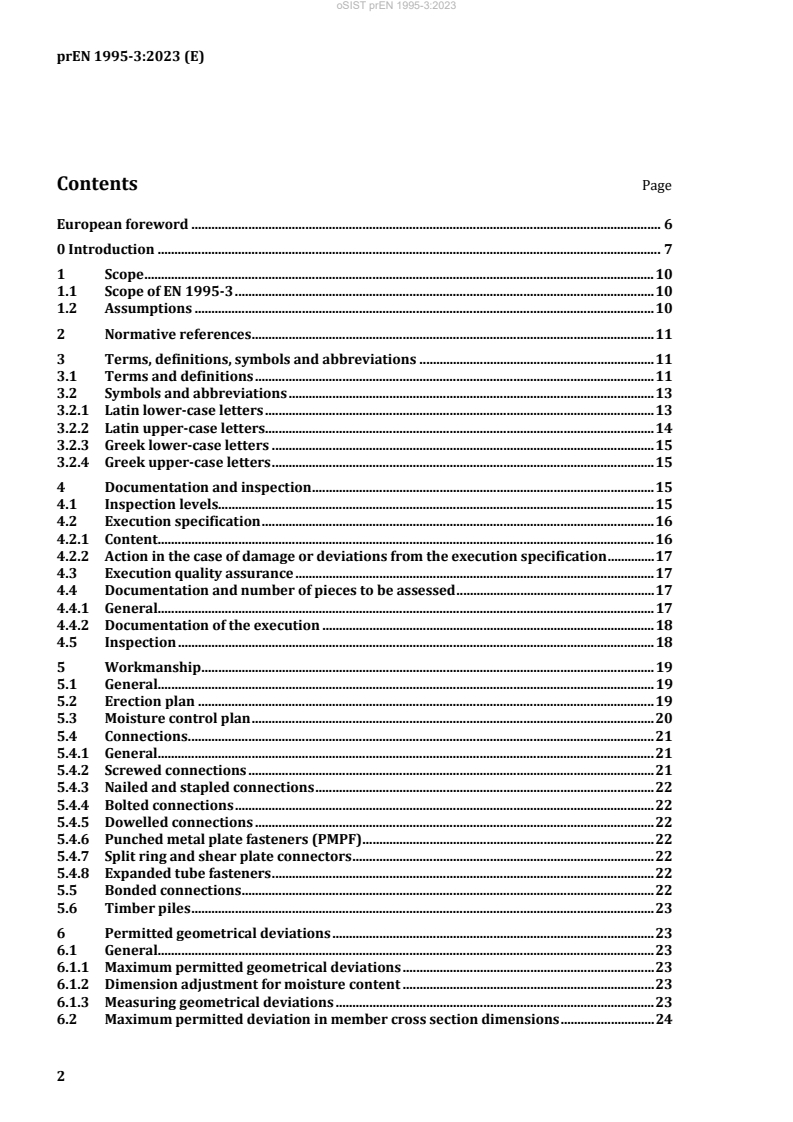
Contents Page
European foreword . 6
0 Introduction . 7
1 Scope . 10
1.1 Scope of EN 1995-3 . 10
1.2 Assumptions . 10
2 Normative references . 11
3 Terms, definitions, symbols and abbreviations . 11
3.1 Terms and definitions . 11
3.2 Symbols and abbreviations . 13
3.2.1 Latin lower-case letters . 13
3.2.2 Latin upper-case letters . 14
3.2.3 Greek lower-case letters . 15
3.2.4 Greek upper-case letters . 15
4 Documentation and inspection . 15
4.1 Inspection levels. 15
4.2 Execution specification . 16
4.2.1 Content . 16
4.2.2 Action in the case of damage or deviations from the execution specification . 17
4.3 Execution quality assurance . 17
4.4 Documentation and number of pieces to be assessed . 17
4.4.1 General. 17
4.4.2 Documentation of the execution . 18
4.5 Inspection . 18
5 Workmanship . 19
5.1 General. 19
5.2 Erection plan . 19
5.3 Moisture control plan . 20
5.4 Connections . 21
5.4.1 General. 21
5.4.2 Screwed connections . 21
5.4.3 Nailed and stapled connections . 22
5.4.4 Bolted connections . 22
5.4.5 Dowelled connections . 22
5.4.6 Punched metal plate fasteners (PMPF) . 22
5.4.7 Split ring and shear plate connectors . 22
5.4.8 Expanded tube fasteners . 22
5.5 Bonded connections . 22
5.6 Timber piles . 23
6 Permitted geometrical deviations . 23
6.1 General. 23
6.1.1 Maximum permitted geometrical deviations . 23
6.1.2 Dimension adjustment for moisture content . 23
6.1.3 Measuring geometrical deviations . 23
6.2 Maximum permitted deviation in member cross section dimensions . 24
oSIST prEN 1995-3:2023
prEN 1995-3:2023 (E)
6.3 Maximum permitted deviation for cutting and machining . 24
6.4 Hole diameters for dowel-type fasteners . 27
6.4.1 General . 27
6.4.2 Hole diameters in metal . 27
6.4.3 Hole diameters in wood . 27
6.5 Location of holes for dowel-type fasteners and connectors . 27
6.5.1 General . 27
6.5.2 Laterally loaded fasteners and connectors . 27
6.5.3 Axially loaded screws . 30
6.6 Penetration and angle to surface of dowel-type fasteners . 32
6.7 Prefabricated wall, floor and roof assemblies . 33
6.8 Erected members and structures . 33
6.8.1 General . 33
6.8.2 Inclination from vertical . 34
6.8.3 Bow in members . 38
6.8.4 Inclination from vertical at end supports and twist in slender beams . 40
6.8.5 Bearings and contact areas . 41
6.8.6 Deviation of base supports . 41
6.9 Carpentry joints . 41
Annex A (informative) Number of pieces to assess and assessment criteria. 42
A.1 Use of this annex . 42
A.2 Scope and field of application . 42
A.3 Sample size and inspection procedures . 42
Annex B (normative) Bonding . 44
B.1 Use of this annex . 44
B.2 Scope and field of application . 44
B.3 General rules . 44
B.4 Competency . 45
B.5 Equipment and premises . 45
B.6 Materials . 45
B.6.1 Timber products for surface bonding . 45
B.6.2 Screws and washers for surface bonding . 46
B.6.3 Adhesives . 46
B.7 Bonded-in rods . 47
B.7.1 Pre-drilled holes . 47
B.7.2 The rods . 47
B.7.3 The bonding process . 47
B.8 Bonding of panels and laminations . 47
B.8.1 General . 47
B.8.2 Surface preparation . 48
B.8.3 Bonding process . 48
B.8.4 Pressing . 48
oSIST prEN 1995-3:2023
prEN 1995-3:2023 (E)
B.8.4.1 Hydraulic pressing . 48
B.8.4.2 Screw-press bonding . 49
B.9 Measures to ensure contact pressure between two members . 52
B.10 Quality control . 52
B.10.1 General. 52
B.10.2 Documentation . 52
B.11 Bonded-in rod installation procedures . 53
B.11.1 General. 53
B.11.2 Procedure (i) . 53
B.11.3 Procedure (ii) . 54
B.11.4 Procedure (iii) . 55
B.12 Type and frequency of quality control for bonding operations . 56
B.13 Inspection levels of bonded-in rods . 58
Annex C (informative) Timber piles . 59
C.1 Use of this annex . 59
C.2 Scope and field of application . 59
C.3 Data recording . 59
C.4 Execution rules . 59
Annex D (normative) Carpentry joints – maximum permitted deviations . 61
D.1 Use of this annex . 61
D.2 Scope and field of application . 61
D.3 Single step connections . 61
D.4 Dovetail connections . 61
D.5 Mortise and tenon joints . 62
Annex E (informative) Detailing rules for structures in seismic areas . 63
E.1 Use of this annex . 63
E.2 Scope and field of application . 63
E.3 Number of fasteners at connections . 63
E.4 Permitted deviations of tie-down to foundations . 63
E.5 Tie-down connection at inter-storey . 64
Annex F (informative) Expanded tube connections . 65
F.1 Use of this annex . 65
F.2 Scope and field of application . 65
F.3 Introduction . 65
F.4 General. 65
F.5 Adhesive . 66
oSIST prEN 1995-3:2023
prEN 1995-3:2023 (E)
F.6 Bonding . 66
F.7 Hole diameter in DLW . 66
F.8 Expansion procedure . 67
F.9 Requirements for the dies . 67
Bibliography . 69
oSIST prEN 1995-3:2023
prEN 1995-3:2023 (E)
European foreword
This document prEN 1995-3:2023 has been prepared by Technical Committee CEN/TC 250 “Structural
Eurocodes”, the secretariat of which is held by BSI. CEN/TC 250 is responsible for all Structural
Eurocodes and has been assigned responsibility for structural and geotechnical design matters by CEN.
This document is currently submitted to the CEN Enquiry.
The first generation of EN Eurocodes was published between 2002 and 2007. This document forms part
of the second generation of the Eurocodes, which have been prepared under Mandate M/515 issued to
CEN by the European Commission and the European Free Trade Association.
The Eurocodes have been drafted to be used in conjunction with relevant execution, material, product
and test standards, and to identify requirements for execution, materials, products and testing that are
relied upon by the Eurocodes.
The Eurocodes recognize the responsibility of each Member State and have safeguarded their right to
determine values related to regulatory safety matters at national level through the use of National
Annexes.
oSIST prEN 1995-3:2023
prEN 1995-3:2023 (E)
0 Introduction
0.1 Introduction to the Eurocodes
The Structural Eurocodes comprise the following standards generally consisting of a number of Parts:
— EN 1990, Eurocode: Basis of structural and geotechnical design
— EN 1991, Eurocode 1 — Actions on structures
— EN 1992, Eurocode 2 — Design of concrete structures
— EN 1993, Eurocode 3 — Design of steel structures
— EN 1994, Eurocode 4 — Design of composite steel and concrete structures
— EN 1995, Eurocode 5 — Design of timber structures
— EN 1996, Eurocode 6 — Design of masonry structures
— EN 1997, Eurocode 7 — Geotechnical design
— EN 1998, Eurocode 8 — Design of structures for earthquake resistance
— EN 1999, Eurocode 9 — Design of aluminium structures
— New parts are under development, e.g. Eurocode for design of structural glass
The Eurocodes are intended for use by designers, clients, manufacturers, constructors, relevant
authorities (in exercising their duties in accordance with national or international regulations),
educators, software developers, and committees drafting standards for related product, testing and
execution standards.
NOTE Some aspects of design are most appropriately specified by relevant authorities or, where not specified,
can be agreed on a project-specific basis between relevant parties such as designers and clients. The Eurocodes
identify such aspects making explicit reference to relevant authorities and relevant parties.
0.2 Introduction to EN 1995 (all parts)
EN 1995 (all parts) applies to the design of timber structures and gives specific design rules for buildings
and civil engineering timber works.
EN 1995 (all parts) complies with the principles and requirements for the safety and serviceability of
structures and the basis of design and verification that are given in EN 1990.
EN 1995 (all parts) addresses only requirements for mechanical resistance, serviceability, durability and
fire resistance of timber structures. Other requirements, e.g. concerning thermal or sound insulation, are
not considered.
EN 1995 is subdivided in various parts:
EN 1995-1-1, Eurocode 5 — Design of timber structures — Part 1-1: General rules and rules for buildings
EN 1995-1-2, Eurocode 5 — Design of timber structures — Part 1-2: Structural fire design
EN 1995-2, Eurocode 5 — Design of timber structures — Part 2: Bridges
EN 1995-3, Eurocode 5 — Design of Timber Structures — Part 3: Execution
oSIST prEN 1995-3:2023
prEN 1995-3:2023 (E)
CEN/TS 19103, Design of timber structures — Structural design of timber-concrete composite structures –
Common rules and rules for buildings
0.3 Introduction to EN 1995-3
EN 1995-3 applies to the execution of timber structures to achieve the intended level of safety and
serviceability during their design service life, as given by EN 1990 and EN 1995.
This document has the following main functions:
— to transfer the requirements set during design to the constructor i.e. to be a link between design and
execution;
— to give advice for supervision and inspection of timber structures.
This document can be used to give a set of standardized technical requirements for the execution when
ordering a timber structure.
In order to achieve these functions, a set of documents and drawings giving all information required for
the execution of the work shall be available before the start of the execution. This set of documents is
referred to as the “execution specification” in this document. This document leaves a number of items
open to be decided in the execution specification.
0.4 Verbal forms used in the Eurocodes
The verb “shall” expresses a requirement strictly to be followed and from which no deviation is permitted
in order to comply with the Eurocodes.
The verb “should” expresses a highly recommended choice or course of action. Subject to national
regulation and/or any relevant contractual provisions, alternative approaches could be used/adopted
where technically justified.
The verb “may” expresses a course of action permissible within the limits of the Eurocodes.
The verb “can” expresses possibility and capability; it is used for statements of fact and clarification of
concepts.
0.5 National Annex for EN 1995-3
National choice is allowed in this standard where explicitly stated within notes. National choice includes
the selection of values for Nationally Determined Parameters (NDPs).
The national standard implementing EN 1995-3 can have a National Annex containing all national choices
to be used for the design of buildings and civil engineering works to be constructed in the relevant
country.
When no national choice is given, the default choice given in this standard is to be used.
When no national choice is made and no default is given in this standard, the choice can be specified by a
relevant authority or, where not specified, agreed for a specific project by appropriate parties.
National choice is allowed in EN 1995-3 through notes to the following clauses:
Table 4.1 Table 6.1 Table 6.2 Table 6.3
Table 6.4 Table 6.5 Table 6.8 Table 6.9
Table 6.10 Table 6.11 6.5.2.1(3), (7) and (8) 6.8.3(8) and (9)
Table B.2 B.4 (1)
oSIST prEN 1995-3:2023
prEN 1995-3:2023 (E)
National choice is allowed in EN 1995-3 on the application of the following informative annexes:
Annex A Annex C Annex E Annex F
The National Annex can contain, directly or by reference, non-contradictory complementary information
for ease of implementation, provided it does not alter any provisions of the Eurocodes.
oSIST prEN 1995-3:2023
prEN 1995-3:2023 (E)
1 Scope
1.1 Scope of EN 1995-3
(1) This document gives minimum requirements for execution of timber structures (buildings and
bridges) designed in accordance with EN 1995 to ensure that what is built meets the requirements for
mechanical resistance, serviceability, durability and fire performance.
(2) This document includes the minimum requirements for moisture control during transport to building
site, storage on site, handling on site and execution.
(3) This document gives guidance on workmanship and permitted geometrical deviations during
execution.
(4) This document relies on an execution specification which states all the specific requirements relevant
for the execution of a particular structure.
(5) For products covered by a European technical product specification, this document only covers those
aspects of fabrication such as cutting, machining and drilling after placement of the product on the
market.
(6) This document does not cover:
a) Design and detailing rules;
b) Secondary members which are not designed according to EN 1995;
c) Temporary works (such as formwork, scaffolding, propping, shoring, etc.);
d) Specification, production and conformity of timber members in accordance with European technical
product specifications;
e) Permitted geometrical deviations required for appearance, thermal or sound insulation;
f) Contractual aspects, responsibilities of the various parties, competency requirements or the degree
of independence of the personnel undertaking the inspection;
g) Health and safety requirements during execution.
1.2 Assumptions
(1) It is recognized in this document that areas such as detailed requirements for competence of
personnel, and details related to the Quality Management are within the competence of the CEN Member
States.
(2) Before the execution begins on a part of the structure, it is assumed the following are available on site
for inspection levels IL2-B and IL3 (Inspection Level according to EN 1990 and Table 4.1 of this
document):
— the design of that part, including calculations, drawings, and specification;
— the execution specification.
(3) Before the start of the execution, it is assumed that the execution specification has been checked for
completeness.
(4) It is assumed that previous work (such as foundations) has been inspected and any work which needs
to be done due to deviations from the execution specification has been carried out.
oSIST prEN 1995-3:2023
prEN 1995-3:2023 (E)
2 Normative references
The following documents are referred to in the text in such a way that some or all of their content
constitutes requirements of this document. For dated references, only the edition cited applies. For
undated references, the latest edition of the referenced document (including any amendments) applies.
NOTE See the Bibliography for a list of other documents cited that are not normative references, including
those referenced as recommendations (i.e. in ‘should’ clauses), permissions (‘may’ clauses), possibilities ('can'
clauses), and in notes.
EN 301, Adhesives, phenolic and aminoplastic, for load-bearing timber structures — Classification and
performance requirements
EN 1090-2, Execution of steel structures and aluminium structures — Part 2: Technical requirements for
steel structures
EN 1090-3, Execution of steel structures and aluminium structures — Part 3: Technical requirements for
aluminium structures
prEN 1995-1-1:2023, Eurocode 5 — Design of timber structures — Part 1-1: General rules and rules for
buildings
prEN 1995-1-2, Eurocode 5 — Design of timber structures — Part 1-2: Structural fire design
prEN 1995-2, Eurocode 5 — Design of timber structures — Part 2: Bridges
EN 14545, Timber structures — Connectors — Requirements
EN 14592, Timber structures — Dowel-type fasteners — Requirements
EN 15425, Adhesives — One component polyurethane (PUR) for load-bearing timber structures —
Classification and performance requirements
EN 17334, Glued-in rods in glued structural timber products — Testing, requirements and bond shear
strength classification
EN 17418, Two-component epoxy and polyurethane adhesives for on-site repair of cracked timber
structures — Testing, requirements and repair strength verification
3 Terms, definitions, symbols and abbreviations
3.1 Terms and definitions
For the purposes of this document, the terms and definitions given in prEN 1995-1-1, prEN 1995-1-2 and
prEN 1995-2 and the following apply.
3.1.1
batch
group of similar members or connections
3.1.2
bow
deviation from straightness where the member is curved about either its weak or strong axis
oSIST prEN 1995-3:2023
prEN 1995-3:2023 (E)
Key
l Member length
Δ , Δ Bow in the y/z-axis direction
y z
Figure 3.1 — Definitions of Δy and Δz which denote the bow in directions parallel to the local
y- and z-axes respectively
Note 1 to entry: In this document, bow is the deviation from straightness of a member that is assumed to be
perfectly straight in the structural model. The term “deviation from the specified curvature” rather than bow is used
where a member is curved or cambered in the model.
3.1.3
design documentation
collection of documents describing the design, usually including drawings and specifications
3.1.4
erection plan
collection of documents necessary for the erection
Note 1 to entry: An erection plan is usually produced by the party responsible for the construction and can include,
for example: the execution specification, storage requirements, weather protection measures, sequence of erection,
requirements for temporary works, execution methods, checking procedures, handling and assembly procedures
and other requirements necessary for the erection.
3.1.5
execution
all activities carried out for the physical completion of the work including procurement, the inspection
and documentation thereof
Note 1 to entry: The term covers work on site; it can also signify the fabrication of parts off site and their
subsequent erection on site.
3.1.6
execution specification
collection of documents that includes all requirements and information necessary for the execution
(3.1.5) of a timber structure as provided by the party responsible for the structural design documentation
Note 1 to entry: The party responsible for structural design can be more than one party and can include a
manufacturer, if that manufacturer has design responsibility.
oSIST prEN 1995-3:2023
prEN 1995-3:2023 (E)
3.1.7
inspection
evaluation of compliance by observation and assessment supported by measurement, testing or
interpretation where appropriate
3.1.8
machining
forming by machine of, for example, slots, recesses, mortices, tenons, or notches
Note 1 to entry: In some countries the term “trimming” is used instead of machining.
3.1.9
moisture control plan
plan to control the moisture content of timber members and assemblies during execution
3.1.10
permitted geometrical deviation
permitted difference between a linear or angular dimension and the corresponding target dimension
3.1.11
structural design specification
project specific document typically used to describe the chosen materials, fasteners and connectors and
specific workmanship requirements
3.1.12
surface treatments
products applied on the surface of members to improve insect resistance or fire performance
3.2 Symbols and abbreviations
3.2.1 Latin lower-case letters
a max. distance between screws in direction i
i,max
a spacing, end or edge distance of a fastener
n
b width
b distance outside slots or between slots
n
b slot width
s
d nominal screw diameter
d screw head diameter
head
f characteristic compressive strength parallel to the grain in water saturated timber
c,0,k,sat
h height
h depth of the slotted in steel-plate
s
h notch dimension
h , h mid-height and ridge height of a duo-pitched truss, or heights to eaves and ridge in a portal
1 2
frame
h diameter of circular hole or height of rectangular hole
h
h storey height
i
oSIST prEN 1995-3:2023
prEN 1995-3:2023 (E)
h locating dimension of a hole
n
k modification factor accounting for the effect of the duration of load and moisture content
mod
l relevant length of a member or part of the length of a continuous member for which bow is
limited
l effective thread length
ef
l locating dimension of a hole
n
l length of rectangular hole
h
l length of the screw point
p
l length of the slot in a timber member
s
l anchorage depth in member
w
l notch dimension
l locating dimension
n number of fasteners in a row
n number of storeys
p calculated minimum pressure
cal,min
s specified spacing, end or edge distance
n
t thickness
t thickness of nail head
head
t thickness of member to be glued 1
t thickness of member to be glued 2
t specified thickness of the steel plate
s
x x-axis
y y-axis
z z-axis
3.2.2 Latin upper-case letters
A influence area of a screw
nom
BGL block glued glulam
CC Consequence class
CLT cross laminated timber
E mean modulus of elasticity in the direction i
mean,i
F design axial resistance
ax,t,d
F characteristic head pull-through resistance
pull,k
GL Glued-laminated timber
GLVL Glued laminated veneer lumber
IL Inspection level
I Second moment of area in the direction i for a width of b = 1 mm, in mm
i,b = 1
oSIST prEN 1995-3:2023
prEN 1995-3:2023 (E)
LR Laterally restrained node
LVL Laminated veneer lumber
OSB Oriented strand board
PMPF Punched metal plate fasteners
PW Plywood
SL1-2 Straight line between centres of supports at 1 and 2
SWP Solid wood panel
SWP-C Solid wood panel with cross-layer
SWP-P Solid wood panel without cross-layer
SL Structural lumber
IL inspection level
3.2.3 Greek lower-case letters
γ partial factor for material properties
M
ε angle of the screw axis to the surface in the parallel to grain direction
μ mean of the actual spacings or edge distances for n fasteners in a row
ρ characteristic density
k
3.2.4 Greek upper-case letters
Δ linear deviation or offset
Δ bow in the local y-axis direction
y
Δ bow in the local z-axis direction
z
Δ deviation from the specified spacing, end or edge distance s where n = 1 … 4
n n
Δ maximum permitted deviation
max
Δ maximum permitted deviation from the specified spacing, end or edge distance s where n =
n,max n
1 … 4
Δ maximum permitted bow in the local y-axis direction
y,max
Δ maximum permitted bow in the local z-axis direction
z,max
ϕ deviation in inclination from vertical
ϕ inclination from vertical of column i
i
ϕ maximum permitted deviation in inclination from vertical
max
NOTE The subscript “n” is used, for example, where the deviation on more than one spacing, end or edge
distance is shown in one figure, such as in Figure 6.2.
4 Documentation and inspection
4.1 Inspection levels
(1) The inspection level (IL) for a structure or part of the structure should be specified in the execution
specification and should be selected based on the consequence class (CC, where relevant), the complexity
of the work and the degree of new technology.
oSIST prEN 1995-3:2023
prEN 1995-3:2023 (E)
(2) The consequence class for a structure or part of the structure should be specified in the execution
specification.
(3) A different consequence class may be appropriate for key members or connections within a structure,
or for items which will be hidden in the completed structure and cannot be inspected afterwards.
4.2 Execution specification
4.2.1 Content
(1) The execution specification should include design information such as the designer’s instructions and
drawings.
(2) Depending on the type of structure, the execution specification may include:
a) The structural design specification;
b) The consequence class(es);
c) Inspection levels including any special requirements;
d) Special requirements for handling including the minimum number and location of lifting points per
lift, for storage including support arrangements (upright or laid flat) and for sequence of erection
including the need for an erection plan and temporary support for stability as the erection proceeds;
e) Maximum permitted geometrical deviations (if different from those given in this document) and
methods of measuring, including identification of surfaces requiring contact in bearing or
identification of members for which the permitted deviations in bow to prevent buckling apply;
f) Which geometrical deviations should be checked and the checking procedure;
NOTE Annex A gives guidance on how many members of the same or similar type in a structure can be checked.
g) Expected moisture content in service, permitted moisture content range during execution, any
assumptions about protection during execution and whether a moisture control plan is required;
h) Fire protection and surface treatments for fire and any need for retreatment after post-processing,
e.g. after cutting or drilling;
NOTE Fire protection and surface treatments for fire are normally specified in the structural design
specification.
i) Information on treatments to improve durability and any need for a reapplication of treatment where
its effectiveness may have been affected by later works such as cutting, drilling and sanding;
NOTE Treatments to improve durability are normally specified in the structural design specification.
j) Corrosion protection of fasteners and connectors and pre-drilling, where required;
NOTE The corrosion protection of fasteners and connectors is normally specified in the structural design
specification.
k) National regulations with regard to the scope of this document;
l) Any documentation which is required in the product standards to be forwarded to the building site,
for example, the requirements in EN 14250;
oSIST prEN 1995-3:2023
prEN 1995-3:2023 (E)
(3) The execution specification should define what is to be inspected or checked.
4.2.2 Action in the case of damage or deviations from the execution specification
(1) Where the inspection reveals damage or deviations from the execution specification, appropriate
measures shall be taken to ensure that the design has not been compromised.
(2) For IL2-B and IL3 according to Table 4.1, the party responsible for the structural design should be
informed without delay and corrective measures shall be agreed before they are carried out.
(3) Corrective measures (if necessary) shall be determined by considering the mechanical resistance,
durability, fire design and serviceability.
4.3 Execution quality assurance
(1) In order to provide a structure that corresponds to the requirements and to the assumptions made in
the design, an appropriate level of quality management should be in place for IL2-B and IL3.
(2) Quality management measures should comprise:
— A project management in charge of supervision of the works;
— A site management in charge of organization of the works and of enabling the correct use of
equipment and machinery, the satisfactory quality of materials, and the execution of a conforming
structure;
— Inspection during execution.
NOTE EN ISO 9001 is an example of an acceptable basis for quality management measures.
4.4 Documentation and number of pieces to be assessed
4.4.1 General
(1) The documentation of inspections, measured deviations and the number of pieces to be assessed
shoul
...