

ISO 6357:1985
(Main)Documentation — Spine titles on books and other publications
General Information
- Abstract
Establishes rules for the general layout (position and orientation) and use of spine titles and corresponding text used on books, serial publications, periodicals, reports and other forms of documentation such as cases, cassettes, and comparable items intended for placing on shelves. Is applicable only to text with Roman, Greek or Cyrillic characters.
- Status
- Published
- Publication Date
- 18-Dec-1985
- Technical Committee
- ISO/TC 46 - Information and documentation
- Drafting Committee
- ISO/TC 46 - Information and documentation
- Current Stage
- 9093 - International Standard confirmed
- Start Date
- 12-Sep-2023
- Completion Date
- 29-Aug-2026
Buy Documents

ISO 6357:1985 - Documentation — Spine titles on books and other publications Released:12/19/1985
ISO 6357:1985 - Documentation — Titres de dos des livres et autres publications
Overview
ISO 6357:1985 is an international standard developed by the International Organization for Standardization (ISO) that specifies the rules for the layout and use of spine titles on books and other publications. This standard focuses on enhancing the readability, consistency, and usability of spine titles on a variety of documented materials, including books, serial publications, periodicals, reports, and similar items such as cases and cassettes intended for shelving.
The primary goal of ISO 6357 is to streamline the positioning and orientation of text on spines to facilitate quick and easy identification of publications, especially in multilingual library collections. It applies exclusively to text using Roman, Greek, and Cyrillic characters and includes guidelines for spine titles, library identification fields, and edge titles.
Key Topics
Spine Title Layout and Content:
- Spine titles should match the content of the title page without introducing new elements or changing the wording.
- Where space permits, include the author’s name and publisher information.
- For periodicals and volumes within a series, titles should include volume numbers and publication years or series information as applicable.
- Use transverse spine titles (horizontal lettering) where possible for ease of reading when books stand upright.
Spine Title Orientation Types:
- Transverse Spine Title: Horizontal letters when the book stands upright.
- Descending Spine Title: Text runs from top to bottom of the spine; common in many libraries.
- Ascending Spine Title: Text runs from bottom to top of the spine (considered non-standard by ISO 6357).
- These orientations support different reading habits and shelving methods, important for international and multilingual applications.
Library Identification Field:
- A dedicated area on the spine (at least 30 mm from the bottom) must remain free for adding library-specific information such as cataloging or location numbers.
- This space can accommodate labels or embossed information without disrupting the spine title.
Edge Titles:
- Used when the spine is too narrow to hold a spine title or in special cases where spine titles are not feasible.
- Edge titles run vertically on the central fold (edge) of the book’s cover-typically descending text on the front cover edge or, optionally, on the back cover.
- They facilitate filing and quick retrieval when books are shelved flat with covers facing upward or stacked.
Typography and Legibility:
- The font and size should ensure easy reading to enable quick identification on shelves or in stacks.
- Consistent typography improves usability for libraries, booksellers, and readers.
Applications
- Libraries and Archives:
Enables efficient cataloging, shelving, and retrieval by standardizing spine title formats and including space for library labeling. - Publishers:
Assists in presenting consistent information on book spines, improving the marketability and usability of publications internationally. - Booksellers and Retailers:
Facilitates better shelf organization and customer interaction through clear, standardized spine titling. - Multilingual Collections:
Supports publications with Roman, Greek, or Cyrillic scripts, promoting accessibility across diverse language materials. - Manufacturers of Cases and Media Storage:
Provides guidance on labeling cassettes, boxes, or similar documentation holders for easy shelf placement and identification.
Related Standards
- ISO 8 - Documentation - Presentation of periodicals: Complements spine titling by addressing periodical covers and general presentation standards.
- ISO 1086 - Documentation - Title-leaves of a book: Provides rules for title pages, ensuring content consistency with spine titles.
- ISO 7275 - Documentation - Presentation of series: Related to the handling of series titles, volume numbering, and publication years relevant to spine titles.
By adhering to ISO 6357:1985, organizations can improve the visual accessibility and management of documentation collections, enhancing user experience and operational efficiency in libraries, archives, and book distribution networks.
Buy Documents
ISO 6357:1985 - Documentation — Spine titles on books and other publications Released:12/19/1985
ISO 6357:1985 - Documentation — Titres de dos des livres et autres publications
Frequently Asked Questions
ISO 6357:1985 is a standard published by the International Organization for Standardization (ISO). Its full title is "Documentation — Spine titles on books and other publications". This standard covers: Establishes rules for the general layout (position and orientation) and use of spine titles and corresponding text used on books, serial publications, periodicals, reports and other forms of documentation such as cases, cassettes, and comparable items intended for placing on shelves. Is applicable only to text with Roman, Greek or Cyrillic characters.
Establishes rules for the general layout (position and orientation) and use of spine titles and corresponding text used on books, serial publications, periodicals, reports and other forms of documentation such as cases, cassettes, and comparable items intended for placing on shelves. Is applicable only to text with Roman, Greek or Cyrillic characters.
ISO 6357:1985 is classified under the following ICS (International Classification for Standards) categories: 01.140.40 - Publishing. The ICS classification helps identify the subject area and facilitates finding related standards.
ISO 6357:1985 is available in PDF format for immediate download after purchase. The document can be added to your cart and obtained through the secure checkout process. Digital delivery ensures instant access to the complete standard document.
Standards Content (Sample)
SLOVENSKI STANDARD
01-junij-1996
Dokumentacija - Hrbtni naslovi pri knjigah in drugih publikacijah
Documentation -- Spine titles on books and other publications
Documentation -- Titres de dos des livres et autres publications
Ta slovenski standard je istoveten z: ISO 6357:1985
ICS:
01.140.40 Založništvo Publishing
2003-01.Slovenski inštitut za standardizacijo. Razmnoževanje celote ali delov tega standarda ni dovoljeno.
International Standard
INTERNATIONAL ORGANIZATION FOR STANDARDIZATION.ME>KflYHAPOflHAR OPTAHM3ALWlR fl0 CTAH~APTM3ALWl~ORGANISATlON INTERNATIONALE DE NORMALISATION
Documentation - Spine titles on books and other
publications
Documentation - Titres de dos des Livres et autres publications
First edition - 1985-12-15
U DC 655.534.2 Ref. No. ISO 6357-1985 (EI
: documentation, publications, binding, titles, Position (location).
Descriptors
Price based on 3 pages
Foreword
ISO (the International Organization for Standardization) is a worldwide federation of
national Standards bodies (ISO member bodies). The work of preparing International
Standards is normally carried out through ISO technical committees. Esch member
body interested in a subject for which a technical committee has been established has
the right to be represented on that committee. International organizations, govern-
mental and non-governmental, in liaison with ISO, also take part in the work.
Draft International Standards adopted by the technical committees are circulated to
the member bodies for approval before their acceptance as International Standards by
the ISO Council. They are approved in accordance with ISO procedures requiring at
least 75 % approval by the member bodies voting.
International Standard ISO 6357 was prepared by Technical Committee ISO/TC 46,
Documentation.
Users should know that all International Standards undergo revision from time to time
and that any reference made herein to any other International Standard implies its
latest edition, unless otherwise stated.
International Organkation for Standardkation, 1985
Printed in Switzerland
_----~_-~~-~~~~
ISO 63574985 (EI
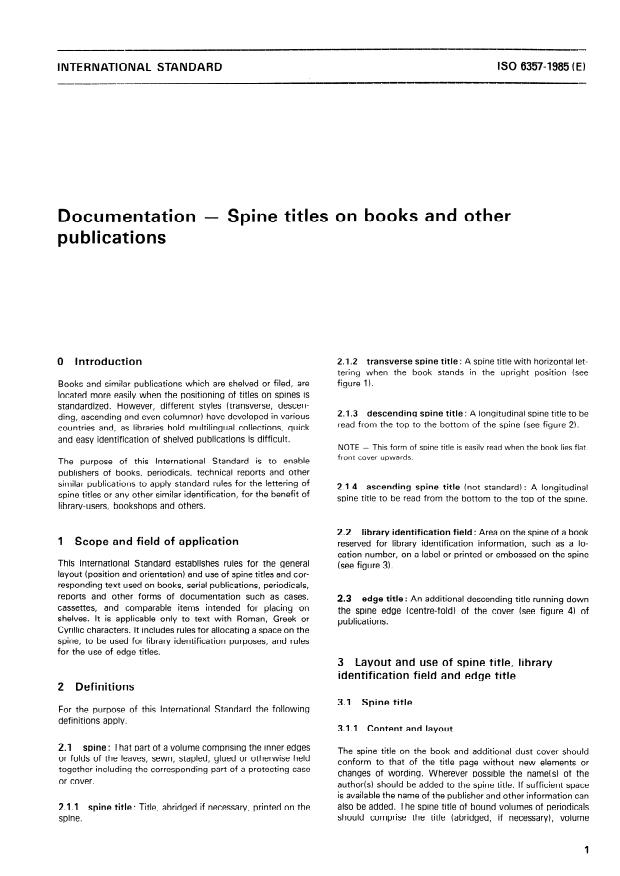
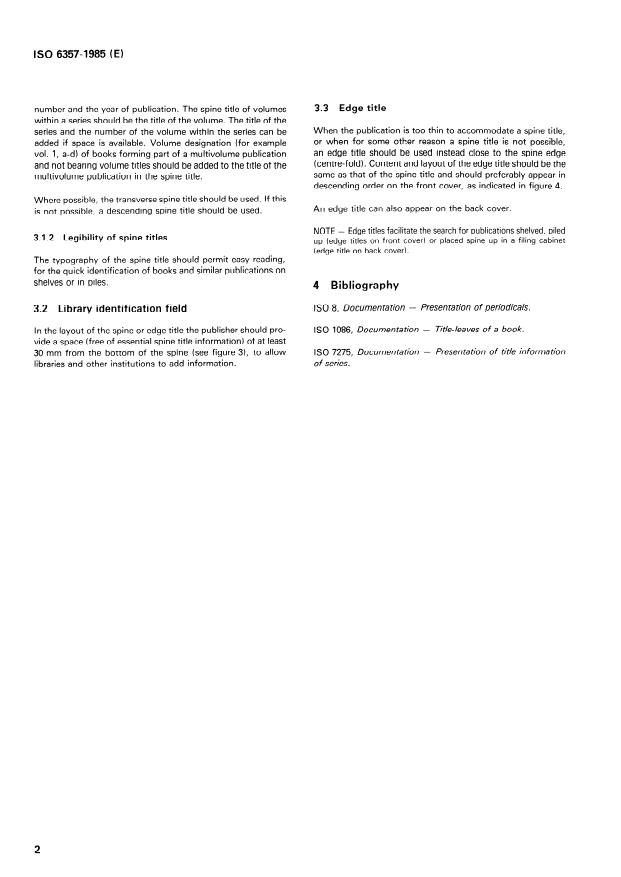
INTERNATIONAL STANDARD
Documentation - Spine titles on books and other
publications
2.1.2 transverse spine title : A spine title with horizontal let-
0 Introduction
tering when the book Stands in the upright Position (sec
figure 1).
Books and similar publications which are shelved or filed, are
located more easily when the positioning of titles on spines is
standardized. However, different styles (transverse, descen-
2.1.3 descending spine title : A longitudinal spine title to be
ding, ascending and even columnar) have developed in various
read from the top to the bottom of the spine (sec figure 2).
countries and, as Iibraries hold multilingual collections, quick
and easy identification of shelved publications is difficult.
NOTE - This form of spine title is easily read when the book lies flat,
front cover upwards.
The purpose of this International Standard is to enable
publishers of books, periodicals, technical reports and other
similar publications to apply Standard rules for the lettering of
2.1.4 ascending spine title (not Standard) : A longitudinal
spine titles or any other similar identification, for the benefit of
spine title to be read from the bottom to the top of the spine.
library-users, bookshops and others.
2.2 library identification field : Area on the spine of a book
1 Scope and field of application
reserved for library identification information, such as a lo-
cation number, on a label or
...
International Standard
INTERNATIONAL ORGANIZATION FOR STANDARDIZATION.ME>KflYHAPOflHAR OPTAHM3ALWlR fl0 CTAH~APTM3ALWl~ORGANISATlON INTERNATIONALE DE NORMALISATION
Documentation - Spine titles on books and other
publications
Documentation - Titres de dos des Livres et autres publications
First edition - 1985-12-15
U DC 655.534.2 Ref. No. ISO 6357-1985 (EI
: documentation, publications, binding, titles, Position (location).
Descriptors
Price based on 3 pages
Foreword
ISO (the International Organization for Standardization) is a worldwide federation of
national Standards bodies (ISO member bodies). The work of preparing International
Standards is normally carried out through ISO technical committees. Esch member
body interested in a subject for which a technical committee has been established has
the right to be represented on that committee. International organizations, govern-
mental and non-governmental, in liaison with ISO, also take part in the work.
Draft International Standards adopted by the technical committees are circulated to
the member bodies for approval before their acceptance as International Standards by
the ISO Council. They are approved in accordance with ISO procedures requiring at
least 75 % approval by the member bodies voting.
International Standard ISO 6357 was prepared by Technical Committee ISO/TC 46,
Documentation.
Users should know that all International Standards undergo revision from time to time
and that any reference made herein to any other International Standard implies its
latest edition, unless otherwise stated.
International Organkation for Standardkation, 1985
Printed in Switzerland
_----~_-~~-~~~~
ISO 63574985 (EI
INTERNATIONAL STANDARD
Documentation - Spine titles on books and other
publications
2.1.2 transverse spine title : A spine title with horizontal let-
0 Introduction
tering when the book Stands in the upright Position (sec
figure 1).
Books and similar publications which are shelved or filed, are
located more easily when the positioning of titles on spines is
standardized. However, different styles (transverse, descen-
2.1.3 descending spine title : A longitudinal spine title to be
ding, ascending and even columnar) have developed in various
read from the top to the bottom of the spine (sec figure 2).
countries and, as Iibraries hold multilingual collections, quick
and easy identification of shelved publications is difficult.
NOTE - This form of spine title is easily read when the book lies flat,
front cover upwards.
The purpose of this International Standard is to enable
publishers of books, periodicals, technical reports and other
similar publications to apply Standard rules for the lettering of
2.1.4 ascending spine title (not Standard) : A longitudinal
spine titles or any other similar identification, for the benefit of
spine title to be read from the bottom to the top of the spine.
library-users, bookshops and others.
2.2 library identification field : Area on the spine of a book
1 Scope and field of application
reserved for library identification information, such as a lo-
cation number, on a label or printed or embossed on the spine
This International Standard establishes rules for the general
(see figure 3).
layout (Position and orientation) and use of spine titles and cor-
responding text used on books, serial pu blications, periodicals,
reports and other forms of documentation such as cases,
2.3 edge title: An additional descending title running down
cassettes, and comparable items intended for placing on
the spine edge (centre-fo
...
Norme internationale
INTERNATIONAL ORGANIZATION FOR STANDARDlZATION.MEX~YHAPOfiHAR OPI-AHM3AUMR l-l0 CTAH~APTM3AL(W’WORGANISATlON INTERNATIONALE DE NORMALISATION
Titres de-dos des livres et autres
Documentation -
publications
Documentation T Spine titles on books and other publications
Première édition - 1985-12-15
CDU 655.534.2 Réf. no : ISO 6357-1985 (FI
Descripteurs : documentation, publication, reliure, titre, position.
Prix basé sur 3 pages
Avant-propos
L’ISO (Organisation internationale de normalisation) est une fédération mondiale
d’organismes nationaux de normalisation (comités membres de I’ISO). L’élaboration
des Normes internationales est confiée aux comités techniques de I’ISO. Chaque
comité membre intéressé par une étude a le droit de faire partie du comité technique
créé à cet effet. Les organisations internationales, gouvernementales et non gouverne-
mentales, en liaison avec I’ISO participent également aux travaux.
Les projets de Normes internationales adoptés par les comités techniques sont soumis
aux comités membres pour approbation, avant leur acceptation comme Normes inter-
nationales par le Conseil de I’ISO. Les Normes internationales sont approuvées confor-
mément aux procédures de I’ISO qui requièrent l’approbation de 75 % au moins des
comités membres votants.
La Norme internationale ISO 6357 a été élaborée par le comité technique ISO/TC 46,
Documentation.
L’attention des utilisateurs est attirée sur le fait que toutes les Normes internationales
sont de temps en temps soumises à révision et que toute référence faite à une autre
Norme internationale dans le présent document implique qu’il s’agit, sauf indication
contraire, de la dernière édition.
cc> Organisation internationale de normalisation, 1985
Imprimé en Suisse
ISO 63574985 (FI
NORME INTERNATIONALE
Titres de dos des livres et autres
Documentation -
publications
nsversal : Titre de dos avec une inscrip-
Introduction 2.1.2 titre de dos tra
tion horizontale quand le livre est debout (voir figure 1
Les livres et les publications similaires, qu’ils soient classés ou
mis en rayons, sont repérés plus facilement si on normalise la
2.1.3 titre de dos descendant: Titre de dos longitudinal lisi-
disposition des titres de dos. Cependant, différentes manières
ble de haut en bas du dos (voir figure 2).
(perpendiculaire à l’arête du dos, parallèle à l’arête du dos et lisi-
Avec cette configuration, le titre de dos se lit facilement
NOTE -
ble soit de haut en bas, soit de bas en haut, et même en
quand le livre repose à plat, la première page de couverture au-dessus.
colonne) se sont développées dans divers pays et, comme les
bibliothèques renferment des collections multilingues, il est dif-
ficile de repérer rapidement les publications en rayons. 2.1.4 titre de dos ascendant (non normalisé) : Titre de dos
longitudinal lisible de bas en haut du dos.
Le but de la présente Norme internationale est de permettre aux
éditeurs de livres, de périodiques, de rapports techniques et
2.2 zone d’identification en bibliothèque : Zone réservée,
autres publications similaires, d’appliquer des règles normali-
sur le dos d’un livre, à des éléments d’identification en biblio-
sées d’inscription des titres de dos ou de toute identification
thèque, une cote par exemple, qui peuvent être inscrits sur une
similaire, au profit des utilisateurs des bibliothèques, des Iibrai-
étiquette, imprimés ou gravés sur le dos (voir figure 3).
ries et autres.
titre de marge de couverture: Titre descendant sup-
23 .
plémentaire, courant sur le bord de la couverture de la publica-
1 Objet et domaine d’application
tion côté dos (voir figure 4).
La présente Norme internationale établit des règles pour la pré-
3 Présentation et utilisation d’un titre de
sentation générale (position et orientation) et l’utilisation des
titres de dos et du texte correspondant utilisés sur les livres, les
dos, zone d’identification en bibliothèque et
publications en série, les périodiques, les rapports et les autres
titre de marge de
...