


ISO 19869:2019
(Main)Clean cookstoves and clean cooking solutions — Field testing methods for cookstoves
Clean cookstoves and clean cooking solutions — Field testing methods for cookstoves
This document provides field testing methods to evaluate cooking system performance in real-world conditions. This document is intended to: a) Provide quantitative and qualitative measurements of cooking system performance. Requirements and guidance are provided for evaluation of usage, usability, fuel consumption, energy consumption, power, emissions, safety, and durability. These measurements include uncontrolled and controlled cooking tests. b) Provide guidance for measurements of household air pollution and personal exposure to PM2,5 and CO. c) Provide guidance for field assessments that compare cooking system performance metrics either to defined performance levels or to a counterfactual scenario that enables assessment of whether the new cooking system is improved compared to what would have been observed without the implementation of a new cooking system. d) Provide guidance for prioritizing measurements that balance comprehensiveness and feasibility. The parts of the cooking system include the cookstove, cooking vessel, fuel, user practice, and additional cooking devices (such as pot skirts and retained heat cookers). Several measurements in this document are presented as measurements of "cookstoves" or "cooking devices" for simplicity, but are intended to be interpreted as measurements of cooking systems. Some measurements (usage, kitchen energy consumption, and pollutant exposure) pertain to household-level cooking systems that include all cookstoves, cooking devices, fuels, and user practices in a household. Cooking systems can also include other aspects of the cooking environment (such as ventilation when measuring exposure). This document is applicable to cookstoves used primarily for cooking or water heating in domestic, small-scale enterprise and in institutional applications, typically with firepower less than 20 kW and cooking vessel volume less than 150 l. The provisions of this document are applicable to solar cookers. This document does not cover electric stoves or cookstoves used primarily for space heating. Although some parts of this document can be applicable to electric stoves (usage, usability, safety, durability, cooking power, and household energy consumption), specific considerations required for testing electric stoves are not provided. This document is intended for manufacturers, implementing organizations, researchers, governments, or other entities that need to evaluate cooking system performance in the field.
Fourneaux et foyers de cuisson propres — Méthodes d'essai sur site des fourneaux
General Information

Standards Content (Sample)
INTERNATIONAL ISO
STANDARD 19869
First edition
2019-09
Clean cookstoves and clean cooking
solutions — Field testing methods for
cookstoves
Fourneaux et foyers de cuisson propres — Méthodes d'essai sur site
des fourneaux
Reference number
©
ISO 2019
© ISO 2019
All rights reserved. Unless otherwise specified, or required in the context of its implementation, no part of this publication may
be reproduced or utilized otherwise in any form or by any means, electronic or mechanical, including photocopying, or posting
on the internet or an intranet, without prior written permission. Permission can be requested from either ISO at the address
below or ISO’s member body in the country of the requester.
ISO copyright office
CP 401 • Ch. de Blandonnet 8
CH-1214 Vernier, Geneva
Phone: +41 22 749 01 11
Fax: +41 22 749 09 47
Email: copyright@iso.org
Website: www.iso.org
Published in Switzerland
ii © ISO 2019 – All rights reserved
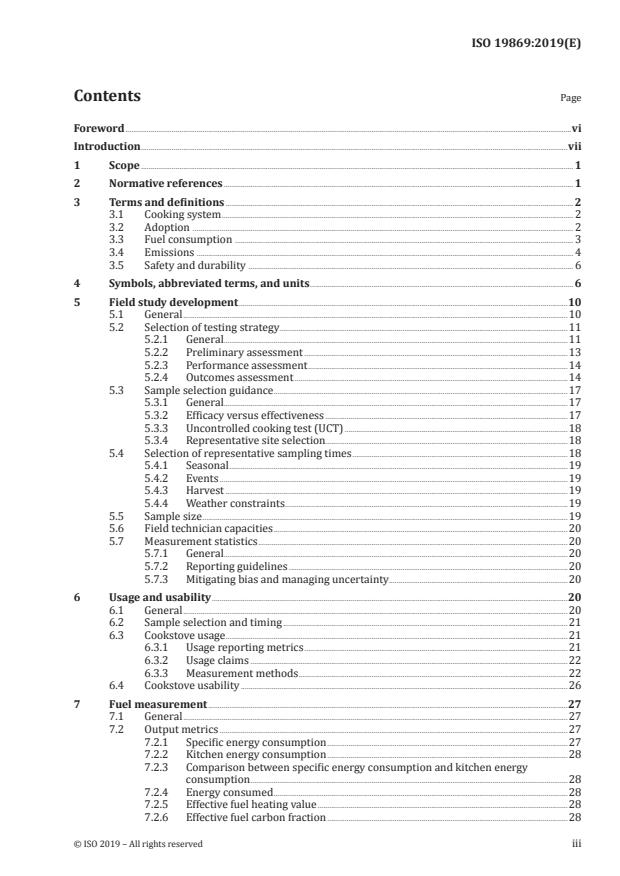
Contents Page
Foreword .vi
Introduction .vii
1 Scope . 1
2 Normative references . 1
3 Terms and definitions . 2
3.1 Cooking system . 2
3.2 Adoption . 2
3.3 Fuel consumption . 3
3.4 Emissions . 4
3.5 Safety and durability . 6
4 Symbols, abbreviated terms, and units . 6
5 Field study development .10
5.1 General .10
5.2 Selection of testing strategy .11
5.2.1 General.11
5.2.2 Preliminary assessment .13
5.2.3 Performance assessment .14
5.2.4 Outcomes assessment .14
5.3 Sample selection guidance .17
5.3.1 General.17
5.3.2 Efficacy versus effectiveness .17
5.3.3 Uncontrolled cooking test (UCT) .18
5.3.4 Representative site selection.18
5.4 Selection of representative sampling times .18
5.4.1 Seasonal .19
5.4.2 Events .19
5.4.3 Harvest .19
5.4.4 Weather constraints .19
5.5 Sample size .19
5.6 Field technician capacities .20
5.7 Measurement statistics .20
5.7.1 General.20
5.7.2 Reporting guidelines .20
5.7.3 Mitigating bias and managing uncertainty.20
6 Usage and usability .20
6.1 General .20
6.2 Sample selection and timing .21
6.3 Cookstove usage .21
6.3.1 Usage reporting metrics .21
6.3.2 Usage claims .22
6.3.3 Measurement methods .22
6.4 Cookstove usability .26
7 Fuel measurement .27
7.1 General .27
7.2 Output metrics .27
7.2.1 Specific energy consumption .27
7.2.2 Kitchen energy consumption .28
7.2.3 Comparison between specific energy consumption and kitchen energy
consumption .28
7.2.4 Energy consumed .28
7.2.5 Effective fuel heating value .28
7.2.6 Effective fuel carbon fraction .28
7.3 Equipment .28
7.4 Moisture measurement .29
7.4.1 Hand-held moisture meter .29
7.4.2 Oven dry method for wood and other non-wood solid fuels .31
7.5 Fuel heating value measurement .31
7.6 Specific fuel consumption .31
7.6.1 Test conditions.31
7.6.2 Sample selection .31
7.6.3 Measurements .32
7.6.4 Equipment .32
7.6.5 Protocol .32
7.6.6 Calculations .33
7.6.7 Reporting .34
7.7 Kitchen energy consumption measurement .35
7.7.1 Considerations .35
7.7.2 Reporting .35
7.8 Fuel measurements for emissions by carbon balance .36
7.8.1 Test conditions.36
7.8.2 Equipment .36
7.8.3 Required measurements .36
7.8.4 Determination of moisture content .37
7.8.5 Determination of lower heating value .37
7.8.6 Determination of fuel carbon fraction . .37
7.8.7 Protocol .37
7.8.8 Calculations .37
7.8.9 Reporting .39
7.9 Limitations .40
8 Emission measurement .40
8.1 Emission species measured .41
8.2 Emission output metrics .41
8.3 Sample selection .41
8.4 Sampling methods .41
8.5 Emission measurements using partial capture sampling with carbon balance .41
8.5.1 Test conditions.41
8.5.2 Required measurements .42
8.5.3 Equipment specifications .42
8.5.4 Sampling protocol .48
8.5.5 Gravimetric analysis of PM mass .49
2,5
8.5.6 Thermal optical analysis of EC/OC mass .49
8.5.7 Gas sensor calibration .49
8.5.8 Filter blanks .49
8.5.9 Leak testing .49
8.5.10 Flow rate quality control and tolerances .50
8.5.11 Dilution.50
8.5.12 Background concentration measurement .50
8.5.13 Fuel measurements .56
8.5.14 Metric calculations .56
8.6 Reporting .72
9 Power measurement .73
9.1 General .73
9.2 Cooking power .73
9.3 Average firepower .74
9.3.1 Test conditions.74
9.3.2 Required measurements .75
9.3.3 Required equipment .75
9.3.4 Measurement protocol .75
9.3.5 Data analysis and calculations .75
iv © ISO 2019 – All rights reserved
9.3.6 Reporting .75
9.3.7 Limitations .76
9.4 Power calculations for solar thermal cookstoves .76
9.4.1 Cooking power .76
9.4.2 Cooking efficiency .76
10 Safety assessment.76
10.1 Context .76
10.2 Purpose .76
10.3 Assumptions .76
10.4 Serious hazards .77
10.5 Training of safety inspectors .78
10.6 Field safety assessment procedure .78
10.6.1 General.78
10.6.2 Background information gathering .78
10.6.3 Household setting risk factors survey .79
10.6.4 Physical checks of cookstove and kitchen safety .79
10.7 Hazard likelihood matrix .84
10.8 Safety assessment report .85
11 Durability assessment .86
11.1 General .86
11.2 Test schedule .86
11.3 Sample size .87
11.3.1 Preliminary assessment sample size .87
11.3.2 Performance assessment sample size .87
11.4 Durability assessment tool outline .87
11.4.1 General information .87
11.4.2 Overall cookstove functionality.88
11.4.3 Cookstove condition .88
11.4.4 Potential reasons for changes in cookstove condition and functionality.88
11.5 Data aggregation and interpretation .89
12 Exposure to airborne pollutants .90
12.1 Area concentration measurements .90
12.1.1 General.90
12.1.2 Measurement of area concentrations .91
12.1.3 Modelled area concentrations .91
12.2 Personal exposure measurements .91
12.2.1 General.91
12.2.2 Measurement of personal exposure concentrations .92
12.2.3 Constructed exposure estimates .92
Annex A (informative) Key concepts and conventions in emission sampling .93
Annex B (informative) Safety assessment questionnaire .98
Annex C (informative) Uncertainty estimates and uncertainty propagation .104
Bibliography .106
Foreword
ISO (the International Organization for Standardization) is a worldwide federation of national standards
bodies (ISO member bodies). The work of preparing International Standards is normally carried out
through ISO technical committees. Each member body interested in a subject for which a technical
committee has been established has the right to be represented on that committee. International
organizations, governmental and non-governmental, in liaison with ISO, also take part in the work.
ISO collaborates closely with the International Electrotechnical Commission (IEC) on all matters of
electrotechnical standardization.
The procedures used to develop this document and those intended for its further maintenance are
described in the ISO/IEC Directives, Part 1. In particular, the different approval criteria needed for the
different types of ISO documents should be noted. This document was drafted in accordance with the
editorial rules of the ISO/IEC Directives, Part 2 (see www .iso .org/directives).
Attention is drawn to the possibility that some of the elements of this document may be the subject of
patent rights. ISO shall not be held responsible for identifying any or all such patent rights. Details of
any patent rights identified during the development of the document will be in the Introduction and/or
on the ISO list of patent declarations received (see www .iso .org/patents).
Any trade name used in this document is information given for the convenience of users and does not
constitute an endorsement.
For an explanation of the voluntary nature of standards, the meaning of ISO specific terms and
expressions related to conformity assessment, as well as information about ISO's adherence to the
World Trade Organization (WTO) principles in the Technical Barriers to Trade (TBT), see www .iso
.org/iso/foreword .html.
This document was prepared by Technical Committee ISO/TC 285, Clean cookstoves and clean cooking
solutions.
Any feedback or questions on this document should be directed to the user’s national standards body. A
complete listing of these bodies can be found at www .iso .org/members .html.
vi © ISO 2019 – All rights reserved
Introduction
Field measurements of cooking systems are essential for providing metrics for impact evaluation
and performance evaluation. Elements of the cooking system include cooking practice, fuel type, fuel
quality, cooking device (cookstove) characteristics, and environmental conditions. Each can affect
performance. Field tests provide measurements that capture elements of the system that are not able
to be reproduced in a laboratory setting. The performance metrics in this document are considered
more representative of cooking system performance than those described in ISO 19867-1. However,
field testing results are generally only applicable to the study region. Guidelines for determining social
[1]
impacts on individuals and communities from the cooking system are the subject of ISO/TR 19915 .
INTERNATIONAL STANDARD ISO 19869:2019(E)
Clean cookstoves and clean cooking solutions — Field
testing methods for cookstoves
1 Scope
This document provides field testing methods to evaluate cooking system performance in real-world
conditions.
This document is intended to:
a) Provide quantitative and qualitative measurements of cooking system performance. Requirements
and guidance are provided for evaluation of usage, usability, fuel consumption, energy consumption,
power, emissions, safety, and durability. These measurements include uncontrolled and controlled
cooking tests.
b) Provide guidance for measurements of household air pollution and personal exposure to PM and
2,5
CO.
c) Provide guidance for field assessments that compare cooking system performance metrics either
to defined performance levels or to a counterfactual scenario that enables assessment of whether
the new cooking system is improved compared to what would have been observed without the
implementation of a new cooking system.
d) Provide guidance for prioritizing measurements that balance comprehensiveness and feasibility.
The parts of the cooking system include the cookstove, cooking vessel, fuel, user practice, and additional
cooking devices (such as pot skirts and retained heat cookers). Several measurements in this document
are presented as measurements of “cookstoves” or “cooking devices” for simplicity, but are intended
to be interpreted as measurements of cooking systems. Some measurements (usage, kitchen energy
consumption, and pollutant exposure) pertain to household-level cooking systems that include all
cookstoves, cooking devices, fuels, and user practices in a household. Cooking systems can also include
other aspects of the cooking environment (such as ventilation when measuring exposure).
This document is applicable to cookstoves used primarily for cooking or water heating in domestic,
small-scale enterprise and in institutional applications, typically with firepower less than 20 kW and
cooking vessel volume less than 150 l. The provisions of this document are applicable to solar cookers.
This document does not cover electric stoves or cookstoves used primarily for space heating. Although
some parts of this document can be applicable to electric stoves (usage, usability, safety, durability,
cooking power, and household energy consumption), specific considerations required for testing
electric stoves are not provided.
This document is intended for manufacturers, implementing organizations, researchers, governments,
or other entities that need to evaluate cooking system performance in the field.
2 Normative references
The following documents are referred to in the text in such a way that some or all of their content
constitutes requirements of this document. For dated references, only the edition cited applies. For
undated references, the latest edition of the referenced document (including any amendments) applies.
ISO 19867-1:2018, Clean cookstoves and clean cooking solutions — Harmonized laboratory test
protocols — Part 1: Standard test sequence for emissions and performance, safety and durability
ASAE S580.1, Testing and reporting solar cooker performance
3 Terms and definitions
For the purposes of this document, the following terms and definitions apply.
ISO and IEC maintain terminological databases for use in standardization at the following addresses:
— ISO Online browsing platform: available at https: //www .iso .org/obp
— IEC Electropedia: available at http: //www .electropedia .org/
3.1 Cooking system
3.1.1
cooking device
apparatus used for cooking (by heating)
Note 1 to entry: Cooking devices include such items as cookstoves (3.1.4), pot skirts, cooking vessels (3.1.3), and
retained heat cookers.
3.1.2
cooking system
combination of cookstove (3.1.4), fuel, cooking equipment, cooking environment (including ventilation)
and cooking practice
3.1.3
cooking vessel
pot or container in which food or water is heated and prepared
3.1.4
cookstove
device primarily employed for the cooking of food, but which can also be employed for space or water
heating, or other purposes
3.1.5
improved cookstove
cookstove (3.1.4) proposed for a geographic region or target community (3.2.7), which has been shown to
outperform a baseline (3.2.2) with respect to primary criteria that can include emission factors (3.4.5),
fuel consumption (3.3.3), thermal efficiency (3.3.12), durability (3.5.2) and/or safety (3.5.7)
3.1.6
solar cookstove
solar cooker
device that delivers useful cooking heat from thermal energy received from the sun
3.1.7
traditional cookstove
type of cookstove (3.1.4) or three-stone open fire that has been in long existence in a region and has
been established from generation to generation
3.2 Adoption
3.2.1
adoption
condition in which a user employs an improved cookstove (3.1.5) regularly and maintains it
3.2.2
baseline
status of a market, community, or cooking system (3.1.2) prior to intervention, determined by
measurements and metadata
2 © ISO 2019 – All rights reserved
3.2.3
displacement
replacement of a cookstove (3.1.4) for major tasks with a different technology that is more efficient,
safer, and/or produces fewer harmful emissions
3.2.4
initial acceptance
regular use of improved cookstove (3.1.5) by household when it is acquired
3.2.5
cookstove stacking
continued household use of one or more traditional biomass-burning cookstoves (3.1.4) in addition to
adoption (3.2.1) of an improved cookstove (3.1.5) for some cooking tasks
3.2.6
sustained adoption
state in which there has been adoption (3.2.1) for an extended period of time
Note 1 to entry: The length of time for an improved cookstove (3.1.5) to be considered adopted is location and stove
specific, but should be defined by the users’ reliance on the stove, integration into regular cooking behaviour, and
frequent use of the improved cookstove, as well as repair and/or replacement of the improved cookstove when it
breaks or wears out.
3.2.7
target community
social group that regularly employs cookstoves (3.1.4) and has expressed a willingness to consider the
use of improved cookstoves (3.1.5)
3.2.8
usability
extent to which a system, product or service can be used by specified users to achieve specified goals
with effectiveness, efficiency and satisfaction in a specified context of use
[SOURCE: ISO 9241-210:2010, 2.13]
3.2.9
usage
action, amount, or mode of using a cooking device; often a quantitative measure of time that a cookstove
(3.1.4) is used
3.3 Fuel consumption
3.3.1
as fired
condition of a fuel immediately before testing in a cookstove (3.1.4)
3.3.2
burn sequence
combustion of fuel in a cookstove (3.1.4) from ignition to an end point defined in a specified protocol
3.3.3
fuel consumed
mass of raw fuel (3.3.9) fed, see fuel fed (3.3.5), minus mass of residual fuel (3.3.10), if applicable, during
a defined burn sequence (3.3.2)
Note 1 to entry: It is expressed in kilogrammes (kg).
Note 2 to entry: For applicability of residual fuel (3.3.10), see details in testing protocol.
3.3.4
fuel energy used
product of the heating value (3.3.6) of the raw fuel (3.3.9) and its mass as fired, less the product of the
heating value of the residual fuel (3.3.10), if applicable, and its mass
3.3.5
fuel fed
fuel supplied to a cookstove (3.1.4) during the course of the burn sequence (3.3.2)
3.3.6
heating value
energy per unit mass released in the complete combustion of a sample of fuel
Note 1 to entry: The heating value shall be stated as either higher heating value (3.3.7) or lower heating value
(3.3.8).
3.3.7
higher heating value
measured value of the energy of combustion of a fuel burned in oxygen in a bomb calorimeter under
−1
such conditions that all the water of the reaction products is in the form of liquid water at 15 °C, MJ.kg
3.3.8
lower heating value
calculated value of the energy of combustion of a fuel burned in oxygen in a combustion bomb under
−1
such conditions that all the water of the reaction products remain as water vapour at 150 °C, MJ.kg
Note 1 to entry: The heating value (3.3.6) at constant pressure is generally used when calculating lower
heating value.
3.3.9
raw fuel
mass of the unburned fuel supplied to a cookstove (3.1.4) during the course of the burn sequence (3.3.2)
3.3.10
residual fuel
material that has a usable energy content that remains after a burn sequence (3.3.2) is completed
3.3.11
specific fuel consumption
amount of fuel consumed (3.3.3), on a mass or energy basis, per mass of food cooked
3.3.12
thermal efficiency
ratio of useful energy delivered (3.3.13) to fuel energy used (3.3.4)
3.3.13
useful energy delivered
energy transferred to the contents of a cooking vessel (3.1.3), including the sensible heat that raises the
temperature of the contents of the cooking vessel and the latent heat of evaporation of water from the
cooking vessel
3.4 Emissions
3.4.1
black carbon
particulate carbonaceous material containing mostly carbon by mass and measured by its high
absorption of visible light
4 © ISO 2019 – All rights reserved
3.4.2
carbon emission ratio
ratio of a pollutant concentration to total carbon concentration
Note 1 to entry: Total carbon includes the CO , CO, CH , non-methane hydrocarbons, and PM.
2 4
3.4.3
carbon monoxide
toxic gas formed during the incomplete combustion of carbonaceous material
3.4.4
elemental carbon
particulate carbonaceous material emitted during combustion that demonstrates a refractory nature
according to a defined thermal-optical protocol
3.4.5
emission factor
ratio of the mass of a pollutant emitted to a defined measure that quantifies the activity emitting the
pollutant
3.4.6
emission rate
ER
mass of an air pollutant emitted per unit time, reported in units such as mg/h or g/s
3.4.7
fuel-based emission factor
EF
mass
mass of pollutant per mass of fuel consumed (3.3.3)
3.4.8
fuel energy-based emission factor
EF
energy
mass of pollutant per MJ of heat from the fuel
3.4.9
household air pollution
presence of air pollutants including solid particles or gases in air in both indoor and outdoor
environments of living spaces
3.4.10
modified combustion efficiency
MCE
proxy for true combustion efficiency calculated as molar CO over the sum of molar CO and CO
2 2
3.4.11
organic carbon
carbonaceous material emitted during combustion in which the carbon is chemically bonded to
hydrogen and possibly also oxygen, nitrogen, sulphur, or other elements
3.4.12
partial capture method
emission sampling method in which part of the exhaust plume is captured and a continuous sample is
collected
3.4.13
particulate matter
PM
solids and liquids of a sufficiently small size to be suspended in air
3.4.14
PM
2,5
fine particulate matter (3.4.13) such that the aerodynamic equivalent diameter of the particles is less
than or equal to 2,5 μm
3.4.15
pyranometer
instrument used for measuring global (all-sky) solar radiation
3.4.16
total capture method
emission sampling method in which all of the exhaust plume is captured and a continuous sample is
collected
3.5 Safety and durability
3.5.1
acute hazard
hazard (3.5.3) that has immediate or short-term negative consequences
3.5.2
durability
ability of a cookstove (3.1.4) to continue to be operated for an extended period safely and with minimal
loss of performance under conditions typical of those found in the target community (3.2.7)
3.5.3
hazard
potential source of harm
[SOURCE: ISO 7176-14:2008, 3.13]
3.5.4
kitchen
location where food is prepared and cooked
Note 1 to entry: The kitchen may be located indoors or outdoors.
3.5.5
likelihood of hazard
probability of occurrence of a hazard (3.5.3)
3.5.6
risk
product of the severity of the consequences of a hazard (3.5.3) and the likelihood that the hazard
will occur
3.5.7
safety
ability of a cookstove (3.1.4) to be operated at an acceptable level of risk of harm
3.5.8
serious hazard
hazard (3.5.3) associated with outcomes that, if present, would lead to severe consequences, such as
death or severe injury
4 Symbols, abbreviated terms, and units
NOTE Following ISO convention, decimal comma and thousand spacer in strings of numbers are used in this
document.
6 © ISO 2019 – All rights reserved
---------
...
Questions, Comments and Discussion
Ask us and Technical Secretary will try to provide an answer. You can facilitate discussion about the standard in here.
Loading comments...