

ISO 21364-22:2025
(Main)Domestic gas cooking appliances — Safety — Part 22: Particular requirements for ovens and compartment grills
General Information
- Abstract
This document specifies requirements for safety, construction and materials of domestic gas ovens and compartment grills. NOTE 1 For general requirements regarding safety, construction and materials of gas ovens and compartment grills, see ISO 21364-1. This document is applicable to the following: — the following gas cooking appliances being built-in, table top or part of a cooking range: — ovens with natural or forced convection; — pyrolytic-self-cleaning ovens and pyrolytic-self-cleaning compartment grills; — compartment grills. — oven accessories. It is not applicable to gas ovens and compartment grills intended for either outdoor use or commercial use, or both, as well as electrical heated elements as part of the appliance. NOTE 2 For requirements regarding electrical safety, refer to the IEC 60335 series. NOTE 3 Attention is drawn to the fact that: — for appliances intended to be used in vehicles or on board ships or aircraft, additional requirements can apply; — in many countries, additional requirements are specified by the national health authorities, the national water supply authorities and similar authorities. This document does not cover requirements relating to gas cylinders, their pressure regulators and their connections. This document does not cover requirements for gas installation.
- Status
- Published
- Publication Date
- 02-Jun-2025
- Technical Committee
- ISO/TC 291 - Domestic gas cooking appliances
- Drafting Committee
- ISO/TC 291 - Domestic gas cooking appliances
- Current Stage
- 6060 - International Standard published
- Start Date
- 03-Jun-2025
- Due Date
- 13-Feb-2025
- Completion Date
- 03-Jun-2025
Overview
ISO 21364-22:2025 - "Domestic gas cooking appliances - Safety - Part 22: Particular requirements for ovens and compartment grills" is the first-edition international standard that specifies safety, construction and material requirements for domestic gas ovens and compartment grills. It applies to built-in, tabletop and cooking-range ovens (natural or forced convection), pyrolytic self‑cleaning ovens and compartment grills, and associated oven accessories. The standard excludes appliances for outdoor or commercial use, electrical heating elements as part of the appliance, gas cylinders/regulators and gas installation requirements.
Key Topics
The standard provides detailed, testable requirements and procedures covering:
- Components and controls: manual shut-off valves, knobs, multifunction controls, thermostats, thermoelectric flame supervision, pressure regulators, automatic shut-off valves, injectors, ignition systems and thermal cut-outs.
- Heat input and heating tests: methods to determine nominal, reduced and total heat input; heating performance and temperature measurements under normal and abnormal conditions (e.g., thermostat failure, blocked fans).
- Combustion and emissions: simultaneous-burner measurements, combustion-product analysis, tests with reference and limit gases, and conditions for forced-convection appliances.
- Ignition, cross-lighting and flame stability: cold and hot ignition tests, behavior during door movement, automatic burner control system tests, and pyrolytic-self-cleaning ignition procedures.
- Leak tightness and unburnt gas accumulation: requirements and tests to prevent hazardous gas leakage and accumulation inside the appliance.
- Test conditions and apparatus: reference gases, pressures, temperature conditions, test pans, and installation conditions used in laboratory verification.
Applications
ISO 21364-22:2025 is used by:
- Manufacturers and product designers to design safe domestic gas ovens and compartment grills and guidance for oven accessories.
- Testing and certification bodies to develop test protocols, type-approval and conformity assessment for market access.
- Regulatory authorities and procurement teams to reference technical safety requirements for domestic gas appliances.
- Safety engineers and R&D teams for risk assessment, failure-mode testing, and verification of combustion, ignition and thermal protection systems.
Practical benefits include improved product safety, harmonized test methods for market acceptance, and clearer guidance for designing forced-convection and pyrolytic self‑cleaning ovens.
Related Standards
- ISO 21364-1 - General requirements for gas ovens and compartment grills (referenced for overarching safety and materials).
- IEC 60335 series - Electrical safety requirements (for electrical components and heating elements integrated into appliances).
Keywords: ISO 21364-22, domestic gas cooking appliances, gas ovens safety, compartment grills, pyrolytic self-cleaning, forced convection, oven safety standard, combustion testing, leak tightness.
Relations
- Effective Date
- 06-Jun-2022
Frequently Asked Questions
ISO 21364-22:2025 is a standard published by the International Organization for Standardization (ISO). Its full title is "Domestic gas cooking appliances — Safety — Part 22: Particular requirements for ovens and compartment grills". This standard covers: This document specifies requirements for safety, construction and materials of domestic gas ovens and compartment grills. NOTE 1 For general requirements regarding safety, construction and materials of gas ovens and compartment grills, see ISO 21364-1. This document is applicable to the following: — the following gas cooking appliances being built-in, table top or part of a cooking range: — ovens with natural or forced convection; — pyrolytic-self-cleaning ovens and pyrolytic-self-cleaning compartment grills; — compartment grills. — oven accessories. It is not applicable to gas ovens and compartment grills intended for either outdoor use or commercial use, or both, as well as electrical heated elements as part of the appliance. NOTE 2 For requirements regarding electrical safety, refer to the IEC 60335 series. NOTE 3 Attention is drawn to the fact that: — for appliances intended to be used in vehicles or on board ships or aircraft, additional requirements can apply; — in many countries, additional requirements are specified by the national health authorities, the national water supply authorities and similar authorities. This document does not cover requirements relating to gas cylinders, their pressure regulators and their connections. This document does not cover requirements for gas installation.
This document specifies requirements for safety, construction and materials of domestic gas ovens and compartment grills. NOTE 1 For general requirements regarding safety, construction and materials of gas ovens and compartment grills, see ISO 21364-1. This document is applicable to the following: — the following gas cooking appliances being built-in, table top or part of a cooking range: — ovens with natural or forced convection; — pyrolytic-self-cleaning ovens and pyrolytic-self-cleaning compartment grills; — compartment grills. — oven accessories. It is not applicable to gas ovens and compartment grills intended for either outdoor use or commercial use, or both, as well as electrical heated elements as part of the appliance. NOTE 2 For requirements regarding electrical safety, refer to the IEC 60335 series. NOTE 3 Attention is drawn to the fact that: — for appliances intended to be used in vehicles or on board ships or aircraft, additional requirements can apply; — in many countries, additional requirements are specified by the national health authorities, the national water supply authorities and similar authorities. This document does not cover requirements relating to gas cylinders, their pressure regulators and their connections. This document does not cover requirements for gas installation.
ISO 21364-22:2025 is classified under the following ICS (International Classification for Standards) categories: 97.040.20 - Cooking ranges, working tables, ovens and similar appliances. The ICS classification helps identify the subject area and facilitates finding related standards.
ISO 21364-22:2025 has the following relationships with other standards: It is inter standard links to ISO/TS 21364-22:2021. Understanding these relationships helps ensure you are using the most current and applicable version of the standard.
ISO 21364-22:2025 is available in PDF format for immediate download after purchase. The document can be added to your cart and obtained through the secure checkout process. Digital delivery ensures instant access to the complete standard document.
Standards Content (Sample)
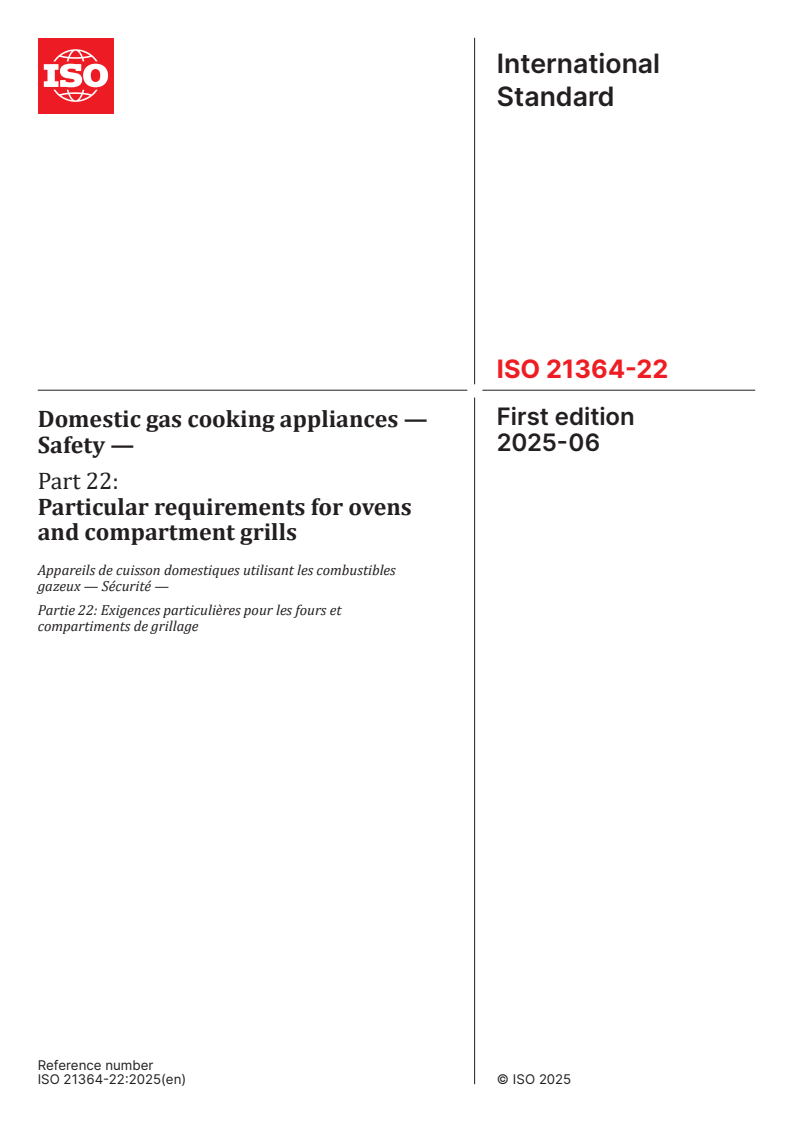
International
Standard
ISO 21364-22
First edition
Domestic gas cooking appliances —
2025-06
Safety —
Part 22:
Particular requirements for ovens
and compartment grills
Appareils de cuisson domestiques utilisant les combustibles
gazeux — Sécurité —
Partie 22: Exigences particulières pour les fours et
compartiments de grillage
Reference number
© ISO 2025
All rights reserved. Unless otherwise specified, or required in the context of its implementation, no part of this publication may
be reproduced or utilized otherwise in any form or by any means, electronic or mechanical, including photocopying, or posting on
the internet or an intranet, without prior written permission. Permission can be requested from either ISO at the address below
or ISO’s member body in the country of the requester.
ISO copyright office
CP 401 • Ch. de Blandonnet 8
CH-1214 Vernier, Geneva
Phone: +41 22 749 01 11
Email: copyright@iso.org
Website: www.iso.org
Published in Switzerland
ii
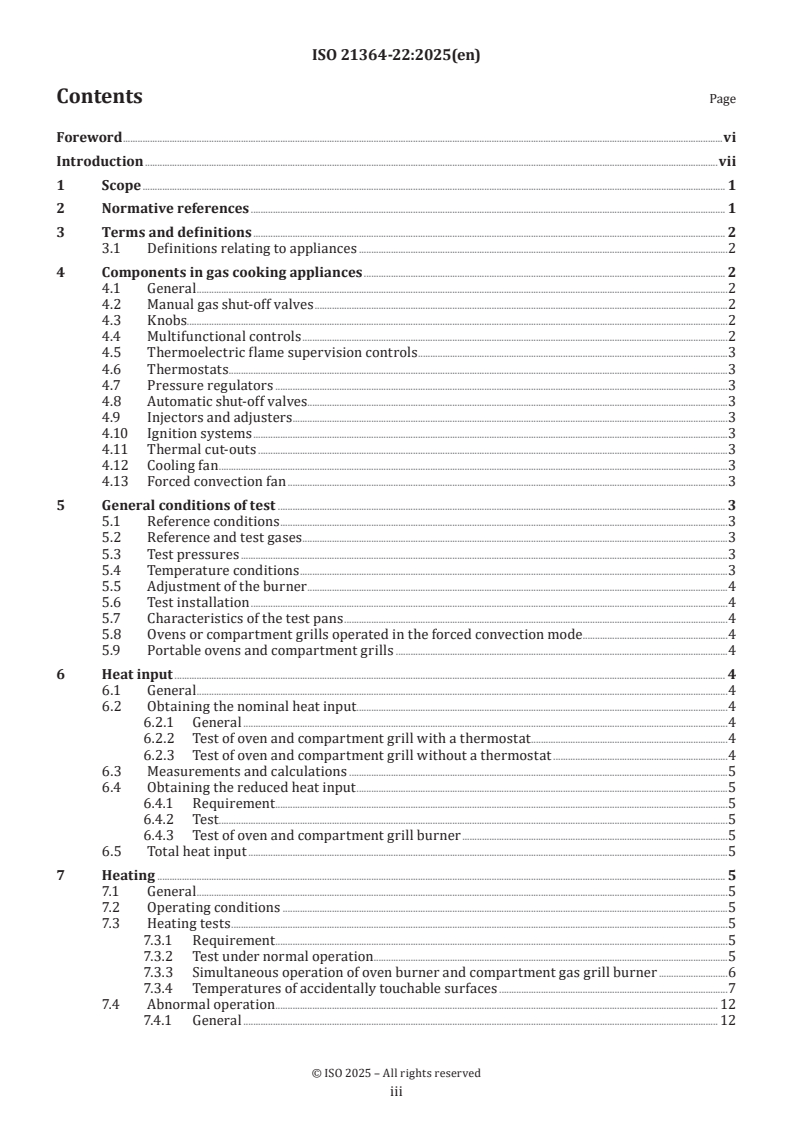
Contents Page
Foreword .vi
Introduction .vii
1 Scope . 1
2 Normative references . 1
3 Terms and definitions . 2
3.1 Definitions relating to appliances .2
4 Components in gas cooking appliances . 2
4.1 General .2
4.2 Manual gas shut-off valves .2
4.3 Knobs.2
4.4 Multifunctional controls .2
4.5 Thermoelectric flame supervision controls .3
4.6 Thermostats . .3
4.7 Pressure regulators .3
4.8 Automatic shut-off valves.3
4.9 Injectors and adjusters . .3
4.10 Ignition systems .3
4.11 Thermal cut-outs .3
4.12 Cooling fan .3
4.13 Forced convection fan .3
5 General conditions of test . 3
5.1 Reference conditions .3
5.2 Reference and test gases .3
5.3 Test pressures .3
5.4 Temperature conditions .3
5.5 Adjustment of the burner .4
5.6 Test installation .4
5.7 Characteristics of the test pans .4
5.8 Ovens or compartment grills operated in the forced convection mode .4
5.9 Portable ovens and compartment grills .4
6 Heat input . 4
6.1 General .4
6.2 Obtaining the nominal heat input . .4
6.2.1 General .4
6.2.2 Test of oven and compartment grill with a thermostat .4
6.2.3 Test of oven and compartment grill without a thermostat .4
6.3 Measurements and calculations .5
6.4 Obtaining the reduced heat input .5
6.4.1 Requirement .5
6.4.2 Test . . .5
6.4.3 Test of oven and compartment grill burner .5
6.5 Total heat input .5
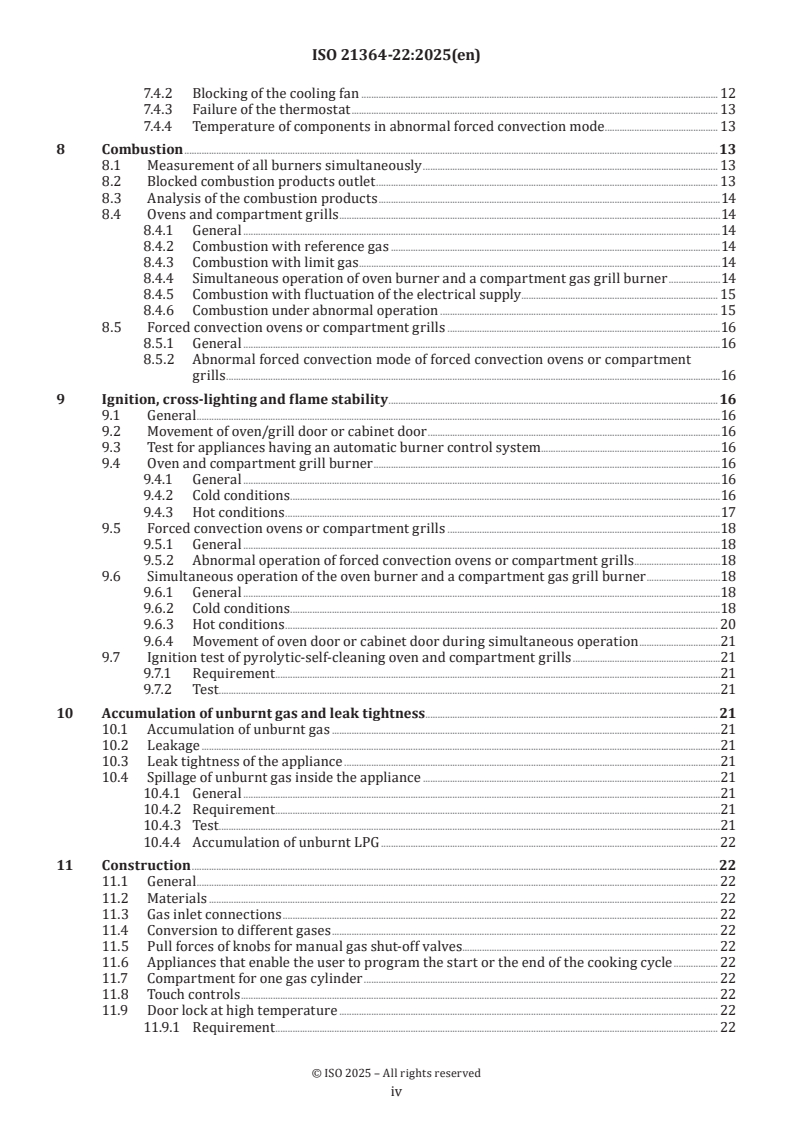
7 Heating . 5
7.1 General .5
7.2 Operating conditions .5
7.3 Heating tests .5
7.3.1 Requirement .5
7.3.2 Test under normal operation .5
7.3.3 Simultaneous operation of oven burner and compartment gas grill burner .6
7.3.4 Temperatures of accidentally touchable surfaces .7
7.4 Abnormal operation . 12
7.4.1 General . 12
iii
7.4.2 Blocking of the cooling fan . 12
7.4.3 Failure of the thermostat . 13
7.4.4 Temperature of components in abnormal forced convection mode . 13
8 Combustion .13
8.1 Measurement of all burners simultaneously . 13
8.2 Blocked combustion products outlet . 13
8.3 Analysis of the combustion products .14
8.4 Ovens and compartment grills .14
8.4.1 General .14
8.4.2 Combustion with reference gas .14
8.4.3 Combustion with limit gas .14
8.4.4 Simultaneous operation of oven burner and a compartment gas grill burner .14
8.4.5 Combustion with fluctuation of the electrical supply. 15
8.4.6 Combustion under abnormal operation . 15
8.5 Forced convection ovens or compartment grills .16
8.5.1 General .16
8.5.2 Abnormal forced convection mode of forced convection ovens or compartment
grills .16
9 Ignition, cross-lighting and flame stability .16
9.1 General .16
9.2 Movement of oven/grill door or cabinet door .16
9.3 Test for appliances having an automatic burner control system.16
9.4 Oven and compartment grill burner .16
9.4.1 General .16
9.4.2 Cold conditions . .16
9.4.3 Hot conditions .17
9.5 Forced convection ovens or compartment grills .18
9.5.1 General .18
9.5.2 Abnormal operation of forced convection ovens or compartment grills .18
9.6 Simultaneous operation of the oven burner and a compartment gas grill burner .18
9.6.1 General .18
9.6.2 Cold conditions . .18
9.6.3 Hot conditions . 20
9.6.4 Movement of oven door or cabinet door during simultaneous operation .21
9.7 Ignition test of pyrolytic-self-cleaning oven and compartment grills .21
9.7.1 Requirement .21
9.7.2 Test . . .21
10 Accumulation of unburnt gas and leak tightness .21
10.1 Accumulation of unburnt gas .21
10.2 Leakage .21
10.3 Leak tightness of the appliance .21
10.4 Spillage of unburnt gas inside the appliance .21
10.4.1 General .21
10.4.2 Requirement .21
10.4.3 Test . . .21
10.4.4 Accumulation of unburnt LPG . 22
11 Construction .22
11.1 General . 22
11.2 Materials . 22
11.3 Gas inlet connections . 22
11.4 Conversion to different gases . 22
11.5 Pull forces of knobs for manual gas shut-off valves. 22
11.6 Appliances that enable the user to program the start or the end of the cooking cycle . 22
11.7 Compartment for one gas cylinder . 22
11.8 Touch controls . 22
11.9 Door lock at high temperature . 22
11.9.1 Requirement . 22
iv
11.9.2 Test . . . 22
11.10 Appliances having pyrolytic-self-cleaning ovens and compartment grills . 23
11.10.1 Door locking means for pyrolytic-self-cleaning oven and compartment grills . 23
11.10.2 Door lock mechanism that are temperature actuated . 23
11.10.3 Door lock mechanism that are manually or electrically actuated . 23
11.10.4 Sealing means for pyrolytic ovens and compartment grills .24
11.10.5 Temperature limiting means for pyrolytic ovens and compartment grills .24
11.10.6 Vapour combustion or flash-out during the pyrolytic-self-cleaning cycle .24
11.10.7 Flue gas temperatures of pyrolytic-self-cleaning ovens and compartment grills . 25
11.11 Ignition with an external lighter . 26
12 Mechanical strength .26
12.1 Parts made of glass and glass-ceramic . 26
12.1.1 General . 26
12.1.2 Spring hammer test . 26
12.1.3 Punch test . 26
12.1.4 Appliance door . 26
12.2 Appliance body of freestanding appliances .27
12.2.1 Requirement .27
12.2.2 Test . . .27
12.3 Oven door strength.27
12.3.1 Requirement .27
12.3.2 Test . . .27
12.4 Tilting of freestanding ovens and compartment grills.27
12.4.1 Tilting .27
12.4.2 Tilting under special conditions . 28
12.5 Strength and stability of oven and grill accessories . 28
12.5.1 Requirement . 28
12.5.2 Test . . . 28
12.6 Portable ovens and compartment grills . 29
12.6.1 General . 29
12.6.2 Tilting of portable ovens and compartment grills . 29
13 Electrical safety .29
14 Marking and instructions .29
14.1 Marking . 29
14.1.1 Marking on the appliance . 29
14.2 Instructions . 30
Annex A (normative) National deviations in various countries.31
Annex B (informative) Additional tests for oven burners and compartment grill burners
supplied with natural gas and hydrogen admixtures .33
Annex C (informative) Additional combustion test for NO measurement of oven burners and
compartment grill burners .38
Bibliography .40
v
Foreword
ISO (the International Organization for Standardization) is a worldwide federation of national standards
bodies (ISO member bodies). The work of preparing International Standards is normally carried out through
ISO technical committees. Each member body interested in a subject for which a technical committee
has been established has the right to be represented on that committee. International organizations,
governmental and non-governmental, in liaison with ISO, also take part in the work. ISO collaborates closely
with the International Electrotechnical Commission (IEC) on all matters of electrotechnical standardization.
The procedures used to develop this document and those intended for its further maintenance are described
in the ISO/IEC Directives, Part 1. In particular, the different approval criteria needed for the different types
of ISO document should be noted. This document was drafted in accordance with the editorial rules of the
ISO/IEC Directives, Part 2 (see www.iso.org/directives).
ISO draws attention to the possibility that the implementation of this document may involve the use of (a)
patent(s). ISO takes no position concerning the evidence, validity or applicability of any claimed patent
rights in respect thereof. As of the date of publication of this document, ISO had not received notice of (a)
patent(s) which may be required to implement this document. However, implementers are cautioned that
this may not represent the latest information, which may be obtained from the patent database available at
www.iso.org/patents. ISO shall not be held responsible for identifying any or all such patent rights.
Any trade name used in this document is information given for the convenience of users and does not
constitute an endorsement.
For an explanation of the voluntary nature of standards, the meaning of ISO specific terms and expressions
related to conformity assessment, as well as information about ISO's adherence to the World Trade
Organization (WTO) principles in the Technical Barriers to Trade (TBT), see www.iso.org/iso/foreword.html.
This document was prepared by Technical Committee ISO/TC 291, Domestic gas cooking appliances.
This first edition of ISO 21364-22:2025 cancels and replaces ISO/TS 21364-22:2021.
A list of all parts in the ISO 21364 series can be found on the ISO website.
Any feedback or questions on this document should be directed to the user’s national standards body. A
complete listing of these bodies can be found at www.iso.org/members.html.
vi
Introduction
Gas burning appliances using fuel gases must withstand the type of gas which is specified. Other International
Standards cover the testing and properties of fuel gases.
Due to the differing properties of fuel gas depending on its source and region of origin, certain differences in
regulations exist in different regions at present; some of these differences are presented in Annex A.
This document is designed to be used in combination with ISO 21364-1. Together, they establish the
requirements to the product covered by this document. Where needed, this document adapts certain
requirements from ISO 21364-1 with amendments such as:
— “with the following modification”;
— “with the following addition”;
— “is replaced by the following”;
— “is not applicable”.
In order to identify specific requirements that are particular to this document, and not already covered by
ISO 21364-1, this document contains clauses or subclauses that differ to the structure of ISO 21364-1.
To ensure the global relevance of this document, the differing requirements resulting from practical
experience and installation practices in various regions of the world are taken into account. The variations
in basic infrastructure associated with appliances are also taken into account, some of which are addressed
ISO 21364-1:2025, Annex E and Annex A of this document. This document intends to provide a basic
framework of requirements that recognize these differences.
vii
International Standard ISO 21364-22:2025(en)
Domestic gas cooking appliances — Safety —
Part 22:
Particular requirements for ovens and compartment grills
1 Scope
This document specifies requirements for safety, construction and materials of domestic gas ovens and
compartment grills.
NOTE 1 For general requirements regarding safety, construction and materials of gas ovens and compartment
grills, see ISO 21364-1.
This document is applicable to the following:
— the following gas cooking appliances being built-in, table top or part of a cooking range:
— ovens with natural or forced convection;
— pyrolytic-self-cleaning ovens and pyrolytic-self-cleaning compartment grills;
— compartment grills.
— oven accessories.
It is not applicable to gas ovens and compartment grills intended for either outdoor use or commercial use,
or both, as well as electrical heated elements as part of the appliance.
NOTE 2 For requirements regarding electrical safety, refer to the IEC 60335 series.
NOTE 3 Attention is drawn to the fact that:
— for appliances intended to be used in vehicles or on board ships or aircraft, additional requirements can apply;
— in many countries, additional requirements are specified by the national health authorities, the national water
supply authorities and similar authorities.
This document does not cover requirements relating to gas cylinders, their pressure regulators and their
connections.
This document does not cover requirements for gas installation.
2 Normative references
The following documents are referred to in the text in such a way that some or all of their content constitutes
requirements of this document. For dated references, only the edition cited applies. For undated references,
the latest edition of the referenced document (including any amendments) applies.
ISO 3864-1, Graphical symbols — Safety colours and safety signs — Part 1: Design principles for safety signs and
safety markings
ISO 7010, Graphical symbols — Safety colours and safety signs — Registered safety signs
ISO 21364-1:2025, , Domestic gas cooking appliances — Safety — Part 1: General requirements
ISO 21364-21:2025, Domestic gas cooking appliances — Safety — Part 21: Particular requirements for gas
hobs, gas grills and gas griddles
IEC 60335-2-102, Household and similar electrical appliances — Safety — Part 2-102: Particular requirements
for gas, oil and solid-fuel burning appliances having electrical connections
IEC 60584-1:2013, Thermocouples - Part 1: EMF specifications and tolerances
IEC 61032:1997, Protection of persons and equipment by enclosures – Probes for verification
3 Terms and definitions
For the purposes of this document, the terms and definitions given in ISO 21364-1 and the following apply.
ISO and IEC maintain terminological databases for use in standardization at the following addresses:
— ISO Online browsing platform: available at https:// www .iso .org/ obp
— IEC Electropedia: available at https:// www .electropedia .org/
3.1 Definitions relating to appliances
3.1.1
pyrolytic self-cleaning oven
oven in which cooking deposits are removed by heating the oven to a temperature exceeding 350 °C
[SOURCE: IEC 60335-2-6:2014, 3.5.105]
3.1.2
cooking surface
horizontal surface of the hob section
3.1.3
forced convection mode
heating mode for appliances equipped with a fan intended to assist the transmission of heat by creating a
forced circulation of air or products of combustion
Note 1 to entry: This fan is not intended to supply combustion air.
4 Components in gas cooking appliances
4.1 General
ISO 21364-1:2025, 4.1 shall apply.
4.2 Manual gas shut-off valves
ISO 21364-1:2025, 4.2 shall apply.
4.3 Knobs
ISO 21364-1:2025, 4.3 shall apply.
4.4 Multifunctional controls
ISO 21364-1:2025, 4.4 shall apply.
4.5 Thermoelectric flame supervision controls
ISO 21364-1:2025, 4.5 shall apply.
4.6 Thermostats
ISO 21364-1:2025, 4.6 shall apply.
4.7 Pressure regulators
ISO 21364-1:2025, 4.7 shall apply.
4.8 Automatic shut-off valves
ISO 21364-1:2025, 4.8 shall apply.
4.9 Injectors and adjusters
ISO 21364-1:2025, 4.9 shall apply.
4.10 Ignition systems
ISO 21364-1:2025, 4.10 shall apply.
4.11 Thermal cut-outs
ISO 21364-1:2025, 4.11 shall apply.
4.12 Cooling fan
A motor of a cooling fan shall conform with the requirements of IEC 60335-2-102.
If the appliance has a cooling fan, the fan shall operate automatically.
4.13 Forced convection fan
The motor of a forced convection fan shall conform with the requirements of IEC 60335-2-102.
5 General conditions of test
5.1 Reference conditions
ISO 21364-1:2025, 5.1 shall apply.
5.2 Reference and test gases
ISO 21364-1:2025, 5.2 shall apply.
5.3 Test pressures
ISO 21364-1:2025, 5.3 shall apply.
5.4 Temperature conditions
ISO 21364-1:2025, 5.4 shall apply.
5.5 Adjustment of the burner
ISO 21364-1:2025, 5.5 shall apply.
5.6 Test installation
ISO 21364-1:2025, 5.6 shall apply.
5.7 Characteristics of the test pans
ISO 21364-1:2025, 5.7 shall apply.
5.8 Ovens or compartment grills operated in the forced convection mode
Ovens and compartment grills that can be operated in the forced convection mode shall be tested in the
same way as ovens or grills operated with natural convection but operated in the forced convection mode.
5.9 Portable ovens and compartment grills
Portable ovens and compartment grills shall be tested according to all the applicable clauses for ovens and
compartment grills with the exception of 7.3.4.2, 12.2, 12.3, 12.4 and 12.5.
6 Heat input
6.1 General
ISO 21364-1:2025, 6.1 shall apply.
6.2 Obtaining the nominal heat input
6.2.1 General
ISO 21364-1:2025, 6.2 shall apply, with the following additions.
6.2.2 Test of oven and compartment grill with a thermostat
The burner of an appliance with thermostat shall be tested under the following conditions:
— the burner is ignited and operated with the thermostat at full rate at normal pressure and with the door
closed or open to avoid cycling of the thermostat;
— measuring begins from ignition. For analogue meters, measuring terminates when the highest number
of complete revolutions have been made before the end of the fifth minute. The test shall be finished
before the thermostat starts cycling.
Then the heat input is calculated under reference conditions according to ISO 21364-1:2025, 6.3.
6.2.3 Test of oven and compartment grill without a thermostat
The burner of an appliance without a thermostat shall be tested under the following conditions:
— with the appliance at ambient temperature, the burner is ignited and operated at full rate at normal
pressure for 10 min;
— measurement starts at the end of the tenth minute and finishes at the latest at the end of the thirteenth
minute, with a minimum measurement time of one minute or when the highest number of complete
revolutions of the meter have been made before the end of the thirteenth minute. For analogue meters,
the measurement shall be taken over at least one complete revolution.
Then the heat input shall be calculated under reference conditions according to ISO 21364-1:2025, 6.3.
6.3 Measurements and calculations
ISO 21364-1:2025, 6.3 shall apply.
6.4 Obtaining the reduced heat input
6.4.1 Requirement
ISO 21364-1:2025, 6.4.1 shall apply.
6.4.2 Test
ISO 21364-1:2025, 6.4.2 shall apply.
6.4.3 Test of oven and compartment grill burner
The reduced heat input shall be measured after the nominal heat input at the same conditions with the oven
door closed and the gas control is changed to reduced rate. For appliances with thermostatic regulation, the
measurement shall be done after 30 minutes, with a minimum measurement time of one minute. If using
analogue meters, measurements shall be taken over at least one complete revolution of the analogue meter.
6.5 Total heat input
ISO 21364-1:2025, 6.5 shall apply.
7 Heating
7.1 General
ISO 21364-1:2025, 7.1 shall apply.
7.2 Operating conditions
ISO 21364-1:2025, 7.2 shall apply.
7.3 Heating tests
7.3.1 Requirement
ISO 21364-1:2025, 7.3.1 shall apply.
7.3.2 Test under normal operation
7.3.2.1 General
ISO 21364-1:2025, 7.3.2.1 shall apply.
7.3.2.2 Hob burner
ISO 21364-1:2025, 7.3.2.2 shall apply.
7.3.2.3 Electric hob elements
ISO 21364-1:2025, 7.3.2.3 shall apply.
7.3.2.4 Oven burner
ISO 21364-1:2025, 7.3.2.4 shall apply.
7.3.2.5 Electric oven
ISO 21364-1:2025, 7.3.2.5 shall apply.
7.3.2.6 Gas compartment grill
ISO 21364-1:2025, 7.3.2.6 shall apply.
7.3.2.7 Electric compartment grill
ISO 21364-1:2025, 7.3.2.7 shall apply.
7.3.2.8 Gas griddle
ISO 21364-1:2025, 7.3.2.8 shall apply.
7.3.2.9 Electric griddle
ISO 21364-1:2025, 7.3.2.9 shall apply.
7.3.2.10 Gas surface grill
ISO 21364-1:2025, 7.3.2.10 shall apply.
7.3.2.11 Electric surface grill
ISO 21364-1:2025, 7.3.2.11 shall apply.
7.3.2.12 Gas warming drawer
ISO 21364-1:2025, 7.3.2.12 shall apply.
7.3.2.13 Electric warming drawer
ISO 21364-1:2025, 7.3.2.13 shall apply.
7.3.2.14 Ovens or compartment grills operated in the forced convection mode
Ovens and compartment grills that can be operated in the forced convection mode shall be tested in the
same way as ovens or grills with natural convection (see ISO 21364-1:2025, 7.3.2.4 and 7.3.2.6), but with an
average temperature of 210 °C instead of 230 °C at the centre of the compartment.
7.3.3 Simultaneous operation of oven burner and compartment gas grill burner
7.3.3.1 Requirement 1
At the end of Test 1 specified in 7.3.3.2, the temperature rise of accessible touchable surfaces shall meet the
values indicated in 7.3.4.2.1, Table 1.
7.3.3.2 Test 1
The oven burner is operated at an average temperature of 200 °C in the centre of the oven. This temperature
is maintained. The grill burner is operated at full rate.
After 1 h of operation, the temperatures are measured. For this test, the measurement procedure of 7.3.4.2.2
applies.
7.3.3.3 Requirement 2
At the end of Test 2 specified in 7.3.3.4, the temperature rise shall meet the values indicated in
ISO 21364-
...