

ISO 21364-1:2025
(Main)Domestic gas cooking appliances — Safety — Part 1: General requirements
General Information
- Abstract
This document specifies the safety requirements for domestic gas cooking appliances. This covers appliances that are freestanding, built-in or table-top and are intended to be used indoors. This document applies to the gas sections of the appliances and their component parts (e.g. combined gas-electric cooking appliances). This document does not apply to: a) electrical heated elements as part of the appliance; b) outdoor appliances; c) appliances supplied at pressures greater than the maximum pressure of the test gases; d) cook stoves covered by the standards developed by ISO/TC 285. In general, it does not take into account children playing with the appliance. NOTE 1 For requirements regarding electrical safety, refer to the IEC 60335 series. NOTE 2 Attention is drawn to the fact that: — for appliances intended to be used in vehicles or on board of ships or aircrafts, additional requirements can apply; — in many countries, additional requirements are specified by the national health authorities, the national water supply authorities and similar authorities. This document does not cover requirements relating to gas cylinders, their pressure regulators and their connections. This document does not cover requirements for gas installation.
- Status
- Published
- Publication Date
- 02-Jun-2025
- Technical Committee
- ISO/TC 291 - Domestic gas cooking appliances
- Drafting Committee
- ISO/TC 291 - Domestic gas cooking appliances
- Current Stage
- 6060 - International Standard published
- Start Date
- 03-Jun-2025
- Due Date
- 13-Feb-2025
- Completion Date
- 03-Jun-2025
Overview
ISO 21364-1:2025 - Domestic gas cooking appliances - Safety - Part 1: General requirements is an international safety standard that defines the safety requirements and test methods for indoor domestic gas cooking appliances. It covers freestanding, built-in and table-top gas cooking appliances (including combined gas‑electric units) and focuses on the gas sections and their component parts. The standard explicitly excludes electrical heating elements, outdoor appliances, appliances supplied above the maximum test-gas pressure, cook stoves covered by ISO/TC 285, gas cylinders and their regulators, and gas installation requirements.
Key topics and requirements
The standard organizes technical requirements and tests around appliance components, operating conditions and safety performance. Major topics include:
- Components and controls: requirements for manual gas shut-off valves, knobs, multifunctional controls, thermostats, pressure regulators and automatic shut-off valves.
- Flame supervision and ABCS: provisions for thermoelectric flame supervision controls and components for appliances with an Automatic Burner Control System (ABCS), including flame detection, direct flame establishment and safety on ignition failure or flame failure.
- Ignition and stability: ignition systems, cross‑lighting, flame stability and tests related to door movement that affect combustion.
- Heating and heat input: methods to obtain nominal, reduced and total heat input, and heating test procedures under normal and abnormal conditions.
- Combustion and emissions: simultaneous burner measurement, blocked outlet tests and combustion-products analysis (CO/CO2/O2 considerations) to assess safe operation.
- Test conditions: reference gases and pressures, temperature conditions, test installations for built‑in, freestanding and table‑top appliances, and specified pan characteristics for testing.
- General test procedures: normative references, definitions and general conditions of test (e.g., reference gases, test pressures and adjustment of burners).
Note: electrical safety is out of scope and referred to the IEC 60335 series; additional national or application‑specific requirements may apply for vehicles, ships or aircraft.
Applications and users
ISO 21364-1:2025 is used for:
- Manufacturers and product designers to develop safe domestic gas cooking appliances and to prepare for compliance testing.
- Test laboratories and certification bodies performing type testing and conformity assessments.
- Regulatory authorities and standards committees harmonizing safety requirements for gas appliances.
- Product safety engineers and procurement teams assessing gas appliance risk and market readiness.
Practical uses include product design validation, type testing protocols, safety documentation for market access, and establishing consistent test methods for gas appliances safety.
Related standards
- IEC 60335 series (electrical safety of household appliances) - for electrical aspects of combined appliances.
- Standards developed by ISO/TC 285 (cook stoves) - items excluded from this document.
Relations
- Revises
ISO/TS 21364-1:2021 - Domestic gas cooking appliances — Safety — Part 1: General requirements - Effective Date
- 06-Jun-2022
Frequently Asked Questions
ISO 21364-1:2025 is a standard published by the International Organization for Standardization (ISO). Its full title is "Domestic gas cooking appliances — Safety — Part 1: General requirements". This standard covers: This document specifies the safety requirements for domestic gas cooking appliances. This covers appliances that are freestanding, built-in or table-top and are intended to be used indoors. This document applies to the gas sections of the appliances and their component parts (e.g. combined gas-electric cooking appliances). This document does not apply to: a) electrical heated elements as part of the appliance; b) outdoor appliances; c) appliances supplied at pressures greater than the maximum pressure of the test gases; d) cook stoves covered by the standards developed by ISO/TC 285. In general, it does not take into account children playing with the appliance. NOTE 1 For requirements regarding electrical safety, refer to the IEC 60335 series. NOTE 2 Attention is drawn to the fact that: — for appliances intended to be used in vehicles or on board of ships or aircrafts, additional requirements can apply; — in many countries, additional requirements are specified by the national health authorities, the national water supply authorities and similar authorities. This document does not cover requirements relating to gas cylinders, their pressure regulators and their connections. This document does not cover requirements for gas installation.
This document specifies the safety requirements for domestic gas cooking appliances. This covers appliances that are freestanding, built-in or table-top and are intended to be used indoors. This document applies to the gas sections of the appliances and their component parts (e.g. combined gas-electric cooking appliances). This document does not apply to: a) electrical heated elements as part of the appliance; b) outdoor appliances; c) appliances supplied at pressures greater than the maximum pressure of the test gases; d) cook stoves covered by the standards developed by ISO/TC 285. In general, it does not take into account children playing with the appliance. NOTE 1 For requirements regarding electrical safety, refer to the IEC 60335 series. NOTE 2 Attention is drawn to the fact that: — for appliances intended to be used in vehicles or on board of ships or aircrafts, additional requirements can apply; — in many countries, additional requirements are specified by the national health authorities, the national water supply authorities and similar authorities. This document does not cover requirements relating to gas cylinders, their pressure regulators and their connections. This document does not cover requirements for gas installation.
ISO 21364-1:2025 is classified under the following ICS (International Classification for Standards) categories: 97.040.20 - Cooking ranges, working tables, ovens and similar appliances. The ICS classification helps identify the subject area and facilitates finding related standards.
ISO 21364-1:2025 has the following relationships with other standards: It is inter standard links to ISO/TS 21364-1:2021. Understanding these relationships helps ensure you are using the most current and applicable version of the standard.
ISO 21364-1:2025 is available in PDF format for immediate download after purchase. The document can be added to your cart and obtained through the secure checkout process. Digital delivery ensures instant access to the complete standard document.
Standards Content (Sample)
International
Standard
ISO 21364-1
First edition
Domestic gas cooking appliances —
2025-06
Safety —
Part 1:
General requirements
Appareils de cuisson domestiques utilisant les combustibles
gazeux — Sécurité —
Partie 1: Exigences générales
Reference number
© ISO 2025
All rights reserved. Unless otherwise specified, or required in the context of its implementation, no part of this publication may
be reproduced or utilized otherwise in any form or by any means, electronic or mechanical, including photocopying, or posting on
the internet or an intranet, without prior written permission. Permission can be requested from either ISO at the address below
or ISO’s member body in the country of the requester.
ISO copyright office
CP 401 • Ch. de Blandonnet 8
CH-1214 Vernier, Geneva
Phone: +41 22 749 01 11
Email: copyright@iso.org
Website: www.iso.org
Published in Switzerland
ii
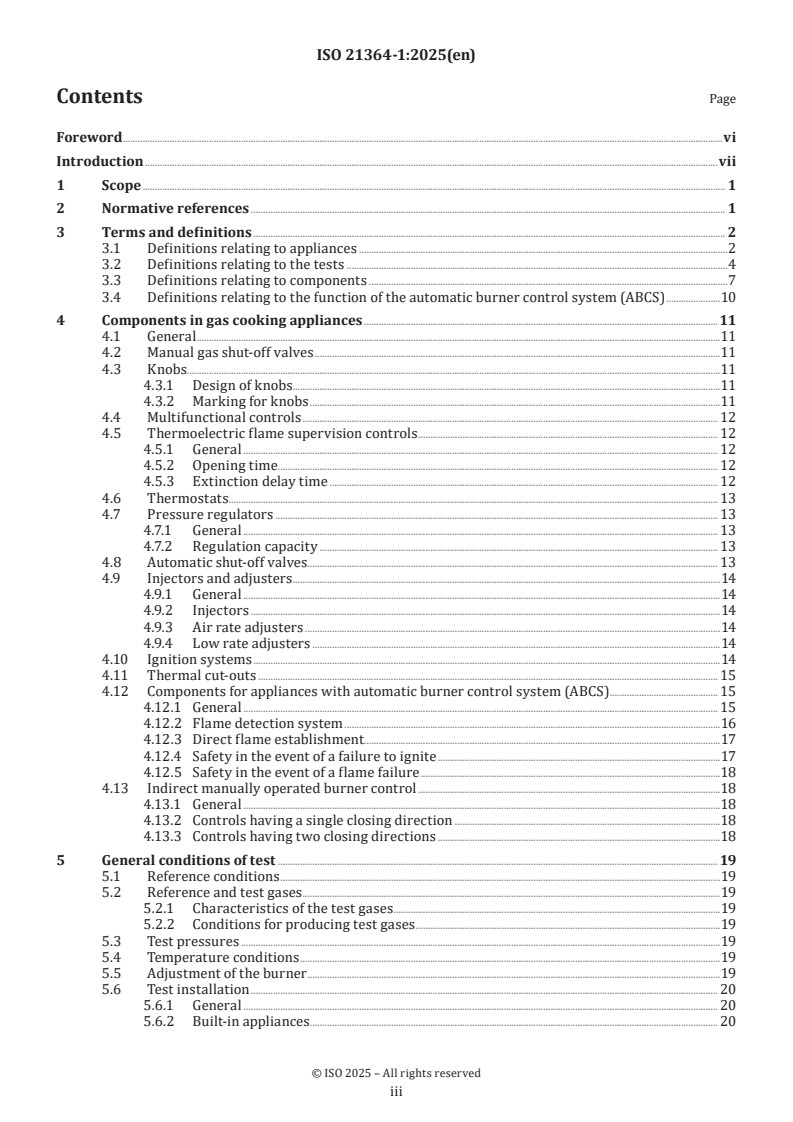
Contents Page
Foreword .vi
Introduction .vii
1 Scope . 1
2 Normative references . 1
3 Terms and definitions . 2
3.1 Definitions relating to appliances .2
3.2 Definitions relating to the tests .4
3.3 Definitions relating to components .7
3.4 Definitions relating to the function of the automatic burner control system (ABCS) .10
4 Components in gas cooking appliances .11
4.1 General .11
4.2 Manual gas shut-off valves .11
4.3 Knobs.11
4.3.1 Design of knobs.11
4.3.2 Marking for knobs .11
4.4 Multifunctional controls . 12
4.5 Thermoelectric flame supervision controls . 12
4.5.1 General . 12
4.5.2 Opening time . . 12
4.5.3 Extinction delay time . 12
4.6 Thermostats . . 13
4.7 Pressure regulators . 13
4.7.1 General . 13
4.7.2 Regulation capacity . 13
4.8 Automatic shut-off valves. 13
4.9 Injectors and adjusters . .14
4.9.1 General .14
4.9.2 Injectors .14
4.9.3 Air rate adjusters .14
4.9.4 Low rate adjusters .14
4.10 Ignition systems .14
4.11 Thermal cut-outs . 15
4.12 Components for appliances with automatic burner control system (ABCS) . 15
4.12.1 General . 15
4.12.2 Flame detection system .16
4.12.3 Direct flame establishment.17
4.12.4 Safety in the event of a failure to ignite .17
4.12.5 Safety in the event of a flame failure .18
4.13 Indirect manually operated burner control .18
4.13.1 General .18
4.13.2 Controls having a single closing direction .18
4.13.3 Controls having two closing directions .18
5 General conditions of test . 19
5.1 Reference conditions .19
5.2 Reference and test gases .19
5.2.1 Characteristics of the test gases .19
5.2.2 Conditions for producing test gases .19
5.3 Test pressures .19
5.4 Temperature conditions .19
5.5 Adjustment of the burner .19
5.6 Test installation . 20
5.6.1 General . 20
5.6.2 Built-in appliances . . 20
iii
5.6.3 Freestanding appliances .21
5.6.4 Table-top appliances . 22
5.7 Characteristics of the test pans . 22
5.7.1 Pans required for testing on gas burners . 22
5.7.2 Pans required for testing on electric hob elements and induction hob elements . 23
6 Heat input .24
6.1 General .24
6.2 Obtaining the nominal heat input . .24
6.3 Measurements and calculations .24
6.3.1 General .24
6.3.2 Appliances with automatic burner control system (ABCS) . 26
6.4 Obtaining the reduced heat input . 26
6.4.1 Requirement . 26
6.4.2 Test . . . 26
6.5 Total heat input . 26
6.5.1 Requirement . 26
6.5.2 Test . . . 26
7 Heating .26
7.1 General . 26
7.2 Operating conditions . 26
7.3 Heating tests .27
7.3.1 Requirement .27
7.3.2 Test under normal operation .27
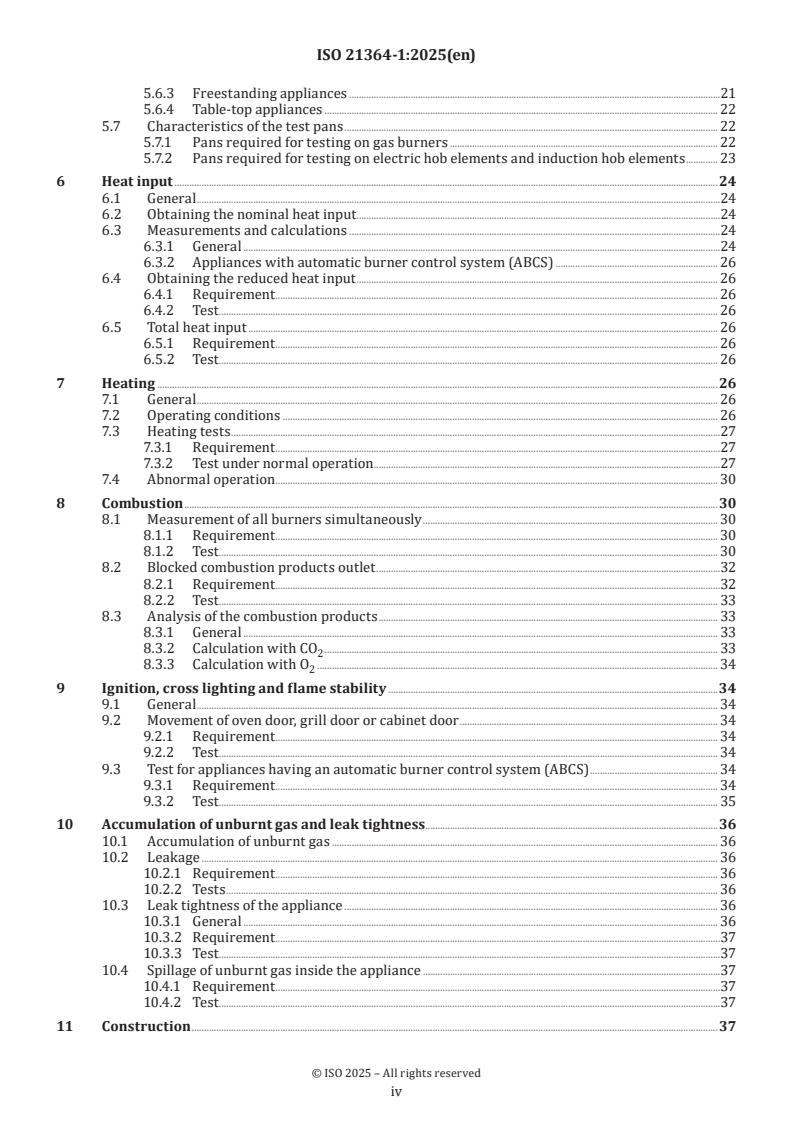
7.4 Abnormal operation . 30
8 Combustion .30
8.1 Measurement of all burners simultaneously . 30
8.1.1 Requirement . 30
8.1.2 Test . . . 30
8.2 Blocked combustion products outlet .32
8.2.1 Requirement .32
8.2.2 Test . . . 33
8.3 Analysis of the combustion products . 33
8.3.1 General . 33
8.3.2 Calculation with CO . 33
8.3.3 Calculation with O . 34
9 Ignition, cross lighting and flame stability .34
9.1 General . 34
9.2 Movement of oven door, grill door or cabinet door . 34
9.2.1 Requirement . 34
9.2.2 Test . . . 34
9.3 Test for appliances having an automatic burner control system (ABCS) . 34
9.3.1 Requirement . 34
9.3.2 Test . . . 35
10 Accumulation of unburnt gas and leak tightness .36
10.1 Accumulation of unburnt gas . 36
10.2 Leakage . 36
10.2.1 Requirement . 36
10.2.2 Tests . 36
10.3 Leak tightness of the appliance . 36
10.3.1 General . 36
10.3.2 Requirement .37
10.3.3 Test . . .37
10.4 Spillage of unburnt gas inside the appliance .37
10.4.1 Requirement .37
10.4.2 Test . . .37
11 Construction .37
iv
11.1 General .37
11.2 Materials . 38
11.2.1 General . 38
11.2.2 Burner material test . 38
11.2.3 Sealings . 38
11.3 Gas inlet connections . 38
11.4 Conversion to different gases . 38
11.5 Pull forces of knobs for manual gas shut-off valves. 39
11.5.1 Requirement . 39
11.5.2 Test . . . 39
11.6 Appliances that enable the user to program the cooking cycle . 39
11.6.1 General . 39
11.6.2 Electronic timer . 40
11.6.3 Electro-mechanical or motorized timer . 40
11.7 Compartment for one gas cylinder . 40
11.8 Touch controls . 40
12 Mechanical strength . 41
12.1 Parts made of glass and glass-ceramic .41
12.1.1 General .41
12.1.2 Spring hammer test .41
12.1.3 Punch test .41
13 Electrical safety .43
13.1 General .43
13.2 Battery powered appliances.43
14 Marking and instructions .43
14.1 Marking .43
14.1.1 Marking on the appliance .43
14.1.2 Marking on the packaging. 44
14.2 Instructions .45
14.2.1 General .45
14.2.2 Instructions for use and maintenance .45
14.2.3 Instructions for use and maintenance of glass parts .47
14.2.4 Instructions for the installer .47
Annex A (normative) Table of test gases .51
Annex B (normative) Purity of gases .71
Annex C (normative) Accuracy of test equipment .72
Annex D (informative) Gas supply connections in force in various countries .73
Annex E (normative) National deviations in various countries .79
Bibliography .83
v
Foreword
ISO (the International Organization for Standardization) is a worldwide federation of national standards
bodies (ISO member bodies). The work of preparing International Standards is normally carried out through
ISO technical committees. Each member body interested in a subject for which a technical committee
has been established has the right to be represented on that committee. International organizations,
governmental and non-governmental, in liaison with ISO, also take part in the work. ISO collaborates closely
with the International Electrotechnical Commission (IEC) on all matters of electrotechnical standardization.
The procedures used to develop this document and those intended for its further maintenance are described
in the ISO/IEC Directives, Part 1. In particular, the different approval criteria needed for the different types
of ISO document should be noted. This document was drafted in accordance with the editorial rules of the
ISO/IEC Directives, Part 2 (see www.iso.org/directives).
ISO draws attention to the possibility that the implementation of this document may involve the use of (a)
patent(s). ISO takes no position concerning the evidence, validity or applicability of any claimed patent
rights in respect thereof. As of the date of publication of this document, ISO had not received notice of (a)
patent(s) which may be required to implement this document. However, implementers are cautioned that
this may not represent the latest information, which may be obtained from the patent database available at
www.iso.org/patents. ISO shall not be held responsible for identifying any or all such patent rights.
Any trade name used in this document is information given for the convenience of users and does not
constitute an endorsement.
For an explanation of the voluntary nature of standards, the meaning of ISO specific terms and expressions
related to conformity assessment, as well as information about ISO's adherence to the World Trade
Organization (WTO) principles in the Technical Barriers to Trade (TBT), see www.iso.org/iso/foreword.html.
This document was prepared by Technical Committee ISO/TC 291, Domestic gas cooking appliances.
This first edition of ISO 21364-1:2025 cancels and replaces ISO/TS 21364-1:2021.
A list of all parts in the ISO 21364 series can be found on the ISO website.
Any feedback or questions on this document should be directed to the user’s national standards body. A
complete listing of these bodies can be found at www.iso.org/members.html.
vi
Introduction
Gas burning appliances using fuel gases must withstand the type of gas which is specified. Other International
Standards cover the testing and properties of fuel gases, e.g. ISO 6976 and ISO 13443.
Due to the differing properties of fuel gas, depending on its source and region of origin, certain differences in
regulations exist at present in different regions; some of these differences are presented in Annexes A and E.
This document is supplemented by the corresponding clauses of ISO 21364-21 and ISO 21364-22.
vii
International Standard ISO 21364-1:2025(en)
Domestic gas cooking appliances — Safety —
Part 1:
General requirements
1 Scope
This document specifies the safety requirements for domestic gas cooking appliances. This covers appliances
that are freestanding, built-in or table-top and are intended to be used indoors. This document applies to the
gas sections of the appliances and their component parts (e.g. combined gas-electric cooking appliances).
This document does not apply to:
a) electrical heated elements as part of the appliance;
b) outdoor appliances;
c) appliances supplied at pressures greater than the maximum pressure of the test gases;
d) cook stoves covered by the standards developed by ISO/TC 285.
In general, it does not take into account children playing with the appliance.
NOTE 1 For requirements regarding electrical safety, refer to the IEC 60335 series.
NOTE 2 Attention is drawn to the fact that:
— for appliances intended to be used in vehicles or on board of ships or aircrafts, additional requirements can apply;
— in many countries, additional requirements are specified by the national health authorities, the national water
supply authorities and similar authorities.
This document does not cover requirements relating to gas cylinders, their pressure regulators and their
connections.
This document does not cover requirements for gas installation.
2 Normative references
The following documents are referred to in the text in such a way that some or all of their content constitutes
requirements of this document. For dated references, only the edition cited applies. For undated references,
the latest edition of the referenced document (including any amendments) applies.
ISO 3166-1, Codes for the representation of names of countries and their subdivisions — Part 1: Country code
ISO 21364-22, Domestic gas cooking appliances — Safety — Part 22: Particular requirements for ovens and
compartment grills
ISO 23550:2018, Safety and control devices for gas and/or oil burners and appliances — General requirements
ISO 23551-1:2024, Safety and control devices for gas burners and gas-burning appliances — Particular
requirements — Part 1: Automatic and semi-automatic, shut-off valves
ISO 23551-2, Safety and control devices for gas burners and gas-burning appliances — Particular requirements
— Part 2: Pressure regulators
ISO 23551-5, Safety and control devices for gas burners and gas-burning appliances — Particular requirements
— Part 5: Manual gas valves
ISO 23551-6, Safety and control devices for gas burners and gas-burning appliances — Particular requirements
— Part 6: Thermoelectric flame supervision controls
ISO 23551-8, Safety and control devices for gas burners and gas-burning appliances — Particular requirements
— Part 8: Multifunctional controls
ISO 23551-9, Safety and control devices for gas burners and gas-burning appliances — Particular requirements
— Part 9: Mechanical gas thermostats
IEC 60068-2-75, Environmental testing Part 2: Test Eh: Hammer test
IEC 60335-1:2020, Household and similar electrical appliances - Safety - Part 1: General requirements
IEC 60335-2-6:2024, Household and similar electrical appliances - Safety - Part 2-6: Particular requirements for
stationary cooking ranges, hobs, ovens and similar appliances
IEC 60335-2-102:2017, Household and similar electrical appliances - Safety - Part 2-102: Particular requirements
for gas, oil and solid-fuel burning appliances having electrical connections
IEC 60730-1, Automatic electrical controls - Part 1: General requirements
IEC 60730-2-5, Automatic electrical controls - Part 2-5: Particular requirements for automatic electrical burner
control systems
IEC 60730-2-7, Automatic electrical controls - Part 2-7: Particular requirements for timers and time switches
IEC 60730-2-9, Automatic electrical controls - Part 2-9: Particular requirements for temperature sensing
controls
3 Terms and definitions
For the purposes of this document, the following terms and definitions apply.
ISO and IEC maintain terminology databases for use in standardization at the following addresses:
— ISO Online browsing platform: available at https:// www .iso .org/ obp
— IEC Electropedia: available at https:// www .electropedia .org/
3.1 Definitions relating to appliances
3.1.1
domestic gas cooking appliance
appliance burning gas for food preparation incorporating one or more cooking function(s) and to be used by
private individuals in a domestic environment
3.1.2
freestanding appliance
appliance intended to be placed on the floor, having an enclosure and not intended to have direct contact
with adjacent furniture and not intended to be built-in
3.1.3
built-in appliance
appliance intended to be installed in a cabinet or unit or in a housing located in a wall
3.1.4
cooking range
combination of a hob (3.1.9) and an oven (3.1.12) which can incorporate a grill (3.1.5) or a griddle (3.1.10)
Note 1 to entry: A cooking range can be freestanding or built-in.
[SOURCE: IEC 60335-2-6:2024, 3.5.104]
3.1.5
grill
appliance, or a part of an appliance, constructed so that the food is supported on a grid or spit and is cooked
by radiant heat
Note 1 to entry: The appliance can be built-in, freestanding, placed in a compartment or a cooking surface. The grill
(3.1.5) is sometimes also named as radiant.
[SOURCE: IEC 60335-2-6:2024, 3.5.102 modified — Note 1 to entry has been replaced.]
3.1.6
combined gas-electric cooking appliance
appliance where the cooking function is powered by gas and electrical energy
Note 1 to entry: Examples are a cooking range (3.1.4) with an electrical oven (3.1.12) and a gas hob (3.1.9) or a hob
(3.1.9) with gas burners and electrical heating elements.
3.1.7
warming drawer
appliance or part of the appliance that fulfils an independent warming function
Note 1 to entry: The same requirement of a warming drawer is applied to a warming cabinet.
3.1.8
table-top appliance
appliance that is intended to be placed on a table or working surface
Note 1 to entry: A table-top appliance can be portable.
Note 2 to entry: Portable appliances have a mass less than 18 kg.
3.1.9
hob
appliance that incorporates either one or several covered or open burners, or one or more electric heating
element(s), or both
Note 1 to entry: A hob can be built-in, part of a cooking range (3.1.4) or table top.
3.1.10
griddle
appliance or part of an appliance constructed so that the food is only cooked by contact heat on a closed surface
3.1.11
surface cooking appliance
appliance that can be a hob (3.1.9), griddle (3.1.10), surface grill (3.1.5) or a combination of these devices
3.1.12
oven
appliance or part of an appliance having a closed compartment constructed so that the food is cooked by the
heat transmitted by natural convection or by forced convection
Note 1 to entry: The oven can be freestanding, built-in, table top or part of a cooking range (3.1.4).
3.1.13
compartment grill
appliance or part of an appliance having a radiant heating element placed in a cavity
Note 1 to entry: The compartment grill can be built-in or freestanding.
3.2 Definitions relating to the tests
3.2.1
gas family
group of combustible gases with similar burning characteristics linked together by a range of Wobbe indices
Note 1 to entry: Three gas families are known:
— First family: Town gas or manufactured gas.
— Second family: Natural gas.
— Third family: Liquefied petroleum gas (LPG).
3.2.2
Wobbe index
ratio of the calorific value of a gas per unit volume and the square root of its relative density (3.2.17) under
the same reference conditions (3.2.15)
Note 1 to entry: The Wobbe index is said to be gross (W ) or net (W ) according to whether the calorific value used is
s i
the gross or net calorific value.
Note 2 to entry: In this document, only the gross Wobbe index (W ) is used.
S
Note 3 to entry: The Wobbe index is expressed either in:
a) megajoules per cubic metre (MJ/m ) of dry gas;
b) megajoules per kilogram (MJ/kg) of dry gas.
3.2.3
test gas
gas intended for the verification of the operational characteristics of appliances using combustible gas; it
can be reference gas (3.2.4) or limit gas (3.2.5)
3.2.4
reference gas
test gas (3.2.3) representative of the gas family (3.2.1) with which appliances operate under nominal
conditions
3.2.5
limit gas
test gas (3.2.3) representative of the extreme variations in characteristics of the gas family (3.2.1) for which
the appliances have been designed; such as:
— for incomplete combustion (3.2.10);
— for flame lift (3.2.6);
— for light back (3.2.7);
— for sooting (3.2.8) or yellow tipping (3.2.9).
3.2.6
flame lift
phenomenon characterized by the partial or total movement of the base of the flame away from the burner port
3.2.7
light back
phenomenon characterized by the return of the flame inside the body of the burner or on the injector (3.3.10)
3.2.8
sooting
phenomenon appearing at the time of incomplete combustion (3.2.10) and characterized by a deposit of soot
on the surfaces in contact with the flames or the combustion products (3.2.25)
3.2.9
yellow tipping
phenomenon characterized by the appearance of yellow colouring at the top of the blue cone of an aerated flame
3.2.10
incomplete combustion
combustion process which entails only partial burning of gas
Note 1 to entry: Carbon monoxide is typically produced as a by-product of incomplete combustion.
3.2.11
cross lighting
either complete ignition of all ports around a ring of flame ports or successful ignition of all rings of ports
from an adjacent ring of ports, or both
3.2.12
heat input
quantity of energy used in unit time corresponding to the volumetric (3.2.23) or mass flow rates (3.2.24), the
calorific value used being the Gross calorific value (3.2.16)
Note 1 to entry: The heat input is expressed in kilowatts (kW).
3.2.13
nominal heat input
value of the heat input (3.2.12) as declared by the manufacturer
[SOURCE: ISO 22967:2010, 3.5.1.8]
3.2.14
gas installation
combination of consumer piping, fittings, components, flues, sub-meters, apparatus or other devices and
associated requirements, which are used or intended to be used in the supply and utilisation of gas taken as
separate items or as a whole
3.2.15
reference conditions
dry gas under conditions of temperature and pressure:
...