

ISO/TS 21364-1:2021
(Main)Domestic gas cooking appliances — Safety — Part 1: General requirements
General Information
- Abstract
This document specifies the safety requirements for domestic gas cooking appliances. These appliances are freestanding, built-in or table-top and are intended to be used indoors. This document applies to the gas sections of the appliances and their component parts (e.g. combined gas-electric cooking appliances). This document does not apply to: a) electrical heated elements as part of the appliance; b) outdoor appliances; c) appliances supplied at pressures greater than the maximum pressure of the test gases; d) cook stoves, covered by the standards being developed in ISO/TC 285 In general, it does not take into account children playing with the appliance. NOTE 1 For requirements of electrical safety refer to the IEC 60335 standard series. NOTE 2 Attention is drawn to the fact that − for appliances intended to be used in vehicles or on board of ships or aircrafts, additional requirements could be necessary; − in many countries additional requirements are specified by the national health authorities, the national water supply authorities and similar authorities This document does not cover requirements relating to gas cylinders, their pressure regulators and their connections. This document does not cover requirements for gas installation.
- Status
- Withdrawn
- Publication Date
- 20-May-2021
- Technical Committee
- ISO/TC 291 - Domestic gas cooking appliances
- Drafting Committee
- ISO/TC 291/WG 1 - Safety of domestic gas cooking appliances
- Current Stage
- 9599 - Withdrawal of International Standard
- Start Date
- 03-Jun-2025
- Completion Date
- 29-Aug-2026
Buy Documents
ISO/TS 21364-1:2021 - Domestic gas cooking appliances — Safety — Part 1: General requirements/21/2021
ISO/TS 21364-1:2021 - Domestic gas cooking appliances — Safety — Part 1: General requirements Released:5/21/2021
ISO/TS 21364-1:2021 - Appareils de cuisson domestiques utilisant les combustibles gazeux — Sécurité — Partie 1: Exigences générales/21/2021
ISO/TS 21364-1:2021 - Appareils de cuisson domestiques utilisant les combustibles gazeux — Sécurité — Partie 1: Exigences générales Released:5/21/2021



ISO/DIS 21364-1:2020 - BARVE
Overview
ISO/TS 21364-1:2021 - Domestic gas cooking appliances - Safety - Part 1: General requirements specifies safety requirements for the gas sections of domestic gas cooking appliances (freestanding, built‑in or table‑top) intended for indoor use. The technical specification covers component requirements, test conditions and safety checks for combined gas‑electric appliances as far as their gas systems are concerned. It excludes electrical safety (refer to IEC 60335 series), outdoor appliances, gas cylinders/pressure regulators/connections, gas installation and appliances supplied above the test gas maximum pressure.
Key topics and requirements
The document sets out procedural and constructional requirements that govern the safe design, testing and verification of gas cooking appliances. Major topics include:
- Components: requirements and definitions for taps (manual gas shut‑off valves), knobs, multifunctional controls, thermostats, pressure regulators, automatic shut‑off valves, injectors/adjusters and ignition systems.
- Flame supervision and safety controls: thermoelectric flame supervision controls (opening/ extinction delay) and thermal cut‑outs.
- Test conditions: reference/test gases, pressures, temperature conditions, test installations for built‑in, freestanding and portable appliances.
- Heat input and heating tests: procedures to determine nominal and reduced heat inputs, total heat input and heating performance.
- Combustion and emissions: measurement and analysis of combustion products (CO, O2), spillage, blocked flue tests and simultaneous burner measurements.
- Ignition and flame stability: ignition, cross‑lighting, behaviour with oven/grill/cabinet doors.
- Leak tightness and accumulation of unburnt gas: leak tests, accumulation and internal spillage assessments.
- Construction and materials: material suitability, sealing, gas inlet connections, conversion to different gases and mechanical requirements (e.g., pull forces on knobs).
- Test pans and measurement setups: specifications for pans and instrumentation used during standardized testing.
Applications - who uses this standard
ISO/TS 21364-1:2021 is used by:
- Manufacturers and design engineers to design compliant gas sections and select approved components.
- Test laboratories and conformity assessment bodies for type testing, safety verification and certification of domestic gas appliances.
- Regulatory authorities and product safety officers to assess appliance safety and to reference technical requirements in national regulations.
- Procurement, OEMs and R&D teams for specifying safe gas appliance characteristics and interoperability (conversion to different gases).
Related standards
- IEC 60335 series - electrical safety of household appliances (electrical aspects not covered by ISO/TS 21364‑1).
- ISO/TC 285 - standards under development for cook stoves (outdoor/alternative appliance types).
- National regulations and health/water authority requirements may add further obligations for specific markets.
This technical specification is essential for ensuring the safe gas operation of domestic cooking appliances, guiding manufacturers and testers through standardized safety evaluation and compliance processes.
Relations
- Effective Date
- 06-Jun-2022
Buy Documents
ISO/TS 21364-1:2021 - Domestic gas cooking appliances — Safety — Part 1: General requirements/21/2021
ISO/TS 21364-1:2021 - Domestic gas cooking appliances — Safety — Part 1: General requirements Released:5/21/2021
ISO/TS 21364-1:2021 - Appareils de cuisson domestiques utilisant les combustibles gazeux — Sécurité — Partie 1: Exigences générales/21/2021
ISO/TS 21364-1:2021 - Appareils de cuisson domestiques utilisant les combustibles gazeux — Sécurité — Partie 1: Exigences générales Released:5/21/2021
ISO/DIS 21364-1:2020 - BARVE
Frequently Asked Questions
ISO/TS 21364-1:2021 is a technical specification published by the International Organization for Standardization (ISO). Its full title is "Domestic gas cooking appliances — Safety — Part 1: General requirements". This standard covers: This document specifies the safety requirements for domestic gas cooking appliances. These appliances are freestanding, built-in or table-top and are intended to be used indoors. This document applies to the gas sections of the appliances and their component parts (e.g. combined gas-electric cooking appliances). This document does not apply to: a) electrical heated elements as part of the appliance; b) outdoor appliances; c) appliances supplied at pressures greater than the maximum pressure of the test gases; d) cook stoves, covered by the standards being developed in ISO/TC 285 In general, it does not take into account children playing with the appliance. NOTE 1 For requirements of electrical safety refer to the IEC 60335 standard series. NOTE 2 Attention is drawn to the fact that − for appliances intended to be used in vehicles or on board of ships or aircrafts, additional requirements could be necessary; − in many countries additional requirements are specified by the national health authorities, the national water supply authorities and similar authorities This document does not cover requirements relating to gas cylinders, their pressure regulators and their connections. This document does not cover requirements for gas installation.
This document specifies the safety requirements for domestic gas cooking appliances. These appliances are freestanding, built-in or table-top and are intended to be used indoors. This document applies to the gas sections of the appliances and their component parts (e.g. combined gas-electric cooking appliances). This document does not apply to: a) electrical heated elements as part of the appliance; b) outdoor appliances; c) appliances supplied at pressures greater than the maximum pressure of the test gases; d) cook stoves, covered by the standards being developed in ISO/TC 285 In general, it does not take into account children playing with the appliance. NOTE 1 For requirements of electrical safety refer to the IEC 60335 standard series. NOTE 2 Attention is drawn to the fact that − for appliances intended to be used in vehicles or on board of ships or aircrafts, additional requirements could be necessary; − in many countries additional requirements are specified by the national health authorities, the national water supply authorities and similar authorities This document does not cover requirements relating to gas cylinders, their pressure regulators and their connections. This document does not cover requirements for gas installation.
ISO/TS 21364-1:2021 is classified under the following ICS (International Classification for Standards) categories: 97.040.20 - Cooking ranges, working tables, ovens and similar appliances. The ICS classification helps identify the subject area and facilitates finding related standards.
ISO/TS 21364-1:2021 has the following relationships with other standards: It is inter standard links to ISO 21364-1:2025. Understanding these relationships helps ensure you are using the most current and applicable version of the standard.
ISO/TS 21364-1:2021 is available in PDF format for immediate download after purchase. The document can be added to your cart and obtained through the secure checkout process. Digital delivery ensures instant access to the complete standard document.
Standards Content (Sample)
TECHNICAL ISO/TS
SPECIFICATION 21364-1
First edition
2021-05
Domestic gas cooking appliances —
Safety —
Part 1:
General requirements
Appareils de cuisson domestiques utilisant les combustibles gazeux —
Sécurité —
Partie 1: Exigences générales
Reference number
©
ISO 2021
© ISO 2021
All rights reserved. Unless otherwise specified, or required in the context of its implementation, no part of this publication may
be reproduced or utilized otherwise in any form or by any means, electronic or mechanical, including photocopying, or posting
on the internet or an intranet, without prior written permission. Permission can be requested from either ISO at the address
below or ISO’s member body in the country of the requester.
ISO copyright office
CP 401 • Ch. de Blandonnet 8
CH-1214 Vernier, Geneva
Phone: +41 22 749 01 11
Email: copyright@iso.org
Website: www.iso.org
Published in Switzerland
ii © ISO 2021 – All rights reserved
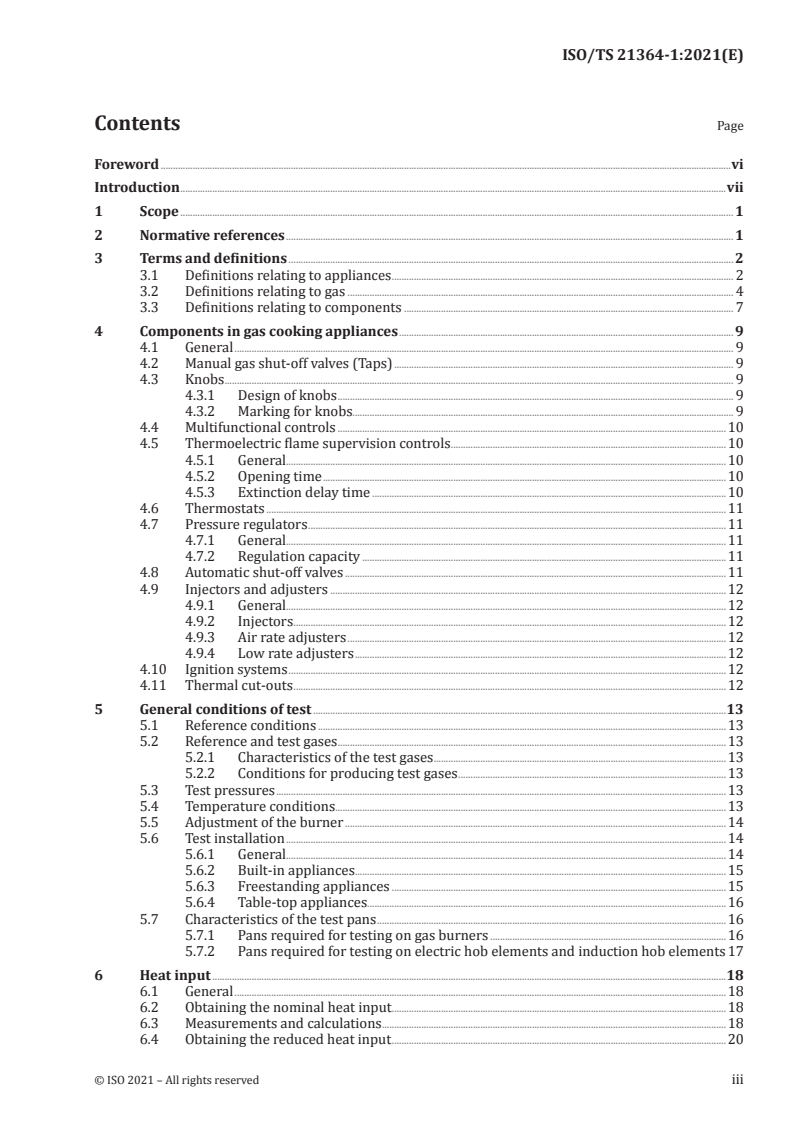
Contents Page
Foreword .vi
Introduction .vii
1 Scope . 1
2 Normative references . 1
3 Terms and definitions . 2
3.1 Definitions relating to appliances . 2
3.2 Definitions relating to gas . 4
3.3 Definitions relating to components . 7
4 Components in gas cooking appliances . 9
4.1 General . 9
4.2 Manual gas shut-off valves (Taps) . 9
4.3 Knobs . 9
4.3.1 Design of knobs . 9
4.3.2 Marking for knobs. 9
4.4 Multifunctional controls .10
4.5 Thermoelectric flame supervision controls .10
4.5.1 General.10
4.5.2 Opening time .10
4.5.3 Extinction delay time .10
4.6 Thermostats .11
4.7 Pressure regulators .11
4.7.1 General.11
4.7.2 Regulation capacity .11
4.8 Automatic shut-off valves .11
4.9 Injectors and adjusters .12
4.9.1 General.12
4.9.2 Injectors .12
4.9.3 Air rate adjusters .12
4.9.4 Low rate adjusters .12
4.10 Ignition systems .12
4.11 Thermal cut-outs .12
5 General conditions of test .13
5.1 Reference conditions .13
5.2 Reference and test gases .13
5.2.1 Characteristics of the test gases .13
5.2.2 Conditions for producing test gases .13
5.3 Test pressures .13
5.4 Temperature conditions .13
5.5 Adjustment of the burner .14
5.6 Test installation .14
5.6.1 General.14
5.6.2 Built-in appliances.15
5.6.3 Freestanding appliances .15
5.6.4 Table-top appliances.16
5.7 Characteristics of the test pans .16
5.7.1 Pans required for testing on gas burners .16
5.7.2 Pans required for testing on electric hob elements and induction hob elements 17
6 Heat input .18
6.1 General .18
6.2 Obtaining the nominal heat input . .18
6.3 Measurements and calculations .18
6.4 Obtaining the reduced heat input .20
6.4.1 Requirement .20
6.4.2 Test .20
6.5 Total heat input .20
6.5.1 Requirement .20
6.5.2 Test .20
7 Heating .20
7.1 General .20
7.2 Operating conditions .20
7.3 Heating tests.21
7.3.1 Requirement .21
7.3.2 Test under normal operation .21
7.4 Abnormal operation .24
8 Combustion .24
8.1 Measurement of all burners simultaneously .24
8.1.1 Requirement .24
8.1.2 Test .24
8.2 Blocked combustion products outlet .26
8.2.1 Requirement .26
8.2.2 Test .27
8.3 Analysis of the combustion products .27
8.3.1 General.27
8.3.2 Calculation with CO .
2 27
8.3.3 Calculation with O .
2 28
9 Ignition, cross lighting and flame stability .28
9.1 General .28
9.2 Movement of oven/grill door or cabinet door .28
9.2.1 Requirement .28
9.2.2 Test .28
10 Accumulation of unburnt gas and leak tightness .28
10.1 Accumulation of unburnt gas .28
10.2 Leakage .29
10.2.1 Requirement .29
10.2.2 Tests .29
10.3 Leak tightness of the appliance .29
10.3.1 General.29
10.3.2 Requirement .29
10.3.3 Test .29
10.4 Spillage of unburnt gas inside the appliance .30
10.4.1 Requirement .30
10.4.2 Test .30
11 Construction .30
11.1 General .30
11.2 Materials .30
11.2.1 General.30
11.2.2 Burner material test . .31
11.2.3 Sealings .31
11.3 Gas inlet connections .31
11.4 Conversion to different gases .31
11.5 Pull forces of knobs for manual gas shut-off valves (taps) . .31
11.5.1 Requirement .31
11.5.2 Test .32
11.6 Appliances that enable the user to program the start or the end of the cooking cycle .32
11.6.1 General.32
11.6.2 Electronic timer .32
11.6.3 Electro-mechanical or motorized timer .32
11.7 Compartment for one gas cylinder .32
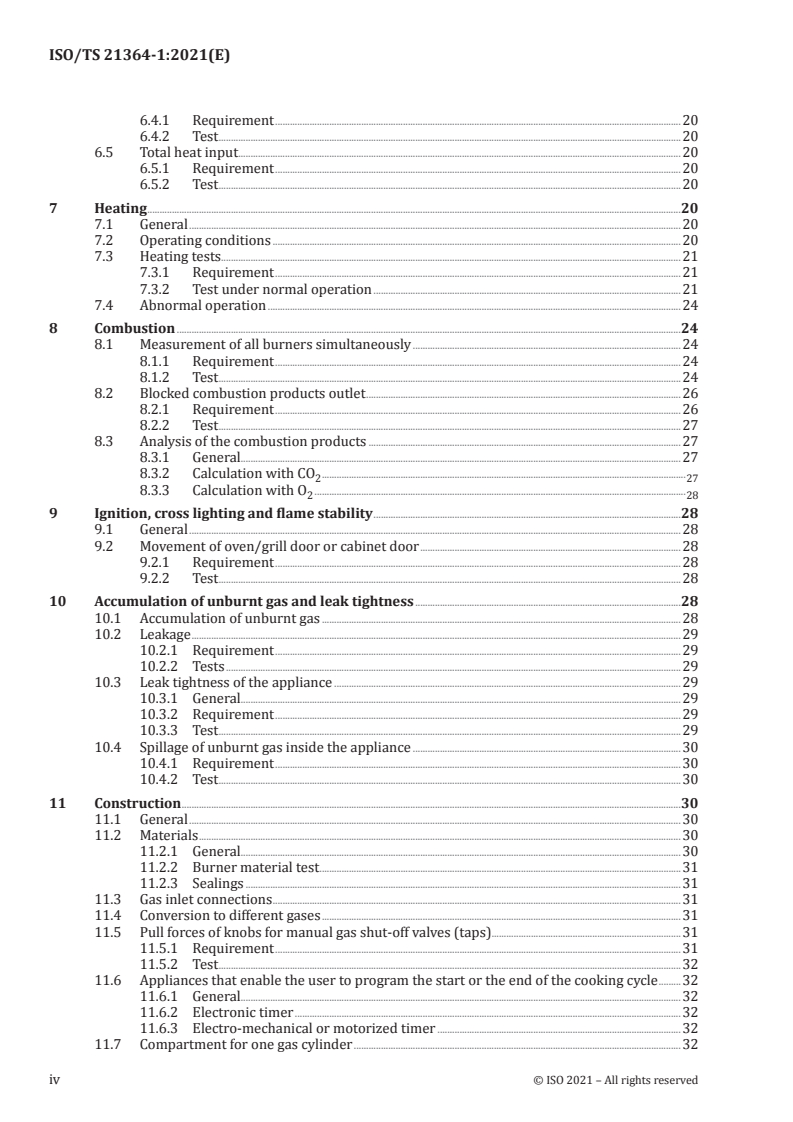
iv © ISO 2021 – All rights reserved
11.8 Touch controls .33
12 Mechanical strength .33
12.1 Parts made of glass and glass-ceramic .33
12.1.1 General.33
12.1.2 Spring hammer test .33
12.1.3 Punch test.34
13 Electrical safety .35
13.1 General .35
13.2 Battery powered appliances.35
14 Marking and instructions .36
14.1 Marking .36
14.1.1 Marking on the appliance .36
14.1.2 Marking on the packaging .37
14.2 Instructions .37
14.2.1 General.37
14.2.2 Instructions for use and maintenance.38
14.2.3 Instructions for use and maintenance of glass parts .40
14.2.4 Instructions for the installer .40
Annex A (normative) Table of test gases .44
Annex B (normative) Purity of gases .67
Annex C (normative) Accuracy of test equipment .68
Annex D (informative) Gas supply connections in force in various countries .69
Annex E (normative) National deviations in various countries .75
Bibliography .79
Foreword
ISO (the International Organization for Standardization) is a worldwide federation of national standards
bodies (ISO member bodies). The work of preparing International Standards is normally carried out
through ISO technical committees. Each member body interested in a subject for which a technical
committee has been established has the right to be represented on that committee. International
organizations, governmental and non-governmental, in liaison with ISO, also take part in the work.
ISO collaborates closely with the International Electrotechnical Commission (IEC) on all matters of
electrotechnical standardization.
The procedures used to develop this document and those intended for its further maintenance are
described in the ISO/IEC Directives, Part 1. In particular the different approval criteria needed for the
different types of ISO documents should be noted. This document was drafted in accordance with the
editorial rules of the ISO/IEC Directives, Part 2 (see www .iso .org/ directives).
Attention is drawn to the possibility that some of the elements of this document may be the subject of
patent rights. ISO shall not be held responsible for identifying any or all such patent rights. Details of
any patent rights identified during the development of the document will be in the Introduction and/or
on the ISO list of patent declarations received (see www .iso .org/ patents).
Any trade name used in this document is information given for the convenience of users and does not
constitute an endorsement.
For an explanation on the voluntary nature of standards, the meaning of ISO specific terms and
expressions related to conformity assessment, as well as information about ISO's adherence to the
World Trade Organization (WTO) principles in the Technical Barriers to Trade (TBT) see the following
URL: www .iso .org/ iso/ foreword .html.
This document was prepared by Technical Committee ISO/TC 291, Domestic gas cooking appliances.
vi © ISO 2021 – All rights reserved
Introduction
This document provides general requirements for safety of domestic gas cooking appliances.
This document can also be applied, so far as is reasonable, to appliances not mentioned in this
specific standard and to appliances designed on the basis of new principles, in which case additional
requirements may be necessary.
Where no specific International Standard for an appliance exists, the appliance can be tested according
to this document and further tests which take into account the intended use.
Gas burning appliances using fuel gases need to withstand the type of gas which is specified. Other ISO
technical committees, e.g. ISO/TC 193, Natural gas, deal with the testing and properties of fuel gases.
Note that, due to the differing properties of fuel gas depending on its source/region of origin, certain
differences in regulations exist at present in different regions; some of these differences are presented
in Annexes A and E.
This document covers type testing.
This document series ISO 21364 "Domestic gas cooking appliances – Safety" is structured as follows:
− Part 1: General requirements
− Part 21: Particular requirements for hobs, surface grills and griddles
− Part 22: Particular requirements for ovens and compartment grills
This document can be supplemented by the corresponding clauses of ISO/TS 21364-21:2021 and
ISO/TS 21364-22:2021.
TECHNICAL SPECIFICATION ISO/TS 21364-1:2021(E)
Domestic gas cooking appliances — Safety —
Part 1:
General requirements
1 Scope
This document specifies the safety requirements for domestic gas cooking appliances. These appliances
are freestanding, built-in or table-top and are intended to be used indoors. This document applies
to the gas sections of the appliances and their component parts (e.g. combined gas-electric cooking
appliances). This document does not apply to:
a) electrical heated elements as part of the appliance;
b) outdoor appliances;
c) appliances supplied at pressures greater than the maximum pressure of the test gases;
d) cook stoves, covered by the standards being developed in ISO/TC 285
In general, it does not take into account children playing with the appliance.
NOTE 1 For requirements of electrical safety refer to the IEC 60335 standard series.
NOTE 2 Attention is drawn to the fact that
− for appliances intended to be used in vehicles or on board of ships or aircrafts, additional
requirements could be necessary;
− in many countries additional requirements are specified by the national health authorities, the
national water supply authorities and similar authorities
This document does not cover requirements relating to gas cylinders, their pressure regulators and
their connections.
This document does not cover requirements for gas installation.
2 Normative references
The following documents are referred to in the text in such a way that some or all of their content
constitutes requirements of this document. For dated references, only the edition cited applies. For
undated references, the latest edition of the referenced document (including any amendments) applies.
ISO 3166-1:2020, Codes for the representation of names of countries and their subdivisions — Part 1:
Country codes
ISO 21364-22:2021, Domestic gas cooking appliances – Safety- Part 22: Particular requirements for ovens
and compartment grills
ISO 23550:2018, Safety and control devices for gas and/or oil burners and appliances — General
requirements
ISO 23551-1:2012, Safety and control devices for gas burners and gas-burning appliances — Particular
requirements — Part 1: Automatic and semi-automatic valves
ISO 23551-2:2018, Safety and control devices for gas burners and gas-burning appliances — Particular
requirements — Part 2: Pressure regulators
ISO 23551-5:2014, Safety and control devices for gas burners and gas-burning appliances — Particular
requirements — Part 5: Manual gas valves
ISO 23551-6:2014, Safety and control devices for gas burners and gas-burning appliances — Particular
requirements — Part 6: Thermoelectric flame supervision controls
ISO 23551-8:2016+Amd 1:2019, Safety and control devices for gas burners and gas-burning appliances —
Particular requirements — Part 8: Multifunctional controls
ISO 23551-9:2015, Safety and control devices for gas burners and gas-burning appliances — Particular
requirements — Part 9: Mechanical gas thermostats
IEC 60068-2-75:2014, Environmental testing Part 2: Test Eh: Hammer test
IEC 60335-1:2020, Household and similar electrical appliances — Safety — Part 1: General requirements
IEC 60335-2-6:2014, Household and similar electrical appliances — Safety — Part 2-6: Particular
requirements for stationary cooking ranges, hobs, ovens and similar appliances
IEC 60335-2-102:2017, Household and similar electrical appliances — Safety — Part 2-102: Particular
requirements for gas, oil and solid-fuel burning appliances having electrical connections
IEC 60730-1:2013+AMD1: 2015+ AMD2: 2020, Automatic electrical controls - Part 1: General requirements
IEC 60730-2-7:2015, Automatic electrical controls for household and similar use — Part 2-7: Particular
requirements for timers and time switches
IEC 60730-2-9:2015+AMD1: 2018+ AMD2: 2020, Automatic electrical controls for household and similar
use — Part 2-9: Particular requirements for temperature sensing controls
3 Terms and definitions
For the purposes of this document, the following terms and definitions apply.
ISO and IEC maintain terminological databases for use in standardization at the following addresses:
— ISO Online browsing platform: available at https:// www .iso .org/ obp
— IEC Electropedia: available at http:// www .electropedia .org/
3.1 Definitions relating to appliances
3.1.1
domestic gas cooking appliance
appliance burning gas for food preparation incorporating one or more cooking function(s) and to be
used by private individuals in a domestic environment
3.1.2
freestanding appliance
appliance intended to be placed on the floor, having an enclosure and not intended to have direct contact
with adjacent furniture and not intended to be built-in
3.1.3
built-in appliance
appliance intended to be installed in a cabinet or unit or in a housing located in a wall
2 © ISO 2021 – All rights reserved
3.1.4
cooking range
combination of a hob (3.1.10) and an oven (3.1.13) which may incorporate a grill (3.1.5) or a griddle
(3.1.11)
Note 1 to entry: Can be freestanding or built-in.
[SOURCE: IEC 60335-2-6:2014, 3.104]
3.1.5
grill
appliance or a part of an appliance constructed so that the food is supported on a grid or spit and is
cooked by radiant heat
Note 1 to entry: Can be built-in, freestanding, placed in a compartment or a cooking surface. The grill (3.1.5) is
sometimes also named as radiant.
[SOURCE: IEC 60335-2-6:2014, 3.102 modified – Note to entry has been replaced.]
3.1.6
combined gas-electric cooking appliance
appliance where the cooking function is powered by gas and electrical energy.
Note 1 to entry: Examples are a cooking range (3.1.4) with an electrical oven (3.1.13) and a gas hob (3.1.10) or a
hob (3.1.10) with gas burners and electrical heating elements.
3.1.7
warming drawer
appliance or part of the appliance that fulfils an independent warming function
Note 1 to entry: The same requirements of a warming drawer are applied to a warming cabinet.
3.1.8
portable appliance
appliance that is intended to be placed on a table or working surface and having a mass less than 18 kg
3.1.9
table-top appliance
appliance that is intended to be placed on a table or working surface
Note 1 to entry: It can be portable
3.1.10
hob
appliance that incorporates one or several covered or open burners, and/or one or more electric heating
element(s)Note to entry: Can be built-in, part of a cooking range (3.1.4) or table top.
[SOURCE: IEC 60335-2-6:2014, 3.103]
3.1.11
griddle
appliance or part of an appliance constructed so that the food is only cooked by contact heat on closed
surface
3.1.12
surface cooking appliance
appliance that can be a hob (3.1.10), griddle (3.1.11), surface grill (3.1.5) or a combination of these
devices
3.1.13
oven
appliance or part of an appliance having a closed compartment constructed so that the food is cooked
by the heat transmitted by natural convection or by forced convection
Note 1 to entry: Can be freestanding, built-in, table top or part of a cooking range (3.1.4)
3.1.14
compartment grill
appliance or part of an appliance having a radiant heating element placed in a cavity
Note 1 to entry: Can be built-in or freestanding.
3.2 Definitions relating to gas
3.2.1
gas family
group of combustible gases with similar burning characteristics linked together by range of Wobbe
indices
Note 1 to entry: Three gas families are known:
− First family: Town/Manufactured gas
− Second family: Natural gas
− Third family: Liquefied Petroleum Gas (LPG)
3.2.2
Wobbe index
ratio of the calorific value of a gas per unit volume and the square root of its relative density (3.2.17)
under the same reference conditions (3.2.15)
Note 1 to entry: In this document only the gross Wobbe index (W ) is used
S
Note 2 to entry: The Wobbe index is expressed either in
a) megajoules per cubic metre (MJ/m ) of dry gas, or
b) megajoules per kilogram (MJ/kg) of dry gas.
3.2.3
test gas
gas intended for the verification of the operational characteristics of appliances using combustible gas;
it can be reference gas (3.2.4) or limit gas (3.2.5)
3.2.4
reference gas
test gas (3.2.3) representative of the gas family (3.2.1) with which appliances operate under nominal
conditions
3.2.5
limit gas
test gas (3.2.3) representative of the extreme variations in characteristics of the gas family (3.2.1) for
which the appliances have been designed; such as:
— for incomplete combustion (3.2.10),
— for flame lift (3.2.6),
— for light back (3.2.7),
— for sooting (3.2.8) or yellow tipping (3.2.9).
4 © ISO 2021 – All rights reserved
3.2.6
flame lift
phenomenon characterized by the partial or total movement of the base of the flame away from the
burner port
3.2.7
light back
phenomenon characterized by the return of the flame inside the body of the burner or on the injector
(3.3.10)
3.2.8
sooting
phenomenon appearing at the time of incomplete combustion (3.2.10) and characterized by a deposit of
soot on the surfaces in contact with the flames or the combustion products (3.2.25)
3.2.9
yellow tipping
phenomenon characterized by the appearance of yellow colouring at the top of the blue cone of an
aerated flame
3.2.10
incomplete combustion
combustion process which entails only partial burning of gas
Note 1 to entry: Carbon monoxide is typically produced as a by-product
3.2.11
cross lighting
complete ignition of all ports around a ring of flame ports and/or successful ignition of all rings of ports
from an adjacent ring of ports
3.2.12
heat input
quantity of energy used in unit time corresponding to the volumetric or mass flow rates (3.2.23, 3.2.24),
the calorific value used being the Gross calorific value (3.2.16)
Note 1 to entry: The heat input is expressed in kilowatts (kW)
3.2.13
nominal heat input
value of the heat input (3.2.12) as declared by the manufacturer
[SOURCE: ISO 22967:2010]
3.2.14
gas installation
a combination of the following used or intended to be used in the supplying and utilisation of gas taken
as separate items or as a whole: Consumer piping, fittings, components, flues, sub-meters, apparatus or
other devices and associated requirements
3.2.15
reference conditions
dry gas under conditions of temperature and pressure: 15 °C and 101,325 kPa
[SOURCE: ISO 6976:2016]
3.2.16
Gross calorific value
amount of heat that would be released by the complete combustion with oxygen of a specified quantity
of gas, in such a way that the pressure, 101,325 kPa, at which the reaction takes place remains constant,
and all the combustion products (3.2.25) are returned to the same specified temperature, 15 °C, as that
of the reactants, all of these products being in the gaseous state except for water, which is condensed to
the liquid state at 15 °C
[SOURCE: ISO 6976:2016, 3.1, modified – p1 replaced by 101,325 kPa; t1 replaced by 15°C, Note to entry
has been replaced]
Note 1 to entry: The calorific value is expressed:
− either in megajoules per cubic metre (MJ/m ) of dry gas;
− or in megajoules per kilogram (MJ/kg) of dry gas.
Note 2 to entry: In this document only the Gross calorific value is used
3.2.17
relative density
ratio of the masses of equal volumes of dry gas and dry air under the same conditions of temperature
and pressure
[SOURCE: ISO 22967:2010, 3.2.3]
3.2.18
gas supply pressure
difference between the static pressure measured at the inlet connection of the appliance in operation
and the atmospheric pressure
[SOURCE: EN 30-1-1:2008+A3: 2013]
Note 1 to entry: The gas pressures used are expressed in kilopascals (kPa).
3.2.19
test pressure
gas pressure used to verify the operational characteristics of appliances using combustible gases,
consisting of normal or limit pressure (3.2.21)
[SOURCE: EN 30-1-1:2008+A3: 2013]
3.2.20
normal pressure
pressure under which the appliances operate in nominal conditions, when they are supplied with the
corresponding reference gas (3.2.4)
Note 1 to entry: The gas pressures used are expressed in kilopascals (kPa)
3.2.21
limit pressure
pressure representative of the extreme variations in the supply conditions
maximum pressure: p ;
max
minimum pressure: p
min
3.2.22
pressure couple
combination of two distinct gas distribution pressures applied by reason of the significant difference
existing between the Wobbe indices within a single family in which:
6 © ISO 2021 – All rights reserved
− the higher pressure corresponds only to gases of low Wobbe index (3.2.2);
− the lower pressure corresponds to gases of high Wobbe index (3.2.2)
[SOURCE: EN 437:2018, modified – Note to entry has been deleted]
3.2.23
volumetric flow rate
volume of gas consumed by the burner or burners in unit time, with the gas under reference conditions
(3.2.15)
Note 1 to entry: The volumetric flow rate is expressed in cubic meter per hour (m3/h) or possibly litre per minute
(l/min), litre per second (l/s), cubic decimetre per hour (dm3/h), cubic decimetre per second (dm3/s).
[SOURCE: EN 30-1-1:2008+A3: 2013]
3.2.24
mass flow rate
mass of gas consumed by the appliance in unit time during continuous operation
Note 1 to entry: The mass flow rate is expressed in kilogram per hour (kg/h), or eventually gram per hour (g/h).
[SOURCE: EN 30-1-1:2008+A3: 2013]
3.2.25
combustion products
constituents resulting from the combustion of a fuel gas with the oxygen of the air, including the inerts,
but excluding excess air
3.3 Definitions relating to components
3.3.1
pressure regulator
device that maintains the outlet pressure constant within given limits, independently of the variations
in inlet pressure and/or flow rate
[SOURCE: ISO 23551-2:2006, 3.1.1]
3.3.2
manual gas shut-off valve (tap)
manually operated valve for the control of the gas flow from an “off” to an “on” position and vice versa
[SOURCE: ISO 23551-5:2014]
3.3.3
multifunctional control
combination of two or more controls, at least one of these is a mechanical control, whereby the
functional parts cannot operate if separated
[SOURCE: ISO 23551-8: 2016+Amd 1:2019]
3.3.4
mechanical thermostat
thermostat which controls the temperature by adjusting the flow rate accordingly to the temperature
of the thermal sensing element without any external energy, such that the temperature remains within
defined limits
[SOURCE: ISO 23551-9:2015]
3.3.5
flame supervision device
device designed to stop flammable gas going to the burner of a gas appliance if the flame is extinguished
...
TECHNICAL ISO/TS
SPECIFICATION 21364-1
First edition
2021-05
Domestic gas cooking appliances —
Safety —
Part 1:
General requirements
Appareils de cuisson domestiques utilisant les combustibles gazeux —
Sécurité —
Partie 1: Exigences générales
Reference number
©
ISO 2021
© ISO 2021
All rights reserved. Unless otherwise specified, or required in the context of its implementation, no part of this publication may
be reproduced or utilized otherwise in any form or by any means, electronic or mechanical, including photocopying, or posting
on the internet or an intranet, without prior written permission. Permission can be requested from either ISO at the address
below or ISO’s member body in the country of the requester.
ISO copyright office
CP 401 • Ch. de Blandonnet 8
CH-1214 Vernier, Geneva
Phone: +41 22 749 01 11
Email: copyright@iso.org
Website: www.iso.org
Published in Switzerland
ii © ISO 2021 – All rights reserved
Contents Page
Foreword .vi
Introduction .vii
1 Scope . 1
2 Normative references . 1
3 Terms and definitions . 2
3.1 Definitions relating to appliances . 2
3.2 Definitions relating to gas . 4
3.3 Definitions relating to components . 7
4 Components in gas cooking appliances . 9
4.1 General . 9
4.2 Manual gas shut-off valves (Taps) . 9
4.3 Knobs . 9
4.3.1 Design of knobs . 9
4.3.2 Marking for knobs. 9
4.4 Multifunctional controls .10
4.5 Thermoelectric flame supervision controls .10
4.5.1 General.10
4.5.2 Opening time .10
4.5.3 Extinction delay time .10
4.6 Thermostats .11
4.7 Pressure regulators .11
4.7.1 General.11
4.7.2 Regulation capacity .11
4.8 Automatic shut-off valves .11
4.9 Injectors and adjusters .12
4.9.1 General.12
4.9.2 Injectors .12
4.9.3 Air rate adjusters .12
4.9.4 Low rate adjusters .12
4.10 Ignition systems .12
4.11 Thermal cut-outs .12
5 General conditions of test .13
5.1 Reference conditions .13
5.2 Reference and test gases .13
5.2.1 Characteristics of the test gases .13
5.2.2 Conditions for producing test gases .13
5.3 Test pressures .13
5.4 Temperature conditions .13
5.5 Adjustment of the burner .14
5.6 Test installation .14
5.6.1 General.14
5.6.2 Built-in appliances.15
5.6.3 Freestanding appliances .15
5.6.4 Table-top appliances.16
5.7 Characteristics of the test pans .16
5.7.1 Pans required for testing on gas burners .16
5.7.2 Pans required for testing on electric hob elements and induction hob elements 17
6 Heat input .18
6.1 General .18
6.2 Obtaining the nominal heat input . .18
6.3 Measurements and calculations .18
6.4 Obtaining the reduced heat input .20
6.4.1 Requirement .20
6.4.2 Test .20
6.5 Total heat input .20
6.5.1 Requirement .20
6.5.2 Test .20
7 Heating .20
7.1 General .20
7.2 Operating conditions .20
7.3 Heating tests.21
7.3.1 Requirement .21
7.3.2 Test under normal operation .21
7.4 Abnormal operation .24
8 Combustion .24
8.1 Measurement of all burners simultaneously .24
8.1.1 Requirement .24
8.1.2 Test .24
8.2 Blocked combustion products outlet .26
8.2.1 Requirement .26
8.2.2 Test .27
8.3 Analysis of the combustion products .27
8.3.1 General.27
8.3.2 Calculation with CO .
2 27
8.3.3 Calculation with O .
2 28
9 Ignition, cross lighting and flame stability .28
9.1 General .28
9.2 Movement of oven/grill door or cabinet door .28
9.2.1 Requirement .28
9.2.2 Test .28
10 Accumulation of unburnt gas and leak tightness .28
10.1 Accumulation of unburnt gas .28
10.2 Leakage .29
10.2.1 Requirement .29
10.2.2 Tests .29
10.3 Leak tightness of the appliance .29
10.3.1 General.29
10.3.2 Requirement .29
10.3.3 Test .29
10.4 Spillage of unburnt gas inside the appliance .30
10.4.1 Requirement .30
10.4.2 Test .30
11 Construction .30
11.1 General .30
11.2 Materials .30
11.2.1 General.30
11.2.2 Burner material test . .31
11.2.3 Sealings .31
11.3 Gas inlet connections .31
11.4 Conversion to different gases .31
11.5 Pull forces of knobs for manual gas shut-off valves (taps) . .31
11.5.1 Requirement .31
11.5.2 Test .32
11.6 Appliances that enable the user to program the start or the end of the cooking cycle .32
11.6.1 General.32
11.6.2 Electronic timer .32
11.6.3 Electro-mechanical or motorized timer .32
11.7 Compartment for one gas cylinder .32
iv © ISO 2021 – All rights reserved
11.8 Touch controls .33
12 Mechanical strength .33
12.1 Parts made of glass and glass-ceramic .33
12.1.1 General.33
12.1.2 Spring hammer test .33
12.1.3 Punch test.34
13 Electrical safety .35
13.1 General .35
13.2 Battery powered appliances.35
14 Marking and instructions .36
14.1 Marking .36
14.1.1 Marking on the appliance .36
14.1.2 Marking on the packaging .37
14.2 Instructions .37
14.2.1 General.37
14.2.2 Instructions for use and maintenance.38
14.2.3 Instructions for use and maintenance of glass parts .40
14.2.4 Instructions for the installer .40
Annex A (normative) Table of test gases .44
Annex B (normative) Purity of gases .67
Annex C (normative) Accuracy of test equipment .68
Annex D (informative) Gas supply connections in force in various countries .69
Annex E (normative) National deviations in various countries .75
Bibliography .79
Foreword
ISO (the International Organization for Standardization) is a worldwide federation of national standards
bodies (ISO member bodies). The work of preparing International Standards is normally carried out
through ISO technical committees. Each member body interested in a subject for which a technical
committee has been established has the right to be represented on that committee. International
organizations, governmental and non-governmental, in liaison with ISO, also take part in the work.
ISO collaborates closely with the International Electrotechnical Commission (IEC) on all matters of
electrotechnical standardization.
The procedures used to develop this document and those intended for its further maintenance are
described in the ISO/IEC Directives, Part 1. In particular the different approval criteria needed for the
different types of ISO documents should be noted. This document was drafted in accordance with the
editorial rules of the ISO/IEC Directives, Part 2 (see www .iso .org/ directives).
Attention is drawn to the possibility that some of the elements of this document may be the subject of
patent rights. ISO shall not be held responsible for identifying any or all such patent rights. Details of
any patent rights identified during the development of the document will be in the Introduction and/or
on the ISO list of patent declarations received (see www .iso .org/ patents).
Any trade name used in this document is information given for the convenience of users and does not
constitute an endorsement.
For an explanation on the voluntary nature of standards, the meaning of ISO specific terms and
expressions related to conformity assessment, as well as information about ISO's adherence to the
World Trade Organization (WTO) principles in the Technical Barriers to Trade (TBT) see the following
URL: www .iso .org/ iso/ foreword .html.
This document was prepared by Technical Committee ISO/TC 291, Domestic gas cooking appliances.
vi © ISO 2021 – All rights reserved
Introduction
This document provides general requirements for safety of domestic gas cooking appliances.
This document can also be applied, so far as is reasonable, to appliances not mentioned in this
specific standard and to appliances designed on the basis of new principles, in which case additional
requirements may be necessary.
Where no specific International Standard for an appliance exists, the appliance can be tested according
to this document and further tests which take into account the intended use.
Gas burning appliances using fuel gases need to withstand the type of gas which is specified. Other ISO
technical committees, e.g. ISO/TC 193, Natural gas, deal with the testing and properties of fuel gases.
Note that, due to the differing properties of fuel gas depending on its source/region of origin, certain
differences in regulations exist at present in different regions; some of these differences are presented
in Annexes A and E.
This document covers type testing.
This document series ISO 21364 "Domestic gas cooking appliances – Safety" is structured as follows:
− Part 1: General requirements
− Part 21: Particular requirements for hobs, surface grills and griddles
− Part 22: Particular requirements for ovens and compartment grills
This document can be supplemented by the corresponding clauses of ISO/TS 21364-21:2021 and
ISO/TS 21364-22:2021.
TECHNICAL SPECIFICATION ISO/TS 21364-1:2021(E)
Domestic gas cooking appliances — Safety —
Part 1:
General requirements
1 Scope
This document specifies the safety requirements for domestic gas cooking appliances. These appliances
are freestanding, built-in or table-top and are intended to be used indoors. This document applies
to the gas sections of the appliances and their component parts (e.g. combined gas-electric cooking
appliances). This document does not apply to:
a) electrical heated elements as part of the appliance;
b) outdoor appliances;
c) appliances supplied at pressures greater than the maximum pressure of the test gases;
d) cook stoves, covered by the standards being developed in ISO/TC 285
In general, it does not take into account children playing with the appliance.
NOTE 1 For requirements of electrical safety refer to the IEC 60335 standard series.
NOTE 2 Attention is drawn to the fact that
− for appliances intended to be used in vehicles or on board of ships or aircrafts, additional
requirements could be necessary;
− in many countries additional requirements are specified by the national health authorities, the
national water supply authorities and similar authorities
This document does not cover requirements relating to gas cylinders, their pressure regulators and
their connections.
This document does not cover requirements for gas installation.
2 Normative references
The following documents are referred to in the text in such a way that some or all of their content
constitutes requirements of this document. For dated references, only the edition cited applies. For
undated references, the latest edition of the referenced document (including any amendments) applies.
ISO 3166-1:2020, Codes for the representation of names of countries and their subdivisions — Part 1:
Country codes
ISO 21364-22:2021, Domestic gas cooking appliances – Safety- Part 22: Particular requirements for ovens
and compartment grills
ISO 23550:2018, Safety and control devices for gas and/or oil burners and appliances — General
requirements
ISO 23551-1:2012, Safety and control devices for gas burners and gas-burning appliances — Particular
requirements — Part 1: Automatic and semi-automatic valves
ISO 23551-2:2018, Safety and control devices for gas burners and gas-burning appliances — Particular
requirements — Part 2: Pressure regulators
ISO 23551-5:2014, Safety and control devices for gas burners and gas-burning appliances — Particular
requirements — Part 5: Manual gas valves
ISO 23551-6:2014, Safety and control devices for gas burners and gas-burning appliances — Particular
requirements — Part 6: Thermoelectric flame supervision controls
ISO 23551-8:2016+Amd 1:2019, Safety and control devices for gas burners and gas-burning appliances —
Particular requirements — Part 8: Multifunctional controls
ISO 23551-9:2015, Safety and control devices for gas burners and gas-burning appliances — Particular
requirements — Part 9: Mechanical gas thermostats
IEC 60068-2-75:2014, Environmental testing Part 2: Test Eh: Hammer test
IEC 60335-1:2020, Household and similar electrical appliances — Safety — Part 1: General requirements
IEC 60335-2-6:2014, Household and similar electrical appliances — Safety — Part 2-6: Particular
requirements for stationary cooking ranges, hobs, ovens and similar appliances
IEC 60335-2-102:2017, Household and similar electrical appliances — Safety — Part 2-102: Particular
requirements for gas, oil and solid-fuel burning appliances having electrical connections
IEC 60730-1:2013+AMD1: 2015+ AMD2: 2020, Automatic electrical controls - Part 1: General requirements
IEC 60730-2-7:2015, Automatic electrical controls for household and similar use — Part 2-7: Particular
requirements for timers and time switches
IEC 60730-2-9:2015+AMD1: 2018+ AMD2: 2020, Automatic electrical controls for household and similar
use — Part 2-9: Particular requirements for temperature sensing controls
3 Terms and definitions
For the purposes of this document, the following terms and definitions apply.
ISO and IEC maintain terminological databases for use in standardization at the following addresses:
— ISO Online browsing platform: available at https:// www .iso .org/ obp
— IEC Electropedia: available at http:// www .electropedia .org/
3.1 Definitions relating to appliances
3.1.1
domestic gas cooking appliance
appliance burning gas for food preparation incorporating one or more cooking function(s) and to be
used by private individuals in a domestic environment
3.1.2
freestanding appliance
appliance intended to be placed on the floor, having an enclosure and not intended to have direct contact
with adjacent furniture and not intended to be built-in
3.1.3
built-in appliance
appliance intended to be installed in a cabinet or unit or in a housing located in a wall
2 © ISO 2021 – All rights reserved
3.1.4
cooking range
combination of a hob (3.1.10) and an oven (3.1.13) which may incorporate a grill (3.1.5) or a griddle
(3.1.11)
Note 1 to entry: Can be freestanding or built-in.
[SOURCE: IEC 60335-2-6:2014, 3.104]
3.1.5
grill
appliance or a part of an appliance constructed so that the food is supported on a grid or spit and is
cooked by radiant heat
Note 1 to entry: Can be built-in, freestanding, placed in a compartment or a cooking surface. The grill (3.1.5) is
sometimes also named as radiant.
[SOURCE: IEC 60335-2-6:2014, 3.102 modified – Note to entry has been replaced.]
3.1.6
combined gas-electric cooking appliance
appliance where the cooking function is powered by gas and electrical energy.
Note 1 to entry: Examples are a cooking range (3.1.4) with an electrical oven (3.1.13) and a gas hob (3.1.10) or a
hob (3.1.10) with gas burners and electrical heating elements.
3.1.7
warming drawer
appliance or part of the appliance that fulfils an independent warming function
Note 1 to entry: The same requirements of a warming drawer are applied to a warming cabinet.
3.1.8
portable appliance
appliance that is intended to be placed on a table or working surface and having a mass less than 18 kg
3.1.9
table-top appliance
appliance that is intended to be placed on a table or working surface
Note 1 to entry: It can be portable
3.1.10
hob
appliance that incorporates one or several covered or open burners, and/or one or more electric heating
element(s)Note to entry: Can be built-in, part of a cooking range (3.1.4) or table top.
[SOURCE: IEC 60335-2-6:2014, 3.103]
3.1.11
griddle
appliance or part of an appliance constructed so that the food is only cooked by contact heat on closed
surface
3.1.12
surface cooking appliance
appliance that can be a hob (3.1.10), griddle (3.1.11), surface grill (3.1.5) or a combination of these
devices
3.1.13
oven
appliance or part of an appliance having a closed compartment constructed so that the food is cooked
by the heat transmitted by natural convection or by forced convection
Note 1 to entry: Can be freestanding, built-in, table top or part of a cooking range (3.1.4)
3.1.14
compartment grill
appliance or part of an appliance having a radiant heating element placed in a cavity
Note 1 to entry: Can be built-in or freestanding.
3.2 Definitions relating to gas
3.2.1
gas family
group of combustible gases with similar burning characteristics linked together by range of Wobbe
indices
Note 1 to entry: Three gas families are known:
− First family: Town/Manufactured gas
− Second family: Natural gas
− Third family: Liquefied Petroleum Gas (LPG)
3.2.2
Wobbe index
ratio of the calorific value of a gas per unit volume and the square root of its relative density (3.2.17)
under the same reference conditions (3.2.15)
Note 1 to entry: In this document only the gross Wobbe index (W ) is used
S
Note 2 to entry: The Wobbe index is expressed either in
a) megajoules per cubic metre (MJ/m ) of dry gas, or
b) megajoules per kilogram (MJ/kg) of dry gas.
3.2.3
test gas
gas intended for the verification of the operational characteristics of appliances using combustible gas;
it can be reference gas (3.2.4) or limit gas (3.2.5)
3.2.4
reference gas
test gas (3.2.3) representative of the gas family (3.2.1) with which appliances operate under nominal
conditions
3.2.5
limit gas
test gas (3.2.3) representative of the extreme variations in characteristics of the gas family (3.2.1) for
which the appliances have been designed; such as:
— for incomplete combustion (3.2.10),
— for flame lift (3.2.6),
— for light back (3.2.7),
— for sooting (3.2.8) or yellow tipping (3.2.9).
4 © ISO 2021 – All rights reserved
3.2.6
flame lift
phenomenon characterized by the partial or total movement of the base of the flame away from the
burner port
3.2.7
light back
phenomenon characterized by the return of the flame inside the body of the burner or on the injector
(3.3.10)
3.2.8
sooting
phenomenon appearing at the time of incomplete combustion (3.2.10) and characterized by a deposit of
soot on the surfaces in contact with the flames or the combustion products (3.2.25)
3.2.9
yellow tipping
phenomenon characterized by the appearance of yellow colouring at the top of the blue cone of an
aerated flame
3.2.10
incomplete combustion
combustion process which entails only partial burning of gas
Note 1 to entry: Carbon monoxide is typically produced as a by-product
3.2.11
cross lighting
complete ignition of all ports around a ring of flame ports and/or successful ignition of all rings of ports
from an adjacent ring of ports
3.2.12
heat input
quantity of energy used in unit time corresponding to the volumetric or mass flow rates (3.2.23, 3.2.24),
the calorific value used being the Gross calorific value (3.2.16)
Note 1 to entry: The heat input is expressed in kilowatts (kW)
3.2.13
nominal heat input
value of the heat input (3.2.12) as declared by the manufacturer
[SOURCE: ISO 22967:2010]
3.2.14
gas installation
a combination of the following used or intended to be used in the supplying and utilisation of gas taken
as separate items or as a whole: Consumer piping, fittings, components, flues, sub-meters, apparatus or
other devices and associated requirements
3.2.15
reference conditions
dry gas under conditions of temperature and pressure: 15 °C and 101,325 kPa
[SOURCE: ISO 6976:2016]
3.2.16
Gross calorific value
amount of heat that would be released by the complete combustion with oxygen of a specified quantity
of gas, in such a way that the pressure, 101,325 kPa, at which the reaction takes place remains constant,
and all the combustion products (3.2.25) are returned to the same specified temperature, 15 °C, as that
of the reactants, all of these products being in the gaseous state except for water, which is condensed to
the liquid state at 15 °C
[SOURCE: ISO 6976:2016, 3.1, modified – p1 replaced by 101,325 kPa; t1 replaced by 15°C, Note to entry
has been replaced]
Note 1 to entry: The calorific value is expressed:
− either in megajoules per cubic metre (MJ/m ) of dry gas;
− or in megajoules per kilogram (MJ/kg) of dry gas.
Note 2 to entry: In this document only the Gross calorific value is used
3.2.17
relative density
ratio of the masses of equal volumes of dry gas and dry air under the same conditions of temperature
and pressure
[SOURCE: ISO 22967:2010, 3.2.3]
3.2.18
gas supply pressure
difference between the static pressure measured at the inlet connection of the appliance in operation
and the atmospheric pressure
[SOURCE: EN 30-1-1:2008+A3: 2013]
Note 1 to entry: The gas pressures used are expressed in kilopascals (kPa).
3.2.19
test pressure
gas pressure used to verify the operational characteristics of appliances using combustible gases,
consisting of normal or limit pressure (3.2.21)
[SOURCE: EN 30-1-1:2008+A3: 2013]
3.2.20
normal pressure
pressure under which the appliances operate in nominal conditions, when they are supplied with the
corresponding reference gas (3.2.4)
Note 1 to entry: The gas pressures used are expressed in kilopascals (kPa)
3.2.21
limit pressure
pressure representative of the extreme variations in the supply conditions
maximum pressure: p ;
max
minimum pressure: p
min
3.2.22
pressure couple
combination of two distinct gas distribution pressures applied by reason of the significant difference
existing between the Wobbe indices within a single family in which:
6 © ISO 2021 – All rights reserved
− the higher pressure corresponds only to gases of low Wobbe index (3.2.2);
− the lower pressure corresponds to gases of high Wobbe index (3.2.2)
[SOURCE: EN 437:2018, modified – Note to entry has been deleted]
3.2.23
volumetric flow rate
volume of gas consumed by the burner or burners in unit time, with the gas under reference conditions
(3.2.15)
Note 1 to entry: The volumetric flow rate is expressed in cubic meter per hour (m3/h) or possibly litre per minute
(l/min), litre per second (l/s), cubic decimetre per hour (dm3/h), cubic decimetre per second (dm3/s).
[SOURCE: EN 30-1-1:2008+A3: 2013]
3.2.24
mass flow rate
mass of gas consumed by the appliance in unit time during continuous operation
Note 1 to entry: The mass flow rate is expressed in kilogram per hour (kg/h), or eventually gram per hour (g/h).
[SOURCE: EN 30-1-1:2008+A3: 2013]
3.2.25
combustion products
constituents resulting from the combustion of a fuel gas with the oxygen of the air, including the inerts,
but excluding excess air
3.3 Definitions relating to components
3.3.1
pressure regulator
device that maintains the outlet pressure constant within given limits, independently of the variations
in inlet pressure and/or flow rate
[SOURCE: ISO 23551-2:2006, 3.1.1]
3.3.2
manual gas shut-off valve (tap)
manually operated valve for the control of the gas flow from an “off” to an “on” position and vice versa
[SOURCE: ISO 23551-5:2014]
3.3.3
multifunctional control
combination of two or more controls, at least one of these is a mechanical control, whereby the
functional parts cannot operate if separated
[SOURCE: ISO 23551-8: 2016+Amd 1:2019]
3.3.4
mechanical thermostat
thermostat which controls the temperature by adjusting the flow rate accordingly to the temperature
of the thermal sensing element without any external energy, such that the temperature remains within
defined limits
[SOURCE: ISO 23551-9:2015]
3.3.5
flame supervision device
device designed to stop flammable gas going to the burner of a gas appliance if the flame is extinguished
...
SPÉCIFICATION ISO/TS
TECHNIQUE 21364-1
Première édition
2021-05
Appareils de cuisson domestiques
utilisant les combustibles gazeux —
Sécurité —
Partie 1:
Exigences générales
Domestic gas cooking appliances — Safety —
Part 1: General requirements
Numéro de référence
©
ISO 2021
DOCUMENT PROTÉGÉ PAR COPYRIGHT
© ISO 2021
Tous droits réservés. Sauf prescription différente ou nécessité dans le contexte de sa mise en œuvre, aucune partie de cette
publication ne peut être reproduite ni utilisée sous quelque forme que ce soit et par aucun procédé, électronique ou mécanique,
y compris la photocopie, ou la diffusion sur l’internet ou sur un intranet, sans autorisation écrite préalable. Une autorisation peut
être demandée à l’ISO à l’adresse ci-après ou au comité membre de l’ISO dans le pays du demandeur.
ISO copyright office
Case postale 401 • Ch. de Blandonnet 8
CH-1214 Vernier, Genève
Tél.: +41 22 749 01 11
E-mail: copyright@iso.org
Web: www.iso.org
Publié en Suisse
ii © ISO 2021 – Tous droits réservés
Sommaire Page
Avant-propos .vi
Introduction .vii
1 Domaine d'application . 1
2 Références normatives . 1
3 Termes et définitions . 2
3.1 Définitions relatives aux appareils . 2
3.2 Définitions relatives aux gaz . 4
3.3 Définitions relatives aux composants . 7
4 Composants des appareils de cuisson utilisant les combustibles gazeux .9
4.1 Généralités . 9
4.2 Robinets manuels de sectionnement de gaz . 9
4.3 Manettes .10
4.3.1 Conception des manettes .10
4.3.2 Marquage des manettes .10
4.4 Équipements multifonctionnels .10
4.5 Équipements thermoélectriques de surveillance de flamme .10
4.5.1 Généralités .10
4.5.2 Temps d'inertie à l'allumage .11
4.5.3 Temps d'inertie à l'extinction .11
4.6 Thermostats .11
4.7 Régulateurs de pression.11
4.7.1 Généralités .11
4.7.2 Capacité de régulation.11
4.8 Robinets automatiques de sectionnement .12
4.9 Injecteurs et organes de préréglage .12
4.9.1 Généralités .12
4.9.2 Injecteurs .12
4.9.3 Organes de préréglage de l'admission d'air .12
4.9.4 Organe de préréglage du débit faible .12
4.10 Systèmes d’allumage .12
4.11 Dispositifs de coupure thermique .13
5 Conditions générales d'essai .13
5.1 Conditions de référence .13
5.2 Gaz de référence et gaz d'essai .13
5.2.1 Caractéristiques des gaz d’essai .13
5.2.2 Conditions de production des gaz d'essais .13
5.3 Pressions d’essai .13
5.4 Conditions de température .14
5.5 Réglage du brûleur .14
5.6 Installation d'essai .14
5.6.1 Généralités .14
5.6.2 Appareils encastrés .15
5.6.3 Appareils isolés .16
5.6.4 Appareils mobiles .17
5.7 Caractéristiques des récipients requis pour les essais .17
5.7.1 Récipients requis pour les essais sur brûleurs à gaz .17
6 Débit calorifique .19
6.1 Généralités .19
6.2 Obtention du débit calorifique nominal . .19
6.3 Mesures et calculs .19
6.4 Obtention du débit calorifique réduit .21
6.4.1 Exigence.21
6.4.2 Essai .21
6.5 Débit calorifique total .21
6.5.1 Exigence.21
6.5.2 Essai .21
7 Échauffement .21
7.1 Généralités .21
7.2 Conditions de fonctionnement .21
7.3 Essais d’échauffement .22
7.3.1 Exigence.22
7.3.2 Essai de base en fonctionnement normal.22
7.4 Fonctionnement anormal .25
8 Combustion .26
8.1 Mesurage de tous les brûleurs fonctionnant simultanément .26
8.1.1 Exigence.26
8.1.2 Essai .26
8.2 Orifice de sortie des produits de combustion bloqué .28
8.2.1 Exigence.28
8.2.2 Essai .28
8.3 Analyse des produits de combustion .28
8.3.1 Généralités .28
8.3.2 Calcul avec (CO ) .28
8.3.3 Calcul avec (O ) .29
9 Allumage, interallumage, stabilité des flammes .29
9.1 Généralités .29
9.2 Mouvement de la porte du four/gril ou de la porte du meuble .30
9.2.1 Exigence.30
9.2.2 Essai .30
10 Accumulation de gaz non brûlés et étanchéité .30
10.1 Accumulation de gaz non brûlé .30
10.2 Étanchéité .30
10.2.1 Exigence.30
10.2.2 Essais.30
10.3 Étanchéité de l’appareil .31
10.3.1 Généralités .31
10.3.2 Exigence.31
10.3.3 Essai .31
10.4 Écoulement de gaz non brûlé à l’intérieur de l’appareil .31
10.4.1 Exigence.31
10.4.2 Essai .31
11 Construction .32
11.1 Généralités .32
11.2 Matériaux .32
11.2.1 Généralités .32
11.2.2 Mise à l’essai du matériau des brûleurs .32
11.2.3 Joints .32
11.3 Raccord d'alimentation de gaz .32
11.4 Adaptation aux différents gaz .33
11.5 Forces de traction des manettes pour les robinets manuels de sectionnement de gaz .33
11.5.1 Exigence.33
11.5.2 Essai .33
11.6 Appareils permettant à l’utilisateur de programmer le démarrage ou la fin du cycle
de cuisson .33
11.6.1 Généralités .33
11.6.2 Minuterie électronique .34
11.6.3 Minuterie électromécanique ou motorisée . .34
11.7 Logement pour une bouteille de gaz .34
iv © ISO 2021 – Tous droits réservés
11.8 Touches sensitives .35
12 Résistance mécanique .35
12.1 Verre et vitrocéramique .35
12.1.1 Généralités .35
12.1.2 Essais au marteau à ressort .35
12.1.3 Essais au poinçon .36
13 Sécurité électrique .37
13.1 Généralités .37
13.2 Appareils alimentés par batterie .37
14 Marquage et instructions .38
14.1 Marquage .38
14.1.1 Marquage sur l'appareil .38
14.1.2 Marquage de l'emballage .39
14.2 Instructions .39
14.2.1 Généralités .39
14.2.2 Notice d’utilisation et d’entretien .40
14.2.3 Instructions relatives à l’utilisation des parties en verre .42
14.2.4 Notice d’installation .42
Annexe A (normative) Tableau des gaz d’essai (à compléter) .46
Annexe B (normative) Pureté des gaz .69
Annexe C (normative) Précision de l’appareillage d’essai .70
Annexe D (informative) Raccordements d’alimentation d'usage habituel dans divers pays .71
Annexe E (informative) Divergences nationales pour divers pays .77
Bibliographie .81
Avant-propos
L'ISO (Organisation internationale de normalisation) est une fédération mondiale d'organismes
nationaux de normalisation (comités membres de l'ISO). L'élaboration des Normes internationales est
en général confiée aux comités techniques de l'ISO. Chaque comité membre intéressé par une étude
a le droit de faire partie du comité technique créé à cet effet. Les organisations internationales,
gouvernementales et non gouvernementales, en liaison avec l'ISO participent également aux travaux.
L'ISO collabore étroitement avec la Commission électrotechnique internationale (IEC) en ce qui
concerne la normalisation électrotechnique.
Les procédures utilisées pour élaborer le présent document et celles destinées à sa mise à jour sont
décrites dans les Directives ISO/IEC, Partie 1. Il convient, en particulier de prendre note des différents
critères d'approbation requis pour les différents types de documents ISO. Le présent document a été
rédigé conformément aux règles de rédaction données dans les Directives ISO/IEC, Partie 2 (voir www
.iso .org/ directives).
L'attention est attirée sur le fait que certains des éléments du présent document peuvent faire l'objet de
droits de propriété intellectuelle ou de droits analogues. L'ISO ne saurait être tenue pour responsable
de ne pas avoir identifié de tels droits de propriété et averti de leur existence. Les détails concernant
les références aux droits de propriété intellectuelle ou autres droits analogues identifiés lors de
l'élaboration du document sont indiqués dans l'Introduction et/ou dans la liste des déclarations de
brevets reçues par l'ISO (voir www .iso .org/ brevets).
Les appellations commerciales éventuellement mentionnées dans le présent document sont données
pour information, par souci de commodité, à l'intention des utilisateurs et ne sauraient constituer un
engagement.
Pour une explication de la nature volontaire des normes, la signification des termes et expressions
spécifiques de l'ISO liés à l'évaluation de la conformité, ou pour toute information au sujet de l'adhésion
de l'ISO aux principes de l'Organisation mondiale du commerce (OMC) concernant les obstacles
techniques au commerce (OTC), voir le lien suivant: www .iso .org/ iso/ fr/ avant -propos.
Le présent document a été élaboré par le comité technique ISO/TC 291, Appareils de cuisson domestiques
utilisant les combustibles gazeux.
vi © ISO 2021 – Tous droits réservés
Introduction
Le présent document fournit des exigences générales pour la sécurité des appareils de cuisson
domestiques utilisant des combustibles gazeux.
Le présent document peut aussi être appliqué, dans la mesure du raisonnable, à des appareils non
traités par cette norme particulière et à des appareils conçus sur la base de principes nouveaux, auquel
cas des exigences supplémentaires peuvent être nécessaires.
Lorsqu’il n’existe pas de document spécifique pour un appareil, celui-ci peut être testé conformément
au présent document et à des essais complémentaires tenant compte de l’usage auquel il est destiné.
Les appareils à gaz utilisant des combustibles gazeux doivent supporter le type de gaz spécifié. D’autres
comités techniques de l’ISO, par exemple l’ISO/TC 193, Gaz naturel, traitent des essais et des propriétés
des gaz combustibles.
Il convient de noter qu'en raison des changements de propriétés du gaz combustible en fonction de sa
source/région d'origine, il existe actuellement certaines différences entre les réglementations dans
différentes régions; certaines de ces différences sont présentées dans les Annexes A et E.
Le présent document couvre les essais de type.
La législation locale du pays d'utilisation prévu doit être respectée (par exemple, les exigences en
matière de substances dangereuses, d'efficacité énergétique et d'efficacité des matériaux).
La présente série de documents ISO 21364 « Appareils de cuisson domestiques utilisant les combustibles
gazeux — Sécurité » est structurée comme suit:
— Partie 1: Exigences générales;
— Partie 21: Exigences particulières pour les tables de cuisson, grils et grils par contact;
— Partie 22: Exigences particulières pour les fours et compartiments de grillage.
Ce document peut être complété par les articles correspondants de ISO/TS 21364-21:2021 et
ISO/TS 21364-22:2021.
SPÉCIFICATION TECHNIQUE ISO/TS 21364-1:2021(F)
Appareils de cuisson domestiques utilisant les
combustibles gazeux — Sécurité —
Partie 1:
Exigences générales
1 Domaine d'application
Le présent document spécifie les exigences de sécurité des appareils de cuisson domestiques utilisant
les combustibles gazeux. Ces appareils sont isolés, encastrés ou à poser sur table et sont destinés à
être utilisés en intérieur. Le présent document s'applique aux sections à gaz des appareils et à leurs
éléments (par exemple, appareils de cuisson combinés utilisant l’électricité et les combustibles gazeux).
La présente Norme internationale ne s'applique pas aux:
a) éléments chauffés électriquement faisant partie de l’appareil;
b) appareils utilisés en extérieur;
c) appareils alimentés à des pressions supérieures à la pression maximale des gaz d’essai;
d) fourneaux, couverts par les normes en cours d’élaboration par l’ISO/TC 285.
Elle ne tient généralement pas compte d’enfants jouant avec l’appareil.
NOTE 1 Pour les exigences relatives à la sécurité électrique, se référer à la série des normes IEC 60335.
NOTE 2 L'attention est attirée sur le fait que:
— pour les appareils destinés à une utilisation dans des véhicules ou à bord de bateaux ou aéronefs,
des exigences supplémentaires peuvent être nécessaires;
— dans de nombreux pays, des exigences supplémentaires sont spécifiées par les autorités sanitaires
nationales, les services nationaux de distribution d’eau et les autorités similaires.
Le présent document ne couvre pas les exigences relatives aux bouteilles à gaz, à leurs régulateurs de
pression ou à leurs raccords.
Le présent document ne couvre pas les exigences relatives à l’installation de gaz.
2 Références normatives
Les documents suivants cités dans le texte constituent, pour tout ou partie de leur contenu, des
exigences du présent document. Pour les références datées, seule l'édition citée s'applique. Pour les
références non datées, la dernière édition du document de référence s'applique (y compris les éventuels
amendements).
ISO 3166-1:2013, Codes pour la représentation des noms de pays et de leurs subdivisions — Partie 1: Codes
de pays
ISO 21364-22:2021, Appareils de cuisson domestiques utilisant les combustibles gazeux — Sécurité —
Partie 22: Exigences particulières pour les fours et compartiments de grillage
ISO 23550:2018, Dispositifs de commande et de sécurité pour brûleurs à gaz et appareils à gaz — Exigences
générales
ISO 23551-1:2012, Dispositifs de commande et de sécurité pour brûleurs à gaz et appareils à gaz —
Exigences particulières — Partie 1: Robinets automatiques et semi-automatiques
ISO 23551-2:2006, Dispositifs de commande et de sécurité pour brûleurs à gaz et appareils à gaz —
Exigences particulières — Partie 2: Régulateurs de pression
ISO 23551-5:2014, Dispositifs de commande et de sécurité pour brûleurs à gaz et appareils à gaz —
Exigences particulières — Partie 5: Robinets de gaz manuels
ISO 23551-6:2014, Dispositifs de commande et de sécurité pour brûleurs à gaz et appareils à gaz —
Exigences particulières — Partie 6: Équipements thermoélectriques de surveillance de flamme
I S O 23551- 8:2019+A 1: 2019, Dispositifs de commande et de sécurité pour brûleurs à gaz et appareils à
gaz — Exigences particulières — Partie 8: Équipements multifonctionnels
ISO 23551-9:2015, Dispositifs de commande et de sécurité pour brûleurs à fioul et pour appareils à fioul -
Exigences particulières — Partie 9: Thermostats mécaniques
IEC 60068-2-75:2014, Essais d’environnement — Partie 2: Test EH: Essais au marteau
IEC 60335-1:2010, +A1: 2013+ A2: 2016, Appareils électrodomestiques et analogues — Sécurité —
Partie 1: Exigences générales
IEC 60335-1:2020, Appareils électrodomestiques et analogues — Sécurité — Partie 1: Exigences générales
IEC 60335-2-6:2014, Appareils électrodomestiques et analogues — Sécurité — Partie 2-6: Exigences
particulières pour les cuisinières, les tables de cuisson, les fours et appareils fixes analogues
IEC 60335-2-102:2017, Appareils électrodomestiques et analogues — Sécurité — Partie 2-102: Règles
particulières pour les appareils à combustion au gaz, au mazout et à combustible solide comportant des
raccordements électriques
I EC 6 0730 -1:2013+A 1: 2015+ A 2: 2020, Dispositifs de commande électrique automatiques —
Partie 1: Exigences générales
IEC 60730-2-7:2015, Dispositifs de commande électrique automatiques à usage domestique et analogue —
Partie 2-7: Règles particulières pour les minuteries et les minuteries cycliques
I EC 6 0730 -2-9:2015+A 1: 2018 + A 2: 2020, Dispositifs de commande électrique automatiques à usage
domestique et analogue — Partie 2-9: Règles particulières pour les dispositifs de commande thermosensibles
3 Termes et définitions
Pour les besoins du présent document, les termes et définitions suivants s'appliquent.
L'ISO et l'IEC tiennent à jour des bases de données terminologiques destinées à être utilisées en
normalisation, consultables aux adresses suivantes:
— ISO Online browsing platform: disponible à l'adresse https:// www .iso .org/ obp
— IEC Electropedia: disponible à l'adresse http:// www .electropedia .org/
3.1 Définitions relatives aux appareils
3.1.1
appareil de cuisson domestique utilisant les combustibles gazeux
appareil utilisant les combustibles gazeux pour la préparation des aliments comprenant une ou
plusieurs fonction(s) de cuisson et destiné à être utilisé par des particuliers dans un environnement
domestique
2 © ISO 2021 – Tous droits réservés
3.1.2
appareil isolé
appareil destiné à être placé sur le sol, qui possède une enceinte et qui n’est destiné ni à être mis en
contact direct avec les meubles adjacents, ni à être encastré
3.1.3
appareil encastré
appareil destiné à être installé dans un meuble ou dans un logement pratiqué dans une paroi
3.1.4
cuisinière
combinaison d’une table de cuisson (3.1.10) et d’un four (3.1.13) qui peut comporter un gril (3.1.5) ou un
gril par contact (3.1.11)
Note 1 à l'article: Peut être isolée ou encastrée.
[SOURCE: IEC 60335-2-6:2014, 3.104]
3.1.5
gril
appareil ou partie d'un appareil construit(e) de sorte que les aliments soient supportés par une grille ou
une broche et soient cuits par la chaleur rayonnante
Note 1 à l'article: Peut-être encastré, isolé, placé dans un compartiment ou sur une surface de cuisson. Le gril
(3.1.5) est parfois appelé gril à chaleur rayonnante.
[SOURCE: IEC 60335-2-6:2014, 3.102 modifiée – Note 1 à l’article a été remplacée]
3.1.6
appareil de cuisson combiné utilisant l’électricité et les combustibles gazeux
appareil dont la fonction de cuisson est alimentée par des combustibles gazeux et par énergie électrique
Note 1 à l'article: Par exemple, une cuisinière (3.1.4) équipée d’un four électrique (3.1.13) et d’une table de cuisson
à gaz (3.1.10) ou une table de cuisson (3.1.10) avec des brûleurs à gaz et des éléments chauffants électriques.
3.1.7
tiroir chauffant
appareil ou partie de l’appareil qui assure une fonction chauffante indépendante
Note 1 à l'article: Les mêmes exigences des tiroirs chauffants s’appliquent aux meubles chauffants.
3.1.8
appareil mobile
appareil prévu pour être placé sur une table ou une surface de travail et dont la masse est inférieure
à 18 kg
3.1.9
appareil sur table
appareil prévu pour être placé sur une table ou une surface de travail
Note 1 à l'article: Il peut être fixe ou mobile.
3.1.10
table de cuisson
appareil comportant un ou plusieurs brûleurs couverts ou découverts et/ou un ou plusieurs éléments
chauffants électriques
Note 1 à l'article: Peut-être encastrée, faire partie d’une cuisinière (3.1.4) ou être à poser sur table.
[SOURCE: IEC 60335-2-6:2014, 3.103]
3.1.11
gril par contact
appareil ou partie d'un appareil construit(e) de sorte que les aliments soient cuits uniquement par
chaleur de contact sur une surface fermée
3.1.12
appareil de cuisson de surface
appareil qui peut être une table de cuisson (3.1.10), un gril par contact (3.1.11), un gril (3.1.5) de surface
ou une combinaison de ces appareils
3.1.13
four
appareil ou partie d’un appareil disposant d'un compartiment fermé construit(e) de sorte que les
aliments soient cuits par la chaleur transmise par convection naturelle ou par convection forcée
Note 1 à l'article: Peut être isolé, encastré, sur table ou faire partie d’une cuisinière (3.1.4).
3.1.14
compartiment de grillage
appareil ou partie d'un appareil qui possède un élément chauffant radiant placé dans une cavité
Note 1 à l'article: Peut-être encastré ou isolé.
3.2 Définitions relatives aux gaz
3.2.1
famille de gaz
ensemble de gaz combustibles ayant des caractéristiques de combustion similaires et liés par une plage
d'indice de Wobbe
Note 1 à l'article: Trois familles de gaz sont connues:
— première famille: Gaz de ville/manufacturé;
— deuxième famille: Gaz naturel;
— troisième famille: Gaz de Pétrole Liquéfiés (GPL).
3.2.2
indice de Wobbe
rapport entre le pouvoir calorifique du gaz par unité de volume et la racine carrée de sa densité (3.2.17)
dans les mêmes conditions de référence (3.2.15)
Note 1 à l'article: Dans la présente Norme internationale, seul l’indice de Wobbe supérieur (W ) est utilisé.
S
Note 2 à l'article: Les unités utilisées pour l'indice de Wobbe sont les suivantes:
a) mégajoules par mètre cube (MJ/m ) de gaz sec; ou
b) mégajoules par kilogramme (MJ/kg) de gaz sec.
3.2.3
gaz d'essai
gaz destiné à vérifier les caractéristiques de fonctionnement des appareils utilisant les combustibles
gazeux; ils comprennent les gaz de référence (3.2.4) et les gaz limites (3.2.5)
3.2.4
gaz de référence
gaz d’essai (3.2.3) représentatif de la famille de gaz (3.2.1) avec laquelle les appareils fonctionnent dans
les conditions nominales
4 © ISO 2021 – Tous droits réservés
3.2.5
gaz limite
gaz d'essai (3.2.3) représentatif des variations extrêmes des caractéristiques de la famille de gaz (3.2.1)
pour laquelle les appareils ont été conçus; par exemple:
— pour une combustion incomplète(3.2.10);
— pour le décollement de la flamme (3.2.6);
— pour le retour de flamme (3.2.7);
— pour le charbonnement (3.2.8) ou l’apparition de pointes jaunes (3.2.9)
3.2.6
décollement de flamme
phénomène caractérisé par l'éloignement, en partie ou en totalité, vers l'extérieur, de la base de la
flamme de l'orifice de sortie du brûleur
3.2.7
retour de flamme
phénomène caractérisé par l'entrée de la flamme à l'intérieur du corps du brûleur ou sur l’injecteur
(3.3.10)
3.2.8
charbonnement
phénomène apparaissant lors d'une combustion incomplète (3.2.10) et caractérisé par un dépôt de
carbone sur les surfaces en contact avec la flamme ou les produits de combustion (3.2.25)
3.2.9
pointe jaune
phénomène caractérisé par l'apparition d'une coloration jaune au sommet du cône bleu des flammes
aérées
3.2.10
combustion incomplète
processus de combustion qui n’engendre qu’une combustion partielle du gaz
Note 1 à l'article: Le monoxyde de carbone est généralement un sous-produit de ce processus.
3.2.11
interallumage
allumage complet de tous les orifices autour d'une couronne d’orifices de formation de flammes et/ou
allumage réussi de toutes les couronnes à partir d’une couronne adjacente
3.2.12
débit calorifique
quantité d’énergie consommée par unité de temps correspondant aux débits volumique ou massique
(3.2.23, 3.2.24), le pouvoir calorifique à considérer étant le pouvoir calorifique supérieur (3.2.16)
Note 1 à l'article: Le débit calorifique est exprimé en kilowatts (kW).
3.2.13
débit calorifique nominal
valeur du débit calorifique (3.2.12) déclarée par le fabricant
[SOURCE: ISO 22967:2010]
3.2.14
installation de gaz
combinaison des éléments suivants utilisés ou destinés à être utilisés pour l’alimentation et l'utilisation
de gaz pris en tant qu’éléments séparés ou en tant qu’ensemble: Tuyauterie, raccords, composants,
conduits d’évacuation, sous-compteurs, appareillage ou autres dispositifs du consommateur et
exigences associées
3.2.15
conditions de référence
gaz sec aux conditions de température et de pression suivantes: 15 °C et 101,325 kPa
[SOURCE: ISO 6976:2016]
3.2.16
pouvoir calorifique supérieur
quantité de chaleur qui serait libérée par la combustion complète d’une quantité déterminée de gaz
avec de l’oxygène, de sorte que la pression 101,325 kPa à laquelle la réaction a lieu reste constante et
que tous les produits de la combustion (3.2.25) soient ramenés à la même température spécifiée 15 °C
que celle des réactifs, tous ces produits étant à l’état gazeux, à l’exception de l’eau, qui est ramenée à
l’état liquide par condensation à 15 °C
Note 1 à l'article: Le pouvoir calorifique s'exprime:
— soit en mégajoules par mètre cube (MJ/m ) de gaz sec;
— soit en mégajoules par kilogramme (MJ/kg) de gaz sec.
Note 2 à l'article: Dans la présente Norme internationale, seul le pouvoir calorifique supérieur est utilisé.
[SOURCE: ISO 6976:2016, 3.1 modifiée – p1 remplacée par 101,325 kPa; t1 remplacée par 15°C, Note 1 à
l’article a été remplacée]
3.2.17
densité
rapport entre les masses de volumes égaux de gaz et d’air secs pris dans les mêmes conditions de
température et de pression
[SOURCE: ISO 22967:2010, 3.2.3]
3.2.18
pression d'alimentation en gaz
différence entre la pression statique mesurée au raccord d'arrivée de gaz à l'appareil en fonctionnement
et la pression atmosphérique
Note 1 à l'article: Les pressions de gaz utilisées sont exprimées en kilopascals (kPa).
[SOURCE: EN 30-1-1:2008+A3: 2013]
3.2.19
pression d’essai
pression de gaz utilisée pour vérifier les caractéristiques de fonctionnement des appareils utilisant les
combustibles gazeux. Elle se compose de la pression normale ou de la pression limite (3.2.21)
[SOURCE: EN 30-1-1:2008+A3: 2013]
3.2.20
pression normale
pression sous laquelle les appareils fonctionnent dans les conditions nominales, lorsqu'ils sont alimentés
avec le gaz de référence (3.2.4) correspondant
Note 1 à l'article: Les pressions de gaz utilisées sont exprimées en kilopascals (kPa).
6 © ISO 2021 – Tous droits réservés
3.2.21
pression limite
pression représentative des variations extrêmes des conditions d'alimentation des appareilspression
maximale: p ;pres
...
SPÉCIFICATION ISO/TS
TECHNIQUE 21364-1
Première édition
2021-05
Appareils de cuisson domestiques
utilisant les combustibles gazeux —
Sécurité —
Partie 1:
Exigences générales
Domestic gas cooking appliances — Safety —
Part 1: General requirements
Numéro de référence
©
ISO 2021
DOCUMENT PROTÉGÉ PAR COPYRIGHT
© ISO 2021
Tous droits réservés. Sauf prescription différente ou nécessité dans le contexte de sa mise en œuvre, aucune partie de cette
publication ne peut être reproduite ni utilisée sous quelque forme que ce soit et par aucun procédé, électronique ou mécanique,
y compris la photocopie, ou la diffusion sur l’internet ou sur un intranet, sans autorisation écrite préalable. Une autorisation peut
être demandée à l’ISO à l’adresse ci-après ou au comité membre de l’ISO dans le pays du demandeur.
ISO copyright office
Case postale 401 • Ch. de Blandonnet 8
CH-1214 Vernier, Genève
Tél.: +41 22 749 01 11
E-mail: copyright@iso.org
Web: www.iso.org
Publié en Suisse
ii © ISO 2021 – Tous droits réservés
Sommaire Page
Avant-propos .vi
Introduction .vii
1 Domaine d'application . 1
2 Références normatives . 1
3 Termes et définitions . 2
3.1 Définitions relatives aux appareils . 2
3.2 Définitions relatives aux gaz . 4
3.3 Définitions relatives aux composants . 7
4 Composants des appareils de cuisson utilisant les combustibles gazeux .9
4.1 Généralités . 9
4.2 Robinets manuels de sectionnement de gaz . 9
4.3 Manettes .10
4.3.1 Conception des manettes .10
4.3.2 Marquage des manettes .10
4.4 Équipements multifonctionnels .10
4.5 Équipements thermoélectriques de surveillance de flamme .10
4.5.1 Généralités .10
4.5.2 Temps d'inertie à l'allumage .11
4.5.3 Temps d'inertie à l'extinction .11
4.6 Thermostats .11
4.7 Régulateurs de pression.11
4.7.1 Généralités .11
4.7.2 Capacité de régulation.11
4.8 Robinets automatiques de sectionnement .12
4.9 Injecteurs et organes de préréglage .12
4.9.1 Généralités .12
4.9.2 Injecteurs .12
4.9.3 Organes de préréglage de l'admission d'air .12
4.9.4 Organe de préréglage du débit faible .12
4.10 Systèmes d’allumage .12
4.11 Dispositifs de coupure thermique .13
5 Conditions générales d'essai .13
5.1 Conditions de référence .13
5.2 Gaz de référence et gaz d'essai .13
5.2.1 Caractéristiques des gaz d’essai .13
5.2.2 Conditions de production des gaz d'essais .13
5.3 Pressions d’essai .13
5.4 Conditions de température .14
5.5 Réglage du brûleur .14
5.6 Installation d'essai .14
5.6.1 Généralités .14
5.6.2 Appareils encastrés .15
5.6.3 Appareils isolés .16
5.6.4 Appareils mobiles .17
5.7 Caractéristiques des récipients requis pour les essais .17
5.7.1 Récipients requis pour les essais sur brûleurs à gaz .17
6 Débit calorifique .19
6.1 Généralités .19
6.2 Obtention du débit calorifique nominal . .19
6.3 Mesures et calculs .19
6.4 Obtention du débit calorifique réduit .21
6.4.1 Exigence.21
6.4.2 Essai .21
6.5 Débit calorifique total .21
6.5.1 Exigence.21
6.5.2 Essai .21
7 Échauffement .21
7.1 Généralités .21
7.2 Conditions de fonctionnement .21
7.3 Essais d’échauffement .22
7.3.1 Exigence.22
7.3.2 Essai de base en fonctionnement normal.22
7.4 Fonctionnement anormal .25
8 Combustion .26
8.1 Mesurage de tous les brûleurs fonctionnant simultanément .26
8.1.1 Exigence.26
8.1.2 Essai .26
8.2 Orifice de sortie des produits de combustion bloqué .28
8.2.1 Exigence.28
8.2.2 Essai .28
8.3 Analyse des produits de combustion .28
8.3.1 Généralités .28
8.3.2 Calcul avec (CO ) .28
8.3.3 Calcul avec (O ) .29
9 Allumage, interallumage, stabilité des flammes .29
9.1 Généralités .29
9.2 Mouvement de la porte du four/gril ou de la porte du meuble .30
9.2.1 Exigence.30
9.2.2 Essai .30
10 Accumulation de gaz non brûlés et étanchéité .30
10.1 Accumulation de gaz non brûlé .30
10.2 Étanchéité .30
10.2.1 Exigence.30
10.2.2 Essais.30
10.3 Étanchéité de l’appareil .31
10.3.1 Généralités .31
10.3.2 Exigence.31
10.3.3 Essai .31
10.4 Écoulement de gaz non brûlé à l’intérieur de l’appareil .31
10.4.1 Exigence.31
10.4.2 Essai .31
11 Construction .32
11.1 Généralités .32
11.2 Matériaux .32
11.2.1 Généralités .32
11.2.2 Mise à l’essai du matériau des brûleurs .32
11.2.3 Joints .32
11.3 Raccord d'alimentation de gaz .32
11.4 Adaptation aux différents gaz .33
11.5 Forces de traction des manettes pour les robinets manuels de sectionnement de gaz .33
11.5.1 Exigence.33
11.5.2 Essai .33
11.6 Appareils permettant à l’utilisateur de programmer le démarrage ou la fin du cycle
de cuisson .33
11.6.1 Généralités .33
11.6.2 Minuterie électronique .34
11.6.3 Minuterie électromécanique ou motorisée . .34
11.7 Logement pour une bouteille de gaz .34
iv © ISO 2021 – Tous droits réservés
11.8 Touches sensitives .35
12 Résistance mécanique .35
12.1 Verre et vitrocéramique .35
12.1.1 Généralités .35
12.1.2 Essais au marteau à ressort .35
12.1.3 Essais au poinçon .36
13 Sécurité électrique .37
13.1 Généralités .37
13.2 Appareils alimentés par batterie .37
14 Marquage et instructions .38
14.1 Marquage .38
14.1.1 Marquage sur l'appareil .38
14.1.2 Marquage de l'emballage .39
14.2 Instructions .39
14.2.1 Généralités .39
14.2.2 Notice d’utilisation et d’entretien .40
14.2.3 Instructions relatives à l’utilisation des parties en verre .42
14.2.4 Notice d’installation .42
Annexe A (normative) Tableau des gaz d’essai (à compléter) .46
Annexe B (normative) Pureté des gaz .69
Annexe C (normative) Précision de l’appareillage d’essai .70
Annexe D (informative) Raccordements d’alimentation d'usage habituel dans divers pays .71
Annexe E (informative) Divergences nationales pour divers pays .77
Bibliographie .81
Avant-propos
L'ISO (Organisation internationale de normalisation) est une fédération mondiale d'organismes
nationaux de normalisation (comités membres de l'ISO). L'élaboration des Normes internationales est
en général confiée aux comités techniques de l'ISO. Chaque comité membre intéressé par une étude
a le droit de faire partie du comité technique créé à cet effet. Les organisations internationales,
gouvernementales et non gouvernementales, en liaison avec l'ISO participent également aux travaux.
L'ISO collabore étroitement avec la Commission électrotechnique internationale (IEC) en ce qui
concerne la normalisation électrotechnique.
Les procédures utilisées pour élaborer le présent document et celles destinées à sa mise à jour sont
décrites dans les Directives ISO/IEC, Partie 1. Il convient, en particulier de prendre note des différents
critères d'approbation requis pour les différents types de documents ISO. Le présent document a été
rédigé conformément aux règles de rédaction données dans les Directives ISO/IEC, Partie 2 (voir www
.iso .org/ directives).
L'attention est attirée sur le fait que certains des éléments du présent document peuvent faire l'objet de
droits de propriété intellectuelle ou de droits analogues. L'ISO ne saurait être tenue pour responsable
de ne pas avoir identifié de tels droits de propriété et averti de leur existence. Les détails concernant
les références aux droits de propriété intellectuelle ou autres droits analogues identifiés lors de
l'élaboration du document sont indiqués dans l'Introduction et/ou dans la liste des déclarations de
brevets reçues par l'ISO (voir www .iso .org/ brevets).
Les appellations commerciales éventuellement mentionnées dans le présent document sont données
pour information, par souci de commodité, à l'intention des utilisateurs et ne sauraient constituer un
engagement.
Pour une explication de la nature volontaire des normes, la signification des termes et expressions
spécifiques de l'ISO liés à l'évaluation de la conformité, ou pour toute information au sujet de l'adhésion
de l'ISO aux principes de l'Organisation mondiale du commerce (OMC) concernant les obstacles
techniques au commerce (OTC), voir le lien suivant: www .iso .org/ iso/ fr/ avant -propos.
Le présent document a été élaboré par le comité technique ISO/TC 291, Appareils de cuisson domestiques
utilisant les combustibles gazeux.
vi © ISO 2021 – Tous droits réservés
Introduction
Le présent document fournit des exigences générales pour la sécurité des appareils de cuisson
domestiques utilisant des combustibles gazeux.
Le présent document peut aussi être appliqué, dans la mesure du raisonnable, à des appareils non
traités par cette norme particulière et à des appareils conçus sur la base de principes nouveaux, auquel
cas des exigences supplémentaires peuvent être nécessaires.
Lorsqu’il n’existe pas de document spécifique pour un appareil, celui-ci peut être testé conformément
au présent document et à des essais complémentaires tenant compte de l’usage auquel il est destiné.
Les appareils à gaz utilisant des combustibles gazeux doivent supporter le type de gaz spécifié. D’autres
comités techniques de l’ISO, par exemple l’ISO/TC 193, Gaz naturel, traitent des essais et des propriétés
des gaz combustibles.
Il convient de noter qu'en raison des changements de propriétés du gaz combustible en fonction de sa
source/région d'origine, il existe actuellement certaines différences entre les réglementations dans
différentes régions; certaines de ces différences sont présentées dans les Annexes A et E.
Le présent document couvre les essais de type.
La législation locale du pays d'utilisation prévu doit être respectée (par exemple, les exigences en
matière de substances dangereuses, d'efficacité énergétique et d'efficacité des matériaux).
La présente série de documents ISO 21364 « Appareils de cuisson domestiques utilisant les combustibles
gazeux — Sécurité » est structurée comme suit:
— Partie 1: Exigences générales;
— Partie 21: Exigences particulières pour les tables de cuisson, grils et grils par contact;
— Partie 22: Exigences particulières pour les fours et compartiments de grillage.
Ce document peut être complété par les articles correspondants de ISO/TS 21364-21:2021 et
ISO/TS 21364-22:2021.
SPÉCIFICATION TECHNIQUE ISO/TS 21364-1:2021(F)
Appareils de cuisson domestiques utilisant les
combustibles gazeux — Sécurité —
Partie 1:
Exigences générales
1 Domaine d'application
Le présent document spécifie les exigences de sécurité des appareils de cuisson domestiques utilisant
les combustibles gazeux. Ces appareils sont isolés, encastrés ou à poser sur table et sont destinés à
être utilisés en intérieur. Le présent document s'applique aux sections à gaz des appareils et à leurs
éléments (par exemple, appareils de cuisson combinés utilisant l’électricité et les combustibles gazeux).
La présente Norme internationale ne s'applique pas aux:
a) éléments chauffés électriquement faisant partie de l’appareil;
b) appareils utilisés en extérieur;
c) appareils alimentés à des pressions supérieures à la pression maximale des gaz d’essai;
d) fourneaux, couverts par les normes en cours d’élaboration par l’ISO/TC 285.
Elle ne tient généralement pas compte d’enfants jouant avec l’appareil.
NOTE 1 Pour les exigences relatives à la sécurité électrique, se référer à la série des normes IEC 60335.
NOTE 2 L'attention est attirée sur le fait que:
— pour les appareils destinés à une utilisation dans des véhicules ou à bord de bateaux ou aéronefs,
des exigences supplémentaires peuvent être nécessaires;
— dans de nombreux pays, des exigences supplémentaires sont spécifiées par les autorités sanitaires
nationales, les services nationaux de distribution d’eau et les autorités similaires.
Le présent document ne couvre pas les exigences relatives aux bouteilles à gaz, à leurs régulateurs de
pression ou à leurs raccords.
Le présent document ne couvre pas les exigences relatives à l’installation de gaz.
2 Références normatives
Les documents suivants cités dans le texte constituent, pour tout ou partie de leur contenu, des
exigences du présent document. Pour les références datées, seule l'édition citée s'applique. Pour les
références non datées, la dernière édition du document de référence s'applique (y compris les éventuels
amendements).
ISO 3166-1:2013, Codes pour la représentation des noms de pays et de leurs subdivisions — Partie 1: Codes
de pays
ISO 21364-22:2021, Appareils de cuisson domestiques utilisant les combustibles gazeux — Sécurité —
Partie 22: Exigences particulières pour les fours et compartiments de grillage
ISO 23550:2018, Dispositifs de commande et de sécurité pour brûleurs à gaz et appareils à gaz — Exigences
générales
ISO 23551-1:2012, Dispositifs de commande et de sécurité pour brûleurs à gaz et appareils à gaz —
Exigences particulières — Partie 1: Robinets automatiques et semi-automatiques
ISO 23551-2:2006, Dispositifs de commande et de sécurité pour brûleurs à gaz et appareils à gaz —
Exigences particulières — Partie 2: Régulateurs de pression
ISO 23551-5:2014, Dispositifs de commande et de sécurité pour brûleurs à gaz et appareils à gaz —
Exigences particulières — Partie 5: Robinets de gaz manuels
ISO 23551-6:2014, Dispositifs de commande et de sécurité pour brûleurs à gaz et appareils à gaz —
Exigences particulières — Partie 6: Équipements thermoélectriques de surveillance de flamme
I S O 23551- 8:2019+A 1: 2019, Dispositifs de commande et de sécurité pour brûleurs à gaz et appareils à
gaz — Exigences particulières — Partie 8: Équipements multifonctionnels
ISO 23551-9:2015, Dispositifs de commande et de sécurité pour brûleurs à fioul et pour appareils à fioul -
Exigences particulières — Partie 9: Thermostats mécaniques
IEC 60068-2-75:2014, Essais d’environnement — Partie 2: Test EH: Essais au marteau
IEC 60335-1:2010, +A1: 2013+ A2: 2016, Appareils électrodomestiques et analogues — Sécurité —
Partie 1: Exigences générales
IEC 60335-1:2020, Appareils électrodomestiques et analogues — Sécurité — Partie 1: Exigences générales
IEC 60335-2-6:2014, Appareils électrodomestiques et analogues — Sécurité — Partie 2-6: Exigences
particulières pour les cuisinières, les tables de cuisson, les fours et appareils fixes analogues
IEC 60335-2-102:2017, Appareils électrodomestiques et analogues — Sécurité — Partie 2-102: Règles
particulières pour les appareils à combustion au gaz, au mazout et à combustible solide comportant des
raccordements électriques
I EC 6 0730 -1:2013+A 1: 2015+ A 2: 2020, Dispositifs de commande électrique automatiques —
Partie 1: Exigences générales
IEC 60730-2-7:2015, Dispositifs de commande électrique automatiques à usage domestique et analogue —
Partie 2-7: Règles particulières pour les minuteries et les minuteries cycliques
I EC 6 0730 -2-9:2015+A 1: 2018 + A 2: 2020, Dispositifs de commande électrique automatiques à usage
domestique et analogue — Partie 2-9: Règles particulières pour les dispositifs de commande thermosensibles
3 Termes et définitions
Pour les besoins du présent document, les termes et définitions suivants s'appliquent.
L'ISO et l'IEC tiennent à jour des bases de données terminologiques destinées à être utilisées en
normalisation, consultables aux adresses suivantes:
— ISO Online browsing platform: disponible à l'adresse https:// www .iso .org/ obp
— IEC Electropedia: disponible à l'adresse http:// www .electropedia .org/
3.1 Définitions relatives aux appareils
3.1.1
appareil de cuisson domestique utilisant les combustibles gazeux
appareil utilisant les combustibles gazeux pour la préparation des aliments comprenant une ou
plusieurs fonction(s) de cuisson et destiné à être utilisé par des particuliers dans un environnement
domestique
2 © ISO 2021 – Tous droits réservés
3.1.2
appareil isolé
appareil destiné à être placé sur le sol, qui possède une enceinte et qui n’est destiné ni à être mis en
contact direct avec les meubles adjacents, ni à être encastré
3.1.3
appareil encastré
appareil destiné à être installé dans un meuble ou dans un logement pratiqué dans une paroi
3.1.4
cuisinière
combinaison d’une table de cuisson (3.1.10) et d’un four (3.1.13) qui peut comporter un gril (3.1.5) ou un
gril par contact (3.1.11)
Note 1 à l'article: Peut être isolée ou encastrée.
[SOURCE: IEC 60335-2-6:2014, 3.104]
3.1.5
gril
appareil ou partie d'un appareil construit(e) de sorte que les aliments soient supportés par une grille ou
une broche et soient cuits par la chaleur rayonnante
Note 1 à l'article: Peut-être encastré, isolé, placé dans un compartiment ou sur une surface de cuisson. Le gril
(3.1.5) est parfois appelé gril à chaleur rayonnante.
[SOURCE: IEC 60335-2-6:2014, 3.102 modifiée – Note 1 à l’article a été remplacée]
3.1.6
appareil de cuisson combiné utilisant l’électricité et les combustibles gazeux
appareil dont la fonction de cuisson est alimentée par des combustibles gazeux et par énergie électrique
Note 1 à l'article: Par exemple, une cuisinière (3.1.4) équipée d’un four électrique (3.1.13) et d’une table de cuisson
à gaz (3.1.10) ou une table de cuisson (3.1.10) avec des brûleurs à gaz et des éléments chauffants électriques.
3.1.7
tiroir chauffant
appareil ou partie de l’appareil qui assure une fonction chauffante indépendante
Note 1 à l'article: Les mêmes exigences des tiroirs chauffants s’appliquent aux meubles chauffants.
3.1.8
appareil mobile
appareil prévu pour être placé sur une table ou une surface de travail et dont la masse est inférieure
à 18 kg
3.1.9
appareil sur table
appareil prévu pour être placé sur une table ou une surface de travail
Note 1 à l'article: Il peut être fixe ou mobile.
3.1.10
table de cuisson
appareil comportant un ou plusieurs brûleurs couverts ou découverts et/ou un ou plusieurs éléments
chauffants électriques
Note 1 à l'article: Peut-être encastrée, faire partie d’une cuisinière (3.1.4) ou être à poser sur table.
[SOURCE: IEC 60335-2-6:2014, 3.103]
3.1.11
gril par contact
appareil ou partie d'un appareil construit(e) de sorte que les aliments soient cuits uniquement par
chaleur de contact sur une surface fermée
3.1.12
appareil de cuisson de surface
appareil qui peut être une table de cuisson (3.1.10), un gril par contact (3.1.11), un gril (3.1.5) de surface
ou une combinaison de ces appareils
3.1.13
four
appareil ou partie d’un appareil disposant d'un compartiment fermé construit(e) de sorte que les
aliments soient cuits par la chaleur transmise par convection naturelle ou par convection forcée
Note 1 à l'article: Peut être isolé, encastré, sur table ou faire partie d’une cuisinière (3.1.4).
3.1.14
compartiment de grillage
appareil ou partie d'un appareil qui possède un élément chauffant radiant placé dans une cavité
Note 1 à l'article: Peut-être encastré ou isolé.
3.2 Définitions relatives aux gaz
3.2.1
famille de gaz
ensemble de gaz combustibles ayant des caractéristiques de combustion similaires et liés par une plage
d'indice de Wobbe
Note 1 à l'article: Trois familles de gaz sont connues:
— première famille: Gaz de ville/manufacturé;
— deuxième famille: Gaz naturel;
— troisième famille: Gaz de Pétrole Liquéfiés (GPL).
3.2.2
indice de Wobbe
rapport entre le pouvoir calorifique du gaz par unité de volume et la racine carrée de sa densité (3.2.17)
dans les mêmes conditions de référence (3.2.15)
Note 1 à l'article: Dans la présente Norme internationale, seul l’indice de Wobbe supérieur (W ) est utilisé.
S
Note 2 à l'article: Les unités utilisées pour l'indice de Wobbe sont les suivantes:
a) mégajoules par mètre cube (MJ/m ) de gaz sec; ou
b) mégajoules par kilogramme (MJ/kg) de gaz sec.
3.2.3
gaz d'essai
gaz destiné à vérifier les caractéristiques de fonctionnement des appareils utilisant les combustibles
gazeux; ils comprennent les gaz de référence (3.2.4) et les gaz limites (3.2.5)
3.2.4
gaz de référence
gaz d’essai (3.2.3) représentatif de la famille de gaz (3.2.1) avec laquelle les appareils fonctionnent dans
les conditions nominales
4 © ISO 2021 – Tous droits réservés
3.2.5
gaz limite
gaz d'essai (3.2.3) représentatif des variations extrêmes des caractéristiques de la famille de gaz (3.2.1)
pour laquelle les appareils ont été conçus; par exemple:
— pour une combustion incomplète(3.2.10);
— pour le décollement de la flamme (3.2.6);
— pour le retour de flamme (3.2.7);
— pour le charbonnement (3.2.8) ou l’apparition de pointes jaunes (3.2.9)
3.2.6
décollement de flamme
phénomène caractérisé par l'éloignement, en partie ou en totalité, vers l'extérieur, de la base de la
flamme de l'orifice de sortie du brûleur
3.2.7
retour de flamme
phénomène caractérisé par l'entrée de la flamme à l'intérieur du corps du brûleur ou sur l’injecteur
(3.3.10)
3.2.8
charbonnement
phénomène apparaissant lors d'une combustion incomplète (3.2.10) et caractérisé par un dépôt de
carbone sur les surfaces en contact avec la flamme ou les produits de combustion (3.2.25)
3.2.9
pointe jaune
phénomène caractérisé par l'apparition d'une coloration jaune au sommet du cône bleu des flammes
aérées
3.2.10
combustion incomplète
processus de combustion qui n’engendre qu’une combustion partielle du gaz
Note 1 à l'article: Le monoxyde de carbone est généralement un sous-produit de ce processus.
3.2.11
interallumage
allumage complet de tous les orifices autour d'une couronne d’orifices de formation de flammes et/ou
allumage réussi de toutes les couronnes à partir d’une couronne adjacente
3.2.12
débit calorifique
quantité d’énergie consommée par unité de temps correspondant aux débits volumique ou massique
(3.2.23, 3.2.24), le pouvoir calorifique à considérer étant le pouvoir calorifique supérieur (3.2.16)
Note 1 à l'article: Le débit calorifique est exprimé en kilowatts (kW).
3.2.13
débit calorifique nominal
valeur du débit calorifique (3.2.12) déclarée par le fabricant
[SOURCE: ISO 22967:2010]
3.2.14
installation de gaz
combinaison des éléments suivants utilisés ou destinés à être utilisés pour l’alimentation et l'utilisation
de gaz pris en tant qu’éléments séparés ou en tant qu’ensemble: Tuyauterie, raccords, composants,
conduits d’évacuation, sous-compteurs, appareillage ou autres dispositifs du consommateur et
exigences associées
3.2.15
conditions de référence
gaz sec aux conditions de température et de pression suivantes: 15 °C et 101,325 kPa
[SOURCE: ISO 6976:2016]
3.2.16
pouvoir calorifique supérieur
quantité de chaleur qui serait libérée par la combustion complète d’une quantité déterminée de gaz
avec de l’oxygène, de sorte que la pression 101,325 kPa à laquelle la réaction a lieu reste constante et
que tous les produits de la combustion (3.2.25) soient ramenés à la même température spécifiée 15 °C
que celle des réactifs, tous ces produits étant à l’état gazeux, à l’exception de l’eau, qui est ramenée à
l’état liquide par condensation à 15 °C
Note 1 à l'article: Le pouvoir calorifique s'exprime:
— soit en mégajoules par mètre cube (MJ/m ) de gaz sec;
— soit en mégajoules par kilogramme (MJ/kg) de gaz sec.
Note 2 à l'article: Dans la présente Norme internationale, seul le pouvoir calorifique supérieur est utilisé.
[SOURCE: ISO 6976:2016, 3.1 modifiée – p1 remplacée par 101,325 kPa; t1 remplacée par 15°C, Note 1 à
l’article a été remplacée]
3.2.17
densité
rapport entre les masses de volumes égaux de gaz et d’air secs pris dans les mêmes conditions de
température et de pression
[SOURCE: ISO 22967:2010, 3.2.3]
3.2.18
pression d'alimentation en gaz
différence entre la pression statique mesurée au raccord d'arrivée de gaz à l'appareil en fonctionnement
et la pression atmosphérique
Note 1 à l'article: Les pressions de gaz utilisées sont exprimées en kilopascals (kPa).
[SOURCE: EN 30-1-1:2008+A3: 2013]
3.2.19
pression d’essai
pression de gaz utilisée pour vérifier les caractéristiques de fonctionnement des appareils utilisant les
combustibles gazeux. Elle se compose de la pression normale ou de la pression limite (3.2.21)
[SOURCE: EN 30-1-1:2008+A3: 2013]
3.2.20
pression normale
pression sous laquelle les appareils fonctionnent dans les conditions nominales, lorsqu'ils sont alimentés
avec le gaz de référence (3.2.4) correspondant
Note 1 à l'article: Les pressions de gaz utilisées sont exprimées en kilopascals (kPa).
6 © ISO 2021 – Tous droits réservés
3.2.21
pression limite
pression représentative des variations extrêmes des conditions d'alimentation des appareilspression
maximale: p ;pres
...
SLOVENSKI STANDARD
oSIST ISO/DIS 21364-1:2020
01-marec-2020
Plinski kuhalni aparati za gospodinjstvo - Varnost - 1. del: Splošne zahteve
Domestic gas cooking appliances - Safety - Part 1: General requirements
Appareils de cuisson domestiques utilisant les combustibles gazeux - Sécurité - Partie 1:
Exigences générales
Ta slovenski standard je istoveten z: ISO/DIS 21364-1:2020
ICS:
97.040.20 Štedilniki, delovni pulti, Cooking ranges, working
pečice in podobni aparati tables, ovens and similar
appliances
oSIST ISO/DIS 21364-1:2020 en,fr,de
2003-01.Slovenski inštitut za standardizacijo. Razmnoževanje celote ali delov tega standarda ni dovoljeno.
oSIST ISO/DIS 21364-1:2020
oSIST ISO/DIS 21364-1:2020
DRAFT INTERNATIONAL STANDARD
ISO/DIS 21364-1
ISO/TC 291 Secretariat: DIN
Voting begins on: Voting terminates on:
2020-01-30 2020-04-23
Domestic gas cooking appliances — Safety —
Part 1:
General requirements
Appareils de cuisson domestiques utilisant les combustibles gazeux — Sécurité —
Partie 1: Exigences générales
ICS: 97.040.20
THIS DOCUMENT IS A DRAFT CIRCULATED
FOR COMMENT AND APPROVAL. IT IS
THEREFORE SUBJECT TO CHANGE AND MAY
NOT BE REFERRED TO AS AN INTERNATIONAL
STANDARD UNTIL PUBLISHED AS SUCH.
IN ADDITION TO THEIR EVALUATION AS
BEING ACCEPTABLE FOR INDUSTRIAL,
This document is circulated as received from the committee secretariat.
TECHNOLOGICAL, COMMERCIAL AND
USER PURPOSES, DRAFT INTERNATIONAL
STANDARDS MAY ON OCCASION HAVE TO
BE CONSIDERED IN THE LIGHT OF THEIR
POTENTIAL TO BECOME STANDARDS TO
WHICH REFERENCE MAY BE MADE IN
Reference number
NATIONAL REGULATIONS.
ISO/DIS 21364-1:2020(E)
RECIPIENTS OF THIS DRAFT ARE INVITED
TO SUBMIT, WITH THEIR COMMENTS,
NOTIFICATION OF ANY RELEVANT PATENT
RIGHTS OF WHICH THEY ARE AWARE AND TO
©
PROVIDE SUPPORTING DOCUMENTATION. ISO 2020
oSIST ISO/DIS 21364-1:2020
ISO/DIS 21364-1:2020(E)
© ISO 2020
All rights reserved. Unless otherwise specified, or required in the context of its implementation, no part of this publication may
be reproduced or utilized otherwise in any form or by any means, electronic or mechanical, including photocopying, or posting
on the internet or an intranet, without prior written permission. Permission can be requested from either ISO at the address
below or ISO’s member body in the country of the requester.
ISO copyright office
CP 401 • Ch. de Blandonnet 8
CH-1214 Vernier, Geneva
Phone: +41 22 749 01 11
Fax: +41 22 749 09 47
Email: copyright@iso.org
Website: www.iso.org
Published in Switzerland
ii © ISO 2020 – All rights reserved
oSIST ISO/DIS 21364-1:2020
ISO/DIS 21364-1:2020(E)
Contents
Foreword . 6
Introduction . 7
1 Scope . 1
2 Normative references . 1
3 Terms and definitions . 2
4 Components in gas cooking appliances . 10
4.1 General . 10
4.2 Manual gas shut-off valves (Taps) . 10
4.3 Knobs . 11
4.3.1 Design of knobs . 11
4.3.2 Marking for knobs . 11
4.4 Multifunctional controls . 11
4.5 Thermoelectric flame supervision controls . 11
4.5.1 General . 11
4.5.2 Opening time . 12
4.5.3 Extinction delay time . 12
4.6 Thermostats . 12
4.7 Pressure regulators . 12
4.7.1 General . 12
4.7.2 Regulation capacity . 12
4.8 Automatic shut-off valves . 13
4.9 Injectors and adjusters . 13
4.9.1 General . 13
4.9.2 Injectors . 13
4.9.3 Air rate adjusters . 13
4.9.4 Low rate adjusters . 13
4.10 Ignition systems . 14
4.11 Thermal cut-outs . 14
5 General conditions of test . 14
5.1 Reference conditions . 14
5.2 Reference and test gases . 14
5.2.1 Characteristics of the test gases . 14
5.2.2 Conditions for producing test gases . 14
5.3 Test pressures . 15
5.4 Temperature conditions . 15
5.5 Adjustment of the burner . 15
5.6 Test installation . 15
5.6.1 General . 15
5.6.2 Built-in appliances . 16
5.6.3 Freestanding appliances . 17
5.6.4 Portable appliances . 18
5.7 Characteristics of the test pans . 18
5.7.1 Pans required for testing on gas burners . 18
5.7.2 Pans required for testing on electric hob elements and induction hob elements . 21
6 Heat input . 21
ii
oSIST ISO/DIS 21364-1:2020
ISO/DIS 21364-1:2020(E)
6.1 General . 21
6.2 Obtaining the nominal heat input . 21
6.3 Measurements and calculations . 21
6.4 Obtaining the reduced heat input . 23
6.5 Total heat-input . 23
6.5.1 Requirement . 23
6.5.2 Test . 23
7 Heating . 23
7.1 General . 23
7.2 Operating conditions . 24
7.3 Heating tests . 24
7.3.1 Basic test under normal operation . 24
7.3.2 Maximum temperature rises . 26
7.4 Abnormal operation . 27
8 Combustion . 28
8.1 Measurement of all burners simultaneously . 28
8.1.1 Requirement . 28
8.1.2 Test . 28
8.2 Blocked combustion products outlet . 30
8.2.1 Requirement . 30
8.2.2 Test . 30
8.3 Analysis of the combustion products . 30
8.3.1 General . 30
8.3.2 Calculation with (CO ) . 30
8.3.3 Calculation with (O ) . 31
9 Ignition, cross-lighting and flame stability . 31
9.1 General . 31
9.2 Movement of oven/grill door or cabinet door . 32
9.2.1 Requirement . 32
9.2.2 Test . 32
10 Accumulation of unburnt gas and leak tightness . 32
10.1 Accumulation of unburnt gas . 32
10.2 Leakage . 32
10.2.1 Requirement . 32
10.2.2 Tests . 32
10.3 Leak tightness of the appliance . 33
10.3.1 General . 33
10.3.2 Requirement . 33
10.3.3 Test . 33
10.4 Spillage of un-burnt gas inside the appliance . 33
10.4.1 Requirement . 33
10.4.2 Test . 33
11 Construction . 34
11.1 General . 34
11.2 Materials . 34
11.2.1 General . 34
11.2.2 Burner material test . 34
11.2.3 Sealings . 34
11.3 Gas inlet connections. 34
iii
oSIST ISO/DIS 21364-1:2020
ISO/DIS 21364-1:2020(E)
11.4 Conversion to different gases . 35
11.5 Pull forces of knobs for manual gas shut off valves (taps) . 35
11.5.1 Requirement . 35
11.5.2 Test . 35
11.6 Appliances that enable the user to program the start or the end of the cooking cycle . 35
11.6.1 General . 35
11.6.2 Electronic timer . 36
11.6.3 Electro-mechanical or motorized timer . 36
11.6.4 Mechanical timer . 36
11.7 Compartment for one gas cylinder . 36
12 Mechanical strength . 37
12.1 Glass and glass-ceramic . 37
12.1.1 Spring hammer test . 37
12.1.2 Toughened glass parts and glass with different behaviour . 37
13 Electrical safety . 39
13.1 General . 39
13.2 Battery powered appliances . 39
13.3 Touch controls. 39
14 Marking and instructions . 39
14.1 Marking . 39
14.1.1 Marking on the appliance . 39
14.1.2 Marking on the packaging . 40
14.2 Instructions . 41
14.2.1 General . 41
14.2.2 Instruction for use and maintenance . 41
14.2.3 Instructions for use of glass parts . 43
14.2.4 Instructions for the installer . 44
Annex A (informative) Table of test gases (to be completed) . 47
A.1 General . 47
A.1.1 Germany . 47
A.1.2 France . 49
A.1.3 Netherlands . 50
A.1.4 Spain . 52
A.1.5 Portugal . 53
A.1.6 Slovenia . 54
A.1.7 Canada/USA . 58
A.1.8 China . 59
A.1.9 Korea . 65
A.1.10 Japan . 66
Annex B Purity of gases (normative) . 70
Table B.1 — Gas Purities . 70
Annex C Accuracy of test equipment (normative) . 71
iv
oSIST ISO/DIS 21364-1:2020
ISO/DIS 21364-1:2020(E)
C.1 General . 71
Annex D Gas supply connections in force in various countries (informative) . 72
Table D.1 — Inlet connections permitted . 72
Figure D.1 — Diagrams showing the various types of push-on hose connections . 77
Annex E National deviations in various countries (informative) . 78
E.1 China . 78
E.2 Japan . 78
Bibliography . 81
v
oSIST ISO/DIS 21364-1:2020
ISO/DIS 21364-1:2020(E)
Foreword
ISO (the International Organization for Standardization) is a worldwide federation of national
standards bodies (ISO member bodies). The work of preparing International Standards is normally
carried out through ISO technical committees. Each member body interested in a subject for which a
technical committee has been established has the right to be represented on that committee.
International organizations, governmental and non-governmental, in liaison with ISO, also take part in
the work. ISO collaborates closely with the International Electrotechnical Commission (IEC) on all
matters of electrotechnical standardization.
The procedures used to develop this document and those intended for its further maintenance are
described in the ISO/IEC Directives, Part 1. In particular the different approval criteria needed for the
different types of ISO documents should be noted. This document was drafted in accordance with the
editorial rules of the ISO/IEC Directives, Part 2 (see www.iso.org/directives).
Attention is drawn to the possibility that some of the elements of this document may be the subject of
patent rights. ISO shall not be held responsible for identifying any or all such patent rights. Details of
any patent rights identified during the development of the document will be in the Introduction and/or
on the ISO list of patent declarations received (see www.iso.org/patents).
Any trade name used in this document is information given for the convenience of users and does not
constitute an endorsement.
For an explanation on the voluntary nature of standards, the meaning of ISO specific terms and
expressions related to conformity assessment, as well as information about ISO's adherence to the
World Trade Organization (WTO) principles in the Technical Barriers to Trade (TBT) see the following
URL: www.iso.org/iso/foreword.html.
This document was prepared by Technical Committee ISO/TC 291, Domestic gas cooking appliances.
vi
oSIST ISO/DIS 21364-1:2020
ISO/DIS 21364-1:2020(E)
Introduction
This document provides general requirements for safety of domestic gas cooking appliances.
This document can also be applied, so far as is reasonable, to appliances not mentioned in this specific
standard and to appliances designed on the basis of new principles, in which case additional
requirements may be necessary.
Where no specific document for an appliance exists, the appliance can be tested according to this
document and further tests which take into account the intended use.
Gas burning appliances using fuel gases need to withstand the type of gas which is specified. Other ISO
technical committees, e.g. ISO/TC 193, Natural gas, deal with the testing and properties of fuel gases.
Note that, due to the differing properties of fuel gas depending on its source/region of origin, certain
differences in regulations exist at present in different regions; some of these differences are presented
in Annexes A and E.
This document covers type testing.
The local legislation of the intended country of use shall be respected (e.g. requirement for hazardous
substances, energy and material efficiency).
This document series ISO 21364 "Domestic gas cooking appliances – Safety" is structured as follows:
− Part 1: General requirements
− Part 21: Particular requirements for hobs, grills and griddles
− Part 22: Particular requirements for ovens and compartment grills
vii
oSIST ISO/DIS 21364-1:2020
oSIST ISO/DIS 21364-1:2020
DRAFT INTERNATIONAL STANDARD ISO/DIS 21364-1:2020(E)
Domestic gas cooking appliances — Safety —
Part 1:
General requirements
1 Scope
This document specifies the safety requirements for domestic gas cooking appliances. These appliances
are freestanding, built-in or table-top and are intended to be used indoors. This document applies to the
gas sections of the appliances and their component parts (e.g. combined gas-electric cooking
appliances). This International Standard does not apply to:
a) electrical heated elements as part of the appliance;
b) outdoor appliances;
c) appliances supplied at pressures greater than the maximum pressure of the test gases;
d) cook stoves, covered by the standards being developed in ISO/TC 285
In general, it does not take into account children playing with the appliance.
NOTE 1 For requirements of electrical safety refer to the IEC standards.
NOTE 2 Attention is drawn to the fact that
− for appliances intended to be used in vehicles or on board ships or aircraft, additional requirements may
be necessary;
− in many countries additional requirements are specified by the national health authorities, the national
water supply authorities and similar authorities
This document does not cover requirements relating to gas cylinders, their pressure regulators and
their connections.
This document does not cover requirements for gas installation.
2 Normative references
The following documents are referred to in the text in such a way that some or all of their content
constitutes requirements of this document. For dated references, only the edition cited applies. For
undated references, the latest edition of the referenced document (including any amendments) applies.
ISO 3166-1:2013, Codes for the representation of names of countries and their subdivisions — Part 1:
Country codes
ISO 21364-22:20xx, Domestic gas cooking appliances – Safety- Part 22: Particular requirements for ovens
and compartment grills
oSIST ISO/DIS 21364-1:2020
ISO/DIS 21364-1:2020(E)
ISO 23550:2018, Safety and control devices for gas and/or oil burners and appliances — General
requirements
ISO 23551-1:2012, Safety and control devices for gas burners and gas-burning appliances — Particular
requirements — Part 1: Automatic and semi-automatic valves
ISO 23551-2:2006, Safety and control devices for gas burners and gas-burning appliances — Particular
requirements — Part 2: Pressure regulators
ISO 23551-5:2014, Safety and control devices for gas burners and gas-burning appliances — Particular
requirements — Part 5: Manual gas valves
ISO 23551-6:2014, Safety and control devices for gas burners and gas-burning appliances — Particular
requirements — Part 6: Thermoelectric flame supervision controls
ISO 23551-8:2019, Safety and control devices for gas burners and gas-burning appliances — Particular
requirements — Part 8: Multifunctional controls
ISO 23551-9:2015, Safety and control devices for gas burners and gas-burning appliances — Particular
requirements — Part 9: Mechanical gas thermostats
IEC 60068-2-75:2014, Environmental testing Part 2: Test Eh: Hammer test
IEC 60335-1:2010 +A1:2013+A2:2016, Household and similar electrical appliances — Safety — Part 1:
General requirements
IEC 60335-2-6:2014, Household and similar electrical appliances — Safety — Part 2-6: Particular
requirements for stationary cooking ranges, hobs, ovens and similar appliances
IEC 60335-2-102:2017, Household and similar electrical appliances — Safety — Part 2-102: Particular
requirements for gas, oil and solid-fuel burning appliances having electrical connections
IEC 60730-1: 2014 Automatic electrical controls - Part 1: General requirements
IEC 60730-2-7:2008 Automatic electrical controls for household and similar use — Part 2-7: Particular
requirements for timers and time switches
IEC 60730-2-9:2018, Automatic electrical controls for household and similar use — Part 2-9: Particular
requirements for temperature sensing controls
3 Terms and definitions
For the purposes of this document, the following terms and definitions apply.
ISO and IEC maintain terminological databases for use in standardization at the following addresses:
— IEC Electropedia: available at http://www.electropedia.org/
— ISO Online browsing platform: available at https://www.iso.org/obp
oSIST ISO/DIS 21364-1:2020
ISO/DIS 21364-1:2020(E)
3.1 Definitions relating to appliances
3.1.1
domestic gas cooking appliance
appliance burning gas for food preparation incorporating one or more cooking function(s) and to be
used by private individuals in a domestic environment
3.1.2
freestanding appliance
appliance intended to be placed on the floor, having an enclosure and not intended to have direct
contact with adjacent furniture and not intended to be built-in
3.1.3
built-in appliance
appliance intended to be installed in a cabinet or unit or in a housing located in a wall
3.1.4
range
combination of a hob and an oven which may incorporate a grill or a griddle
[SOURCE: IEC 60335-2-6:2014, 3.104]
Note to entry: Can be freestanding or built-in
3.1.5
grill
appliance or a part of an appliance constructed so that the food is supported on a grid or spit and is
cooked by radiant heat
[SOURCE: IEC 60335-2-6:2014, 3.102 modified]
Note to entry: Can be built-in, freestanding, placed in a compartment or a cooking surface. The grill is
sometimes also named as radiant grill.
3.1.6
combined gas-electric cooking appliance
appliance where the cooking function is powered by gas and electrical energy.
Note to entry: Examples are a range with an electrical oven and a gas hob or a hob with gas burners and
electrical heating elements.
3.1.7
warming drawer
appliance or part of the appliance that fulfils an independent warming function
3.1.8
portable appliance
appliance that is intended to be placed on a table or working surface and having a mass less than 18 kg
[SOURCE: IEC 60335-1:2016, Ed 5.2; 3.5.1 modified]
oSIST ISO/DIS 21364-1:2020
ISO/DIS 21364-1:2020(E)
3.1.9
table-top appliance
appliance that is intended to be placed on a table or working surface.
Note to entry: It can be stationary or portable
3.1.10
hob
appliance that incorporates one or several covered or open burners, and/or one or more electric
heating element(s)
[SOURCE: IEC 60335-2-6:2014, 3.103]
Note to entry: Can be built-in, part of a cooking range or table top.
3.1.11
griddle
appliance or part of an appliance constructed so that the food is only cooked by contact heat on closed
surface
[SOURCE: IEC 60335-2-6:2014, 3.107 modified]
3.1.12
surface cooking appliance
appliance that can be a hob, griddle, surface grill or a combination of these devices
3.1.13
oven
appliance or part of an appliance having a closed compartment constructed so that the food is cooked
by the heat transmitted by natural convection or by forced convection
[SOURCE: IEC 60350-1:2013, 3.3, modified]
Note to entry: Can be freestanding, built-in, table top or part of a cooking range
3.1.14
compartment grill
appliance or part of an appliance having a radiant heating element placed in a cavity
Note to entry: Can be built-in or freestanding.
3.2 Definitions relating to gas
3.2.1
gas family
group of combustible gases with similar burning characteristics linked together by range of Wobbe
indices
Note to entry: Three gas families are known:
− First family: Town/Manufactured gas
− Second family: Natural gas
− Third family: Liquefied Petroleum Gas (LPG)
oSIST ISO/DIS 21364-1:2020
ISO/DIS 21364-1:2020(E)
3.2.2
Wobbe index
ratio of the calorific value of a gas per unit volume and the square root of its relative density under the
same reference conditions
Note 1 to entry: In this International Standard only the superior Wobbe index (W ) is used
S
Note 2 to entry: The units used for the Wobbe index are used either
a) megajoules per cubic metre (MJ/m ) of dry gas, or
b) megajoules per kilogram (MJ/kg) of dry gas.
3.2.3
test gas
gas intended for the verification of the operational characteristics of appliances using combustible gas;
it consists of reference gases and limit gases
3.2.4
reference gas
test gas representative of the gas family with which appliances operate under nominal conditions
3.2.5
limit gas
test gas representative of the extreme variations in characteristics of the gas family for which the
appliances have been designed; such as:
— for incomplete combustion,
— for flame lift,
— for light back,
— for sooting or yellow tipping.
3.2.6
flame lift
phenomenon characterized by the partial or total movement of the base of the flame away from the
burner port
3.2.7
light back
phenomenon characterized by the return of the flame inside the body of the burner or on the injector
3.2.8
sooting
phenomenon appearing at the time of incomplete combustion and characterized by a deposit of soot on
the surfaces in contact with the flames or the combustion products
oSIST ISO/DIS 21364-1:2020
ISO/DIS 21364-1:2020(E)
3.2.9
yellow tipping
phenomenon characterized by the appearance of yellow colouring at the top of the blue cone of an
aerated flame
3.2.10
incomplete combustion
combustion process which entails only partial burning of gas
Note to entry: Carbon monoxide is typically produced as a by-product
3.2.11
cross lighting
complete ignition of all ports around a ring of flame ports and/or successful ignition of all rings of ports
from an adjacent ring of ports
3.2.12
heat Input
quantity of energy used in unit time corresponding to the volumetric or mass flow rates, the calorific
value used being the gross calorific value
NOTE to entry: The heat input is expressed in kilowatts (kW)
3.2.13
nominal heat input
value of the heat input as declared by the manufacturer
[SOURCE: ISO 22967:2010]
3.2.14
gas installation
a combination of the following used or intended to be used in the supplying and utilisation of gas taken
as separate items or as a whole: Consumer piping, fittings, components, flues, sub-meters, apparatus or
other devices and associated requirements
3.2.15
reference conditions
dry gas under conditions of temperature and pressure: 15 C and 101,325 kPa
[SOURCE: ISO 6976:2016]
3.2.16
gross-calorific value
amount of heat that would be released by the complete combustion with oxygen of a specified quantity
of gas, in such a way that the pressure, 101,325 kPa, at which the reaction takes place remains constant,
and all the combustion products are returned to the same specified temperature, 15 °C, as that of the
reactants, all of these products being in the gaseous state except for water, which is condensed to the
liquid state at 15 °C
[SOURCE: ISO 6976:2016(en), 3.1, modified]
NOTE 1 to entry The calorific value is expressed:
oSIST ISO/DIS 21364-1:2020
ISO/DIS 21364-1:2020(E)
− either in megajoules per cubic metre (MJ/m ) of dry gas under the reference conditions;
− or in megajoules per kilogram (MJ/kg) of dry gas.
NOTE 2 to entry In this International Standard only the gross calorific value is used
3.2.17
relative density
ratio of the masses of equal volumes of dry gas and dry air under the same conditions of temperature
and pressure
[SOURCE: ISO 22967:2010, 3.2.3]
3.2.18
gas supply pressure
difference between the static pressure measured at the inlet connection of the appliance in operation
and the atmospheric pressure
[SOURCE: EN 30-1-1:2013]
NOTE to entry The gas pressures used are expressed in kilopascals (kPa).
3.2.19
test pressure
gas pressure used to verify the operational characteristics of appliances using combustible gases,
consisting of normal or limit pressure
[SOURCE: EN 30-1-1:2013]
3.2.20
normal pressure
pressure under which the appliances operate in nominal conditions, when they are supplied with the
corresponding reference gas
NOTE to entry: The gas pressures used are expressed in kilopascals (kPa)
3.2.21
limit pressure
pressure representative of the extreme variations in the supply conditions
maximum pressure: p ;
max
minimum pressure: p
min
3.2.22
pressure couple
combination of two distinct gas distribution pressures applied by reason of the significant difference
existing between the Wobbe indices within a single family in which:
− the higher pressure corresponds only to gases of low Wobbe index;
− the lower pressure corresponds to gases of high Wobbe index
oSIST ISO/DIS 21364-1:2020
ISO/DIS 21364-1:2020(E)
[SOURCE: EN 437:2017, modified]
3.2.23
volumetric flow rate
volume of gas consumed by the burner or burners in unit time, with the gas under reference conditions
NOTE to entry The volumetric flow rate is expressed in cubic meter per hour (m3/h) or possibly litre per
minute (l/min), litre per second (l/s), cubic decimetre per hour (dm3/h), cubic decimetre per second (dm3/s).
[SOURCE: EN 30-1-1:2013]
3.2.24
mass flow rate
mass of gas consumed by the appliance in unit time during continuous operation
NOTE to entry The mass flow rate is expressed in kilogram per hour (kg/h), or eventually gram per hour (g/h).
[SOURCE: EN 30-1-1:2013]
3.2.25
combustion products
constituents resulting from the combustion of a fuel gas with the oxygen of the air, including the inerts,
but excluding excess air
3.3 Definitions relating to components
3.3.1
pressure regulator
device that
...