


ISO 21217:2014
(Main)Intelligent transport systems — Communications access for land mobiles (CALM) — Architecture
Intelligent transport systems — Communications access for land mobiles (CALM) — Architecture
ISO 21217:2014 describes the communications reference architecture of nodes called "ITS station units" designed for deployment in intelligent transport systems (ITS) communication networks. The ITS station reference architecture is described in an abstract way. While ISO 21217:2014 describes a number of ITS station elements, whether or not a particular element is implemented in an ITS station unit depends on the specific communication requirements of the implementation. ISO 21217:2014 also describes the various communication modes for peer-to-peer communications over various networks between ITS communication nodes. These nodes may be ITS station units as described in ISO 21217:2014 or any other reachable nodes. ISO 21217:2014 specifies the minimum set of normative requirements for a physical instantiation of the ITS station based on the principles of a bounded secured managed domain.
Systèmes intelligents de transport — Accès aux communications des services mobiles terrestres (CALM) — Architecture
L'ISO 21217:2014 décrit l'architecture de communication de référence des n?uds appelés «unités de station ITS», conçus pour le déploiement sur les réseaux de communication des systèmes intelligents de transport (ITS). L'architecture de référence de station ITS est décrite sous forme abstraite. Si la présente Norme internationale décrit un certain nombre d'éléments de station ITS, le fait qu'un élément particulier est mis en ?uvre ou non dans une unité de station ITS dépend des exigences de communication spécifiques de la mise en ?uvre. L'ISO 21217:2014 décrit également les différents modes de communication P2P, sur divers réseaux, entre les n?uds de communication ITS. Ces n?uds peuvent être des unités de station ITS telles que décrites dans la présente Norme internationale ou d'autres n?uds accessibles. L'ISO 21217:2014 définit les exigences normatives minimales d'une instanciation physique de la station ITS fondées sur les principes d'un domaine administré sécurisé délimité.
General Information
- Status
- Withdrawn
- Publication Date
- 18-Mar-2014
- Withdrawal Date
- 18-Mar-2014
- Technical Committee
- ISO/TC 204 - Intelligent transport systems
- Drafting Committee
- ISO/TC 204/WG 16 - Communications
- Current Stage
- 9599 - Withdrawal of International Standard
- Start Date
- 17-Dec-2020
- Completion Date
- 14-Feb-2026
Relations
- Effective Date
- 06-Jun-2022
- Effective Date
- 23-Apr-2020
- Effective Date
- 23-Feb-2012
Buy Documents



ISO 21217:2014 - Intelligent transport systems -- Communications access for land mobiles (CALM) -- Architecture


ISO 21217:2014 - Systemes intelligents de transport -- Acces aux communications des services mobiles terrestres (CALM) -- Architecture
Get Certified
Connect with accredited certification bodies for this standard

BSI Group
BSI (British Standards Institution) is the business standards company that helps organizations make excellence a habit.

Great Wall Tianjin Quality Assurance Center
Established 1993, first batch to receive national accreditation with IAF recognition.
Hong Kong Quality Assurance Agency (HKQAA)
Hong Kong's leading certification body.
Sponsored listings
Frequently Asked Questions
ISO 21217:2014 is a standard published by the International Organization for Standardization (ISO). Its full title is "Intelligent transport systems — Communications access for land mobiles (CALM) — Architecture". This standard covers: ISO 21217:2014 describes the communications reference architecture of nodes called "ITS station units" designed for deployment in intelligent transport systems (ITS) communication networks. The ITS station reference architecture is described in an abstract way. While ISO 21217:2014 describes a number of ITS station elements, whether or not a particular element is implemented in an ITS station unit depends on the specific communication requirements of the implementation. ISO 21217:2014 also describes the various communication modes for peer-to-peer communications over various networks between ITS communication nodes. These nodes may be ITS station units as described in ISO 21217:2014 or any other reachable nodes. ISO 21217:2014 specifies the minimum set of normative requirements for a physical instantiation of the ITS station based on the principles of a bounded secured managed domain.
ISO 21217:2014 describes the communications reference architecture of nodes called "ITS station units" designed for deployment in intelligent transport systems (ITS) communication networks. The ITS station reference architecture is described in an abstract way. While ISO 21217:2014 describes a number of ITS station elements, whether or not a particular element is implemented in an ITS station unit depends on the specific communication requirements of the implementation. ISO 21217:2014 also describes the various communication modes for peer-to-peer communications over various networks between ITS communication nodes. These nodes may be ITS station units as described in ISO 21217:2014 or any other reachable nodes. ISO 21217:2014 specifies the minimum set of normative requirements for a physical instantiation of the ITS station based on the principles of a bounded secured managed domain.
ISO 21217:2014 is classified under the following ICS (International Classification for Standards) categories: 03.220.01 - Transport in general; 35.240.60 - IT applications in transport. The ICS classification helps identify the subject area and facilitates finding related standards.
ISO 21217:2014 has the following relationships with other standards: It is inter standard links to ISO 13140-2:2016, ISO 21217:2020, ISO 21217:2010. Understanding these relationships helps ensure you are using the most current and applicable version of the standard.
ISO 21217:2014 is available in PDF format for immediate download after purchase. The document can be added to your cart and obtained through the secure checkout process. Digital delivery ensures instant access to the complete standard document.
Standards Content (Sample)
INTERNATIONAL ISO
STANDARD 21217
Second edition
2014-04-01
Intelligent transport systems —
Communications access for land
mobiles (CALM) — Architecture
Systèmes intelligents de transport — Accès aux communications des
services mobiles terrestres (CALM) — Architecture
Reference number
©
ISO 2014
© ISO 2014
All rights reserved. Unless otherwise specified, no part of this publication may be reproduced or utilized otherwise in any form
or by any means, electronic or mechanical, including photocopying, or posting on the internet or an intranet, without prior
written permission. Permission can be requested from either ISO at the address below or ISO’s member body in the country of
the requester.
ISO copyright office
Case postale 56 • CH-1211 Geneva 20
Tel. + 41 22 749 01 11
Fax + 41 22 749 09 47
E-mail copyright@iso.org
Web www.iso.org
Published in Switzerland
ii © ISO 2014 – All rights reserved
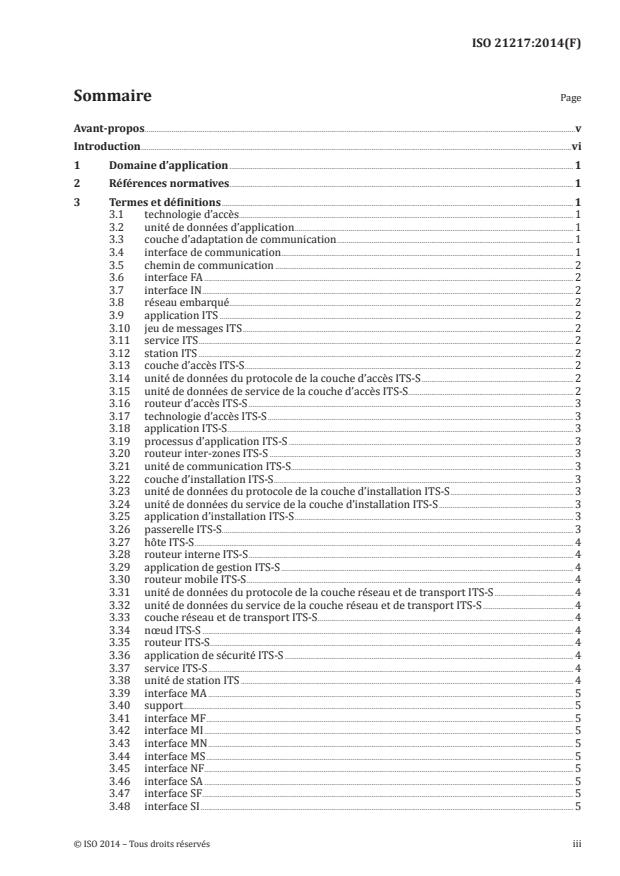
Contents Page
Foreword .iv
Introduction .v
1 Scope . 1
2 Normative references . 1
3 Terms and definitions . 1
4 Symbols and abbreviated terms . 5
5 Requirements . 7
6 Overview of ITS communications . 7
6.1 ITS services and applications . 7
6.2 ITS communication means . 7
6.3 ITS communication characteristics . 8
6.4 ITS communication networks . 9
6.5 ITS station interconnection scenarios .10
6.6 ITS concept of paths and flows .11
7 ITS station overview .13
7.1 ITS station concept .13
7.2 ITS-S architecture .14
8 Details of elements of ITS-S reference architecture.20
8.1 ITS-S interfaces .20
8.2 ITS-S access layer .21
8.3 ITS-S networking and transport layer .24
8.4 ITS-S facilities layer .26
8.5 ITS-S management entity .29
8.6 ITS-S security entity .31
8.7 ITS-S applications .32
9 Typical implementations of ITS station units .34
Annex A (informative) Illustration of typical ITS-SU implementations .36
Annex B (informative) ITS-S configurations .40
Bibliography .45
Foreword
ISO (the International Organization for Standardization) is a worldwide federation of national standards
bodies (ISO member bodies). The work of preparing International Standards is normally carried out
through ISO technical committees. Each member body interested in a subject for which a technical
committee has been established has the right to be represented on that committee. International
organizations, governmental and non-governmental, in liaison with ISO, also take part in the work.
ISO collaborates closely with the International Electrotechnical Commission (IEC) on all matters of
electrotechnical standardization.
The procedures used to develop this document and those intended for its further maintenance are
described in the ISO/IEC Directives, Part 1. In particular the different approval criteria needed for the
different types of ISO documents should be noted. This document was drafted in accordance with the
editorial rules of the ISO/IEC Directives, Part 2 (see www.iso.org/directives).
Attention is drawn to the possibility that some of the elements of this document may be the subject of
patent rights. ISO shall not be held responsible for identifying any or all such patent rights. Details of
any patent rights identified during the development of the document will be in the Introduction and/or
on the ISO list of patent declarations received (see www.iso.org/patents).
Any trade name used in this document is information given for the convenience of users and does not
constitute an endorsement.
For an explanation on the meaning of ISO specific terms and expressions related to conformity
assessment, as well as information about ISO’s adherence to the WTO principles in the Technical Barriers
to Trade (TBT) see the following URL: Foreword - Supplementary information
The committee responsible for this document is ISO/TC 204, Intelligent transport systems.
This second edition cancels and replaces the first edition (ISO 21217:2010) which has been technically
revised.
iv © ISO 2014 – All rights reserved
Introduction
“Communications Access for Land Mobile” (CALM) is the acronym used to refer to ISO TC204 WG16
work items. This acronym is used in the titles of the set of International Standards on communication
for “Intelligent Transport Systems” (ITS). These International Standards focus on specifying open
interfaces with regard to the functionalities required for all relevant layers and entities of the ITS station
reference architecture specified in this International Standard. Note that these International Standards
may also specify implementation details in situations where such specifications are deemed essential to
interoperability of interface protocols.
The set of CALM International Standards is designed to allow interoperable instantiations of ITS
stations which are based on the concept of abstracting applications and services from the underlying
communication layers of the ITS station. This abstraction and the functionalities and services that
can be easily implemented make the ITS station architecture described herein also well-suited to the
development and deployment of ITS applications and services that share information amongst each
other to improve the safety, sustainability and efficiency of transport systems.
The set of CALM International Standards include specifications for
— ITS station management,
— ITS communications security,
— ITS station facilities layer protocols,
— ITS station networking and transport layer protocols,
— communication interfaces (CIs) designed specifically for ITS applications and services such as those
designed specifically for safety of life and property,
— interfacing existing access technologies into ITS stations,
— distributed implementations of ITS stations, and
— interfacing ITS stations to existing communication networks and communicating with nodes
thereon.
This International Standard describes the common architectural framework around which ITS stations
are instantiated and provides references to relevant International Standards, including access technology
support standards, various networking and transport protocol standards, facilities standards, and ITS
station management and security standards. It also describes the general architecture of peer-to-peer
communications over various communication networks between ITS communication nodes. These
nodes may be ITS stations as described in this International Standard or any other reachable nodes.
The set of CALM International Standards is complemented by ITS communication International
Standards from other International Standards development organizations which together form the
basis for implementation of ITS communications networks around the world.
INTERNATIONAL STANDARD ISO 21217:2014(E)
Intelligent transport systems — Communications access
for land mobiles (CALM) — Architecture
1 Scope
This International Standard describes the communications reference architecture of nodes called “ITS
station units” designed for deployment in intelligent transport systems (ITS) communication networks.
The ITS station reference architecture is described in an abstract way. While this International Standard
describes a number of ITS station elements, whether or not a particular element is implemented in an
ITS station unit depends on the specific communication requirements of the implementation.
This International Standard also describes the various communication modes for peer-to-peer
communications over various networks between ITS communication nodes. These nodes may be ITS
station units as described in this International Standard or any other reachable nodes.
This International standard specifies the minimum set of normative requirements for a physical
instantiation of the ITS station based on the principles of a bounded secured managed domain.
2 Normative references
The following documents, in whole or in part, are normatively referenced in this document and are
indispensable for its application. For dated references, only the edition cited applies. For undated
references, the latest edition of the referenced document (including any amendments) applies.
None.
3 Terms and definitions
For the purposes of this document, the following terms and definitions apply.
3.1
access technology
technology employed in a communication interface to access a specific medium
3.2
application data unit
data unit exchanged between ITS-S application processes
3.3
communication adaptation layer
set of protocols and functions to adapt access technologies to the ITS-S networking and transport layer
3.4
communication interface
instantiation of a specific access technology and ITS-S access layer protocol
3.5
communication path
directed sequence of nodes connected by links, starting at a source node and ending at one or more
destination nodes
3.6
FA interface
interface between the ITS-S facilities layer and the ITS-S applications entity
3.7
IN interface
interface between the ITS-S access layer and the ITS-S networking and transport layer
3.8
in-vehicle network
generic term for a network in a vehicle which is not an ITS station-internal network
3.9
ITS application
instantiation of an ITS service that involves an association of two or more complementary ITS-S
application processes
Note 1 to entry: Fragments of an application may also reside in nodes that are not ITS stations.
3.10
ITS message set
set of messages designed for an ITS-related purpose
3.11
ITS service
functionality provided to users of intelligent transport systems designed e.g. to increase safety,
sustainability, efficiency, or comfort
3.12
ITS station
functional entity comprised of an ITS-S facilities layer, ITS-S networking and transport layer, ITS-S
access layer, ITS-S management entity, ITS-S security entity, and ITS-S applications entity providing ITS
services
Note 1 to entry: From an abstract point of view, the term “ITS station” refers to a set of functionalities. The
term is often used to refer to an instantiation of these functionalities in a physical unit. Often, the appropriate
interpretation is obvious from the context. The proper name of the physical instantiation of an ITS-S is ITS station
unit (ITS-SU).
3.13
ITS-S access layer
protocol layer in the ITS-S reference architecture containing the OSI physical and data link layer
protocols for ITS communications
3.14
ITS-S access layer protocol data unit
protocol data unit exchanged between peer ITS-S access layers
3.15
ITS-S access layer service data unit
service data unit exchanged between ITS-S access layer and ITS-S networking and transport layer
3.16
ITS-S access router
ITS-S border router with additional functionality that provides other ITS communication nodes a point
of attachment to an external network
3.17
ITS-S access technology
access technology dedicated to operation in an ITS-S
3.18
ITS-S application
ITS-S application process residing in the ITS-S application entity
2 © ISO 2014 – All rights reserved
3.19
ITS-S application process
element in an ITS station that performs information processing for a particular application and uses
ITS-S services to transmit and receive information
3.20
ITS-S border router
ITS-S router with additional functionality that provides connectivity to other ITS communication nodes
over external networks
3.21
ITS-S communication unit
physical unit in an ITS-SU containing a part or all of the functionality of an ITS-S
Note 1 to entry: In case an ITS-SU consists of a single physical unit, the ITS-SU and the ITS-SCU are identical. In
case an ITS-SU consists of more than one ITS-SCU, then these ITS-SCUs are interconnected via the ITS station-
internal network of the ITS-SU.
3.22
ITS-S facilities layer
layer in the ITS-S reference architecture containing OSI layers 5, 6, and 7 that connects applications to
the ITS-S networking and transport layer
3.23
ITS-S facilities layer protocol data unit
protocol data unit exchanged between peer ITS-S facility layers
3.24
ITS-S facilities layer service data unit
service data unit exchanged between ITS-S facilities layer and ITS-S application entity
3.25
ITS-S facility application
ITS-S application process residing in the ITS-S facilities layer
3.26
ITS-S gateway
ITS-S node used to interconnect two different OSI protocol stacks at layers 5 through 7
Note 1 to entry: An ITS-S gateway may convert between different protocols.
3.27
ITS-S host
ITS-S node comprised of ITS-S functionalities other than the functionalities of an ITS-S router, ITS-S
border router, ITS-S mobile router, or an ITS-S gateway
3.28
ITS-S internal router
ITS-S router that connects two or more ITS station-internal networks
3.29
ITS-S management application
ITS-S application process residing in the ITS-S management entity
3.30
ITS-S mobile router
ITS-S border router with additional functionality that allows a change of point of attachment to an
external network while maintaining session continuity
3.31
ITS-S networking and transport layer protocol data unit
protocol data unit exchanged between peer ITS-S networking and transport layers
3.32
ITS-S networking and transport layer service data unit
service data unit exchanged between ITS-S networking and transport layer and ITS-S facilities layer
3.33
ITS-S networking and transport layer
layer in the ITS-S reference architecture containing OSI layers 3 and 4 that connects the ITS-S facilities
layer to the ITS-S access layer
3.34
ITS-S node
node comprised of a set of functionalities in an ITS station unit that is connected to the ITS station-
internal network or comprises an entire ITS station unit
3.35
ITS-S router
ITS-S node comprised of routing functionalities of an ITS station unit used to connect two networks and
to forward packets not explicitly addressed to itself
3.36
ITS-S security application
ITS-S application process residing in the ITS-S security entity
3.37
ITS-S service
communication functionality of an ITS-S that provides the capability to connect to other nodes
3.38
ITS station unit
implementation of an ITS-S
3.39
MA interface
interface between the ITS-S management entity and ITS-S applications
3.40
medium
physical entity that supports the transmission of signals carrying information between ITS
communication nodes, e.g. a set of wires supporting Ethernet signals or the space between two antennas
that supports electromagnetic, optical, or acoustical transmissions
3.41
MF interface
interface between the ITS-S management entity and the ITS-S facilities layer
3.42
MI interface
interface between the ITS-S management entity and the ITS-S access layer
3.43
MN interface
interface between the ITS-S management entity and the ITS-S networking and transport layer
3.44
MS interface
interface between the ITS-S management entity and the ITS-S security entity
3.45
NF interface
interface between the ITS-S networking and transport layer and the ITS-S facilities layer
4 © ISO 2014 – All rights reserved
3.46
SA interface
interface between the ITS-S security entity and ITS-S applications
3.47
SF interface
interface between the ITS-S security entity and the ITS-S facilities layer
3.48
SI interface
interface between the ITS-S security entity and the ITS-S access layer
3.49
SN interface
interface between the ITS-S security entity and the ITS-S networking and transport layer
4 Symbols and abbreviated terms
ADU Application Data Unit
API Application Programming Interface
BSMD Bounded Secured Managed Domain
BSME Bounded Secured Managed Entity
CAL Communication Adaptation Layer
CALM Communications Access for Land Mobiles
CI Communication Interface
C-ITS Cooperative ITS
DSRC Dedicated Short-Range Communication
ETSI European Telecommunications Standards Institute
FA name of interface between ITS-S facilities layer and ITS-S application entity
IN name of interface between ITS-S access layer and ITS-S networking and transport layer
IP Internet Protocol
IPv6 IP version 6
IR Infra-Red
ISO International Standards Organization
ITS Intelligent Transport Systems
ITS-APDU ITS Station Access layer Protocol Data Unit
ITS-ASDU ITS Station Access layer Service Data Unit
ITS-FPDU ITS Station Facility layer Protocol Data Unit
ITS-FSDU ITS Station Facility layer Service Data Unit
ITS-NTPDU ITS Station Networking and Transport layer Protocol Data Unit
NOTE The deprecated term ITS-NPDU is in use in published standards with the same mean-
ing as ITS-NTPDU.
ITS-NTSDU ITS Station Networking and Transport layer Service Data Unit
ITS-S ITS Station
ITS-SCU ITS-S Communication Unit
ITS-SU ITS-S Unit
IVN In-Vehicle Network
LCH Logical Channel
LTE Long Term Evolution
MA name of the interface between the ITS-S management entity and ITS-S applications
MAE Management Adaptation Entity
MAP name of an ITS message set used to carry information on digital maps covering the area of
intersections
MF name of the interface between the ITS-S management entity and the ITS-S facilities layer
MI name of the interface between the ITS-S management entity and the ITS-S access layer
MIB Management Information Base
MN name of the interface between the ITS-S management entity and the ITS-S networking and
transport layer
MS name of the interface between the ITS-S management entity and the ITS-S security entity
NF name of the interface between the ITS-S networking and transport layer and the ITS-S facili-
ties layer
PCH Physical Channel
PDM Probe Data Management; name of an ITS message set
PDU Protocol Data Unit
POI Point of Interest
PVD Probe Vehicle Data; name of an ITS message set
SA name of the interface between the ITS-S security entity and ITS-S applications
SAP Service Access Point
SDU Service Data Unit
SF name of the interface between the ITS-S security entity and the ITS-S facilities layer
SI name of the interface between the ITS-S security entity and the ITS-S access layer
SMIB Security Management Information Base
SN name of the interface between the ITS-S security entity and the ITS-S networking and trans-
port layer
6 © ISO 2014 – All rights reserved
SOA Service Oriented Architecture
SPaT Signal Phase and Timing; name of an ITS message set
SRM Signal Request Message; name of an ITS message set
SSM Signal Status Message; name of an ITS message set
TOPO name of an ITS message set used to carry information on digital maps covering the area of
intersections
UMTS Universal Mobile Telecommunication System
5 Requirements
A physical instantiation of an ITS-S shall provide as a minimum
— the functionality of an ITS-S host specified in 7.2.2, i.e. acting as a terminal only or
— the functionality of an ITS-S host and ITS-S router specified in 7.2.2.
This includes a minimum set of related security procedures and principles that can be verified by an
appropriate ITS-related authority described in Reference [54]. These security procedures and principles
are used to allow the BSME to assert a level of trust to other BSMEs in the communication network.
6 Overview of ITS communications
6.1 ITS services and applications
The wide variety of services and applications to be deployed in the ITS sector and the global time-varying
nature of transportation itself lead to challenges in the design of communication systems to support
these services and applications. One of the challenges is to support widely disparate communication
requirements with respect to reliability, security, latency, and other performance parameters.
Furthermore, the possibility of having multiple applications in an ITS station unit (ITS-SU) simultaneously
competing for communication resources leads to the need for a controlled access to these resources.
Useful means for addressing this issue are e.g. application and message prioritization and logical
channels.
6.2 ITS communication means
ITS communications involves communications between a wide variety of ITS communication nodes on
different platforms, e.g. vehicles, roadside equipment, portable devices, control centres, using various
means and methods as illustrated in Figure 1. The various access and networking technologies illustrated
are used to interconnect stations on a peer-to-peer basis serving a range of ITS service domains. For
example, any of the vehicles in Figure 1 connected to an RSE via 5 GHz or IR could communicate with the
vehicle connected to the wireless LAN hotspot.
Figure 1 — Examples of ITS communications
6.3 ITS communication characteristics
Characteristics of ITS communications are presented in the following list:
— station mobility leads to complex time-varying networking topologies and time-varying properties
of wireless communication channels (fading, hidden-nodes, etc.);
— variety of stations connected via various networking and access technologies including the Internet,
various public and private networks, Bluetooth and WiFi, dedicated technologies, such as 5,8 GHz
DSRC for road tolling:
— a station with multiple access and networking technologies can maintain session continuity
through a change of either or both;
— two stations with different access technologies can establish end-to-end connectivity
— variety of communication requirements resulting from different ITS applications with different
priorities, e.g. road safety, traffic efficiency, mobility and infotainment, e.g. with respect to
communications capacity (data rate), communications reliability, communications availability;
— variety of communication requirements resulting from user needs, e.g. with respect to
communications cost (in terms of money), communications privacy, communications security;
— variety of communication requirements resulting from regional regulations and policies;
8 © ISO 2014 – All rights reserved
— global applicability, where intended.
6.4 ITS communication networks
An illustration of the various networks used in ITS communications is presented in Figure 2.
Figure 2 — Networking view of ITS communications
Figure 2 illustrates the following networks:
— an ITS infrastructure network comprised of ITS-SUs with a (quasi-) static topology, e.g. a collection
of roadside stations connected via a fibre backbone;
— an ITS ad hoc network comprised of ITS-SUs in which the topology may change rapidly, e.g. a mesh
network of (vehicle) stations connected via microwave technologies;
— a local data network, e.g. a proprietary in-vehicle network based on CAN bus technology or a
6LoWPAN wireless sensor network;
— a public access network, e.g. WiFi hotspot or cellular networks;
— a private access network, e.g. a proprietary road operator network;
— a core network, e.g. the Internet, a virtual private network.
NOTE An ITS station-internal network is not presented in Figure 2; however, it is necessary in implementations
illustrated in Figures 14 and 15.
ITS infrastructure and ITS ad hoc networks are networks specifically designed to accommodate and
implement ITS services and applications. They are connected to each other and to public access, private
access, and local data networks through an ITS-SU as shown in Figure 2. The concept of an ITS-SU is
described in Clause 7.
6.5 ITS station interconnection scenarios
Four basic ITS station unit interconnection scenarios are identified as illustrated in Figures 3, 4, 5, and
6. The distinction between these scenarios is based on two criteria:
— whether ITS station units connect to peer stations with or without a network;
— whether a peer station unit is a BSME presented in 7.1 or not.
This classification of scenarios does not consider any details of the network(s) between the peer station
units.
Single-hop communication between two BSMEs is illustrated in Figure 3. This can represent, for example,
a link between two vehicle BSMEs, or between a vehicle BSME and a roadside BSME, or between a
personal BSME and a vehicle BSME.
Figure 3 — BSME to BSME communication without an external network (single-hop)
Communication between two BSMEs over a network is illustrated in Figure 4. This can represent, for
example, a peer-to-peer communication involving a single-hop link from a BSME to a base station of
a cellular network which is connected to the Internet through which connection to a central BSME is
established.
Figure 4 — BSME to BSME communication over an external network (multiple hops)
Single-hop communication between a BSME and an ITS station unit not implementing the principles of a
BSMD is illustrated in Figure 5. This can represent, for example, a link between a 5,8 GHz DSRC on-board
unit implemented in a vehicle BSME, as specified in Reference [43], and a 5,8 GHz DSRC roadside unit.
10 © ISO 2014 – All rights reserved
Figure 5 — BSME to ITS station unit (no BSME) communication without an external network
(single-hop)
Communication between a BSME and an ITS station unit (no BSME) involving network connectivity is
illustrated in Figure 6. This can represent, for example, a single-hop link from a BSME to a base station
of a cellular network which connects to the Internet through which connection to an ITS station unit is
established.
Figure 6 — BSME to ITS station unit (no BSME) communication over an external network
(multiple hops)
An ITS-SU (with or without implementing the principles of a BSMD) may have multiple simultaneously
active sessions involving any or all of these basic communication scenarios.
6.6 ITS concept of paths and flows
The concept of paths and flows in ITS is very beneficial in describing the abstraction of ITS-S application
[55]
processes from the communications services available in an ITS-S. This concept is based on similar
[103]
concepts in IPv6 networking. Procedures for ascertaining available communication paths and
for mapping flows to those paths are divided into distinct functions within the ITS-S management as
specified in Reference [35].
A communication path is defined as a directed sequence of nodes connected by links, starting at a
source node (VCI which connects to the next hop node) and ending at one or more destination nodes.
Note that for bidirectional communications, two such paths exist, i.e. one at each peer station. Note
further that there could be multiple paths between a source and its destination.
A flow type is a set of communication requirements and characteristics associated with a specific flow.
A flow is an identifiable sequence of packets of a given flow type to be transmitted to one or more
entities over a communication path. Each flow is identified by a FlowID which is unique in an ITS-SU and
is mapped to a given communication path or a set of available communication paths.
Categories of communication requirements and objectives requested by an ITS-S application process
to select an appropriate communication profile and communication path include e.g. operational,
[55]
destination type, performance, financial, security, and protocol requirements.
Note that, in general, it cannot be ensured that the communication requirements will be met all along a
communication path as there may be no knowledge of the capabilities of all the nodes along a particular
path.
Figure 7 illustrates the architectural components (building blocks and management data flows)
of the ITS-S which are involved in the path selection process. The same architecture applies to the
[55]
communication profile selection process introduced in 7.1.
Figure 7 — Architecture of communication profile and path selection
“Communication protocols status” contains continuously updated properties and status of
— the various CIs and VCIs in the ITS-S access layer,
— protocols and parameters in the ITS-S networking and transport layer, and
— protocols, functions, and parameters in the ITS-S facilities layer.
It is updated via MI-SAP, MN-SAP, and MF-SAP.
Requirements and objectives obtained from ITS-S application processes, e.g. from ITS-S applications
[55]
via the API or from ITS-S facility applications via the MF-SAP, are maintained in “ITS-S application
requirements and objectives”.
[35]
NOTE The path selection process requires maintenance of further tables not illustrated in Figure 7.
12 © ISO 2014 – All rights reserved
7 ITS station overview
7.1 ITS station concept
The ITS station concept is based on the abstraction of ITS application processes from communication
protocols serving these ITS application processes along with the ability to securely manage those
application processes and communications. It is embodied in the abstract definition of an ITS station
(ITS-S) as a “Bounded Secured Managed Domain” (BSMD), i.e. a trusted ITS-S described in this
International Standard. An instantiation of a trusted ITS-S is referred to as a “Bounded Secured Managed
Entity” (BSME) if the trust nature of the implementation is relevant. In general, an instantiation of an
ITS-S is referred to as an “ITS station unit” (ITS-SU).
NOTE In this International Standard, the acronym ITS-S is used to indicate an ITS station based on the
principles of the BSMD. A general classification of stations used in ITS is outside the scope of this International
standard. A general high-level description of communications in cooperative ITS is presented in Reference [14].
The salient feature of the ITS-S concept that distinguishes it from the concept behind traditional
communication systems is that application processes are abstracted from both the access technologies
that provide the wireless connectivity and the networks that transport the information from the
source to the destination(s). ITS-Ss are not limited to either a single access technology or to a specific
networking and transport protocol. ITS-SUs can implement any of those technologies that are supported
through appropriate adaptation specifications.
While the aforementioned abstraction is generally useful for most application processes, this abstraction
does not prevent application processes from requesting a specific communication profile to be
[55]
considered in the communication profile selection process or specifying communication parameters
[25][42][95]
on a packet-per-packet basis.
The flexibility that ITS-S management has to make optimal use of all available ITS-S resources
(communication media and higher layer protocols) is one of the key enabling features of ITS
communications and applications. The means for (dynamically) assigning ITS-S application processes
to communication media and networking and transport layer protocols is specified in References [25],
[35], [54], and [55]. To exploit this flexibility, BSMD-compliant systems provide the ability to support
handover of different types including
— those involving a change of “Communication Interface” (CI) (which may or may not involve a change
of access technology) because ITS-SUs may have multiple communication interfaces using the same
access technology,
— those involving reconfiguration or change of the network employed to provide connectivity, and
— those involving both a change in communication interface and network reconfiguration.
The handover architecture is specified in Reference [8].
Finally, to be able to meet the stringent security requirements of ITS application processes related
to safety of life and property, the ITS-S concept provides for secure peer-to-peer communications
between entities that are themselves capable of being secured and remotely managed. While this is an
abstract definition, it has very specific physical consequences. The bounded nature is derived from the
requirement for ITS-Ss to be able to communicate amongst themselves, i.e. peer-to-peer, as well as with
devices that are not secured. Realizing that to achieve this in a secure manner often requires distribution
and storage of security-related material that must be protected within the boundaries of the ITS-S leads
to the secured nature of the entity. As there is great flexibility to achieve desired communication goals,
there is a requirement that this flexibility be managed. Thus, ITS-Ss are referred to as bounded secured
managed domains (BSMD).
7.2 ITS-S architecture
7.2.1 Generalized OSI model
[47]
The “ISO Open Systems Interconnect Reference Model” is used in a number of figures within this
International Standard with reference to the ITS-S communications architecture that embody the ITS
station concept. Several levels of abstraction will be used to illustrate different points of view.
Figure 8 shows the general ITS-S reference architecture, including interfaces (IN, NF, FA, ;I, MN, MF,
MA, SI, SN, SF, SA, MS, API) between the various blocks with informative details. Such interfaces may
be partly non-observable and thus non-testable service access points (SAPs), or observable and testable
interfaces (e.g. plug-and-play), or application programming interfaces (APIs).
Figure 8 — ITS-S reference architecture
A simplified presentation of the ITS-S reference architecture is shown in Figure 9.
14 © ISO 2014 – All rights reserved
Figure 9 — Simplified ITS-S reference architecture
NOTE The interfaces MA, FA, and SA are not shown explicitly in Figure 9, as the functionality of these
interfaces is provided in the API.
The blocks in Figures 8 and 9 contain the following functionality:
— ITS-S access layer, referred to as “Access”, comprised of OSI layers 1 (Physical) and 2 (Data Link) of
the OSI communication protocol stack;
— ITS-S networking and transport layer, referred to as “Networking & Transport”, comprised of OSI
layers 3 (Network) and 4 (Transport) of the OSI communication protocol stack;
— ITS-S facilities layer, referred to as “Facilities”, comprised of OSI layers 5 (Session), 6 (Presentation),
and 7 (Application) of the OSI communication protocol stack;
— ITS-S management entity, referred to as “Management”, containing station management
functionalities;
— ITS-S security entity, referred to as “Security”, comprised of security services provided to the OSI
communication protocol stack and to the ITS-S management entity;
— ITS-S application entity, referred to as “Applications”, which make use of the OSI communication
protocol stack.
The functional blocks presented in Figures 8 and 9 are interconnected either via observable interfaces
or via service access points (SAPs) as specified in e.g. References [25], [32], and [42] or via an API. The
identifiers of these interfaces are shown in Figures 8 and 9.
Implementations of ITS stations, referred to as ITS station units (ITS-SU), constitute “endpoints” of a
communication path. An ITS-SU designed and configured to provide one or several specific ITS services
to its user is expected to provide those functionalities of the blocks in Figures 8 and 9 necessary for these
ITS services . Some of the functionalities in the various blocks may not be applicable and therefore do
not need to be implemented. For example, some ITS-S application processes might not require specific
support from the ITS-S facilities layer or from the ITS-S security entity. The requirement to instantiate
certain functionalities does not imply anything about the actual implementation. These functionalities
(blocks) may be spread over several physical devices or they may be implemented inside a single device,
as illustrated in this International Standard.
7.2.2 ITS station nodes
An ITS-SU comprises ITS-SCUs connected via an ITS station-internal network as illustrated in 7.2.4. The
functionality contained in an ITS-SCU may be expressed by the functionalities of one or several ITS-S
nodes as illustrated in Annex B. The following ITS-S nodes are identified:
a) ITS-S router
1) ITS-S border router
— Access router
— Mobile router
2) ITS-S internal router
b) ITS-S host
c) ITS-S gateway
The following definitions apply.
— An ITS-S router is an ITS-S node comprised of routing functionalities of an ITS-S used to connect
two networks and to forward packets not explicitly addressed to itself as illustrated in Figure 10
with the example of an ITS station-internal network and an external network B.
Figure 10 — ITS-S router
— An ITS-S border router is an ITS-S router with additional functionality that provides connectivity
to other ITS communication nodes over external networks (network B in Figure 10).
— An ITS-S access router is an ITS-S border router with additional functionality that provides other
ITS communication nodes a point of attachment to an external network.
— An ITS-S mobile router is an ITS-S border router with additional functionality that allows a change
of point of attachment to an external network while maintaining session continuity.
— An ITS-S internal router is an ITS-S router that connects two or more ITS station-internal networks.
16 © ISO 2014 – All rights reserved
— An ITS-S host is an ITS-S node comprised of ITS-S functionalities other than the functionalities
of an ITS-S router, ITS-S border router, ITS-S mobile router, or an ITS-S gateway, i.e. not capable to
forward packets not explicitly addressed to itself.
NOTE Being an ITS-S node, an ITS-S host obviously contains the communication functionality to connect to
at least one network, although routing functionality is not part of the ITS-S host functionality.
— An ITS-S gateway interconnects an “external protocol stack” to the ITS-S management entity, or
to the ITS-S facilities layer, or to the ITS-S networking and transport layer, and thus supports also
direct routing on a default path to Internet which enables end-to-end communications. An ITS-S
gateway may convert between different protocols. The protocol stack on the right hand side in
Figure 11 is connected to the ITS station-internal network. The protocol stack on the left-hand side
in Figure 11 is connected to an external network.
NOTE The external network may be a proprietary network, i.e. its technical specification may not be publicly
available.
Figure 11 — Example of an ITS-S gateway at the ITS-S facilities layer
7.2.3 Protocol and service data units in the ITS-S protocol stack
Figure 12 shows the data unit transfer, i.e. service data units (SDU) and protocol data units (PDU),
through the ITS-S communication stack of two peer ITS stations communicating with each other and
the grouping of protocol layers as used in ITS:
— Session, presentation, and application OSI layers 5 through 7 comprise the “ITS-S facilities layer”.
— Network and transport OSI layers 3 and 4 comprise
...
NORME ISO
INTERNATIONALE 21217
Deuxième édition
2014-04-01
Systèmes intelligents de transport —
Accès aux communications des
services mobiles terrestres (CALM) —
Architecture
Intelligent transport systems — Communications access for land
mobiles (CALM) — Architecture
Numéro de référence
©
ISO 2014
DOCUMENT PROTÉGÉ PAR COPYRIGHT
© ISO 2014
Droits de reproduction réservés. Sauf indication contraire, aucune partie de cette publication ne peut être reproduite ni utilisée
sous quelque forme que ce soit et par aucun procédé, électronique ou mécanique, y compris la photocopie, l’affichage sur
l’internet ou sur un Intranet, sans autorisation écrite préalable. Les demandes d’autorisation peuvent être adressées à l’ISO à
l’adresse ci-après ou au comité membre de l’ISO dans le pays du demandeur.
ISO copyright office
Case postale 56 • CH-1211 Geneva 20
Tel. + 41 22 749 01 11
Fax + 41 22 749 09 47
E-mail copyright@iso.org
Web www.iso.org
Publié en Suisse
ii © ISO 2014 – Tous droits réservés
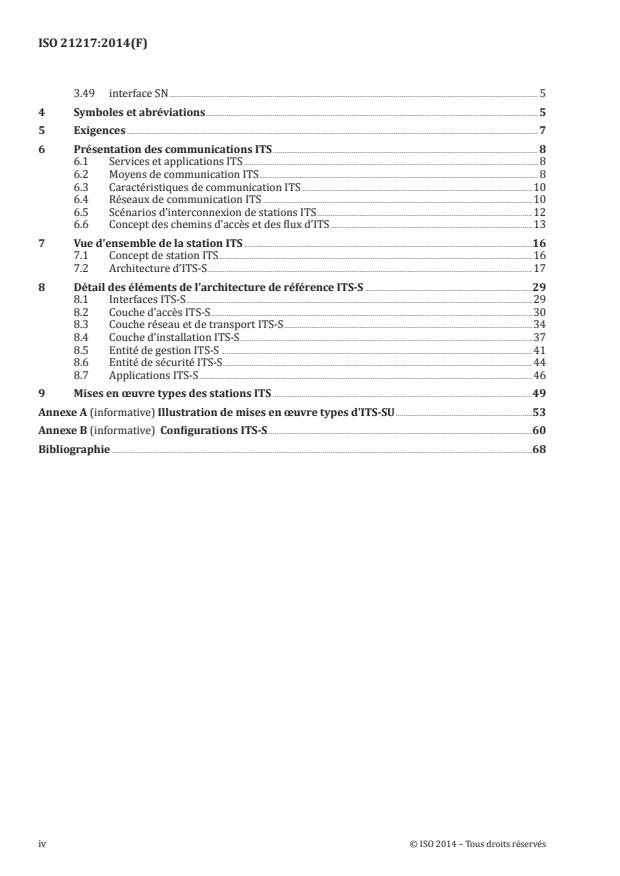
Sommaire Page
Avant-propos .v
Introduction .vi
1 Domaine d’application . 1
2 Références normatives . 1
3 Termes et définitions . 1
3.1 technologie d’accès . . 1
3.2 unité de données d’application . 1
3.3 couche d’adaptation de communication . 1
3.4 interface de communication . 1
3.5 chemin de communication . 2
3.6 interface FA . 2
3.7 interface IN . 2
3.8 réseau embarqué . . 2
3.9 application ITS . 2
3.10 jeu de messages ITS . 2
3.11 service ITS . 2
3.12 station ITS . 2
3.13 couche d’accès ITS-S . 2
3.14 unité de données du protocole de la couche d’accès ITS-S . 2
3.15 unité de données de service de la couche d’accès ITS-S . 2
3.16 routeur d’accès ITS-S . 3
3.17 technologie d’accès ITS-S . 3
3.18 application ITS-S . 3
3.19 processus d’application ITS-S . 3
3.20 routeur inter-zones ITS-S . 3
3.21 unité de communication ITS-S. 3
3.22 couche d’installation ITS-S . 3
3.23 unité de données du protocole de la couche d’installation ITS-S . 3
3.24 unité de données du service de la couche d’installation ITS-S . 3
3.25 application d’installation ITS-S . 3
3.26 passerelle ITS-S. 3
3.27 hôte ITS-S . 4
3.28 routeur interne ITS-S . 4
3.29 application de gestion ITS-S . 4
3.30 routeur mobile ITS-S . 4
3.31 unité de données du protocole de la couche réseau et de transport ITS-S . 4
3.32 unité de données du service de la couche réseau et de transport ITS-S . 4
3.33 couche réseau et de transport ITS-S . 4
3.34 nœud ITS-S . 4
3.35 routeur ITS-S . 4
3.36 application de sécurité ITS-S . 4
3.37 service ITS-S . 4
3.38 unité de station ITS . 4
3.39 interface MA . 5
3.40 support . 5
3.41 interface MF . 5
3.42 interface MI . 5
3.43 interface MN . 5
3.44 interface MS . 5
3.45 interface NF . 5
3.46 interface SA . 5
3.47 interface SF . 5
3.48 interface SI . 5
3.49 interface SN . 5
4 Symboles et abréviations . 5
5 Exigences . 7
6 Présentation des communications ITS . 8
6.1 Services et applications ITS . 8
6.2 Moyens de communication ITS . 8
6.3 Caractéristiques de communication ITS .10
6.4 Réseaux de communication ITS .10
6.5 Scénarios d’interconnexion de stations ITS .12
6.6 Concept des chemins d’accès et des flux d’ITS .13
7 Vue d’ensemble de la station ITS .16
7.1 Concept de station ITS .16
7.2 Architecture d’ITS-S .17
8 Détail des éléments de l’architecture de référence ITS-S .29
8.1 Interfaces ITS-S .29
8.2 Couche d’accès ITS-S .30
8.3 Couche réseau et de transport ITS-S .34
8.4 Couche d’installation ITS-S .37
8.5 Entité de gestion ITS-S .41
8.6 Entité de sécurité ITS-S .44
8.7 Applications ITS-S .46
9 Mises en œuvre types des stations ITS .49
Annexe A (informative) Illustration de mises en œuvre types d’ITS-SU .53
Annexe B (informative) Configurations ITS-S.60
Bibliographie .68
iv © ISO 2014 – Tous droits réservés
Avant-propos
L’ISO (Organisation internationale de normalisation) est une fédération mondiale d’organismes
nationaux de normalisation (comités membres de l’ISO). L’élaboration des Normes internationales est
en général confiée aux comités techniques de l’ISO. Chaque comité membre intéressé par une étude
a le droit de faire partie du comité technique créé à cet effet. Les organisations internationales,
gouvernementales et non gouvernementales, en liaison avec l’ISO participent également aux travaux.
L’ISO collabore étroitement avec la Commission électrotechnique internationale (IEC) en ce qui concerne
la normalisation électrotechnique.
Les procédures utilisées pour élaborer le présent document et celles destinées à sa mise à jour sont
décrites dans les Directives ISO/IEC, Partie 1. Il convient, en particulier de prendre note des différents
critères d’approbation requis pour les différents types de documents ISO. Le présent document a été
rédigé conformément aux règles de rédaction données dans les Directives ISO/IEC, Partie 2 (voir www.
iso.org/directives).
L’attention est appelée sur le fait que certains des éléments du présent document peuvent faire l’objet de
droits de propriété intellectuelle ou de droits analogues. L’ISO ne saurait être tenue pour responsable
de ne pas avoir identifié de tels droits de propriété et averti de leur existence. Les détails concernant les
références aux droits de propriété intellectuelle ou autres droits analogues identifiés lors de l’élaboration
du document sont indiqués dans l’Introduction et/ou dans la liste des déclarations de brevets reçues par
l’ISO (voir www.iso.org/brevets).
Les appellations commerciales éventuellement mentionnées dans le présent document sont données
pour information, par souci de commodité, à l’intention des utilisateurs et ne sauraient constituer un
engagement.
Pour une explication de la signification des termes et expressions spécifiques de l’ISO liés à l’évaluation de
la conformité, ou pour toute information au sujet de l’adhésion de l’ISO aux principes de l’OMC concernant
les obstacles techniques au commerce (OTC), voir le lien suivant: Avant-propos — Informations
supplémentaires.
Le comité responsable de ce document est l’ISO/TC 204, Systèmes intelligents de transport.
Cette deuxième édition annule et remplace la première édition (ISO 21217:2010), qui a fait l’objet d’une
révision technique.
Introduction
CALM (Accès aux communications des services mobiles terrestres, de l’anglais «Communication access
for land mobiles») est l’acronyme utilisé pour désigner les éléments de travail de l’ISO TC204 WG16.
Cet acronyme est utilisé dans les titres des normes internationales de communication régissant les
«Systèmes intelligents de transport» (ITS). Ces Normes internationales visent à spécifier des interfaces
ouvertes concernant les fonctionnalités exigées pour toutes les couches et entités concernées de
l’architecture de référence de station ITS spécifiées dans la présente Norme internationale. Notez que
ces Normes internationales peuvent également spécifier des détails de mise en œuvre dans les cas où de
telles spécifications sont réputées essentielles pour l’interopérabilité des protocoles d’interface.
Les Normes internationales CALM sont conçues pour permettre des instanciations interopérables
de stations ITS, qui reposent sur la notion d’extraction d’applications et de services des couches de
communication sous-jacentes de la station ITS. Grâce à cette extraction et aux fonctionnalités et
services qui peuvent être facilement mis en œuvre, l’architecture de station ITS décrite dans le présent
document est parfaitement adaptée au développement et au déploiement d’applications et de services
ITS partageant des informations entre eux en vue d’améliorer la sécurité, la durabilité et l’efficacité des
systèmes de transport.
Les Normes internationales CALM comprennent des spécifications pour:
— la gestion de stations ITS;
— la sécurité des communications ITS;
— les protocoles de la couche d’installation de stations ITS;
— les protocoles de la couche réseau et transport des stations ITS;
— des interfaces de communication (CI) conçues spécialement pour les applications et les services ITS,
telles que la protection des personnes et des biens;
— l’interface entre les technologies d’accès existantes sur les stations ITS;
— les mises en œuvre réparties des stations ITS; et
— l’interface des stations ITS avec les réseaux de communication existants, et la communication avec
les nœuds de ces réseaux.
La présente Norme internationale décrit le cadre architectural commun autour duquel les stations ITS
sont instanciées. Elle fournit des références aux Normes internationales concernées, notamment aux
normes de prise en charge des technologies d’accès, aux différentes normes régissant les protocoles
réseau et de transport, aux normes régissant les installations, ainsi qu’aux normes de gestion des
stations ITS et de sécurité. Elle décrit également l’architecture générale des communications P2P via
divers réseaux de communication entre nœuds de communication ITS. Ces nœuds peuvent être des
stations ITS telles que décrites dans la présente Norme internationale ou d’autres nœuds accessibles.
Les Normes internationales CALM sont complétées par les Normes internationales ITS d’autres
organismes de définition de normes internationales qui, conjointement, constituent le fondement de la
mise en œuvre des réseaux de communication ITS à travers le monde.
vi © ISO 2014 – Tous droits réservés
NORME INTERNATIONALE ISO 21217:2014(F)
Systèmes intelligents de transport — Accès aux
communications des services mobiles terrestres (CALM) —
Architecture
1 Domaine d’application
La présente Norme internationale décrit l’architecture de communication de référence des nœuds
appelés «unités de station ITS», conçus pour le déploiement sur les réseaux de communication des
systèmes intelligents de transport (ITS). L’architecture de référence de station ITS est décrite sous
forme abstraite. Si la présente Norme internationale décrit un certain nombre d’éléments de station
ITS, le fait qu’un élément particulier est mis en œuvre ou non dans une unité de station ITS dépend des
exigences de communication spécifiques de la mise en œuvre.
La présente Norme internationale décrit également les différents modes de communication P2P, sur
divers réseaux, entre les nœuds de communication ITS. Ces nœuds peuvent être des unités de station ITS
telles que décrites dans la présente Norme internationale ou d’autres nœuds accessibles.
La présente Norme internationale définit les exigences normatives minimales d’une instanciation
physique de la station ITS fondées sur les principes d’un domaine administré sécurisé délimité.
2 Références normatives
Les documents suivants sont cités en référence de manière normative, en intégralité ou en partie, dans le
présent document et sont indispensables pour son application. Pour les références datées, seule l’édition
citée s’applique. Pour les références non datées, la dernière édition du document de référence s’applique
(y compris les éventuels amendements).
Aucune.
3 Termes et définitions
Pour les besoins du présent document, les termes et définitions suivants s’appliquent.
3.1 technologie d’accès
technologie employée dans une interface de communication pour accéder à un support spécifique
3.2 unité de données d’application
unité de données échangée entre processus d’application ITS-S
3.3 couche d’adaptation de communication
ensemble de protocoles et de fonctions servant à adapter des technologies d’accès à la couche réseau et
de transport ITS-S
3.4 interface de communication
instanciation d’une technologie d’accès spécifique et du protocole de la couche d’accès ITS-S
3.5 chemin de communication
séquence dirigée de nœuds connectés par des liaisons, commençant par un nœud d’origine et prenant fin
sur un ou plusieurs nœuds de destination
3.6 interface FA
interface entre la couche d’installation ITS-S et l’entité des applications ITS-S
3.7 interface IN
interface entre la couche d’accès ITS-S et la couche réseau et de transport ITS-S
3.8 réseau embarqué
terme générique désignant un réseau à bord d’un véhicule, qui n’est pas un réseau interne de station ITS
3.9 application ITS
instanciation d’un service ITS qui implique une association de deux ou plusieurs processus d’application
ITS-S complémentaires
Note 1 à l’article Des fragments d’une application peuvent également résider sur des nœuds qui ne sont pas des
stations ITS.
3.10 jeu de messages ITS
jeu de messages dont l’objet est lié à un ITS
3.11 service ITS
fonctionnalité fournie aux utilisateurs de systèmes intelligents de transport et conçue, par exemple,
pour améliorer la sécurité, la durabilité, l’efficacité ou le confort
3.12 station ITS
entité fonctionnelle comprenant une couche d’installation ITS-S, une couche réseau et de transport
ITS-S, une couche d’accès ITS-S, une entité de gestion ITS-S, une entité de sécurité ITS-S et une entité
applications ITS-S fournissant des services ITS
Note 1 à l’article D’un point de vue abstrait, le terme «station ITS» fait référence à un ensemble de fonctionnalités.
Ce terme sert souvent à désigner une instanciation de ces fonctionnalités dans une unité physique. Le contexte
rend souvent son interprétation évidente. Le nom correct de l’instanciation physique d’une ITS-S est unité de
station ITS (ITS-SU).
3.13 couche d’accès ITS-S
couche de protocole de l’architecture de référence ITS-S contenant les protocoles de la couche physique
et de la liaison de données OSI pour les communications ITS
3.14 unité de données du protocole de la couche d’accès ITS-S
unité de données de protocole échangée entre couches d’accès ITS-S homologues
3.15 unité de données de service de la couche d’accès ITS-S
unité de données de service échangée entre la couche d’accès ITS-S et la couche réseau et de transport
ITS-S
2 © ISO 2014 – Tous droits réservés
3.16 routeur d’accès ITS-S
routeur inter-zones comportant des fonctionnalités supplémentaires fournissant aux autres nœuds de
communication ITS un point de raccordement à un réseau externe
3.17 technologie d’accès ITS-S
technologie d’accès dédiée au fonctionnement dans une ITS-S
3.18 application ITS-S
processus d’application ITS-S résidant dans l’entité d’application ITS-S
3.19 processus d’application ITS-S
élément d’une station ITS assurant le traitement des informations pour une application particulière et
utilisant les services ITS-S pour échanger des informations
3.20 routeur inter-zones ITS-S
routeur ITS-S comportant des fonctionnalités supplémentaires assurant la connectivité avec d’autres
nœuds de communication ITS via des réseaux externes
3.21 unité de communication ITS-S
unité physique d’une ITS-SU comprenant tout ou partie des fonctionnalités d’une ITS-S
Note 1 à l’article Si une ITS-SU consiste en une seule entité physique, l’ITS-SU et l’ITS-SCU sont identiques. Si une
ITS-SU consiste en deux ou plusieurs ITS-SCU, celles-ci sont interconnectées via le réseau interne de la station ITS
de l’ITS-SU.
3.22 couche d’installation ITS-S
couche de l’architecture de référence ITS-S contenant les couches OSI 5, 6 et 7, qui relient les applications
à la couche réseau et de transport de l’ITS-S
3.23 unité de données du protocole de la couche d’installation ITS-S
unité de données de protocole échangée entre couches installations ITS-S homologues
3.24 unité de données du service de la couche d’installation ITS-S
unité de données de service échangée entre la couche d’installation ITS-S et la couche d’application ITS-S
3.25 application d’installation ITS-S
processus d’application ITS-S résidant dans l’entité des installations ITS-S
3.26 passerelle ITS-S
nœud ITS-S servant à interconnecter deux piles de protocole OSI indépendantes au niveau des couches
5 à 7
Note 1 à l’article Une passerelle ITS-S peut assurer la conversion entre différents protocoles.
3.27 hôte ITS-S
nœud ITS-S comprenant des fonctionnalités ITS-S autres que celles d’un routeur ITS-S, un routeur inter-
zones ITS-S, un routeur mobile ITS-S ou une passerelle ITS-S.
3.28 routeur interne ITS-S
routeur ITS-S reliant deux ou plusieurs réseaux internes de station ITS
3.29 application de gestion ITS-S
processus d’application ITS-S résidant dans l’entité de gestion ITS-S
3.30 routeur mobile ITS-S
routeur inter-zones comportant des fonctionnalités supplémentaires permettant un changement de
point de raccordement à un réseau externe sans interruption de la session
3.31 unité de données du protocole de la couche réseau et de transport ITS-S
unité de données du protocole échangée entre couches réseau et de transport ITS-S homologues
3.32 unité de données du service de la couche réseau et de transport ITS-S
unité de données de service échangée entre la couche réseau et de transport ITS-S et sa couche
d’installation ITS-S
3.33 couche réseau et de transport ITS-S
couche de l’architecture de référence ITS-S contenant les couches OSI 3 et 4, qui relient la couche
d’installation ITS-S à la couche d’accès ITS-S
3.34 nœud ITS-S
nœud comprenant un ensemble de fonctionnalités dans une unité de station ITS reliée au réseau interne
de la station ITS ou comprenant une unité de station ITS entière
3.35 routeur ITS-S
nœud ITS-S comprenant les fonctionnalités de routage d’une unité de station UTS servant à connecter
deux réseaux et à réacheminer les paquets qui ne sont pas adressés spécifiquement à lui-même
3.36 application de sécurité ITS-S
processus d’application ITS-S résidant dans l’entité de sécurité ITS-S
3.37 service ITS-S
fonctionnalité de communication d’une ITS-S offrant la possibilité de se connecter à d’autres nœuds
3.38 unité de station ITS
mise en œuvre d’une ITS-S
4 © ISO 2014 – Tous droits réservés
3.39 interface MA
interface entre l’entité de gestion ITS-S et ses applications ITS-S
3.40 support
entité physique prenant en charge la transmission de signaux acheminant l’information entre les nœuds
de communication ITS, par exemple, ensemble de fils transmettant les signaux Ethernet ou espace entre
deux antennes transmettant les signaux électromagnétiques, optiques ou acoustiques
3.41 interface MF
interface entre la couche de gestion ITS-S et la couche d’installation ITS-S
3.42 interface MI
interface entre la couche de gestion ITS-S et la couche d’accès ITS-S
3.43 interface MN
interface entre l’entité de gestion ITS-S et la couche réseau et de transport ITS-S
3.44 interface MS
interface entre la couche de gestion ITS-S et l’entité de sécurité ITS-S
3.45 interface NF
interface entre la couche réseau et de transport ITS-S et la couche d’installation ITS-S
3.46 interface SA
interface entre l’entité de sécurité ITS-S et ses applications ITS-S
3.47 interface SF
interface entre l’entité de sécurité ITS-S et la couche d’installation ITS-S
3.48 interface SI
interface entre l’entité de sécurité ITS-S et la couche d’accès ITS-S
3.49 interface SN
interface entre l’entité de sécurité ITS-S et la couche réseau et de transport ITS-S
4 Symboles et abréviations
ADU Unité de données d’application
API Interface de programmation d’application
BSMD Domaine administré sécurisé délimité
BSME Entité administrée sécurisée délimitée
CAL Couche d’adaptation de communication
CALM Accès aux communications des services mobiles terrestres
CI Interface de communication
C-ITS ITS coopératif
DSRC Communication dédiée à courte portée
ETSI Institut européen des normes de télécommunication
FA Nom de l’interface entre la couche d’installation ITS-S et l’entité d’application ITS-S
IN Nom de l’interface entre la couche d’accès ITS-S et la couche réseau et de transport ITS-S
IP Internet Protocol
IPv6 IP version 6
IR Infrarouge
ISO International Standards Organization
ITS Systèmes intelligents de transport
ITS-APDU Unité de données du protocole de la couche d’accès de station ITS-S
ITS-ASDU Unité de données de service de la couche d’accès de station ITS-S
ITS-FPDU Unité de données du protocole de la couche d’installation de station ITS
ITS-FSDU Unité de données du service de la couche d’installation de station ITS-S
ITS-NTPDU Unité de données de protocole de la couche réseau et de transport de station ITS
NOTE Le terme obsolète ITS-NPDU utilisé dans les normes publiées a la même signification
qu’ITS-NTPDU.
ITS-NTSDU Unité de données du service de la couche réseau et de transport ITS
ITS-S Station ITS
ITS-SCU Unité de communication ITS-S
ITS-SU Unité ITS-S
IVN Réseau embarqué
LCH Canal logique
LTE Evolution à long terme
MA Nom de l’interface entre l’entité de gestion ITS-S et les applications ITS-S
MAE Management Adaptation Entity
MAP Nom d’un jeu de messages ITS utilisé pour acheminer des informations sur des plans numé-
riques couvrant la zone des intersections
MF Nom de l’interface entre l’entité de gestion ITS-S et la couche d’installation ITS-S
MI Nom de l’interface entre l’entité de gestion ITS-S et la couche d’accès ITS-S
6 © ISO 2014 – Tous droits réservés
MIB Base d’informations de gestion
MN Nom de l’interface entre l’entité de gestion ITS-S et la couche réseau et de transport ITS-S
MS Nom de l’interface entre l’entité de gestion ITS-S et l’entité de sécurité ITS-S
NF Nom de l’interface entre la couche réseau et de transport ITS-S et la couche d’installation ITS-S
PCH Canal physique
PDM Probe Data Management; nom d’un jeu de messages ITS
PDU Unité de données de protocole
POI Point d’intérêt
PVD Probe Vehicle Management; nom d’un jeu de messages ITS
SA Nom de l’interface entre l’entité de sécurité ITS-S et les applications ITS-S
SAP Point d’accès de service
SDU Unité de données de service
SF Nom de l’interface entre l’entité de sécurité ITS-S et la couche d’installation ITS-S
SI Nom de l’interface entre l’entité de sécurité ITS-S et la couche d’accès ITS-S
SMIB Base d’informations de gestion de la sécurité
SN Nom de l’interface entre l’entité de sécurité ITS-S et la couche réseau et de transport ITS-S
SOA Architecture orientée services
SPaT Signal Phase and Timing; nom d’un jeu de messages ITS
SRM Signal Request Message; nom d’un jeu de messages ITS
SSM Signal Status Message; nom d’un jeu de messages ITS
TOPO Nom d’un jeu de messages ITS utilisé pour acheminer des informations sur des plans numé-
riques couvrant la zone des intersections
UMTS Système universel de télécommunications mobiles
5 Exigences
Une instanciation physique d’une ITS-S doit fournir au minimum
— les fonctionnalités d’un hôte ITS-S spécifiées en 7.2.2, c’est-à-dire remplissant uniquement une
fonction de terminal ou
— les fonctionnalités d’un hôte ITS-S et d’un routeur ITS-S spécifiées en 7.2.2.
Cela inclut un ensemble minimum de procédures et de principes de sécurité associés, qui peut être
[54]
confirmé par une autorité compétente liée à ITS décrite à la Référence . Ces procédures et principes
de sécurité sont appliqués pour permettre au BSME d’affirmer un niveau de confiance vis-à-vis d’autres
BSME dans le réseau de communication.
6 Présentation des communications ITS
6.1 Services et applications ITS
La grande diversité des services et des applications à déployer dans le secteur ITS, et l’évolutivité
du transport proprement dit se traduisent par des difficultés dans la conception des systèmes de
communication devant prendre en charge ces services et applications. L’une de ces difficultés réside
dans la nécessité de répondre à des exigences de communication disparates par rapport à la fiabilité, à
la sécurité, à la latence et à d’autres paramètres de performance.
De plus, la possibilité que plusieurs applications d’une unité de station ITS (ITS-SU) soient en concurrence
pour des ressources de communication conduit à la nécessité d’un accès contrôlé à ces ressources. Pour
y remédier, des moyens tels que la hiérarchisation des applications et des messages, ainsi que les canaux
logiques, sont envisageables.
6.2 Moyens de communication ITS
Les communications ITS impliquent des communications entre une grande diversité de nœuds de
communication ITS sur différentes plates-formes, telles que des véhicules, des équipements fixes, des
terminaux portables et des centres de commande, par divers moyens et méthodes, comme le montre la
Figure 1. Les différentes technologies d’accès et réseau sont utilisées pour interconnecter les stations
en mode P2P et desservir tout un éventail de domaines de services ITS. Par exemple, n’importe lequel
des véhicules de la Figure 1 connecté à un RSE via une liaison à 5 GHz ou IR peut communiquer avec le
véhicule connecté au hotspot LAN sans fil.
8 © ISO 2014 – Tous droits réservés
Anglais Français
Satellite Broadcast Diffusion satellite
GPS/GALILEO GPS/GALILEO
Terrestrial Broadcast Diffusion terrestre
Internet Internet
Cellular Cellulaire
RSE-to-RSE RSE vers RSE
RSE to vehicle RSE vers véhicule
vehicle-to-vehicle véhicule vers véhicule
Hot-Spot (Wireless LAN) Hotspot (LAN sans fil)
RSE to vehicle RSE vers véhicule
ad-hoc communication (e.g. 5 GHz, 60 GHz, IR) Communication ad hoc (ex: 5 GHz, 60 GHz, IR)
portable-to-vehicle (e.g. Bluetooth) portable vers véhicule (ex: Bluetooth)
5.8GHz DSRC DSRC 5,8 GHz
Figure 1 — Exemples de communication ITS
6.3 Caractéristiques de communication ITS
La liste suivante présente les caractéristiques des communications ITS:
— la mobilité des stations se traduit par des topologies réseau complexes et évolutives, ainsi que par
des propriétés évolutives des canaux de communication sans fil (atténuation, nœuds cachés, etc.);
— diversité des stations connectées via différentes technologies réseau et d’accès, dont Internet, divers
réseaux publics et privés, Bluetooth et WiFi, technologies dédiées telles que DSRC 5,8 GHz pour le
péage routier:
— une station intégrant plusieurs technologies d’accès et réseau peut maintenir la continuité d’une
session en cas de changement de l’une ou l’autre, ou des deux;
— deux stations intégrant des technologies d’accès différentes peuvent assurer une connectivité
de bout en bout.
— diversité des exigences de communication du fait que les différentes applications ITS ont des
priorités différentes, telles que la sécurité routière, la fluidité de la circulation, la mobilité et
l’infodivertissement, par rapport à la capacité (débit binaire), à la fiabilité et à la disponibilité des
communications;
— diversité des exigences de communication résultant des besoins des utilisateurs, par exemple en
termes de coût (pécuniaire), de confidentialité et de sécurité des communications;
— diversité des exigences de communication résultant de réglementations et de politiques régionales;
— applicabilité globale, là où elle est prévue.
6.4 Réseaux de communication ITS
La Figure 2 présente une illustration des différents réseaux utilisés dans les communications ITS.
10 © ISO 2014 – Tous droits réservés
Anglais Français
ITS station unit Unité de station ITS
ITS Infrastructure Network Réseau d’infrastructure ITS
Private Access Network Réseau d’accès privé
Core Networks Réseaux centraux
Public Access Network Réseau d’accès public
Local Data Network Réseau de données local
ITS Ad Hoc Network Réseau ad hoc ITS
Figure 2 — Vue réseau des communications ITS
La Figure 2 présente les réseaux suivants:
— un réseau d’infrastructure ITS comprenant des ITS-SU dans une topologie (quasi) statique, par
exemple, un ensemble de stations fixes reliées par une dorsale à fibre optique;
— un réseau ad hoc ITS constitué d’ITS-SU, dont la topologie peut changer rapidement, par exemple en
prenant la forme d’un réseau maillé de stations (embarquées) reliées par micro-ondes;
— un réseau de données local, tel qu’un réseau embarqué propriétaire reposant sur la technologie des
bus CAN ou un réseau de capteurs sans fil 6LoWPAN;
— un réseau d’accès public, tel qu’un hotspot WiFi ou des réseaux cellulaires;
— un réseau d’accès privé tel que le réseau propriétaire d’un exploitant de routes;
— un réseau central tel qu’Internet, ou un réseau privé virtuel.
NOTE La Figure 2 ne présente pas un réseau interne d’une station ITS; il est cependant nécessaire dans les
mises en œuvre présentées dans les Figures 14 et 15.
L’infrastructure ITS et les réseaux ad hoc ITS sont spécialement conçus pour accueillir et mettre en
œuvre des services et des applications ITS. Ils sont connectés entre eux et aux réseaux d’accès publics et
privés, ainsi qu’aux réseaux de données locaux, via une ITS-SU, comme le montre la Figure 2. Le concept
de l’ITS-SU est décrit à l’Article 7.
6.5 Scénarios d’interconnexion de stations ITS
Quatre scénarios de base pour l’interconnexion d’unités de station ITS sont identifiés, comme le montrent
les Figures 3, 4, 5 et 6. La distinction entre ces scénarios repose sur deux critères:
— le fait que les unités de station ITS se connectent à leurs homologues en passant par un réseau ou
non;
— le fait qu’une unité de station homologue est un BSME présenté en 7.1 ou non.
Cette classification des scénarios ne tient pas compte des caractéristiques du ou des réseaux reliant les
unités de station homologues.
La communication à un seul bond entre deux BSME est illustrée à la Figure 3. Cela peut représenter, par
exemple, une liaison entre deux BSME embarqués, ou entre un BSME embarqué et un BSME fixe, ou entre
un BSME personnel et un BSME embarqué.
Figure 3 — Communication entre deux BSME sans réseau extérieur (un seul bond)
La communication entre deux BSME via un réseau est illustrée à la Figure 4. Cela peut représenter, par
exemple, une communication P2P impliquant une liaison à un seul bond entre un BSME et une station de
base d’un réseau cellulaire, reliée à Internet et permettant d’établir la connexion avec un BSME central.
Anglais Français
ITS-SU (BSME) ITS-SU (BSME)
ITS-SU (BSME) ITS-SU (BSME)
Network / Multiple hops Réseau/bonds multiples
Figure 4 — Communication entre deux BSME via un réseau extérieur (bonds multiples)
La Figure 5 montre une communication à un seul bond entre un BSME et une unité de station ITS ne
mettant pas en œuvre les principes d’un BSMD. Cela peut représenter, par exemple, une liaison entre un
[43]
équipement DSRC à 5,8 GHz mis en œuvre dans un BSME embarqué, tel que spécifié dans la Référence
et un DSRC fixe à 5,8 GHz.
12 © ISO 2014 – Tous droits réservés
Anglais Français
ITS-SU (BSME) ITS-SU (BSME)
Station in ITS (No BSME) Station dans un ITS (sans BSME)
Figure 5 — Communication entre BSME et unité de station ITS (sans BSME) sans réseau
extérieur (un seul bond)
La Figure 6 montre la communication entre un BSME et une unité de station ITS (sans BSME) impliquant
une connectivité réseau. Cela peut représenter, par exemple, une liaison à un seul bond entre un BSME
et une station de base d’un réseau cellulaire, reliée à Internet et permettant d’établir la connexion avec
une unité de station ITS.
Anglais Français
ITS-SU (BSME) ITS-SU (BSME)
Station in ITS (No BSME) Station dans un ITS (sans BSME)
Network/Multiple hops Réseau/bonds multiples
Figure 6 — Communication entre BSME et unité de station ITS (sans BSME) via un réseau
extérieur (bonds multiples)
Une ITS-SU (avec ou sans mise en œuvre des principes d’un BSMD) peut comporter plusieurs sessi
...
Questions, Comments and Discussion
Ask us and Technical Secretary will try to provide an answer. You can facilitate discussion about the standard in here.
Loading comments...