

ISO 16063-22:2005/Amd 1:2014
(Amendment)Methods for the calibration of vibration and shock transducers — Part 22: Shock calibration by comparison to a reference transducer — Amendment 1
General Information
- Abstract
- Status
- Published
- Publication Date
- 12-Nov-2014
- Technical Committee
- ISO/TC 108 - Mechanical vibration, shock and condition monitoring
- Drafting Committee
- ISO/TC 108/WG 34 - Calibration of vibration and shock transducers
- Current Stage
- 6060 - International Standard published
- Start Date
- 13-Nov-2014
- Due Date
- 04-Jun-2015
- Completion Date
- 04-Jun-2015

Overview
ISO 16063-22:2005/Amd 1:2014 is an amendment to the international standard detailing methods for the calibration of vibration and shock transducers, specifically focusing on shock calibration by comparison to a reference transducer. This updated document built on the original 2005 edition expands on the shock pulse duration and dynamic range applicability, providing enhanced guidelines that ensure traceability and accuracy in shock calibration practices. The standard is developed and maintained by ISO Technical Committee ISO/TC 108, which specializes in mechanical vibration, shock, and condition monitoring.
The amendment revises key parameters such as acceleration peak magnitudes, pulse durations, and uncertainty ranges while referencing the primary calibration method ISO 16063-13:2001 for high-precision shock calibrations. It provides detailed methodologies and conditions under which shock calibration can be reliably performed using secondary and primary calibration techniques.
Key Topics
Shock Calibration Range
The amendment extends the applicability to shock pulse durations ranging from 0.025 ms to 8.0 ms with a dynamic acceleration range of 100 m/s² up to 2,000 km/s² (time dependent).Traceability to Primary Calibration
Larger accelerations exceeding 100 km/s² and shorter pulse durations than 0.05 ms can be calibrated with traceability to the primary shock calibration outlined in ISO 16063-13 using laser interferometry.Reference Transducers and Measurement Methods
Calibration is performed by comparing the test transducer to a reliable reference transducer using methods compliant with ISO 16063-13 specifications.Uncertainty Limits
The amendment provides updated tables defining uncertainty limits for various shock calibrator apparatus including pendulum, drop ball, pneumatic pistons, and Hopkinson bars.Dispersion in Bars
Annex C discusses wave dispersion phenomena in slender bars used in calibration (e.g., Hopkinson bar). It explains the impact of frequency-dependent wave speeds on calibration accuracy and sets requirements for bar dimensions and wave propagation.Measurement Resolution
Recommendations call for transducer output measurements to have a resolution of at least 12 bits, preferably 16 bits, enhancing data accuracy.Pulse Duration Recommendations
Suggested minimum pulse duration follows the relation t ≥ 5/f_shock,res, where f_shock,res is the shock measurement's effective bandwidth, ensuring proper signal resolution.
Applications
ISO 16063-22:2005/Amd 1:2014 is essential for organizations and laboratories engaged in:
Calibration Laboratories
Performing accurate shock calibration of transducers to maintain traceability and meet precision requirements.Manufacturers of Vibration and Shock Sensors
Ensuring their products are calibrated against recognized standards for industrial, automotive, aerospace, and defense applications.Quality Control and Testing Facilities
Applying standardized calibration methods for shock measurement devices used in product testing and condition monitoring.Research and Development
Conducting experimental work requiring precise measurement of transient shock events with calibrated instrumentation.
This standard improves confidence in shock measurement accuracy, critical in industries where shock and vibration monitoring affect safety, reliability, and product performance.
Related Standards
ISO 16063-13:2001
Methods for the calibration of vibration and shock transducers - Part 13: Primary shock calibration using laser interferometry
Provides primary calibration methodologies referenced by the 16063-22 amendment for high-accuracy shock calibrations.ISO 16063 Series
Covers various aspects of vibration and shock transducer calibration, offering a comprehensive framework to establish traceability and accuracy.IEC Standards on Electromechanical Sensors
Often collaborate with ISO on electrotechnical standardization to ensure harmonized calibration techniques.
Keywords: ISO 16063-22 amendment, shock calibration, vibration transducer calibration, reference transducer, shock pulse duration, primary shock calibration, secondary shock calibration, Hopkinson bar dispersion, calibration uncertainty, laser interferometry shock calibration.
ISO 16063-22:2005/Amd 1:2014 is pivotal for advancing standardization in the calibration of shock transducers, enhancing measurement reliability across diverse industrial and scientific fields.
Relations
- Effective Date
- 25-Aug-2026
- Effective Date
- 25-Aug-2026
- Effective Date
- 25-Aug-2026
- Effective Date
- 15-Apr-2026
- Effective Date
- 25-Apr-2020
Get Certified
Connect with accredited certification bodies for this standard

BSMI (Bureau of Standards, Metrology and Inspection)
Taiwan's standards and inspection authority.
Sponsored listings
Frequently Asked Questions
ISO 16063-22:2005/Amd 1:2014 is a standard published by the International Organization for Standardization (ISO). Its full title is "Methods for the calibration of vibration and shock transducers — Part 22: Shock calibration by comparison to a reference transducer — Amendment 1". This standard covers: Methods for the calibration of vibration and shock transducers — Part 22: Shock calibration by comparison to a reference transducer — Amendment 1
Methods for the calibration of vibration and shock transducers — Part 22: Shock calibration by comparison to a reference transducer — Amendment 1
ISO 16063-22:2005/Amd 1:2014 is classified under the following ICS (International Classification for Standards) categories: 17.160 - Vibrations, shock and vibration measurements. The ICS classification helps identify the subject area and facilitates finding related standards.
ISO 16063-22:2005/Amd 1:2014 has the following relationships with other standards: It is inter standard links to EN ISO 10326-1:2016, EN ISO 8041-1:2017, EN ISO 8041-2:2021, EN ISO 8437-4:2021, ISO 16063-22:2005. Understanding these relationships helps ensure you are using the most current and applicable version of the standard.
ISO 16063-22:2005/Amd 1:2014 is available in PDF format for immediate download after purchase. The document can be added to your cart and obtained through the secure checkout process. Digital delivery ensures instant access to the complete standard document.
Standards Content (Sample)
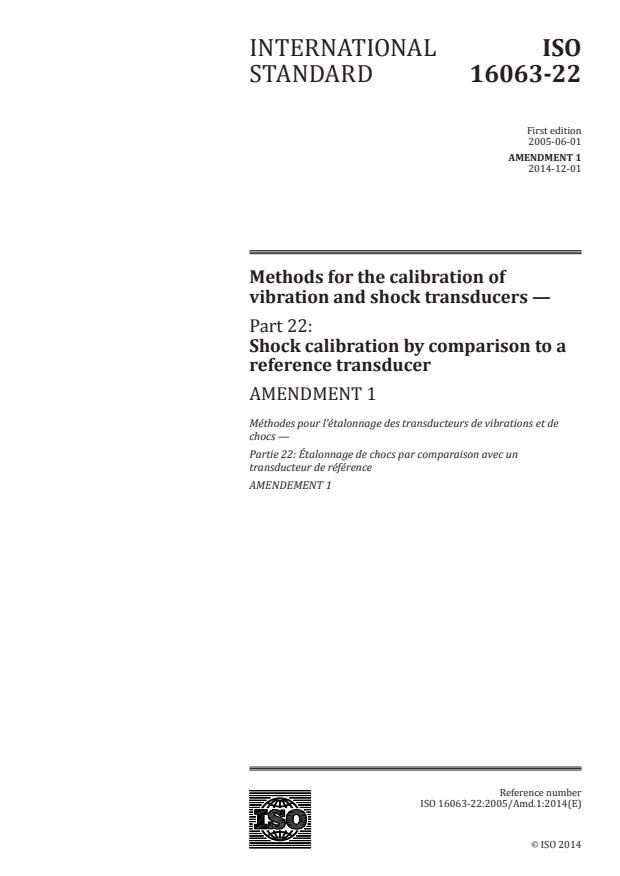
INTERNATIONAL ISO
STANDARD 16063-22
First edition
2005-06-01
AMENDMENT 1
2014-12-01
Methods for the calibration of
vibration and shock transducers —
Part 22:
Shock calibration by comparison to a
reference transducer
AMENDMENT 1
Méthodes pour l’étalonnage des transducteurs de vibrations et de
chocs —
Partie 22: Étalonnage de chocs par comparaison avec un
transducteur de référence
AMENDEMENT 1
Reference number
ISO 16063-22:2005/Amd.1:2014(E)
©
ISO 2014
ISO 16063-22:2005/Amd.1:2014(E)
© ISO 2014
All rights reserved. Unless otherwise specified, no part of this publication may be reproduced or utilized otherwise in any form
or by any means, electronic or mechanical, including photocopying, or posting on the internet or an intranet, without prior
written permission. Permission can be requested from either ISO at the address below or ISO’s member body in the country of
the requester.
ISO copyright office
Case postale 56 • CH-1211 Geneva 20
Tel. + 41 22 749 01 11
Fax + 41 22 749 09 47
E-mail copyright@iso.org
Web www.iso.org
Published in Switzerland
ii © ISO 2014 – All rights reserved
ISO 16063-22:2005/Amd.1:2014(E)
Foreword
ISO (the International Organization for Standardization) is a worldwide federation of national standards
bodies (ISO member bodies). The work of preparing International Standards is normally carried out
through ISO technical committees. Each member body interested in a subject for which a technical
committee has been established has the right to be represented on that committee. International
organizations, governmental and non-governmental, in liaison with ISO, also take part in the work.
ISO collaborates closely with the International Electrotechnical Commission (IEC) on all matters of
electrotechnical standardization.
The procedures used to develop this document and those intended for its further maintenance are
described in the ISO/IEC Directives, Part 1. In particular the different approval criteria needed for the
different types of ISO documents should be noted. This document was drafted in accordance with the
editorial rules of the ISO/IEC Directives, Part 2 (see www.iso.org/directives).
Attention is drawn to the possibility that some of the elements of this document may be the subject of
patent rights. ISO shall not be held responsible for identifying any or all such patent rights. Details of
any patent rights identified during the development of the document will be in the Introduction and/or
on the ISO list of patent declarations received (see www.iso.org/patents).
Any trade name used in this document is information given for the convenience of users and does not
constitute an endorsement.
For an explanation on the meaning of ISO specific terms and expressions related to conformity
assessment, as well as information about ISO’s adherence to the WTO principles in the Technical Barriers
to Trade (TBT) see the following URL: Foreword - Supplementary information
The committee responsible for this document is ISO/TC 108, Mechanical vibration, shock and condition
monitoring, Subcommittee SC 3, Use and calibration of vibration and shock measuring instruments.
ISO 16063-22:2005/Amd.1:2014(E)
Methods for the calibration of vibration and shock
transducers —
Part 22:
Shock calibration by comparison to a reference transducer
AMENDMENT 1
Page 1, Clause 1
Replace the 2nd sentence of the 1st paragraph by:
1)
The methods are applicable in a shock pulse duration range of 0,025 ms to 8,0 ms and a dynamic range
2 2
(peak value) of 100 m/s to 2 000 km/s (time dependent).
Replace NOTE 1 by the following:
NOTE 1 Larger accelerations (peak values) than 100 km/s and shorter pulse durations than 0,05 ms are
possible with traceability to ISO 16063-13 under the following conditions for the primary shock calibration.
— The shock machine is based on wave propagation inside a long thin bar as specified in ISO 16063-13:2001, 4.3.
— An interferometer method and procedure specified in ISO 16063-13, 4.6 is used observing the maximum
measurable velocity.
— The uncertainty requirements specified in ISO 16063-13 are complied with.
— Reference to primary methodologies (traceability) is limited to the maximum acceleration value used in the
primary calibration.
Page 1, Clause 2
Add the following to the Normative references:
ISO 16063-13:2001, Methods for the calibration of vibration and shock transducers — Part 13: Primary
shock calibration using laser interferometry
ISO 16063-22:2005/Amd.1:2014(E)
Page 2, Clause 4, Table 1
Replace the table by the following, thereby substituting 2 000 for 100 as the acceleration peak magnitude
and changing the corresponding minimum pulse duration.
Table 1 — Uncertainty reference conditions for secondary shock calibration
Acceleration peak Minimum pulse
a a b
Shock calibrator apparatus magnitude duration Uncertainty limit
km/s ms
Pendulum 1,5 2 5 %
Dropball 100 0,100 5 %
Pneumatically operated piston 100 0,100 5 %
c c
Hopkinson bar with velocity comparison 2 000 0,025 10 %
c c
Hopkinson bar with acceleration compar- 2 000 0,025 6 %
ison
c c
Split Hopkinson bar with force comparison 2 000 0,025 10 %
a
Variations in peak values and duration = ± 10 %.
b
Pulse duration is measured at 10 % of the peak value (see Clause 7).
c
In the case of Hopkinson bars, the minimum pulse duration is limited by the bandwidth over which the bar approximates
an ideal compressional waveguide as dictated by the diameter and material properties of the bar. For mor
...